Read Transcript
Child: Welcome to my Mommy’s podcast.
Katie: This episode is sponsored by BON CHARGE, and specifically one of my favorite things that they have, which is their PEMF mini mat. If you are new to PEMF, this stands for pulsed electromagnetic field, which is magnetic energy that’s being sent into the body via this mat. And these energy waves are fascinating.
They work with your body’s natural magnetic field to elevate your wellbeing in a multitude of ways. Similar effect that we would have from being in direct contact with the earth, which I also think is an amazing thing to do daily. I love PEMF mats to improve sleep, to ground me, to increase calmness.
I often say that sitting on one of these mats, I feel like a cat in the sunshine and just, like, so calm and cozy. Some of the reasons I personally like this particular mini mat, it is small enough to fit in any room, and it’s easy to move from room to room. I also have a larger one, but that one is more difficult to move around.
There are different settings, so you can find what works best for you, and it’s low EMF. Some of these are not. I feel like this is an important thing to pay attention to. Some easy ways that you can use a mini mat like this: it’s great on an office chair or on a sofa or on the floor, wherever you are sitting and reading, meditating, working, et cetera.
I love to use it before bedtime or after a workout or I’m actually doing yoga teacher training. I’ll often use it during restorative classes or when you need kind of like a creative boost or a brain reset. And like I said, I love how portable this one is. You can find out more about it and get a discount by using the code wellnessmama at wellnessmama.com/go/boncharge
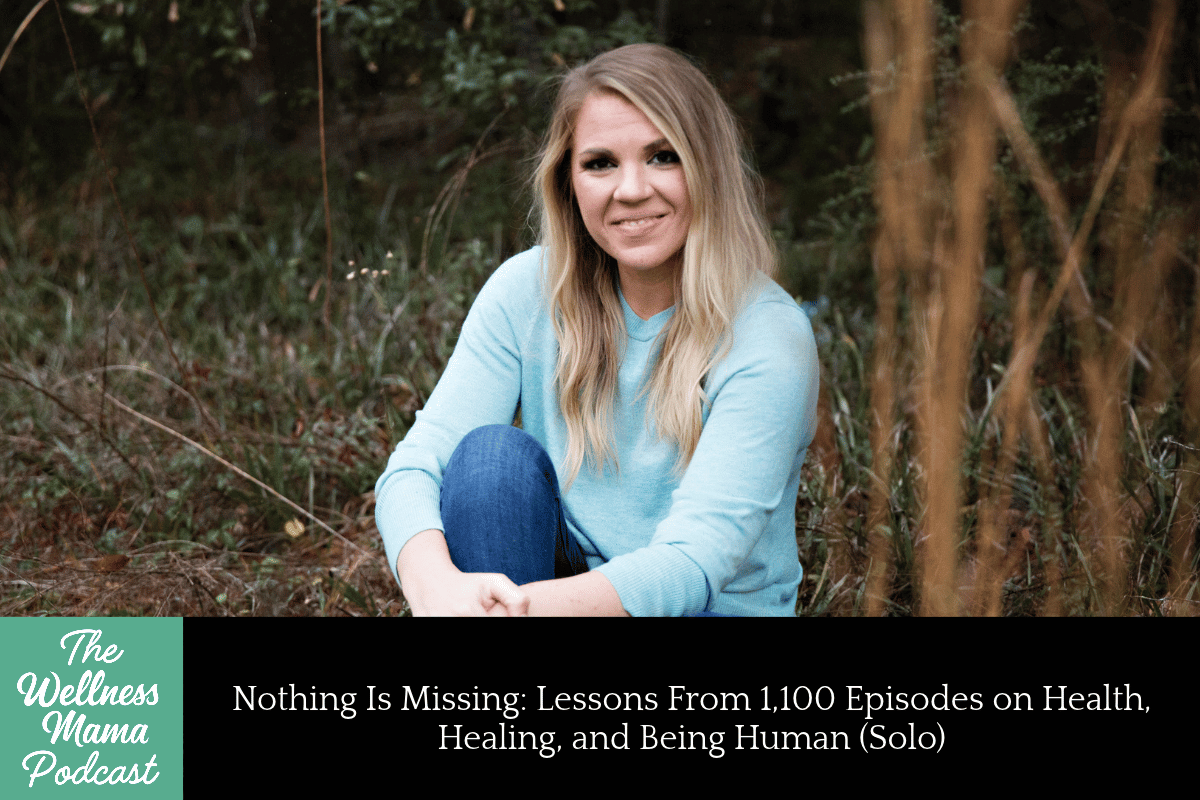
Hello, and welcome to the Wellness Mama podcast. I’m Katie from wellnessmama.com, and this is hard to believe, it’s episode 1100. And in this one I want to do a solo episode that delves into some of the lessons that I’ve learned in the past almost 13 years of podcasting, almost 20 years online, and wanted to share kind of themes that I have found internally among these.
So this will be a deviation from the normal data-driven episodes and episodes on health. And if you guys enjoy this format, let me know, and I would love to record more of these as well. The theme I really saw as I started reflecting on these past, over a decade, is that I spent years learning how to try to fix myself or how to make my life better, and somewhere along the way, I instead learned to love my life exactly how it is.
And what I … My takeaway is this: is that, of course, health and growth matter, but they can’t be the prerequisites for loving your life. And I’ve talked about this before, how I used to have this story of I would be happy if only I were this size. I would be happy if only these things were true. And what I learned is I can choose to be happy now, and those things will work out how they will.
And it’s not an exaggeration to say that I am happier and more peaceful now after a lot of changes that I thought would be so painful and heartbreaking. And the deeper shift here is from away from controlling and perfecting life and trying to make it look a certain way, and into being fully present for it, including and especially the hard parts, and really learning to embrace the present moment and embrace our humanness.
And I find, while I’m still practicing this, that in the moments I’m able to do that, it’s really beautiful and I find much more peace. And in this journey I, I realized there was a question I didn’t know that I was asking along the way. because what if after 1100 episodes, which is wild to think, that’s well over 1100 hours, about health, one of the most important things I’ve learned is that health was never the destination.
And I see, I saw this in myself, and I see this in other people now as well. For me, for so long, getting to a certain state of health, a certain size, a certain metrics was the goal. Um- But I realized that I was taking on the identity of being a person pursuing that goal, and I was making health the destination.
And for me, this started with, as a mom looking for answers to my own health issues, and I’ve shared about those before, wanting to create the best start for my kids in life and realizing that statistically their generation was going to face a lot. And coming from a journalism and research background, that was the paradigm that I applied to trying to solve my health as well and trying to create the healthiest future for my kids.
And in the beginning, I believed that enough research and the right protocols would solve everything. And the search was worth it, but the biggest gift actually wasn’t the answers or the destinations. It was the questions that I got to ask along the way and the paradigm shifts that happened internally through that process.
And if you’re new here, just a quick recap. My story looked like being told I had Hashimoto’s and that I would have it for the rest of my life, that medication was necessary, and then learning through listening to my own body that that was not the case, going on a very long journey of trauma recovery and healing and spreadsheets of supplements, eventually reversing my Hashimoto’s.
It is now fully in remission. My labs are not just normal, but optimal. Losing over 80 pounds naturally without focusing on it after years of chronic dieting, becoming a mom to seven kids along the way, including a new baby that was, really shook up my world last year, and you can listen to the episode about the hardest year of my life if you wanna hear that story.
Building businesses along the way, massive personal changes, navigating a divorce, shifts in friendships and business partnerships, and so many things. And I thought I was learning to be healthier, but really what I was learning along the way was how to be fully present and fully alive, and I think this shift, especially for anyone who’s a parent, can be so important because I’ve talked about in parenting episodes our kids don’t need 100% of our undivided attention 24 hours a day.
They need our presence when we’re with them in just small amounts throughout the day. They need to feel connected to us, and we need that ourselves, to learn to feel connected internally as well. We can only give that when we have figured it out internally So the first kind of theme lesson I wanna call out here is the idea of what if we were never broken?
And this w- is not a statement that would’ve made sense to me when my language was still things like, “Why am I sick? Why can’t I lose weight? My body is attacking itself. I have Hashimoto’s, my body’s attacking my thyroid.” And slowly I learned to start s- to view my body as this wonderful, brilliant, intelligent, adaptive system, and not a problem to solve.
And every time I share this quote, I get a lot of people who say it really resonates with them. But the quote I found that really spoke to me was, “I said to my body, ‘I want to be your friend.’ And she exhaled and said, ‘I’ve been waiting our whole life for this.’” In my early years, coming from a place of fear certainly, a place of overwhelm and stress, and not being able to figure out even what was going on at first.
I had many years of restrictive protocols, very intense elimination diets, controlling all the variables, being afraid that if I let any of them slip through, that my health would crash even more. And Dr. Kelly Brogan has a podcast about when she shifted this mindset as well, and it… She was called out by one of her daughters who said, “Mama, you’re afraid of so many things.”
And looking back, I shared that. I was afraid of so many things. I was becoming more and more restrictive with food, adding so many supplements, making literally everything from scratch to avoid any potential toxin exposure. And while I’m so grateful for learning how to do all those things, I’m also very grateful to have found more balance along the way in realizing that we’re not broken.
The body’s communicating brilliant messages through our symptoms that we don’t have to, hopefully over time, become more and more restricted. The goal is actually resilience and adaptability, and the body knows how to do that when we’re able to give it what it needs. And I think a big mindset shift here was shifting away from the idea of managing a fragile body and toward the idea of building a resilient and adaptable one.
And I’ve touched on this in episodes, like my multiple episodes with Dr. Gabrielle Lyon about the importance of strength, especially for women, wanting to become strong and not small. That was a big paradigm shift for me, and one that I really hope that my daughters learn by osmosis, and that they don’t take on the idea that they need to take up less space or be small, and that they embrace their strength.
I learned to shift into viewing symptoms, rather than as a problem to get rid of, into a message or information. Of course, sometimes they still need medical attention, but this doesn’t mean the symptom is the problem. I now view symptoms as communication, and that invites a way of welcoming them. If a symptom pops up, instead of like, “Oh, I have a headache, I’ll take a Motrin,” it’s a, “Hmm,” get curious.
Why? Where did this headache come from? What is my body trying to tell me? Do I need sunlight? Do I need hydration? Am I deficient in something? What is the reason? Because the, the headache itself is not the problem, it’s simply a message. And really, this kind of became the overarching understanding of supporting my body versus being obsessively, monitoring it all the time.
And that led into a lot of research around nervous system safety, and I’ve had many guests on now that talk about that. I do think the nervous system lever is one of the strongest ones we can pull, and that while we cannot out-diet, out-supplement, out-exercise any of the things, if we have a nervous system that is stressed out- And the reverse is actually not true, which is that if we support our nervous system, for me at least, m- often many of the other problems kind of worked themselves out and a lot of supplements became less necessary.
My body was able to better absorb the nutrients I was already giving it, and my sleep improved. I’ve talked a lot about those things. I’ll link to some of my light podcasts, ’cause that was a big lever for me with nervous system health. I would say light, and movement, and sleep are big levers we can pull.
But I realized in this long journey, that I’m still very much on, is that self-improvement can become self-rejection if we feel unworthy until we feel fixed. And I know I got kind of caught in that loop, and it was a, a slow befriending process and a slow process of nurturing presence, and not buying into the urgency, not buying into the fixation on the problem, and learning to be and listen to my body.
Because at the end of the day, what if the goal isn’t to make our world smaller so that our body can tolerate that small world, but to build a body that can handle a bigger world, to become more adaptable, more resilient, and thriving in whatever conditions we choose to engage with? I learned over time, very slowly, that my body is not a project that we have to, that I have to finish before I can enjoy my life.
And I think a lot of us get stuck in this, even with the scripts and ideas that are projected onto us by society of how we’re supposed to look, and be, and behave. and so I think this paradigm shift started internally, and has drastically impacted my external world as well. So my question related to this kind of recurring lesson that I leave you with on this lesson is, what would change in your life if you approached your body with curiosity instead of criticism?
And I know how tough that can be. I know all the years that I looked in the mirror with such self-judgment, and it did not change overnight. I just wonder if we all had a little bit more curiosity instead of criticism, what would begin to shift within us? Another le- lesson that really stood out to me in these years of podcasting is that we’ve optimized the inputs often, but what about optimizing the life below that?
Health is a means to living fully. It’s not the end goal, and I know that I did, and I’ve seen other people become obsessed with the end goal and become the identity of a work in progress And I still, of course, believe in the foundations. Things like sunlight, protein, minerals, movement, sleep, connection.
Those are really important and these are all part of building that life and living it fully, not the end goal themselves. I feel like we talk, don’t talk enough yet about how relationships, agency and autonomy within ourselves, belonging and significance, community, and having purpose really shape our wellness as well.and I… This has become a big lesson for me the last few years. I’ve even built an in-person wellness center and community where I live, that has co-working space, it has all the wellness modalities that I use.
And the real focus there is to build and nurture community because as my friend Dr. Lauryn Lax says, “Humans are nutrients,” and many of us are not getting enough. And I think that nothing replaces proximal human community, nothing replaces time in nature. Our body is meant to have those things, and our nervous system registers those as a problem if we’re not getting them. And at the end of the day, we can track every biomarker and forget to ask if we’re actually enjoying our life.
Is the goal really to live a perfectly optimized life that fits a spreadsheet and a schedule? And I have done that, and I definitely am type A and, and lived that for a long time. But at the end of the day, what if the metric we were tracking was presence and enjoyment in life? And that kind of often quoted cliché of building more life into the years of our life, not just more years into our life.
And it, I have talked about so many versions of this over the years, the idea that we can’t out-supplement a poor diet, we can’t, can’t out-exercise a poor diet. We can’t out-supplement lack of sleep. We can’t out-supplement or out-diet lack of sunlight. I would add to that list that we cannot out-supplement, diet, or exercise our way out of a life that does not fit.
And for me, that was a painful and, intense lesson, was finding that in my own life and the changes that came with it. And I have found so much peace, peace I could not have even fathomed before once I learned to make that shift and, and look at how do I put the most life into the years that I have, however long that is.
So the, the question I would love to leave with curiosity for this lesson is, if every one of your health markers were perfect tomorrow, what would you want to do with your life? Because I know for me, often the health problems, this is hard to admit, but it was important for me to kind of stare at in the face.
The health problems for me for a while- were of course a physical manifestation, but they also represented something I was having trouble doing. For instance, I had trouble setting boundaries, resting, taking any time to myself, and having the identity of an autoimmune disease made that non-negotiable. My body was on my side, and it was helping me to do something I had not learned the skill of doing yet It also let me have limits in the way I could show up in the world, in the way I could try to help people, and not having to face the bigger, scarier questions of what, what I wanna do with my life, how would I wanna help people, how would I want to improve the world if I didn’t have these limitations in the form of health problems.
So I leave you with that challenge on this episode, and it dovetails into the next lesson, which is the identity around I didn’t realize that I was protecting when I was on this journey. And I did a recent episode about the identity of health, and how often we can sort of internalize the identity of a diagnosis or a word that we’ve been given or a health problem that we have going on.
And often this can actually serve a purpose because we find community around that, and community is so important. But not just in health, I would say in life in general, I have noticed that much of our suffering comes from attachment to an identity of some sort and how others see us. And there were some sticky ones for me, especially anything that I would have put after the word I am.
Like, I am a mom. That one’s really important. It’s the greatest honor of my life to walk alongside my kids. But the I itself is not mom. That’s just one role I get to have. I am sick. That’s one I had for a long time. I am a podcaster. I am a business owner. I am… I used to put all these things after the word I am, which brings with it, attachment to that identity, and worrying about how other people see us within that identity.
And I shared in my episode about my hardest year, that that was one of the gifts on the other side of it, was a lot more freedom in not using external metrics of what people think or how others see me as the barometer by which I navigate my life. And I think that while of course we’re going to carry and at least wear the roles of different identities in our lifetime, and of course I want to still exist in the world as a mother to my children, that detaching from the attachment to it and the, the fears of how other people see us can often lead to a lot more freedom.
Other identities that I subtly had that didn’t e- I didn’t even realize and I’m still working on, were things like capable, analytical, independent, problem solver. These did serve me. They were helpful, and I got attached to them, and I was challenged once that what I was calling independence was actually invulnerability, and that I had this story that if I did everything myself, no one could let me down and hurt me.
And that was a tricky one to look at. And I feel like we all have our own examples of whatever these identities are that we attach to, and they might be personality traits. They might be, “I’m an Aquarius.” They might be, “I’m a projector in human design.” They might be, “I’m a blonde.” Whatever it is. And they can be subtle, and not all of them are bad.
I just feel like an over-identification with them can be problematic, because roles become things that we defend. I’m a good mom, I’m a successful founder, I’m a healthy person, I’m the one who knows the answers to questions. And those are all roles, but when they become identities, they can become really high stakes.
And like I said, for me, the last couple of years really disrupted some of those identities. I inadvertently set the challenge to myself or to the, the question to God and the universe that if there was any place in my life that was not rooted in love, to shake it up. And as I explained in that episode, absolutely that happened, and I got to go through a circumstance where I felt like every identity, every relationship, every aspect of my life was kind of dissolving and being stripped away, and I’m grateful for it now.
I would not have said it in the moment. I’m still working on that. But I learned that not everything can be solved with research or planning or effort, and those were my defaults. Those were kind of my safety walls. And I got to navigate a situation where none of those were helpful, and I’m really glad for the freedom on the other side, because I think releasing the need to be understood is freedom.
It’s not a loss of self. It doesn’t mean that we don’t still navigate those roles, that we don’t still show up for our kids, that we don’t still go to work. But releasing that need for that external side and finding it, which ties back into that presence. It’s not a loss of self. I would argue it is actually a finding of perhaps more true self.
Because as a person who loves logistics, I used to really, like, hyper-focus on the planning and the research and the effort, and I realized you can solve a logistics problem, but you cannot spreadsheet your way into certainty about being human. And that comes with that presence and connection and befriending of self.
I got to learn last year that I don’t need everyone else to understand me in order to understand myself. So the question I would give you for this pillar is, who would you be if you didn’t have those roles or identities, and if you no longer needed anyone to see you a certain way? And where in your life do you navigate things based on how someone might see you?
The next lesson, I actually have a tattoo on my right wrist that says Amor Fati, which is Latin. It literally translate to love of fate or loving what is. And this one I feel like really hit home in the past few years for me as I’ve navigated some big changes. And I saw a beautiful example of this online.
I’m gonna do a whole video just about this. But I feel like this phrase I love because it’s beyond just finding gratitude. It’s actually true love and joy in what is. And I heard someone once put this into a question format where they said, “If you found out that you were going to repeat your exact life exactly as it has been over and over and over, what would your emotional reaction be?
Would it be joy and excitement and love, or would it be anxiety?” And I feel like that can be really illuminating to look at because not just like a, “Oh, yeah, I would do it again because I learned all these things and here’s where I am now,” but all of the pieces. Could we embrace all of the pieces? I’m not there yet, but this is something I actually spend t- time journaling around now, and the idea of moving past tolerating our reality into loving the life that’s actually happening even and especially when it’s hard.
This concept is not new. In fact, it’s very old. I learned it from kind of diving into the Stoics and, Marcus Aurelius and all of the Stoics. Ryan Holiday’s work is phenomenal for this as well. But this idea of love of fate is not new. It’s not resignation either. It’s not acceptance. It’s not just gratitude.
It’s actively loving what is in a non-bypassing way, so it can’t be fate. And I think this is actually one of the most, compelling challenges I get to learn and work on still in daily life. I’ve realized, this was another big takeaway for me along this journey, that suffering often comes from arguing with what has already happened.
And Peter Crone has a great quote along those lines. I think he said, in a podcast, “It couldn’t have happened any other way because it didn’t.” But how much time do we spend thinking about or trying to edit what already happened? And I feel like to really embrace this idea of amor fati and love of fate is realizing it’s not, like, that loving what is is not approving of harm.
It’s not dropping our boundaries. It’s not refusing to act. It’s simply letting go of the fact that we don’t control a way to change what has already happened or, in some, some cases, things that are even happening currently. We can still act decisively without making happiness conditional on the result, and I think that’s where the nuance comes in, in realizing that hard ch- hard chapters are very much a part of the story.
They’re not detours from the story. As a friend told me last year when I was navigating everything, and I was like… I was unable to share it- At the time because it was too vulnerable. But she was like, “This is the plot twist. This is the part people pay attention to.” And I… For me, it helped to kind of like, if I reframe everything as earth school, this is a really interesting, difficult class that I’m getting to go through, and I wonder what it will lead to.
But even that is not fully amor fati. That’s still, “Oh, I’ll love this when the good comes from it.” And I feel like amor fati is embracing and learning that I actively love it even and especially when it’s still hard. And just like with happiness, I used to think that peace would come when everything was finally okay.
And what I’m learning is that I can nurture peace even while some things are unresolved and unsolved. And my, kind of my focus of this year is a more present one versus an active one, which is, what if I can learn to just love the entire story, not just the chapters I would’ve chosen, and not the ones I would choose in hindsight even.
And so my list or question for this one is simply, what if the life you’re waiting to begin is already happening? What if all of the parts of your life are not detours from the plan? What if they are part of it?
The next lesson I wanna talk a little bit about is what I hope my children learn and what I hope they don’t. Because I’ve had so many shifts in the last 20 years for sure, and especially the last five. And the parent that I was when my older kids were young is much different from the, the parent and the woman I am now.
And everything I’ve talked about so far has also really reshaped how I parent. And while it’s easy to wish I could go back and do certain things differently or teach them different things at the beginning, amor fati, I’m loving what is and working from the now. In many ways, Wellness Mama started for my kids and really centered around them, the idea of, improving their health outcomes, of hopefully helping in some small way to change these chronic disease outcomes that we are seeing in younger populations than we ever have.
However, my definition of what a healthy life is for them has grown I’ve said many times before. Our children are infinite autonomous beings. They’re not just extensions of us. And if anything, I have only gotten to learn deeper layers of this in the last couple of years through interactions and ex- situations with them.
It’s very clear to me and important that we don’t own our children. We get the beautiful privilege of guiding them through the first part of their lives, but we don’t own them, and they are not just extensions of us that we’re trying to kind of program to be a certain way. We get to help them navigate the world.
We get to give safety and guidance and boundaries, hopefully while honoring their autonomy. And this is a part that has been there for me since the beginning with my older ones. But the way I’ve shown up with this has shifted lately. I would say especially in early parenting, I had a much stronger need or desire to impart certain ways of beliefs or ways of living on them, and this has shifted for me a lot in learning to honor their agency in hopefully a deeper way.
Learning to model health while not teaching fear or perfectionism, even as I was unlearning those things myself. Things like not protecting them from all difficulties, but helping them build the capacity to meet it. And this is perhaps one of the toughest things as a parent, because we of course don’t want our children to suffer.
But perhaps often in wanting to help them avoid suffering, we also kind of avo- like remove obstacles that might be really important for their growth. I know for me as an individual, and if I look back, the things that I would have defined in the moment as the hardest things in my life led to lessons and some of the beautiful, most beautiful things in my life.
Yet it’s still hard to watch my children navigate difficult things. And I feel like I’m getting a kind of a new take at this and also getting to sort of navigate two different life stages simultaneously with having a new baby again after so much growth. Getting to raise him a- actively with all the things that I have said in the past, I wish I had known this when my kids were little, being present for his childhood as it’s happening while also still being present in a much different way for my other kids who are much older, including two who are adults, a few more who are right behind them, and who are navigating the adult world in a new way, while also still showing up as mom for a very young one.
And realizing how I did the best I could when my other kids were young and along the way, and I think I still passed on some of the things that I have learn- I have learned my way out of now, and trying to figure out how do I, without trying to change them, just show up for my kids in learning for them to ask some of these questions, and hopefully have a healthier foundation and mindset than I did, even though that was the mom they had when they were little.
And I hope that my children never learn, for instance, that their bodies are something to be ashamed of, that their health requires perfection, that love needs to be earned, that they need to take up less space, that their voice is not valued. So many things I had to learn the hard way myself, and hopefully still get to impart to them before they leave home.
And I feel like I’m talking mostly about the parenting aspect of this, because that is one of my primary things, the primary thing I focus on these days. But I feel like this also is present in every relationship we have in life as well, that honoring of agency, the loving of someone exactly as they are.
So my question around this is, what if we focused less on shaping other people and more on loving them exactly how they are? I think that’s really helpful and profound, especially with our children, and probably also very important in other relationships. I just am not entering any of those personally at the moment.
Another lesson that has been present but shifted for me along these years is the freedom to question everything, and I would even say the challenge to do so. I would say perhaps the most valuable skill after 1,100 conversations is the willingness to change my mind, the openness to changing my mind. And the…
I feel like the more I learn, the more I see what I don’t know. And I have shared in the past how I used to have a questioning practice, where every year I would actually make a list of all the things I thought I knew or believed, and I would question them actively throughout the year by reading and watching sources that were from a different viewpoint, with the idea that if I was right, this would only help me hopefully gain empathy for people who believe something different.
And if I was wrong, I would like to know that. This has shifted for me in the past couple of years, because as I started questioning things, especially beliefs I had inherited, ways of pro- ways of navigating the world or relationships that I had inherited, there just became fewer and fewer things on the list.
And so now I’m in a much more kind of a dance with this, skill versus a, a list that I used to navigate. But I’m learning that strong values do not require rigid beliefs. And I know that when I see someone else who has thoughtfully examined a belief and changed it, that I really admire that, yet I think the beliefs can often tie into identities, like I talked about before, and it can be really hard to question especially strongly held beliefs.
And I do subscribe to the idea that if something is worth believing, it is worth questioning and challenging. And I feel like now I see that changing our minds is growth. It’s not failure, even though it can be quite uncomfortable, especially if it is again connected to our identity piece. And so I would say the evolution of this for me has been at first I would put things on the list, but they were more topical, like questions around health-related topics, questions around business, questions around, like more cognitive topics.
And then it took a while before the really closely held beliefs ever actually made that list. And in the past few years in doing that, it has unraveled so much of what I thought I believed, and led to so much more freedom and peace in not needing to know all the answers, and being willing to let go of things that I realized were beliefs that I had been given, or beliefs that, were leading to more judgment, not more love.
And I’ve talked about this a little bit. I did a podcast with Lauren Gersten, about her kind of deconstruction journey, and I’ve been on a similar one as well. And I know those are controversial topics. I just feel like it’s a worthwhile endeavor to be open to questioning everything. I love that quote that, “I would rather have questions that can’t be answered than answers that can’t be questioned.”
And I feel like that is kind of the active dance I’m in with this freedom to question everything at the moment. And this can apply in sort of every ide- area of life, and sort of sums up ones that I’ve already talked about. In health, it’s like does resilience matter more than perfection? In relationships, this is a big one for me, I’m actually writing a book on this, about all of the roles that we have lumped under primary partnership in our world, and where those came from, how they developed over time, and questions around if perhaps there might be a better paradigm for the modern world.
But the question related to that for me is, what if we designed partnerships around mutual wellbeing and autonomy rather than pre- pre-established roles and legal structures? And then even on the identity level, who am I beyond my roles and stories? Who would I be if those things did not exist? I think one of the greatest freedoms is being able to say, “I might be wrong,” without feeling like identity is threatened.
There’s also so many quotes around the idea of that true intelligence is being able to hold multiple opposing beliefs or truths, without needing to take a side. And I feel like this is a skill that m- certainly I can continue to work on, and I think would be beneficial for so many of us, because it brings you, again, into a place of curiosity rather than judgment.
And I feel like c- curiosity is a much more fertile soil for growth. And on this note, I kind of the question I would leave here is, what if the goal isn’t to transcend being human, but to experience it fully? Which also ties into some of the others as well. And I’m actually… I was gonna read this as part of this episode.
I’m gonna do a whole separate episode on it as well. A journal entry that came from one of the toughest nights of last year when I couldn’t sleep and was just writing. And it kind of was a reflection on suffering and being human, and a lot of things fell into place for me in that internal shift.
So I’m gonna actually reserve that as its own episode. But the kind of overarching theme, simplified, that I realized in this is that for me, I was on kind of this spiritual journey of trying to figure out what I actually believed and who or what God was and where we came from. And in that process, I realized slowly that the humanness was actually the point, that we aren- it wasn’t the distraction.
I’ve been on this exploration of kind of consciousness, non-duality, and spirituality for several years. I still don’t have all the answers, and I love that. I’m comfortable with not having the answers in this realm, and I, I wonder if that’s perhaps part of the point as well. But I had this understanding around that very often-used analogy of the ocean and the wave, and how the wave is an individual wave, but it’s never been made up of wave.
The wave has always been made up entirely of ocean. And when the wave hits the shore, it will return entirely to ocean. So the beauty of the wave is not in learning to be the whole ocean while it’s a wave. It’s actually in learning to embody the uniqueness of that wave for the very short, beautifully fleeting time that it is.
So the idea is… And again, I’ll go into this its own separate one. I think it deserves its own episode. But the wave is truly an individual, but yet never separate from the ocean. And the impermanence of that, the impermanence of our human lives, makes things more precious, not less. And so I feel like part of this journey for me has been returning to individuality with less identity and with deeper gratitude and appreciation for how fleeting it is.
And I think within this is kind of the line that I wanna leave with in this episode and the, the thing that I wanna bring all of this to, which is that the sacred might be found actually in the ordinary life, not in transcending it, not in going beyond it. There’s that kind of Buddhist quote of, “Before enlightenment, chop wood, carry water. After enlightenment, chop wood, carry water.”
And I think there’s so much depth within that statement beyond what we even might initially feel. From that meditation or that journal that I had that I will do it o- its own episode on, it’s kind of the idea that, like, a song doesn’t become meaningless because it ends.
The ending might be part of why it was so beautiful. And the idea of, like, what is existence doing by becoming me for a while? And I think when we can approach that, again, with that curiosity, with that non-attachment, with that non-identity, letting go of the attachment of self, it seems like we get to experience life a little bit more completely.
So coming full circle, I just wanna kind of bring back that idea that what if nothing is missing? What if…Amor Fati. What if everything is perfect exactly as it is, even and especially when it’s hard? I know this is a lot more kind of esoteric than a lot of my health topics, and I am curious how you guys, what you thought of this one, if this is something you would like in the future, if you would like me to stick to health.
But as I reflect on these years that I have gotten to podcast and talk to some incredible people and go on this deep inner journey as well, I have so much gratitude for that woman who started Wellness Mama almost 20 years ago, even though I might barely recognize her now, but her boldness and her curiosity and her willingness to at least begin.
And I have so much gratitude for the journey that’s unfolded along the way. I’m so grateful for these 1,100 episodes, the incredible people I’ve gotten to talk to, and especially for all of you who have become part of this community, who I’ve gotten to know, at least digitally, along the years, who have hopefully gotten some pieces of wisdom from any of these episodes that have helped your life in some way.
And I think the beauty is that this journey didn’t lead to me actually having answers to the questions or having it all figured out, but it’s hopefully led to a little bit more presence and a little bit more peace with the uncertainty. And if I could go back to my younger self in 2014 who started this podcast, I wish I could just tell her some of the things I have figured out now, and hopefully some of these will come across to my kids in their life as well.
Things like you don’t have to figure everything out. You can care deeply without controlling everything. You can change your mind, and you don’t have to earn the right to be fully present and to enjoy being alive. I spent so many years learning how to make my life better on paper, and somewhere along the way, I’m slowly learning how to love my life exactly as it is.
I’m so grateful to you for sharing time with me along the way, for sharing time with me today. It’s always truly an honor that you would be willing to share what I truly consider your most valuable resources, which are your time and your energy and your attention with me. I never take that lightly.
I’m so, so grateful, and I hope that you will join me again on future episodes and keep exploring the deeper questions together, and I would love to hear if any of this resonated with what you’re navigating in your life. But for today, thank you so, so much for listening.




Leave a Reply