Read Transcript
Child: Welcome to my mommy’s podcast!
Katie: This episode is brought to you by Hiya Health, which I have a now extended and renewed interest in, especially with having a baby around who will be starting solid foods pretty soon. Because here’s something that’s kept me up at night as a parent, and I’ve talked about before. Our kids are the first generation growing up on not just ultra-processed foods, but foods that don’t have the same nutrient content that they used to due to soil changes and so many other factors.
In fact, we’re just beginning to understand the extent of this problem. And this is why Hiya exists and why I’m glad that they do, which is to give parents a real solution in a market that is flooded with kids’ vitamins that are actually contributing to the ultra-processed foods. They have candy-like appeal, but not actual nutrition.
In fact, some children’s vitamins on the market contain up to seven grams of sugar per serving and are stuffed with additives and petroleum-based dyes that I go to great lengths to avoid in my kids’ diet. So Hiya took the opposite approach with zero sugar, zero gummy additives, just clean nutrition. And the great part is kids actually love them.
My younger kids are a huge fan. I have tried them, and the flavor is actually great, although obviously I don’t take them daily. But what makes them different is how thoughtfully they are designed, formulated to meet very specific nutritional gaps that modern kids face. And they worked alongside pediatrician and nutrition specialists to make a chewable multivitamin that packs a blend of twelve organic fruits and vegetables and fills the common nutrient gaps that kids face.
They’re also non-GMO, vegan, dairy-free, allergy-free, gelatin-free, nut-free. They really have thought of everything to make these ideal for kids. And they are NSF certified and receive Clean Label Project’s Highest Purity Award. So when it comes to something I feel safe giving my kids, they are definitely on the list.
It’s designed for kids two and up. They ship straight to your door. And I love that they send you a reusable bottle and stickers with your first order. So this helps you keep up with the refills, and they send refills every month as well. I am a big fan of these as well. And Hiya just launched something new.
If your kids are active and growing, you can add a clean protein powder with minerals designed just for kids to be exactly what they need. Their new Kids Daily Growth Plus Protein is a game-changer. It’s more than a protein shake. It’s a purity awarded clean protein powder with added minerals and healthy fats that can mix right into water or smoothies and support muscle development and cognition and fuel everything else they’ve got going on.
So, we worked out a special deal with Hiya. You can receive 50% off your first order on any of their products. To claim this deal, you must go to hiyahealth.com/wellnessmama. This deal is not available on their regular website. So again, that’s H-I-Y-A-H-E-A-L-T-H.com/wellnessmama, and get your kids the full body support they deserve.
This episode is sponsored by BON CHARGE, and specifically one of my favorite things that they have, which is their PEMF mini mat. If you are new to PEMF, this stands for pulsed electromagnetic field, which is magnetic energy that’s being sent into the body via this mat. And these energy waves are fascinating.
They work with your body’s natural magnetic field to elevate your wellbeing in a multitude of ways. Similar effect that we would have from being in direct contact with the earth, which I also think is an amazing thing to do daily. I love PEMF mats to improve sleep, to ground me, to increase calmness.
I often say that sitting on one of these mats, I feel like a cat in the sunshine and just, like, so calm and cozy. Some of the reasons I personally like this particular mini mat, it is small enough to fit in any room, and it’s easy to move from room to room. I also have a larger one, but that one is more difficult to move around.
There are different settings, so you can find what works best for you, and it’s low EMF. Some of these are not. I feel like this is an important thing to pay attention to. Some easy ways that you can use a mini mat like this: it’s great on an office chair or on a sofa or on the floor, wherever you are sitting and reading, meditating, working, et cetera.
I love to use it before bedtime or after a workout or I’m actually doing yoga teacher training. I’ll often use it during restorative classes or when you need kind of like a creative boost or a brain reset. And like I said, I love how portable this one is. You can find out more about it and get a discount by using the code wellnessmama at wellnessmama.com/go/boncharge
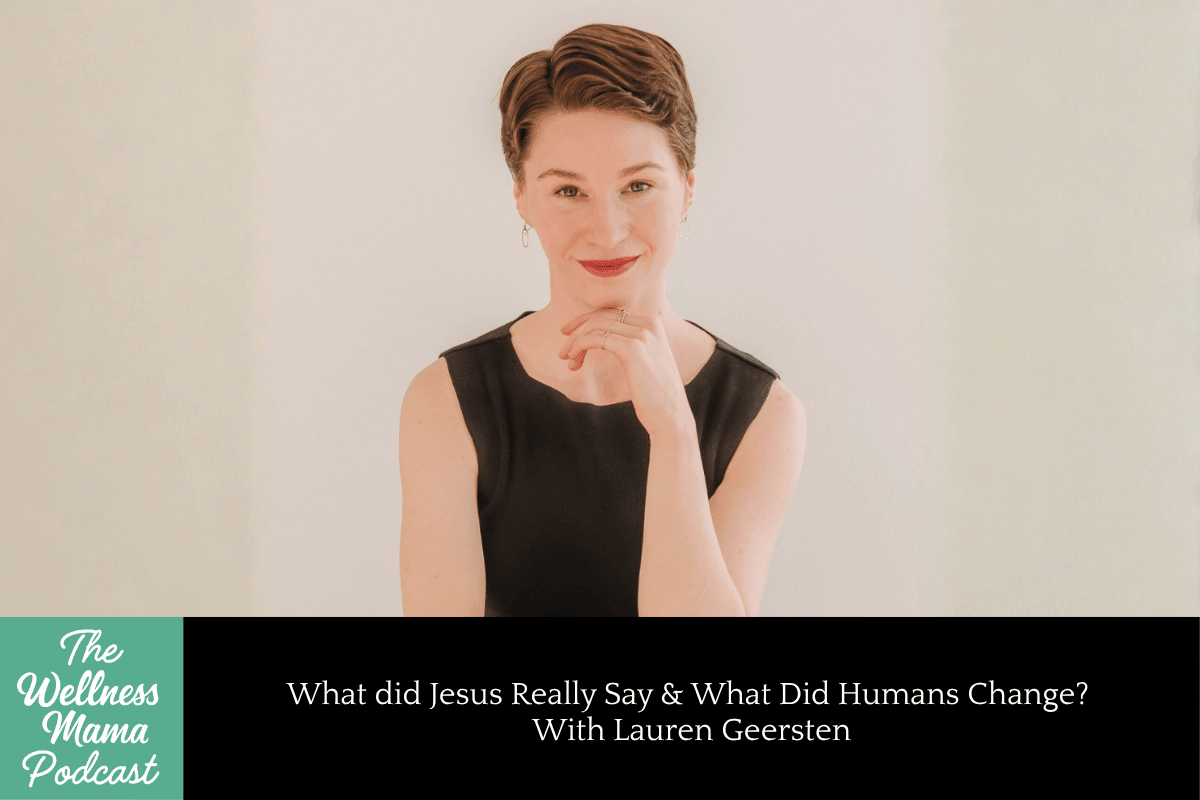
Katie: ?Hello, and welcome to the Wellness Mama podcast. I’m Katie from wellnessmama.com, and I’m so excited to have a deep conversation with a personal friend today, Lauren Geersten, who I’ve known since our health blogging days many, many years ago, and who I feel like we’ve been on similar but different kind of parallel journeys this last decade, both inner and outer and everything, kind of everything sacred on the chopping block for a long time.
And I’ve followed your writing for a long time. You’re a phenomenal writer, Lauren, and I was so excited. I’ve read several of your books. I have one more on my nightstand to read. And I was most excited for the one we’re gonna be talking about today, which is called Jesus Rewritten. It was personally so helpful to me and where I am on my journey.
And when I saw it, I immediately was so excited that you tackled this and thought how courageous you were to do such a deep dive into a topic that, I know can be somewhat controversial, and I’m guessing, probably has been a little bit in response maybe. And I loved that in researching for this episode, I ask guests, like, “If you were gonna do a TED Talk, what would yours be on?”
And your response was, basically on how to ruin your reputation by, kind of tackling these kind of topics. And that said, I think one thing you call out so well in the book is the idea of being the… the more importance of being loving and truthful than of being right, and that’s a hard-learned lesson for me these last couple of years especially.
And I also think, like, of what we know of Jesus’ own words. We know he said to love as he loved and to not judge, and I feel like you approached a very difficult topic with that energy and really embodied it in your writing. So that said, I don’t mean for this episode to be in any way controversial. I know it has that potential simply because of the topic, and I think both of us, neither of us has a desire to change anyone’s mind.
I just also feel like if something is worth believing, it’s worth deeply understanding and asking the hard questions around. And vulnerably, I have, I’ve talked about before, a questioning practice where every year I write down a list of things I think I believe to be true, and then throughout that year I question those things with the idea that if I’m wrong, I want to know, and if I’m right, I’m simply learning different perspectives and gaining empathy for people who have a different perspective.
Though admittedly, for a long time I did not put religion on that list because it was such a sacred cow for me, and when I did, it was quite the journey. And I feel like I- you put things in words much better than I ever could have, and so that’s why I was so excited to have this conversation with you. So for a little bit of background story, like I said, we met in the health blogging world, so I would love to hear a little of your journey as background for how you have gone from health blogger to now getting to tackle some of life’s really deep topics.
Lauren: Well, it is quite a journey that I’ve found is kind of archetypal of once you start healing your body, then it goes deeper automatically. So for me, my healing and questioning journey started with being super ill with an autoimmune disease when I was 18 years old, and I turned that around through nutrition.
And that led me to start asking, “Where am I being lied to?” Right? “And how is it impacting my freedom, my health, my joy?” So of course, the big place I started with was the pharmaceutical industry. Then I started questioning the beauty industry, the Botox industry, the cancer industry, the taxation system, the school system, all of these things that, you know, both you and I have gotten into.
And I started to develop a skill set for asking these questions that uncover hidden history and big corruption. But more than that, show the alternatives that are available to us, because what I found is it is really hard to open my mind to truth When I’ve been manipulated by fear to think I need a belief system, unless I know that there’s more love on the other side.
So with that said, as my kind of paradigm for questioning, I got started on this journey when I was 21 with a spiritual awakening. And up until that point in my life, I described myself as a devout Christian. For me, that was my biggest identity, and I came at it from having, personal experiences with a higher power, with angelic presences, and I was grateful that I had a vocabulary for that given to me through religion.
And until I was 21, I didn’t have to question or challenge everything else that was given to me through that religious paradigm. Then when I was 21, in a state of meditation, I had a sudden mystical awakening, and in that awakening, it was kind of an out-of-body experience, is the best way I can describe it, where I felt my soul go to this place where everything was connected.
I was connected to all times, all people, all places, and it was a, an experience of ecstasy and pure bliss, pure peace. You’ve said something similar of having an experience of, of a peace where you felt like this is where we come from and this is where we return to, and that was absolutely my sense as well.
I was having, experiences in that awakening of remembering times my soul had been on earth before this go around, and thank goodness my logical mind was completely shut down in that moment ’cause I wouldn’t have known how to process that. But for me, coming out of that experience, when I came back into my body, I had this sense that love is that which connects everything.
And even if suffering and pain is happening on one level of reality, there is this level of reality where there’s connection and peace happening at the same time. So coming out of that, I had a major season of identity crisis, which I highly recommend, you know? I would prescribe an identity crisis every couple of years or so for people, if you’re feeling stuck in life, if you’re feeling like, you’re not making progress.
It’s not always comfortable, but for me it was certainly necessary, and that started my journey of questioning the hidden history, the theological plot holes, and the lost gospels in Christianity. And it’s been more than 10 years later, and that all turned into my book, Jesus Rewritten.
Katie: I love that, and we’ll get to like double-click on several of those topics.
And like you, I was raised very Catholic, and I have so much deep gratitude for that now. I think I had a phase where I had anger around religion, and now I actually… I think it’s beautiful. There can be many beautiful parts of that. I’m grateful I had that journey. I think for many people it’s a wonderful source of community and an example of a loving presence, and there’s so much beauty there, so I never want to speak ill of anyone’s beliefs certainly or anyone’s tradition.
I think there’s beauty in everything and truth in everything. And to your point, as I was on my journey as well, I had several years where I was reading all of these spiritual texts from any tradition I could find. And during that phase, while I was still in my logical mind, what stood out to me the most was the similarities.
I feel like we often want to like highlight the differences and, and argue about those, but what I- what stood out to me was like across all these traditions, there was this core message of love. And I feel like that’s what you and I both kind of got to experience when the identity and the ego parts go away.
I had a similar experience that I was not prepared for and had no context for, and it took a while to integrate of that awakening where there’s not really words, I’m sure you would say s- as well, to like accurately describe, and I wish I could just infuse that feeling to everyone because it was bliss.
It was incredible. And the, the closest words can come is I felt both as I was everything and loved everything unconditionally all at once. And also that a love that big, that maybe is like a touch of what God’s love actually is, was so overwhelming and beautiful, but also painful. Like it was everything kind of all at once.
And now back to the questioning list. This year it was the first year I haven’t done this in 20 years because the only thing I have on that list that I believe without question is that love is, and that there’s only one thing and we are all it. And so there wasn’t really anything to quite… Like, those are not things you can logically really read text to question in the same way.
And there’s also a peace that comes from that. Though the peace didn’t come until after the upheaval, which, it sounds like was your journey as well. But the real part of this that I love and how you tackled this so gracefully was that I still have such affection for the message of Jesus himself, and I think he has brought so much beauty, and that like there’s a reason we’re still talking about him 2,000 years later.
The part that I feel like is worth understanding more deeply, especially if someone loves Jesus, is what did, what did he actually say, and what got changed over time? Because, to illustrate this as, like, a very topical example, I recently had a conversation with a friend who speaks five languages, and English is his fifth language, and he runs a business in the US in English
And he was saying he couldn’t even explain some of these health concepts to his dad in his native language of Lebanese because it’s like they don’t fully transfer, and he learned them in English, and there’s not– there’s no accurate way to completely explain it in his other language. And I realized the Bible has been translated through many languages over the course of many years and many translations, and if someone in real time speaking to another human can’t accurately describe something, like, to me, it’s worth looking at the logic of, like, could something that has been passed down verbally and written but changed so many times throughout history have the accuracy we often attribute to it?
Which I think, like, really the overarching question, in your book is, like, what did Jesus himself actually say? What did he actually teach? And then what did we change as humans throughout history? So that’s where I’d love to kind of dive in. And you mentioned the, the Gospels and the canonical Gospels versus the Gnostic Gospels.
Maybe people have heard of those. Maybe they haven’t even heard of the Gnostic Gospels. So can you maybe kind of give us an introduction to those and talk about, like, when they started coming into being and maybe, like, how they changed at different phases based on what was happening in history?
Lauren: Absolutely. There’s so much to unpack here, and what I wanna start with is where I personally needed to start to dive into all this was being comfortable in curiosity rather than certainty. So for me, I grew up being taught that my eternal salvation rested on me believing a set of creeds and doctrines that were provided to me that I thought came from Jesus. And I had a lot of fear about deeply questioning any of that because there was this programming I received that my existential wellbeing would be at risk, that I would be making myself vulnerable to Satan’s influence if I looked at perspectives outside of this certain theology that I was raised with.
So for me, I thought that certainty and not questioning equated to f- faith, especially faith in Jesus. What I realized is that’s the opposite of faith. Faith is placing trust in truth and love. That’s my definition. And that equips a person to go into the exploration of topics and different ideas that they might, might have been uncomfortable with before or f- afraid of before.
You know, I don’t think that there’s anything such as misinformation. I think there’s just information, because lies serve the purpose of making the truth shine brighter, so why should we be afraid of looking at what we might think is a lie? So that’s the, the biggest shift that I had to start with, moving out of certainty into curiosity.
And then I went deep into the history of- W- why are we told that the Bible is the inerrent word of God, and that what’s in the Bible accurately represents what Jesus taught, and that things that didn’t make it into the Bible didn’t because they weren’t representative of Jesus’ teachings? Now, what I found in my historical research is that’s not true.
Now everything is contested and argued about in biblical history, and I do my best to make that clear in my book. So what I want to give people is information, maybe starting points to do their own deeper research. But it is important to understand that there’s not really a set of solidified facts when it comes to biblical scholarship, because people bring their own belief systems, their own ideas, especially when dating the Gospels or trying to figure out who wrote them.
Very, very contested. People’s presuppositions really get in the way there. So I wanna put a note with that, too. This is a starting point. Everything is debated. So one of the things that really opened my eyes was learning that arguably, I u- I use that word carefully there, Jesus’ earliest followers, which we would consider Jewish Jesus followers pre-Christianity, ’cause Christian theology hadn’t been invented yet in the 1st century when, when Jesus was living, and this few decades after Jesus died and his followers were spreading their message.
So very arguably, his earliest followers believed things entirely different than modern Christian theology. Basically, what we have in modern Christianity is the framework that God so loved the world that it gave its one and only son, which was a human-man hybrid, as a blood sacrifice, because without this blood sacrifice, God couldn’t forgive humanity.
We would be condemned to eternal torture in hell, and it is only through the death of this innocent God-man hybrid that humans get a heavenly hall pass, right? And that creates divine justice, and that’s a form of love, and God needed that to forgive humans for their sins, which could otherwise be considered, you know, mistakes or learning or lessons.
That whole theology was not present in the earliest groups of Jesus followers. Those would be called the Ebionites and the Nazarenes. Now, unfortunately, the texts that these groups used that arguably predate the Gospels in our Bible, we only have fragments of those texts. The books, the canonical Gospels, the Gospels in our Bible, Matthew, Mark, Luke, and John, those were written starting in 70 AD.
Jesus died around 30 AD. So we have a gap of time there. And John was the last Gospel to be written around 95 to 110 AD. Again, these are general dates, and they are debated. But when I was growing up in church, I assumed that these Gospels were written by the people for whom they were named, right? Like, oh, the Gospel of Mark was written by Mark.
No. Only a very, very few fundamentalist Bible scholars believe that these days. Even religious Bible scholars, the majority of them know that that is a, a false assumption. Jesus’s disciples were Aramaic-speaking blue-collar Jews, mostly illiterate. Maybe there’s an exception with Matthew, a tax collector, but it even says in the Bible that his disciples were unlettered.
So these gospels circulated for about 100 years before they were given names after Jesus’s disciples. And why? Why was that? To give them credence, right? To give them authority, not because they were written by his disciples. But also because at the time, there were gospels circulating named after other Jesus disciples.
We have the Gospel of Thomas, the Gospel of Mary Magdalene, the Infancy Gospel of Thomas, the Ascent of James. These texts that, the dating is very debated, but they had a certain degree of credibility because they carried the names of Jesus’s followers. So when, when I saw- started to see that big picture, then it allowed me to go deeper into why do the gospels teach different theology than what the Hebrew Gospel of Matthew teaches, which is the book referenced by the Ebionites.
And one big difference there… You can stop me at any point as I go off on these, these rabbit trails. One big difference between the theology of Jesus’s earliest followers and the books we have in the Bible today is the absence of blood atonement theology. Now, this is the crux for many people of Christianity. That God needed a murder, a blood sacrifice, and there’s so much spiritual importance placed on that bloodshed.
But when we look at the Hebrew Gospel of Matthew, unfortunately only fragments remain of that, we see that Jesus completely rejected this blood sacrifice idea, because it ran very deep in ancient Judaism. We only need to look at the Old Testament or the Torah to see that supposedly, you know, God gives the commandments not to kill, but then a few pages later, this concept of God is like, “Oh, so for me to forgive humanity of sins, you guys need to go out and murder an innocent being.
You have to go out and kill an animal, and only through that violent bloodshed can I forgive humanity.”
Katie: Yeah, that, that piece is so interesting to me, and it’s honestly one that I… Like, it made so much sense when I read it, and I hadn’t overtly questioned that one, ’cause especially growing up Catholic, that one is held extremely sacred, and, like, that is one you are, like, literally not allowed to question.
Like, you’re allowed to l- ask lots of questions about ac- a lot of things, but that is considered dogma and unquestionable. And I loved the gentleness with which you phrased a lot of these questions in the book, and it really,… Like, I kind of had this, like, flashback to childhood when I had asked some of these questions, like, just with childlike curiosity of, like, well, if we weren’t supposed to eat from the tree, why did God put the tree there in the first place?
Or, like, if God doesn’t like sin and he made us, why did he make people sin? And just, like… And those were, like, kind of shut down as a kid. And I also, like you, got to a place where I was like, “Okay, well, I, it doesn’t feel safe to question these things, and this is, like, my identity and my community and my family and all these things, so I won’t,” until that, like, soft inner voice started questioning.
And I feel like that, like, the intuition whispers and anxiety yells, but, like, I had to… I couldn’t ignore that soft inner voice, forever. But I love… Let’s, if you’re willing, let’s go a little deeper on the blood atonement part, because one question I had had was, like, would… If Jesus were here today, would he even recognize Christianity in its modern form?
And it seems like the, the blood atonement piece might be one that he especially might be like, “I think you guys kind of lost the message at some point about this one.”
Lauren: Right. So one question for people to consider that I had to sit deeply with when looking at this piece of theology is, what is love?
Because I do believe that God is love. Now, holding that concept allowed me to challenge the biblical concept of God that was presented to me. I also want to make a little note for people listening that the Bible itself says that it is corrupted. In Jeremiah it talks about the Torah, the Old Testament, being corrupted by the lying pens of the scribes, and that people were following false prophets.
So if people are holding the assumption that the Bible as we have it is the infallible word of God, well, the Bible itself says that it was corrupted. So I just want to give that piece to chew on be- what I am doing is challenging the, some of the frameworks around this biblical concept of God. I do believe that some representations of God in the Bible are reflecting human ego rather than real divine nature.
That is a, a, an assumption that is gonna make some people really uncomfortable, and it would’ve made me really uncomfortable, but I’m just giving the, my own personal process of how I arrived at that conclusion. So yeah, with the blood sacrifice, it came down for me first looking at, what is love? It… Why is it love for God to require death and murder to forgive people?
You know, the only other places we see a similar focus on the kind of holy or ritualistic nature of blood is in traditions like voodoo, Satanism, Santería. It’s like, why are the… Then why is it in Christianity as well? And people are just like, “Well, mine’s, mine’s the sacred one.” All, all of those blood ritual and blood beliefs are dark.
But I, I would just encourage some questioning around that. And then why is it necessary or even possible for God to forgive people? Because if God is love, love is the ultimate state of understanding. The ultimate state of understanding why people do what they do. The more loving and forgiving that I’ve become as a human, the less judgment and hate I have towards others, even if they hurt me, because I have more understanding of why they did that.
And love itself cannot be harmed. It is the state of ultimate fulfillment, fulfillment, ultimate peace, ultimate wellbeing. That state itself cannot be harmed no matter what another person does. So of course, God cannot be harmed by the actions of humans, and therefore there’s no need for God to forgive.
Forgiveness is a human process that we have to go t- through, that humans projected onto this ultimate state of love. Why, why is it love or even justice to require the death of an innocent person for guilty people? There’s no way that creates justice. That is the very definition of injustice. So even the blood sacrifice rituals that we see in ancient Judaism, the opposite of justice.
So then we can ask why was blood sacrifice so prevalent in ancient Judaism, and why did it become the cornerstone of Christianity? So my conclusion here is that there was a… We could call it the Jewish temple sacrifice industrial system. This is a similar term used by Aaron Abke, who has a lot of great historical information on this as well.
And the temple priesthood in Jesus’s days had a lot of financial incentive to get people to buy animals for sacrifice. It was a huge booming business. The priesthood was making a lot of money on that, and, there’s ancient texts that talk about how the Jewish temple had channels carved out of the stone in the floor to allow for the rivers of blood that were flowing out.
Now, I don’t think there’s anything holy about that. I don’t think that divine law works in hypocrisy. Meaning God would tell us not to murder and to be non-violent, but then require us to commit an act of violent murder against an animal, right, to be cleansed of sin. And blood sacrifice was also a big piece in Greco-Roman mythology, which was a big influence in shaping Christianity.
So the two biggest religious influences, ancient Judaism and Greco-Roman paganism, shaped Christianity and just carried forward this, what I call a primitive superstition in blood atonement. I don’t think that came from God. And when we look at some early texts like the Hebrew Gospel of Matthew, in it Jesus says, “I have come to abolish sacrifices.
If you do not cease from sacrificing, the wrath will not cease from you.” And one other point on this is all the Synoptic Gospels talk about Jesus going into the Jewish temple and turning over the tables of the money changers and the merchants. What were they selling? They were selling animals for sacrifice.
So many historians and scholars interpret that as Jesus’s repration, knowing that he was putting his life on the line to challenge the most corrupt and lucrative system in his religion. And there’s one other note. I’ll just mention this briefly because it took a couple chapters in my book, was Jesus’ Essene connections.
So in the Bible, people are familiar with the Pharisees and the Sadducees, which were two main groups, branches, of Judaism at Jesus’s time. We know that Jesus had some bones to pick with them, right? He criticized them in certain ways. Well, the other main branch of Jews at the time were the Essenes, and I see these as like the Quaker version of a, you know, a, a Jewish denomination.
They were entirely non-violent. And what we know from the Dead Sea Scrolls, which are texts from Essene communities, is that they also completely rejected blood sacrifice and the Jewish temple, sacrifice system. They called it a holocaust. They called it an abomination. They saw it as a corruption of God’s teachings.
And there’s a lot of historical indication that Jesus taught some Essene principles. Maybe he was integrated into a- an Essene community, maybe not, because he also in his teachings seems to refute some Essene ideology. But there’s a very considerable overlap between Essene teachings and Jesus’s teachings that lead people to think, hmm, maybe there was some influence there.
We know that the Essenes were vegetarians, completely non-violent, and horrified by this idea of blood sacrifice.
Katie: Yeah, that was, some of that was definitely, like, new information to me for sure. And to echo your point, like, me of years ago would have had harsh judgment of me now for even asking these questions. And I realize there’s a lot of dissonance that can happen if someone is, is still on that journey with religion.
And I don’t mean, and I know you don’t either, to create that. And in fact, you even call out in the book, like, it might not be the right time for you to question these things. Like, if you’re not willing to be in that curiosity and to have some, like, hard challenges, it maybe is not the time to, to do that.
But I love how you said in the book too, like, we hear that man was made in God’s image, but in what ways have, like, we kind of made God in our image? And, like, the forgiveness piece being potentially one of those. And that was a thought I had on the journey at some point as well, was like, like when my kids were little, like if a toddler acted up or, like, did something quote unquote “wrong,” I was like, even as a human, very much still on the journey and not perfect in love, I would never want to harm my child or, like, put them into internal punishment because they did something wrong, so how could a all-loving God desire that?
And that was one of those hard questions I kind of stared in the face as well. And you also mention Thomas Aquinas in your book, and he wrote the Summa, which I would guess I’m a small percentage of people who actually has read it in its entirety. So it really stood out to me when you mentioned, I didn’t know this part, that after he had a mystical experience he went non-verbal, didn’t talk, and called his past writings straw.
And so I, I, I found that really striking because that had been such a big part of my journey as well. But I think also, like, with the blood sacrifice part, and you touched on this with the fear a little bit, like, it also brings into question the idea of hell. And that is potentially something that Jesus would have understood differently than what we understand in a potentially, like, modern translation of what we think the Bible says.
So I’d love to touch on that as well, ’cause like you said, that is kind of the core thing that for many people is the reason we can’t question things, is the reason that we believe things, and the reason we do a lot of things. So I feel like it’s another one worth understanding deeply if we’re going to base our identity on it.
Lauren: Right. Right. And now before I touch into the translations and ideologies around hell, I wanna touch on this topic you brought up around how you could forgive your kids, you know, without telling them that, “Oh, you sinned. Go kill your cat, ’cause I need blood to forgive you,” or, “I’m gonna send you permanently away from my love, child, because you have made a mistake or did something wrong.”
So what does Jesus say? If, if people are believing that the words of Jesus in the canonical Gospels are accurate, it’s debated or not, but I, I invite people to hold that assumption as they question things. Maybe they are accurate. Look at the red letters in the Bible, which are the words attributed to Jesus.
What does Jesus actually say about forgiveness? That is a really interesting assignment for people to go through, because they’re gonna find things like, “Forgive and you shall be forgiven.” They’re gonna find things like the Lord’s Prayer. They’re gonna find things like, “Forgive 70 times seven times.”
There’s no mention from Jesus’ mouth that you need to believe in his death and resurrection. That was a later theological development in order to be forgiven and to be saved from eternal punishment. And now we get into this concept of eternal punishment and the theology of hell. This was another mind-blowing piece for me to discover as I went deep into translations and context.
Now, a big piece of context here is that ancient Jews during Jesus’s time had very different beliefs about the afterlife. So the Pharisees and the Sadducees believed different things. Two main sects of, of Jews. I believe it… I might have these reversed, but the Pharisees did believe in an afterlife, and a bodily resurrection of righteous individuals.
Now, the Torah, which is the scripture that ancient Jews would have had during Jesus’s time, does not reference eternal punishment or hell as we know it today. It talks about Sheol, which is S-H-O-E-L. I might have that misspelled, but it’s basically a place of spiritual slumber, of sleep, not of torture, that everyone went to after death.
And there was this idea that there would come a judgment day where there would be a bodily resurrection, whether that people were given new bodies or, you know, the bodies would spring out of the grave and be perfected. That was debated. But the righteous would receive this bodily resurrection. No idea that the, quote, “unrighteous” would suffer permanently in hell.
So that was one piece of context. The Sadducees didn’t believe in an afterlife. Again, I might have those, those two reversed, but very stark differences. And then we have the Essenes, who did believe in the continuation of the soul after the human death, and the ancient Jewish historian Josephus talks about this.
He records the different beliefs of these branches of Judaism. He says that this was very much in alignment with the emerging Greek thought at the time, this thought of- A- an eternal torture for, wrongdoers and, an enjoyable afterlife for righteous individuals. So Josephus was like, “Oh, hey, this idea that we see in the Essenes is actually really prevalent in the Greco-Roman community.”
It’s argued by some that that might solely stem from Greco-Roman mythology. I do not know what Jesus believed about hell. How would I know? What I do know is that the words attributed to him in the Gospels, in our Bible, there’s no word for hell. There’s words for Hades, which is the Greek mythological location of an afterlife.
There’s a Greek word that translates into eternal purification. I don’t know what he meant by that. There’s a, a word, Gehenna, that has been translated into hell. Well, Gehenna was a physical location outside of Jerusalem. It was considered forsaken by God because that’s where criminals were burned and where babies were sacrificed to Moloch.
So if God… if, if Jesus was saying that people will go to Gehenna, how would his audience have interpreted that? I don’t know. But I think it’s quite reasonable to ask them questions or maybe just say, “I don’t know.” You know? What I present in my book is the historical information I found. I have my own personal conclusions, but that’s, that’s for me to hold.
And conclusions that I came to through my own personal spiritual experiences. I’m not interested in convincing other people of those beliefs. I just want to support people with this historical information and be an example of this is what it looks like to maybe trust your own intuitive spiritual discernment and to ask some of these questions.
Katie: Yeah, and I love that ’cause I feel like that’s kind of y- that’s very n- in your essence throughout the whole book is, like, never are you it seems like trying to convince anyone even of anything. Like, you’re trying to help people, like, move into that curiosity if they even want to. Because I think that’s one thing that I’ve been in lately with my journey is realizing…
So I grew up very religious, then I moved away from it, but all of my kids, especially my older ones, the first part of their life they were raised in that tradition. And I haven’t wanted to, like, change that for them if it’s a place they find community and that they feel loved and all those things. So a lot of my older kids still go to church.
And as I’ve kind of unpacked some of these things, I have noticed in myself feelings at times where I was like, “Oh, I just need to convince my kids of this so they understand.” And then I was like, “Oh, wait. Hang on. That’s actually one of the parts I’m unpacking and letting go of,” is the need to be right or the need to have my kids believe the same things I believe.
Because as, like, for instance, the understanding of hell and the fear of hell moved away, if I no longer feel like my kids are in danger of eternal damnation for not believing the same thing that I believe, I can just be with them on their journey wherever it is, hopefully without judgment and hopefully with curiosity, and just love them where they are and let it be a beautiful part of their journey wherever it takes them without the need to be right.
And I can understand, because I love my kids so much, why it is often hard for that letting go and, like, in ourselves and with other people, and why if we believe something strongly, there’s a tendency to want to convince other people of it. However, like as you point out so well, sometimes maybe that’s us trying to convince ourselves of it if there’s some underlying questioning that we’re a little bit afraid of, and, like, everything kind of being a mirror.
Lauren: Absolutely. My definition of codependency is needing to change other people so that we can be okay. And what do we see, not just in Christianity, but every religion essentially? There’s a teaching that we need to change how other people are acting or believing so we ourselves personally can be okay or that our world can be okay, our communities can be okay.
But I don’t believe that’s love. If love is a state of consciousness of total wholeness, total peace, and it cannot be harmed. If we fully embody love, which means the closer we get to God, the less we need other people to change. There’s such a freedom. And, you know, this… I do use some strong words when I look into this ideology of hell that was really codified by some of the early church fathers who said things like, like Tertullian, I might be mispronouncing his name, or Thomas Aquinas, who when he was writing, these individuals said that there would be a joy among the saved, among people in heaven, seeing the suffering of the damned in hell. So that there, there would be pleasure gained in watching people who have different beliefs or, quote, “wronged us” suffer.
And that is an indication these people were very far away from God. That is actually a very sociopathic and psychopathic framework. And it doesn’t come from love. When we are fully embodied in love, we don’t want the people who hurt us to hurt more because we understand that’s the root of the problem, is they’re hurting.
They’re disconnected from love. We wish love upon them. Maybe we remove ourselves from their lives, but that is also the power of love. The more love we embody, the more choice and freedom we have. We get to take ourselves out of those harmful environments or interactions. We’re not playing the victim card anymore.
So that’s a philosophical framework that I applied when I was looking at the development of Christian theology as well.
Katie: I’m so glad you touched on, like, we’re not in the victim role anymore. That’s actually one of my more popular podcasts recently, is when I unpack just my own experience with what they call the drama triangle, which is, like, victim, perpetrator, and then the sneaky one for me was savior.
Especially in part growing up Christian, and in part because I like to help people, that’s the one I had the biggest blind spot around. Because I was like, that one felt good and I was helping people. And then I was looking at all the ways… I had a moment where I felt all the ways I had, like, taken away someone’s agency or their journey, or not shown up in love because I was trying to, like, save them or fix them or change them.
And to your point, like, the more that love is, the less that that exists. It’s like they just don’t exist in the same place. And so, and also that idea of codependency, I love that definition of, like, if only you do this, then I’ll be happy. And then there’s the next level, which I feel like is like, oh, I can change things within myself, so if I do this, then I can be happy.
And then eventually it’s like there’s a layer of, like, actually nothing is required to be happy because happiness is a state of love, and I can just be there even in really hard situations, which was something I got a glimpse of last year in my own really hard situations. And without getting too esoteric, I feel like the other side of that is also after an experience like you had as well with the kind of the oneness, realizing, like, nothing is required for me to be okay because even death is okay.
And a lot of those fears kind of fall away. And I know you go so much more into these things in the book than we can cover in a podcast, but I would love to briefly touch on a couple other ones because I feel like you offered a perspective I had not encountered, and I feel like there’s some great questions around these.
The first being the concept of the Trinity, ’cause that’s also very core to Christian theology, and one that, like, you’re not allowed to question if you grew up Catholic, for instance. And you explain really beautifully, like, how that developed sort of over time as well, and wasn’t directly something Jesus ever explained.
Lauren: This is a big topic to unpack, so I’ll just touch on it briefly here. The Jewish concept of a Messiah, I mean, we can argue whether or not Jesus was the Messiah, but the Jewish concept of the Messiah was a human being appointed by God to restore the nation of Israel. And now you ask a Christian what’s the Messiah, it’s likely that they may say, “Oh, it was God incarnated as a human to die for our sins, because we need the blood sacrifice so we don’t go to hell.”
But that was not present in ancient Judaism, that belief. We see some interesting mythological overlap with Greco-Roman mythology, and I get into that in the book, where these themes of a human-God hybrid being sired by God and a virgin woman, and then, you know, a God hybrid, rising from the dead, ascending into heaven.
These are themes we see really strongly in Greco-Roman mythology. So that can raise people’s hackles when they hear it, when they hear that their beliefs are being conflated with what they would consider mythological fluff, and that’s why I really, for my own understanding, had to go deep with how did this concept of Jesus as this human-God hybrid blood sacrifice come about?
A- and a big piece is that Paul, the self-proclaimed Apostle Paul, was writing before our canonical Gospels in the Bible, and it’s very possible some of these Greco-Roman themes originated from Paul’s ideology. Paul, who did not follow Jesus during Jesus’ lifetime, it’s really questionable how much Paul even knew of the words that Jesus had spoken, ’cause he only quotes Jesus once, maybe twice, in all of his writings.
And Paul does say he’s writing his gospel. He’s sharing, quote, “my gospel.” He demeans Jesus’ disciples, calling them super apostles, saying, “They added nothing to my message.” And early texts that didn’t get into the Bible, unfortunately we only have fragments of some, like the Ascent of James, which was referenced by the Ebionites, very early group of Jewish Jesus followers, indicate there was a big ideological difference between Paul’s beliefs and the lineage of Jesus’ teachings, which was continued by James, Jesus’ brother.
That’s pretty uncontested historically, that James was the leader of the church in Jerusalem, and that there was conflict between Paul and James. But early Jesus followers, some, at least the Ebionites, fully rejected Paul as a false apostle. And as people may dive into my book and look at the historical attestation for that, it might raise some questions of these Greco-Roman themes, mythological themes, may have gotten woven into our idea of who Jesus was.
Again, this is an area where I am not drawing conclusions for people, but in the book, I point out some very interesting parallels between the storyline Christians hold about Jesus and Greco-Roman mythology that was heavily circulating at the time.
Katie: Yeah, I think that’s an important point as well. That was next on my list, was just to bring up the concept of Paul. Because as you explained, like, it’s even- Jesus even called out that there would be a, potentially, like, a false prophet that came later, that, as you point out, shares some similarities with what we know of Paul.
But at the very least, I feel like if someone’s goal is to follow Jesus, it’s worth at least distilling down, is what we’re following in modern times Jesus, or is it Paul’s agenda that then got woven into Christianity? And, like, which parts of that would Jesus actually even recognize in today’s world?
And like I said, there’s way more points that we can go into and way more chapters than we can cover in a podcast, but the last one I’d love to kind of touch on is Revelation. ‘Cause I feel like this one gets almost, like, weaponized a little bit, and, like, used-
Lauren: This is a big one
Katie:… to pit people against each other, and I think that you brought up some fascinating questions around this as well.
Lauren: Yeah, I’m so glad this is a point we can address.
So for me, wisdom is a journey to more love and less fear. And so I think that a lot of people approach the Book of Revelation from a lack of wisdom because it provokes a lot of fear in people. There’s a common belief among Christians, but even among non-Christians, that the Book of Revelation is a future apoc- apocalyptic prophecy. That these terrible things are gonna happen in the future.
And the reality, again, I’m making statements here about what I believe. This is debated, but for me, this is the conclusion that makes the most sense, is that John of Patmos, who wrote the Book of Revelation, was actually describing the times in which he lived because he thought he was living in the end of times.
So for example, the themes that people tend to be most familiar with is the mark of the beast and the number 666 and the woman Babylon. Those are all conflated. Okay, so the mark of the beast being required for commerce. The beast is the woman Babylon, and, he describes her as sitting on, seven hills with a river.
So that is indicating the Roman Empire. There were coins from Asia Minor that showed that symbolism, the goddess Roma sitting on seven hills on the Tiber River. So literally, the mark of the beast, the mark of the Roman Empire, who were on coins required for commerce at his time. And this number 666, well, the readers at the time would have understood that he was indicating to use gematria, which is a system of decoding letters to numbers, and a lot of historians have applied that framework and used 666 to decode to Emperor Nero’s, imperial name, something like Caesar Nerones.
Again, there are different, understandings and translations of that, but among many historians, that’s understood that he was indicating one of the Roman Empires. So it wasn’t that he was describing what was gonna happen in the future, as much as he was describing what he was seeing around him now, and he was using a lot of metaphors and imagery that people would have recognized from the Torah.
So his readers would have been very well-versed in these, images from the Book of Isaiah, for example, the Leviathan, Israel represented as a woman giving birth. Readers now may be confused about that symbology, but the whole point of the Book of Revelation was John was trying to describe the Roman Empire as the most evil force on the face of planet Earth, the force that killed Jesus, and he was using this ancient Jewish symbolism and saying in a way that people would understand if they knew that Jewish symbolism, but Roman officials wouldn’t, ’cause they weren’t versed in that scripture.
So it would have flown under the radar that he was criticizing the Roman Empire as the most evil force on the planet. And another point here, and this comes into play with Paul as well. In- I’m gonna say this, I’m gonna say this gently. So there are numerous religions we might look at where people have claimed a direct revelation of God, a direct revelation of a prophet or a messiah, and they will tell people, “I have this special connection.
You better listen to me, ’cause you all don’t have this special connection. So I’m gonna give you these, these divine revelations. You don’t have these special powers to connect to God, but I do.” So, you know, one place we see this is in Mormonism, where the self-proclaimed prophet Joseph Smith was like, “Oh, I have this special direct revelation of Jesus.
All of you all don’t have the same access that I do to important spiritual information that’s necessary for your salvation, so you all should listen to me.” Okay? And a lot of people bought into that. Well, John of Patmos did the same thing. He said, “I’ve had a special revelation of Jesus. I have this direct spiritual connection.
I’m seeing things that all of y’all don’t, so you better listen to me.” And the depiction that John of Patmos paints of Jesus is arguably very, very different than the depiction of Jesus we see in the canonical Gospels. You know, John describes a vengeful Jesus, a violent Jesus, a Jesus who is cutting off heads of people, robes dripped in blood.
Okay, so contrast that with the depiction of Jesus in the Gospels, who when people came to steal his clothing and unjustly kill him and take his life, did Jesus respond with any force, any violence at all? No. So we have perhaps the highest example of non-violence contrasted with this vengeful, vindictive, violent Jesus that John describes.
I posit that this is a representation of Jesus made in John’s ego’s image. When people want vengeance and violent justice like that, they are not connected to God. They’re not.
Katie: Yeah, and like I said, there’s so many other examples where you, you give evidence and show, like, the connections to what was going on at the time or to an agenda or, or how even the Bible developed over time. You talk about the Council of Nicaea. There are so many more points than we can cover in this episode, and, I hope we’ll get to do many more future rounds of podcasts in general, ’cause I love talking to you.
But I guess as we get close to the end, one thing I just also wanna maybe call out and speak to is the idea that, like, I know that if I was listening to this 15 years ago, I would have been listening with, an agenda of how I was going to, like, dismantle the argument or disagree, and some people may be experiencing that, and I don’t want to belittle that experience at all.
I just also would maybe invite curiosity, like to your point of curiosity, around that, or if this is igniting a reason to prove someone else wrong versus an ability to sit with a question. Like, if what someone believes is actually correct, it is nothing to be harmed by someone else not believing the same thing if that person’s not harming people in, in their belief directly.
So I feel like that’s an invitation to, like, sitting with our own discomfort internally to see where the root of that might be, because hopefully, like, the result might be more love no matter what someone believes going forward. Which I feel like kinda comes full circle, but I would love to directly ask, I know this is a big topic and a controversial one, and you probably didn’t just sit there going, “You know what would be, like, a fun, easy, loving path that would be, you know, without any conflict would be I’m gonna write this book.”
So I would love to know, like, what was your motivation specifically in writing this book, and what would you hope people… Like, what was your, your goal, and what would you hope people can take away if they read the book?
Lauren: Well, this came as a divine assignment, believe it or not. I felt compelled by God to write this book, and I’ll tell you, my first response was, “No, thank you.I don’t want to. Thank you very much.” Like, are you kidding me?
Can I just stick with writing about vaccines and Botox and, and chemotherapy and, like, we’ll call that a day ’cause I get enough hate for that? But I’ve had enough experiences in my life to learn to listen to that still, small voice inside me. And I, I believe that the more, courageous I become questioning my own beliefs and in getting closer to love, the more fulfilling and open-hearted my life is, and that’s ultimately what I want.
And yeah, it was interesting ’cause I didn’t, I didn’t come at this book with any kind of agenda. I was at a place where I was fully open to Christian theology being accurate and me writing a book on how that was true or not. I didn’t have a horse in the race, and it really was catalyzed when, mm, about a year and a half ago, I moved to a new town, didn’t know anybody, and drove past a church.
I felt an angel tap on my shoulder and say, “Lauren, go here.” I hadn’t been to church in a decade, and I started crying, and I knew, I knew I was to go. The next Sunday showed up. I went to that church for about two months. Wonderful community of people, but I sat through, you know, eight Sunday school lessons and eight sermons, and seeing it with, fresh eyes, I was having all of these questions go through my head.
Questions about history, questions about the theological plot holes, and I just r- you know, started to ask them questions, realized that wasn’t allowed. People really weren’t interested in that. They were interested in calcifying their beliefs. But I just had a lot of questions sparked in me from, you know, s- kind of a, a part two of my spiritual development at that time.
And so that’s where I went into researching all this. The more I researched, the more I just knew in my soul I’ve got to write what I’m learning.
Katie: Well, I love that. And like I said in the beginning, I really enjoy your writing style, and I appreciate the grace in which you can ask, like, the hard questions with both gentleness and clarity. Like, that’s a gift not everyone has, and I appreciate that you were willing to tackle such a hard topic. I realize by even having this podcast, like, we might both be opening up to some questions and feedback and disagreement.
And, personally, I would guess maybe you feel this way, too, I’m also in a place where that feels okay. And even the people in my life that I had in the past felt the most harmed by, I can now have genuine gratitude as some of my best teachers, even if there was pain from that in the past. And, I feel like you are just opening up some beautiful questions in the world.
I appreciate your bravery in doing that, and I appreciate your time and being here and sharing today.
Lauren: Thank you so much, Katie. It- I’m so grateful to chat with you about this and for your open-heartedness and curiosity as well.
Katie: And thanks to all of you for listening, especially if you stuck with us through this whole thing, especially if it raised some challenging questions for you.
I won’t spoil it, but I love your intro to the book, where you call out that it may bring a, a whole range of emotions and that, that people are welcome for whatever that experience is that they have and, not to direct their experience, but just to be with it. And so I appreciate you guys all being here, for listening, and I hope that you will join me again on the next episode of the Wellness Mama podcast.






Leave a Reply