Read Transcript
Child: Welcome to my mommy’s podcast!
Katie: This podcast is brought to you by BIOptimizers and their Magnesium Breakthrough product. Our bodies need seven different types of magnesium. Each one has its own unique purpose. One form helps muscles recover, another supports heart rhythm. A third supports the nervous system and so on.
Most supplements, even the high quality, expensive ones only contain one to two forms at best, and that’s like trying to build a house with just a hammer and a screwdriver. You need the complete toolkit, and that’s why I started taking Magnesium Breakthrough from BIOptimizers, which contains all seven forms.
No other magnesium supplement on the market offers this complete approach. I have looked, and BIOptimizers is so confident in their formula that they offer a full year, 365 day money back guarantee. So you can try it for up to a year and still get a refund if you’re not happy. So if you wanna try this, go to bioptimizers.com/wellnessmama. And use the code WELLNESSMAMA for 15% off your order.
Plus, when you subscribe, you’ll enjoy exclusive discounts, free gifts, and a guaranteed monthly supply. All natural ingredients, no synthetic additives or preservatives and always vegan, gluten-free, soy-free, and lactose-free.
This podcast is brought to you by Just Thrive. And you guys know I don’t share products that I don’t personally believe in and take, and Just Thrive Probiotic is one of my absolute go-to. I’ve been taking it consistently for years, and I have noticed a huge difference in digestion, energy, and really how I feel day to day.
It wasn’t an overnight dramatic change, but it’s one I notice when I don’t have. And I really respect this company and the products they make and their values, so when I had a chance to negotiate something special for you guys, I jumped at the chance. And here is the very special offer that I was able to lock in that’s not available anywhere else, which is if you buy a ninety-day supply of Just Thrive Probiotic, you get three full months of their digestive bitters completely free, and these are awesome.
I use them occasionally with meals. They help digestion. I notice a difference in my digestion with them. And this is a ninety-dollar value added at no cost just for being a Wellness Mama listener. It’s a tremendously good deal. You save a lot, and here’s why I love this pair. The probiotic works by surviving the journey to your gut.
Most probiotics don’t. They die before they get there. But their spore based formula is clinically proven to arrive a hundred percent alive, so it can actually do something, and the digestive bitters are the perfect complement. I take them before meals to help my body break down food more efficiently, and I notice that I don’t have that sluggish feeling post meals, and they help your body’s enzyme production.
So together, they cover the full picture of gut health, and ninety days is the sweet spot where a lot of people really say they start to see the difference really tangibly. So that’s why I am encouraging you to try this for the full ninety days and made this offer where you are able to get both for ninety days.
Give it the time it needs. They back every order with their money back guarantee. There’s genuinely no risk. And you can use this link to get this personalized deal that’s not available on their main website, which is get.justthrivehealth.com/pages/wellnessmama. I know that’s long. This will be linked in the show notes as well.
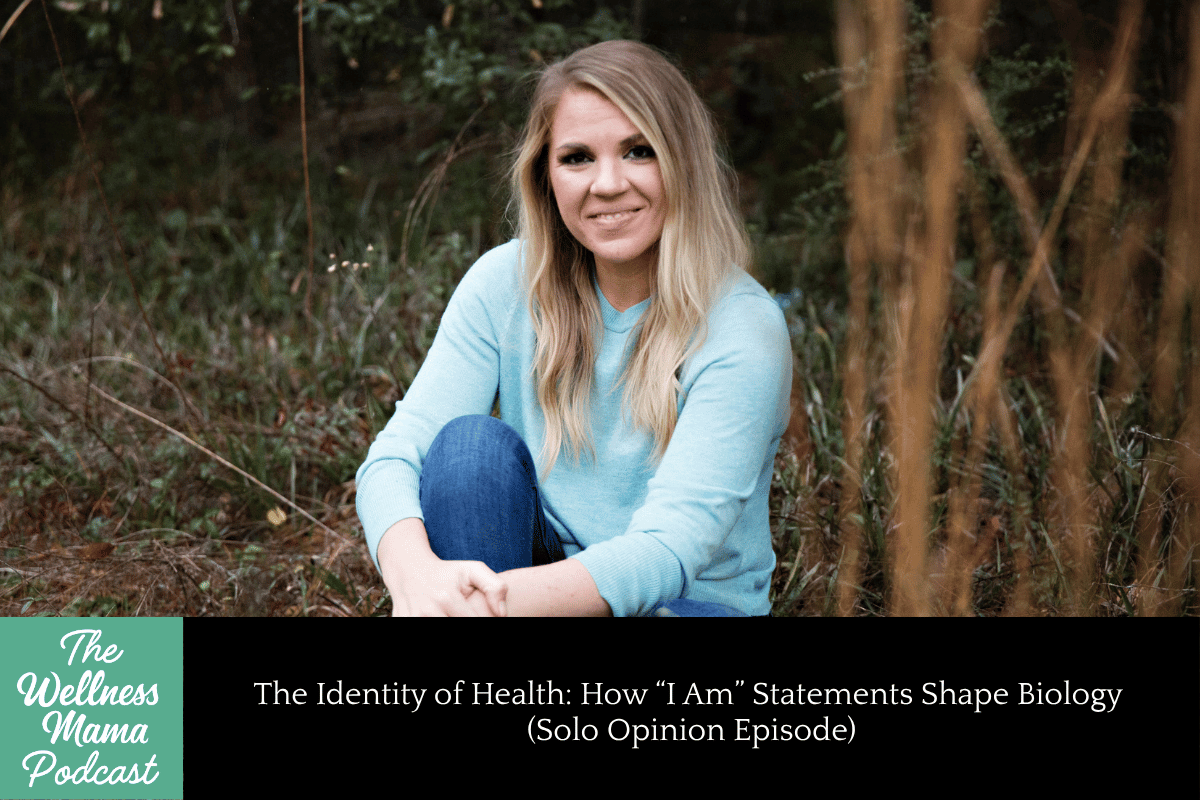
Hello, welcome to the Wellness Mama podcast. I’m Katie from wellnessmama.com. And this episode is a little bit deeper of a dive into a topic I’ve talked about before. I recently talked about my journey of letting go this past decade and what that has looked like mentally, emotionally, and especially physically.
And in this one I wanna really double-click on one particular part of that, which is the identity piece, and especially the identity of health and how this related to my physical healing. And how, in a very real way, “I am” statements shape our biology, which I will explain in this episode. But thank you for spending part of your day with me today.
Before we jump in, I just wanna reiterate that, as always, that nothing I share is medical advice, mental health advice, health advice of any kind, or even personal advice. I’m actually not a fan of advice in general, and you are the expert on you. I am simply sharing my own experience, things I’ve learned, my journey, and ideas that have been helpful to me, if anything, to serve as inspiration or information in your own decision-making, never for comparison or pressure or prescription.
You are and always will be your own primary healthcare provider and the expert on you. So I encourage you to be curious, to do your own research, and to question everything, including and especially me. Okay, so this topic I have found fascinating the last few years and I have learned more about, but really have been on more of my inner journey about that I wanted to share with you today because there’s a little bit of science that backs this up and a whole lot of anecdotal evidence from myself and from others.
And I think this is super fascinating because it is a small thing within our control to shift that might make a big difference. And that is specifically I am statements. So in other words, anything that we put, any words that we put after the words I am, which could be little things like I’m tired or I am sick, or certainly big things like, I’m not good at XYZ or I’m not a good person.
I, I’ve heard people make all kinds of I am statements. I certainly had my own huge list of them in the past. But I find these fascinating because they actually might inform our biology more than we thought. Because I am statements are not just, they’re not affirmations. I know they get tossed around on social media quite a bit these days that way, but they are actually identity declarations.
And I talked in my letting go episode recently about how many of the things we consider ourselves are actually just roles and identities that we take on. And while there can be positives to that, there’s at least a benefit in having awareness about them and choosing those positives and being able to step out of those roles when necessary.
I have personally learned to be extremely careful with my words, especially with I am statements or requests I make or anything basically I put after that. And I’ve shared before one example of this would be in the past when I was told I had Hashimoto’s, which I no longer have, I would internally say things like, “I am sick,” or, “I am broken,” or things along those lines. And I didn’t think that there was much weight to those.
That was just my experience of what I was feeling at the time. But over time, I have learned to be a lot more aware of what comes after those words. And so today, I would love to just approach this topic with curiosity, because I think it can inform a lot. And as a little bit of an anecdote here, there’s a movie, I don’t actually know which movie this was from, but I saw the clip where, someone was talking to Morgan Freeman, and Morgan Freeman’s response to this person was, like, “Well, when you pray for patience, you don’t just get patience, you get opportunities to learn patience. And when you pray for courage, you’re not just gifted courage, you get experiences to learn courage.”
I think that actually relates to this I am piece as well, because in a sense, we’re making very real identity statements and also direct requests of both our body and the environment. One thing that took me a long time to really understand is that our body pays attention to every word we say to it, especially our inner language.
And for many of us, that can be running, I know for me it was, running quite negative scripts for a very long time with repetition around some of those negative statements. So as far as affirmations go, I was repeatedly programming myself with some pretty negative beliefs about myself and about the world. But the body’s always listening and finding evidence to support that our body, our mind, and our nervous system are kind of always hearing that inner script.
And our identity becomes part of our beliefs or those are very connected, which also tie into our nervous system cues, which I also talked a lot about in the letting go episode. But these relate to very real biochemical outcomes. Extreme examples of this would be people who were told they had terminal cancer.
They died when they told they were, were told they were gonna die, and then it was found at an autopsy that they had been misdiagnosed, but their belief was so strong that they were dying that they actually died. On the positive side of this, there are times when someone– something shifted and someone completely reversed or healed from something very extreme, like a stage four cancer, and science couldn’t explain it.
And Dr. Zach Bush says they don’t let you write miracles in medical text, so the, the word they have for that is spontaneous remission. But in both cases, something fundamentally shifted in these people that led to these outcomes that was unexplainable by science. And I have personal experience with this, not on the stage four cancer level, but of how I saw this play out within my own body and nervous system. Which is that when I was in the experience of and my internal script said, “I am sick,” which I both internally and externally said often then, this was keeping my body in survival mode, and my body was looking for evidence to support that, and that was the script I was running.
When I was able to shift even just subtly into I am healing, that opened the door for change because my nervous system, my subconscious, and my body all were looking for evidence of that. I have now come to feel that personally, I think identity is one of the deepest layers of health, and I think that behavior change built, on the wrong identity is still always gonna feel like force and willpower.
And you may have heard people say it’s a little bit like instead of having the story of like, “If this thing happens with my health, then I will be this person,” or, “Then I will be this way,” instead it’s becoming the person that is that before our body reflects it, and the body is always on our side, and it eventually will.
But I think this is a piece of why many diets and health protocols can fail long term is because people, myself included, I did this for a long time, excessive protocols, try to do healthy things while still operating from a story of being broken. And so this piece is about nothing to do with the medical side or the health side.
Of course, still work with practitioners, do your own research, use protocols and tools when necessary, of course. This is about shifting the underlying script that we have, that we already have within our ability to at least start being aware of, to evaluate, and to create and change around. My thought now is that when identity truly shifts first, the habits follow automatically.
For me, this looked like when I– my identity shifted to that I am healed or I am a person who, instead of being tired all the time from Hashimoto’s, loves nature, loves activity. My body became the size I used to want to punish it into being without me having to do all those excessive things. In fact, as I’ve shared before, I actually ate more and reverse dieted and nourished myself much better.
But I was eating substantially more calories while losing weight. And I think the identity is a big part of that because I wasn’t willpowering myself into doing those things. I was– My identity had shifted into a person who already was that. And so my choices, my body, my environment started to reflect that.
And the paradox here, as I’ve said, you can’t out-supplement a bad diet, you can’t out-diet lack of sleep. There’s lots of caveats. But I do feel like the paradox here is you cannot out-supplement, out-diet, out-sleep, out any of the things a self-concept of illness. I think if you believe you are fragile, if you believe you are broken, you will find those things to be true.
The good news is, conversely, if you believe that you are capable of healing and you are healing, if you believe that you are wonderfully, beautifully, magnificently made and that your body’s always on your side and you operate from that self-concept, you will find that to be true as well.
From my understanding, again, not medical advice, here’s how, from what I understand, “I am” statements actually shape our biology. And I find this fascinating. From the neuroscience perspective, I’m of course not a neuroscientist. I’ve just, thanks to the internet, gotten to read a whole lot on this topic.
The brain treats identity statements as predictions, and later our predictions become our physiology. So if we say, for instance, “I am anxious” or “I have anxiety,” the brain primes for anxiety.
If we say, if our identity statement is, “I am inflamed,” the brain scans for inflammation. What we believe to be true becomes true. The science can’t even fully explain this yet, and perhaps they’re not meant to. But if someone believes that they are dying or they are fragile, that plays out.
And so this, I believe, is a powerful piece we don’t even fully yet begin to understand. But I do think that identity, these, these statements that we make, act as a filter, and the brain seeks proof of the identity that we’ve chosen. So just like in a very simplistic way that they often say, like, if you decide you’re gonna buy a certain car, you start seeing that car everywhere.
It’s because your filter, your brain, is now scanning for that thing.
The same thing is perhaps true about our body, but in even more profound and deep way. There is also a nervous system component here. I think, in, in my own life I saw this, that our identity piece really shapes what our body perceives as stress and safety signals. And so if our identity and our nervous system are…
If our identity is, is in a state of threat, of I’m sick, I’m broken, I’m whatever, then the nervous system registers threat detection.
So if our internal script is that I’m sick, I’m broken, I’m fragile, I have Lyme, I have mold, I have whatever, I’m the victim of these things, then our nervous system is in a state of alert as it should be, because it’s always on our side. Whereas same external variables being true, if our identity is that I am healing, that puts our nervous system in a state of more parasympathetic access and safety.
But another way of thinking about this is you can’t heal when you’re in threat mode, and this is by design. If you are being chased by the metaphorical tiger, that’s not when your body is concerned with healing, with fertility, with things that it considers secondary because it’s gotta keep you alive.
And in my opinion, shifting our identity statements can actually help signal either threat or safety to our body. So in this case, if we can signal more safety even by our inner dialogue and our identity around self, that self-belief then contributes to whatever our body reflects.
I also think there’s a mitochondrial piece here because like I said, our nervous system registers whatever we claim as our identity, and if our identity is something stressful and threat-based, then we are producing physically stress hormones which influence even how our mitochondrial function, the voltage within our body, it influences so much downstream of that.
So if the narrative is that I am fragile, the nervous system registers threat, mitochondria behave defensively, the body is in a stress state. Whereas if the narrative is I’m resilient or I’m healing, mitochondria can shift towards repair and energy, the nervous system can shift into parasympathetic. We have a whole different experience even with the same external variables or words that we were given, I don’t like diagnosis, but those same things being true.
So to give you a little bit of my short story around this, I think shifting my identity was a piece of really building resilience and changing my actual physical health outcomes. Though I didn’t see how profound the shift was until I was able to look at it in hindsight, which is why I wanna share it now, because I think I would have perhaps learned to be much more aware more quickly had I realized how powerful this can be.
So after years of, like I’ve shared, AIP diets, very restrictive diets, keto, paleo, fasting protocols, healing diets, all the things, I had all these stories about being I’m sick, I’m inflamed, I can’t handle XYZ, I have Hashimoto’s, et cetera. And these kept my system scanning for danger. And so my world got smaller, my diet got smaller, my stress got higher.
But as I started to shift my identity and realize my body wasn’t broken, I realized my identity was still wired toward illness because that had become part of my reality for so long. So I had to have a conscious effort to rewrite my internal scripts so they became eventually, without me thinking about them, but with very much conscious effort in the beginning, that I am healing.
I am expanding my capacity. I am learning to trust my body again. My body knows how to heal. And like I said, this was a gradual process internally. At first it was just noticing and even being aware of, ’cause often our internal scripts run kind of almost sub-perceptively. We don’t even, we’re not even aware that we’re repeating those statements to ourselves so much.
And then I would consciously edit them, sort of rewrite them in real time, and then over time I realized that the new ones were starting to stick and become automatic. So symptom identity can sound something like, “I am anxious, I’m inflamed, I’m chronically ill, I’m sensitive to everything. I have XYZ.
I can’t do this because XYZ. I’m a person who can’t blah, blah, blah. My body doesn’t work right,” or, “I’m broken.” Those would all be kind of symptom-based identities. The shift into healing identity sounds like, “I am healing. I’m someone who listens to my body. I’m supporting my healing every day. I’m rebuilding my strength and resilience.
I am safe in my body. I’m learning what helps me thrive. I’m expanding my capacity.” Now, one thing I wanna mention as a side note here, and this might be a whole podcast of its own one day, I would avoid, this was a pitfall for me, making the identity piece then only being about a person who is healing.
Eventually mine had to shift into, “I am healed,” and that I no longer had those things. And I believed that before the lab test reflected it, and then eventually the lab test did and still do reflect that. But I have seen instances where someone made their identity about healing from, for instance, Lyme disease, but then they built such community around the healing process that they were unwilling to let go of the healing to actually be healed.
So I just wanna mention that as a potential pitfall.
So here’s why that matters. When we make I am statements, we are telling our body and our nervous system what reality to build. One shift away from that, like I said, is to instead of I am, be very careful what goes after those words.
So here’s why this matters. Statements that begin with “I am” tell the body and the nervous system what reality to build. If we can simply shift some of those statements into “I feel” instead of “I am,” so instead of, “I am anxious,” “I feel anxious,” or, “I feel angry,” or, “I feel sad,” this creates space for those experiences to still exist, of course, without making them our identity.
So I feel sad instead of I am depressed. I feel tired versus I am tired. Those little shifts actually can be really, really profound. And I think when we become aware of this identity piece and learn to curate it consciously, that identity piece can actually become a healing accelerator, which is what I experienced.
Like I said, eventually shifting into I am healed before I had lab proof of that, and then eventually my labs then showed the same. When the identity changes, the body follows. Again, there’s not a lot of double-blind studies that prove this. There wouldn’t really be an incentive for anyone to run those studies.
This is just my personal experience, and I’ve seen it in others as well. When we can shift the inner narrative, our brain can stop overreacting to inputs, even if the inputs are still the same. Symptoms can lose the emotional charge that they have when we carry a broken identity, and we often then, being in a place of curiosity or experiencing those as feelings versus who we are, can interpret sensations differently.
So there’s less threat registering in the nervous system, more curiosity, and hopefully more healing. And this alone I feel like can help reduce inflammation and nervous system load, especially if we’re also supporting our nervous system directly in that transition. So here’s what I’ve learned in my kind of how-to of rewriting health identity.
The first thing is just auditing what our current statements and identity pieces are, so anywhere the “I am” shows up. And I mentioned in my last episode how for me it was even a long-term process of releasing things like, “I am a mom. I am…” Anything that came after the words “I am,” I started being very aware of.
But noticed what we say when we’re stressed. Notice what comes after the words “I am.” Notice our internal dialogue around food, around symptoms, around aging, around emotions. And even just start writing those down, not even trying to change them, but for me just being aware of them first. Then slowly I shifted the phrasing from “I am” to “I feel,” from “I can’t” to “I’m learning,” from “I’m broken” to “my body’s speaking,” whatever it was into moving myself into more curiosity and not making the illness or the healing being my whole identity.
And then from there we can update our identity story into what version we want to curate of who am I becoming? What does the healthiest version of me say and believe and feel? I think tapping into how do I feel actually is a big piece there as well. How does that person talk to herself? What are my default “I am” statements?
And those over time, they took a while to shift, but it’s been really profound, my inner experience as my identity shifted. And I think this requires a little bit of self-attunement. At first, like I said, some of these were sub-perceptive. They were not even on my radar. And as I mentioned in my last episode, the nervous system doesn’t always love change.
So I feel like there are some helpful things we can do to self-attune and to support the body in the experience of whatever it’s going through and in the shift. Things like being aware of the nervous system and doing anything that helps with nervous system regulation, whether that be breathwork or there’s many modalities that act on the nervous system.
Even humming can be helpful. Light exposure, breath, movement. I’ve talked a lot about minerals. I have a whole five-part mineral series. Minerals and hydration can make a big difference here. Eating enough nutrients to actually nourish ourselves, that’s a tremendous safety signal. But these can create enough internal safety for that identity shift to actually land.
But like I said, I think this identity piece is kind of the actually the beginning and the final stage of health and healing. Protocols can get us part of the way. Willpower can get us part of the way. I tried those things for years. The nervous system work can expand our capacity. Light, minerals, movement, those things are really important for rebuilding foundation and for supporting the body and the nervous system.
But for me, identity and shifting who I believed I was, was actually what really sealed the transformation and took the willpower out because then that was just who I was. And so I made choices in my life that reflected who I was. But really I want to highlight, I didn’t actually shift into not having Hashimoto’s and into this state of health by restriction.
I got here by rewriting my internal story, by trusting my body, and by a lot of letting go, which I talked about before. So in this episode, I would just encourage you to, as we end, think of who are you becoming and learn to start operating from that place, not from where you are right now, and to audit the places that you might have an identity that isn’t what you would actually want it to be or what you would choose.
I don’t think we heal from protocols or from being perfect. I think we heal by shifting who we believe ourselves to be. I think our identity shapes our biology, and I’ve seen this play out in my own body. I think our biology shapes our behavior, our behavior shapes our reality, and reality becomes the evidence of our new identity.
So it comes full circle. So I would love to invite you to notice and rewrite any place you have I am statements that are not serving you. And I would be so curious your feedback. If you have ever done this or if you do this now, what statements show up for you and what your preferred statements will be as you begin to shift them?
But for today, thank you so much for joining me, for sharing your time, your attention, your presence. Those are your greatest resources, and I don’t take it lightly that you shared them with me. It means the world that you are here. And if this was helpful to you or if any of my episodes have been helpful to you, it would mean the world to me if you could leave an honest review wherever you listen to podcasts, which helps other people find and listen as well.
And if you would like or would enjoy receiving an email from me each week with some of my favorites, my behind-the-scenes or insider tips, you of course can unsubscribe at any time, but that is found at wellnessmama.com. You can sign up for my VIP newsletter there, and I hope you will join me again on the next episode of the Wellness Mama Podcast.




Leave a Reply