Read Transcript
Child: Welcome to my mommy’s podcast!
Katie: ?This episode is brought to you by Hiya Health, which I have a now extended and renewed interest in, especially with having a baby around who will be starting solid foods pretty soon. Because here’s something that’s kept me up at night as a parent, and I’ve talked about before. Our kids are the first generation growing up on not just ultra-processed foods, but foods that don’t have the same nutrient content that they used to due to soil changes and so many other factors.
In fact, we’re just beginning to understand the extent of this problem. And this is why Hiya exists and why I’m glad that they do, which is to give parents a real solution in a market that is flooded with kids’ vitamins that are actually contributing to the ultra-processed foods. They have candy-like appeal, but not actual nutrition.
In fact, some children’s vitamins on the market contain up to seven grams of sugar per serving and are stuffed with additives and petroleum-based dyes that I go to great lengths to avoid in my kids’ diet. So Hiya took the opposite approach with zero sugar, zero gummy additives, just clean nutrition. And the great part is kids actually love them.
My younger kids are a huge fan. I have tried them, and the flavor is actually great, although obviously I don’t take them daily. But what makes them different is how thoughtfully they are designed, formulated to meet very specific nutritional gaps that modern kids face. And they worked alongside pediatrician and nutrition specialists to make a chewable multivitamin that packs a blend of twelve organic fruits and vegetables and fills the common nutrient gaps that kids face.
They’re also non-GMO, vegan, dairy-free, allergy-free, gelatin-free, nut-free. They really have thought of everything to make these ideal for kids. And they are NSF certified and receive Clean Label Project’s Highest Purity Award. So when it comes to something I feel safe giving my kids, they are definitely on the list.
It’s designed for kids two and up. They ship straight to your door. And I love that they send you a reusable bottle and stickers with your first order. So this helps you keep up with the refills, and they send refills every month as well. I am a big fan of these as well. And Hiya just launched something new.
If your kids are active and growing, you can add a clean protein powder with minerals designed just for kids to be exactly what they need. Their new Kids Daily Growth Plus Protein is a game-changer. It’s more than a protein shake. It’s a purity awarded clean protein powder with added minerals and healthy fats that can mix right into water or smoothies and support muscle development and cognition and fuel everything else they’ve got going on.
So, we worked out a special deal with Hiya. You can receive 50% off your first order on any of their products. To claim this deal, you must go to hiyahealth.com/wellnessmama. This deal is not available on their regular website. So again, that’s H-I-Y-A-H-E-A-L-T-H.com/wellnessmama, and get your kids the full body support they deserve.
This episode is sponsored by Just Thrive Health, one of my favorite companies, and especially their new Digestive Bitters. So I’ve been talking about gut health for years before it was so trendy. I love that everybody’s talking about it now, and the one brand that I have continuously used for my gut health is Just Thrive.
I started on their probiotic seven years ago, and my whole family uses it. I prefer their probiotic over any others as it’s guaranteed to arrive 100% alive in your gut, and it has a thousand times better survivability than most probiotics. It’s also one of the most versatile probiotics out there that we can take in capsule form and I can also add it to smoothies or even bake with it because it’s heat stable up to 450 degrees. So it survives all the ways I use it. I also love their newest product, their Digestive Bitters, and I got to record a fascinating episode on this because for centuries, traditional cultures turned bitter herbs into an ultimate digestive activator.
But in today’s world, these essential compounds have all but disappeared from our diets, and that’s why I am really enjoying their di digestive bitters. Which features 12 clinically proven herbs. It activates your body’s natural digestive processes and encourages healthy GLP one production naturally. So for you, that means smooth digestion, better nutrient absorption, and balanced cravings.
And best of all, the capsule design delivers the benefits of bitters without the unpleasant taste, which is a massive breakthrough. Just Thrive Digestive Bitters work with your body’s natural process to optimize digestion, nutrient absorption, and gut health, all backed by science and centuries of proven efficacy.
They can replace several digestive aids like antacids making instead of masking symptoms. These actually help acid levels and regulate bile production. Some of the many benefits of Bitters, they can ease occasional bloating and indigestion, support GLP-1 production, naturally help you break down your food better for better nutrient absorption, support your healthy blood sugar balance and appetite control, encourage and support optimal bile flow and enzyme production, enhance digestion of fats and proteins and without the bitter taste.
It can promote balanced gut microbiome, support healthy gut barrier function, and can be taken alongside probiotics for peak gut support like all of their products. These are microbiologists formulated, evidence-based and safe, as well as non-GMO and free of gluten, soy, dairy, sugar, and artificial ingredients with a 100% satisfaction or your money back.
I have been experimenting with these and really, really loving them. If you would love to check them out too, go to justthrivehealth.com/wellnessmama and use the code WellnessMama15 for a discount.
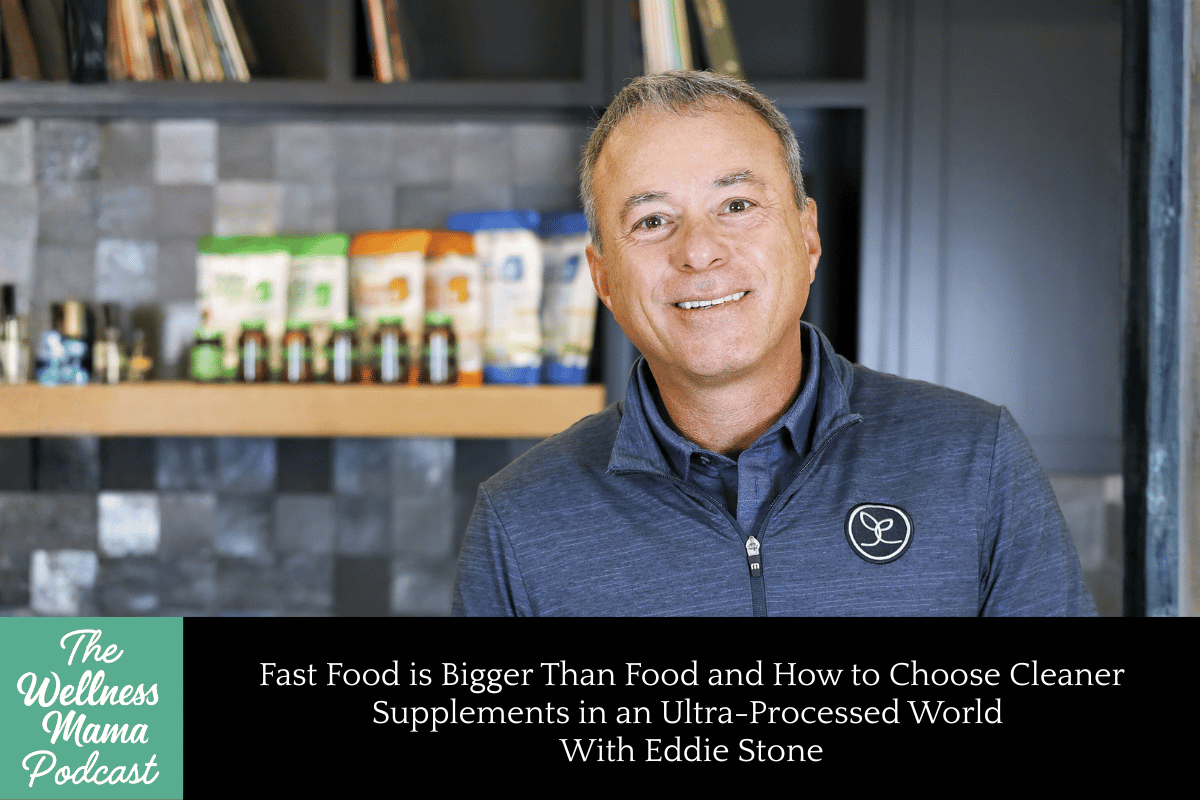
Katie: Hello, and welcome to the Wellness Mama podcast. I am here for part two with Eddie Stone, who’s the founder of Touchstone Essentials, to go deeper on a few topics. In our first episode, which I will link to in the show notes, we talked about the modern toxic burden, what we can do about it, and how I’m personally using zeolite.
In this one, we’re gonna talk about how fast food is bigger than food, what that means, how to slow down a little, and how to choose cleaner supplements in an ultra-processed world. And he has done a, like a ton of research in the supplement industry and highlights some big problems that consumers may not realize exist in supplements.
For instance, what does clean really mean when it comes to supplements? I will say that over the years, my list of supplements I will take has gotten shorter and shorter, and I prioritize now very few but very impactful ones that I know are clean and effective. So without any further ado, let’s join him and learn about how to choose cleaner supplements in an ultra-processed world. Eddie, welcome back. Thanks for being here again.
Eddie: Glad to be back.
Katie: If you guys missed it, I highly recommend our first episode that has already aired about something that I have recently introduced to my routine and I love, which is zeolite. It was something I didn’t fully understand and I have very much enjoyed getting to learn about.
In this episode, I wanna talk about two specific things that I’ve heard you talk about that I feel like are really important and resonant, one being that the idea that fast food is bigger than just the food, and like the hurry culture that we live in, and the other of what’s hiding in supplements and how to actually navigate choosing supplements that are not gonna make things worse.
I feel like both of those are very resonant and relevant to moms. So to start with, let’s maybe just tackle first what do you mean by your phrase that fast food is bigger than just food?
Eddie: You know, it’s really a cultural standpoint. And I, and I wanna be careful not to kind of impart my values on people, but I just really believe we sort of ignore the value of just taking a moment to enjoy the food that we’re consuming and or the preparation thereof.
Now, that doesn’t mean I’m not completely sensitive to the fact, and at this point in my life it’s not quite the same as it was when Marie and I were raising our kids. We have a couple kids. And so I know what it’s like when you’re fighting dance lessons and practices and school activities and all these things.
And so many times you’re choosing a meal by just how fast you can grab it, get it in the kids. It’s kind of like a fuel stop. But outside of that, I really do believe there’s a lot of opportunities where we can take time and enjoy the food that we’re eating or, even better, get everybody in the family involved in some level of preparation of that food.
You know, I think there’s a, l- a series of lessons that can be taught if someone is, if we’re teaching the kids or even if partners are together working on getting the food, purchasing the food, knowing a little bit about the food that you’re buying, learning how to see the difference in, you know, maybe conventional versus organic or whatever it happens to be.
People can take that as far as they want to. But then they’re having to do a little cook and preparation themselves, and then that appreciation that comes from the meal. I’m not trying to say that it solves world problems, but I am saying that if a family a couple times a week has meals where they set their phones on another table so they’re not a part of the dinner table or the discussion. And if they turn off the television or what it happens to be, if they just take some moment to three, four times a week as much as possible to enjoy it, the social interaction and the appreciation of food impacts how you digest, impacts how well you uptake the nutrients in that food, and I think over time teaches lessons to everybody involved about the importance of food.
If you look at human beings, about 40% of the energy consumption or energy that’s utilized on a daily basis comes from digestion So in the way that our bodies work, food is playing this sort of massive role, and oftentimes if you just look at the statistics, right, I think it’s 90 plus percent of the calories consumed are processed food calories.
Now, some of that’s because the processed foods have such a higher concentration of calories, but if you look at how much they’re devoid of basic nutritions, we’re really short-changing our body’s own ability to maintain the immune system, good health, bone density, gosh, all these things over time. And so there’s a lot of things that can be, not solved, but maybe addressed, and even get us pointed in the right direction if we think about slow food or slowing the whole process down, ’cause I think it has a ripple impact on all the rest or parts of our life.
Even if it’s two or three times a week in addition to eating together, you set the dishes aside for a few minutes and everybody walks for 15 minutes, right, to burn off that initial amount of a glucose spike that comes from the food that you’ve just eaten. And so for me, it’s almost a cultural dynamic that just gets lost in the hustle, the bustle, the shuffle, that I deeply appreciate the modern world that we live in.
Everybody’s just doing the best they can, but if we somehow could hit the reset button some, it’d be a, it’d be a profound impact.
Katie: I love that reminder, and it stands out to me that perhaps this is a commonality in blue zones. I know it’s often debated and kind of controversial. What is the factor in blue zones that makes it stand out, and why do they live longer?
I think it’s probably multifaceted, and there’s some interesting data in lots of directions. However, seems agreed that they tend to have really strong community and that they move slower, that they might take hours to eat their evening meal, for instance, and they’re spending time together in community while doing that.
And I will say just for me as a mom, those are some of my favorite moments in the world are when all my kids are home, and we’re slowly… We’re not rushing. We’re having dinner. Everybody’s laughing. They’re joking or just spending time together, and I think that does get easily pushed out in the modern world.
That’s an interesting statistic that 40% of energy comes from digestion. I would guess also some of it comes from sunlight, which is another thing I encourage people to please get more of natural light as much as possible. But that is really astounding that 40% from our food, and it- I would guess if we’re eating in a state of stress, to your point, we’re just not optimally making use of that food.
And I’ve said this before as well, like, I think we could eat the quote unquote perfect diet on paper, and if we’re doing it when we’re stressed, we have a fear about it. We think our food is bad for us, whatever it may be, even just kind of an orthorexic perspective. We’re not gonna be optimally interacting with that food because we have fear around it.
Whereas there’s probably counter examples where people were in a state of complete calm. They were not stressed. They maybe didn’t eat the perfect diet, and their body could utilize it wonderfully. I think that, like, this is a, an intangible that we don’t often talk about. But really what I wanna hone in on is that point that it’s not about the calories.
I think we kind of lost the script for a while when we started thinking it was about the calories, but it’s really in my mind about the nutrients and that many of us are that often quoted overfed and undernourished. But I think that is a huge piece because as we said in the first episode, our bodies are wise, and if we’re not getting the nutrients, our body’s gonna keep craving food to try to get us to eat the things to get those nutrients.
So I love, love that reframe, and I know also in the modern world, one thing we face as a problem, and many people talk about this, is our- even our food supply is kind of depleted of the nutrients it once had. So even if you were eating a really beautiful diet and varied and getting enough fiber, you still aren’t getting the same nutrients from the same foods that our grandparents did, for instance.
And I know many people now agree, like, often there are times when supplements can be not only helpful but in some cases necessary. So I would love your take on that. Perhaps maybe if I’m incorrect on that, push back. Or if that is the case, give me your perspective on why you became concerned about the supplement industry because I would guess many people listening consume supplements in some forms.
This is a very relevant topic.
Eddie: Yeah. Well, there’s a lot to unpack there. And let me just, let me give this sort of dynamic to start with. A lot of people when they think about food, they think about it at a very macro level. And if you can just master this sort of one dynamic, it really can make a difference.
And what they’re doing is they’re thinking about it calorically as, carbohydrates, fats, and proteins. That’s kind of all they think about. But what they don’t think about or what’s further there in that story is the type of fats, saturated fats, trans fats, right? We’ve all kind of heard these terms generally.
And the types of protein, plant-based, animal-based, is the protein coming from a heavily fatted piece of meat? And from a carbohydrate standpoint, this is really where it gets profound. A Snickers bar and a head of broccoli are both gonna be principally carbohydrates, right? But I think we intuitively know the difference in nutrient value is really dramatic.
And so I try to get people to think about, from a food standpoint, to think about, that you can even think about something as simple as, say, pasta. Is your pasta being served al dente or is it a bit soft and mushy? Because al dente is a little harder for the body to digest, and so it lowers the glycemic index and has a great impact on the body and blood sugar.
So those are things that a little bit of simple mastery and a little concept matters. The reason I bring that all- bring that up is when you talk about supplements, supplements to me is- the title is the key here. It’s a supplement to where you are and where you wanna be And for most people, if they just do the simple level of evaluation about what they’re consuming and the nutrient density of what they’re consuming, they realize, really, I’m falling short on the amount of antioxidants, I’m falling short of the amount of micronutrients because I’m really not eating fruits and vegetables on a high level.
And the food supply in our country, you get to count ketchup as a vegetable, right, if you’re trying to do a count. And we all know things like that are really not advantageous or beneficial. White potatoes that are fried, again, count. And not that there’s no nutrients there, but not the density that we need, particularly when we talk about green leafy vegetables of that ki- of that kind.
And so with those things in mind, we created our supplements. And all of this started for me, I’ve been in the supplement industry, as I said, you know, well over three decades, and a part of my journey was to see how that they’re manufactured. And for 99% of the supplements that are available, and I don’t- it doesn’t matter if they’re $5 a month or $500 a month, they’re generally going to be made like fast foods in that it’s assembled series of chemicals that look like, chemically, from a chemical standpoint, they’re synthetics or they’re basically parts of synthetics which look like the molecule, let’s say, of, say, vitamin C.
An example I can give you is that almost everyone that buys a supplement or even a lot of your packaged foods, you’ll see on the label vitamin C, and in parentheses it says ascorbic acid. And people just sort of assume, “Oh, that’s vitamin C.” That’s really not the case. Ascorbic acid is just the outer ring of an eight-part vitamin C molecule.
And in order for it to be taken into the body and utilized, the body’s gonna have to basically break down those other components from collagen, mostly, inside the body, to reassemble and make that C into a usable C by the body. That’s why very often people are taking such massive amounts of C, same thing can be said of D and others, because it’s really inefficient.
And it isn’t just that it’s inefficient, very often those processes can create inflammatory responses by the digestive system. And so, you know, the general idea that, “Hey, I’m probably not getting enough vitamin C,” right? People recognize that can be true. But when they go source it and the source is a synthetic, even if it’s an output of some food product, it doesn’t show up in the body in a way that it’s basically recognized like food is.
And so the body almost treats it as a foreign substance in terms of how it breaks it down and tries to make it bioavailable. I don’t mean to complicate this for people. If you just simply learn to look at labels. Unfortunately, most supplement labels read like a fast food label or an ultra processed food label.
We decided that was not good enough. And so we worked with food scientists and doctors to put together products that are actually made from real food. I’ll give you an example. We have a greens juice. It’s a powdered greens product. It’s made for, from 44 different USD organic fresh fruits and vegetables that we take great care to dry at very low temperatures so that we preserve those delicate phytonutrients that are found in the greens, and we make it palatable.
Because if it doesn’t taste good, and if it’s not easy to use, no one uses it, right? We sort of recognize the dynamics, and we’ve taken that approach to an entire product line, realizing that it isn’t just that people are missing nutrients, they’re missing the components of food that go beyond C and D and E.
If you look at an apple, most research would say an apple has 700, 700-plus different chemicals in the apple, not just pectin, not just C or other dynamics like that, that all work in concert to supply the benefits of the apple, which we know you really can’t supplement yourself away from. And so we’ve taken this concept and applied it to products that are made from food powders, so we can give people something that looks like to the body, from a bioavailability standpoint, looks like what food looks like.
Is it the same as an absolutely perfect proper diet? It is not. It’s not trying to be. But is it an incredible supplement to what people’s actual diets and habits really look like? It absolutely is. And so if you don’t have a teeming organic garden 24/7 in your backyard, and you’re looking a way to get more fiber or more greens or an organic, highly available protein, whatever happens to be, then that is the nature of the work that we’re doing, right?
And we’ve cultivated this. Almost all of our ingredients are coming from here in the United States. Almost everything we have is completely certified USD organic or Oregon Tilth. And so we’ve worked hard to make sure we give the consumer that choice of a product that really provides, in its own way, those things that are missing from the modern diet, trying to give them a supplement, and we really hope it leads them to making better food choices otherwise because of the inspiration of what it’s like to have those nutrients and how your body feels.
Katie: That’s a great summation, and I’ll say in my personal experience, I experienced what you’re talking about with vitamin D. Kind of early on in my health journey, I got labs. They said, “Your vitamin D is, like, very, very low, like critically low. You need to take a ton of vitamin D.” And not knowing any better, I was like, “Okay, this seems bad.
I’m gonna take a lot of vitamin D.” And I did this for a long time. Not only did my levels not improve, I felt worse, not better, and I eventually over a long time learned that part of the reason why was I have some genetic things with VDR mutations, and turns out the body knows how to create and work with vitamin D from sunshine, and it doesn’t necessarily know how to work from most forms that we take in an oral supplement.
So long story short, I now try to get lots of sunshine, and my vitamin D hovers around 85 all the time, and I never take a supplement. But it’s almost like the body is so wise and it knows exactly what to do, and that we’re missing this nature component. So I love that you guys bring the nature component in even with the supplements.
And I’m curious, you kind of touched on this already, but what are some of the biggest problems that consumers may not know about in really popular supplements, or what does clean actually mean? Like, for you guys, it sounds like food-based, but I would guess the vast majority on the market are not meeting those criteria.
Eddie: They’re not, and so if they were really to look at the label closely and look at the definitions, and we have on our website some blog posts and things that go into this in detail. But the bottom line is most of what they see on the label are what’s are called fractionated ingredients, and so just like I described with the ascorbic acid, the version of E, the version of D, all those things are fractionated.
In fact, the majority of D consumed in this nation is D that basically the oil that is found on lamb’s wool is scraped. It’s actually called cholesterol, not the same as human cholesterol, and then irradiated, and that’s how that D is formed. And so that’s the majority of what people consume, and so no wonder the effectiveness has limitations because of the fact that it isn’t what the body is producing or what nature can produce otherwise.
And so that’s the challenge is they’re incomplete molecules and the, and they’re asking for a big lift by the body to make that effective. And so, and for me, this really started with the skepticism that you hear from a lot of doctors and scientists about supplements. You know, it’s a throwaway phase that, oh, it’ll just make your urine more expensive.
Unfortunately, there’s more truth to that than people want it to be. And so when you start to do a deep dive, it’s, a lot of it’s coming from the fractionated ingredients, the overheat processing, and most of these ingredients are not coming from food in any way, shape, form, or fashion. Petroleum byproducts or sort of this large-esque sourcing or different types of vegetable-based oils, seed oils that most people are uncomfortable with even in their whole form.
And so that’s what I mean by that is just, you know, the sourcing and what it actually is just is not what’s found in food, and that’s really to me that fundamental problem of getting the max benefit.
Katie: That makes sense, and I like that your approach doesn’t seem like fear-based. Like, you’re not trying to make people afraid of any of this.
You’re kind of trying to give, like, impactful ways to simplify this. And I think of a world we live in where there are people who are very public about the fact that they take hundreds of supplements a day, literally hundreds. I don’t even know how you have enough room in your stomach to want food after taking hundreds of supplements, but there are people doing that.
And it makes me wonder, like, in life lately, I have gotten the lesson that often it’s subtraction, not addition, that is the most impactful. It’s often simplification, not complexity, that is the most impactful. So I’m curious how you would navigate that when it comes to supplements. Like, are there ways to simplify this piece of wellness without it being fear-based or complex or, like, you know, overly hard, especially for moms?
Because I also believe moms are the busiest people on the planet, and some simplicity goes a long way.
Eddie: You know, and I hear exactly what you’re saying. And I, you know, I consume a fair amount of supplements. I mean, that’s just sort of the nature of my work. But the way I approach it is, before a meal, particularly when I’m at home, sometimes on the road it’s not as convenient, I’ll have a fiber shake.
And we have a great tasting series of natural fibers. I’ll mix some of our green juice with it because it’s food powders and it’s pretty simple. It takes about 30 seconds to shake it, mix it, and drink it. It’s a nice little base before I eat. I do also take some supplements, but instead of me trying to go out and figure out how much C, D, A, B, C…
I mean, whatever you wanna talk about where I’m trying to create a cocktail and trying to become a food scientist or a doctor on my own, I more look at the food concentrates and think about, what are the foods I’m missing? And particularly when I travel, I’m not eating enough deep green leafy vegetables, right?
It’s just not a part of the day, and most salads are not gonna come close, right? Every now and then you’ll get access to something with some arugula or other deep green leafy vegetables that are impactful. And so I try to look at what’s missing and make up for it with food concentrates. I even do it when I buy frozen berries, right?
It’s not always in season to get blueberries, right? But I keep frozen blueberries at the house that I’ll thaw out the night before so they’re nice and juicy to put in my, yogurt or whatever it happens to be. And so I try to think about it in terms of getting to a food supply as best I can, but considering how demanding life can be.
And I am particularly sensitive to the moms out there that don’t have enough time for anything, particularly themselves. And so it does take some strategic approaches, and I think food concentrates, which is what we focus on, is sort of the best way to do that instead of trying to have 100 bottles and being a food scientist assembling them
Katie: And I will of course link to the ones that you’re talking about in the show notes.
I know you guys have some special stuff just for the listeners of this podcast. Are there any other red flags that moms especially need to be aware of when they are reading labels, whether it’s supplement or even food labels that maybe we don’t know to be aware of?
Eddie: I’m not a big fan of fillers and binders, so things like magnesium stearate and others are red flags for me.
It’s just a sign, as far as I’m concerned, of shortcuts and not trying to find ways to really make a supplement. Those things are often used as flow agents, and so they’re trying to simplify the process with how quickly a powder or a liquid flows through a filling tube or things like that to make a capsule or simply, fill the mold to eventually to make a tablet.
And so one of the things I look for, what in there can’t I pronounce? What I don’t understand? Filler agents, artificial coloring, anything of that nature, artificial sweeteners and flavors, anything of that nature. It’s just one more chemical for your body to process. Maybe the impact is minimal, but cumulatively it’s too much over time.
And so this is really where we get into these digestive issues, these immune issues. I can’t sleep. They’re just all kind of factors that come from that. So I… Read labels. You know, just take a few minutes to look for your own internal red flags about binders or things that just don’t make sense. If you don’t see a fruit or a vegetable labeled there as an ingredient source, then that’s a question mark
Katie: And I know you guys have a lot of resources about this. You also have an amazing zeolite that we covered in depth in our first episode together. I’ll link to that as well. It’s one that I have added to my routine and actually feel a difference from, and I’m just now kind of experimenting with the others.
I’ll put that link, ’cause I know that right this week in particular there’s a really special discount situation happening. and I also know that there’s a really cool opportunity related to this, especially for moms. So I will put both of those links in the show notes for anyone listening. At this point, is there anything I have not asked you that you wish I had asked you or that you feel like is especially relevant for moms on these topics?
I think you’ve asked all the questions. I appreciate the thoroughness of your interviews. I’ve watched some of your work online. So the, here’s the one thing I would say for moms or dads out there listening, don’t be overwhelmed by this. Just take a bite at a time, right? If you’re not feeling great, you don’t feel like your kid’s health or everybody’s doing as well as they could, then just look at one thing, right?
What is one thing you might do? A little less processed food over the course of the week. A little more time spent on one or two meals over the course of the week. It, I- what are things you can pay a little bit of attention to to kind of grow a series of habits? Don’t let it look so large that you don’t begin.
Everybody should believe that they can have an impact even with a few minutes a day or a few minutes a week, ’cause I know that they can. It’s just a question of jumping in
Katie: I love it. Well, like I said, so many links will be in the show notes for this one. I love the simplicity that you brought to this topic.
I feel like the peace of mind that you brought and years and years and years of experience. I will definitely keep you guys posted. I’ll do a solo episode pretty soon on what I specifically noticed anecdotally with adding in some things like zeolite. But for now, Eddie, thank you so much for your time. We got to do two really fun episodes, and I’m so grateful that you were here.
Eddie: Katie, thank you for the opportunity.
Katie: And as always, thank you for sharing your most valuable resources, your time, your energy, and your attention with us today. We’re both so grateful that you did, and I hope that you will join me again on the next episode of the Wellness Mama podcast.




Leave a Reply