Read Transcript
Child: Welcome to my mommy’s podcast!
Katie: This episode is brought to you by Hiya Health. Everyone’s talking about their New Year’s resolutions, and while everyone else is promising to hit the gym in 2026, I am focusing on something much easier that’ll actually stick (gym’s already pretty well a habit for me) which is better nutrition for my younger kids.
And that is exactly why Hiya exists, to give parents a real solution in a market flooded with products that prioritize candy-like appeal over actual nutrition. Some children’s vitamins on the market have up to seven grams of sugar per serving and are stuffed with additives and petroleum based dyes.
Hiya took the opposite approach. Zero sugar, zero gummy junk, just clean nutrition. And the crazy thing is kids actually love them. The taste, the experience, all of it. It’s thoughtfully designed. They looked at what modern kids are eating and not eating, and formulated around those specific nutritional gaps.
Working alongside pediatricians and nutrition scientists, Hiya created a superpowered chewable vitamin that packs 12 organic fruits and vegetables, plus 15 essential vitamins and minerals, including B12, C, zinc, folate, and more. The ingredient list is clean with no GMOs. It’s dairy free, allergy free, gelatin free, nut free.
They’ve thought of everything. Plus, they’ve earned their clean label projects, highest purity award certification, and they put every batch of product through third party testing for heavy metals and contaminants. So it’s the kind of transparency that actually means something. They are designed for kids 2 and up, shipped straight to your door in a reusable bottle with refills that come every month.
We have worked out a special deal with Hiya for their bestselling children’s vitamin. Receive 50% off your first order. To claim this deal go to hiyahealth.com/wellnessmama This deal is not available on their regular website. So again, go to hiyahealth.com/wellnessmama and get your kids the full body nourishment they need.
This episode is brought to you by Just Thrive Daily Gut Detox. Here’s a hot take. Most detoxes are just an expensive way to feel terrible for a week, and this is because they force toxins out with laxative and harsh ingredients, which can result in fatigue and days of discomfort. And I’ve talked about before, how it’s not, detox is not a thing we do to our body.
It’s a thing we work with our body because it already naturally knows how to do it. And that’s why I love Just Thrive Daily Gut Detox. It’s different. It works with your body, not against it. It’s not doing something external to you. It’s powered by clinically proven immunoglobulins that act like a toxin magnet.
They bind to the bad guys in your gut and safely carry them out so there’s no extreme flushing or cramping. No shock to your system, and because daily gut detox is gentle enough for everyday use, it helps give you the support you need to stay healthy long term. So if you’re dealing with signs of toxin buildup like embarrassing bloat, or brain fog or fatigue, there’s finally a science backed detox that’s easy to stick with long term.
And it’s microbiologists formulated, gluten-free, dairy-free, and non-GMO. And as always, you can try it risk free with their hundred percent money back guarantee. Just visit justthrivehealth.com/wellnessmama. And use the code WELLNESSMAMA at checkout to save 20%. So again, that’s justthrivehealth.com/wellnessmama. Take control today with Just Thrive.
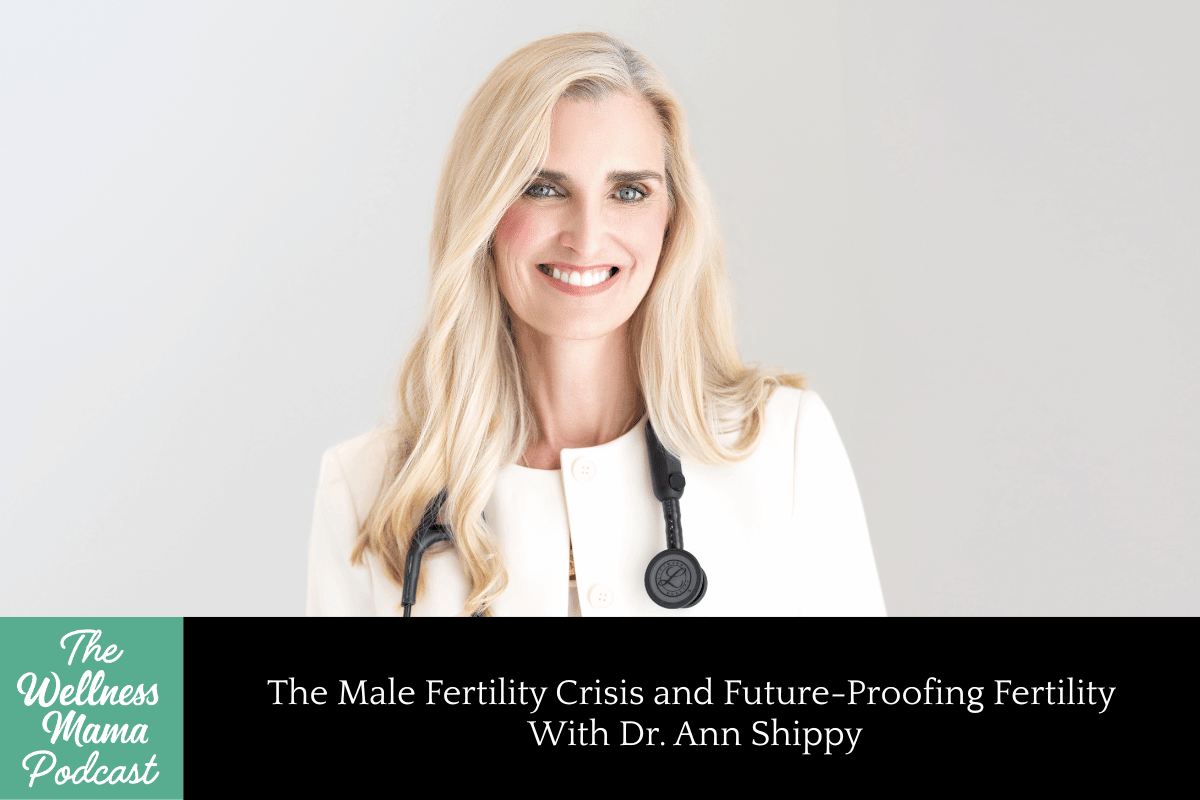
Katie: Hello and welcome to the Wellness Mama Podcast. I’m Katie from wellnessmama.com, and I am back today with a dear friend, Dr. Ann Shippy for part two of a conversation around the preconception revolution and about the fertility crisis in general.
And in this episode we dive into the male side of the fertility crisis as well as things people can do to future-proof fertility and how fertility is really a barometer of health. So even if we’re not actively trying to conceive, these are actually important steps to take for ourselves, for our children, for their future fertility and so much more.
And she has absolutely incredible stories of couples having healthy, thriving pregnancies naturally in their forties and some of the factors that she’s seeing clinically and in research that make the biggest difference in fertility. She routinely sees couples who were told they were never going to be able to conceive or that IVF were their only option go on to have natural, healthy pregnancies without IVF. And I love her approach.
I love her message of hope. She’s a board certified internal medicine physician, a functional medicine practitioner. A leading voice in functional medicine and now this preconception revolution. And I feel like her voice is very important as a counterpoint to this trend we keep hearing of declining fertility rates and very bleak outlook across the board. So let’s learn from her now.
Dr. Ann, welcome back. Thanks for being here again.
Ann: Oh, thanks so much. Love chatting with you.
Katie: If you guys missed it, we got to have a really fun foundational conversation. I’ll link to it in the show notes about the preconception period of time and also like things we can optimize really within our control, within our environment and our lifestyle that can make a dramatic outcome in our fertility and our pregnancy journey and our children’s life long health.
And I love that you’re bringing so much clarity and data to this topic. In this episode, I’m really excited to keep learning specifically on the topics of future proofing, fertility and the male fertility side. Because we didn’t really get to dive into that yet, and I feel like often the burden of fertility gets put on women when it seems like actually there’s a lot that depends on male fertility as well.
So there’s a lot to cover in this topic for sure. And we touched a little bit in the first episode on how age is not necessarily the actual limiting factor when it comes to fertility, but we do know statistically many people are choosing to have kids later. So for people who are delaying starting a family but wanna be able to have children later, what are some things we can know of and do to kind of future-proof fertility and help it, to help ourselves thrive as long as possible?
Ann: I think it actually comes back to some of the things we talked about in the first episode. Keeping those mitochondria really working well is such an amazing thing to keep the ovaries from aging. So there’s a new study that came out recently that looked at the mitochondria in the ovaries compared to the mitochondria and the rest of the body, and they actually were preserved better than the other mitochondria. So just even a little bit of support with mitochondria supplementation can make a big difference. And then we can help the eggs be healthier by really minimizing toxins like I think we need to really think about everything that goes on or in our bodies, even from young ages.
So, even things like nail polish and hair color and some of these things that are just so much part of our culture. We wanna be more intentional about what we’re actually adding to the mix in our body. Because what goes in, we have to be able to eliminate and there’s just so much we can’t control. So the things that we can control can make a huge difference. And then lowering inflammation, like really eating healthy most of the time I think is one of the best things that we could do for fertility and future proofing it.
And then just setting up really good lifestyle habits. So exercise and prioritizing sleep and meditation. Stress is such a huge issue for so many things in our lives. And predisposing our risk for other diseases as well as having to deal with infertility. Just as we, you know, raise our children and as we implement our own lifestyle things, it can really make a difference to be looking at all these things.
And I can’t imagine for you with six kids, like you have to set some boundaries, right? Like you have to have some me time.
Katie: Yeah, I think that’s for moms in general, it’s one of the tougher things is to like create that time and that space, especially the more kids we have, but also just all the demands of mom life and I love that you are bringing this up because I feel like even people who aren’t necessarily immediately planning on having children, if people who already have children, these are things to be aware of for their lifelong fertility as well, which I know isn’t necessarily something that’s top of mind for us when we have, for instance, like a 2-year-old.
However, to your point, we know a lot of these things bioaccumulate and so these like exposures they have throughout childhood will be things they get to address one day when it comes to their own fertility. So I feel like understanding these things benefits us, but also ripples down and benefits our children in a major way and I think also, I love thinking of fertility.
Even if someone’s not actively trying to conceive, I feel like it’s such a helpful barometer because if the body feels safe and nourished, it typically is then in a place where it’s fertile and is open to having new life. Whereas if the body doesn’t feel safe, it makes sense to me that would be one of the first things that it would be cut off actually very logically. That’s a very kind of common sense protective response in the body is like, if I’m being chased by a tiger, it’s not a good time to conceive a baby. And so I love the idea of like, even if we’re not actively trying to have a baby at this moment, having these markers and understanding fertility is actually a great insight into how healthy are we overall too.
Ann: It really is a, it’s like a dashboard of how healthy our bodies are in a way, right? So infertility is just like the check engine light coming on and saying, oh, there’s something outta balance. And when instead of bypassing it with things like IVF, we need to help the body just get into better balance.
And I see that that’s so possible to do even in late thirties, early forties, even mid forties. Even when there’s been an infertility issue, a lot of times the body just gets in such good balance. It’s like, yes, I can crank out one more baby. And then the male factor, you know, I think that’s even more important in a way to kind of future protect.
We’re seeing such devastating numbers with sperm counts dropping over the last 50 years. They’ve dropped 50% and it’s accelerating. It’s 2.6% the last year it was assessed. So, you know, it’s really quite alarming. And then out of the one in five or six couples, it’s 50% or it’s a male factor. What’s even more alarming is that the health of the sperm can impact the health of the pregnancy we’re now finding out, so if the sperm isn’t as healthy, we can have a higher risk for miscarriage, preterm labor, or preeclampsia and small uterine growth. So all things that we are trying to avoid for the complications of pregnancy can be increased when the sperm is less healthy. So I’m really encouraging couples to work together to go through the book because it’s not just for the women. And what I’m finding is men are super excited about this.
Like when they know that there’s things that they can do that’ll impact the health of the pregnancy and impact the health of their future child, they wanna know, like, it might be overwhelming at times because they’re, you know, working hard and they’ve got their lifestyle patterns already set, but it seems to be one of the most empowering, inspiring things for men to know that it makes a difference what they’re eating, what their blood sugar is, them taking care of themselves and getting exercise. Like for men, one of the things is actually having, they can have healthier hormones by making sure that they’re exercising and building muscle. How fun is that?
Katie: That’s, I feel like that part’s not talked about as much. And like I said, for a long time it seemed like the majority of fertility was put on women. And if there was an issue, like women were certainly looked at first or at all. And now we’re understanding a lot more, like you said, about how male fertility comes into play as well.
And I would guess for men especially, there’s probably so much they can do because sperm does regenerate like, isn’t it a pretty quick cycle? So like a man makes changes. I bet, I would guess he could see a big difference pretty quickly.
Ann: Very quickly, I still prefer at least three months before trying to conceive, if not longer, to get a more optimal effect. But there’s a study that just came out, didn’t make it into the book because it’s so new, where they took men and for three weeks they fed ’em a highly processed diet in one group.
And then the other group had mostly whole foods. And then they did a little washout period and they switched groups. And in just three weeks, the sperm quality could significantly change and their hormones were better. So, if it feels overwhelming to do six months or 12 months, at least do the three months because it can make such a huge difference for the health of the sperm.
Katie: And I am curious to, statistically, and I know you work with this clinically all the time, but I have heard from so many people who were told like they have these fertility issues and that like they were not fixable or their only option was IVF or they’re kind of given a pretty bleak outlook from the conventional medical world.
And I know some of them who have gone on to conceive naturally even much later. And I never buy the idea that the body cannot improve and thrive. And I think we’re actually like beautifully designed to heal and to move toward optimal at all times if we give our bodies what they need. But what do you see clinically with that?
Like I’m sure there are of course cases where there’s something major going on or something structural. But for the most part, like, is it as bleak as people are sometimes told that like there’s no hope or do you see kind of like dramatic shifts happen when people address these things?
Ann: I see dramatic shifts and one particular patient is coming to mind. Before they had come to see me, they did IVF for their first child because the husband’s sperm count was pretty much non-detectable. So they, you know, they were told their only option was to do IVF. So they did go on and have a child with IVF, but then came to see me and we realized that they were in toxic mold. And so they got out of the mold and, you know, rebuilt their bodies. And then they’ve gone on to have two children, naturally, one late thirties, second early forties, very healthy children. So even in those dire circumstances. Had another patient, she had failed IVF multiple times and to the point where no one would take her on as a client.
She went coast to coast and there were no IVF docs that would even try again. And so she heard about me and came to see me and we found that she had some autoimmune, underlying autoimmunity with her thyroid and got that reversed. And some environmental toxins that had built up in our body, nutritional deficiencies, microbiome.
And like six months later she got pregnant with her first child naturally, like just suddenly showed up because her body was healthy. Right. And while she was nursing with the first one she wasn’t having regular periods yet, so she just didn’t think she’d be fertile and she got pregnant with twins. And then when she was nursing the twins, she got pregnant with the fourth one. So she went from having, being told no babies, to having four naturally all amazing, healthy.
Katie: That’s incredible and I feel like probably very encouraging because I’ve seen even personal friends go through the experience of IVF or be told they have various fertility problems and I don’t feel like people are often given very much hope or understanding of there’s so much they can shift within their control and having not experienced it, it seems like from the outside, like IVF seemingly can be very tough on the body as well, just seeing people close to me go through that. And you’ve talked about this as kind of IVF should be a last resort, not a first resort, even though it seems like it’s becoming more popular as a first resort as people wait until they get older to start having kids. But do you feel like in most cases, is there seemingly certainly things people can do to improve fertility, but in most cases, is it possible to help the body get to a place of being able to conceive naturally?
Ann: In most cases, yes, there are a couple of places where I think it’s reasonable to consider IVF, but most of the time I think it’s a sign that there’s something outta balance in one or both people’s bodies and we should help get that addressed so that the babies are healthier. But there are two situations where I think it’s very reasonable to do IVF.
One is if both parents are the carriers of a recessive disorder, like cystic fibrosis. So with cystic fibrosis, if you just have one gene, you don’t have any disease. It takes having two of the genes. So you have to get one from mom and one from dad. So there’s hundreds of those types of recessive diseases that you can actually check for. And those are so devastating that if they can actually choose an embryo that doesn’t have the two recessive genes, of course, by all means, like to not have to have a child that has serious disease would be much more preferable and probably worth the expense and the, you know, challenge to the mom’s body to have that danger avoided. The other thing is if the woman has, if both tubes are blocked and they’re not able to open them, there are some additional procedures now where the, it’s more likely to be able to open up the blocked tubes. But, that would be another case where IVF is certainly a very reasonable thing to consider.
Other than that I think, you know, usually you can avoid it and so you avoid the wear and tear on the mom’s hormones. A lot of times after IVF it really is hard to get back into a good menstrual pattern and then I think I really trust Mother Nature to do some sorting with the egg and the sperm better than we can do in a lab. So I think relying on, you know, what’s gotten us healthier babies over many years is a better option than a test tube.
Katie: Yeah, that makes sense. And I don’t know, I saw something floating around recently that said there’s new data that shows that we always thought kind of like the sperm chases the egg, but perhaps like we’re understanding now that the egg might actually send signals out and kind of prioritize and choose the sperm. Is that data backed, have you seen that as well?
Ann: Yeah, I’ve seen that as well. It’s so interesting. And then the spark of light that, there’s the zinc reaction that happens when the sperm actually enters an egg. It’s really fascinating how it really does seem like it’s almost like magical when we get fertilization. So I think there’s probably a lot of things that we don’t, we can’t measure and we can’t understand yet.
Katie: Yeah, which is beautiful. I love that. And it’s like, it’s such a both and because, like your book represents, there’s so much now that we understand that we didn’t use to, which I feel like is so empowering, especially for couples and I mean you have all these case studies of women in their, easily, in their thirties and even forties conceiving naturally and having like very easy, wonderful pregnancies.
And I feel like even often just, I’m sure hearing those stories and reading about that, it opens up the possibilities in our own mind and like women can then see and feel like it could be possible for them. And we went deep on some of the lifestyle factors in the first episode, but I’d love to kind of go through sort of like a triage effect of if someone is wanting to just future proof their fertility.
So maybe they’re not trying to conceive right now, but it is something that’s kind of on the radar for the future. What are kind of the big places to start? Or like the 80 20 most important factors to like really get right.
Ann: Especially from the toxin load, because that’s just becoming a bigger and bigger issue every year. It’s getting those lifestyle things in place. Filtering your air, filtering your water with as good a filter as you can, eating organic as much as possible. And then the awareness around what goes in and on your body. And then I think most people need to be doing some amount of active detoxification. So really supporting your own body systems to get rid of the toxins with things like liposomal glutathione, liver support, the phosphatidylcholine and binders and methylating.
So it can be fairly simple, straightforward. But to be doing that, if not all of the time, a lot of the time can really make a difference in that toxic load that’s building up in your body. And then I’d love for people to have some type of an exercise program that they enjoy, you know, really getting sleep dialed in so the circadian rhythms are good and some type of meditation. And then what I really love for people to do is to have the intimate conversations with each other on, you know, why they want a family or why they wanna grow their family and what it really means to them to bring another life into the family to be intentional about it. So just starting those conversations about who do we wanna be, how do we wanna be and what it means.
It’s, I think it’s a really important part of settling the nervous system down because when we’ve had those conversations, we know where we are. We’ve really strengthened the relationship. That’s when the magic happens for enhancing fertility.
Katie: That makes sense. And that’s like an intangible that isn’t gonna show up on a lab test, but seemingly probably is so important. And we haven’t really touched much on, you talked about for men like the movement and exercise side is actually really vital for sperm quality. But I’d love to just briefly touch on this because I feel like two factors that I talk about a lot that I would guess also convert into this fertility conversation are things like with, when it comes to food, instead of focusing on macros or calories, focus on how do I maximally like, nourish myself with this meal?
How do I get the most micronutrients and variety of micronutrients? And then for movement, I try to like move away from the exercise term because I feel like that creates a category where we’re just moving at a gym in a certain plane of motion versus humans being designed to move constantly throughout the day for like the piezoelectric effect and the fascial effects and all the things we know downstream of that.
But are there any fertility specific things related to either of those, whether it’s nutrients to maximize in food or specific movements that seemingly really line up with fertility?
Ann: Yeah, I think adequate protein and really good quality protein is often overlooked, especially for men, but also for women because we, you know, we turn into, when we get pregnant, we turn into a baby factory that needs, it takes a fair amount of nutrients. Right. So I, for men, it’s really clear that getting that adequate protein, phytonutrients to lower inflammation and to build muscle can make a huge difference into the, both their hormone production but then also the quality of the sperm. So, avoiding the inflammatory foods and really getting as many high quality nutrients in, we can see a change in the tests on the sperm and on their hormone levels.
So just really wanna prioritize that. And then, you know, just having worked with patients over 20 years, there’s no one right answer on the movement on the most important thing is to find something that you really enjoy and to do it. So if it’s, you know, having some weights by the side of your desk that you pick up between meetings or do some pushups or pull-ups or something a few times a day versus going for long walks versus more the traditional hiit training.
The main thing on the exercise, I think, both for men and women is to not overdo it, like, find the movement that you like, but when you overdo it, you actually increase oxidative stress. So you increase the inflammation in your body and you can disrupt your hormones. And I think that’s a, that can be part of what’s going on in a number of couples, where they think they’re actually doing the right things to be healthy, but it may be overdrive their body so that it’s not the best thing for fertility.
Because the body’s listening for the signs that it might not be safe to have a baby. Like is there danger, like you mentioned, is the tiger in the room. And so over exercising, I think is kind of equivalent to the messaging that would happen. Like if we’re moving the tribe because we’re not safe or there’s not food or something like that.
Katie: That’s a really helpful reframe and I’ll link in the show notes. I did a podcast actually about something that was a big paradigm shift for me was thinking of kind of that electrical first nervous system first approach to the body. It’s like, how do we in our daily life send more safety signals to our body and fewer dangerous signals?
And that helped me reframe a lot of things, whether it’s light exposure, movement, food, stress levels in general, clutter in my house. Like there’s so many things that fall in that category that we may not register, but our body is, and our nervous system is. So I love that you even get to dive into that.
And I, as we get close to the end of this, I also really wanna come back to the message of hope because having watched very close friends go through infertility journeys, it, I have seen kind of the heartbreak and the defeat that seems to come month after month when they’re trying or being told by doctors that things aren’t gonna work.
And just so much that comes into that. And I feel like one thing I love so much about your message is the tangible takeaways you give people, but also the message of hope and that like restoring faith in their bodies and their fertility and that they can, in fact, like this is a path that they can influence and that they can walk.
So I would love to kind of bring it back and to where we started a little bit with that message of hope and just anything we can say to couples from that perspective. Just having seen how heartbreaking this journey can be for so many people.
Ann: I mean, some of the stories that I’ve seen are even, like, they just amaze me, right? Like the fact that the body can heal so dramatically, you know, go from no sperm count to great sperm count and super healthy babies and that women in their mid and even late forties can very easily get pregnant and have healthy babies. It just reminds me of what I see even happening in my patients with like early dementia or autoimmunity or, you know, inflammatory bowel disease, like people that are listening, regardless of what their body’s up against, whether it’s the fertility piece or other things.
What my body has taught me, having gone through several really hard things, ALS like symptoms, when I got in toxic mold, a couple of autoimmune disorders, adult onset asthma, like my body’s shown me it’s possible to be and feel your healthiest into your sixties. And so I just want the people listening to really know that by putting in the effort to really help know what their body needs, and it’s not being overwhelmed by things in the environment, it’s so wise, it will definitely click into gear and heal.
Katie: I love that. I do feel like that’s one of the few things I feel like I have complete confidence on now, having also experienced it in my own life, is that the body is beautifully designed for that and infinitely capable of healing. And that if something, if we’re not having that experience of healing, it’s often our body is communicating to us in some way either something it needs that it’s not getting or something it’s getting that it doesn’t need. And if we can learn to have that conversation with our body and to work with it instead of against it, at least that was my experience. I feel like there’s almost no limit to what the body’s capable of and its healing capacity.
And that’s something that’s just innate, and I love that you bring that into the fertility conversation in this book. And I’m guessing people listening might be wondering where they can of course keep learning from you, but also if they’re able to work with you directly. So where can people find you on the internet?
Where can they learn from you and can they work directly with you?
Ann: Yes, absolutely. There’s lots of information about all of that on my website, annshippymd.com. And then we’re constantly putting out new blogs and on that website we’re just starting a new place to find me called Every Baby Well, where we’re also putting out regular content. And then Instagram, @Ann Shippy MD.
It’s just such an important message to get out, so I appreciate everybody helping me with spreading the word and thank you so much for having this conversation with me. I just adored talking with you and it’s amazing how aligned we are in our approach to health.
Katie: I’m so grateful to you for being here and that you are bringing your voice to this conversation because we certainly hear from I know many people talking about this fertility crisis and how bleak it’s getting and what this will mean for humanity as a whole within the next 60 to 80 years, and I feel like most of those sources kind of take that as a given, and they don’t challenge that narrative.
And so I love that you’re bringing both data, clinical experience, and such passion and heart to this conversation of saying, wait, there is more to the story. There are things we can do. And you laid that out so beautifully in your book, which I will link to in the show notes. I hope personally we get to have many future conversations, but I’m so grateful for this one. Thank you so much for your time and your wisdom.
Ann: Oh, thank you so much for having me. Hope to see you soon.
Katie: And thank you as always for listening and sharing your most valuable resources, your time, your energy, your presence with us today. We’re both so grateful that you did, and I hope that you will join me again on the next episode of The Wellness Mama Podcast.




Leave a Reply