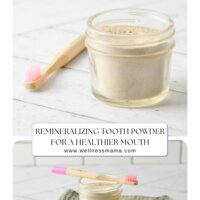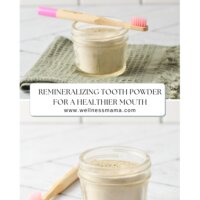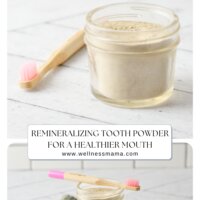

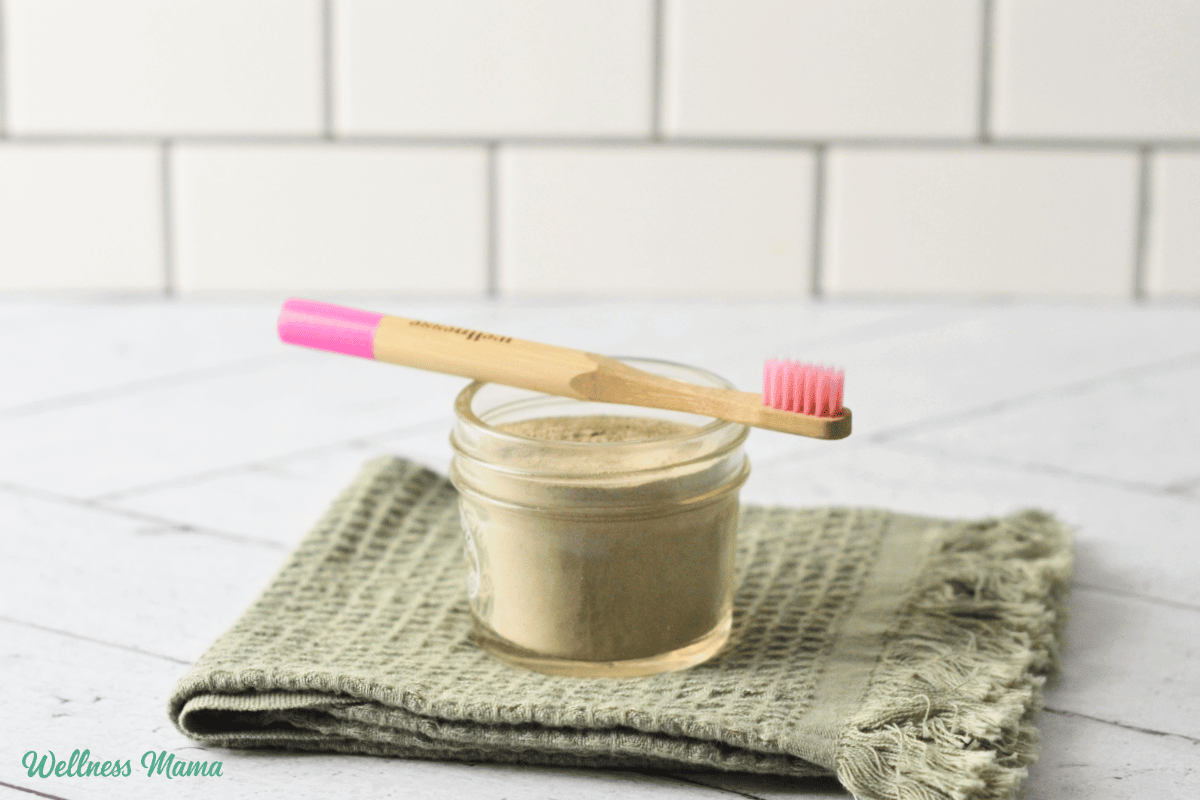
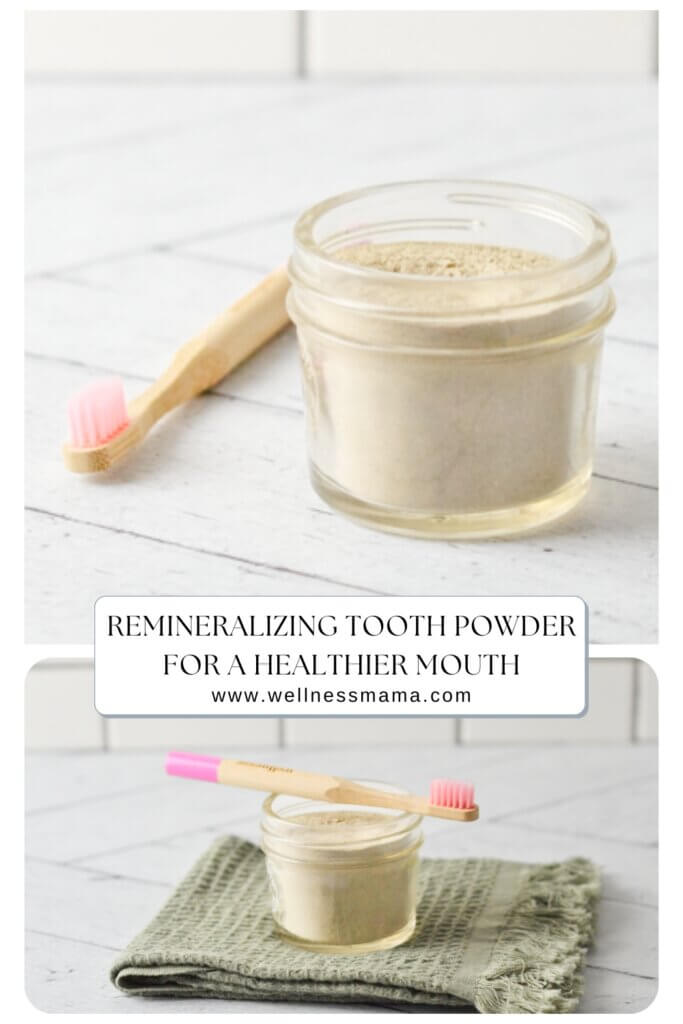
Remineralizing Tooth Powder For a Healthier Mouth

Katie Wells Avatar

Reading Time: 5 minutes

This post contains affiliate links.

Read my affiliate policy.

remineralizing tooth powder
Wellness Mama » Blog » Natural Remedies » Remineralizing Tooth Powder For a Healthier Mouth

My remineralizing toothpaste is one of the most visited posts at Wellness Mama. Over the years I’ve had a lot of emails from people who’ve switched and love it. After I remineralized my teeth and reversed cavities, I became a convert to natural toothpaste!

The only downfall to my homemade toothpaste is that it can leave residue on sinks. Plus there’s some concern with the coconut oil if you have a septic system (like we do). I also wanted to figure out how to incorporate the benefits of healing clays into our oral health regimen. However, there were some definite texture issues with the clays and coconut oil.

What resulted was this remineralizing tooth powder and I couldn’t be happier with the results. It’s even easier to make than homemade toothpaste. Plus you can use ground herbs and spices instead of essential oils if preferred.

Choosing a Natural Toothpaste

Over the past decade, more and more natural toothpastes have come on the market. They advertise fluoride-free, sulfate-free, and natural ingredients. Some are certainly better than others, but there are some good ones on the market. I compare different natural toothpastes in this article. Or you can find the toothpaste I helped develop here (we have tooth whitening toothpaste plus a kid’s strawberry flavor!).

You’ll still find DIY products in my bathroom though because I love being able to customize my oral care products.

Why Tooth Powder?

Natural tooth powder is less messy than a tube of toothpaste. This makes it easier to travel with or take camping. I don’t have to worry about toothpaste all over my clothes if it accidentally gets squished in my suitcase. And it has a much longer shelf life since we’re not introducing any liquids.

The main ingredient in this homemade tooth powder is bentonite clay. Years ago I became a big fan of bentonite clay for its amazing health properties. Not only does it bind and draw out heavy metals and toxins (a big plus for the mouth!), but it’s also mineral rich.

You can take bentonite internally to help remove toxins, so it’s safe to use in the mouth. Be sure to get food-grade bentonite clay though! The one I have linked in the recipe below is safe to use internally. In recent years there’s been talk about the lead naturally found in bentonite clay. While there is a tiny amount of lead (like many things), it’s bound within the clay and not bioavailable. You can read more about that here.

Bentonite is also rich in calcium, magnesium, and silica to help nourish teeth. So how does it work? Bentonite clay is unique because once mixed with water the molecules develop an electrical charge. This charge attracts and soaks up toxins, drawing them into the inside of the clay structure and holding them there.

To put it another way…

Bentonite is a swelling clay. When it becomes mixed with water it rapidly swells open like a highly porous sponge that traps toxins. It’s also very gentle and has a milder taste. I use it for facial masks, healing poultices, and even my hair.

Healthy Tooth Powder Ingredients

The other tooth powder ingredients also support a healthy oral microbiome. The blend of herbs and minerals fights bad breath and leaves your mouth feeling squeaky clean. For a pure mint flavor you can use more mint and omit the cinnamon and clove. You can adjust the amount of powder to your preferences. Personally, I love the balanced blend of organic peppermint powder, cinnamon, and refreshing clove.

  • Baking soda – Helps remove stains and whiten teeth but it’s gentle enough that it won’t harm enamel. Helps remove plaque and reduces gum bleeding and inflammation. Because it’s alkaline it supports a healthy mouth pH to discourage harmful bacteria.
  • Calcium Carbonate powder – Provides the calcium needed for strong enamel and can help reduce tooth sensitivity.
  • Ground cloves – Naturally antioxidant and a broad spectrum antimicrobial. Clove freshens breath, increases circulation for healthier gums, soothes inflammation, and can reduce the pain of sensitive teeth. It also gives the tooth powder a yummy taste.
  • Cinnamon – Also antimicrobial and antifungal (especially against candida). Tastes great and helps discourage bacterial growth in the mouth for fresh breath. Reduces gum inflammation and increases circulation.
  • Mint – Tastes great and soothes the gums. Mint is antimicrobial, helps relieve tooth pain, and freshens breath. There’s also some evidence it can help fight the virus that causes cold sores.
  • Xylitol – This sweetener adds to the tooth powder flavor but also has some impressive oral health benefits. Studies show it helps fight plaque and gingivitis inflammation. It also helps prevent cavities and binds with calcium to help remineralize teeth.

Adding Essential Oils

It’s completely optional, but you can add some essential oils to your tooth powder. They’re a potent way to increase the oral health benefits. Most antimicrobial essential oils are strong so a little goes a long way. When I add essential oils to this recipe, I just add a few drops total per batch.

Here are some essential oils to try in your DIY tooth powder!

The great thing about this tooth powder is you can customize the flavor however you want. You can add essential oils to increase the potency or leave them out for a milder taste (that even my kids like).
remineralizing tooth powder
Print
4.37 from 139 votes

Remineralizing Tooth Powder

This homemade tooth powder uses ingredients that rebuild enamel, freshen breath, and detox your mouth.
Author: Katie Wells

Materials

Instructions

  • Mix all of the ingredients in a bowl. Use a fork to mash any clumps and mix in any essential oils (if using).
  • Store in a small glass jar with a lid.
  • To use, place some powder in your palm and dip a wet toothbrush into the powder. Brush and rinse.

Notes

You can customize the powder to your taste and all of the herbal ingredients are optional. Create your own flavor with the herbs and essential oils of your choice.

How to Use Tooth Powder

Dump a little powder into your palm and dip the bristles of a wet toothbrush into the powder. Sometimes I’ll also add a few drops of the OraWellness Brushing Blend. Brush and rinse with cool water. Adults and kids can use this daily (or multiple times a day). Follow it up with some mouthwash or flossing if needed.

Shelf Life and Storage

This tooth powder will last for several years if stored properly. Store away from direct light and heat (like the car in summer). While it doesn’t have any water and the ingredients are antimicrobial, be sure to avoid getting the tooth powder jar wet. Always put a little powder into your palm before applying it to a wet toothbrush. Never dip the brush into the jar of powder as this introduces bacteria.

Oral Health Regimen

My teeth have never been whiter or healthier (according to my dentist) thanks to my oral health regimen. I eat foods that support oral health and use mouth-healthy products. I don’t do the same thing every single day, but here are some of the things I use. I’ve changed it up some since I reversed my cavities and often now I’ll just use Wellnesse toothpaste.

Have you ever had success reversing a cavity? What does your oral health routine look like? Leave a comment and share below!
Sources
  1. Valeii, K. (2022, August 8). Does Brushing Teeth With Baking Soda Really Work? Very Well Health.
  2. Gasmi Benahmed, A., et al. (2020). Health benefits of xylitol. Applied microbiology and biotechnology, 104(17), 7225–7237.
  3. Lin, S. (n.d.) How to Cure Tooth Decay | A Dentist’s Guide to Reverse Cavities in 3 Steps. Dr. Steven Lin.

Become a VIP member!

Get access to my VIP newsletter with health tips, special deals, my free ebook on Seven Small Easy Habits and so much more!

Easy Habits ebook on ipad
Katie Wells Avatar

About Katie Wells

Katie Wells, CTNC, MCHC, Founder of Wellness Mama and Co-founder of Wellnesse, has a background in research, journalism, and nutrition. As a mom of six, she turned to research and took health into her own hands to find answers to her health problems. WellnessMama.com is the culmination of her thousands of hours of research and all posts are medically reviewed and verified by the Wellness Mama research team. Katie is also the author of the bestselling books The Wellness Mama Cookbook and The Wellness Mama 5-Step Lifestyle Detox.

Comments

772 responses to “Remineralizing Tooth Powder For a Healthier Mouth”

    1. Dr. Kim Marie LAc AP DOM Avatar
      Dr. Kim Marie LAc AP DOM

      No, zeolite and bentonite are different.
      Zeolite comes from a mixture of volcanic ash and sea water, and carries a negative charge, making it ideal to specifically detoxify heavy metals.

      Bentonite clay has a positive charge, and comes from a different source. While it is also wonderful for detoxifying – both topically and internally (IF the brand you buy states clearly on the label it is safe for internal use), it works in a different way, and on different types of toxins than zeolite; and isn’t very effective in removing heavy metals from the body.

      I use both in different ways for different reasons.

      My comments are informational only, and not intended to diagnose or treat any symptom or disease.

      Regards,

      Dr. Kim DOM

  1. Caroline Avatar
    Caroline

    I want to use this powder but I looked up Bentonite Clay and there are warnings about the lead and arsenic content. What do you think about this?

  2. Pat Avatar

    Love your info in the post above.

    The info below, which I found elsewhere online, may warrant you updating / making a minor change to your post:

    If info I found elsewhere online — at https://healthfully.com/health-benefits-of-green-clay-4761570.html — is correct, there are *two* types of bentonite clay.

    One — sodium bentonite — is swelling, and is known as western bentonite.
    The other — calcium bentonite– is non-swelling, and is known as southern, bentonite.

    I am pretty sure that *calcium* bentonite — the *non-swelling* bentonite — is better for use in tooth powders and for tooth whitening, in part because our teeth are predominantly comprised of calcium.

    And of course, it is important to use choose food-grade bentonite clay for tooth powders and tooth whitening, as well as for other applications (including for drinking and using in bath water).

  3. Lawin Avatar

    What is the calcium powder? Do you mean normal calcium supplement tablets and crush them?

    1. Heather Avatar
      Heather

      5 stars
      You can do that but if you follow the link (the highlighted word) then you will see what she means. I just ordered it myself 🙂

  4. Rebecca Avatar
    Rebecca

    5 stars
    Hi Katie,

    Would bone meal work in place of the calcium carbonate? It contains magnesium, phosphorus and calcium carbonate.

    Thanks!

  5. Kristi Avatar
    Kristi

    Hi! I was wondering if it is safe to use Bentonite clay if you have silver fillings? Also, is using the clay and the baking soda together too abrasive?
    Thank you!

  6. Rebecca Avatar
    Rebecca

    Hello Katie,

    Would I be able to use Bone Meal powder in place of the calcium carbonate powder?

    Thanks!

    1. kanta Avatar

      Wow…you are correct. This one is nearly the same as the ‘homemade’ recipe. Seems like if you were choosing to ‘try out a sample’ before buying all the ingredients required to make your own, this is a good bet. They also have 3 other flavors btw…one just for “sensitive” teeth. It’s a one-woman show…she handmakes it all, even to order, if you prefer to customize.

  7. ed Avatar

    sorry but twould be great if some of the comments were deleted, like the ones that are just tsaying thank you or that it works,, sorry i just think it would make it easier to go through them and get the useful shared info, theres just SO many comments.
    Or maybe where useful info is shared we could use some symbols like # or @ around it so its easier to see or search for. Or maybe we could all try to make them as short as possible,,

    *HOW TO USE TOOTH POWDER*
    This is how me and many people i know use ayurvedic tooth powder so you dont have to have separate bottles/containers for each person and dipping the toothbrush in a bottle that is kept for months is also not very hygienic i think, even though the ingredients are antibacterial, i think this spoils the purpose.
    You just put some powder in your left palm and collect some with the brush, i usually get a bit from the palm for each side of my mouth.

    A tip for brushing teeth that some people might not realise, you should start with the FRONT of your teeth cause thats the cleanest part of the mouth, then go to the insides of the front theeth and then the sides. (and one indian dentist told me to brush in a motion away from gums)
    I personally splash some bottled water on the brush after each side or a tooth that i know is a bit bad so the bacteria doesnt spread so much. And obviously rinse mouth with filtered/bottled water.
    (Plastic bottled water has been found to have many dangerous chemicals but i think its safer than tap water in many places, i have glas bottled since i have not found a good filter yet:C )
    Oh and these are the cheapest bamboo toothbrushes i found for europe (bout 3eur per brush) https://www.ebay.com.au/itm/Environmental-Toothbrush-Bamboo-Oral-Care-Eco-Dental-Child-Soft-Box-of-12-/271621188172?ssPageName=ADME:X:AAQ:AU:1123
    i use child size which i find comfotable but they obviously have adult size and mixed pack.

  8. mickie Avatar

    5 stars
    I was wondering if I could use the liquid from calcium capsules. That’s all I have. It would be a pain to squeeze each one, but I’d do it!

  9. Lynn Bakeman Avatar
    Lynn Bakeman

    I want to make up a powder for my son whose teeth are highly sensitive due to prednisone-induced osteoporosis. I thought I saw a recipe of yours that used coconut oil, baking soda, bentonite clay, and mint but I can’t locate those particular ingredients?

    Thanks for all your recommendations!

  10. Jenny Avatar

    5 stars
    If you add activated charcoal to your mixture you will have the BEST teeth whitener of your life! Totally knocks any white strips I have ever used out of the park and is actually good for your oral health.

  11. Becky Avatar

    First, I want to say, I love your site, and second I am just starting my natural living journey and have lots of questions!

    I want to make this to help my husband remineralize his teeth but he has a porcelain crown and metal fillings. Would this still work for him? I also started oil pulling and wanted him to start as well but I read in some of the comments above that oil pulling wasn’t great for crowns. I would love your input!

    Thank again!

  12. Preston Jones Avatar
    Preston Jones

    I’ve been trying to follow this with oiling pulling twice a day with supplements aimed toward calcium absorption, watching my ph with an alkaline diet, drinking water with a little baking soda, which I’ve only recently started dechlorinating the water. Every couple hours, I would even use a little of this powder in a shot glass to swish when my ph starts getting low again. I still run in to the problem of decalcifcation, brown spots not going away and new stains forming in the tops of the teeth my brush has a hard time getting.
    I’m seeing what else I might doing wrong, one thing I wonder, the powder does sit in all the crevices of the teeth are you suppose rinse right after you brush, or can you let it sit on your teeth all day? I was thinking letting the residues sit might be causing stains, or even bacteria to form.

  13. Greg Avatar

    4 stars
    Been brushing with the powder (without xylitol) a couple times a day for a few weeks now in addition to my normal routine and just got a comment from someone that my teeth were looking really good and white and what was I doing. There face when I said brushing with clay was priceless….
    Thanks for all the info and hard work on your blog Katie.

  14. Diana Avatar

    Hello! I’m from Romania and here I don’t have acces to Redmond clay beacuse it’s really expensive. I can buy bentonite clay but I don’t know what kind of : – calcium bentonite or -sodium bentonite ? I understood that sodium bentonite is for external use . I read that Redmond clay is rare because it contains sodium and calcium and that’s why is used both internal and external . Can someone help me ?

    1. Lisa Avatar

      Maybe this will help:
      http://www.funwithhealthyfood.com/sodium-vs-calcium-bentonite-clay.html

      I can’t even use bentonite clay in my tooth powder because it is too desiccating to my tongue – I wake up in the middle of the night with hardly any moisture in my mouth. The one I tried was calcium bentonite which I had on hand for facial masks. I even tried zeolite clay, which I do take internally, and that was too drying also.

  15. Eric Avatar

    1 star
    I really hoped that this would work but after a month of use, maybe 1.5, I noticed that my gum began separating a lot from a back molar and the powder, cloves and cinnamon would collect in it. Once I stopped, the problem corrected itself (well, it got better anyway). I can’t pinpoint anything that would have caused this other than the tooth powder.

  16. keri Avatar

    i know there isn’t going to be a set answer to this, but how long should one expect it to take for remineralization to happen? i have a small cavity now and i’d love to try this before getting it filled- and hope to not have to. how long should i give it a try before i have the dentist check it again?

  17. Jessica Avatar
    Jessica

    So I’ve read through all the comments, yes really, ALL of them. And I have a couple of questions.

    1) I recently bought cal/mag in citrate form and noticed a fizzing action when my wet toothbrush touches the powder. I’m assuming it’s a reaction between the acid in the citrates and the base of the baking soda. Do you know what kind of an effect this reaction has on the integrity of the ingredients?

    2) I’ve been reading about and just ordered Theobromine. Have you ever heard of Theobromine? I’d be interested in your thoughts on it as the research I’ve read sounds almost too good to be true. It’s a compound found in cacao that is safe for human consumption and has proven to work better than fluoride at repairing damaged and sensitive teeth.

    Also, I’ve been using this recipe (or a variation of it based on what I have on hand) for a couple of years now and love it. 2.5 years ago I had a dentist tell me I had 15-20 cavities that needed filled and 8 months ago was told I had 1 that needed to be filled and 2 that needed to be watched. Since I never had the original 15-20 filled (actually never had any of them filled) the first dentist was either a total scam artist or the tooth powder is a miracle worker. I’m sure the truth lies somewhere in the middle 🙂

4.37 from 139 votes (108 ratings without comment)

Leave a Reply

Your email address will not be published. Required fields are marked *

Recipe Rating