

The Problem With Night Lights (and Better Solutions)

Katie Wells Avatar

Reading Time: 5 minutes

This post contains affiliate links.

Read my affiliate policy.

night lights for kids
Wellness Mama » Blog » Health » The Problem With Night Lights (and Better Solutions)

I’ve had the privilege of interviewing and meeting a lot of amazing health experts over the years. Not a single one has ever said that sleep isn’t important. Something as simple (and common) as night lights though are enough to sabotage sleep.

I noticed a big difference once I overhauled my sleep environment and I’ve heard from plenty of readers who say the same. Sleeping in a cool, completely dark space is so important for healthy sleep. It means better sleep quality and more energy from some simple changes (like turning off the ever present night light). 

Here’s why:

What’s the Problem With Night Lights?

Light exposure during the night is linked with an increased risk of depression, higher breast cancer risk, brain fog, and unbalanced hormones. As PhD Joyce Walseben explains, light inhibits the secretion of melatonin. And even if we do fall asleep, our brain can still detect the light through our eyelids, making it confused. 

A cool, dark nighttime environment is vital for hormone health, yet we often put lights in kids’ rooms. Only within the last 100 years has this even been possible. Before that, there was a natural cycle of light and darkness. While people might have had candles or lamps after dark, there wouldn’t have been lights on all night.

More and more research is emerging that shows a link between nighttime light exposure and health problems. A CDC report and a recent meta-analysis showed a surprising link between lack of sleep and increased cancer risk. 

The CDC found that profoundly blind women had less than half the breast cancer risk of women with normal vision. Profoundly blind men had less than half the risk of other cancers as normally sighted men. Even more interesting, those who were legally blind but could still see light didn’t have a reduced cancer risk. 

Shift workers (those who work after dark) who are exposed to artificial blue light through the night are more likely to develop cancer. Research shows shift work raises the risk of death from all causes, likely due to circadian disruption and abnormal light exposures. 

Night Light Free Zone Importance For Kids

Nighttime light exposure can decrease sleep quality, but it can also shorten the duration of sleep, leading to further problems. A 2024 study in Biomedicines reports that children who get quality sleep are less likely to struggle with obesity.  They also point to healthy sleep as having a positive impact on the epigenetics that affect the genes linked with obesity. 

Chronic sleep deprivation may cause weight gain by affecting the way our bodies process and store carbohydrates. It may also alter hormone levels that affect appetite.

Moreover, Dr. Zee, the director of the Sleep Disorders Center at Northwestern Memorial Hospital reports:

“Perhaps even more important than sleep duration is the effect of day to day variability of sleep wake timing on weight regulation.”

Why Sleep is So Critical For Kids

Sleep is important for everyone, but especially children. This is when our brains clean up from the stress of the day, organize information, and the body goes into recovery mode. 

Children who don’t get enough sleep or have disrupted sleep may experience the following: 

  • Allergies and immune system problems
  • Anxiety and depression 
  • Obesity, diabetes, and future high blood pressure
  • Poor academic performance and trouble concentrating
  • Learning and memory problems
  • ADHD like symptoms 
  • Mood swings and irritability
  • More stress hormone levels and irregular heartbeat
  • Daytime sleepiness (which leads to many of the above issues)

Blue light from screens and most night lights is especially harmful at night since they signal to the brain it’s daytime. It’s equally important to get morning sunlight to set the circadian rhythms for the day. This further sets the stage for healthy sleep. 

Practical Changes For Better Sleep

For years I’ve made getting out into the morning sunshine a daily habit and many of my kids have followed suit. I also model a positive nighttime routine for them and made practical changes in our home lighting. Not only do we use amber lights in the evening, but I also use red light in certain areas (like bathrooms) if needed at night. 

Switching to complete darkness as an adult is a relatively easy process. It isn’t so easy for children, especially those who are afraid of the dark or are used to nightlights. 

With all the research showing the importance of nighttime darkness, I felt strongly that this was something I wanted my kids to do. It took a little time to get all of the kids used to sleeping in darkness, but they finally did.

Step by Step How to Ditch the Nightlights (Mostly)

My kids’ rooms look a little different now that I have several teens (and one grown and out of the house!). The older kids have a similar setup to my bedroom. When the kids were little, here’s how I helped them transition into a healthy sleep environment for better sleep. 

  • Removed night lights, regular alarm clocks, and other things with lights. 
  • Kept the house cool and used a mattress cooling pad as needed 
  • Used blackout shades to cover artificial light from street lights and to help with heating and cooling costs.
  • Used sound machines to help them stay asleep. The “rain” sound was a favorite. We now have air filters in the bedrooms that have ambient white noise. 

My kids have lamps with these amber light bulbs in their bedrooms to use while winding down in the evening. Once it’s bedtime though, these go off. We’ve also used these Himalayan salt lamps that have a red tone in the hallway and bathrooms. This way their rooms are dark, but they can see to go to the bathroom if needed, without blue light disruption. 

The same place where I get my amber and red light bulbs from also has red light night lights. These are also a good option for hallways and bathrooms, but I’d avoid putting them in a kid’s room at night. 

Helpful Tips For Better Sleep

Years ago when I helped my kids set their rooms up like this, I did a bedtime routine with them to help them transition. First, I turned on the sound machine and read to them with the light on. Then, I turned off the light but left the door open with the salt lamp in the hallway. From here, I slowly worked up to putting them to sleep with the door closed and complete darkness.

Here are some more helpful tips to help kids avoid blue light and get better sleep: 

  • Put screens away after dark. A DIY charging drawer to store devices has been helpful! 
  • If screens are needed, use blue light glasses or the kids’ Daytime Computer that doesn’t have blue light. 
  • A cup of chamomile tea with a little raw honey and butter blended in is a restful way to wind down. The healthy fats support hormones and the chamomile soothes and calms. 
  • Use magnesium lotion on feet and legs before bed. Magnesium promotes sleep and helps with so many other things. 
  • Switching to organic mattresses also made a big difference, especially for my son with allergies. Along with diet changes, this was one way I helped him reverse his allergies. The light made a bigger difference, so I wouldn’t put new mattresses as the highest priority. 

Let Them Be A Part of the Process

I’ve found that my kids often make healthy choices when given the information to help them do so. I talked to my older kids about the reasons why nightlights weren’t good for them. This lets them be involved in the decision making process to get rid of the night lights.

I’m continually surprised by how smart and curious kids innately are and the decisions they can come up with when given the chance. Just one of the reasons behind my unconventional parenting style!

Final Thoughts on Night Lights

Sleep is so important for everyone, but especially growing children. Making the transition to a night light free room can be challenging, but very doable with the right approach. 

Have a chat with your kids about why you want to make changes, and make the process fun. Calming bedtime rituals like a cup of herbal tea and a bedtime story go a long way in helping kids ditch the night light in their rooms. 

Do your kids have night lights? Ever thought about removing them? Share below!
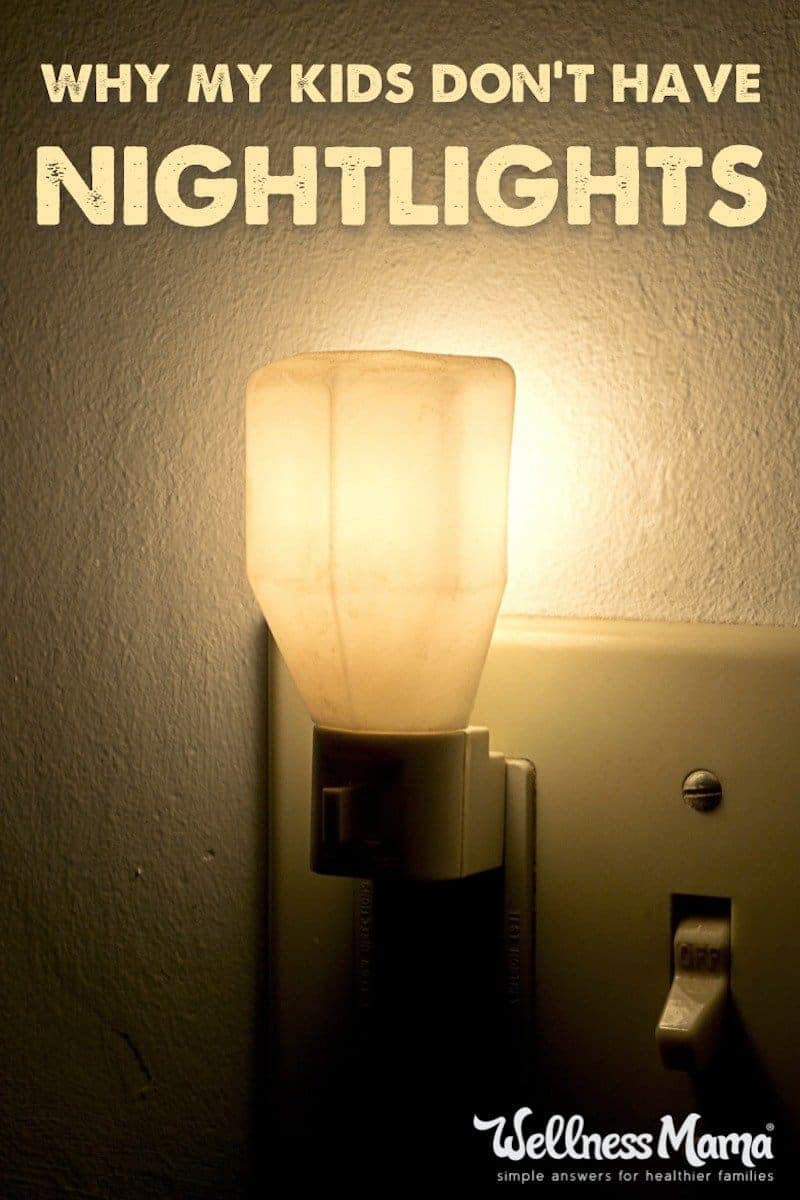
A night light can disrupt sleep, and light at night time has been linked to increased caner risk, hormone imbalances, depression and other health problems.

Sources
  1. Waugh, R. (2012, July). Too much light at night causes depression (but if you make your bedroom dark enough, you can get away with staying up late). Daily Mail.
  2. Brady, K. (2025, November 22). Is Sleeping With the TV On Bad for Your Health? Health.
  3. Medical Daily. (2011, October 11). Lack of Sleep, Light at Night Can Raise Cancer Risk. 
  4. Richter, E., et al. (2024). The Importance of Sleep in Overcoming Childhood Obesity and Reshaping Epigenetics. Biomedicines, 12(6), 1334. 
  5. Ma, S., et al.  (2024). Exposure to Light at Night and Risk of Cancer: A Systematic Review, Meta-Analysis, and Data Synthesis. Cancers, 16(15), 2653. 
  6. National Toxicology Program. (2026, April 2). NTP Review of Shift Work at Night, Light at Night, and Circadian Disruption. US Department of Health and Human Services.
  7. LeWine, H. (2024, July 24) Blue light has a dark side: What is blue light? The effect blue light has on your sleep and more. Harvard Health Publishing Harvard Medical School. 
  8. Schreiber, D. R., & Dautovich, N. D. (2019). Sleep Duration as an Indirect Link Between Sleep Timing and Weight in Midlife Women. Journal of women’s health (2002), 28(11), 1543–1554. 
  9. Pacheco, D. (2025, July 23). Children and Sleep. Sleep Foundation.

Become a VIP member!

Get access to my VIP newsletter with health tips, special deals, my free ebook on Seven Small Easy Habits and so much more!

Easy Habits ebook on ipad
Katie Wells Avatar

About Katie Wells

Katie Wells, CTNC, MCHC, Founder of Wellness Mama and Co-founder of Wellnesse, has a background in research, journalism, and nutrition. As a mom of seven, she turned to research and took health into her own hands to find answers to her health problems. WellnessMama.com is the culmination of her thousands of hours of research and all posts are medically reviewed and verified by the Wellness Mama research team. Katie is also the author of the bestselling books The Wellness Mama Cookbook and The Wellness Mama 5-Step Lifestyle Detox.

Comments

111 responses to “The Problem With Night Lights (and Better Solutions)”

  1. Yiota Avatar

    Hell no i have feared the dark ask a kid.my parents did this to me never forgive them about nightmares

  2. xiaofung Avatar

    I want to know about those projector lights. You know the ones that can project planets and water life. Are those safe? And do they help with sleep? The reason why I’m asking is because I want to get an alarm clock for my kids and I noticed that many of them have these projectors on them. I am thinking maybe it will help my kid stay in his room, but I don’t want it to be a distraction either. We currently have a red/orange light from their diffuser.

  3. Pam Avatar

    My 7 yo has had problems with bad dreams. I NEVER associated her dreams with nightlights! Since removing all night lights and adding black-out curtains…..no more bad dreams, I moved the large salt lamp we were using into the bathroom adjacent to her room, so she’s not afraid to go into the bathroom after dark.
    Who would have thought?
    It’s amazing that I’ve gone my whole life and 34 years as a mom, not knowing about night lights!
    Thank you SO much for sharing…

  4. Jan Avatar

    I noticed you use sound machine to aid sleep. Here is research don on having any kind of “white noise’ while trying to sleep..
    Possible Developmental Delays-

    It’s possible that a child’s brain may suffer negative effects with continuous exposure to background white noise, according to researchers connected with the University of California, San Francisco and the Howard Hughes Medical Institute. In the study, immature rats received exposure to constant white noise, simulating common noisy environments. Researchers determined that the rats experienced auditory development delays as a result of the noise levels. Later, when the rats’ environment returned to normal noise levels, auditory development matured to normal levels. It’s possible that overexposure to a sound machine could lead to impaired language acquisition and hearing.

    Several studies have indicated that stress resulting from ongoing white noise can induce the release of cortisol, a hormone that helps to restore homeostasis in the body after a bad experience. Excess cortisol impairs function in the prefrontal cortex—an emotional learning center that helps to regulate ‘executive’ functions such as planning, reasoning and impulse control. Some recent evidence indicates that the prefrontal cortex also stores short-term memories. Changes to this region, therefore, may disrupt a person’s capacity to think clearly and to retain information.
    Recent research also suggests that noise-induced stress may decrease dopamine availability in the prefrontal cortex, where the hormone controls the flow of information from other parts of the body. Stress resulting from background noise, then, may decrease higher brain function, impairing learning and memory.”
    Other Noise Effects

    Sustained and irritating noises may threaten a child’s psychological and physical health, according to the U.S. Environmental Protection Agency. In addition to language and hearing impairments, it’s possible that a child could also experience learning impairments and disturbances to the cardiovascular system. The EPA recommends a quiet sleeping environment for children.

    1. xiaofung Avatar

      I acknowledge this too, but my husband insist they have one in their room and now they have gotten use to it. I am trying to and would like to rid the noise maker, but it is hard to. Any suggestions for that? Could you give me the sources that you mentioned about in links so I can show them to my husband?

      Thank you

  5. Karyn Avatar

    I have tried to turn off my three year old’s lights once she is asleep and she just wakes up crying within an hour or two. So now we use two red night lights for her. I am trying to gradually remove them by situating them behind things but she wakes up if it is not enough light.
    I’m thankful the red lights are comforting enough for her.
    Should this be good enough given the research?

  6. Kristy Avatar

    What would you recommend for newborns. We are about to have our first baby and know that we will need to change diapers in the middle of the night for some time. I was going to keep a blue light filtered nightlight on at all times next to the changing table.

    1. Wellness Mama Avatar

      A blue light filtered nightlight or a salt lamp is a great solution for nighttime diaper changes. (Though if it is encouraging, we’ve really only had to do night time changes for a few months with each baby). Congrats on your little one.

  7. Stefani Avatar

    My friend suggested putting a green lightbulb in our himalayan salt lamp and it works great so its not so bright

  8. Kathy Avatar

    Did you know that iPhone has a setting under display and brightness, in which you can change the screen lighting to orange instead o blue? You can sync it with the sunrise and sunset automatically.

  9. Sophia Avatar
    Sophia

    I am glad i found this post. For the past month or so my eight year old daughter has been waking several times a night saying she is scared. None of us are having any sleep. I was also really puzzled as before she had been a really deep sleeper and would hardly wake up. We normally had the hallway light on and that was enough light! Well a couple of months ago I bought her a globe LED light and I though to myself, well yes I realise she is waking up scared but why is she sleeping so lightly? Well yesterday after i read your post I turned off her night light. She slept in till five in the morning! I will not be using the night light from now on and I hope this is the end of her sleep issue.

  10. Kendra Avatar
    Kendra

    What about investing in eye sleep masks instead of curtains? I wear a mask to sleep

  11. Kristen Avatar

    Is any red tone light okay? Our daughters’ bathroom has a pink nightlight

  12. Anna Avatar

    Katie,

    I didn’t see this question elsewhere, so I apologize if it’s a repeat. My first child is coming in May and I’m planning to nurse and assume I will need to be up at night with her for a while. What do you do about waking up at night to feed and/or change baby? I do want her to sleep in total darkness but obviously want to see what I’m doing when I’m up with her.

    Thank you (and congrats on your newest addition – I loved reading the birth story)!

  13. Alexis Avatar

    Ive always used a Himilayian Salt Lamp (instead of a night light) in my daughters room. I assumed it had great benefits being left on all night. Is it not as harmful because as you stated its a different tone than a traditional light? Would love to know your thoughts on this thanks!

    1. Wellness Mama Avatar

      It is an orange tone, which is better at night, and what I would use if we were ever going to leave a light on at night for the kids, but mine definitely sleep better with no light.

  14. Claire Avatar

    HI, This was a great summary and we have already been doing these things but I do need to check on my children before I go to sleep or if they have a problem at night e.g. toilet, nightmare, illnness, covers come off etc… not often but sometimes I do need to check on them in the middle of the night. I have been using my mobile light for this and I know it’s the wrong type of light. I cannot find an orange hand held nightlight though. Do you know of one? Or a torch with an orange bulb …..? We do have a salt lamp where my 3 yr old sleeps but I find that very bright to turn on at night. I wanted something small handhelp and dim orange. If anyone knows of something like this please share! Thank you

  15. Tatyana Avatar

    Thanks for the info. I have heard of research citing noise machines to also be detrimental to sleep.

  16. Lori Avatar

    Seriously, have you never gone camping? The night is NOT black. There are stars and the moon. Since the creation of the Earth we have had light at night. If you simply can’t sleep with ANY light, get yourself a night mask (and some ear plugs for all the noise). For heaven’s sake, God created the heavens for a reason. What a bunch of balleyhoo.

    1. Wellness Mama Avatar

      The difference is that light from the moon and stars is natural light, the lights in our homes is artificial and our bodies react to it differently…

  17. Leanne Avatar

    Does anyone have any recommendations for darker or otherwise less-disruptive night lights? I HATE the one in our own bedroom (little girl doesn’t have a night light) but my husband insists he’ll stub his toes or otherwise die without it….can you tell it’s driving me bonkers? I keep looking thru Amazon to no avail…i might need to cause an “accident” to happen to ours!

  18. Shae Avatar

    Some people, like myself, can’t sleep in total darkness without risking an episode wherein you can’t fully wake up all the way and you find yourself disoriented and confused in blackness. You shouldn’t advocate things for everyone across the board without knowing some of the conditions out there that do not lend themselves well to them.

    1. Wellness Mama Avatar

      I should hope that someone who has a condition like what you describe would know enough not to follow this advice. Clearly it does not apply to you, but that does not mean that it is bad for everyone.

  19. Deena Avatar

    Hi Katie,

    I found the sleeping in complete darkness interesting. I recall reading some info on the con of sleeping in a “cave like” room, even after the sun rises. Using black out curtains or blocking out streetlights to make your room pitch black can help you fall asleep and stay asleep BUT if daylight isn’t able to creep in by morning, your body’s natural circadian rhythm won’t know that it’s time to wake up. I’m wondering if this is why you said you don’t feel like a “morning person”..Lol Have you heard anything like this before or come across it in your research of complete darkness sleeping?

  20. Jennifer Avatar
    Jennifer

    My son has autism and pure darkness causes him to have panic attacks, so no night light is NOT an option. He actually only sleeps through the night with his bedroom light on. We’ve tried turning it off constantly when he turns it on, but all that does is cause him to get up several times a night to turn it back on. We tried taking the bulb out of his bedroom light, but that only resulted in him opening his bedroom door & turning the hall light on to sleep on the hall floor. I’d rather he sleep through the night.

Leave a Reply

Your email address will not be published. Required fields are marked *