
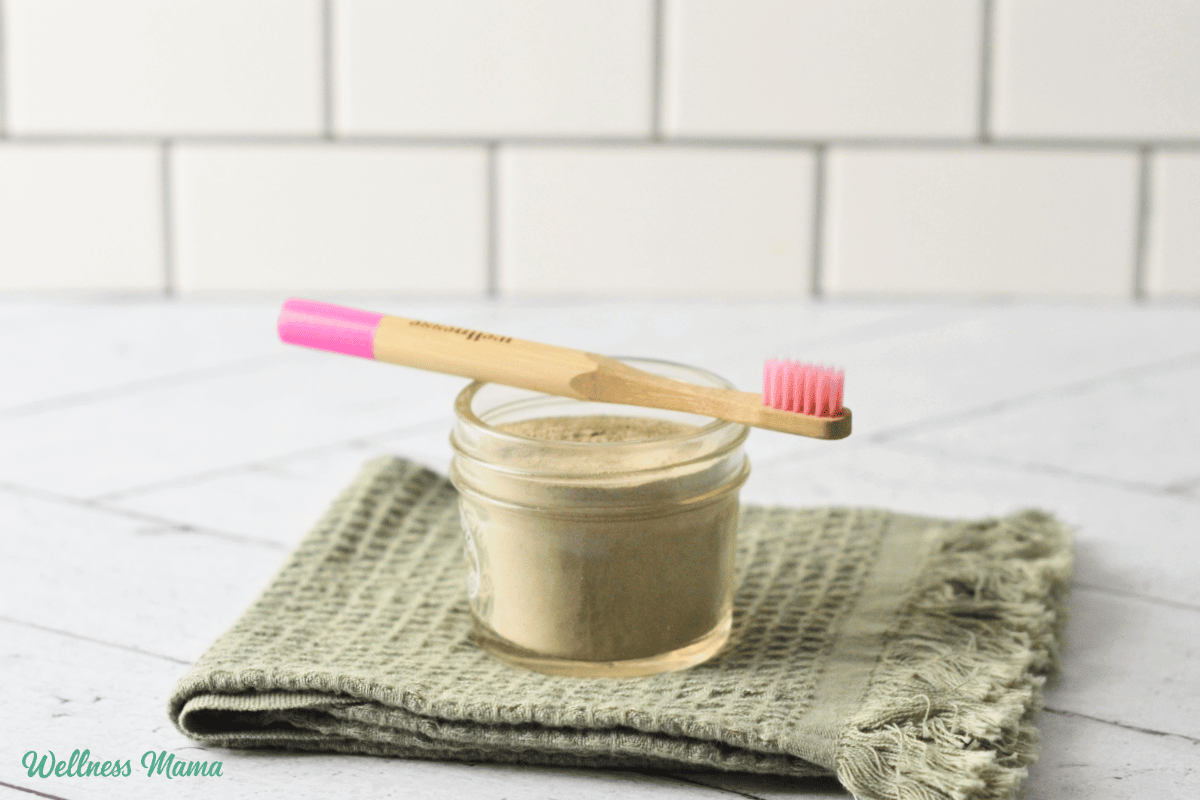
Remineralizing Tooth Powder For a Healthier Mouth

Katie Wells Avatar

Reading Time: 5 minutes

This post contains affiliate links.

Read my affiliate policy.

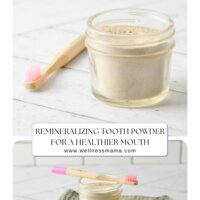
remineralizing tooth powder
Wellness Mama » Blog » Natural Remedies » Remineralizing Tooth Powder For a Healthier Mouth

My remineralizing toothpaste is one of the most visited posts at Wellness Mama. Over the years I’ve had a lot of emails from people who’ve switched and love it. After I remineralized my teeth and reversed cavities, I became a convert to natural toothpaste!

The only downfall to my homemade toothpaste is that it can leave residue on sinks. Plus there’s some concern with the coconut oil if you have a septic system (like we do). I also wanted to figure out how to incorporate the benefits of healing clays into our oral health regimen. However, there were some definite texture issues with the clays and coconut oil.

What resulted was this remineralizing tooth powder and I couldn’t be happier with the results. It’s even easier to make than homemade toothpaste. Plus you can use ground herbs and spices instead of essential oils if preferred.

Choosing a Natural Toothpaste

Over the past decade, more and more natural toothpastes have come on the market. They advertise fluoride-free, sulfate-free, and natural ingredients. Some are certainly better than others, but there are some good ones on the market. I compare different natural toothpastes in this article. Or you can find the toothpaste I helped develop here (we have tooth whitening toothpaste plus a kid’s strawberry flavor!).

You’ll still find DIY products in my bathroom though because I love being able to customize my oral care products.

Why Tooth Powder?

Natural tooth powder is less messy than a tube of toothpaste. This makes it easier to travel with or take camping. I don’t have to worry about toothpaste all over my clothes if it accidentally gets squished in my suitcase. And it has a much longer shelf life since we’re not introducing any liquids.

The main ingredient in this homemade tooth powder is bentonite clay. Years ago I became a big fan of bentonite clay for its amazing health properties. Not only does it bind and draw out heavy metals and toxins (a big plus for the mouth!), but it’s also mineral rich.

You can take bentonite internally to help remove toxins, so it’s safe to use in the mouth. Be sure to get food-grade bentonite clay though! The one I have linked in the recipe below is safe to use internally. In recent years there’s been talk about the lead naturally found in bentonite clay. While there is a tiny amount of lead (like many things), it’s bound within the clay and not bioavailable. You can read more about that here.

Bentonite is also rich in calcium, magnesium, and silica to help nourish teeth. So how does it work? Bentonite clay is unique because once mixed with water the molecules develop an electrical charge. This charge attracts and soaks up toxins, drawing them into the inside of the clay structure and holding them there.

To put it another way…

Bentonite is a swelling clay. When it becomes mixed with water it rapidly swells open like a highly porous sponge that traps toxins. It’s also very gentle and has a milder taste. I use it for facial masks, healing poultices, and even my hair.

Healthy Tooth Powder Ingredients

The other tooth powder ingredients also support a healthy oral microbiome. The blend of herbs and minerals fights bad breath and leaves your mouth feeling squeaky clean. For a pure mint flavor you can use more mint and omit the cinnamon and clove. You can adjust the amount of powder to your preferences. Personally, I love the balanced blend of organic peppermint powder, cinnamon, and refreshing clove.

  • Baking soda – Helps remove stains and whiten teeth but it’s gentle enough that it won’t harm enamel. Helps remove plaque and reduces gum bleeding and inflammation. Because it’s alkaline it supports a healthy mouth pH to discourage harmful bacteria.
  • Calcium Carbonate powder – Provides the calcium needed for strong enamel and can help reduce tooth sensitivity.
  • Ground cloves – Naturally antioxidant and a broad spectrum antimicrobial. Clove freshens breath, increases circulation for healthier gums, soothes inflammation, and can reduce the pain of sensitive teeth. It also gives the tooth powder a yummy taste.
  • Cinnamon – Also antimicrobial and antifungal (especially against candida). Tastes great and helps discourage bacterial growth in the mouth for fresh breath. Reduces gum inflammation and increases circulation.
  • Mint – Tastes great and soothes the gums. Mint is antimicrobial, helps relieve tooth pain, and freshens breath. There’s also some evidence it can help fight the virus that causes cold sores.
  • Xylitol – This sweetener adds to the tooth powder flavor but also has some impressive oral health benefits. Studies show it helps fight plaque and gingivitis inflammation. It also helps prevent cavities and binds with calcium to help remineralize teeth.

Adding Essential Oils

It’s completely optional, but you can add some essential oils to your tooth powder. They’re a potent way to increase the oral health benefits. Most antimicrobial essential oils are strong so a little goes a long way. When I add essential oils to this recipe, I just add a few drops total per batch.

Here are some essential oils to try in your DIY tooth powder!

The great thing about this tooth powder is you can customize the flavor however you want. You can add essential oils to increase the potency or leave them out for a milder taste (that even my kids like).
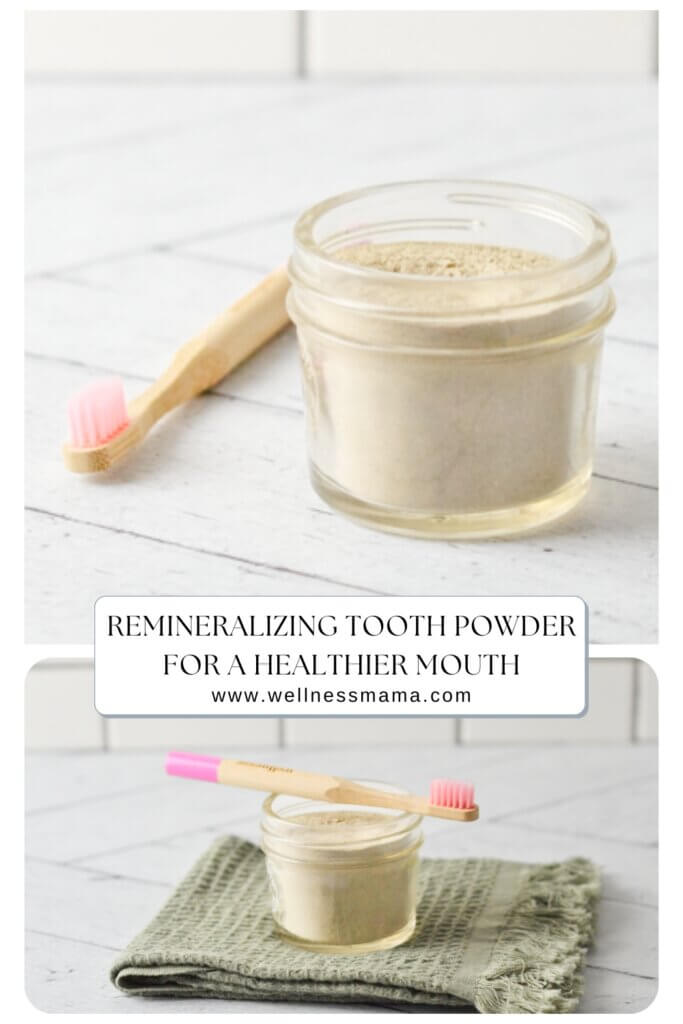
remineralizing tooth powder
Print
4.37 from 139 votes

Remineralizing Tooth Powder

This homemade tooth powder uses ingredients that rebuild enamel, freshen breath, and detox your mouth.
Author: Katie Wells

Materials

Instructions

  • Mix all of the ingredients in a bowl. Use a fork to mash any clumps and mix in any essential oils (if using).
  • Store in a small glass jar with a lid.
  • To use, place some powder in your palm and dip a wet toothbrush into the powder. Brush and rinse.

Notes

You can customize the powder to your taste and all of the herbal ingredients are optional. Create your own flavor with the herbs and essential oils of your choice.

How to Use Tooth Powder

Dump a little powder into your palm and dip the bristles of a wet toothbrush into the powder. Sometimes I’ll also add a few drops of the OraWellness Brushing Blend. Brush and rinse with cool water. Adults and kids can use this daily (or multiple times a day). Follow it up with some mouthwash or flossing if needed.

Shelf Life and Storage

This tooth powder will last for several years if stored properly. Store away from direct light and heat (like the car in summer). While it doesn’t have any water and the ingredients are antimicrobial, be sure to avoid getting the tooth powder jar wet. Always put a little powder into your palm before applying it to a wet toothbrush. Never dip the brush into the jar of powder as this introduces bacteria.

Oral Health Regimen

My teeth have never been whiter or healthier (according to my dentist) thanks to my oral health regimen. I eat foods that support oral health and use mouth-healthy products. I don’t do the same thing every single day, but here are some of the things I use. I’ve changed it up some since I reversed my cavities and often now I’ll just use Wellnesse toothpaste.

Have you ever had success reversing a cavity? What does your oral health routine look like? Leave a comment and share below!
Sources
  1. Valeii, K. (2022, August 8). Does Brushing Teeth With Baking Soda Really Work? Very Well Health.
  2. Gasmi Benahmed, A., et al. (2020). Health benefits of xylitol. Applied microbiology and biotechnology, 104(17), 7225–7237.
  3. Lin, S. (n.d.) How to Cure Tooth Decay | A Dentist’s Guide to Reverse Cavities in 3 Steps. Dr. Steven Lin.

Become a VIP member!

Get access to my VIP newsletter with health tips, special deals, my free ebook on Seven Small Easy Habits and so much more!

Easy Habits ebook on ipad
Katie Wells Avatar

About Katie Wells

Katie Wells, CTNC, MCHC, Founder of Wellness Mama and Co-founder of Wellnesse, has a background in research, journalism, and nutrition. As a mom of six, she turned to research and took health into her own hands to find answers to her health problems. WellnessMama.com is the culmination of her thousands of hours of research and all posts are medically reviewed and verified by the Wellness Mama research team. Katie is also the author of the bestselling books The Wellness Mama Cookbook and The Wellness Mama 5-Step Lifestyle Detox.

Comments

772 responses to “Remineralizing Tooth Powder For a Healthier Mouth”

  1. Melinda Stiles Avatar
    Melinda Stiles

    Would slippery elm powder work instead of calcium magnesium powder.

  2. David Avatar

    not sure about mixing the powders. you show to mix it in a bowl or coffee grinder. you aslo state that it will last becasue it is a dry mix, but you said we could add oils, wont this make it a wet mixture?

  3. John Avatar

    5 stars
    I find this article quit fascinating.. I have recently been looking for the best options for my teeth. I know I do have some issues that would need fixed by a dentist but, with no insurance, dental work can be VERY expensive.. My big question is. What if you have some teeth that are already very badly decayed?. Could you still used this, or would it not be good for those teeth?. Some don’t have much enamel left.

  4. Niki Avatar

    Hi! I want to use this but I also came across a link for Remineralizing Toothpaste(https://wellnessmama.com/2500/remineralizing-toothpaste/) on your page and was wondering which one of the two is better? I recently had an oral surgery and was unable to brush my teeth for days and now 1 month post surgery i looked at my teeth and I am terrified with the amount of cavities created. I want to reverse them if it’s really possible!
    Can I use just this toothpaste or do I have to go with the diet too on your page https://wellnessmama.com/3650/remineralize-teeth/

  5. Scully Avatar

    5 stars
    I improvised something like this with zeolite instead of betonite clay, and I used bone meal powder, as well. I powdered the granulated xylitol using a coffee grinder and it made a very fine powder of it.

    Used:
    xylitol
    baking soda
    zeolite
    bone meal
    1-2 drops clove oil
    1-2 drops cinnamon oil

    I may make more of a “paste” out of it by adding water, but it works fine just dipping a toothbrush in it. Tastes great! I have a terrible allergy to SLS in toothpastes, so I’ve been improvising toothpastes for a while to avoid terrible mouth blisters and acne-like rashes around my mouth.

  6. Adrian Avatar

    Love this powder! Is great instead of toothpaste and leaves teeth feeling so clean. Also after just a few days using it my tooth sensitivity stopped dramatically. Thanks heaps 🙂

  7. Beth Avatar

    Your toothpaste recipe revolutionized my oral health program. My teeth always feel as though I’ve just come from a cleaning. I wonder two things 1) how to you feel about oil pulling? and 2) I use peroxide and baking soda blend when I brush my teeth a couple times a week for gum health. Feelings?

  8. Lindsey Avatar
    Lindsey

    Hi, can these ingredients be used in a paste version instead of dry? I would like to combine this recipe and your toothpaste recipe and just experiment with amounts for consistency. I know you mention here that because no water is used in this recipe that there is an indefinite shelf life. If I made a paste version, I would probably only make two or three weeks worth at a time, so I am not concerned with the shelf life issue, unless you think it would go bad even faster than that. So would these ingredients be fine when mixed with water and coconut oil to make a paste?

      1. Karis Avatar

        I always make this recipe in a paste. I have had it for a few months, and it hasn’t gone bad. I doubt you’ll have any problems, especially if you’re only making up to 3 weeks worth.

  9. Cate Avatar

    Hi – I’ve read all the comments and see a few people asked about the effect on crowns. I have a dental implant with a crown and used the recipe containing coconut oil. The crown was put on in February and popped off – much to my and my dentist’s shock, in July. After research, and many conflicting opinions, I’ve drawn the conclusion that coconut oil will dissolve the cement holding the crown on. My question is – is there any ingredients in the powder that will also dissolve crown cement? I’ve been using a fluoride-free toothpaste, but am not happy with some staining I’m seeing. Now I’m using baking soda and calcium carbonate, but am concerned about the ingredients dissolving the cement. My dentist wasn’t real helpful, so any advice is welcome!

    1. jemared Avatar
      jemared

      I beleive it is the bentonite clay that is causing the problem. I had pain in the area where I have a crown with earache and headache. I will reformulate without the clay.

  10. Angelica Avatar
    Angelica

    I don’t have calcium citrate but I do have calcium carbonate and “Natural Calm” which is a calcium magnesium blend of some sorts. Would either of these work instead? And if so would I replace with even amount or less or more? Thanks!!!!

  11. star Avatar

    Is it safe to use myrrh essential oil which was extracted with diethyl phthalate? The steam extracted essential oil is so expensive 🙁

    1. Laurie Avatar

      phthalate is one of the bad guys that no one wants touching their bodies any more. I have some fragrance oils with it, and now…just use them with vinegar to clean the basement floors with . There is evidence that these ‘ph’ bad guys cause cell damage and eventually cancer…
      you don’t use much essential oil in this recipe… I bought my too far away daughter ingredients for a ‘kit’ to do this , and ordered 1/8 oz….we’re also making our own oral wellteeth mixture for the kids and their families…So far everyone really likes it.
      laurie

  12. Shaunda Avatar
    Shaunda

    Does anyone know how silver fillings would deal with the bentonite clay, it draws out toxins and I’m concerned about the mercury. Shouldn’t have got those fillings in the first place.

  13. Leah Avatar

    Hi Katie! I recently made the remineralizing toothpaste and I love it!

    I’m working to get my teeth stronger and I noticed I have a few very small cavities. I just had a couple of questions in regard to your experience with reversing cavities. Right now, I’m brushing with the remineralizing toothpaste every day, both morning and night, I use activated charcoal every Monday, Wednesday, and Friday, I’m taking two fermented cod liver oil/butter oil capsules every night, and today I’m going to start a batch of bone broth to begin incorporating into my diet.

    Did you use the activated charcoal everyday at the time? Multiple times a day? Or just every couple of days?

    Should I be taking more capsules of the FCLO/butter oil blend while I’m trying to reverse the cavities?

    Have you ever had any experience with or has anyone else relayed to you that this toothpaste helped to rebuild your enamel? I went to my dentist about eight months ago and he told me that my enamel was wearing and needless to say, I’m a bit concerned about it.

    Also, I have some tooth pain here and there (due to grinding at night) and a tad bit of looseness. Do you know if this regimen will help in that regard?

  14. Rose R Avatar
    Rose R

    Hello,
    I mixed all the powder and then I put coconut oil and water in it. …All the dry power was so different in my teeth. .. is The little granuels supposed to be difficult to wash out of the teeth. I put liquid in it cause I thought it would soak up the dry granules. … it takes me a long time to wash them out of my teeth. .. I wonder if I’ve done something wrong?

    1. Karis Avatar

      I have the same problem. I have to floss the granules out of my teeth, but my teeth feel so good that it’s worth the extra effort to me.

  15. Erika Avatar

    I made this last night (mixing 1/2 calcium and 1/2 magnesium b/c I bought them separately), and have brushed twice with it.

    My teeth feel so clean and I can’t really believe it but I think they already look whiter!
    Also, I had a mouth ulcer forming yesterday afternoon…it is practically gone today, and I am thinking it has to do with this powder, as they usually last at least 3-4 days.

    My peppermint powder hasn’t arrived yet, but I can’t wait to add it to my mix. The mix isn’t horrible on its own, but will definitely benefit from some minty flavor 🙂

    Thanks so much for sharing this “recipe”.

  16. Sara Avatar

    Do you use both the powder and the remineralizing toothpaste? My son (14) has a cavity and doesn’t like going to the dentist so much he agreed to use the remineralizing toothpaste AND take fermented cod liver oil/butter blend (takes him a while to get it down, but he does it). We will see in August if it healed itself. Praying! But we do not use the Bentonite Clay. Should I add this to our brushing routine? Brush twice? He’s 14, I’m not sure how much I can expect from him. A friend’s dentist just told her to use Bentonite Clay and Baking Soda for toothpaste and start oil pulling. I love oil pulling, but my dentist told me to stop until I get the metal out of my mouth. Does the oil pulling pull the heavy metals out and contaminate you more? It made me feel so good! Can you help me understand?

    1. Katie - Wellness Mama Avatar

      I’d stick with the remineralizing toothpaste for now. The oil pulling with metal fillings is a tough debate but I’d stick with what your dentist said if you are planning to remove those fillings.

    2. Andrew Avatar

      Hi. I was wondering what conclusions you came to about oil pulling with fillings? I have a bunch of amalgam fillings and do oil pull. I also would like to get them taken out and remineralize but am at a loss as to how to go about it.

  17. Yvonne Avatar

    Hi Katie,
    My calcium/magnesium supplement also has vitamin D. Do you think that will be ok to use for this recipe.
    Thanks,
    Yvonne

  18. Parvick Avatar

    I’m wondering if this would work to brighten the teeth of somebody who used tetracycline for acne when they were teenagers. One of the side effects of this drug is discoloration of the teeth or dingy looking teeth. This happened to a friend of mine. He had beautiful white teeth until years later after using the tetracycline. I’m hoping I can get him to try this~!! It will be a good experiment.
    Since this is a common problem with this drug, I wonder if anybody else out there has this condition and can report back if activated charcoal worked for them. Thanks much~!!

  19. Martha Avatar

    I have now all the ingredients so I could try make my first batch of tooth powder. I ordered the bentonite clay from Mountain Rose Herbs, and saw those small tin jars. I bought those too. Later I read that bentonite clay and anything metal doesn’t go well together. What is the problem with these, really? I loved that those tins are small enough to give each kid their own little jar, and no worries about breaking glass in the tub… Will my tooth powder be ‘ruined’ if I still use the tins? Or is it harmfull for health? Thanks for any advice!

  20. Bonnie Avatar

    Ok, so how many times have I read it now? Calcium citrate is citric acid folks. I would not use this on my teeth, it is NOT the same as the other calcium.

    Secondly, personally, I love what this formula does for your oral health. I would totally recommend you try it!! BUT, as many are also commenting, we found after a few months of use, it was discolouring our teeth. So we’ve omitted the cloves and cinnamon powder and now use essential oils. We actually make small batches and change the oils every time. Sometimes peppermint, sometimes anise and actually for the BF’s birthday I bought him that yucky cherry flavoring from the cake store just cause he loves cherry (yeah, he loved it). Anyway, just suggest you keep that in mind. We now just use baking soda, xylitol, white clay, neem and essential oils. Teeth have never been healthier. Especially mine as I realized my aversion to brushing was not about brushing but the burning from the mint. So now I can make it with no mint and poof! No problem! Who knew! I would highly encourage you to simply use common sense. There really isn’t any rocket science behind it. Trust yourself! You can do this! 🙂

    1. erin Avatar

      see below …

      Calcium citrate is an intermediate in the isolation of citric acid from the fermentation process by which citric acid is produced industrially.[1] The citric acid in the broth solution is neutralized by calcium hydroxide, precipitating insoluble calcium citrate. This is then filtered off from the rest of the broth and washed to give clean calcium citrate.

      So, the citric acid you speak of is neutralized during the production of calcium citrate.

4.37 from 139 votes (108 ratings without comment)

Leave a Reply

Your email address will not be published. Required fields are marked *

Recipe Rating