Read Transcript
Child: Welcome to my mommy’s podcast!
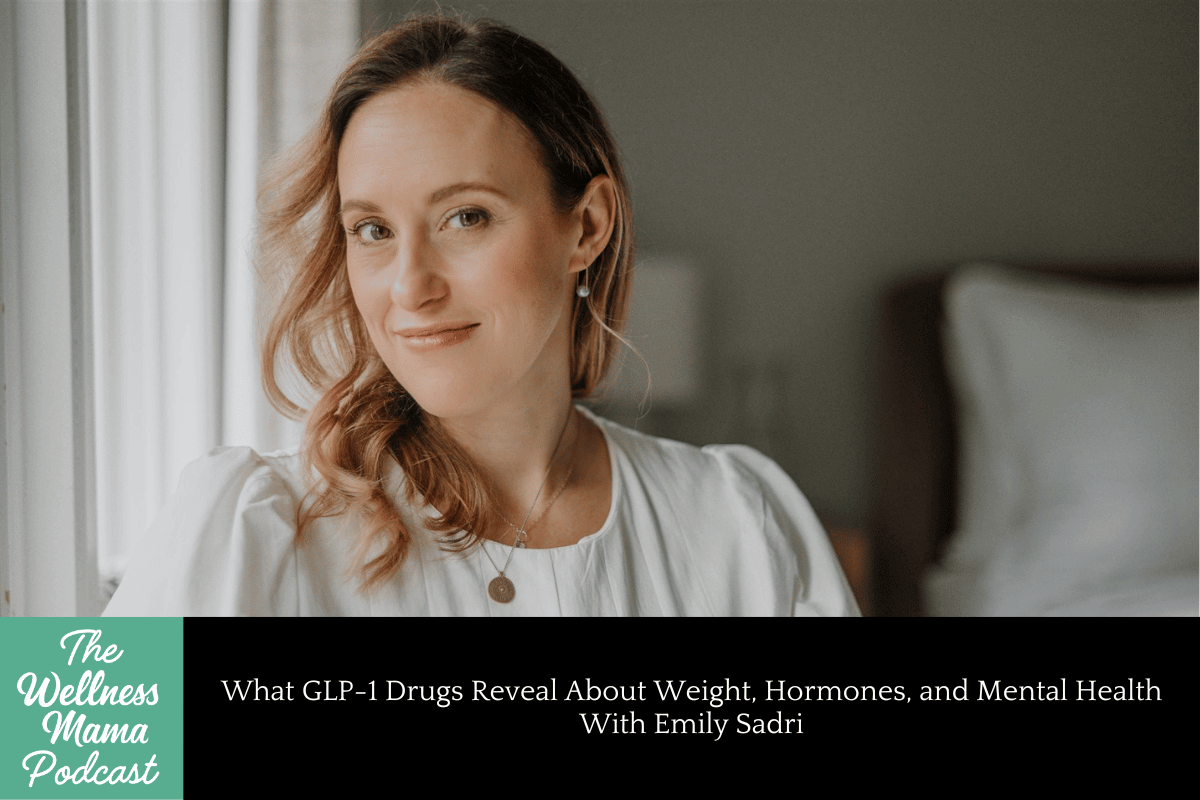
Katie: Hello and welcome to the Wellness Mama Podcast. I’m Katie from wellnessmama.com, and I am back today with Emily Sadri to talk about GLP-1 drugs and what they reveal about weight, hormones, and mental health, which is, I think the part that has not talked about in enough. We talk about the emotional underpinnings of weight loss, why that’s important to address.
The muscle and bone factors related to this, how these can be a valuable tool, but what to know if they are and so much more. Emily is a wealth of knowledge. She’s a double board certified women’s health nurse practitioner and nurse midwife, as well as the founder of Aurelia Health, which serves women who are navigating these changes, who are busy and raising kids, as she is as well.
And she loves breaking down norms and rejecting the idea that a woman’s worth is derived from her productivity or her weight. She believes that women can have it all. And that it starts with great healthcare and a woman standing beside each other, walking hand in hand. I learned a lot from her in this episode. I know that you will as well, so let’s jump in.
Emily, welcome back. Thank you for being here again.
Emily: Thank you so much for having me. I’m so excited to talk about this new topic. I think it’s super important and I love your work.
Katie: Well, thank you. And if you guys missed it, we recorded our first episodes together all about perimenopause and hormones and supporting ovarian function at all ages of life and what that actually looks like. It was super comprehensive and helpful. And in this one I would love to shift gears and talk about what seems to be a very relevant topic in today’s world, which is the topic of GLPs and their role and their downsides, which I feel like don’t get addressed as much. And knowing how to navigate decisions around that and or if someone’s going to try GLP-1s, what are the best and most supportive and safest ways to do this?
And I know that you’ve worked with hundreds of women in particular when it comes to GLP ones. And I would love to kind of hear what you’ve learned in that process of working with so many women and maybe any surprising things that you saw that you didn’t expect.
Emily: Hmm. Yeah, such a good question. I think that, as you know, weight loss and women’s relationship with their weight is so complex. And I have a tendency initially to focus on all of the data and the science and like the labs and all the things that I’m seeing, and, you know, my goal of helping people achieve metabolic flexibility and reduce their risk for chronic disease.
But in reality, for the woman who is either my patient or the woman who’s listening, this is so much more deeply personal. And I think it’s interesting. We know that, of course, hormones play a really large role in the reason why women have an increased risk of or supersede their male counterparts in risk of cardiovascular disease after age 50. But I also, sort of feel like intuitively, and this is not backed by evidence at all, but just my feeling like some of our relationship to our increased risk for metabolic problems and cardiovascular problems, as we know those two things go hand in hand, is that for women, our weight is so deeply personal that sometimes our response is to, to kind of dissociate from how what’s happening in our body is like translating to problematic pathophysiologic changes internally.
So when I’m working with women on a weight loss approach obviously we’re doing a very comprehensive approach, right? A real functional kind of holistic, obviously nutrition is important and you know, all the things and we can talk about those things today. But it’s so important that the person that you’re becoming in your weight loss journey is addressed. And that there’s attention given to that and that we’re acknowledging that there were aspects of who you were that contributed to you being in metabolic imbalance. And that we can use lots of chemical interventions to help you lose weight.
But if we’re not also simultaneously working on the who you become, as you lose weight and maybe aspects of yourself that you need to let go of, we’re really missing an opportunity to protect your mental health. Which was my inspiration for chatting with you about this today because there was a large study that came out last year in 2024, that showed dramatic data around the incidents of mental health issues in GLP-1 users.
Katie: Yeah, I feel like I haven’t heard that piece talked about and it makes sense to me that if the kinda underlying factors related to who you are becoming are not addressed, then you potentially are just gonna shift that same kind of internal friction to somewhere else in your life and or that it might show up in the form of a mental health challenge.
I know for me, I didn’t use GLP-1s, but I had a massive weight loss when I started kinda my inner healing journey. And it was actually, for me, a big part of like rewriting those inner scripts and the stories I was telling myself and the language. And also realizing I had a story about if I looked a certain way or if I was a certain size, then I would be happier, then I could be at peace in my body.
And it actually, for me, was flipping that script and learning to be at peace and to find happiness that ironically led to the weight loss becoming much more effortless when I wasn’t coming from a place of resistance. And I know that there’s so much inner emotional and mental work that is seemingly tied into that, as you explained with our, our self-worth being often connected to our weight or how we feel about ourselves.
And in our first episode we talked a lot about hormones. I also haven’t seen or heard a lot of data about, do we know much about how these medications might affect hormone levels and the effects they can have on normal physiological processes, either in a positive or a negative way?
Emily: Yeah. Well, I think that there’s a lot of answers to that. So when we talk about rapid weight loss in anyone. And I think there’s large populations of women who are using these drugs, especially with traditional dosing and maybe with minimal oversight. As is the case with sort of many aesthetic clinics or online telehealth clinics that prescribe these medications.
Women can have rapid weight loss and that can cause major shifts in their entire endocrine system. Namely, when we lose weight quickly, it triggers the alert system in our body and it tells our body to slow down the thyroid. Something must be wrong if there’s rapid weight loss there. We must be starving like we must be in famine.
We must slow down the metabolism. And we slow down the metabolism by slowing down the thyroid. So we can, we definitely see thyroid changes, especially with rapid weight loss and. Especially if there is poor nutrition. So adequate nutrition is incredibly important. And what you probably understand and what maybe some of the audience doesn’t know to be true is that many people who are overweight or obese are actually malnourished.
They’re not getting enough B vitamins, they’re not getting enough minerals, they are not getting enough protein. And so you take someone who’s already undernourished and then you simply reduce their caloric intake, they become nauseous and food averse, and so they’re eating a simpler diet and now they’re becoming even more malnourished. And of course, these micronutrients and macronutrients really impact our brain chemistry and our hormonal production. So, I have not seen it in my practice, but I’m sure that there are incidences of women using these drugs who have cycle shutdown amenorrhea, who stop menstruating because we know that that happens with anorexia.
Right. I have seen reports of women who have new onset osteoporosis from using these drugs. And that’s a really scary thing. So, you know, it’s an interesting thing to hold two truths. On the one hand, the fears are conflated with regard to GLP one medications. And that, you know, there’s a lot of fear mongering out there.
And at the same time, I think that an important aspect that’s missing and that we’re not talking about is really the difference between using these medications in an individualized, tailored, patient specific approach. Or just using them kind of by the traditional dosing that was originally developed by the commercial pharmaceutical for the purpose of weight loss and diabetes.
Katie: That makes sense. And I know I’ve heard some about the potential for muscle and bone density loss with these medications. It seemingly can be mitigated if someone understands how to navigate that, but it seems like it requires alot of intentionality and nuance. And I love that you brought up the point of people can be overweight and still malnourished.
It seems like we actually have an epidemic of this in the Western world. And that’s kind of a theory I’ve honed over the last 10 years or so is this, I kind of call it the protein and micronutrient theory, which is that nutrition is not just about calories. And we might be achieving enough calorie consumption, however, if we’re not getting the bare minimum of minerals and micronutrients and protein, the body in its wisdom, trying to keep us alive is going to continue craving things for survival.
And that is something that we can only out willpower for so long because it’s a very strong and important signal from our body. So I wonder if kind of the rise in popularity of these medications might actually further exacerbate that problem.
And if there is a way to navigate GLP ones? Like do they have a time and a place, is there a way to navigate them while taking into account the complex emotional factors that come into play, the nutritional and micronutrient factors that come into play that can kind of mitigate some of the downsides?
Like what do you see in your work? Is there a time and a place for them? And if someone is using them, what are kind of the most important factors to be aware of to kind of capture the benefit with as little downside as possible?
Emily: Yeah, no, I think that’s spot on. And I think that anytime the body’s needs aren’t being met, there will be a response. And if you’re a mother, you know how this plays out, right? If your child’s needs aren’t met, sleep, food, attention, that will come out in some reaction, but maybe not in a way that tells you exactly what the unmet need was. Right? And so if your unmet need is micronutrient based or macronutrient based, it will come out in excessive hunger, dysregulated hunger, right? But it can also come out because there’s an unmet emotional need, right? An unmet need for safety, security, connection, relationship, all of these things that we know are so important for the body to function optimally.
And so I think we really have an epidemic of that. I mean, we have lots of data about how disconnected our population is becoming. How Gen Zers are more disconnected than any generation before them, right? With the rising use of technology and how we need human connection and we need certain things for a positive mental health, right?
And often though, there’s this disconnection between what we think we need and what we actually need, right? So this sort of craving and not feeling full. And there are some, there’s like a Buddhist representation of this where it’s like the sort of ghost who can never be full. Like just continues to eat and never feels full.
And I think that some of that is playing out. And, you know, we really need to address so many foundational things about sort of human health and happiness in order to think about that. That being said, if you’re working with someone who understands those nuances, who treats someone as a whole person, who also gets to know you, right?
It’s just sort of like, I think I apply everything from a midwifery model because you can’t really prepare to be with someone in birth if you don’t know who they are, what their preferences are, their values, like who their people are, what makes them feel safe. Do they want noise? Do they not want noise?
Do they want touch? Do they not want touch? It’s the same thing on any transformational journey, right? Like, if we’re going on a weight loss journey, if we’re going on a journey through perimenopause and menopause, this is massive transformation that we’re talking about. And so being in relationship with someone who you trust and who gives you a feeling of safety. And you’ll know that that’s true if you sort of end a face-to-face visit with them.
And I don’t encourage that you do these, use these medications if you’re not engaging in synchronous medical care with someone who you trust. You will get off the visit and you will feel a feeling of safety in your body. Right? You will feel more confident, comfortable, and that’s just, we need to clue into that.
Right? That’s a gauge. Additionally, and to answer your question, I think it’s really important that the dosing be titrated to your personal response and that you’re working with someone who can coach you on nutrition from a very additive versus reductive approach. I find that people who have issues with their metabolic health and have had trouble losing weight, that the more that you introduce reductive approaches like restrictive diets, excessive fasting, a diet that uses a lot of the words like no, can’t, don’t, that can be very emotionally triggering to people.
And for example, in our program, we do spend some time focusing on inflammation at a certain point, but we wait and we also personalize using any elimination of say things like gluten and dairy, which can be very triggering, especially for our autoimmune patients. We really do not do that in a blanket way, right?
It’s we have a assessment that we use within our clinical team to really determine if someone’s emotionally ready to do those things right. And we’re testing and assessing as we go, right? So we’re measuring someone’s response and then adapting. And I think that, you know, what we know to be true about these medications is that they’re incredibly effective at reducing inflammation, at prevention of chronic disease.
At, in diabetics, we have really good studies about how they impact chronic disease outcomes for these people. We have seen how much it impacts sort of autoimmune issues, but also the way that it impacts craving and sort of that never feeling full. The way that it kind of impacts that drive that where there is some psychological root in nature. think it, we have some evidence that it also reduces addictive behavior. So it reduces, the drive to gamble. It reduces the drive to spend money and even engage in other kinds of addictive behavior. And we know that from the research. And I just think that that’s so fascinating, especially in the context of this study from 2024 that showed a 98% increased risk of psychiatric disorders in over 160,000 people that were observed in this study.
So it was observational, it was retrospective. So not randomized, meaning we were just taking a bunch of people on GLP one and a bunch of people not on GLP one who were self-selected. Right? So their doctor prescribed it, or their provider prescribed it. Then we were observing in those two populations what were the outcomes. And in the population on GLP ones, there was like 195% chance of major depression disorder. Meaning that, like that, not that 195% right? But it was that, so if there were a hundred people in one group that had it, then there were gonna be 200 people in the other group, right, that had depression. Just to understand how percentages work. I think that there are lots of things that we can explain about this.
One, I think is related to the micronutrient deficiencies that when you further deprive people who are already deprived right, you increase the chance of psychiatric issues. One I think is probably because it’s stressful on the body, as we mentioned, right? To lose weight. And if you’re not sort of taking an additive approach in terms of community connection, relationship trust with a provider and an additive approach from a nutritional standpoint, then you are increasing that person’s risk of feeling unsafe, right? And triggering nervous system dysregulation. We also know that GLP increase sympathetic output.
This is why people who take semaglutide or tirzepatide, if they’re heart rate monitoring, they’ll notice that their baseline heart rate goes up by about 10 points. And that’s one of the ways that it works. When you increase sympathetic output, just like when you do exercise, you increase sympathetic output that stimulates a mechanism by which we lose weight. But if you already have a dysregulated nervous system, that shift in sympathetic output can be detrimental, can be positive for people. Some people report improved mood. So I think it’s just so interesting and there’s so much more nuance here that needs to be explored, that we’re just kind of missing. Missing in our, in our conversation about like, I don’t know.
I mean, there’s just so, there’s so much out there. Like it’s, I know there’s one camp that has had a lot of attention in the current administration about this is the biggest crime to the metabolic crisis and we really need to be focusing on food. And like, and I agree with all of that, but I also think that unless you’ve really sat with a woman who has failed in her weight loss attempts for years and years and years, and you sit with that devastation and then you see the impact that even small doses of this drug can have on changing her life and giving her a leg up on her own journey. And it doesn’t mean that she’s taking herself out of the journey or that she’s not putting forth effort, right? It’s just this biochemical hack that really gives her the support that she needed.
Katie: Yeah, it feels like in if these medications are going to be used, it’s actually very much a both and. Like it’s a call to be even more aware and intentional of nutritional and metabolic factors because you now have a unique and different way to support the body and those probably become even more important.
I love that you addressed the sympathetic output aspect of this, because I’ve heard from people that they saw their like readiness scores decline ’cause their heart rate was elevated and they couldn’t figure out why. And it makes sense to me that that would be the mechanism. And also that in light of that, it might become more important also to become aware of intentional ways to bring more parasympathetic tone into your life to deal with stress a little bit more.
To make sure the body is getting enough nutrients from all sources so that that’s not a source of stress. To get sunlight like we talked about in our first episode, so that the body is able to kind of function as optimally as possible. And it seems like to your point, this is an extremely nuanced conversation. That it can and does have a place and it’s very helpful and that it brings the importance of these other factors actually more into light.
It doesn’t discount the need for effort and for quality nutrition and for addressing sleep and stress and all the things we would talk about anyway. It just gives another potential tool that people can use when they understand all of those things. And I’d love to, for the rest of our time, circle back also to the kind of the emotional piece we started with. And address even more deeply why so many women are seeing depression, why women still seem unhappy, even if they reach their weight loss goals?
I know for me it was because I had a false story. And I thought that weight loss would make me happy. And it turns out the reverse was true. That finding happiness actually led to releasing a lot of the stuff that was making weight loss difficult. But you work directly with women all the time. What are we overlooking when it comes to how we define weight loss success and the way we support ourselves or support others through that journey?
Emily: Yeah, I mean it, I got chills. I think so many people come to our program and we ask them to define what their goal is when they start. And I would say more than half of women, when they reach their goal, go you know, actually I’m not happy yet. I wanna lose more. Like I want, I wanna change my goal. And of course we have conversations about like what’s actually physiologically a proper goal.
But I think that’s beside the point. The point is that I think we have an epidemic of women who have been conditioned to be overgiving. Have been conditioned to be more about everybody else than they are for themselves because we’re praised for that. And I think that we are so far down that hole.
Many women are. Especially if you’re deeply unhappy, you’re so far down that track that you don’t even really know what you want and desire. Many women find themselves in unhappy marriages, in friendships that don’t actually serve them because they’re so used to kind of being a yes girl. And to going along with other people’s needs that they just really are deeply unhappy.
I think that there are also, of course, lots of environmental factors that affect our mental health, but I think it’s a lot more interesting to talk about the psychosocial factors. I think that especially as we age and after we’re done having children, because there is an aspect to child rearing and childbearing that is deeply imbalanced in terms of giving and receiving just by way of like actual nature. Like the 10 years that I was breastfeeding and child rearing and birthing and all of those things. You know, as much as I wanted to take care of myself, it’s like your brain actually can’t hold the space for who do you truly wanna be and how do you wanna show up? Because you’re just sustaining and nurturing life.
So I think when, if you’ve sort of passed through that threshold, it’s a real opportunity. I always like to think that health and when we work on our body, it allows, it’s like a catalyst for us to get to know ourselves. And I think you’ve described that process so personally. I’ve had that experience, that sort of when all is lost and when you kind of don’t know who you are and what you want or what even makes you happy, one of the best places to start is with like daily foundational routines that make you feel better physically. Because when you feel better physically, it starts to open up space for you to get clarity about like what you actually want and what’s meaningful to you. And so I think it’s really just about a whole society that hasn’t taught women how to know their bodies and live in accordance with their cycle.
Right. You can go back to our other episode if you wanna know about more about that. And to a society that doesn’t train young people to really get curious about who they are. Right. We are trained to be performative and to know how to be what other people want us to be. In terms of like even how our education works and how job preparation and, you know, finding our partner.
Like, we get really good, especially women because we can be kind of chameleonlike, just sort of be whoever everybody else needs us to be. Especially the highly sensitive empathic types. Right? We’re really good at that. But if you start with sort of the foundations, which you’re so beautiful at talking about, right?
The just simple things of like a really good regulated sleep schedule, hydration in the morning, sun exposure, movement. And also strip away the things that inherently kind of make you go, ugh. Like how many times do you say yes to something and then like right before it’s about to happen, you cancel and like make up an excuse for doing that thing.
Like everyone’s done that. But if you, if you’re doing that a lot, like you really need to ask yourself, are you, are you over saying yes? Like, do you need some work on your boundaries? Right? And that’s what I see like is sort of the through line of people who are coming to us who are desperately out of alignment with their body and feeling on emptiness that they think will be filled once their body looks a certain way. But in reality it’s both. You have to be on the journey toward feeling better internally. And you have to get to the change in your physiology and your metabolic health by way of your personal transformation.
Katie: That was beautiful, and I think both of our episodes together highlight that, especially for women and all of the beautiful cycles of our physiology. There is so much nuance and it’s very personalized. And I know that you work directly with so many women. For people listening who want to keep learning from you and or work with you directly, where can they find you and learn more?
Emily: yeah. Please follow me on Instagram, EmilySadri_NP. You can also go to emilysadri.com/wellnessmama for a direct sort of gift and summary of the episode that we have for you guys. Or you can follow my clinical practice.It’s a aureliahealth.com.
Katie: Amazing. Well, I will put all of those links in the show notes for any of you listening on the go, that’s always at wellnessmama.com. Emily, I’ve learned so much from you. I love your approach to this, and the understanding and depth and listening that you bring to your work and how much you’ve shared today. Thank you so much for your time and for everything you shared today.
Emily: Well, thank you Katie. I’m such a fan and I think that you bring such a new and fresh approach always. You always have and always will to this thing called life, the parenting, the mothering, the self-development, and I’m just here for all of it, so it’s a pleasure.
Katie: Well, thank you. And thank you as always for listening and sharing your most valuable resources, your time, your energy, and your attention with us today. We’re both so grateful that you did and I hope that you will join me again on the next episode of The Wellness Mama Podcast.





Leave a Reply