Read Transcript
Child: Welcome to my Mommy’s podcast.
Katie: This episode is sponsored by BON CHARGE, and specifically one of my favorite things that they have, which is their PEMF mini mat. If you are new to PEMF, this stands for pulsed electromagnetic field, which is magnetic energy that’s being sent into the body via this mat. And these energy waves are fascinating.
They work with your body’s natural magnetic field to elevate your wellbeing in a multitude of ways. Similar effect that we would have from being in direct contact with the earth, which I also think is an amazing thing to do daily. I love PEMF mats to improve sleep, to ground me, to increase calmness.
I often say that sitting on one of these mats, I feel like a cat in the sunshine and just, like, so calm and cozy. Some of the reasons I personally like this particular mini mat, it is small enough to fit in any room, and it’s easy to move from room to room. I also have a larger one, but that one is more difficult to move around.
There are different settings, so you can find what works best for you, and it’s low EMF. Some of these are not. I feel like this is an important thing to pay attention to. Some easy ways that you can use a mini mat like this: it’s great on an office chair or on a sofa or on the floor, wherever you are sitting and reading, meditating, working, et cetera.
I love to use it before bedtime or after a workout or I’m actually doing yoga teacher training. I’ll often use it during restorative classes or when you need kind of like a creative boost or a brain reset. And like I said, I love how portable this one is. You can find out more about it and get a discount by using the code wellnessmama at wellnessmama.com/go/boncharge
Today’s episode is brought to you by LMNT, which is my go-to electrolyte drink for staying hydrated and feeling my best every day. I have used this for years, and unlike many sports drinks which are loaded with sugar, LMNT delivers a science-backed blend of electrolytes with the sodium your body actually needs, especially if, like me, you live in a hot climate, sauna regularly, or work out regularly.
Whether you are working out, walking the dog, traveling, or simply trying to keep your minerals and your energy levels up, LMNT makes this simple and delicious. I keep their canned ones in my fridge all the time now, and their convenient salt packets are perfect for tossing in your purse, your gym bag, or your carry-on, so you are never without electrolytes when you need them.
My kids are also a huge fan, especially of their new pink lemonade. What I especially love about LMNT that they have so many flavors now, so it’s easier to drink throughout the day. If mixing isn’t your thing, they also now have what I love, their new sparkling canned beverages that give you the same electrolyte benefits but in a ready-to-drink format. And those are a favorite among people who visit my wellness center as well. Adding LMNT to your daily routine is one of the easiest ways to support hydration and help your body perform at its best. I also find very helpful if you’re a breastfeeding mom.
So if you’re looking for a simple upgrade to your wellness routine, give LMNT a try and experience it for yourself. They have some delicious new flavors like lemonade iced tea and pink lemonade, and they always have their happiness guarantee. Go to drinklmnt.com/wellnessmama for a special offer.
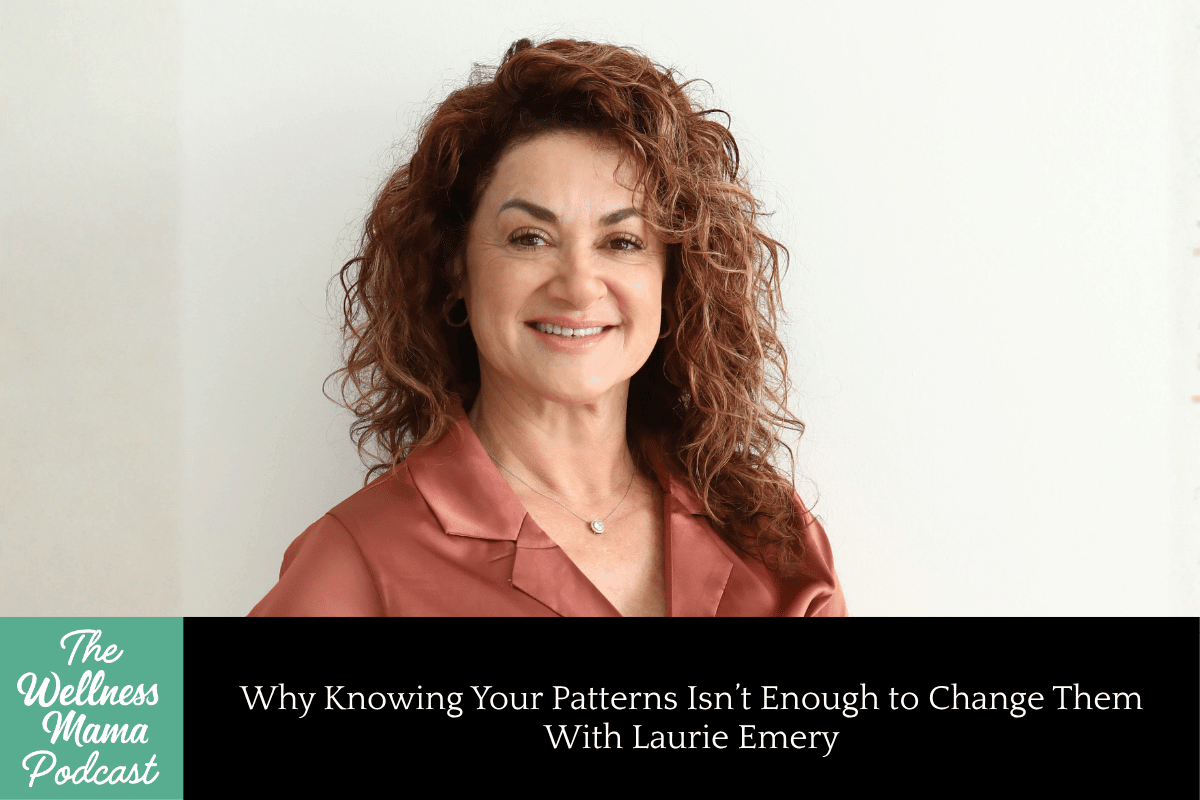
Katie: Hello, and welcome to the Wellness Mama podcast. I’m Katie from wellnessmama.com, and I am deeply excited for today’s topic about how knowing your patterns isn’t enough to change them, which I’m guessing many of us have experienced and felt stuck around. And today we’re going to unpack that and so much more with a new friend of mine, Dr. Laurie, who is absolutely incredible.
She brings together psychology, neuroscience, somatic work, ontological coaching, and experiential transformation to help people really make shifts that stick. And this is something she has seen throughout her career, is the people can understand why they do what they do, but not still have the tools to change that pattern.
And I know that resonates for me as well. I think we live in a social media world where there’s more access than ever before to information. It certainly doesn’t seem to be an information problem. tI seems like there’s something deeper, and I feel like you are the perfect expert to really take us through this.
So to jump into that topic broadly, Dr. Laurie, welcome. And can you walk us through your background and some of how you came to understand that simply knowing what’s going on or why is not enough for those patterns to start shifting?
Laurie: Yeah. Wow. It’s- it’s been a journey of my own specifically. I started out in the field of psychology myself, right?
And I think why I came to understand it deeply is I lived it ever before I really had the language for it, right? I had four degrees. I started my career in special education, working with kids who had lived through trauma and neglect, and then I went on to study psychology and eventually earned my doctorate.
I spent years understanding human behavior, you know, helping people understand themselves, and building a, a large practice here in Boca Raton and even training some other clinicians at the time. And at the same time, there were still places in my own life where I knew, I knew so much. I could tell you my story.
I could tell you why I did what I did. I t- I could even tell you what I shouldn’t be doing, but I just still wasn’t free, and I could not understand a pattern- I could understand it intellectually, but I could, and I could tell you, you know, where I could see why it all made sense, but then something would happen in my real life, in my marriage, with money, in my own self-worth.
All of that knowing just, I mean, it would disappear in 30 seconds, right? And, and that was really humbling for me. I felt super capable at so much in my life, and I just couldn’t get underneath what all of those patterns were about and create a breakthrough for myself. And I think that’s where my work began to shift, because I stopped being as interested in why do I do this or why do other people do what they do, and I became more interested in what actually happens inside of a person in the moment before we go and do it again, right?
Because our patterns aren’t random. Most of them began as an incredibly intelligent way of protecting us. And so if achievement got me love or approval, I may become an extraordinary achiever, right? If I, if I, if reading the room kept me safe, I may become highly attuned to everybody else. Or something like if, if being in control reduced uncertainty for me, then I might become incredibly capable at handling everything.
And all of those things can become strengths. The problem is when I can no longer choose when I use them, and they’re actually choosing for me, right? And I’ve got my self-worth and my value and my comfort attached to them, right? So that’s the real distinction, I think, that changed everything for me that, that insight matters, understanding matters.
I’m not throwing, not throwing out the baby with the bad wa- bath water. But I was looking for when, how do we create real, permanent, lifelong change, like transformation, right? Transformation happens when I can catch my pattern while it’s happening, I can stay with, with what’s underneath it, and create enough space that something other than my automatic response come, becomes possible in that moment.
And that’s the work I’m most interested in now, not just helping people know themselves better, but helping people become more free inside of those moments that used to run them. ‘Cause as most people know, we can do a workshop, we can read a book, we can listen to an audiobook, whatever, but what’s really important is what happens on a Tuesday morning when we’re with our children or with our staff or with our husbands.
And, and I think that’s where it really, where it really makes a difference.
Katie: Yeah, I love so much about this, and I think of the, kind of the correlation I’ve seen in physical health where I’ve said so many times over the years, like, our symptoms are a gift and they’re messengers. It’s the body communicating.
They’re not a bad thing. And if we spot treat the symptom without understanding and shifting whatever’s underneath that, then we potentially just move the problem somewhere else. And I love-
Laurie: Yeah
Katie:… your approach with this. I feel like, in my early days when I was trying to figure out how to work through things, in talk therapy especially, I got really good at intellectualizing, and I knew what the therapist wanted me to say.
I knew how to talk to my inner child, but I wasn’t shifting it because I was still all in the cognitive realm. And so that’s what I love about your work because at the end of the day, like you said, it’s, it can be great to understand why. That might be a really important curiosity for someone, but if it doesn’t shift the behavior, then I would guess you might even feel more frustrated because now you’re aware of why you’re doing this, and you’re still doing it.
Did that happen to you where you’re just like you got more frustrated because you could understand rationally the problem and why it shouldn’t be there, and yet it still would show up?
Laurie: Yeah. Me, me and a lot of, a lot of my clients that I work with will say, like, “I understand why I do what I do. I can tell you, I can tell you all of it and link it back to whatever I, wherever the root came from. And I still do it.”
I even had a, a, a good friend of mine and I were talking the other day and he said, “You know, I changed the behavior for a while, but then in certain situations when I wasn’t as strong or paying attention or if I had a, a drink, then that behavior would come out again,” right? And because even just behavioral change doesn’t create permanent lifelong change if the root of it is, has got you internally in your nervous system. Yeah.
Katie: Yeah. I think that’s important. And something I’ve noticed also on this is as I started to learn and understand my own patterns, I was also applying that to other people. So if someone did something that I would’ve felt hurt by, and rather than being with my own emotion of feeling hurt, I would, like, cognitively understand them and start to rationalize what they were doing and then try to talk myself out of my own emotions because I’m like, “Oh, well, it’s because of this, so I shouldn’t be mad about this,” or whatever it was.
And so I feel like this-
Laurie: Yeah
Katie: … what you’re talking about actually maybe gives us such a deeper understanding of ourselves and ability to shift as well as, I’m sure, shows up in relationship in really profound ways as well. And I know from researching for this episode, you have so much great information around how the body is actually a part of undoing these patterns and how it can be such an incredible part of this.
And I… That’s what I would love to jump into next, because I talk a lot about physical health and I’ve talked a lot about mental and emotional health as well, and I feel like you connect those so beautifully in a way that’s really profound. I also think a lot of times people, we can get stuck in our emotions or in our mind or in our head when it comes to these experiences, and perhaps miss out on something that can be really life-changing by not connecting to the body in those moments. So can you walk us through what does the body have to do with actually changing our emotional patterns?
Laurie: Yeah. That’s a great question. and, I love that you bring that up because like you, I intellectualized for so long and I thought, “I’ve got this. I’m so smart and so capable.”
Right? And, and I, I do wanna say thing, want something really quick. I don’t wanna make it that behavioral change is unimportant, that I felt like I, I wanted to leave, make sure we didn’t leave that hanging. But sometimes changing a behavior, it, it, it is important. It’s just a doorway.
It’s not the destination, so I wanted to be clear about that. You know, linking the body is, is so incredibly important, because- Our body has implicit memory, right? The body, it, it, it ha- you get activated in the body, and it knows we’re activated be- be- before the thinking mind does, right? We tend to think the pattern starts with thought, but a lot of times there’s already a, a tightening in the chest or a, a clenching in your jaw or a drop in your stomach, right?
Or your, maybe your, there’s heat in your face or a numbness or a pressure, and you wanna defend or explain or control. And if I don’t know how to notice that, then by the time I’m consciously thinking about what I’m doing, I’m already inside the pattern. So for me, the body becomes a doorway into slowing down automatically.
And, and I wanna be clear- Is that when people hear body work, oftentimes they’ll think that I’m talking about some kind of huge cathartic experience. Like, and I’m often talking about something much simpler. Like, can you notice what’s happening inside of you without trying to change it? Like, if you’re hurt, like what you brought up, can you actually notice the hurt before you explain, why the other person did what they did?
Like, if you’re scared, can you feel the fear before you turn it into control? Or if you’re disappointed, can you stay with the disappointment before you fix, perform, or withdraw, or make somebody else wrong? That’s where the body becomes incredibly important because it gives us access to the experience underneath the behavior.
And our, our experience is made up of three things: our thoughts, our feelings, and our physical sensations. And once we link all three together, now we’re having an experience, and it happens in, it’s so fast, right? And so that’s where my methodology, see, see that you’re activated, breathe into it. And not like we’re doing breathwork, we’re not trying to get rid of it, but breathing into the body, going to that place in the body where there’s even just a slight physical sensation, staying with it, and that’s where the work happens, right?
Can I stay with what’s here long enough that I don’t immediately perform the old protection? And then, then choosing a response becomes possible. And choosing real choice comes from, being able to notice that I have a physical sensation or a reaction in my body, being able to see what that activation of my body wants me to do, and not obeying it, right?
Because someone might cut me off on the road, and I might wanna go and be, you know, do road rage and be, and, and get them back. And if I’m not at choice in that moment, and I do that, there are serious consequences, right? And that’s just one example in, of so many. But if I can stay with it to go, “Oh, when that person cut me off, I got scared ’cause it was out of control,” right?
Then I can breathe into that physical sensation. I can stay, and I can choose a response from my adult self, my higher self, my, right, my logical mind, my, my rational mind that says, “Okay, I’m not gonna do that. I just got scared.” I can tolerate feeling what’s happening inside of me. ‘Cause if I never stay with the experience underneath the pattern, I’m not really choosing, I’m reacting.
And I think that’s where so much, real change, transformational change becomes possible, where we stop trying to talk ourselves out of, what we feel, and we begin to learn how to be with ourselves inside of what we feel.
Katie: Yeah, I think that’s huge, and I’m guessing even that is, like, a little bit more practice required than just understanding it. Although I would guess in that area awareness is a huge piece of it, because that shifts the paradigm through which we’re approaching things. Even though it sounds so simple, I’ve noticed that just staying with the feeling and actually being willing to feel it versus trying to resist it or run away from it, or something I did for so many years was categorize it, and it was like there were these category feelings that were bad, and there was this category of feelings that were good, and I wanted to feel the good feelings and ignore the bad feelings.
And I got really good at the mental gymnastics of that. But I had to start unpacking that actually so much, and last year was my trial by fire of actually learning that in a very profound way. But I h- I’ve heard that, like, there’s the experience of what happens and the emotions that happen within our body around that, and then often much of what happens after is actually our story that we’re creating around it.
And it sounds like your method helps to sort of unpack and go to the deeper layers so that we’re not just kind of running these automatic scripts. Is that kind of… Am I understanding it correctly of, like, really, like-
Laurie: Absolutely
Katie: … being with ourselves versus, like, rationalizing away or categorizing away what we’re actually feeling?
Laurie: Absolutely. Right. Being able to stay with it and realize that this is, this sounds, for some people, might sound s- like such a crazy statement, but that, you know, life is lifing. Events are happening in life, and technically speaking, those events are neutral events. They’re facts, and then we bring everything else to the table.
Like you said, we bring our sto- what we make it mean, our story, our perceptions, our perspectives. We bring all of that to the table, and we don’t realize that we’ve now left the fact of what happened, and we’ve interpreted that fact and made it mean something. And then we interact with it like our interpretation is the truth or the fact.
And it’s not a fact, right? It- what happened happened, but what we made it mean is the piece that is our stuff, right? And this becomes enormously important in relationships because the person in front of us often isn’t only interacting with who we are today, they’re bumping into everything our system has learned to protect us.
So for example, my husband can say something relatively simple, but my body may experience it as rejection or criticism or abandonment or not enough or whatever that particular doorway is for me. And now I’m no longer responding to what he said, I’m responding to what he said that activated inside of me.
And that’s why two people can have the exact same conversation and experience it completely d- different realities in that moment, right? And it’s where, that’s where relationships become such an incredible mirror for our work because the people closest to us, our partners, our children, can activate the places where all of our intellectual understanding disappears very quickly, right?
So the practice, as you, as you mentioned, is can I notice what’s happening in me before I make you responsible for it? And that doesn’t mean I excuse, you know, bad behavior or it doesn’t mean I don’t have boundaries. It just means I can become responsible for understanding what belongs to this moment and what this moment activated inside of me, and that creates a very different kind of relationship.
Katie: Yeah, I love that so much. And my friend Ryan says, like, often in early life we’re hurt in relationship. Like, we learn things and pattern them based on how we were interacted with in childhood or throughout experiences in life or certainly in trauma. And he’s like, “But we also heal in relationship.” Like, it’s, it’s with humans that we could, like you said, that mirror.
And I, I was a slow learner of learning. Like, I was good at not having boundaries at first, and I had all those patterns of people-pleasing and over-giving and all of that. And learning that boundaries and kindness can exist together and they’re actually both more powerful when they do was a slow process for me.
But I love that you tie this into relationships. And I also know, like, like, those can be our biggest grounds for learning because when we feel safe with someone, when we love them so much, like you said, those triggers feel safe to activate with them. And so I would love to talk through, I love this see, breathe, stay framework even as it’s just a mental tool to know, like, and to be aware of as we enter those moments.
So I would love for you to walk us through maybe an ordinary moment or a time when someone could, as an example of how they could apply this to create a little bit more space between what’s happening and their response.
Laurie: Absolutely. And as y- as you said, I wanna, I want your listeners to be mindful that, first of all, it can sound so simple, and, and it really, it really is a practice of how do I even notice when it- before activations become really big?
And let’s make it super ordinary. Like, let’s say someone’s husband or partner walks into the kitchen and says, “Did you remember to call the school?” And maybe objectively that’s all he said, but inside of you something happens instantly where your chest tightens or your stomach drops, and before you even realize it, you’re saying, “I’ve had a million things to do today.
Why don’t you call the school?” And now we’re in it, right? So See is simply can I catch that something just happened inside of me, right? Not that he’s wrong, not that I’m wrong, just whoa, I got activated, right? Like, I can hear the tone change in my voice, and I might be able to see that maybe my chest got tight, and that I spoke to my husband in that way.
And then noticing it and then breathing is coming back into the body. Instead of lashing out, I come back in, right? Where do I feel it? And maybe that’s the pressure in my chest. Maybe that’s heat in my face. Maybe it’s, Right? So I’m not breathing to make it go away. I’m breathing so I can stay connected to myself while it’s here.
And when I say breathe into it, I mean literally let it be there and observe it, and then stay. And this is usually the part that people wanna skip. It’s can I stay with that sensation for longer than is normally comfortable for me without immediately defending myself or reacting? And, and staying means allowing that feeling to be there, observing that physical sensation, just allowing it in the body. And then maybe what I discover underneath it is when he asked me that, I immediately heard, “You dropped the ball.
You’re not doing enough.” But he didn’t actually say that, and that’s what got activated in me. And now when I stay with it long enough, I get to choose, and instead of, “Why don’t you do it yourself?” or defending, maybe I say, “I haven’t called yet, and I just noticed when you asked me that, I immediately felt like I was being criticized.
So can, can you give me a second?” Right? That’s an entirely different conversation. It’s me being completely responsible for my reaction. And what I love about this is we’re not trying to become people who never get activated. That’s not possible, and that’s not the goal, right? We are human beings, and the goal is that the activation no longer automatically gets to decide what happens next, right?
And so, I mean, imagine what that changes in marriage, in our responses with our children, right? Because now my husband doesn’t have to defend himself against something he may not, he may not even know, you know, what’s happened, and I don’t have to abandon myself by pretending that I wasn’t hurt or activated, right?
It’s a very vulnerable way to be in relationship, and I can stay with myself and stay in the relationship at the same time. And I think that’s, that’s part of what healing in a relationship actually looks like is can I bring those old… Those activations right here in the space with my partner and create safety for both of us in the middle of that activation?
Katie: Yeah, I think often even in physical health I see it, we often underestimate the simple things because they’re simple, and often when they’re consistent, I’ve seen over and over they’re the most profound. And I say things like that all the time, like people discount getting morning sunlight because it seems so simple and I don’t wanna get up at sunrise.
And the people who do it see their labs change very profoundly. And I would guess just like that in your work people might like be like, “Well, this seems so simple,” and if they actually do it, I bet they would see like, “Wow, this has profoundly shifted all of my relationships.” And we’re gonna get to do a part two, so you guys stay tuned for the next episode with Dr.
Laurie and I together where we’re gonna really take this into the family realm and the parenting realm and creating that in our family, which I’m so excited to jump into. But I think that for this, the rest of this episode, I wanna make sure we really also tie this into the experience of the person staying present with themselves.
I think that is so powerful and also so difficult to do. And I think it’s also important to differentiate, mindfulness or simply calming yourself down versus this kind of like active participation and staying with yourself that you’re talking about, ’cause I feel like those kind of could get muddled together and it seems like there’s a, an important distinction there.
Laurie: Absolutely, Katie, I love that you brought that up. ‘Cause, you know, I think as people listen, they’re… It’s in- it’s easy to pigeonhole it into what we already know. And, and I think the distinction is huge, because sometimes we use mindfulness or regulation almost like another sophisticated way to leave ourselves.
Like, we believe something uncomfortable, or we feel something uncomfortable and immediately think, “How do I calm this down? How do I make this go away and regulate myself?” And sometimes regulation is, is what we need, so I’m, again, I’m not making that wrong. But staying with what… Staying the way that I mean it is different.
Staying is not, “How do I get rid of this feeling?” It’s, “Can I remain with myself while the feeling is here?” Right? That’s a very different relationship with discomfort. And the reason it’s not easy is oftentimes the activation comes up, and the way the brain is wired is we just wanna get rid of the feeling so quickly just to make our nervous system calm down and make it go away.
It’s the reason we have addictions, like shopping or drinking or yelling or whatever that is. Because if every time sadness shows up, I try to breathe it away, or every time fear shows up, I try to regulate it away, or every time anger shows up, I immediately try to become calm, I may still be sending myself a message that these parts of my experience are not welcome.
And staying says, “You can be here. I’m just not going to react to you. Like, I’m gonna stay inside of me.” So I can feel hurt and not collapse into the hurt. I can feel fear and not let fear make the decision, and I can feel anger and not become mean or reactive, right? I can feel disappointment and not immediately fix it.
And so this is an activated participation in what’s happening in my body, right? It’s very active. And so I’m observing my body. I’m noticing my, the thoughts that are coming up. I’m noticing the meaning I’m making. I’m staying close enough to myself that I don’t abandon myself or hand control over to the activation.
And I think that’s why something that sounds incredibly simple can be, it can be so profound in practice, is we spend so much of our lives trying to control our external world so that we don’t have to feel certain internal experiences. And when I learn I can actually stay, I’m actually creating safety inside of myself. Right?
I can tolerate this. I don’t have to run, fix, perform, attack, withdraw, or make it disappear. Then the entire world starts to open up, right? And because now I don’t need to, to… I don’t need life to behave a certain way in order for me to be okay.
Katie: Yeah, I think that’s a huge shift. And I remember one day when I read that we have this kind of misconception that a regulated nervous system is always calm and zen, and that actually a regulated nervous system is present with whatever’s actually happening, and sometimes that is a fight or flight response, and sometimes that is whatever response happens in our body.
It’s learning that, like what you’re… exactly what you’re talking about, that we don’t have to just ride that wave to whatever outcome happens. We actually get to have awareness within that moment, and sometimes that does mean, like, we might wanna go move our body to process an emotion. We might wanna do something physical.
We might wanna… We don’t wanna just, like, immediately jump to calm if that’s not what our nervous system is feeling. And at the same time, I feel like what your work so beautifully gives tools for is that also doesn’t mean we have to kind of set fire to the people around us because we’re having that experience. It’s learning to be present-
Laurie: Yeah, I completely…
Katie: … with ourselves without damaging others in the process.
Laurie: Yeah. And we build, we build them the same way we build any capacity, in, in one small moment over and over again, right? Not when we’re at a 10 out of 10 and completely flooded. Start when you’re at a two, right?
Notice the irritation in traffic, or notice the urge to immediately answer a text, or notice tightening when your child is upset. Just notice the small ones, and instead of instantly acting, stay for just a few seconds longer than you normally would, and that’s the practice. Like, even if you have to just put your hand on where the activation is in the body and just go in and be with it.
That’s where the work gets done is like, “Wow, what does this want me to do? Oh, it wants me to leave. It wants me to, you know, defend myself.” Okay, just notice that. Okay, how do I know this feeling? How long has this been a part of me, right? And this is what… another piece, that, we- wasn’t mentioned in my…
Where I pull from is, excuse me, internal family systems parts work, right? That’s the somatic piece. And ’cause every time I can experience something uncomfortable without abandoning myself, reacting automatically, or needing the outside world to change first, I’m teaching my system something now like some- and it’s new, right?
That I can be with this. And over time it creates self-trust. ‘Cause we’re leaving ourself when we react. We’re leaving ourself when we defend. We’re literally leaving when we’re having a feeling instead of staying with it. And that kind of trust, basically we’re saying to ourself, “I’m safe inside of any feeling that come, comes up inside of me.
Nothing bad is going to happen.” And that says, “Whatever happens, I won’t leave in the middle of it. I can be with what I feel and what’s happening.” And that’s a very different dene- definition of safety.
Katie: Yeah. I think that’s-
Laurie: And then we’re not requiring our partner to be safe. We are safe.
Katie: That’s so tremendous, and I think, like, your work shows it really shifts so much in every area of your life, and it creates these amazing ripples that are just absolutely profound.
And I know that you have so many resources around this. I’ve really enjoyed finding you and following your work, and I’m gonna make sure I link to all the places people can find you. But I also know you have a specific tool you’ve created for listeners that I’m gonna link to in the show notes. But can you walk us through what that is, as well as you do events that are very immersive and really help people to kind of cement these shifts in a really quick and profound way.
So can you explain both of those resources, and I’ll make sure they’re linked?
Laurie: Yes, absolutely. Thank you so much. We actually created something specifically for your listeners, ’cause I really didn’t want people to listen to this conversation, understand it intellectually, and then just have one more thing that they know, right?
And, and like you and I, you and I have a lot of children, and we’re moms, and, and life is busy, and it… We called it The One Thing Underneath Everything, is what we called it. And it starts with a short assessment that helps you look at where something may be asking for your attention right now. And that might be in your relationship, or your parenting and family, or maybe your work and your purpose, or your relationship with yourself.
And then based on what comes up for you, you’ll receive a private audio from me where I’ll actually walk you through an experience. Because the point isn’t to diagnose you or tell you what’s wrong with you, it’s to help you begin to notice what may be underneath the thing that you think is the the problem.
And so let’s say you think the problem is that you’re overwhelmed all the time, or you keep having the same argument with your partner, or you can’t stop controlling something, or you’re incredibly successful and you can’t, still can’t seem to enjoy what you’ve built. I wanna help you get curious about what may be actually happening underneath that, and that’s really w- what I hope people take from our conversation, is, you don’t need to become less human, right?
You need to just stop… And you don’t need to stop getting activated, right? The opportunity is to, to know yourself deeply enough to stay with yourself long enough that those automatic places no longer run your life. And so I’m excited that we’re gonna get to, to take this into parenting and family in our next conversation, ’cause that becomes really powerful and in, and in- incredible to me when we start looking at what we’re modeling and creating for, our families.
And I’ve been coaching, one-on-one at a, a pretty high level for a long time and, people kept saying to me, “You know, Dr. Laurie, I have so many friends who’d love to do your work, but they can’t afford you,” ’cause admittedly, I, I can, I, I’m a little expensive. And so I thought, “How do I scale this? ‘Cause I really wanna get this out to as many people as possible.”
So I decided to create an experiential weekend where people can come and experience for the three days, what we ca- we’re calling it Return to, Return to Knowing, your knowing inside of yourself. And so we call it Return. And, the next one is October 23rd to 25th in West Palm Beach, Florida. And it really is being able to to practice real time going in.
And in that work, we go in when we stay with what’s happening, we go in pretty deeply with how do I even assess what’s happening with that part? How do I know what it needs? How do I listen? How do I be with it for an extended period of time? How do I even know what my, my activations feel like, and what are those intelligent patterns, right?
Or what are my go-to patterns, right? Some of us love to avoid as a pattern. Some of us love to control as a pattern. That those are our ways that we tend to feel safe. So we spend a weekend doing that and immersed in it. I’m really excited about it I love that.
Katie: And like I said, I will make sure the links are in the show notes, and I’m very excited for our follow-up conversation that’s so near and dear to my heart on how this relates to family systems and children.
So you guys please stay tuned for that one, and all the links we’ve talked about are linked in the show notes at wellnessmama.com. Dr. Laurie, thank you so much for this conversation. I am so excited for our next one. Thank you for being here.
Laurie: Thank you so much.
Katie: And thank you as always for listening, and I hope you will join me again on the next episode of the Wellness Mama podcast.





Leave a Reply