Read Transcript
Child: Welcome to my mommy’s podcast!
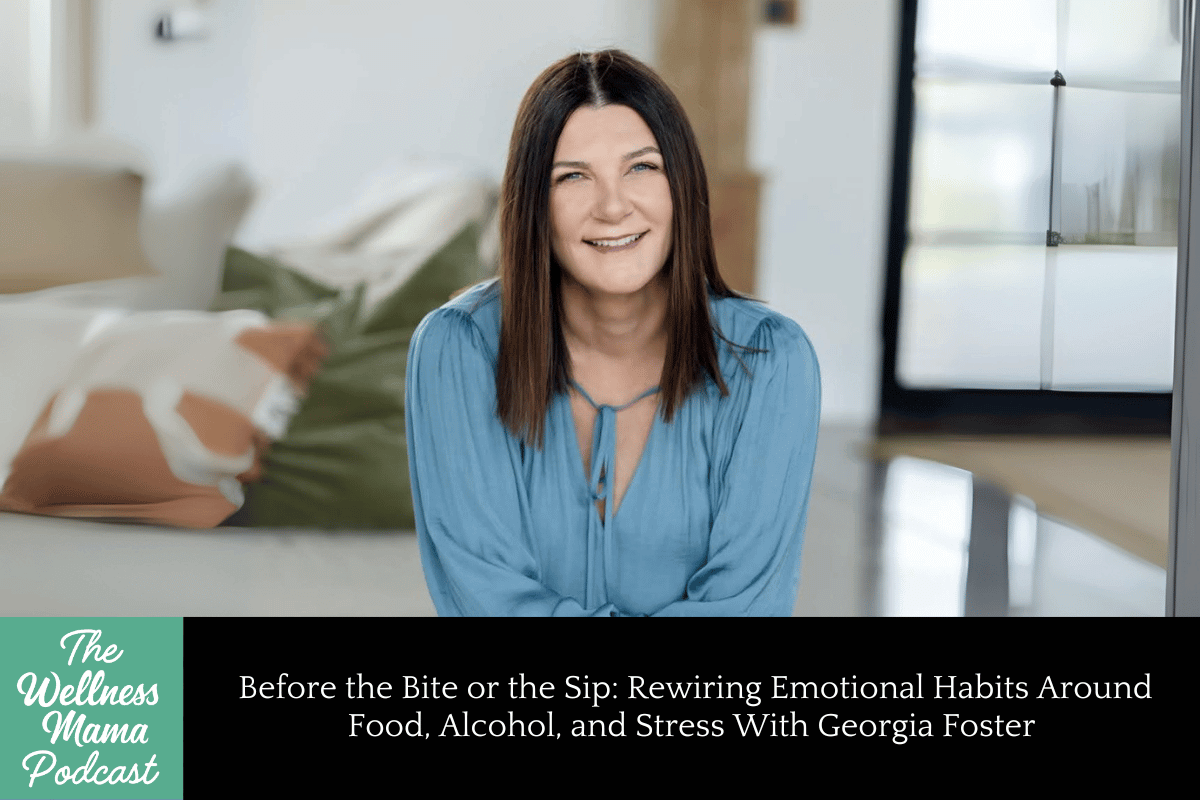
Katie: Hello and welcome to the Wellness Mama podcast. I’m Katie from wellnessmama.com, and I am back today with Georgia Foster for round two all about before taking that first bite or sip, rewiring emotional habits around food, alcohol, and stress. And she is a leading voice in this work. She’s a clinical hypnotherapist and a voice dialogue trainer who is known as the go-to expert in the UK and Australia for everything related to food and alcohol issues, as well as inner critic and people pleaser work.
She’s written many books, developed courses around this. And in this episode she shares some immediately practical tools that you can start doing today at home without taking a course or learning anything additional. And I also link in the show notes to all of her resources that she has available. So you can check those out there.
But let’s jump in and join Georgia. Georgia, welcome back. Thank you for being here again.
Georgia: Thank you for having me
Katie: Well, I’m so grateful to have you back, especially considering it is late night where you are in Australia. And we had an amazing first episode together where you explained a lot of things related to our inner critics, to people pleasing and to how hypnosis and even self hypnosis as a tool can be really impactful.
And especially for moms, how we can use this to help kind of rewire our inner critic and to build our own self-esteem and resilience. And in this second episode, I would love to go deeper, especially on the topics of, related to anything around emotional eating or emotional drinking. Because it seems like these can be really important and relevant topics, especially for moms.
And you touched on this in our first episode, but I would love to kind of establish the foundation of how these things kind of tie into those inner things that we talked about in the first episode. And especially how they tie into stress. You mentioned in the first episode, it’s the thinking before the drinking that’s the problem. And I would love to go deeper on that concept, because I don’t, I actually don’t drink anymore. But I remember when I did, kind of those feelings that you touched on in the first one. And I would love to kind of really understand this topic and then create some understanding around impactful tools that can help if someone is in that experience still.
Georgia: Yeah, no. And I think it’s a very taboo subject, drinking in particular. And you know some people call it mothers little helper, that glass of wine. And in particular talking about drinking is, what’s interesting about alcohol consumption, and food and sugar in particular as well. But just talking about drinking for a moment is that when we drink alcohol, the inner critic goes away, right? So it’s the chemical reaction of alcohol.
So I say to people, look, you know what. If you’re a mom at home and the kids have gone to bed and that one glass of wine tends to creep up to the second and the third and before you know it like the bottle’s nearly gone. Two things are happening. The first thing is that through your day your mind and body have not had any window of time to actually release of the tension and the stress. You’ve been on the go all all day.
And because of the lifestyle, or how you may manage your life, is after a period of time, as I said in the first section, is that your mind is lazy. It works on default. So if you’ve trained your mind that a glass of wine or two or three is the great way to relax, turn off from the day, communicate. Because a lot of people drink to communicate which is not a good idea. Which I’ll talk about a little bit more in a moment.
But people just think that they’ve got a drinking problem. They’ve got a thinking problem. They’ve got an inner critic problem. They’ve got a stress management tool issue. And these are all the points I’m saying if, that if you’re drinking habitually more than you really want to, there is absolutely nothing wrong with you. I can assure you. It’s just that you have got yourself …you’ve literally, your mind has trained itself that alcohol is your go-to.
And it’s great because it stops inner critic, you relax. A lot of perfectionists will be all or nothing drinkers. They can be really good at staying all week with alcohol free days and then Friday hits, bang. And they’ll drink a bottle of wine, whatever it is. And a lot of this drinking is done in the home. So it’s not like people are out in the bars. We’re talking most of this drinking is done in the home. And so it goes under the radar a lot.
But the problem with the drinking, because it’s such a taboo subject, and it’s a very shameful subject for a lot of people. That’s why I wanna just stop all the shame and the guilt, cause that causes the sneaky drinking. Like you know, a story, I had a client who had a second bottle going on in the in the garage. When her husband is at home and and he was saying, I think you’re drinking too much. She’s like I’m not drinking, look how much is there. And then he found the second bottle. And it was all because she felt shamed and she was anxious, she was very fearful. She’s in a high power job and all of a sudden she was a stay at home mom.
She had lost her self esteem. She’s feeling critical of herself. And not having any space for herself. So looking at the reasons why people drink too much, there’s always an emotional reason. People don’t want to drink too much. And I’m not saying that if you win the lottery tomorrow you’re gonna have too much champagne. But I’m talking about the regular drinking that’s causing the grief. And I think that’s why the subject, I like to keep it private. My programs are all about, you can use the programs in your home. Nobody needs to know what you’re doing. All they’ll see is that you are drinking less and you’ve actually improved your sense of self-worth. Because underpinning that once again is, if you are drinking to become a better version of yourself, which a lot of people do, because the inner critic when we’re sober says, you’re boring, you need to drink. You’re not as interesting, you’re not as funny, you’re not as sexy, you’re not as relaxed.
And if we believe that propaganda to be true, we will use alcohol as that crutch. But the problem is it can get to be a bit of a problem. So I’m saying let’s get that inner critic in check so that you can start to nurture yourself. And start to bring in those healthy coping strategies before you drink so that you’re not using the alcohol as the solution to the emotional. The emotional, suppressing those emotions. Because emotions are there for a reason. I mean they’re there…when you get your inner critic in check you realize that a lot of what you’ve been doing and thinking and feeling has been over timed and overused.
And that you can train the other part of your mind, the prefrontal cortex, to be here so that you don’t need that drink to relax. I mean a lot of people drink to be intimate because they’ve got such bad body dysmorphia, have low self-esteem about themselves. Feel they can’t relax. A lot of people won’t go and have a coffee in the morning with the moms after drop off because they feel so anxious.
They’ll wait for the glass of wine. That’s all Social anxiety. Like social anxiety is such a big gig for so many people. And a lot of people will use alcohol as that social crutch and have that one sneaky glass while they’re getting ready and put their makeup on. And they’ll say Georgia, you know I’m really worried that if people knew what I was doing. I’m like you know what, there’s nothing wrong with you. You’ve just got yourself into a drinking rut because of your negative state and too many stress chemicals in your body. And your brain has assumed that this is the way, this is the solution.
So I’m very proud of people who wanna do the sober route. I think it’s fantastic, like yourself. And I think it’s a fantastic idea. But a lot of people want the middle ground. They wanna be able to enjoy a glass of wine with dinner and friends and but feel that they’re managing it rather than the alcohol’s managing them
Katie: Hmm. Yeah, that makes so much sense. And I feel like this also ties in to, or can, to the emotional eating component as well. Especially when you talked about the shame and the hiding it. It seems like this is also a pattern that can show up when it comes to eating food. Especially certain foods that are considered like not good for you or junk foods that people can kind of have that similar reaction and pursue those things from an emotional place.
In fact, this is something that years ago I also feel like I struggled with. And I got to like unpack over time things related to how certain foods were tied to comfort when I was a kid or to feelings of happiness or celebration, and things like that. It seems like there can be also a lot of emotional ties when it comes to food. And in some cases, maybe this is even harder to address because at least like regular drinking in public at least has some societal connotations that tend to make it less acceptable.
Whereas food is everywhere. And it can be harder to address that, or at least that was my experience. So can you explain how this also can relate to food for people who maybe don’t drink, but maybe feel that related to a food or certain foods?
Georgia: Yeah, no very valid. The difference between drinking and food is you have to eat to survive. And that’s why a lot of people who go on fasts or those liquid shake diets they actually do really well because they don’t have to think about food. They have a reprieve from food. And I often say that people who struggle with the weight or struggle with emotional eating actually do live in fear of food. And they have this inner dialogue with inner critic, it’s just gonna make me thin or it’s just gonna make me fat.
And so they on a week where they’re dieting and they’re doing really well is then they have one extra almond or one extra cookie or whatever and then they go, oh my God I’ve failed. And that’s that perfectionist all or nothing syndrome. But that once again is a learnt behavior. It’s a trained behavior. But food is about love. And pleasers love food. They’re very good at stretching one meal to five. Friends can drop over, they’re always very accommodating. And pleasers in particular love food. And they’ll be, they may be great bakers.
They’re very much into the decadence of food and they’re very passionate about food, which is fantastic. But they often use food as that way to retreat. But you know like drinking is, there’s still, especially with sugar, high sugar content food, is that will give a dopamine effect as well, just like alcohol does. And the dopamine effect is what people get hooked into. But the problem is the chemical reaction of that high sugar food. We know you get the high, and then you get the massive low, and then the depression can kick in.
So what I train people to do with the the Weightless Mind program and the Pajama Diet, which is also about, more like about fitness, is that what actually happens is when you become kinder to yourself, like you said before, and it does take training. When you are kinder to yourself you make healthier choices, but you also don’t set things in stone as this is who I am for the rest of my life. That you can go to a a party and have birthday cake. You can do what you want because you intuitively eat. And intuitively eating means that food is something that you see as an energy source of nutritional value.
And that you can eat whatever you want without worrying about, I mean maybe on holiday you might go to South of France and have lots of croissants. I don’t know, put on a bit of weight. But there’s a balance to it. And it’s not giving you that sense of shame or guilt. And I think that a lot of people… and we really do have to look at the media and how the dieting industry has caused so much anxiety and angst around being this perfect weight.
And I think weight does fluctuate for people from time to time, but it’s really about honoring that food is there to be nurtured and to be loved rather than to be in fear of. And when people stop losing the fear of what they’re gonna eat, which comes from training them to tune out the inner critic. And being present with what they eat. And a lot of people are not present when they eat. They’re shoving it down. They’re shoving it down because of emotions. They’re shoving it down because they’re trying to get this fix that they look back and think, where was I when I had that whole packet of cookies?
They weren’t even present. So what I do is help people train to be present when they’re eating. And it may seem really silly, but bless your food, nurture it, give it lots of energy. And this is all what we do with the hypnosis, is train that mind to bring in that starting to nurture yourself by pleasing you. Rather than the food being that quick fix. And anybody can look at the history of their relationship with food who’ve struggled with yo-yo dieting or big weight fluctuations.
For example, somebody who has a lot of weight to lose and they lose like you know 20, 30 pounds and then a year later they put it back on. The reason why they put it back on is because the inner world, they the weight consciously, okay. But when they lost the weight the inner mind hadn’t caught up. The inner mind didn’t know it was safe to be that weight. And hypnosis is a fantastic tool to train the deeper part of the mind that it’s safe to intuitively eat. That it’s safe to be slim. That it’s safe to be sexy. That it’s safe to be attractive.
And a lot of people keep the weight on because they feel that they… people say I’ll do this in my life when I’ve lost the weight, right? Well let’s flip it. Build the self-esteem first and then the weight will come away. So the weight can be the biggest stumbling block to actually making that change. So you know, and people say, oh Georgia I just procrastinate. No, that’s just fear, pure fear. Fear of the unknown. But hypnosis can train the mind to…
And there’s a particular technique which I’d love to share with the group and it’s just a beautiful simple self-hypnosis technique. And you can do it, doesn’t have to be with food or alcohol, it can be with anything. But what’s really powerful, and this has been it’s… I’m smiling because it’s a technique that a lot of people don’t want people to know. But I love to share it because everybody has the resources to do this. I don’t know, I mean I know a lot of, when I was in London I used to treat a lot of actors, performers on stage. A lot of people in the theater world, the classical music world. A lot of people in the sports performance.
And this technique is really powerful when it comes to looking into your future. Because a really big top tip: the inner critic cannot see into your future. It can only see into your past. And what hypnosis can do, it can, when your eyes are closed and you’re in that lovely relaxed state, you can train the mind to look into the future. And seeing somebody feeling happy, feeling calm before they eat. Feeling calm before they drink, feeling calm before they go for their job interview. Feeling calm before they go to the school gates.
And the more you practice that in hypnosis, the more the mind thinks it’s real. And bringing in lots of love, positive emotions. Not everybody’s visual and I really respect that. It could be more kinesthetic where you feel touchy. Where you can feel the warmth of the sun on your skin as you are wearing a beautiful dress that you love to wear. Where you’re feeling good about yourself. Starting to imagine all of these outcomes, but past the event. This is what’s really important. It’s a bit like a client of mine who said to me, Georgia I want you to help me find a husband. I’m like, well I can’t help you do that.
But I can help you be in a more confident, charismatic space to attract the right person. And she said to me, I can’t, I can’t marry a plumber. My sister’s married to a plumber. I’ve gotta have a corporate guy. I’m like okay that’s fine. She’s now married to a plumber. But the point is, the reason why was because we’ve gotta change the energy. And when you are in hypnosis, you start to attract the right situations and the right people. And this tool is going past the event and seeing yourself looking back on a reflection. That you don’t know how you got there, but you just see the end result.
Because sometimes the universe has a better picture for you than you think. Like the plumber. The universe has a lot more to offer you than you may think at this point in time. Whether it’s that you deserve to earn this amount of money when you could be earning this amount of money. Or you could have… I mean I use this technique a lot with women who were struggling with having babies, for example. When there was more of a psychological block than anything else. And taking them through to the experience of trusting that the body knows how to get pregnant.
But getting to the point where the journey has already been sold, but you get to the other side and look back. And it’s a fantastic tool. And I’ve used it just so many times with with very well-known people in different industries. And it can be used by everybody, including myself and people listening to this right now. And all you need is just wake up in the morning, set your alarm five minutes earlier, and just close your eyes and just imagine your day going by really well. And coming home and feeling calm and just saying my day’s gonna go really well.
I don’t know what’s gonna happen, but I just trust. And just having that lovely inner dialogue. And any inner critic comment just put it in a cloud and blow it away. Send its energy somewhere else, and then bring in the calm. But another thing is, affirmations are really powerful because the mind listens. So post-it notes, phone alarms, just a lovely mantra. It’s safe to be me. I deserve to feel well. I deserve to like myself. I don’t have to be perfect to achieve my goals.
Just little mantras make such a difference because the mind does listen. And, but this particular technique is called the Future Technique and I highly recommend it. A really good example of this is when you can’t see something being resolved. And then what you see is you look past the event and see yourself has, that moment has passed, and being in a good space. It’s incredible how much that thought process will help something evolve in a much better way than maybe you think. Whether it’s a difficult relationship with somebody.
Whether it’s you wanna get out of a job that you’re not really happy in. Could be anything really from losing weight to drinking less. And also to do with anxiety, because anxiety is such a, it’s a curse. And I think that realizing anxiety is the inner critic and being able to train your mind to tune out of it and look into your future. Because anxiety’s about the fear of the future. What’s gonna happen if I do this, this, or this. And so it’s a beautiful technique to train the mind and body to trust in the destination. That it isn’t where you’ve been. That your past is not a true reflection of where you’re going.
Katie: I love that. That’s, and I love that you’re willingly sharing something people can try. Literally starting today at home without even needing to work with a therapist. I think those are so impactful. And especially like you talked about in the beginning, if these are areas where someone might have shame or like struggle with even the idea that they need to work on this, being able to do that at home, especially at first feels like it can be really helpful in taking those first steps toward moving in a more positive direction when it comes to this.
And I feel like, like I said, this has been something very deeply impactful for me. And another thing that you’ve talked about is the idea of presence. And kind of presence also being seemingly an antidote to some of these like emotional escapes related to food or to alcohol. And I feel like also something very relevant and tied into motherhood. In that I know a lot of us can feel guilt if we’re not fully present with our kids or around things related to our presence with our families.
So I would love to talk a little bit more about presence and specifically how we can nurture that more in our lives, especially as women and as moms.
Georgia: Well I think it’s really important. Perfectionists in particular are not very good at being in the present. They don’t like standing still. They’re either thinking about what they did yesterday or they’re planning their future. And so a perfectionist will often use food or alcohol to be that moment to stop and be present. There’s a bit of guilt around it about being present as well because you have to be doing all of the time, right? So one of the great ways to do that is to just to take five minutes. Literally nip to the bathroom.
Like just pretend that you, just go to the bathroom for five minutes. And just to do some deep belly breath work. Box breathing which is take three in, hold, and then breathe out. So you breathe in for three, sorry, you breathe in for five seconds and you hold that. And then you breathe out and you hold that for five seconds. And you repeat that three times. And that will start to calm your central nervous system down. It’s called box breathing.
And box breathing is about going into that space where you calm your central nervous system down to the point that you feel safe to be present. Because people who are anxious shallow breathe, that’s a fact. So when you deep breathe you actually are asking yourself to be more present and to be more thoughtful. And in that moment is then… and I and it may sound a bit cliché. But if you can take the time to go to a park, to see the beauty of the world. To, and I know as a mom we have lots of videos these days, don’t we, of our children.
But I often I promise myself through the years of them developing and as they continue to grow into adulthood is that being present is really really important. And often the inner critic or the pleaser, like we should be doing this or doing that with the perfectionist is we just need to park it. And just make a date with yourself to spend five minutes with yourself just to recalibrate, to breathe, and decide to be present. Now that does take practice, but the more you practice it the more your mind becomes familiar with it.
And when things become overwhelming and you feel like you are not present, it’s a great practice just to take that little bit of time out. And look, five minutes is all you need. Not even that, but it’s a nice time to do that. And also another way to do that is before you wanna eat and you wanna drink, have that little five minute moment. Because that will recalibrate and you think, oh I don’t need that drink. I don’t need that food.
If you’ve given yourself the time to pause, to retreat. To really have some big graceful with yourself and take some time out to be present. And it’s interesting, I call it the space between your thoughts. And it is you need to create more space. Because one thought, bang bang bang bang bang bang bang. Think God where have I been in this? Where have I been? But you have to… nobody can do this for you but you. Nobody else can do it. It’s got to be you that can make this change.
So that little bit of five minutes, taking that breather, and pausing and retreating, and giving yourself some space between those negative thoughts or those driving thoughts or those should be doing thing thoughts, it makes a massive difference. And when you do that… and even if you can like… If you’re in a situation and you’re a mom at home. And before you pick the kids up from school it’s just after lunch when you’re feeling a bit tired after having some food, is have that siesta.
Put some lovely music on. Classical music, Mozart is really powerful and its been proven to be incredibly supportive to brainwave training. Which means mind training. And just imagine yourself in beautiful different situations where you’re calm and confident. All these things lead to the road of being more present. You don’t need to have my hypnosis tracks. You can do that yourself if you wanna just put some lovely angel music on or some meditation music. Just to take a bit of time out will make a huge difference. In actual fact that 20 minutes will give you more time. That’s what’s been proven as well. Because you’ve given yourself time to recalibrate, to rejuvenate, to have a clearer mind, and a rested body.
Katie: I love that. I feel like you’ve shared so many immediately actionable and helpful tips in this episode. And I’ll of course link to your work, and you’ve offered a discount on all of your courses for people as well. But for anyone listening on the go, where can people find you and keep learning from you?
Georgia: Sure. My website is georgiafoster.com Georgia as in the State of America. And I say Foster as in the beer. Georgiafoster.com. And I’m based in Australia, but I’m, obviously you can buy my programs anywhere in the world. They’re all very private and they’re all available online. If anybody is interested in my supplement as well it’s a fantastic liver supplement for people who drink alcohol. Which really puts back what alcohol depletes the body of. Probiotics or the vitamin B family, the things that actually make you anxious.
So if you are worried about your drinking, obviously I’m here to help you support to drink less. And emotional overeating the program, the pajama diet, and the weightless mind are there. But I’m here. Any questions please just drop me an email and I will get back to you within 24 hours.
Katie: Amazing. And all of those links will be in the show notes at wellnessmama.com if you are listening on the go. Georgia, this has been phenomenal. You are just incredible, and I’m so grateful for your time, especially so late at night in your time zone. Thank you so much for being here and for everything you’ve shared today.
Georgia: Well thank you for having me. It’s been absolute pleasure.
Katie: And thank you as always for listening and sharing your most valuable resources, your time, your energy, and your attention with us today. We’re both so grateful that you did, and I hope that you’ll join me again on the next episode of The Wellness Mama Podcast.




Leave a Reply