Read Transcript
Child: Welcome to my Mommy’s podcast.
Katie: This podcast is brought to you by BIOptimizers and their Magnesium Breakthrough product. Our bodies need seven different types of magnesium. Each one has its own unique purpose. One form helps muscles recover, another supports heart rhythm. A third supports the nervous system and so on.
Most supplements, even the high quality, expensive ones only contain one to two forms at best, and that’s like trying to build a house with just a hammer and a screwdriver. You need the complete toolkit, and that’s why I started taking Magnesium Breakthrough from BIOptimizers, which contains all seven forms.
No other magnesium supplement on the market offers this complete approach. I have looked, and BIOptimizers is so confident in their formula that they offer a full year, 365 day money back guarantee. So you can try it for up to a year and still get a refund if you’re not happy. So if you wanna try this, go to bioptimizers.com/wellnessmama. And use the code WELLNESSMAMA for 15% off your order.
Plus, when you subscribe, you’ll enjoy exclusive discounts, free gifts, and a guaranteed monthly supply. All natural ingredients, no synthetic additives or preservatives and always vegan, gluten-free, soy-free, and lactose-free.
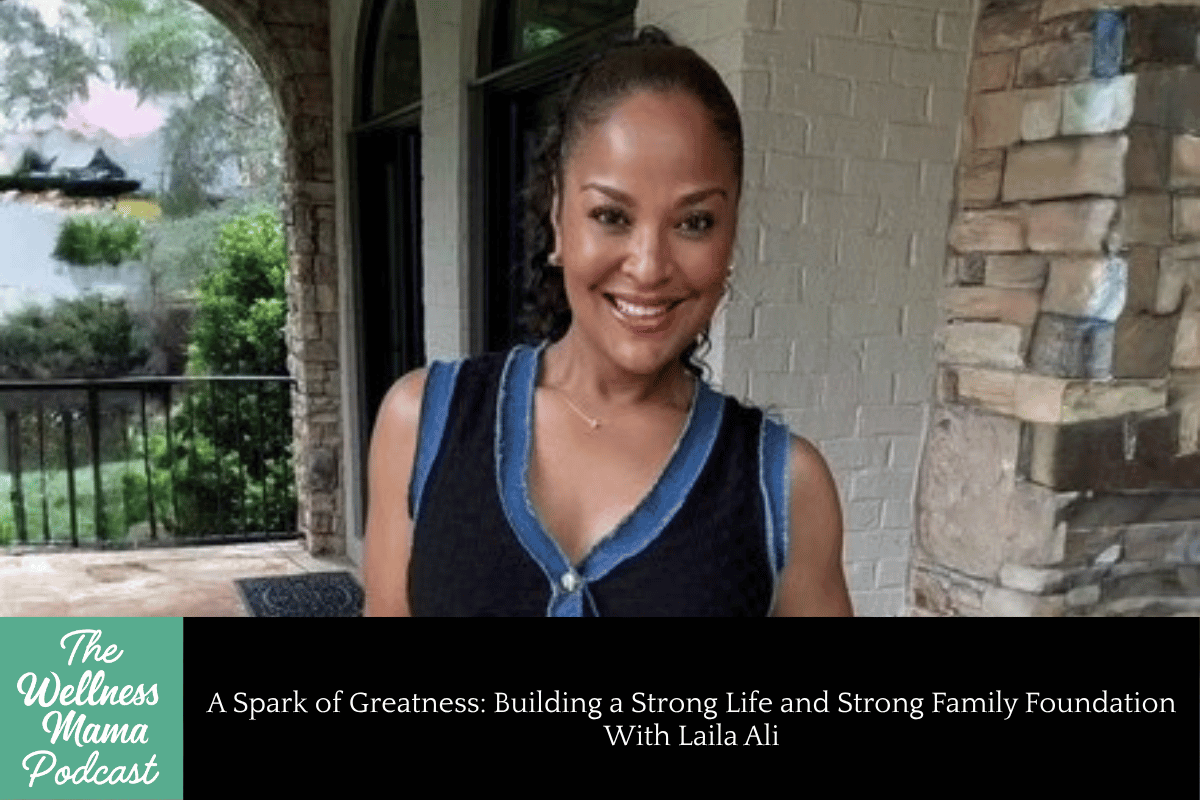
Katie: Hello, and welcome to the Wellness Mama podcast. I am Katie from wellnessmama.com, and I am overjoyed to be here today with a personal friend and someone I deeply admire who practically needs no introduction, Laila Ali. She’s been on before. I’ll link to our first episode together. But I am ecstatic to talk about today well, so many things with you, Laila, but especially you have written a new book, which I am so excited to have for my kids and to donate to some schools where I am.
The… I feel like there’s always a million things I could talk to you about, and we could probably talk for eight hours straight. We will spare the audience that for today. But welcome, and thank you so much for being here.
Laila: Thank you for having me. It’s always great to see you. I hope that you and your family have been well, and this will be a fun catch-up also.
Katie: Exactly. Exactly. Well, like I said, there’s always so many directions we could go. You’re also a mom. You’re a deeply inspiring person, and I feel like we’re gonna, of course, get to the book because I know there’s a amazing story behind it, and you’re so passion-driven and put so much intention into everything that you do.
And I feel like it brings up, some kind of back topics that I would love to kind of tackle first. The first being something you and I have talked about offline, which is the intentionality that goes into creating the family foundation, the values, the culture that you wanna build for your children and to impart into them for their whole lives.
And I know you could give a master class on this, and it’s a broad topic. But to start, maybe just, like, walk us through your experience with that, your intention that went into it, and how you navigate that as a mom and also a very busy human.
Laila: Being a mom is one of the biggest challenges I’ve ever faced, but it’s also so rewarding, and only moms would know that, right?
We, we have that connection. And we all want what’s best for our family, and then we have, you know, our own upbringing that comes into play, things that worked, things that didn’t. So for me, I try to take the things that I wanna pull forward into my family culture and adjust some of those that I didn’t or improve upon them.
And, you know, my story is so different than anyone else’s, obviously. I mean, I, we all have a, our individual stories, but being the daughter of Muhammad Ali, the greatest of all time, you know, was an amazing upbringing. But, you know, it came with its perks, obviously. But then there were the downsides. In my, in my point of view, him being gone all the time, being busy saving the world, you know, you’re gonna miss birthdays, you’re gonna miss graduations, you’re gonna miss those times where I just wanna hug my dad.
And I, I wrote about a lot of that in my first book, Reach, which was geared more towards older children. But, a lot of my upbringing, led me to boxing. A lot of people don’t realize that. I got into a lot of trouble when I was younger, because I was angry. You know, I had animosity, because I didn’t have that family environment that I wanted, that closeness, that warmth.
And, you know, that’s all about bringing my children up differently. The main thing I want them to know, obviously, as kids, is just that they’re perfect. I love them exactly as they are. My love is unconditional, and that they’re, they come first. But I also wanna not only say that to them, I wanna show it to them in my daily actions, and that’s the thing that I think, you know, I try to practice most and be intentional about.
Because life gets busy. We got so many things going on, and we’re not always in a perfect mood. You know, we’re still, we still have our own lives as women and our own challenges and, you know, our own things that we wanna accomplish and ambition, and, you know, sometimes just piles on and, and then you still have to be there for your family.
So, like I said, I know I just said a mouthful, but for me it’s all about intention. And for me, love comes first, being here for my family comes first, and it shows up in the way that I speak, the way that I care, the way that I nurture them, the way that I prepare meals for them, all of that.
Katie: Yeah, it’s true. I feel like motherhood takes you to the, like, absolute depths of your exhaustion, and then you still show up and you cook dinner. And, like, you surpass limits that you didn’t think you could surpass because you just have to, because humans are depending on you. And I love that you brought up the vulnerability around your anger when you were younger, and I’m curious because I had my own, I shared about this a little bit, but my own temper tantrum with God last year.
And I would’ve said before that, like, “I don’t have any anger. I don’t really ever feel angry,” And I got to meet my depths of rage and grief and feelings I had sort of ignored my whole entire life. And I’m grateful in hindsight for that experience, though I wouldn’t have said in the moment that I was grateful for it.
But I’m curious if in navigating that anger, I know for you boxing became somewhat of an outlet, and I’m curious as you navigated the inner experience of that, did you find any other feelings below the anger? ‘Cause what I sort of discovered in my own journey was anger is probably, for me it was there as a mask of places where I had fear or where I had helplessness or where I had things I really didn’t wanna feel, and the anger sort of, like, was a protection from that.
And then when I, like, started to process the anger, I got to really actually feel the roots that were behind it. And I’m curious if you had an experience like that, and if boxing was, like, an outlet that helped you move through that.
Laila: Boxing was definitely an outlet, an outlet to help me move through a lot when I was, when I was younger, and even in young adulthood.
But, I think that what I uncovered, and I still continue to uncover, is just feelings of abandonment. A lot of,… I’m, I’m– I tend to be a perfectionist. I tend to be someone who, feels like I have to, I have to do it myself in order to get it done right. Right? And that just comes from being let down, and just wanting to be able to rely on myself, but then you get burnt out, and you also don’t allow the people around you, you don’t give them that blessing to help you, and to be able to give back.
So sometimes I have to trick myself into thinking that way. It’s a blessing for me of me to let… You know, I’m, I’m sorry, let me say that again. Sometimes I have to trick myself and say, “I’m blessing this person by allowing them to help me,” ’cause then that’ll make me release instead of thinking, “I just gotta do it on my own.
Don’t bother anybody. Don’t ask for help.” So, you know, there’s, there’s all sorts of things that I learned, but, you know, I think at the end of the day, as I’ve gotten older in my life, I’ve tried to be just more open to sharing my feelings, taking a second look from a different perspective, a different point of view.
Not going back to my, you know, my first thought is to… You know, somebody does, does something wrong or meaning against me intentionally wrong, is to get mad, you know. Instead, this is just one example. Instead of getting mad or getting angry, I’ll just say, “Wow, you know, that person might have been really going through something today,” or, you know, “I don’t know what led to that.I’m not gonna take it for what it is at face value and let it upset my day.”
So that, but that takes a level of maturity. even at this age. I’ll be 49 this year, and I’m still having to practice that one. The same things that I’m teaching my children, right?
Katie: It’s so true. I feel like lifelong lessons, and maybe we don’t even learn them by the end, potentially. Well, and I love that. I wanna touch on the abandonment piece, because I, one of my earlier, earliest memories was actually being alone in my crib, and my parents are both hard of hearing, and I realized very young, like, “Oh, they can’t hear me.
No one’s coming.” And so one of my earliest emotional lessons was I’m all on my own. I have to figure it out myself. And I recently got challenged on this, probably similarly to you, of like, someone challenged me back of like this storyline you have that like, “Oh, if I don’t need you, you can’t hurt me.”
That’s not independence. That’s invulnerability, and it shuts you down from connection with other people. And I knew, of course, I didn’t wanna pass on any of that abandonment to my kids, and so it’s something I’ve been very intentional about, and by no means been perfect about. But I’m curious how that has shifted, do you think, you as a mom, having had those experiences and getting to work through them yourself?
Like, how does that change how you show up day to day for your kids, or anything you do intentionally to help build that strong foundation with them?
Laila: I do try to be vulnerable as much as possible. I always, tell my children, I’m like, “I’m not perfect. You know, I’m sorry I made a mistake. I shouldn’t have said that.”
When I do recognize, I don’t have a problem, you know, being honest about it, being upfront about it, and apologizing when I need to. And I think that alone, like I said, I, we, we live by example. Our children learn by example. So for me, that’s what I do. And, and that is, like you mentioned, a level of, not only honesty, but at the same time, you have to have vulnerability, right?
So even the strongest of us, I’m super strong, right? I think that’s one, one of the, qualities about me that a lot of people recognize. Obviously, just not being a professional fighter, but just how I present myself, but I still have my weak moments. And those are the moments a lot of times where we look at it, we can truly grow from it.
Katie: Yeah, I love that. And I think as moms especially, we get that unique chance to model that for our kids. I don’t remember how old yours are, but, like, I know there’s a point where they seem to maybe not listen to much what we say, but they are still paying attention to what we do. And I have to hold onto that hope ’cause, I still see it even with my teenagers.
If I suggest something, they may like, “Ugh.” And if I do it enough, then they might… Even small things, like if I make food for me, they want that food, not whatever other food there is. Or if I go work out, they’re more likely to work out. So I love, I love that, and I would love to hear more about how do you nurture…
I know you’re very into health and wellness as well, that you guys have family culture built around this. And also, like you mentioned, you’re a very strong person. I love seeing there seems to be this trend of women trying to get stronger now, not just trying to get smaller, which I’m so excited to see.
But how do you cultivate that in your own life, and how do you pass that on to your kids in a way that, like, doesn’t create the teenage rebellion, but that they can, like, integrate that as their own habit with internal motivation?
Laila: I think luckily my husband and I both are really, consistent about, speaking to our kids.
I’ve already mentioned being an example, allowing them to speak up. I started that when they were really young. You don’t have to just be quiet, and agree with me. I want you to say what’s on your mind. I want you to say if I, if I create a rule, if I do something you don’t like or tell you to do something, it’s okay to speak up, but you have to do it respectfully.
You still most likely are gonna have to do what I said, but I started that, just them getting used to that, that muscle, for lack of a better word, where no, I’m supposed to speak up. I’m supposed to say how I feel. And they actually expect to be heard so that when they’re in a relationship or when they’re in a workplace or whatever the situation is, their first, you know, thought isn’t, “Oh, let me be quiet.
Let me hold it in,” like a lot of us are trained to do. So I’ve, I’ve been training them, so to speak, to speak up, right? And to do it with intention and to do it with respect, and that their voice matters, what they think matters, how they feel matters. So that is a type of strength that is invaluable, right?
To, to know your power, know your worth. So that is, you know, less obvious than some of the things that we see as being strong, right? As whether it be as women or men, right? Physically. But this is more of that foundational type of strength that I want them to have, and that confidence that they need to really, once you build it, you can apply it to so many different areas of your life and build upon that.
Katie: Yeah, I love that. I’ve told my kids from when they were very young to question everything. And when my oldest was really little, he’s like, “Even you?” And I was like, “Even and especially me, because if you don’t feel safe questioning me, you won’t feel safe questioning any other authority figure in your life.” And I have had moments where I’m like, “Oof, this is a ride to get through this,” because I told them to question everything.
And I’m gonna be glad that they can do it when they’re adults, and hopefully that’ll lead to good adult relationships with them. And I love that you build that in with your kids. And one thing I also really love about you is that it seems like you are very open in sharing things you’ve been through that have been difficult, and always from a perspective seemingly of helping not just your own kids, but, like, anyone to move through things and to learn from lessons so we don’t all have to go through the same hard lessons, and we can potentially learn from each other.
And I love the quote kind of that, “I admire the people who walk through the fire still carrying a bucket of water for those who are still there.” And I feel like that’s what you really embody. So I know that probably came into play with writing this book, and I know you have such a heart for children.
And I would love to hear kind of hear your hero’s journey of taking these lessons you’ve learned through trial and error and hard work, and translating them into something that can help other people.
Laila: Absolutely. and thank you so much for those kind words. I’m glad that you recognize that in me ’cause I do try to be intentional about living my life that way, giving back.
And a lot of that came from just, you know, the example that I have in my father. He literally changed so many hearts and minds in the world, right? And I’ve been able to, create a lane for myself, literally, in, while walking in my father’s, footsteps. And so when I wrote A Spark of Greatness, it wasn’t just about the biography, which it is.
You know, the story of how his youngest daughter out of nine children is the only one that decided to follow into his footsteps, even against his own, you know, advice. When I told my father that I wanted to box, he tried to talk me out of it, understandably so. But at the time, I was 18, hadn’t participated in a sports, just saw women’s boxing on television for first, for the first time, and was so excited.
And I, I talk about in the book this, this little fire that was burning in me, this anger, you know, the things that I had going on within myself that I didn’t understand, my mom didn’t understand, the things that I mentioned earlier to you that got me in trouble. And then when I found boxing, it was just like, “Oh, I’ve arrived.”
Like, this is the environment that, that’s meant for me, that I wanna be in. And then to have your father, who happens to be the greatest of all time, and dad say, “It’s not for you.” You know, but I still pushed through and did it anyway, and I think a lot of people have this, idea that my father held my hand and was like, “Hey, this is my daughter.
Give her the best of everything.” You know, and took me to the gym, and that wasn’t it at all. It was kinda like, “Hmm, forget him. I’m gonna do it anyway. I’m gonna show him, you know, and, I’m gonna show everybody.” And that, that turned into motivation for me to prove myself. You know, of course I made a lot of missteps along the way because of that energy, but it also is that energy that helped me become an undefeated world champion who’s now in the Boxing Hall of Fame with her father.
The same father who told me I couldn’t do it. But looking back, I know why he said that. He was afraid, right? But the story is not just about the boxing because I want it to apply to all children who need to recognize the spark in themselves and, you know, parents that need to nurture the spark in their children.
There is one in every child. Sometimes it’s hidden. It’s not obvious what it is. We have to look underneath the behaviors, you know, offer, room for them to grow into whatever their purpose is, give ’em that support. That’s what I want for parents. And the book has, doesn’t talk about my, you know- It doesn’t go deep into the, the anger and all of that because it’s written for four to eight-year-olds.
So they’re just reading a story, but they’re gonna walk away inspired, right? And they might recognize something, in themselves through my story. So I’m telling it through the lens of boxing, but there’s so much there and I wanted to make sure that in the writing, even though there’s not much of it because it’s a picture book, you know, I wanted that, those, these certain moments to really stand out.
And I’ve even actually created an activity guide for families that I’ve been sharing through, with my audience, like, through my list and my brand so that parents can, after they read the book, they have, questions, conversation starters, and, you know, affirmations and things to help nurture that spark in their children.
Because it’s more than a book for me. I really wanna give back. I actually have an initiative to give 10,000 books to, kids that maybe not rather … Sorry. I actually have an initiative that I started to give 10,000 books away to kids that may not be able to purchase the book, so their parents may not be able to purchase the book.
So that’s something that I have going on. This, this book is just the start of this, which I’m really turning my attention to now. So I’m really excited about it. I wanna get it into as many hands as I can. It, you know, I, the, the illustrations are beautiful by Cosby Cabrera. She is an artist, illustrator that, has done beautiful work, and when I saw her work, I was like, “Oh, she’s the one,” because I really needed the imagery to have the warmth and everything.
I wanna just show you a couple pages while we’re on, how she really captured, you know, the beauty of the stories. And, you know, ’cause, ’cause there’s, there’s a lot in here about my upbringing. Obviously when I’m telling my story, I’m telling a bit of my father’s story, my mom’s story, and, you know, so the illustrations were really important.
And we worked so closely together and, you know, to, to make sure the book was perfect. And I love this image- Of my father and I, because this is like, I remember it like it was yesterday, like this moment where my father … Here, let me turn it this way so you can see it better. My father, I had that talk with him when I first told him that I wanted to, you know, become a boxer, and he was basically trying to talk me out of it.
And I was like, “Daddy, I’ve already made my mind up. I’m gonna do it anyway.” And I can imagine now as a parent, like if my daughter had come to me and, you know, she’s gonna go public and it’s like, it’s scary, you know, you don’t want her to get hurt. And he’s thinking like, “You know how much pressure’s gonna be on you?
You know how much attention’s gonna be on you? You don’t know anything about boxing.” And I’m like, “I’m gonna learn.” You know? And he’s just thinking like, “She has no idea what she’s getting herself into.” And then I also remember the moment he came to me and said, “I was wrong. You were right. You can box.
Women can fight, and I’m proud of you.” And we both hugged and cried it out and, and I know he’s in heaven now looking down proud, at, you know, all that I’ve been able to accomplish along with his other children. So it’s a, it’s an excellent book and, I’m just so excited that it’s here to share now.
Katie: And I’m so curious, you mentioned, like, if your own child, if one of your kids came to you and said they were gonna start boxing, how would that feel? Like, third generation. Would you have a moment of like, “Oof”?
Laila: Oh my God. I am so happy that neither of my children wanna box, neither of my children wanna play football, ’cause my husband played football.
Like, to me, they’re the two craziest sports and the most unhealthy. You got … And someone could say, “Well, you did it.” Well, yeah, because while I was doing it, it was in my heart to do, and I don’t regret it. But be- but I’m just glad that I don’t have to go through that now. I will say that if my children had wanted to box, I would have probably done the similar to what my father said.
Like, “Do you really realize what you’re getting into?” And I would have taken them to the gym. That’s the difference. I would have, you know, supported them, made sure they had the right trainer, made sure they had the right team around them. Like, we’re gonna do this, we’re gonna do it in the best, safest way possible.
I would not try to say, “You can’t do it.” because I, I know that, you know, our children don’t belong to us, they just come through us, right? We have to shape them and nurture them. They’re their own human beings. And we know, as moms, as your children get older and they start talking back to you, and they have something to say, and you’re like, “Whoa,” and you start seeing their personality, you know?
And it’s just an amazing thing. And then they, you know, the ones that have kids, my, my oldest is 18, and he’s getting, he’ll be going to college soon. But then they leave and go off into the world, and then you’re worried, and you start second-guessing yourself. “Did I teach them everything that they need to know?”
You know? And then it all starts unfolding, and they have their own children. You become a grandma. So life is just amazing. But, it all starts at the foundation, and that’s why I decided to write this book for four to eight-year-olds. Because as I look back now, and I think about those unique moments that really shape us, those things that stay with us throughout our life, we know, as grown women, there’s things that we still chal- that are still challenges even from our, our childhood.
Certain mindsets that we have, that we keep having to, you know, come back to, and refine, and get, get stronger at. And, you know, that’s why it’s so important to me for parents to nurture their children, to recognize all those unique qualities. You know, if a child’s talking back or, you know, being rambunctious or whatever it is, you know, maybe a, a change needs to be made in their environment.
Maybe they need support in another area, not to just put that child in a box like, “You’re just a bad kid.” Or for teachers to do that, or counselors, or coaches. Whoever it is, whoever has a child in their life, you know, that’s, that’s what I’m encouraging them to do. Because I went through it.
Katie: Yeah, I love that. And I’ll, of course, I’ll link to the book in the show notes for anybody listening. I know it’s also available everywhere you can find books. But I love this concept of that we don’t own our children, we just get to walk this journey with them for only a brief time. Like, it really is such a short amount of time.
Once you… I also have an 18-year-old, and when you look back, it’s like, where did it go? It was so fast. But I love this idea of like we don’t, we’re not here to determine who they are. We’re here to help them discover who they are and to follow that. And I love that you, like, translated this in storybook format for kids because, like you’re saying, like, not every kid who reads it is gonna have an interest in boxing, but maybe it’s gonna help them have that, like, whether you think you can or you think you can’t, you can’t, you’re right.
Like, they’re gonna have that hopefully about whatever their spark is, like, whatever lights them up. And I think that’s a tremendous gift to kids because they’re each gonna have their beautiful own unique blueprint of what is gonna be their passion in life, and we just get to walk with them and just help them discover that and then watch it unfold, which I think I agree with you, that is the most privilege, the great- greatest work of my life, and I’m the most grateful to is to walk the journey with my children and to see how they unfold.
And I also think I love the, the lens of boxing because it also inspires a physical outlet. And to your point, I feel like modern society doesn’t set kids up to just naturally necessarily have that like it maybe was in the past. And I think a lot of kids, like, these behavior problems, of course, multifaceted, but perhaps one of those things is they’re not meant to sit in a fluorescent light box all day long and not move their bodies.
So I love that you present it through the lens of having a physical outlet, and I’m guessing that was built into your family culture with you from boxing and your husband from football. But how did you nurture that when your kids were little, the physical outlet, physical activity, time outside, all of those pieces so that they wanted to bring that forward in their lives?
Laila: Absolutely. And we all know the struggles now with the devices, and just the way the world is changing. Even at school now, they’re working on pads and things, and I know you homeschool, and I homeschooled for a while, a, a long while, and now my kids are actually in school because I felt like it was time for them to experience the world, differently.
And, but it, it- we’ve always had them participate in sports, and I have a big, you know, regret. Even though I wasn’t in control back then, I wish I participated in sports, as a child, because I didn’t, until I saw boxing. And, you know, I’m like, “Man, I could have been out there with Serena, you know, playing tennis.”
And but you need your parents’ support. You need to be taken to practice. You need, you know, learn that discipline and all of that. So I didn’t have that lifestyle where, I could participate in sports. But my kids, have always played sports, and my daughter just recently decided she doesn’t wanna play sports.
And I’ve, I’ve never pushed them to the point where I was like, “You need to become an athlete.” It was like, “No, you’re gonna participate in sports. You’re not just gonna sit home all day.” Because I also understand, you know, all the benefits of sports and, you know, the character building and discipline building and relationship building and the health of the physical fitness.
But she’s, 15 now, and she gets to decide ’cause she’s too old for me to be forcing her to do something she doesn’t wanna do. So now that’s a challenge for me because she’s at the place where she’s like, “I don’t know. I don’t know. I don’t know.” And I’m like What do you do with a child that, you know, doesn’t really have any excitement towards trying things, resists against it?
You know, and it’s like I can take her somewhere, but if she doesn’t enjoy it, then what? You know, then you’re onto the next thing. So I’m, I’m dealing with that with my own daughter, and a lot of it comes from the fact that she’s very shy, and I think a little, little anxiety socially. So we’re working through that, and I’m being as patient as I can because she’s just not confident, meeting people and being around people, but she’s also highly sensitive.
So there’s a trait actually of a highly sensitive person or a high- highly sensitive child, and I did research about it, when my son was younger because 20%, 20% of people … Let me say that again. 20% of people actually have this trait, and they have books about it and everything. So it- they- some people are sensitive to light, sound, taste, energy, other people’s energy.
So I have two kids that are highly sensitive in different ways. So for me it’s about just trying to find that balance where I don’t feel like I’m pushing her too hard. I understand how she feels, but I still have to encourage her. And I’ve also found that because of the fact that my mom and dad were traveling and I grew up with a lot of nannies, I overcompensate as a mom, you know, sometimes.
And, and, I do too much for them at times. And I, I remember one of our first conversations, it’s so funny, like when we first met and you were like, “My kids have been doing laundry since they were,” I forget how old you said. But like, no, that you had a system. And I was like like, “I need to be doing…” But I’m saying just something like that, you know?
Sharing that with me, opened my eyes to like I’m doing too much around here. So the more we can talk, the more we can share, come on, you know, your podcast, be able to interact with other moms, we can uplift each other, you know? And, so I just try to be better every day, and I try to encourage everyone around me, and I, I take my kids along with me.
That’s just kind of who I am. I think that’s what we should all do. I don’t think you need to be an athlete or a celebrity or a public person. I think we can all make an impact. As long as that’s what your intention is, then you’re going to be able to achieve it.
Katie: Yeah, I love that, especially, honestly, I think the, like, smaller scale grassroots, like where we are proximally is actually the best place to make that difference because, like I’ve heard before, that humans are really wired to have about 150 in-person human connections.
That’s kind of our upper limit, and those are the people we’re meant to care about. We’re not meant to be, like, watching the news all day and getting stressed by things we actually don’t have the ability to affect. But the people in our neighborhood that just had a baby or are sick or need help with something, those are the people we can tangibly help and create change for in our proximity, and so I love that, yeah, bring your kids on those things. We’ve done that sometimes at Christmas. We’ll bring food deliveries to a bunch of people anonymously around our area, and they love that. It’s like playing Secret Santa and dropping off surprises, and we don’t get to see their reactions and if they’re grateful, but it’s, like, like, the joy in getting to have, like, done something for someone else.
And so I love that you bring your kids in that as well. And also I love– I wanna tie this into the women listening as well because a lot of them will have kids, and I hope they get the book for their kids. And as a lot of us, I feel like we kind of sometimes can move out of the, like, physical outlet or the desire to be strong as we get older and as we’re so busy with our kids and with work and everything else.
And it’s something that I’ve rediscovered in my 30s and now almost 40s and that I just wanna, like, have that conversation for women as well and maybe give a little bit of encouragement around finding a new and curious and out of your comfort zone physical outlet, even if it’s just for fun, even if it’s just for that inner challenge because I feel like that pays dividends in other areas of your life.
And I’ve recently made the switch. Instead of thinking about, like, working out as this thing on my to-do list, I’m on this, like, skills acquisition journey where I made a list of things that I cannot currently do that I wanna be able to do again, like cartwheels and back flips but also, like, lifting certain things and doing pull-ups. And these are things that, like, kinda got put on the back burner while I was raising a lot of babies.
And so instead of like, “Oh, I’m gonna go work out and do sets and reps,” I’m like, “Okay, I’m gonna work on handstands today,” or whatever it is, and it’s difficult, and it’s physically challenging, which is awesome ’cause I’m sleeping great. But these are things that, like, my kids do naturally, and I’m getting to learn from them.
So I just encourage women, like, find that thing that’s, like, safe but a little bit beyond your current comfort zone and, like, challenge yourself or find new ways to, like, build that physical strength because it translates also into your mental resilience and into your emotions as well. So on that note, I would love to hear about your lifestyle now ’cause you said you’re 49, which I have a hard time believing.
You look phenomenal. What do you– what does your current lifestyle look like? I know you and I have both been into fasting in the past. But, like, what are your non-negotiables? What do you– what brings you nourishment? What helps your physical, emotional, spiritual health?
Laila: I think, well, my non-negotiable is really comes to the way that I eat. I like to eat home-cooked meals. I think that you’re ahead of the game if you’re cooking at home, no matter what you’re cooking. Like, it- you’re just already ahead of the game if you’re cooking at home. That’s the bare minimright, to me, when it comes to home, to say that. Then I focus on the quality of the food that I eat.
You know, all beef isn’t the same, all chicken isn’t the same, all vegetables aren’t the same, right? So I want the highest nutrition and less amount of, you know, organic as much as possible. I even have a garden. I started, I taught myself, you know, how to garden and started growing food. But you can’t always do that.
So if you don’t have the means to do it or the time to do that, or the patience, the knowledge, then just try to buy the highest quality food that you can, letting go of the process as much as possible. You know, but I still like to enjoy eating, so my thing is all about cooking with flavor. You know, I have my organic spice blends.
But then the days that I can’t cook or I’m too busy or too tired, like I, I mentioned to you before we started, I just had this dental work done that, you know, I’ve been tired, I’ve been on medication, my, I’ve been swollen, and I was just like, “I don’t feel like eating tonight.” You know? I mean, sorry, “I don’t feel…”
One more time. I said, “I don’t feel like cooking tonight.” And my family’s like, “Okay.” And I just don’t, I’m not hard on myself, right? So that’s the other thing is just reducing stress, reducing the negative self-talk. That’s one of the things that I think is really important because we all have this voice in our head or this coach in our head, and it’s either positive and uplifting or it’s tearing you down.
So that’s the thing. And some of us that are like, “I have to cook all the time and I have to do these things for my family,” when you don’t do it, then you get on yourself. So I, I, I allow myself some leeway for that. And I do like to stay physically active. And you know I trained at the highest level to be a boxer, right?
But I don’t need to put my body through that anymore, and I don’t have the same goals anymore. And my body, I can’t sustain that. So now I’ve been actually walking more, which I used to laugh at. Like, literally, I know it was wrong, but, like, I had friends that’d be like, “You wanna go for a walk with me?” I’m like, “Girl, walk?
I don’t walk, I run.” Like, you know, I don’t have time. Like, if I’m gonna walk, if I’m gonna spend- She’s like, “Let’s go on a three-mile walk.” I’m like, “If I’m gonna spend the time to do a three-mile walk, I’ll just do a 20-minute run”, you know? But I wasn’t really educated about the benefits of walking back then.
I had no interest in it because, you know, I’m an athlete. But now I’m like, a walk? Great, but I’ll put on my, my 25-pound vest. A lotta times I’ll walk on the treadmill and walk uphill. I make it more challenging for myself. You know, and then I have a rebounder because of the benefits of rebounding. You know, I do a lot of stretching.
I do a lot of mobility work. It’s funny you mentioned handstands and all of that, but just kind of just crawling. Some of the movements that, we used to do as kids, incorporating it so that I’m actually using my body, because I started noticing that I was getting stiff just from not going through those same movements.
And I have arthritis in some areas just from the wear and tear on my body when I was boxing. So just giving my body grace, not feeling like I have to push so hard, not comparing myself to anyone else. There are some amazing workouts out there. There are some women with some amazing bodies out there at my age, at your age, and older.
So it’s really a choice of how much time, energy, and focus you wanna put into it. So I first have to assess, okay, how do I wanna feel? How much time and energy I wanna put in? Even if you’re into looks, how, how do I wanna look? ‘Cause you can achieve anything you want. You just have to be willing to put in the time, and how much of a priority is it?
My priority is not to win the bodybuilding contest. It’s not to win the fight. It’s really about being healthy, being active, being here for my children and, and my grandchildren. So that’s my lifestyle now, being healthy and, and happy, you know, in my own skin.
Katie: I love that. Yeah, I’m very much right there with you, and my training goals now involve being able to be active with my grandkids, which I have an almost 20-year-old now, I can’t believe, but I realize that could be not as many years away as I thought.
And also now raising a baby and wanting to be active with him for many, many more years, and I love that. I feel like you’re such an inspiration in that category, and I definitely look to you for information and inspiration when it comes to that. And I wanna make sure we just circle back to the book again.
Of course, I’ll put a link in the show notes. I’ll also send it in my newsletter for any of you guys listening. It’s there this week as well. But what do you, what would be your dream? If you could have it all your way and it went perfect, like, what would you hope to accomplish with this book? What, what seeds would you love to plant with the next generation and with moms who are giving their kids this book?
Laila: I would love for every child to… that, that picks up my book and reads it, to recognize the power and the love within themself that they have, and to be able to, know that they can shape who they are to become anything they want. They don’t have to let society define them and put them in a box. And that’s all they really need to know.
Once you know that, you can deal with anything that, that comes in life. You know, we, we, we’re, you know, on even ground, and we’re all in the position we’re in for a reason. And you know, you just have to have that confidence. So I know no matter where you are in the world or what’s going on, just be able to tap into that, that love, which some people call God, right, in you, and then you can go on to, you know, accomplish amazing things and, and be what you were meant to be.
So, don’t let anyone hold them back. And you know, I had to do that even with the greatest of all time. You know, if I would’ve listened to him, then I wouldn’t have gone on to… You know, people would say, “Well, you wouldn’t been a boxer. You wouldn’t been hit in the head, you’d been okay.” Yeah, but that was my dream to do.
That’s what I wanted to do, and that’s what I did really well, and that’s what I needed at the time, and it was my platform. So I’m happy that I didn’t listen to him, and I’m happy that he recognized he was wrong and apologized and, you know. So it’s a great story. I hope, people love it. And I do wanna say, I actually have on my site, lailali.com, book plates that are free.
All people have to do is pay shipping. So if anyone does order the book and they want it personalized or they want a personalized message even, for a special child in your life, all you have to do is go to lailali.com and, and there’s book plates there, and I’ll hand sign it and, send it to you.
Katie: I love that. I’ll put that link as well so you guys can find it in the show notes. It’s always so, so much fun to get to chat with you. I love that we got to record this conversation. I hope we get to have many more in the future. Thank you so much for your time today. This was so much fun.
Laila: Thank you so much.
Katie: And thank you as always for listening, for sharing your time with both of us. We’re so grateful that you did, and I hope that you will join me again on the next episode of the Wellness Mama podcast.




Leave a Reply