Read Transcript
Child: Welcome to my mommy’s podcast!
Katie: This podcast is brought to you by LMNT, and this is a company you might’ve heard me talk about before, and I really love their products because proper hydration leads to better sleep. It sharpens focus, it improves energy, and so much more. But hydration is not about just drinking water because being optimally hydrated, a state called euhydration is about optimizing your body’s fluid ratios. And this fluid balance depends on many factors, including the intake and excretion of electrolytes, which many people don’t get the right amounts of. Electrolytes are charged minerals that conduct electricity to power your nervous system. I talk a lot about nervous system on this podcast.
They also regulate hydration status by balancing fluids inside and outside of our cells. LMNT was created with a science-backed electrolyte ratio of 100 milligrams of sodium, 200 milligrams of potassium, and 60 milligrams of magnesium with no sugar. Since electrolytes are a key component of hydration, here’s what happens when we get our electrolytes dialed in.
We have more steady energy, improved cognitive function, suffer fewer headaches and muscle cramps, we can perform better for longer, and especially the support fasting or low carb diet because when we stop eating carbs like during a fast, the absence of insulin allows the kidneys to release sodium.
So replacing that lost sodium with electrolytes can help you feel good on a fast. Since LMNT is zero sugar, it also doesn’t break up fast. Electrolytes are also important for maintaining blood pressure, regulating digestion and proper fluid balance. Keeping skin hydrated, which is a big one that I feel like often gets missed and so much more.
I feel like proper electrolytes is a missing piece for a lot of people and I love LMNTs new canned drinks, which are sparkling water with all the same ratios and minerals I just talked about, and they are delicious. You can check it out and learn more at drinklmnt.com/wellnessmama. And at that link you will receive a free sample pack with any order.
This episode is brought to you by BIOptimizers, and I love this company. And specifically today I wanna talk about one of the favorite things that they make, which is called Masszymes. So let’s be real. We all kind of start this part of the year saying, we’re going to eat cleaner, train harder, feel lighter.
But it’s not just what we eat and what we do, it’s what we absorb. And if our digestion is sluggish, the body just can’t keep up. And this is why I love Masszymes all year, but especially this time of year because it’s a simple digestive ritual that’s made a huge difference for me. It’s loaded with 18 enzymes, including four times more protease than top competitors, to help us break down dietary protein, carbs, and fats efficiently.
And I’ve shared before, I’ve done a whole episode on enzymes and how this was really, really impactful for me personally. But this means that we get better nutrient absorption, less bloating, and more real energy from the food we’re already eating. I’m also a big fan of nutrient loading and really maximizing that in our food too.
And enzymes help us get the maximal benefit from this. It’s this hardworking, yet smooth enzyme blend, and it’s been a favorite of mine for years, and a customer favorite for over 20 years. It’s a ritual that your stomach will thank you for anecdotally. I feel like I really don’t get sick now that I have made these a regular part of my routine.
A lot of people find they don’t have post-meal food hangovers or bloat after taking these, just clean energy to crush goals all year long. For a limited time, you can save up to 26% off their products and bundles during the New Year New You Sale by using my code wellnessmama15 at checkout.
And select bundles are on sale for up to 45% off, so you can get a massive discount there. Visit bioptimizers.com/wellnessmama and use the code wellnessmama15 at checkout. To get the best deal on Masszymes and all BIOptimizers products. So that’s bioptimizers.com/wellnessmama and the code wellnessmama15.
So start 2026 with a stronger gut, more energy, and better digestion.
Katie: Hello and welcome to the Wellness Mama Podcast. I’m Katie from wellnessmama.com, and I love this episode, which goes into the idea that you’re not broken, you are just misaligned. And what that actually means on the level of brainwaves and how very short, even just two minute shifts in your day, can make a massive difference.
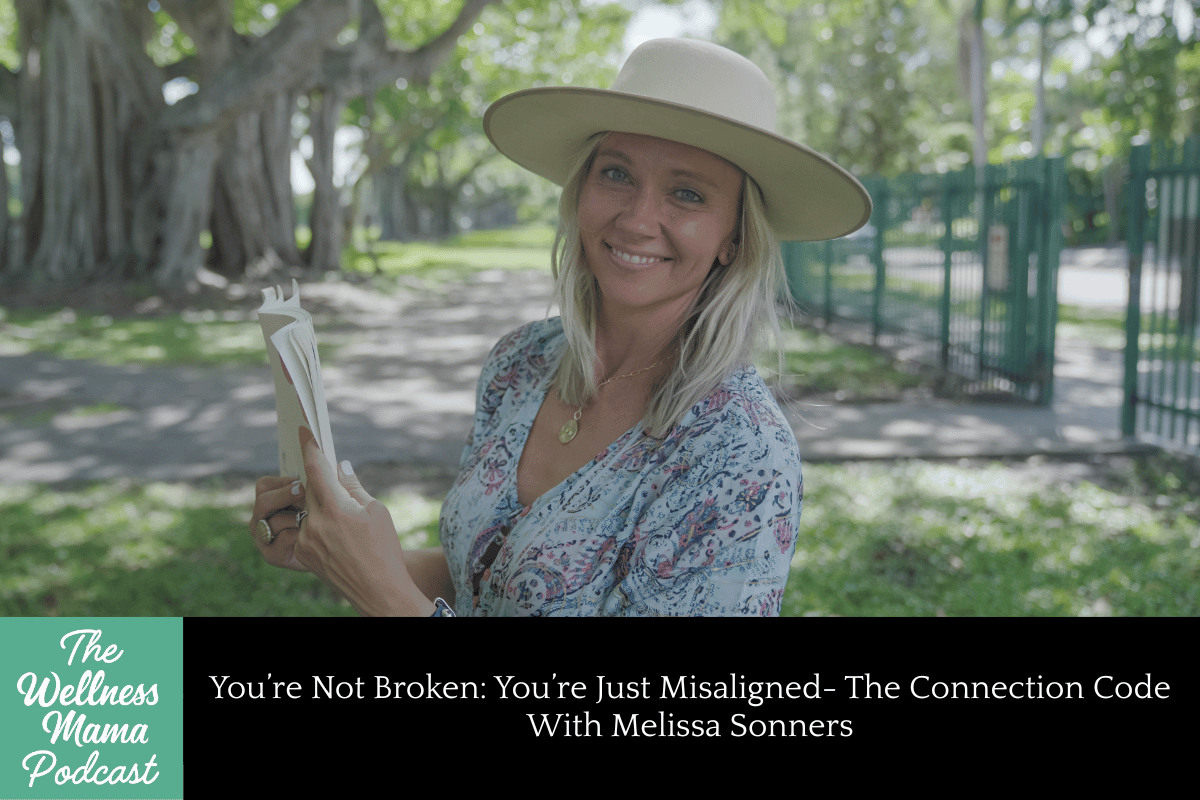
And I really enjoyed getting to know and learn from today’s guest who is Dr. Melissa Sonners. She’s a nervous system guide, brainwave educator and author of a great new book called The Connection Code, which I will link to in the show notes. Definitely a fascinating read. And her story, which she tells in this episode, it’s basically after losing herself between motherhood and career she learned about rebuilding from the inside out and coming back into alignment.
And specifically what this means on a neuro level from a brainwave perspective. And we talk about kinda challenging the idea of self-care and how the normal idea of self-care is a disservice to women. So how it needs a rebrand, understanding the different brainwave states and how we can use these to our advantage.
And a lot about nervous system and so much more. Some definitely like immediately actionable takeaways in this episode. So let’s join Dr. Sonners now. Melissa, welcome. Thanks so much for being here.
Melissa: Oh, I’m so excited to be here with you, Katie. Thanks for having me.
Katie: I’m excited for our conversation. I recently got to connect with your work and start learning from you. And I feel like these are gonna be really resonant topics, especially for a lot of the moms listening. And specifically I loved, I really resonated with the idea that you talk about of you’re not broken, you’re just misaligned.
And I think that is such an important paradigm shift, especially for a lot of women, and I know this comes from a very personal place for you as well. So if you’re willing, I’d actually love to dive in by hearing your story and what kind of led to this understanding in the first place.
Malissa: Yeah, absolutely. I’m a mama of three. You know, like many mamas out there, just busy doing my best to do it all, juggle it all. And long story short, basically at some point when our kids were, six, four and one, I got hit with neurological Lyme disease coupled with mold toxicity. And, you know, looking back I realized a lot of things that set me up to be in the perfect storm to get sick.
And so, you know, my downfall was neurological Lyme and mold, but it really happened because of the way I was living. And I think it’s the way that so many of us as women are living today. And so as much as I want to share my story, I wanna keep it general enough that anyone listening to this can apply this to their life.
Because what was happening, Katie, was, you know, I was getting home from work, doing all the things, trying to take care of myself, you know, do traditional self-care, which is just another to do item on our list, and I kept hearing that little voice, you know, that little voice that we all hear in the morning that’s like, I need to just sleep more.
This is too much. I’m tired. Or that voice that we hear in the middle of the day, you know, I need a break. And I just kept pushing. I kept hitting the gas and I wasn’t pumping the brakes. And so what happens from a body standpoint is when we don’t listen to the whispers, they become screams. And so there’s only so long that we can go on this way.
And for me, you know, Lyme and mold toxicity were essentially the best thing that happened for me because the way my brain works is I love to, you know, figure out solutions and why something’s happening. The body doesn’t make mistakes. And so it led me on this trajectory of really doubling down in the neuroscience and pairing it with wisdom and ancient healing strategies and intuition. And what I found is that the way that we actually can take care of ourselves, that is way more effective than what I was doing for traditional self-care, happens in two minute micro moments, and it creates such a huge shift in not only how we feel but how we show up in our lives for our children, for our work, for our partners.
And what’s, what I’ve realized on the other side of this whole experience is that I was making it so much harder than it had to be. And I think so many of us do that today. You know, we’re just, we’re trying so hard to do all the things, to juggle all the balls, and we’re making our health and our self care just as difficult and just as complicated. We’re living in a time of information and knowledge, and it’s time to get back to wisdom. It’s time to focus less, less on all the to-dos and to figure out more, to change how we be, how we show up. And so that’s what I love to talk about now, you know, I really, I love the science. I love preparing the research with these concepts because it helps women understand how powerful these tiny shifts that we’re gonna talk about today can be.
Katie: I love that and I’m really excited to learn some of these specific shifts. And before we get there, I just wanna double click on something you said that I think is so powerful and even on its own can be absolutely life changing. Something I realized too, but slowly, which was how you said these conditions that you experienced were huge gifts. They were, you said they were the best things that ever had ever happened to you. And I’ve said that before too. Like symptoms are incredible messages from the body and in a sense they’re gifts.
And I eventually got to that place with Hashimoto’s for myself as well, realizing I would never have gotten to go on parts of this journey had I not been given that word and told that I would have it for the rest of my life. But I also know that was for me a very slow and subtle shift that I had to sort of reframe my inner narrative away from, I’m sick and my body’s attacking itself, and why did this happen to me? And into that I was healing every day and my body was always on my side, and what a gift it was to get to have this experience of friendship with my body.
So I’m just curious if there were things in that journey that were helpful for you in making that mindset shift. Because I think that alone, like shifting into more curiosity and friendship with our body can be so absolutely life changing.
Melissa: Yeah, that’s such a great question and I think, you know, I’m very fortunate that I have a background in chiropractic. And so for those that don’t have this innate trust in the human body, like, feel free to borrow mine. But I knew, you know, as chiropractors we’re taught, the body doesn’t make mistakes. It sends signals and it sends messages and you know, we don’t wanna put a bandaid over the check engine light.
We wanna actually figure out what’s the message that this is telling you, what system needs to be addressed or needs help or support, or is getting too much of something that it doesn’t want. And so from that, you know, paradigm, I think it was, although it was really hard and really uncomfortable to experience what I was feeling and very easy to go into victim mode, right, which I think can happen for anyone, but at the end of the day, I knew that I needed to start to peel off the layers and get to the root of this and figure out, you know, what role was I playing in this happening?
Because when we can get there, when we can pull back from the victim mindset, that again is very easy to slide into, whether it’s, you know, for experience, sickness or burnout or any of these things, we really can become empowered because what we start to realize is that we have more control over our life and the outcomes. You know, to some degree. I know there’s some diagnoses and things that other people get that maybe can feel less that way, but I think ultimately almost everything that happens to us, we can shift into this reframe of what is the bigger message here. So many of the most important moments and lessons in our life are gonna feel the hardest viscerally because that, you know, pain is the body’s way of saying pay attention to me. You know, you’ve had babies. I’ve had babies. For any mama listening, you know, birth and labor, we experience some very intense feelings.
And that pain signal is our body’s way of saying pay attention. You know, the contractions guide us to move our hips and our body to help get the baby out. Pain has a purpose. And so, you know, I think if you don’t trust in the human body, like I said, feel free to borrow mine. But this really becomes a moment of empowering control over your life.
Katie: I love that idea like, you can borrow the confidence from you for a little while. And that’s something that I slowly kind of came to also is like I would say there’s very few things in life today that I would say I believe with complete certainty. And one of them is that our body is always on our side.
And when given what it needs, it will always move toward a state of health that like it’s always working for us and never against us. And I love that you explain that so eloquently and beautifully. And now I would love to kinda delve into some of these micro moments because I feel like even just calling them micro moments makes them feel achievable even for the most overwhelmed of moms.
And from what I’ve researched of you, there’s actually like a lot of data to back up that it really doesn’t take these massive, long actions actually, like these little tiny shifts can make a tremendous difference over time. So I do wanna make sure we also talk about play, but before we get into that, let’s talk about brainwaves because I feel like you have a unique perspective on this that I haven’t heard, explained very well.
And I feel like most people don’t have just like a general passing understanding of brainwave states in what they look like in our lives anyway.
Melissa: Yeah. So what’s the question?
Katie: Sorry, can you just kind of like walk us through the different brainwave states we experience as humans and then how they affect us, not just our mood, but actually like so many aspects of life.
Melissa: Yeah, so I’ll start with, you know, cortisol, anxiety, fear, and overwhelm as a feeling that brainwaves can instantly shift in a moment. And because I think that’s, you know, that’s something that a lot of today’s women experience. Brainwaves are something that I did not hear, talked about a lot anywhere, and the research behind them is so incredibly powerful.
And this was the tool that got me out of my hole of feeling completely overwhelmed and thrown into sickness. And not only that, but it’s a tool that I use now every day. It’s two to five minute shifts and I am, I would say my healthiest state now is a 44-year-old woman, physically, mentally, and emotionally because of these micro moments. So the brainwaves are really, really cool and I like to simplify and use analogies so that women or any listeners can really envision this. And just so everyone knows, this is not something that we just have as women. This is for our guys too. So we can share this information with them, but we can think of brainwaves like gears in a car, or even channels on the radio.
And we’ve essentially got five main ones that I like to think about and talk about, and for many of us, we are running in gear three beta brainwave all day. And when we’re in beta brainwave, and we’ll, I’ll talk a little bit more about what that means, but, we are essentially in go, go, go mode. This is the brainwave that we’re in when we’re in do mode. This is the brainwave that we’re in if we’re exposed to white or blue lights or our phones or our screens. So you think about, you know, if you wake up and you’re in traditional household lighting or go on our phones early in the morning to late at night, beta is intended to be our get stuff done brainwave.
However, she’s not intended to be ridden all day. And so what happens when we spend too much time in beta is cortisol goes up. We over fire a part of our brain called our amygdala, which is like our fear center, our security guard that kind of keeps us on high alert. So cortisol goes up. We’re not churning as much dopamine, we aren’t living in present time consciousness.
So you think about these are the moments where we’re constantly either worrying about something in the future or ruminating over something in the past, and, you know, for mamas listening, if this isn’t enough information to switch and work on this for you, these are the moments where, you know, our beautiful kiddos come up and are in front of us and we can’t fully be present with them. We’ve trained our nervous system, we’ve trained our hard wiring to stay in this go, go, go mode. And so, you know, I think as a mama, we hear that quote so much, enjoy every moment. It goes so fast. I call BS because not every moment is enjoyable, you know, to be honest. And I think sometimes that saying just made me feel more guilty, like I’m not enjoying every moment.
But what aligning with our brainwaves does, and we’ll walk you through it here, is it allows us to be present for the moments that matter. And so for those of us living in a constant state of beta, what we can talk about is, you know, how do we spend a little bit more time warming up to gear three for the day? How do we make sure to hit Gear one and two before ramping into high speed for the day? This is where we win. And the reality is, is we don’t have to spend a one hour morning routine that we hear about on all the podcasts out there, you know, that we just don’t have access to. This can literally be two to five minutes in the morning for your morning routine.
This can be a couple of what I call microdosing connection breaks during the day. I’m a huge fan of microdosing, and when I say it, I’m not necessarily talking about mushrooms and things like that. I’m talking about microdosing connection with your brainwaves, with yourself. And then this can also, at the end of the day, be a two to five minute evening wind down.
You know, we don’t have to think about the way that we do this successfully, the way that we take care of ourselves successfully is this one hour bath routine and journaling and this beautiful Instagram friendly picture that we all portray. And so then what happens is we skip over it completely and miss out. We can absolutely take advantage of these small windows of time that we actually have and change how we show up.
Katie: I love that and I would love to delve deeper in that because I would guess many people listening, especially moms, can identify with, as you explained that, that concept of being kind of stuck in the beta state, not even maybe knowing it was called that until now, but just within the daily life of a mom.
And I’m curious especially for these like little micro moments, micro doses, what those look like. Because for instance, one thing that’s been really helpful for me is having a morning routine that’s also pretty short, but around just getting outside and getting natural sunlight and when possible barefoot outside and hydration.
So I’m curious, is this something I could like stack with my like 15 minutes of outside time in the morning? Or how does someone like implement these little short micro moments?
Melissa: A hundred percent. I’m so glad you asked that because this is all about stacking. You know, I say a lot, self-care needs a rebrand. It’s a system that has failed us for so long and we blame ourselves for failing when it’s the system. We don’t need to, we don’t need to make more to do’s in our life. You know, self-care to me is really connection. And so stacking these micro moments with things that you’re already doing is the magic. And a lot of the research shows actually that it’s two minutes, these two minute windows of time in theta and alpha, which we’ll talk about in a moment, are what actually really moves the needle. So it’s not even that we don’t need a one hour to do these things, that actual short bursts of frequent consistent activity are more effective retraining the nervous system.
So that’s amazing. Right? Right there it’s like, oh, I can, I can be super effective in the small pockets of time that I actually have. So something you’re doing in the morning that’s amazing is getting the sunlight. So, let me explain these gear one and two for a moment and then if that sounds good to you, I’ll walk through kind of how we do this.
Okay. So, you know, theta and alpha are gear one and two when it comes to brainwaves, and essentially these are two of the most beautiful states that we’re in naturally if we don’t throw ourselves out. So you know, expert meditators, like, work for years to be able to achieve these states. And we wake up in them.
We wake up in a brain state called Theta. This is gear one. Theta is that transition between sleep and when you’re awake, it’s kind of a dream-like state. It’s a little bit translucent. It is, if you’ve ever heard someone say, I get my best ideas in the shower, that’s Theta. So Theta is a direct channel to our intuition.
It’s a direct channel to source, to creativity, to our insight. Theta is access to our voice in a world where we hear everybody else’s. Theta is also the gateway to our subconscious. What does that mean? That means that anything that you do in Theta, fast track reprograms your nervous system. So in your theta window, if you go right into do, do, do mode, or you go right into cortisol and stress, like it’s so easy to do, you’re basically training your nervous system to run in that gear. But if you go into theta in a more aligned state, by impacting your lighting, like red lighting, amber lighting, keeping your household lights either super dim or even better, getting some circadian friendly lighting in your house, that keeps you in theta.
If you go outside and you enjoy, you know, sunrise, even just for a few minutes, that keeps you in theta, basically the main action step I tell women for theta is to listen and then the main thing to not do is to not go on our devices, not go on our phones, not go on our screens and not expose ourselves to, to traditional household lighting.
Katie: I love that. Because I’ve been saying some of these things for years too, but you give the brain kind of brainwave science to back it up. And I’d also love to go a little deeper. You explained it some, but the idea that self-care needs a rebrand because I have also thought for a long time, like the way that we see self-care portrayed in the media and even just on social media seems like it actually maybe is like actively doing a disservice to moms and I know many women who are stressed of thinking of all these things they’re now supposed to do for self-care that they need to add to their to-do list that are now also just an additional source of mom guilt and are actually, none of those things are actually leading to any legitimate self-care to begin with. So what do you mean by that and how do you think of that and how do you implement that in your life?
Melissa: Yeah, well, self care, the traditional system is definitely failing us and It’s more of doing to yourself, right? We have enough to do’s and it’s usually at the very bottom of our list, and so we don’t get to it. Selfcare, the rebrand that I suggest is connection, and that’s more about being with yourself. And the cool thing about that, I mean, there’s many things, but one, you can do it anytime, anywhere, right?
Like you can incorporate this kind of self-care in the car when you’re doing carpool, when you’re with your children. This is an internal dialogue and check-in. You think about traditional external self-care, right? So for me, I would love to know what you think about Katie, but for me, I would think about, you know, a massage or maybe like a pedicure or a manicure or a facial, right?
All amazing things. I do all those things. I love all those things. However, I don’t assume that those are the things that are moving the needle for me. I no longer assume that I have to push through until I can get to that once a month facial that I scheduled for myself that I have to get a babysitter for, that I have to leave my children for. I now know that I can incorporate this connection in the midst of any day when I actually need the regulation and the connection most.
Because if we look at what a lot of the, you know what a lot of the self-care is, like, supposed to do, it’s supposed to balance our nervous system. It’s supposed to get us out of our head and into our hearts. But for me, so much of the time, you know, I would push and push and push to get on this massage table or to get the facial or whatever. And I don’t know about you, but I would lay on the table and my head is still going right? I’m still doing mom math, I’m planning the meals. I’m still in beta. I’m still ramped up.
And so essentially it’s not really doing what it’s perceived to do for us. And so again, it makes us feel like a failure when it’s the system that’s failing. It needs a rebrand for today’s woman, is what the reality is.
Katie: I absolutely agree with that. I’ve said before, like, it’s not about the like bubble baths or the, even like the facials and the massages. I’m with you. I love body work as well. And I can see your point of like, if we’re not addressing the brainwaves and the inner side and the mental stress as well, like that’s kind of like putting a bandaid on something that’s still very actively bleeding or that like needs to be addressed in a different way.
And so I love this and I think like to your point, it’s a both and. it’s not that you’re saying those things aren’t also awesome, it’s just they aren’t doing what we’re promised they’re doing and we’re still stressed and overwhelmed. And another topic that I love and I think as moms we get a unique and beautiful example of this often is the power of play.
And I know you talk about this as well. This is something I was a very slow learner on as well and was very like type A and kind of discounted play as a concept for a long time. And admittedly, I still even have trouble with things like board games in the category of play. However, I love your approach on this and your mindset. So can you walk us through why play is so effective and so underrated?
Melissa: Yeah, so play, and we can actually tie this to what we were just talking about with the brainwaves. So gear two for the brainwaves is a state called Alpha. And Alpha gets us in a flow state and it gets us in present time. And so when we spend micro moments, which we’ll go into when we talk about play here in a second, when we spend micro moments in alpha, what we teach our nervous system is how to instantly go into present time. So what does this look like? This looks like, I’ll describe my morning this morning actually. Because this is very real and I always wanna be very real, right? I had a sick kiddo last night, so I was up a lot of the night with him.
You know, that’s our most important job as a mama. And I have a full great day of work today. And so what happens, you know, I think because of the tasks that we have taken on as women, we are in this go, go, go mode, this to-do mode, right? And we get in the zone and it’s, I love being in the zone. And then we have to be able to shift gears very quickly into our heart, right? So I’m running around doing the emails, doing the things that we all do. I’m in that go mode and my son is like asking for some lemon tea. Of course, of course, of course, of course. And this sounds so silly, but this is, this is really, really important because this is the power of these tools.
It’s these tools spending two minutes in these amounts of times that teaches our nervous system how to do this in the moments that matter. And every day when you spend two minutes getting into theta or getting into alpha or going into play, which I wanna talk about, because this is a really important topic. You teach your nervous system this is how we do it in the moments that matter. It’s like flexing your bicep muscle a little bit every day so that when you go to lift the big thing you have the ability to do it. This is the most important reps that we need to be doing as women, as mamas. I call ’em regulation reps. And so you wanna aim for two minutes, three times a day, I’ll throw in the four just because 2, 3, 4 is fine. Two minutes, three times a day for you. This is for you because this, what leads to is at the end of the day, we’re not putting our head on the pillow and playing out all the mistakes that we made throughout our day.
We are living our lives from a place of conscious choice in every moment, because we are no longer latching ourselves onto everything external. Whether it’s self-care or whether it’s the things outside of us that we don’t have control of, this is now creating the power from within, and this is the new way, and we do it through regulation reps, through flexing the nervous system, through spending two minutes in theta, two minutes in alpha. What research shows, this is really cool, and we can link some of this if people want, and I also have research on my website, just two minutes in alpha in play, which we’ll talk about right after this, boost dopamine and it boosts our HRV, our heart rate variability, which basically translates into our resilience. Now you think about for your listener, busy mamas, busy women and the men, right? We cannot control what happens in our environment.
And you know, the reality is, the most likely to survive is not the strongest, it’s the most adaptable. And so of all the things that we can impact in our life, HRV is one of the most important because it allows us to kind of go with the flow of what is our life, what is the unpredictability of, especially for mamas, right? And so all these things that I’m talking about in two minute bursts a few times a day, increase dopamine, lower cortisol, and raise your heart rate variability, meaning you become more resilient to what’s going on.
And most importantly, you’re able to quickly shift gears or channels from go, go, go mode into your heart to be fully present with the person in front of you. And so now I would love to talk about play because play, you know, when we think about self-care, it becomes like yet another thing we have to do, right? And when we can make this more fun, just through a reframe and a bit of intention, it completely changes the game. It becomes a I get to, it no longer is something that you have to schedule.
It’s like your body starts to seek out. And I just wanna say, you know, when I say play, this doesn’t have to mean you’re going out and like being silly and funny and laughing and all the things. If that doesn’t feel aligned for you, this is essentially anything that brings you joy. Anything that lights you up, anything that feels like it gets you out of your head into your heart. Play could be a puzzle. Play, could be sitting and having a puzzle on your table and like doing that, you know, a couple minutes here and there throughout the day. Play could be, for me as a 44-year-old woman, two years ago, I went back to gymnastics. I was a gymnast as a kid and for some reason I hit this point where I was like, you know what, I’m sick of just sitting here watching my kids get to do this. I feel this peace in my gut that’s like yearning for this and missing it. And so I asked my kids gymnastics coach if he would train me, and he did. And so, you know, I incorporate micro moments of gymnastics and stretching and tumbling and flexibility training, and then macro of going for an hour once a week and tumbling, you know, at the gym. And so when you think about play, if it’s a word that doesn’t necessarily resonate with you, I encourage you to outside the box and perhaps think about what you did as a kid.
Because you know, connecting back with our inner child, I think a lot of us have heard about some of this work, is one of the most powerful things we could do. Play has the ability to regulate the nervous system. So I know you love biohacking tools just like I do. I’ve got a sauna at home, I’ve got the PEMF mat, I have all the things, you know, and again, the reality of a lot of these tools, what they are doing and why they work, is they regulate our nervous system and they get us from our heads back into our hearts. And so when our nervous system is regulated and working as it’s supposed to, our body can heal. We can handle stress, we can handle load, we can seamlessly pivot through our day without getting, you know, thrown into cortisol and feeling snappy and burnout two minutes of play does that.
Katie: I love that. And like I said, I feel like those of us who have kids, we have like a built in teachers of this. In fact, I look at my kids and see in them so many examples of things that like in the biohacking world, we learn and that we feel like are so novel, but actually like we’re kind of born with these skills on board and we just forget them over time.
Like another example I think of is, I know Huberman did a whole podcast that really went deep on the physiologic side and how that can be helpful for the nervous system. And as he was explaining this in great detail, which was awesome, what I realized was like, oh, babies do that naturally. Like when a baby is really upset and crying, they do the like, hmmhuuh, naturally, like it’s built in and we forget all of these amazing things. And the same with play. I actually, the past couple of years, this year especially, one of my things I’ve been focusing on is realizing, like, trying to get back to a little bit of, like, childlike energy in the world and to like wonder and awe and play.
And I feel like those things is like just touching on them a little bit more brings so much more joy and peace into life. And so I love that you make this tangible and also kind of like give the background of what’s happening in our body when we’re able to do this in just like small moments. And I think to like bring it back to also what we were talking about earlier is kind of the load of motherhood. I feel like this gets talked about some, but never really solved. But kind of the invisible load that moms tend to carry of all the things that we juggle. And statistically, like many moms are very overwhelmed in the modern world. And I’m guessing, as you explained, a lot of this goes from being stuck in that beta state.
But like to get back to the idea of the beginning of this podcast, talking about like we’re not broken, which I think you’ve explained so well, we’re just misaligned. Like, are there any other ways that we can get back into alignment with our nervous system and kind of break this societal overwhelm and mom guilt that we seem to carry so much?
Melissa: Yeah. Yeah. And I’ll say one more thing about play that’ll kind of bridge into that too. You know, one of the things that was really cool in research that I found recently is that what was discovered is that we’ve got these seven emotional circuits basically, that are subcortical, meaning they’re below our awareness and they drive our behavior as human beings. These are things like fear, anger, grief, right? These very real, visceral feelings that we experience as human beings. Well, what was discovered in this research is that play is one of them. And what’s really cool about this is that it showed that play is not just something that we will benefit from incorporating.
It’s something our body actually needs. And so when we’re not incorporating the things that bring us joy or lightness or freedom, what happens is the other circuits get too loud, right? So like fear or anxiety or anger or depression kind of run unchecked. And so what’s really powerful about play, if we look at almost like a circuit system in a home, and each room perhaps is one of these emotions, play has the ability to downshift them all.
And so switching on play literally activates parts of our brain, the amygdala, the prefrontal cortex that make it physically impossible to feel these other emotions. So one of the things I love, I know our friend in common, Molly Eastman, and I geek out on this, is I truly feel that if every woman had the ability to get on a bike and ride her bike for like two to five minutes a day, or jump on a trampoline for like two to five minutes a day and not necessarily like, your head down and do it because you gotta do it.
And you heard on a podcast that exercise is good and zone three training, you know, whatever it is. But like, get out and do it because it feels good. Get out and do it because it’s fun. And for us to look at those things from this perspective, instead of again, just another have to, like, let me go out on my bike and just zone out.
Let me go into theta, let me daydream. We don’t do that anymore in today’s age. And so we’re not giving our brain this opportunity to like clear the slate, right? And to get some of the tabs to close. So when we’re talking about women, you know, being more overwhelmed than ever, you know what’s really interesting is men are juggling a lot as well.
And because of our hormones and because of the way that our brain works, we have a very sensitive, what’s called default mode network. It’s basically a piece of our brain that can pull us into rumination very quickly. It can pull us into having a hundred tabs open in a way that a male’s brain just isn’t designed to work. And again, our body’s not stupid. This is smart. I mean, this is for survival. This is for connection. This is so that we can foresee challenges that might be happening or threats to the community and protect our babies. Right? But the problem is in today’s world, we don’t have the ability to turn it off the way that we used to. And so what’s really powerful about everything that we’ve talked about so far, and you know, I love people’s questions, so please ask questions in the comments or anywhere that you can to help take this concept deeper, it’s also in my book, the Connection Code, this is how we change that.
This is how we literally start to switch off the pieces of our brain that get us stuck into those loops. This is how we can have, you know, many tabs open and be thinking about what our kids need for Spirit Day next week, and what gift we need to bring to blah, blah, blah, and what emails we need to do for work and hey, did I remember to grab butter at the grocery store? Right? Like, we can do all those things, but we can do it from a regulated place. And so this is, again, one of the big things I want everyone listening to understand, is this is where we stop just living our life, focusing on the to-dos, because that gets us in this high cortisol, in this high fear anxiety loop, and we pivot more to the be’s. How do I wanna be? How can I best show up today?
What do I need in this moment? Right? These are things that take no extra time. Going back to what you said earlier on in the podcast, you know, can we stack these with other things? Yes, you can stack this anytime. I literally lay in my bed in the morning and I start my day instead of what I used to do, thinking about all the areas I’m behind and who needs me, it’s like that will come up and I’m like, nope, that’s gonna wait a minute. Let me first ask, what is it that I need?
Yes, this day has a lot and it’s overwhelming. How can I make it feel better? That’s your theta window. That’s your theta time. That is how we change self-care to start making it work for us. And remember theta is where you hear your own voice be before the world gets loud. And again, ladies, I don’t know when’s the last time someone asked you what you want or need, but we need to start to be our own hero here. We need to start to take care of ourselves before we show up to the world asking what they need.
Because it’s not working, right? It’s not working for us. It’s not working for them. And like I said at the beginning, the reality is, is these tools are really quick, easy. And there’s heavy, heavy science and research to prove that they work.
Katie: And you mentioned your book, and I’ll course link to it in the show notes, and there’s so much more in there than we had time to go through in a podcast episode, but can you kinda give an overview of all the other things you cover in your book, how it like really walks people through this and gives you like a super tangible way to start making these shifts. And also where people can find it. And like I said, of course I’ll link as well.
Melissa: Of course, you know, one of my main things is I said I hope people judge this book by the cover because I made the cover super sparkly and fun. And in my vision, I have this vision, I was visualizing this as I wrote this book, you know, of this woman sitting at a beach vacation and reading her self-help book and just feeling like, oh God, now another thing I have to do to take care of myself. And looking over and seeing another woman hold this sparkly, fun looking book and maybe getting that voice inside that’s like, that, I want more of that in my life again, I want ease. I want fun, I want joy.
And so the book, the Connection Code, I really, you know, I love neurology and I kept it super simple, but enough for women to understand how powerful these tools are. And the goal was basically to walk women through connecting them back to their intuition and wisdom and to what we all have literally inside of us. And I know that sounds kind of woo woo, but the end of the day, this isn’t about becoming or doing things to make us a different version of ourselves.
This is getting back to who we’ve always been before the world told us who to be. And this is about creating those opportunities and dialogues with ourselves to get back to who it is that we are. You know, what is it that we want out of this life? What is it that we deserve? How can we have fun and lightness, not just for ourselves, but for our families? And what’s really cool is it’s all really easy, it’s all really attainable. And it’s all really doable in our busy lives.
Katie: And I love even just this concept you talk about so beautifully of like that we’re not broken, we’re just misaligned because alignment is like that coming home to ourselves. It’s not implying that something’s like wrong with us, that needs to be fixed. And to kind of like take this full circle to where we started, I feel like that alone, that mindset shift is so important. I talked about it more on the physical health side of healing and autoimmune disease but so applicable kind of in all aspects of our alignment, whether it’s mental, spiritual, emotional, physical, all of it.
And I think when we can shift from that place of like judgment and overwhelm and into curiosity and friendship with our body, with our mind, with our emotions, we get such powerful messages and data that allow us to build more of that alignment.
And I know for me, this was a kind of slow learning process that I was kind of figuring out as I went along. And I love that you’ve made this like I said, very tangible and given women something that’s not overwhelming, that is in these, like, little micro moments. I feel like even for the busiest of us two minutes is doable.
Even for, I remember the days of like babies and toddlers and felt like I had no time to myself. Even then two minutes was doable and like you said, can make such a drastic difference. Is there anything else that we haven’t touched on that you think is especially relevant, especially for women and moms who are listening and especially maybe resonating with that overload and that overwhelm that we’ve talked about and like really wanting to shift into more of this kind of grace, ease and joy.
Melissa: Yeah. Well, I think it goes with what you were just saying about alignment, and I wanna be clear when I say alignment, it doesn’t mean that it’s necessarily a life of ease that we’re living. In the book I walk through, you know, the first section is misalignments, kind of like, how did we get here? How did we get to this place? What lie were we sold, right? We’re living in a time where we’re told, lean on your village, but we don’t have one. These mantras that we’re given as women put on your oxygen mask first before serving others. Great. How do I do that while I’m serving others? And then I go into getting aligned, right? And so how do these tools help us get there?
And then staying in alignment, like how do we actually make this work amidst our busy lives? And when I say alignment, again, it’s not about ease, but what it is is congruence. And it’s first knowing and making choices from a place that works for you. It’s instead of reacting to everything in our environment and not pausing and having a choice in it, instead of going down that old path, you know, if you visualize like in a field, that path to the left that we’ve always taken that’s maybe really smooth and has quote unquote worked for a long time, it’s starting to take a pause in our life.
And before showing up in any situation, not asking, what do these people need from me, but what do I need from myself? And in that, we’re creating a choice. We’re creating neuroplasticity, we’re laying down new hardwiring in our brain, and we’re starting a new path. And what that path does is in these micro moments, in these small, subtle things, guys, these are small things, you start to create a life out of your design. You stop living someone else’s, you know? You stop waking up and asking maybe like, how did I get here? Is this all there is? You know, even in the best of relationships, I think we can all get to that place. Is this what my life is? And so this allows us to start to live a life, you know, by design and start to fall in love with it again.
Katie: I love that and I think that’s a perfect place to wrap up. And like I said, I’ll link to the book and also to where people can find you on the show notes. But for anybody listening, where can they find you, connect with you and keep learning from you?
Melissa: Yeah, absolutely. My website, drmelissasonners.com. I know we’ll have that linked as well. I have a ton of freebies, resources, research on a lot of the things that we talked about today. You can find my book there. And then also I have a podcast, Be Inspired Mama, MAMA. And my Instagram handle is the same one.
And I love to have these kinds of conversations. And then on Instagram, obviously I do a lot of, you know, creative, fun, short reels, kind of playing off all the things that we feel as women today paired with the neurology and these micro moment tools to help create the shift.
Katie: Amazing. Well, I will put all of those linked in the show notes. This has been such a fun conversation. I feel like you have given us so many actionable, immediate takeaways and that you cover so much more in the book. Highly recommend that and we’ll link to that as well. But for today, thank you so much for your time and your wisdom and for all that you’ve shared.
Melissa: Awesome. Thanks for having me, Katie.
Katie: And thank you as always for listening and sharing your most valuable resources, your time, your energy, and your presence with us today. We’re both so grateful that you did, and I hope that you’ll join me again on the next episode of The Wellness Mama Podcast.




Leave a Reply