Read Transcript
Child: Welcome to my mommy’s podcast!
Katie: This episode is brought to you by BIOptimizers, and I love this company. And specifically today I wanna talk about one of the favorite things that they make, which is called Masszymes. So let’s be real. We all kind of start this part of the year saying, we’re going to eat cleaner, train harder, feel lighter.
But it’s not just what we eat and what we do, it’s what we absorb. And if our digestion is sluggish, the body just can’t keep up. And this is why I love Masszymes all year, but especially this time of year because it’s a simple digestive ritual that’s made a huge difference for me. It’s loaded with 18 enzymes, including four times more protease than top competitors, to help us break down dietary protein, carbs, and fats efficiently.
And I’ve shared before, I’ve done a whole episode on enzymes and how this was really, really impactful for me personally. But this means that we get better nutrient absorption, less bloating, and more real energy from the food we’re already eating. I’m also a big fan of nutrient loading and really maximizing that in our food too.
And enzymes help us get the maximal benefit from this. It’s this hardworking, yet smooth enzyme blend, and it’s been a favorite of mine for years, and a customer favorite for over 20 years. It’s a ritual that your stomach will thank you for anecdotally. I feel like I really don’t get sick now that I have made these a regular part of my routine.
A lot of people find they don’t have post-meal food hangovers or bloat after taking these, just clean energy to crush goals all year long. For a limited time, you can save up to 26% off their products and bundles during the New Year New You Sale by using my code wellnessmama15 at checkout.
And select bundles are on sale for up to 45% off, so you can get a massive discount there. Visit bioptimizers.com/wellnessmama and use the code wellnessmama15 at checkout. To get the best deal on Masszymes and all BIOptimizers products. So that’s bioptimizers.com/wellnessmama and the code wellnessmama15.
So start 2026 with a stronger gut, more energy, and better digestion.
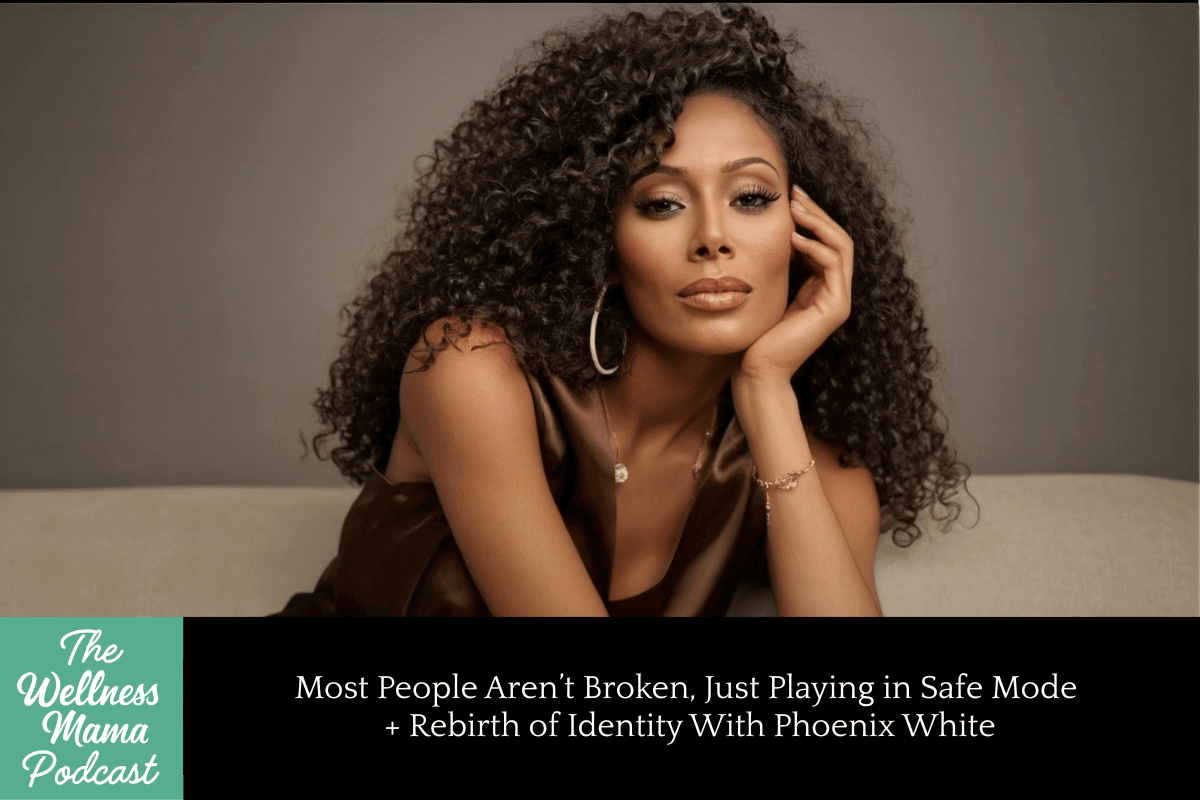
Katie: Hello and welcome to the Wellness Mama Podcast. I’m Katie from wellnessmama.com, and in this episode we tackle the idea of why most people are broken. They’re just playing it safe and being predictable. And how survival mode is killing you, as well as how to reprogram your hardware. Get to go in a lot of different directions with this one.
And I’m here today with Phoenix White, who is the founder and CEO of Origin X and the Sacred Celestial. She is a multidimensional force. She does all kinds of things, including she’s a bestselling author and she’s known for delivering electrifying, soul rewiring experiences that ignite raw cellular power and lasting transformation.
And she’s led these retreats all over the world and has a lot of online resources available as well related to a lot of the things we talk about today. And I will link to all of those in the show notes. But in this episode we go deep on motherhood, surrender, balance breaking predictability, presence, how to engage our senses to rewire our hardware and move out of survival mode and so much more.
So let’s jump in. Phoenix welcome. Thanks for being here.
Phoenix: It’s nice to meet.
Katie: I am so excited to chat with you and oh, I’m excited to meet you too. We get to, we connected through a mutual friend and I got to deep dive into your work in preparation for this episode and feel like there is a hundred directions that we could go and so many things I wanna make sure we get to today.
But one thing especially stood out to me in that I was reading in your work, which is the idea that you say most people aren’t stuck, they’re predictable, and I hear that word stuck a lot, especially even when it comes to physical health. So I would love to use that as our diving in point today. If you could elaborate on what you mean by that.
Phoenix: So what I mean by being predictable, they’re not really stuck because I feel like there’s always a way out, and sometimes when people are being predictable, it’s because they’re being safe. So they’re doing the same things that are keeping them stuck because they wanna be safe, right? So they stay in those same patterns and that’s, that is a predictable pattern.
So what I found is when I’m working with some of my clients, if we can do things that are outside of their predictable patterns, that they normally do, the normal things that they are just accustomed to doing. This is just how it goes. This is just how it has to be. A lot of moms suffer in that way because it’s like, well, this is just, this is just what I have to do. But they don’t. It’s just getting outside of that pattern, trying something different that may feel a bit unsafe because it’s not predictable. You can’t predict the outcome. According to some people, you can’t predict the outcome, so it feels unsafe. So people don’t try, they don’t step out of it. So they stay in this loop of going in a circle of being stuck because they wanna stay in that predictability of safeness. Does that make sense?
Katie: That does make sense and I’ve heard something along the lines of that that we’ll kind of choose predictable discomfort over the unpredictable, even if the unpredictable could be actually really amazing. So it would seem like as humans, we have a little bit of like wiring around this. So how do you work with people on making that step toward doing something that’s not predictable?
Phoenix: I think the first step is being present and honest. I think if people really get honest about their situations, they’ll find when they go deeper into the layers is that some things are choices. Now there’s some experiences where it’s like, okay, this just happened. This is where I am right now. There’s nothing really I could do about it in this moment. But there are things, there are steps you can take to get outside of that. So for instance, the first step for me is honesty. If you can’t acknowledge what you’re, what you got going on, you can’t accept it and you can’t change it. So that first step would be acknowledging. So get really, really deeply honest with yourself and really, really present.
So as a mom, I’m sure you know, it’s very unpredictable, right? With the, with the toddlers or with the kids, right? So I found that when you are going through this space of being frazzled, the most that I’m actually frazzled or frustrated is when I’m not present. If I start trying to do multiple things at the same time, instead of just sitting and focusing in on that one thing that’s happening in that moment, that’s making me crazy, because kids, you know, when you’re on the phone, you’re doing something, they start rowing up. Like they get hyped if you just pause. Take a moment and be really, really present. You actually can fix the issue much faster than if you continue trying to balance it all at the same time. I think it’s just stopping and getting present is the first step, you know, so that is, that is the biggest thing I can tell somebody to do is get present in this moment.
Anxiety comes when you’re living in the future or you’re living in the past. It’s normally not when you’re just in the present moment, you can deal with just right now. Right in that moment.
Katie: That’s such a good point. I think of even in the extreme circumstances, like when in the past when I’ve gone through labor, is like you can actually handle it in that present moment. And if you think ahead to like, there could be hours of this left and then I have to push, then it feels overwhelming.
But you’re right, like we can handle almost anything in the moment if we’re actually in the moment. And it seems like almost every like teacher and guide and guru out there has some quote along the lines of like, being here now or being present or that is all that actually even exists. And I also totally can empathize with mom brain and how easy it’s to like be fragmented into the past and the future and the many open loops and all that goes into that. And in fact, I would say probably motherhood, I would guess is actually one of the biggest like shifts in identity that a person could navigate. And I would love to really dive into that topic as well.
Because I don’t feel like we actually get, like this is even talked about or certainly that we’re not prepared for this. And there’s this kind of like interplay of like losing ourselves in motherhood. And also like there’s an aspect of surrender that comes from that. That’s this beautiful lesson. But like so much goes into this like rapid and complete identity shift of motherhood.
Phoenix: I think that’s really, really true. So a part of motherhood for sure, you can step out of who you really are because you have to become something else in order to take care of your children like full-time. You know, sometimes we just separate from ourselves. And I think for me it’s, I had to learn over time how to remember who I was before they were here, you know?
And remember it’s like, okay, who do I wanna become and try to fit that in, in a, you know, I always say with moms like, you can’t have the perfect balance because I just feel like it’s very unpredictable with children. So it’s like it’s hard to have a balance and to have your career and have all that and it be equal.
Something has to give and take like one you get more of, one you get less of. You know, you’re gonna have to kind of do this juggling, this juggle dance, I guess you could say. But you definitely have to surrender into being a mom, but also surrender into being not o… Being okay with not being perfect or what your vision of a perfect mother is. Because I think a lot of us start to have this mom guilt. Where we feel like if we’re not everything, if we’re not the superhero, if we don’t sacrifice everything for our kids, if we, some of us, if we get a little ounce of something that’s just for ourselves, we’re being selfish, you know? Or that’s not what we’re supposed to be doing.
And I think choosing you first, and it sounds really bad, but choosing you first, then you have this overflow to give to your kids. It’s a much better version of you when you actually take time out to figure out who you are and give to yourself because our kids are an extension of us. So I tell this story like even with my son, my oldest son, when he was 10, we left and we went to Asia. And we sold all our stuff, we went to go work in Cambodia and India and Thailand, we were everywhere.
But he got to come with me. If I were just in my regular mom guilt, I wouldn’t have taken him away from school. I wouldn’t have taken him away from his friends. I wouldn’t have taken him away from all these things, but it’s like I need to show him who I am. So his, a the part of his purpose, I feel, is connected to mine. I think as moms, whoever our kids are to become, they’re connected to our purpose. And if we’re not doing what we were placed on this planet to do, if we’re not being ourselves, the best version, the whole version of ourselves, then our kids will never get to experience that because they won’t have an example to look up to.
You know, my son knows me, he knows what I’m about, he knows what I do, you know, he knows who I am, so if there’s a sacrifice here or there, he understands it. And then I do the same thing with my work. I separate from my work sometimes just to be there for my kids and they understand it, by like, what is, like, what’s a value to me? And I try not to have any guilt in between the two of choosing myself and choosing my kids. I just try to, you know, give and take as I can. That was a long answer.
Katie: I love that. Yeah. I think there is so much tied up when, even in the societal expectations of motherhood and putting everyone else first all the time, and I know I’ve been guilty of that many times and hear from so many women who have as well. And at the same time, like we know that modeling is more important than even our words.
And I would think most of us as moms wouldn’t want our kids to grow up and lose themselves and self-sacrifice to the point of burnout. But that’s what we’re showing them. So I feel like that reframe is super important and like the awareness, like you said, is the first step, even if it is a lifelong practice, to actually know that.
And I feel like also children are our best teachers and certain things can only be really faced and mirrored and processed in relationships, and especially in relationships with our kids because we have this unconditional love for them and they have this amazing way of mirroring back kind of our unresolved internal things that we maybe don’t wanna face.
So I’d love to talk about that a little bit too, because I know trauma has certainly entered the mainstream conversation. In a way that it was definitely not there 10 or 20 years ago. And I’m glad that it’s now okay to talk about that people are now taking on modalities and working through that.
And it still is a big issue. And I know for me it was like a multi-year winding path of finding out the things that were actually helpful. So I’d love to kind of go into the topic of trauma, especially from a motherhood lens and how to navigate that.
Phoenix: I think with navigating traumas, I think sometimes, sometimes we get stuck in that. I feel like the trauma topic has become kind of cliche in a sense. Like it’s so overused to the point that it’s becoming a bit of a crutch. You know? I think if we get out of the conversation of trauma itself and start focusing on, okay, what’s beyond the trauma? Like, what does my life look like beyond the trauma? Because sometimes when we just keep bringing up trauma, we keep reliving it, we keep recycling it into our, you know, into our field. It’s like, okay, when do we move past the trauma? We’ve gotten it, like we’ve talked about it, we’ve pulled it up, we’ve written it down, we’ve had the conversations about it.
We regurgitate in our, you know, all the time, but what does the future version of us look like? What do we want our lives to be like? I think if we start shifting the conversations from trauma after we dug it up, right, like, okay, now what do I wanna do now? Like, when do we stop talking about the trauma and we start talking about who we are, who we want to be, like what does our future look like? What do we wanna bring into our field right now? It’s just, I think that is one of the steps I would love to see people start to take more of, is not necessarily making trauma their identity, because trauma has become a lot of people’s identity and it’s almost like their safe space.
And that also can cause a loop where you stuck. Because that’s what you talk about the most. That’s a part of your identity, that’s your title. You know, I had to, I had to myself shift out of becoming or being the wounded healer. You know, because it was like, oh, I can relate. You know, I’ve been through it too, and it hurt me, you know?
And it just was like, okay, who would we want? Who do we wanna be now? Who are we now? What do we wanna absorb now? Like, where’s your power at now? Where do you, what are you feeling now? What frequency do you wanna bring in at this moment? Because, you know, whatever, we’re reliving, that’s the beacon that’s going out. And so I just, I feel like once we identify that trauma, then we need to change the conversation into like, okay, who am I really? I’m not this anymore. Who am I now? And I think the reframe is more important than the trauma at this moment. Because that trauma, you can get stuck even in trying to heal it.
You can get stuck in healing. You know there was a woman who wrote a book and she had the best title. She said, all this healing is killing me. And was like, wow, that is so good. So good, so good. Because it’s just, you could just go in a circle and you could be healing and healing and healing forever, you know?
And you just get caught in that loop. So, yeah.
Katie: I love that. I think that reframe alone is so important and can be so paradigm shifting and can be like a subtle shift that really compounds over time because I see this also in the physical health realm where people, and I did it for years, I would say I have Hashimoto’s and I identified with having thyroid issues and that became part of my identity, so much a part of my existence.
I had community around that. I see that with people who are like, I have mold exposure, I have Lyme, and I think or I am sick, or I am depressed, or whatever it may be. I think anytime we make anything part of our identity like that we give it tremendous power to your point. And we kind of take away our agency and shifting it and moving away from it. And also realizing like in those experiences, I get how that happens because there can be community and support around it. And certainly some part of us is still benefiting from whatever that experience is. So I knew for me, like with Hashimoto’s, I was fatigued all the time and I was also having trouble setting boundaries. Like I was not good at saying I need to rest or going to bed earlier. I was always doing for everyone else, so the Hashimoto’s was benefiting me. It stepped in and gave me fatigue to prioritize rest when I, like, I physically couldn’t do anything else.
So I think there’s some beautiful excavation that can happen around that. And to your point, without it becoming part of our identity. And the beauty there too is like when we can have that awareness and start to shift, we can hopefully, eventually like reframe and even find gratitude for the trauma, for the illness, for the whatever it is.
And I think that’s when, for me at least, it really, really shifted and I could look back and say like I wouldn’t have necessarily chosen these hard things that I’ve gone through or these traumas, and I wouldn’t trade them because I would never have gotten to go on this beautiful path of excavation and growth without those hard things.
Phoenix: It’s like you don’t skip the pain, you just upgrade your relationship with it. You know, it’s like you there, but you just stop letting it write your story. You know, and it, and even when I’m talking about the predictability and all that stuff, it’s like, it means that your nervous system is just choosing the same emotions, the thoughts and the reactions.
And it’s like, and it’s learned, you’ve learned like, it’s keeping you where you are instead of moving you into where you wanna be. And that is, that’s a part of like what I’m teaching, even with quantum fusion, it’s like we’re moving you into where you wanna be instead of regurgitating where you are. It’s not that the pain or that what’s happening to you is not real, it’s just changing your relationship with it. You know? I think that is, especially when it comes to autoimmune disease, I know a few people who have Hashimoto’s and it is extremely painful. Like it’s very, very painful. Like those flare-ups are very painful. So It’s like, how do I change my relationship with this actual thing? So, that’s a lot to go through though.
So it’s not bypassing the actual experience that people are having.
Katie: Absolutely. And I think that’s another, an important topic, especially for women and especially more as we like, know more about these topics in general. It’s like navigating that line between not making it part of our identity and like overemphasizing it and also not actually bypassing it under the guise of like surrendering or letting go, and we’re actually just like bypassing the entire journey of it to begin with.
And I think that’s like a tricky thing to navigate that I see kind of like play out on social media quite a bit these days. Do you have any advice for like navigating that surrender and kind of like without the bypassing.
Phoenix: I think surrender without the bypassing, I think is going back to the present moment in honesty. I think a lot of people are lying to themselves about a lot of things or saying, oh, I’m okay. You know, like even when I’m doing like manifestations and healing, like I don’t lie to myself. I don’t, okay.
When I’m not, you know, I was like, I’m not okay. I will be at some point, but I’m feeling this, this, and this, and I deep dive into like what I’m actually feeling. You know, like just compartmentalizing it, I feel like our feelings and the things that we’re going through, they deserve a voice and and a lot of times people teach you just be happy.
Just think positive, you know, that’s not real life, honestly. That’s just really not real life. It is try to get people to a neutral space where they’re not stuck in their emotion, but they allow themselves to feel what they’re feeling so that it has the opportunity to pass through them instead of getting trapped in them. Because if people don’t allow themselves to feel what they actually feel, they’re just lying to themselves. And I don’t think that you can fake with the universe. Like you can’t lie to the universe. Like it knows what you’re feeling for real, for real. So you can put on this brave face, but the beacon that’s going out is still pulling in that misery and that hardship.
So you’re still, that’s still what’s bloating in your, in your frequency, in your orbit. So it’s definitely being honest with yourself, but having compassion for yourself at the same time. Because you are doing the best you can and then taking steps after that to move towards where you wanna be and not getting caught in it, but really, really having the opportunity to speak with that feeling that you’re having instead of ignoring it.
So I see my emotions and my feelings like a round table. I have like sadness and fear and I have, you know, joy and, you know optimism. I have like all these emotions around my round table and I’m just sitting at the head of it and I’m just letting everyone state their case. You know, fear is just my biggest protector, it is like, look, you remember what happened last time. We don’t want you to get hurt. You know, you remember this is what happened and this is not safe. You know, it’s like hearing, hearing why you’re feeling what you’re feeling and giving it an opportunity to have a voice and then say, okay, I hear you out, but let’s try this instead.
We’re just gonna go together. Yes, we’re feeling these feelings, but we’re gonna still move forward altogether. We’re gonna take it with us, not leaving anyone behind. Or not dismissing, like, oh, I’m not listening to you. I don’t care about your sadness. You know. I don’t care about your pain or your heartache, or who hurt you. Because that’s what we’re doing when we’re just trying to fake happy and fake positive and, you know, throw all these things away that are really, really real. I think you can move past things when you give it a voice, because then it doesn’t fight so hard against you. You know, anything that you are trying to force, it keeps popping back up.
But if you flow, it doesn’t pop up, It doesn’t bite back so hard. Because it’s like, yeah, I hear you. I heard it. Well, let’s flow with it. Let’s take our time. Let’s flow with it. Instead of like, no, you know I’m saying you don’t have to be in a fight with all your emotions all the time and all your feelings or the things that you’ve gone through.
I think if people just calm down and stop fighting with what’s opposite of what they want to happen and just like flow with it, I feel like they’ll get there faster with less energy too.
Katie: I love that reframe and it, very resonant for me right now. At some point I’ll share more of this story, but this year I got to have the experience of what I can only describe as kind of like a death portal or a dark night of the soul that was more intense than any other experience I’ve ever had in this life, including like my most intense psychedelic experiences.
Like those all felt like child’s play compared to this. And what I realized in that I had done trauma work before and I was aware of things like sexual assault before and how I had locked down all my feelings around it and I thought I had done all this work to fully kind of like work through all of those things.
And what that experience this year beautifully taught me was I still was unwilling to feel a lot of things and it ended up being the perfect catalyst for all those things, like you said, that I had resisted feeling my whole life, whether it was rage, despair, grief, all these things that I had just like packed down, all of a sudden were like, we will be felt now. And I got to have a very intense experience of feeling that. But what I realized in one of the most painful parts of that moment reminded me there’s a quote from Buddha where he said though I’m in heaven or hell, I do not suffer. And I never understood that until somewhere in the middle of that pain where I realized pain happens in life.
That’s a thing that happens and what made sense to me in that moment was suffering is our inability to feel it, our inability to sit with those things, to allow our feelings to be felt, to go into the darkness, that we actually have more choice there than I thought we did. And it took for me the intensity of all of that swirly darkness at once to help me understand that.
But it was such a beautiful gift in that moment to actually get to feel that for a second.
Phoenix: I love that.
Katie: And you also mentioned a term, quantum fusion, which I know is involved in your work and I would love to get to learn more about that and understand more about that as well.
Phoenix: So, Quantum Fusion is like, so if you think of manifestation, so I would say manifestation talks to the mind, but Quantum Fusion talks to the operating system. So it’s less about wishing and more about reprogramming the hardware so that your thoughts and your posture and your energy match the reality that you’re building. So that’s really kind of what I would say quantum fusion is, and so I use a mix of focus and emotional synchronization where the prefrontal cortex kind of lights up and the amygdala quiets and your cells receive a new command. It’s like biology and energy working in the same direction.
It’s literally changing your signal on a quantum level. So it’s a mix of meditation and physical acknowledgement and embodiment at the same time.
Katie: I love that because it seems like often, I mean, manifesting of course has become quite the trendy topic lately, but it does seem like it’s often more like mind focused and then people get frustrated when they don’t get results just from like visualizing or thinking and like, to me, those are all still in the like the umbrella of effort, which doesn’t seem to totally aligned.
So I’d love to understand more about that. Because I’ve also read from your work that this is not like a long, that this doesn’t take years and decades. This is like a very rapid kind of rewiring of the hardware like you talk about, and I think this is so kind of paradigm shifting. So can you explain more about like how this works so rapidly?
Phoenix: Yeah, so what I like to tell people is you could pretty much start to do it in 17 seconds, so there’s a thought that when you can hold a specific focus of a thought for 17 seconds, it starts to move into your world. So that thought, that vision, that idea, that concept starts to align with where you are.
So I think a lot of people, they are out of alignment, they’re out of flow. So getting them to sync back into that flow and alignment back into, you know that, that purpose, you know, of who they are and who they were meant to be, it’s not really that hard. I think a lot of times, like we were talking about when you’re, when you’re living in the past or the future, instead of being in the present, it’s like bringing all these pieces and realigning them. Because you’re just out of balance. A lot of times when people are out of sync and out of flow and outta balance, that’s when they stop manifesting. That’s when their life starts getting hard. It’s just you’re just out of alignment and so it’s sinking that alignment back. So you start with meditation, it’s a key that’s in that meditation.
It’s a part of also quantum jumping. It’s identifying certain things, really getting into the vision of like who it is that you really wanna become. What is it that you really wanna do? Tapping into, how does that smell, how does that feel, what does that look like? What if your clothes look like? What does the house look like?
What does it feel like when you walk into the room? You’re really identifying every single aspect of the future version of you. And then I’m teaching you how to pull that into the present now. And you can do that within 17 seconds. You can start to merge that future version of yourself into the present moment, just with how you decide to act and think. So it’s meditative and it’s physical. And then what you do with that afterwards is the integrative part. And then your life begins to change, but you have to be willing to make the actual changes. So I’ll give you an example, my future self, in order for me to be at my most successful. So I did this jump and I did this fuse. It was like, oh, yes, she goes to bed, I was like, what time does she go to bed? She goes to bed at 10 o’clock. I go to bed at like 2. You know?
It’s like that made her more effective, more productive, because she’s going to bed at 10. So it’s like, okay. Now if I bring that into now, and that’s just a really short, like small thing. It could be my clothes, my hair, it could be the way I talk, the way my house looks, you know, what my environment is like, what I eat, what I take. You know, it’s all the things, how I communicate with people. It’s every single aspect, how I feel about myself, how do I talk to other people, who I’m actually around, who I’m not around, who I, who I eliminate from my world?
What kind of balance do I have? It is bringing all of those things into the present, and you literally can start to do that in 17 seconds.
Katie: And I know you have, I’ll make sure I link to in the show notes, but you actually have all kinds of educational resources where you actually walk people through this, you work with people. I’ll make sure those are all linked. But I think what you just touched on is so valuable in so many areas because it really is also like the work of integration, whether it be from work we do, from experiences we have, like for me, from this like Dark Night of the Soul, it’s like taking the lessons of any of those things and bringing them into the present moment, which is kind of what, like where we started even in this conversation of like all of the anxiety and worry doesn’t exist in the present moment.
And how do we learn that skill of bringing those things into the present moment, releasing the anxiety that’s not in the present moment and living from that space. And you have a course, I believe also called Survival Mode is Killing You, which I love that name because I feel like it’s super, super relevant to moms and that so many of us, at least at times, are very much living in survival mode, which is understandable. But I would love to dive into this topic as well because I know survival mode can feel unavoidable and it can also sometimes feel ironically unsurvivable.
So walk us through the idea of survival mode is killing you and how you help people emerge from that.
Phoenix: The Survival Mode Is Killing You is a free online course that I actually have. It’s a three day course that you get self-paced so people could do it at their own, their own timing. I realized that a lot of people are living in survival mode and living in that survival mode, of course, you know, when it comes to our bodies when it comes to like our cortisol levels, that’s one thing that’s a whole nother topic, but when you’re in survival mode, it’s, you cannot manifest the life that you want in survival mode.
And so I like to tell people, you know how there is a algorithm on the computer, there’s a algorithm on social media, there’s all these algorithms. How do you reprogram your inner algorithm, the things that are constantly circling in your field, in your world, what is constantly coming up for you? Because a lot of times when you’re stuck into a loop of something and a certain algorithm, an inner algorithm, you are attracting the same BS over and over and over, and it’s because of what you’re consuming.
It’s because of what you’re giving your attention and your focus to. So sometimes if you are constantly, say if all your phone calls are with friends that are going through something all the time vs all of your conversations being with people that are productive, that are like about life changing things that are like working on new projects, that are excited about life, you’re frequency is gonna change based off of the energy field that you entertain, what you’re giving your energy to. So it’s just like when we’re scrolling, whatever we’re looking at on social media, we’re gonna get more of that. It’s gonna learn you and it’s gonna give you more of that thing that you’ve been scrolling and looking at.
So if it’s the news about everything that’s going wrong, then that’s what you’re gonna see more of. And so it’s the same thing with our bodies and our, you know, our inner navigational system and our minds and our frequency. It’s how do you reprogram, or I teach you how to reprogram your inner navigational system and it takes you through, I have about three different workbooks, so each day there’s a different workbook that asks you different questions for you to identify and things for you to shift, to change, to remove or to add, so that you can start to reprogram yourself. That’s what that is… I have like a piece of hair stuck in my…
Katie: I love that and I’ll link to that as well. Like I said, you have so many resources available. And before we get to the end of our time, I also wanna touch on ceremony and psychedelics and integration a little bit. And I recognize that this isn’t a topic that will apply to everybody listening.
And from the feedback I hear it actually is applying to many more moms than I would’ve originally expected, or that I would’ve thought, like this is something that I feel like is also kind of rising in the collective consciousness that is being used as a tool, I think. From my own personal experience, it can be an absolutely incredible tool with a caveat of community and support and integration after.
And I feel like those parts can often get overlooked and that these things are incredibly powerful and they can often lead to these massive shifts that then we sort of have to like come back to center on. And I only have the lens of motherhood from which I’ve experienced this. However, it does seem like for moms especially there can be some really profound shifts that happen that can be kind of like identity shaking and we still have kids to take care of and homes to take care of and jobs to go back to, and all of these things.
And I know you do a lot of work in this space as well, so I’d love to just enter this conversation a little bit for people it is relevant for in ways to navigate it, the resources you offer around it, and any advice you have for someone who’s had like a massive life shifting experience.
Phoenix: So, are you asking me like, what, how to enter into psychedelics or what it, what it does for mothers?
Katie: Yeah. Let’s start there with maybe for someone who is just curious about it or who hasn’t yet embarked on that journey but has heard about it or like heard podcast about it or knows that it has potentially a lot of power but hasn’t actually entered that space.
Phoenix: So I would say that psychedelics is not for everyone. I do believe that strongly. I do not believe that it’s for every single person. But what I have seen with my, especially my mom’s, which is really, really beautiful, is I’ve seen psychedelics hold up a mirror that brings them back to themselves. You know, It’s not a magic pill, I feel like it’s more of a mirror. So it cracks you open to where you could see more of who you are in the most vulnerable, most beautiful way.
It can also be painful, like you can see the painful parts of you. You can see the things it makes you really honest, honestly, like you can’t lie on psychedelics. You can’t lie to yourself because it’s really you versus you with psychedelics, it’s not a you and everyone else thing. It’s very much so an introspective experience. And so I’ve found that the moms, they’re able to take a moment out for just themselves because the ceremonies are about six hours long and so they’re just with themselves.
My ceremonies, we do a weekend of like just, overnight, weekend, we, they’re group ceremonies. And I’ve just seen them come out with so much more joy, so much more peace, so much more presence. The pain that they’ve had, a lot of them have been carrying, not from being the mother, but from the things that when they were a child that they haven’t gotten a chance to heal because they’ve had so much responsibility with their children and taking care of everyone else that they didn’t have, they didn’t have an opportunity to do the work on themselves.
And so it’s able to beautifully bring up a mirror of things that you’ve gone through and it helps you to really, really heal those deeper layers. And psychedelics is so good for that is, and I wouldn’t say it’s instant, but the change in people is instant because you have the, you have the information. You know what it is, you know, it’s not just bubbling around the surface. Like you go way, way deep. And I think once you get to uproot some of those things and bring them to the surface, you are like, oh, that’s why I act this way. That’s why I do this. I’m not crazy. Like I went through something, you know, like this happened to me.
Like I’ve had people not even know that they were sexually abused, and they realize it from doing a ceremony. They find out why they’ve been so angry, or why they’ve been so afraid or so tense. You know, it gives you the information sometimes that you’re missing, and the beautiful part after you get the information is the integration part of it. And I feel like that’s the magic, that’s the most powerful part of, it’s like now that you’ve gotten the directions, now you can go and do the work that’s needed, but it’s up to you to make those changes. It’s up to you to say, hey, I’m going to make those changes in this moment. I’m going to eliminate this.
I’m gonna stop doing this. I’m gonna change that behavior. And that’s what makes the beautiful change at the end of the day. But the moms, like every single mom, I’ve done over 500, 600 people in ceremonies. Every single mom. Every single one has had an aha, like now I’m back to myself. Like they’ve gotten to come back to themselves and they know what they need to go change.
Even if some of those changes are really hard, some of those changes are changing relationships that they’ve been, you know, blind to themselves about. You know, it’s so many things that happen. Some of them are jobs. They’re like, this is making me miserable. This is not really what I wanna do. This is not really what, what I wanna be.
You know, they’ll start to make all these beautiful changes and I check back in with them like six months later. Like they’re like off to the races and I just love it. It’s the most beautiful feeling.
Katie: I love that. And to echo what you said, I agree they’re not for everyone. And I would say also like we don’t need them. They’re just a tool. And if anything my having experienced some of them is my feeling was they don’t give us anything that’s not already within us. They just remove the filters. And so, like you said, they help us see things sometimes a little bit more clearly, but that doesn’t mean we need them to be able to see things more clearly.
They’re just, they can be a very, very powerful tool and a portal of sorts. But we can have, in my mind, those experiences through, also through cultivating it through meditation or breath or for moms, like to me, birth is a portal. It is an absolute surrender. It is equally or more intense than psychedelics.
And if, for moms, we’ve been through that. And so I think it’s just like they’re a tool. But I have personally experienced, they can be a very, very powerful one. And so I love that you combine the ceremony aspects so you’re addressing set and setting and a healthy container for that. And the integration piece, because I feel like that was a part that was maybe not addressed for a long time when they were just kind of like more used kind of secretly or for recreation or party purposes is like the integration was kind of ignored.
Phoenix: I think that’s the part that’s really important. This is why I do overnight ceremonies. It’s because when I learned it, you know, I learned it from more from shamanic culture. I’ve also studied it from the scientific perspective. So I wanna touch on just two things real quick. So when it comes to psychedelics, the scientific version of it, it actually is creating new neural pathways.
So whereas you might feel like there’s one way to solve a problem, which is the part that’s keeping you stuck, psychedelics, what it does, well, I will just talk about psilocybin, is it opens up new neural pathways. So whereas there was just one way to solve a problem, there’s now 10 ways to solve that problem. You know, like, well, you can see it like it opens up those ways. So those neural pathways start to open up and that’s actually what it scientifically is doing in your brain. The other one, when it comes to harm reduction, I think that’s something with psychedelics that is not talked about enough because a lot of people are doing psychedelics, whether it be underground or not.
I’m actually ordained minister. So I actually have a ministry under it and I’ve actually really, really studied it. And so the harm reduction part of it is really, really, really important because people are just doing stuff. And I think that makes psychedelics very, very dangerous in my opinion. And I don’t think it’s something that people should just be trying just to be doing. I think you should do it, at least for the first time, with someone who’s experienced or who knows what they’re doing, has studied it. You know, who will take an intake form. You know, who will go through your medical history. You know, people who are really gonna actually keep you safe.
It doesn’t matter if it’s through me or somebody else, it’s asking questions. The more you know before you do it is really important. I just wouldn’t trust, I don’t care who it is. I don’t care if it’s me. I don’t care if it’s another person. I don’t care if it’s a doctor. Ask questions about it and really, really know for yourself about the medicine that you’re choosing to take. I think that’s really important.
Katie: Absolutely. That’s something I say often on this podcast. I question everything, even, and especially me, like don’t take anybody as an expert, like be your own expert researcher and trust your intuition, especially on that. And I know this is such a purpose and passion in life work for you, all these things that we’ve talked about. And that you have, like I mentioned, so many resources available.
Can you just touch on some of the offerings that you have, and I’ll make sure they’re linked in the show notes as well. But for anyone who wants to keep learning and dive deeper on any of these things we’ve talked about.
Phoenix: So, well of course I have the online course, which is free. I have a plant medicine ceremony. That will be coming up in February 21st through 22nd I wanna say. I have a retreat in Egypt. Well, I have one in November. It’s called Origin X, but it’s for healers and lightworkers and warriors, who, it’s pretty wild though.
It’s more of like mastering your mind, body, and spirit. But that one’s already sold out. But we will have another one. But next one will be Awakening Egypt, which is the Priestess Initiation. It’s for all women. And that is really like doing a deep dive into embodying your power, getting your power back really tapping into who you really are.
And then we’ll be traveling through Egypt at the same time. So this will be our second annual one of that. And I think, just follow me because I have like six events coming up that I haven’t posted yet. I just need to get the confirmation on the dates and then, then I’ll put ’em up. So if you follow me on either my Instagram or my websites, you can definitely get me, get my upcoming stuff.
Katie: Amazing. Well, I will link to all of those in the show notes for any of you guys listening on the go, that’s always at wellnessmama.com. Phoenix, I’m so grateful we got to connect and so appreciative of your time today and all these amazing resources that you have for us. Thank you so much for being here, and thank you so much for listening, and I hope you will join me again on the next episode of The Wellness Mama Podcast.




Leave a Reply