
Why You Should NEVER Eat Vegetable Oil or Margarine!

Aside from “healthy whole grains,” vegetable oils and margarine are some of the most misunderstood and over-recommended foods in the health community. You’ve probably heard these referred to as “heart healthy oils,” a good alternative to those “artery clogging saturated fats.”

These oils are supposed to help lower cholesterol and blood pressure, increase weight loss and somehow improve overall health.

Only one problem…. again, science doesn’t back these claims up!

notbutter butteritsnot Why You Should NEVER Eat Vegetable Oil or Margarine!

What Are Vegetable Oils /Margarine?

Vegetable oils (and margarine, made from these oils) are oils extracted from seeds like the rapeseed (canola oil) soybean (soybean oil), corn, sunflower, safflower, etc. They were practically non-existent in our diets until the early 1900s when new chemical processes allowed them to be extracted.

Unlike butter or coconut oil, these vegetable oils can’t be extracted just by pressing or separating naturally. They must be chemically removed, deodorized and altered. These are some of the most chemically altered foods in our diets, yet they get promoted as healthy.

Vegetable oils are found in practically every processed food, from salad dressing to mayo to conventional nuts and seeds. These oils are some of the most harmful substances you can put into your body, but more on that in a minute!

How Vegetable Oils are Made

Vegetable oils are manufactured in a factory, usually from genetically modified crops that have been heavily treated with pesticides. This article has fascinating videos contrasting the production of vegetable oils and butter.

Take for instance, the common Canola oil, the beauty queen of the vegetable oil industry. It was developed by making a hybrid version of the rapeseed, and it was given its name in the 1980s as part of a marketing effort organized by a conference on mono-saturates.

Rapeseed oil contains high amounts of the toxic erucic acid, which is poisonous to the body. Canola oil is an altered version, also called Low Erucic Acid Rapeseed (LEAR) and it is commonly genetically modified and treated with high levels of pesticides.

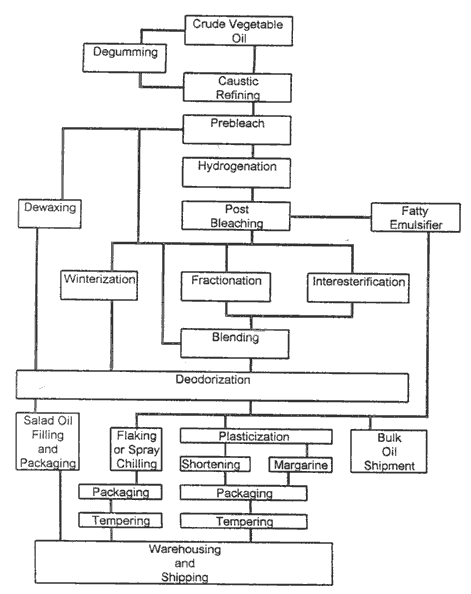
Canola (modified rapeseed oil) is produced by heating the rapeseed and processing with a petroleum solvent to extract the oil. Then another process of heat and addition of acid is used to remove nasty solids (wax) that occur during the first processing.

At this point, the newly created canola oil must be treated with more chemicals to improve color and separate the different parts of the oil. Finally, since the chemical process has created a harsh smelling oil, it must be chemically deodorized to be palatable.

If the vegetable oil is going to be made into shortening or margarine, is undergoes an additional process called hydrogenation to make it solid at cold temperatures. Unlike saturated fats (butter, coconut oil, etc) vegetable oils are not naturally solid at these temperatures and must be hydrogenated to accomplish this. During this process of hydrogenation, those lovely trans fats we’ve heard so much about are created.

This chart from this informative article on the history and production of canola oil shows the process in more detail:
kyf conola oilchart Why You Should NEVER Eat Vegetable Oil or Margarine!

Nothing like petroleum produced, overheated, oxidized and chemically deodorized salad dressing for dinner…. yum.

(Compare that to butter… Step 1: milk cow. Step 2: let cream separate naturally. Step 3: skim off cream. Step 4: shake until it becomes butter.)

History of Vegetable Oil Production and Consumption

As I mentioned, vegetable oil was practically non-existent in its current form in the early 1900s. Until that time, most people got their fats from animal sources like meat, tallow, lard, butter, cream, etc.

The overall amount of fat consumed has not changed much since then (it has decreased slightly) but the type has changed dramatically. In 1900 the amount of vegetable based oils that people consumed was basically none. Today, people consume, on average, about 70 lbs of vegetable oils throughout the year. (Hmm, I wonder what 70 pounds of a “food” that was previously non-existent in human consumption might do to our health?)

Add to this the fact that the animals we eat are also often fed genetically modified pesticide treated seeds and grains (cows are supposed to eat grass by the way!) and the amount of omega-6 rich oils and seeds in our diets is really high!

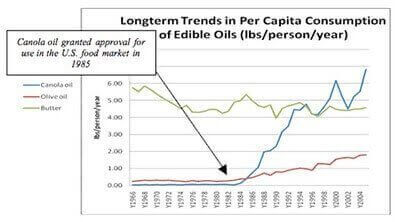
Though vegetable oil existed in the early 1900s, its use increase that much until the 1950s, when a governmental campaign was launched to convince people to eat vegetable oils and margarine and avoid “artery clogging saturated fats.”

Check out the rise of Canola Oil since then (and the decline of butter):
Canola+oil+consumption Why You Should NEVER Eat Vegetable Oil or Margarine!

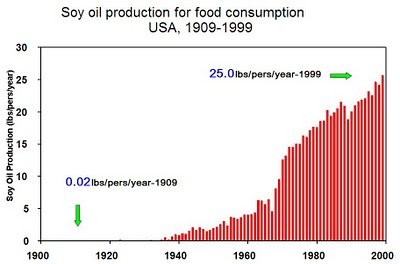
And the rise in soybean oil production and consumption:
Soy+oil+consumption Why You Should NEVER Eat Vegetable Oil or Margarine!

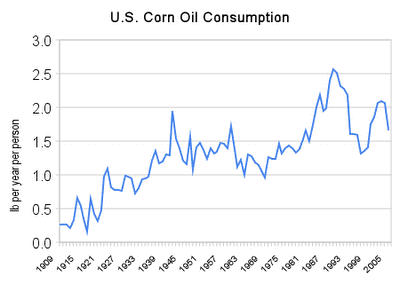
And corn oil:

u s corn oil consumption Why You Should NEVER Eat Vegetable Oil or Margarine!

As an interesting correlation, check out the rates of heart disease and cancer since then. As this article notes:

All one has to do is look at the statistics to know that it isn’t true. Butter consumption at the turn of the century was eighteen pounds per person per year, and the use of vegetable oils almost nonexistent. Yet cancer and heart disease were rare. Today butter consumption hovers just above four pounds per person per year while vegetable oil consumption has soared–and cancer and heart disease are endemic.

Since the 1950′s these vegetable oils and their derivatives have been increasingly used in processed foods and for frying or cooking. They are marketed as healthy because they contain monounsaturated fats and some level of Omega 3 fatty acids.

What’s Wrong with Vegetable Oils?

There are many problems with vegetable oil consumption, and in my opinion, no amount is safe. To understand why, let’s look at a few of the biggest problems with vegetable oils:

Our Bodies Aren’t Meant to Consume Them!

The fat content of the human body is about 97% saturated and monounsaturated fat, with only 3 % Polyunsaturated fats. Half of that three percent is Omega-3 fats, and that balance needs to be there. Vegetable oils contain very high levels of polyunsaturated fats, and these oils have replaced many of the saturated fats in our diets since the 1950s.

The body needs fats for rebuilding cells and hormone production, but it has to use the building blocks we give it. When we give it a high concentration of polyunsaturated fats instead of the ratios it needs, it has no choice but to incorporate these fats into our cells during cell repair and creation.

The problem is that polyunsaturated fats are highly unstable and oxidize easily in the body (if they haven’t already oxidized during processing or by light exposure while sitting on the grocery store shelf). These oxidized fats cause inflammation and mutation in cells.

In arterial cells, these mutations cause inflammation that can clog arteries. When these fats are incorporated into skin cells, their mutation causes skin cancer. (This is why people often get the most dangerous forms of skin cancer in places where they are never exposed to the sun, but that is a topic for another day!)

When these oils are incorporated into cells in reproductive tissue, some evidence suggests that this can spur problems like endometriosis and PCOS. In short, the body is made up of saturated and monounsaturated fats, and it needs these for optimal health.

Vegetable Oils Contain High Levels of Omega-6 Fatty Acids

I’ve talked before about how the body needs Omega-3 and Omega-6 fats in balance, preferably a 1:1 ratio. Most people consume a much higher ratio of Omega-6 fats, and this can lead to problems.

Vegetable oils contain a very high concentration of Omega 6 fatty acids and polyunsaturated fats, which cause an imbalance of these oils in the body. Omega 6 fats are easily oxidized with heat or light exposure. This is another reason that when these types of fats/oils are incorporated into tissue like skin cells, the heat and light from sun exposure can increase skin cancer risk.

Unbalanced levels of Omega-3 and Omega-6 fats have been linked to skin cancer and many types of cancers. As this article explains:

In one study performed at the University of Western Ontario, researchers observed the effects of ten different dietary fats ranging from most saturated to least saturated. What they found is that saturated fats produced the least number of cancers, while omega-6 polyunsaturated fats produced the most. Numerous other studies have also shown that polyunsaturated fats stimulate cancer while saturated fat does not1 and that saturated fats do not break down to form free radicals.2

In another study, Dr. Vivienne Reeve, PhD, Head of the Photobiology Research Group at the University of Sydney irradiated a group of mice while feeding while feeding different groups of them polyunsaturated and saturated fats. She discovered that the mice that consumed only saturated fat were totally protected from skin cancer. Those in the polyunsaturated fat group quickly developed skin cancers. Later in the study, the mice in the saturated fat group were given polyunsaturated fats. Skin cancers quickly developed.

The 3% of our body that is made up of polyunsaturated fats is approximately half Omega-3 fatty acids and half Omega-6 fatty acids and our body needs this balance. Omega-3s have been shown to reduce inflammation and be protective against cancer, while too much Omega-6 fats cause inflammation and increase cancer risk.

Over time, consumption of these oils high in Omega-6s and polyunsaturated fats can also lead to other problems, as the above article elaborates:

The journal Epidemiology published a study called, “Margarine Intake and Subsequent Coronary Heart Disease in Men.” Authors of the study followed participants of the Framingham Heart Study for 20 years and recorded their incidence of heart attack. They also tracked both butter and margarine consumption.

The researchers discovered that as margarine consumption increased… heart attacks went up. As butter consumption increased… heart attacks declined.

The study also divided the data into ten year increments. What they discovered is that during the first ten years, there was little association between margarine consumption and heart attacks. However, during the second decade of follow-up, the group eating the most margarine had 77% more heart attacks than the group eating none!

Hmm… saturated fats don’t cause heart disease and vegetable based fats do! Sounds like something I’ve said before.

Imbalance of these fats can also cause damage to the intestines and along with processed grain consumption can set the body up for a host of food allergies and auto immune problems.

Chemicals and Additives in Vegetable Oils and Fats

Since vegetable oils are chemically produced, its not really surprising that they contain harmful chemicals. Most vegetable oils and their products contain BHA and BHT (Butylated Hydroxyanisole and Butylated Hydroxytoluene) which are artificial antioxidants that help prevent food from oxidizing or spoiling too quickly.

These chemicals have been shown to produce potential cancer causing compounds in the body, and have also been linked to liver/kidney damage, immune problems, infertility or sterility, high cholesterol and behavioral problems in children.

Vegetable oils also contain residues of the pesticides and chemicals used in their growth and manufacture and most often come from genetically modified sources.

Reproductive Problems and Problems in Children caused by Vegetable Oil Consumption

Vegetable oils are extremely damaging to the reproductive system and the developing bodies of unborn babies and children. Because the reproductive system in both men and women is constantly producing and dividing new cells, there is potential for mutation and problems when these cells are made of the wrong kind of fats and are oxidized.

This same thing applies to unborn babies and children, whose cells are dividing at high rates. There is more potential for mutation because there are more cells dividing. From this article:

What the scientific literature does tell us is that low fat diets for children, or diets in which vegetable oils have been substituted for animal fats, result in failure to thrive–failure to grow tall and strong–as well as learning disabilities, susceptibility to infection and behavioral problems. Teenage girls who adhere to such a diet risk reproductive problems. If they do manage to conceive, their chances of giving birth to a low birth weight baby, or a baby with birth defects, are high.

Excess consumption of vegetable oils also causes problems with hormone production, since hormones are dependent on certain fats for their manufacture. Vegetable oils that are hardened by hydrogenation to make shortening or margarine are especially damaging.

Other Effects of Vegetable Oils on the Body

Because vegetable oils oxidize easily, they deplete the body of antioxidants since the body must use these to attempt to neutralize the oxidation. People with high consumption of vegetable oils and their products are at risk for Vitamin E deficiency and other deficiencies.

Vegetable oil consumption has been linked to a host of other problems, among them (from the same article above):

In test animals, diets high in polyunsaturates from vegetable oils inhibit the ability to learn, especially under conditions of stress; are toxic to the liver; compromise the integrity of the immune system; depress the mental and physical growth of infants; increase levels of uric acid in the blood; cause abnormal fatty acid profiles in the adipose tissues: have been linked to mental decline and chromosomal damage and accelerate aging. Excess consumption of polyunsaturates is associated with increasing rates of cancer, heart disease and weight gain.

In light of all that information, how do you sort out which oils are healthy, and which ones aren’t. Even more important, how do you know how much of each one to consume to be healthy?

Oils and Fats to Avoid:

Vegetable Oils and their fats should be avoided completely. There are much healthier alternatives and there is no reason or need to consume these types of fats. The main culprits to watch out for are:

  • Canola Oil
  • Corn Oil
  • Soybean Oil
  • “Vegetable” oil
  • Peanut Oil
  • Sunflower Oil
  • Safflower Oil
  • Cottonseed Oil
  • Grapeseed Oil
  • Margarine
  • Shortening
  • I Can’t Believe Its Not Butter (You better believe it!)
  • Smart Balance (Not a Smart idea!)
  • Any fake butter or vegetable oils products

There is no nutritional need for these oils and healthy fats can be found in higher amounts and better ratios in many other types of fats. This article has a great breakdown of the Polyunsaturated, Monounsaturated and Saturated content in the above oils.

While it is simple enough to avoid these oils themselves, the tougher challenge is avoiding all the foods they are in. Check out practically any processed food, and you will find at least one of these ingredients, often labeled as “partially hydrogenated corn/soybean/etc oil” or “May contain soybean or canola oil.” These foods in particular often contain one of the above unhealthy oils:

  • Salad Dressings
  • Store Bought Condiments
  • Mayo
  • Chips
  • Artificial Cheeses
  • Store bought nuts and snacks
  • Cookies
  • Crackers
  • Snack Foods
  • Sauces
  • Practically anything sold in the middle aisles of the store

Oils and Fats to Use Freely:

There are so many wonderful and healthy fats that are beneficial to the body, so there is no reason to consume the unhealthy ones above. Fats that can be consumed freely for optimal health are:

  • Coconut Oil- Filled with Medium Chain Fatty Acids and Lauric Acid, coconut oil is an all star of the saturated fats. Since the fat composition in cells in the body is largely saturated fat, it is important to get enough of it from healthy sources. Coconut oil does not oxidize easily at high temperatures or go rancid easily, making it a good choice for cooking and baking. It also makes a great natural moisturizer and can be substituted for butter.
  • Meats – Meat, especially red meat, has gotten a bad rap, and unfortunately, the animals we eat have been as mistreated nutritionally as we have. Meats like grassfed beef and free range chicken has a very different nutritional profile than their feedlot counterparts. Grassfed and free range meats have higher nutrient levels, healthy forms of saturated fats and even omega-3s. If possible, consume these forms of meat.
  • Butter- This one food is usually the one people are happiest to start using again. Butter tastes delicious, and pastured grassfed butter is an excellent source of fat soluble vitamins, healthy saturated fat and other nutrients. In contains a compound that Weston A. Price called Activator X, known to improve nutrient absorption and have preventative benefits against disease.
  • Organic Cream- also a good source of healthy saturated fat, organic heavy cream is essentially liquid butter, and is great served whipped on top of fruit, in desserts or in cream based recipes.
  • Olive Oil- High in monounsaturated fats and low in polyunsaturated fats, olive oil is a great oil for salad dressings, homemade mayo,  and cold recipes. It shouldn’t be used for cooking since its high monounsaturated fat content makes it susceptible to oxidation at high temperatures.
  • Palm Oil- Has a high saturated fat content and is also heat stable. Some sources claim that palm oil production often encroaches on the natural habitat of some endangered animals, though sustainable versions can be found. If in doubt, just use coconut oil.
  • Avocados and Avocado Oil- A good source of monounsaturated fats and great on salads or in guacamole. Avocado oil is milk tasting and can be used in salad dressings.
  • Fish- Fish are naturally high in Omega-3 fatty acids and can help improve the Omega-3/Omega-6 balance in the body. Look for sustainable wild caught sources, and stick to small fish like tuna, sardines, salmon, etc to minimize mercury.
  • Eggs- Another all-star in the healthy fats community, eggs are loaded with vitamins, healthy fats and necessary cholesterol. Consume them daily from free range sources.

Oils and Fats to Consume In Moderation:

Some fats are nutritious and beneficial to the body but should still be consumed in moderation if they are eaten. Many contain high levels of Omega-6 fats and can therefore mess up the balance of fats in the body.

  • Flaxseed Oil- Though it contains a good amount of Omega-3s, it also has a lot of Omega-6s and its high Polyunsaturated fat content makes it prone to oxidation if heated. Fish oil is a much better source of Omega-3s, and in general, I don’t recommend flax oil, though it certainly is not the worst option.
  • Walnut Oil- Also high in Omega-6 fats, but it has a great rich taste and can be safely used occasionally in dressings or desserts. It also has a slightly higher resistance to oxidation at higher temperatures than other nut oils.
  • Macadamia Nut Oil- This is one of my favorite tasting oils, but it is expensive. It is great in salad dressings or mayo. It has a lot of monounsaturated fats and low levels of polyunsaturated fats.
  • Nuts- Most types of nuts (remember peanuts are not nuts) are a good source of protein and healthy fats and can be eaten in moderation without problem. Just check to make sure they haven’t been cooked in vegetable oils, which is often the case. Nuts also contain phytic acid, so consuming them in excess can be problematic for tooth and bone health.

What to Do With the Vegetable Oils You Have Already?

If you already have some of the unhealthy vegetable oils in your house… don’t eat them! I’m not a fan of waste either, so use them up in other ways. They can be used to make homemade play dough or floor cleaner. You can also stick them in your shed for oiling tools. (Did I mention, don’t eat them!)


What do you think?Ready to throw out the vegetable oils? Still think canola oil is heart healthy? Sound off below!

Like What You Read?

Sign up for exclusive Wellness Mama updates to get my newsletter, coupon codes, & bonuses emailed FREE! (No spam ever, I promise!)

About Wellness Mama

Wellness Mama is a full-time housewife with a background in nutrition, journalism and communications. Her passion is helping others achieve optimal health through a “Wellness Lifestyle.” She has helped hundreds of clients lose weight, increase athletic performance, improve fertility, and overcome numerous health problems and diseases. Connect with her on Twitter, Facebook, Google+, & Pinterest.

Disclaimer: Many of the links on my site, especially those from Amazon, Mountain Rose Herbs, Tropical Traditions and OraWellness are affiliate links. Should you click on these links and decide to purchase anything, I will receive a small commission and you will have my sincere thanks for supporting Wellness Mama!

DISCLAIMER: The statements made here have not been approved by the Food and Drug Administration. These statements are not intended to diagnose, treat or cure or prevent any disease. This notice is required by the Federal Food, Drug and Cosmetic Act.

  • http://pulse.yahoo.com/_LMQ7ZNVII7LGXVV7EJRFFM4FVI Mel

    Ok so I’m feeling silly here – I love all this info but of course as I learn more and more it becomes overwhelming. What kind of butter should I be buying? I saw my store sells organic, grass-fed butter but I know organic doesn’t always mean healthy. I have some stuff now that is free of hydrogented oil.

  • Lisa

    Do you have any thoughts/recommendations on formula or alternatives? We adopted our first child at birth and are hoping to adopt again (if the diet doesn’t turn our infertility around first!). Our daughter was fed Enfamil and did very well on it, but the ingredients listed include “vegetable oil (palm olein, soy, coconut, and high oleic sunflower oils)”, and now I’m not sure what to do if we need to use formula for our next child.

  • TheresaM

    This is a lot of information. Informative, but also a little overwhelming, considering we just started changing our diet. I could probably come up with a ton of questions but I’ll try to limit it to just a few. I know it’s easy to make salad dressings, but what about other condiments, such as ketchup, bbq sauce (I make my own, but it contains ketchup), or mayo? Do you make your own? If so, what kind of shelf life do they have? I use shortening in my icings for cake, and also in pie crusts. Do you have any suggestions for a substitute?

  • Liz

    Hi Lisa,

    I think that the Weston A Price’s recipe for homemade formula is a great option. It’s deeply nourishing, without any artificial ingredients. More here: http://www.westonaprice.org/childrens-health/319

  • Liz

    Love this post. Very dense, but great info. I’m sending it to everyone I know. :)

  • http://wellnessmama.com Wellness Mama

    Hi Lisa, I was actually going to recommend Nourishing Tradition’s
    recipe as well! Thanks Lizz for sharing! You can also mix coconut oil
    into first foods to help get the medium chain fatty acids and lauric
    acid that are provided by breastmilk (coconut oil also bakes a great
    diaper cream)

  • http://wellnessmama.com Wellness Mama

    Hi Theresa! We make our own ketchup and BBQ sauce too. I’ll post
    those recipes soon. They can be made from store bought tomato sauce/
    paste or from fresh tomatoes that you can yourself. I make mayo also,
    the link is under recipes. The mayo lasts a couple weeks and the
    ketchup/bbq sauce last over a month.
    For shortening, replace with coconut oil. It works really well and
    has a richer taste in my opinion. It also binds really well in cakes,
    even if you use almond or coconut flour.

  • http://wellnessmama.com Wellness Mama

    Organic grass fed butter is great, that means it is pastured and that the cows were eating grass not grains. It will be much higher in fat soluble vitamins and nutrients. The organic stuff is more expensive though, but worth it, in my opinion. It also has a much richer taste!

  • Julie

    Organic Earth Balance is bad for us?!?! Ugh.

  • Katie

    Wow what a great post! I had no idea just how bad the stuff was. I am tossing my canola and peanut oils and pulling out the enormous tub of food grade coconut oil I over-ordered for soap making! Finally a use for it! lol
    Just a silly question, I currently use a commercial olive oil spread in place of marg or butter – bad idea?

  • http://wellnessmama.com Wellness Mama

    It isn’t as bad as some, the problem is that it too has to be
    hydrogenated to become semi-solid. Butter and coconut oil are
    definitely better, and if you are worried about getting enough
    monounsaturated fats in or just like the taste, whip a little olive
    oil into some pastured grassfed butter for non-cooking uses… tastes
    great!

  • http://www.gnolls.org J. Stanton

    I have a few rules about what I eat. One is “If you can put it in a truck and the truck starts, it’s not food.”

    Beef tallow is great to cook with. It’s not hard to make your own from suet, or even trimmings, but I absolutely recommend wet-rendering as it tastes much better. Dry-rendering tastes a bit burnt and excessively beefy to me.

    For traditional pie crusts and cake, use leaf lard, like your grandmother did. (Not regular lard.) It’s tough to find, though: you might have to find the kidney fat and wet-render it yourself.

    Important fact: there is substantial unlabeled trans fat in canola and soybean oil (and probably all other polyunsaturated vegetable oils), created by the process of extraction, deodorizing, etc. that Katie talks about. I wrote an article about that here, with a link to the original study:

    http://www.gnolls.org/1240/eat-more-heart-healthy-trans-fats-we-hid-them-in-plain-sight/

  • http://wellnessmama.com Wellness Mama

    I love this: “I have a few rules about what I eat. One is “If you
    can put it in a truck and the truck starts, it’s not food.”"

    I’ve been experimenting with rendering tallow and lard lately….
    definitely a new experience, but I do love using it in certain types
    of cooking!

    Thanks for the link to your article also… I always enjoy reading
    your posts!
    -Katie

  • http://www.gnolls.org J. Stanton – gnolls.org

    In general, the more health claims are made on the product label, the worse it is for you. AFAIK the “heart-healthy” logo is available to anyone with a $7500 check and whose product doesn’t immediately kill people.

  • http://www.gnolls.org J. Stanton

    Much appreciated! I love what you’re doing here, as it brings healthy eating to a very different audience than most of us have.

    I also like to note that coconut oil comes in refined and unrefined versions. Unrefined probably has more nutrients in it, but it tastes strongly of coconuts. I’m not a fan of the standard industrial RBD oil, but you can get cold-pressed, organic refined oil that has a completely neutral taste.

  • Katie

    After posting this message I went a had a look at the ingredients and found that, of the oils used in the spread, only about 25% of them were olive oil, the rest were vegetable oils. Question answered. Goodbye crap tasting ‘olive oil’ spread – hello butter and avocado! Thanks for your answer :-)

  • Pingback: Seven Ways to Simplify A Healthy Life — Wellness Mama

  • Cathy

    I hope no one that references this website and all the facts is indeed a smoker. That is going to be one of the worst things you can do, you would smoke but then care that your oils and margarine are bad for you!

  • http://wellnessmama.com Wellness Mama

    I agree… smoking is one way to deteriorate your health very
    quickly. I usually assume that most readers aren’t smokers, but I
    suppose some are. I would say that avoiding vegetable oils is even
    MORE important for smokers though, because the smoke and toxins would
    cause the oils to oxidize faster in the body and create a worse
    reaction than in a non-smoker.

  • Tar Gzip

    Varied things:

    @endlesswellness:disqus  I read on a book that some of the harmful, processed, bleached, etc. oils had a natural, pressed version which was healthy, though it had a short shelf life. Is this true?

    @00c8eb3f6e6a1884216044ca29cf868a:disqus : My parents say that when they raised their own pigs the lard was very different from the one in nowadays’ supermarkets. That it tasted better and was “less bland”. How can we (city dwellers) find good lard (general advice, please, I don’t live in the USA)?

    @0b12ee5576d92ef4d5b32980d6d8d130:disqus  My brother makes an olive oil spread by mixing olive oil, ground herbs and ground fresh garlic _and he stores it in the coolest shelf of the fridge_ . This keeps it semi-solid to help spreading and is natural :)

  • Tar Gzip

    Varied things:

    @endlesswellness:disqus  I read on a book that some of the harmful, processed, bleached, etc. oils had a natural, pressed version which was healthy, though it had a short shelf life. Is this true?

    @00c8eb3f6e6a1884216044ca29cf868a:disqus : My parents say that when they raised their own pigs the lard was very different from the one in nowadays’ supermarkets. That it tasted better and was “less bland”. How can we (city dwellers) find good lard (general advice, please, I don’t live in the USA)?

    @0b12ee5576d92ef4d5b32980d6d8d130:disqus  My brother makes an olive oil spread by mixing olive oil, ground herbs and ground fresh garlic _and he stores it in the coolest shelf of the fridge_ . This keeps it semi-solid to help spreading and is natural :)

  • http://wellnessmama.com Wellness Mama

    You are right that there are natural cold pressed versions of some
    oils that are somewhat healthy (though rapeseed aka canola is never
    healthy!) though even the naturally produced ones have a high Omega-6
    ratio, which is not good in any large amounts. Since the natural
    versions of these oils are much more expensive anyway, I still opt
    for better choices like coconut, olive, or even tallow or lard if
    given the choice.

    Lard- that is a tougher one! I know a few resources here in the US,
    but don’t know of any overseas. My best advice would be to ask your
    butcher for the fat and render your own tallow or lard. There are a
    lot of tutorials on this online, but I’ll also be chronicling my
    experience with it soon.

    I love the idea of the olive oil spread! Definitely going to have to
    try that one!

  • Lori

    Hi Mel, and others. I usually buy Organic Valley’s “Pasture Butter” or Kerry Gold. Why, because they are butters made from milk from cows that were grazing on green growing grass. If you compare the color of these butters with other butters, you will find that they are much yellower. The yellow color comes from the vitamin K in the grass.  This is how most butter used to look and why, when margarine first came on the market, it was called “oleo” (which is the name of the yellow coloring added to make them look more like butter). Enjoy!

  • Lori

     This is a very “western” outlook. From my information sources, peanut oil has been used in Asia for centuries. So I presume it is a healthy oil. Also, in addition to cod liver oil, the ancient Vikings used to use rapeseed oil, granted, without all the weird modern processing.

  • http://wellnessmama.com Wellness Mama

    You’re right that some of these oils have been used in other places,
    though to my knowledge, they are cold pressed, and don’t undergo any
    of the chemical processing, which changes the structure considerably.
    They all still have high Omega-6 content though, and many people
    today already consume far too much of these type of oils.

  • Pingback: Natural Homemade Sunscreen Recipe — Wellness Mama

  • Pingback: Avoid Sunburn and Tan Better By Eating Real Food? — Wellness Mama

  • Pingback: San Diego Family Photographer – Homemade Iced Ginger Peach Tea Latte.. | San Diego Photography - Sarah Tolson Photography

  • Pingback: Write-Me-Wednesday

  • Anonymous

    great information about the vegetable oils.  I recently purchased my first jar of coconut oil this is all new to me.    Do you have any insight about sesame oil?  I didn’t see it on any of the lists good, bad or in between.

  • Anonymous

    great information about the vegetable oils.  I recently purchased my first jar of coconut oil this is all new to me.    Do you have any insight about sesame oil?  I didn’t see it on any of the lists good, bad or in between.

  • http://wellnessmama.com Wellness Mama

    It’s not bad, and it is great for flavor. It doesn’t undergo the processing that most vegetable oils do, but it shouldn’t be your main oil Great in salad dressings and stir frys though!

  • Pingback: 2011 Wellness Challenge- Day One — Wellness Mama

  • Pingback: Healthy Onion Rings! — Wellness Mama

  • Pingback: Bad Health Advice or Brilliant Marketing? — Wellness Mama

  • Chris

    Can you explain a bit more on the heating of olive oil?  Is the only ill-effect that it depletes your body of vitamin e?  Can that be offset by taking additional vitamin e? 

  • http://supermilkmama.com Ester

    What an informative and thorough article!  I will be coming back for more info.  I recently read Ramiel Nagels book, Cure Tooth Decay based on Weston Price’s teaching and the reversal on my daughters cavities have been amazing.  We basically were on a low fat diet and have now been on a high fat diet for the last 3 weeks.  In such a short amount of time, her teeth look better, my son had gained weight and my cheeks look nice and rosy.  I now add a spash of cream into my green smoothie and my digestion has improved so much!  I am always learned new things about nutrition!  I look forward to your mayonaisse recipe.  I have not made it because I was avoiding using vegetable oil.  I will see how you make it :)   Thanks.
    Ester

  • Chef Jem

    Tank You for this excellent article!

     Real Butter is one of my favorite topics and my top health food!
    Some more blogs for you all!:
    “Healthy and Well With Butter”:http://curezone.us/blogs/fm.asp?i=1782587
    “The Toils of Oils”:
    http://curezone.us/blogs/fm.asp?i=1506541
    “Real Butter – An Amazing Health Food and Food As Medicine!”:http://curezone.com/blogs/fm.asp?i=1558277“The Use and Benefits of Very High Vitamin Butter For The Control of Dental Caries”:http://curezone.us/blogs/fm.asp?i=1282566Butter Up!Chef Jem

  • http://wellnessmama.com Wellness Mama

    Here it is: http://wellnessmama.com/1739/healthy-homemade-
    mayonnaise/ . Thanks for reading!

  • http://www.facebook.com/people/Kris-Johnson/1299218805 Kris Johnson

    Thanks for this detailed article. For those who don’t want to make mayo, here is a wonderful version on line – and it keeps well.
    http://www.wildernessfamilynaturals.com/category/dressings-condiments-mayo.php

  • http://wellnessmama.com Wellness Mama

    taking additional vitamin E would help, but it is hard to find a bioavailable and stable supplemental source of vitamin E. We use tallow, lard or coconut oil to fry and personally, I think they taste better anyway, plus they don’t smoke at high heat!

  • http://www.facebook.com/jojomosgo Joseph Concaugh

    I’m a bit confused now.  I was pretty much ready to throw out all the vegetable oils I have, and probably will, but I was at Trader Joe’s website and noticed they have an Expeller Pressed Canolla Oil, http://www.purecanola.com/cooking-oil.html, and this stuff claims to be GMO free and uses no chemicals during the extraction process.  Am I missing something?  It’s ratio of Omega 6/Omega 3 is quite a bit better than Olive Oil as well (5.5 vs. 12.8).

  • http://wellnessmama.com Wellness Mama

    You can find expeller pressed ones, but from my understanding, they will have some chemical properties. I’d still stick with olive oil
    and balance out with good food sources of Omega-3s and use coconut oil, tallow, lard, etc for frying.

  • Emami_009

    People should never eat palm & soya oil; as manufacturing of such edible oils is from crude oil. In my openion oil brands like “Gemini” & Nature Fresh” are the worst brands in market.
    People should recommended to not purchase such brands.

  • Pingback: Seven Habits by Katie of Wellness Mama

  • SkygreenWash

    Folks have been using olive oil for years. And peanut oil is natural. Take natural peanut butter and let it sit a few days and you have peanut oil. Same with any nut butter, the oil rises to the top, so your propaganda is flawed.

  • http://wellnessmama.com Wellness Mama

    I don’t have a problem with olive oil and dislike peanut oil because it is from a legume technically and in most cases is chemically extracted. All of the other oils are almost always chemically extracted and our bodies have absolutely no nutritional need for them

  • Pingback: Bringing Common Sense Back Into Eating | Whole-istically Healthy

  • Pingback: More Ingredients Reveal More Dangers With Visalus Products - Healthy Families for God

  • MDMTahiti

    Sept. 2010 I stopped consumption of all vegetable oil and replaced them with olive oil and butter.  I also stopped eating sugar (as much as possible).  I shed 30 lbs. and have kept it off.  I increased protein consumption.  More than a year later, HDLs are up, LDLs about the same – HDL/LDL ratio MUCH better (and still <200), and triglycerides are down too.  Oh, and I cut my BP meds in half, and I feel great at 60.  I wish I had read this article 10 years ago! 

  • Besiaka

    what kind of coconut oil should i use.  the one in my local store is mechanically processed and refined.  i am guessing both are bad? do i need to use non refined one? the bottle also says its made for medium high heat.  what defines medium high? is 400F considered medium high or high? i also read that coconut oil (unrefined) has a low smoke point.  any advice would be greatly appreciated. 

    point 2, my husband is allergic to dairy.  i have been baking / cooking with margarine because of that (dairy free).  sounds like thats a bad idea.  if i can’t baking with that, what should i use instead?

    thank you!

  • Jo Atkinson101

    Hi Mel
    Are you able to provide links to the references you used for this? I have tried clicking on the links, but they aren’t working.
    Thanks in advance
    Jo

  • Cfrance78

    Why do you not like safflower oil?  My nutritionist recommended this to me.  Also, what type of coconut oil do you recommend.  I have Virgin Coconut Oil, which says medium heat up to 280 degrees.

  • Jenn pierce

    A couple years ago, we switched to all butter (no margerine) and gained about 10lbs in a month!!  Any advice on how to avoid the weight gain?? 

  • http://wellnessmama.com Wellness Mama

    Depending in how it is made, safflower oil is either high in monounsaturated fats or polyunsaturated fats. As such, it is not very stable at high temperatures and can go rancid easily. It should not be heated. most people already have too much of these type fats in their diets, which is another reason I recommend Coconut oil. From my understanding, as a saturated fat, coconut oil is much more stable at high temperatures and is not prone to going rancid or breaking down.

  • http://wellnessmama.com Wellness Mama

    Did anything else in your diet change at the same time? Switching to butter shouldn’t have made this much of a difference, unless you were eating it on a lot of breads, pasta, and starchy foods. Overall, how many starchy foods do you consume on a given day? In my experience, weight gain is more often related to more starches than different types of fats.

  • Brenda

    I have been fats somewhat, and this is the best summary I’ve read. I use coconut oil and butter for most of my cooking but when it comes to salad dressings or marinades I didn’t know what to use since they end up being refrigerated. Olive oil strong tasting in salad dressings and shouldn’t be heated as marinaded food will eventually be. Coconut oil turns hard on the frig. I thought grapeseed oil was suppose to be good but then I would read conflicting info on that one.  So I wasn’t sure what to do. So glad to see that walnut oil is an option. Macadamia nut oil is expensive so not an option for now. I had not thought of avocado oil so I will have to try that. I do like sesame oil and especially toasted sesame oil for Asian dishes and marinades. Nothing was said about those oils? What do you think??? I assume they would be on the bad list since all other seed oils are.

    Glad to see you reported olive oil shouldn’t be heated. I have been to cooking demos where the chef put olive oil in a skillet and heated it to the smoking point because that was the way they wanted it. I would sit there and cringe. I have read that Italians add olive oil at the end of cooking or after they take it off the heat because they know this.

    Thanks for the detailed and very informative post.

  • Brenda

    Sorry…..left the word “confused” out of that first line.

  • Pingback: HPC 101… class is in now session kids! « Hot Pink Chilli

  • Pingback: » Happy Birthday Doughnuts! Cave Girl Next Door

  • Science tech

    No disrespect in what I am going to say and also don’t think I’m defending margarine which I am not, but I feel like answering your post  because there are so many mistakes in what you say that you gave me a headache :-) You also put a smile on my face because it’s funny to see how you spread the word(errors actually) and people probably believe them. I won’t even try to defend my pont of view in full because I would be arguing with someone who practically forgot the basic high school chemistry and biology and for instance who doesn’t realize that “vegetable oils” are fats (triglycerides) that have been part of the human diet and people were just fine using them in their diet for millenia. Olive oil, sun flower oil and palm oil are for instance some examples of vegetable oils that have been around in our food for a very long time. You repeatedly classify “vegetable oils” and “margarine” as similar while they are very different. The basic method of making margarine consists of emulsifying a mixture of purified vegetable oils with
    skim milk, and cooling it to solidify the mixture (you actually say that at some point, but I assume you didn’t understand the difference as long as you keep saying “vegetable oils and margarine”). Your readers are probably horrified by those chemical reactions Canola oil has to go through :-) So, let’s remember one of our chemistry classes: we take a piece of sodium metal, we heat it, and we immerse it in chlorine gas (which is extremely dangerous and poisonous to all forms of life, and its well known compounds are bleaches with which we disinfect pools and toilets). This is how we produce sodium chloride (table salt). People have been adding table salt to their food for a long time and I don’t think they were in any danger (unless someone tried to scare them and told them what’s table salt made of…that gas that kills us and out of which we make stuff that disinfect toilets….oh mine, how can we eat that?) . The point I am trying to make is that in a chemical reaction chemicals combine and become new compounds that are not necessarily dangerous.
     You also talk about genetically modified crops as if that would be a deadly thing. Do you know what that means? It means that you select for the best crop/plant and you do it over and over until you end up with the most resistant plant. Is it dangerous to selects for the most resistant and the best seedling of your crop? It looks like you are very scared of that (you probably thought that the oil was made of a plant that underwent some sort of mutagenesis which is mutation breeding using radiation !….oh no, it didn’t happen that way ). You also talk about the Canola oil that is produced  from crops treated with high
    levels of pesticides. Didn’t you know that all the vegetables we buy on the market today are treated with herbicides and pesticides? If you ever find a worm inside an apple, a slug inside your lettuce or a caterpillar in your cabbage….well, those things would be “100% organic” and you should be happy the insect was in there because would prove no insecticides were used on that crop. So that’s old news… almost everything we eat has been treated with chemicals.
    What intrigued me while reading your article was that you say absolutely nothing about OLESTRA which is actually one type of fat that was proven to be dangerous for human consumption. We didn’t need scientists to do research for 20 years to prove it, people felt bad right after eating food containing this type of fat. OLESTRA is indeed a synthetic oil, it’s produced in laboratories and after ingestion, it dissolves fat soluble nutrients in your gastro intestinal tract and it eliminates them through excretions. OLESTRA is banned in Canada and some countries in Europe, but we can still buy food, especially chips made with Olestra in the United States.
    One last thing: you quote scientific literature. When a group of scientists publishes an article, this doesn’t necessarily mean that they found a solution or that they found “the truth.” It’s just research and it’s a hypothesis, and it’s actually provisionally accepted until a theory is produced, in other words, it has to be proven over and over until the scientific world can say “yeah, may be we have an answer now.”
    “In the great wide world of the web false ideas may thrive because of fine presentation or because of moving emotional manipulation” someone once said. I would like to think yours is not precisely that, so please go check reputable sources and try to understand a bit of chemistry and biology before coming up with such a post.

  • http://wellnessmama.com Wellness Mama

    Olive oil, sunflower oil and palm oil can all be produced by pressing the plant and don’t require chemical processing. Vegetable oils and margarine are similar in that they both undergo chemical processing and both are vegetable oil based (as you noted, they emulsify vegetable oils to make margarine… kind of how milk and butter are both dairy. obviously not the same, but similar).
    As for the chemistry of salt… yes, it can be created in this way, and I’d advise readers to avoid chemically created salt as well, since natural salt with trace minerals is abundantly available in our oceans and isn’t just two isolated molecules.
    You should do more research on GMO crops. You are talking about selective breeding, which is not what I’m referring to at all. Companies like Monsanto have altered the genes of plants in a lab to be resistant to the pesticides that they spray on them in extremely high doses. “Round-up ready soybeans” for instance can be sprayed with large doses of herbicides and won’t be affected. (I know this firsthand, as they grow the toxic stuff in a field near our house and I see how much is sprayed on it and what happens to all other vegetation in the area).
    Thank you for reinforcing my point that all of these things have been treated with high levels of chemicals. I recommend organic produce, and eat it myself (and I’ve never been bothered by having to wash insects off of organic produce from my garden). Just because our food supply is constantly treated with toxic chemicals is not in itself an argument for the safety of these chemicals.
    I didn’t mention olestra because THAT is old news. Most readers on this blog are well aware of that and wouldn’t be eating chips anyway, though I will probably write a specific post on it at some point.
    Obviously, when scientists publish an article it isn’t guaranteed to be 100% truth (see: “The China Study” for an example of misinformation!). I find it funny that while you quite “science” and even use it in your name, you provide no actual research or studies that prove the safety of these foods, and no sources to back up your claims.
    I’d still challenge my readers (and anyone) to remove vegetable oils from their diet as there is no nutritional need for them, they are harmful, and many people see health improvements from removing them. (and to clarify again, as I did in the beginning of the article, I am referring to oils that have to be chemically created and didn’t exist before the last century, such as canola, soybean, peanut, corn and other artificially created oils… not olive or palm oils, which can be cold pressed.)

  • Science tech

    Wellness Mama,
    You twisted my comment here and there, and you assumed I said things I didn’t say. This is to answer your post as well as some of your paragraphs:
    ***I never made any argument for the safety of any chemicals. This answers your:
    ["I recommend organic produce, and eat it myself (and I've never been
    bothered by having to wash insects off of organic produce from my
    garden). Just because our food supply is constantly treated with toxic
    chemicals is not in itself an argument for the safety of these
    chemicals."]
    ***I don’t have to quote scientific literature when I give the definition for “vegetable oil” unless I quote the dictionary, I don’t need to quote scientific sources when I explain how to produce table salt in the lab, I don’t need to quote any historian when I say that human kind has been using vegetable oils for millenia, and so on and so forth. Common knowledge doesn’t have to be quoted. I didn’t back up any foods as safe either (where did that come from?!?). This answers your:
    ["I find it funny that while you quite "science" and even use it in your
    name, you provide no actual research or studies that prove the safety of
    these foods, and no sources to back up your claims. "]
    *** Olestra is NOT old news and I think you should indeed start a specific blog about that. Olestra is still used in many foods and not only for producing chips as most people probably think. Please check Procter&Gamble’s website (its producer) : http://www.pgfoodingredients.com/default.asp?p=faq
    So today we find Olestra in bagels, biscuits, English muffins, bread,
    bread sticks, cakes, cookies, corn bread, corn muffins, tortillas and
    taco shells, croissants, crackers, doughnuts, muffins, pancakes, crepes,
    French toast, sweet pastries and pies, meat and vegetable pies and
    pastries, rolls, sweet rolls and quick breads, waffles, and pizza crust;
    and in the cheese portion of prepared foods, frostings and icings, mayonnaise, ice cream and frozen yogurt, breakfast/granola/nutrition bars, chocolate confections (Oh my God….). This answers your:
    ["I didn't mention olestra because THAT is old news. Most readers on this
    blog are well aware of that and wouldn't be eating chips anyway, though I
    will probably write a specific post on it at some point. "]
    Anyway, keep up the good work, I love to see people enforcing healthy diets and you do a great job on this side. My comments are meant to be constructive and help you gain credibility for a different type of readers. That’s all.
    Respectfully,
    A “science tech”

  • Maria Castro

    I was feeling great about only using butter, olive oil, animal fat and coconut oil to cook, but I also only drink rice milk since I dont do too well on cow milk and goat milk is very hard to find here…I looked at the ingridients in my rice milk box today and it says it contains safflower oil and/or sunflower oil and/or canoil oil  :(   What can I do?

  • Suzie

    Thank you for the good article.  I have never eaten margarine in my life don’t even know what it taste like.  My mother was smart enough to serve real butter.  Thanks also for the article on activated charcol.  Have used it for years.  I will try it on my teeth too.
    Suzie

  • Pingback: DIY SPA Citrus Salt Body Scrub – Lindsey Isham

  • Lacigrl

    What do you recommend if I have a dairy allergy? I can’t use butter, so I’m forced to use these things in my cooking as a substitute. Any suggestions for a healthy option?

  • http://wellnessmama.com Wellness Mama

    Coconut oil can sub for butter in any recipe or use that calls for butter.

  • Tlfymail

    I buy expeller pressed grape seed oil and rarely eat it,  I use it to make lotions and other skin care products.  It is a shame grass fed meats/products  are not available in food store chains and are so expensive.  We need to make nutritious food affordable, because that in a nutshell is why our diets are so poor.  

  • buzzkehl

    I’m sorry if you already answered this one, but we use Smart Balance a LOT at home because my oldest child is allergic to dairy, leaving butter pretty much ‘off the table’ for us. Is a coconut oil spread a good alternative? And does one exist?
    thanks

  • http://wellnessmama.com Wellness Mama

    You can just use pure coconut oil. It is semi-solid at room temp and can spread like butter… healthier too.

  • http://twitter.com/Franzonie13 Laura Fran Labovitz

    After following your blog for a few months now I knew to keep off of veggie oils, but didn’t know about grape seed oil!  Another blog I follow, whom I think you do too – Elana’s Pantry, she uses grapeseed in a lot of recipes, so I had used it too.  But would you still recommend grape seed oil for body care?  I find it works really well in my oil concoction I use for face wash, as well as a general moisturizer.  I also had no idea you shouldn’t heat olive oil!  Thanks so much for all you do!

  • Pingback: Which Fats You Should Eat, How, and Why, and How to Buy Olive Oil | The Primal Parent

  • http://twitter.com/GayleDevall Gayle Devall

    I am trying to convince some of my family and friends to stop using margarine and other polyunsaturated oils.  It is a hard battle because of all the negativity about fad diets, and this articl may be helpful to explain why they should make this important change in their daily routine.  Wish me good luck.

  • Chi Chi

    I am so happy olive oil is on the list, I love it over popcorn with sea salt.  WHEW!  : )

  • Steven Smith

    As a scientist with a PhD in biochemistry I would greatly appreciate it if you would substantiate the countless claims you are making in this article with proper citations from credible sources. With out these citations this article becomes nothing more than unsubstantiated propaganda and while I’d like to take you seriously, how can I when I have no idea if you wrote this article based on sound science and nutrition?

  • Pingback: 9 Easy Ways to Boost Your Child’s Health | Wellness Mama

  • Pingback: Using Oil Properly « allthatwander

  • Pingback: Why You Should NEVER Eat Vegetable Oil or Margarine! | Barnsley Personal Training Gym

  • Pingback: What’s Really in Your Non-Dairy Non-Gluten Non-Soy Organic Butter? | MyQute Health & Personal Views

  • Tidyaron

    A good article but terrible that you don’t suggest what to have otherwise, my fiancee has chron’s and has to avoid vegetable oil full stop and to make things worse she can’t have dairy so what is she supposed to have instead to help her bake cakes etc to make her food diet more interesting?

  • http://wellnessmama.com Wellness Mama

    Coconut oil is a great substitute and can almost always be used in place of vegetable oils in recipes.

  • http://www.facebook.com/profile.php?id=616321839 Razzle Mataz

    check out the graph on how veg oil is made

  • http://www.facebook.com/profile.php?id=616321839 Razzle Mataz

    check out the flow chart on how veg oil is made

  • Wendyc

    I can’t believe you have put on Palm Oil on the list. It is not an environmentally sustainable oil. Not only for animals but for the soil and indiginous people. You only need to fly over Indonesia and Malyasia to see how much palm oil plantations there are where there used to be rainforests. Palm oil plantations are built in tropical areas – and tropical forests are being cut down so that we can grow more palm oil. We can do something about global warming by stop cutting down the rainforest, which also affects the peat swamps the water levels drop around the areas of palm oil plantations, then the peat swamps release all the carbon they have been storing for hundreds of years back into the atmosphere. The United Nations Environment Programme has announced that palm oil plantations are now the leading cause of rainforest destruction in Malaysia and Indonesia in Southeast Asia. Throughout Southeast Asia, an area of forest equal to 300 soccer fields is being destroyed every hour.
    It’s great to think of your heath but what about the health and well being of the indigenous people of Indonesia and Malaysia. If this was happening in a Western Country there would be outrage.

  • http://wellnessmama.com Wellness Mama

    I agree with you and the only Palm oil I”d ever suggest is the one from Tropical Traditions that is made sustainably in Western Africa, not Southeast Asia, and which supports the environment and small business. I agree that there need to be huge changes in mass produced Palm oil, but I don’t think throwing out Palm Oil all together is the answer, but encouraging sustainable and fair production.

  • http://pulse.yahoo.com/_5I6KEG5N62CRK64JJMOYG7R3A4 Sturm Brightblade

    This article is full of holes. First of all, vegetable oil is scientifically proven to be better for you. What matters is the TYPE of vegetable oil. For instance coconut oil is by far the worst because of the saturated fat and high calorie content. Whereas olive oil is VERY healthy for you. No animal fat or oil is EVER good for you, which is what I think the author is implying. Secondly, vegetable oil has been consumed for thousands and thousands of years, there is nothing new about it. Native Americans would crush nuts and boil them for their oil. In the middle east, olive oil production has been going on before we started recording history. I recommend that everybody studies science more and not listen to false facts.

  • http://wellnessmama.com Wellness Mama

    I’d love to see some of your “proof” that it is better for you. It is financially proven to be more lucrative for companies… Coconut oil is actually one of the best foods you can consume (I drink 1/4 cup a day straight…) and does not cause heart disease or high cholesterol (more here http://wellnessmama.com/1853/prevent-heart-disease-eat-more-cholesterol/ and most of the links in there are to studies). I am not only implying that animal fat is good for you… I’m flat out saying it. The vegetable oil we consume today has not been consumed for thousands of years (though those *dreaded* animal fats and coconut oil have been consumed that long and longer). If you’ve got “science” I’d love to see it. If not, you’re doing the same thing you are accusing me of doing (and there are links to studies in this article as well.)

  • Sandy

    Great article…thanks

  • Rebecca

    I was raised exclusively on vegetable oil and margarine. My mom would scoff at people who used butter and say that it was so disgusting and was clogging their arteries. I really think it’s a generational thing. She always took pride in raising us so “healthy.” I became much more well informed in early adulthood, and use only butter and olive oil. I still use vegetable oil and crisco for baking sometimes, but after reading your article I will switch to coconut oil. I just didn’t know how to substitute for it before now.

     
    All of this information is really overwhelming to me. I feel like everything in my cupboard is going to kill my family. I am so tired all the time from working full time during the day, staying up late to do housework then being up nursing my daughter all night long. The thought of making everything from scratch is overwhelming to me. Do you have any advice of how to prioritize what to change and what’s not as bad, e.g. crackers and food from the middle aisles of the store? Do you have any advice for time management for busy moms with no help? 

  • jcblank

    How frustrating!  I just typed up a response, and it disappeared!!  
    Anyway, that’s not your problem. :-)  I think I’ll be less wordy this time around, though.

    Unrefined coconut oil is something I use all the time, and I haven’t noticed it having a low smoke point.  The refined is probably higher, but the unrefined is fine.  You can get really good quality of both unrefined and refined at Wilderness Family Naturals or Tropical Traditions.  

    As for dairy free baking, you can use palm shortening.  You can get it at the store, Spectrum brand, or online at Tropical Traditions.  

    Another option, if you husband can tolerate it, is ghee.  In case you’re unfamiliar, ghee is butter oil.  The milk solids and moisture are removed from butter.  That removes the casein and lactose, so that most people who can’t tolerate dairy can tolerate ghee.  It’s also shelf-stable.  I like Purity Farms, because they use butter from pastured cows, and they test for casein.  I’m sure there are other good brands, too.  Right after going dairy-free, my son couldn’t even tolerate ghee.  But he now tolerates it fine.  I use it as a spread, and in baking, and to cook our eggs, and…

  • jcblank

    I don’t think that it is common knowledge that people have been eating vegetable oils for millenia.  As a reader of your comment, I would disregard that statement, given your misinformation about GMO.  If you want people to take you seriously on this, you should offer up some historical evidence that people have been eating vegetable oils for millenia.  So far as I know, there is no such evidence.  Yes, people have been eating olive oil, but that was not referenced here as a vegetable oil.  I’m not sure about sesame oil, as I haven’t read up on it.  But the others were NOT around for more than 100-200 years.  

  • jcblank

    In some places, it’s pretty inexpensive to find good fats.  I can get a big bag of beef fat from my butcher (grass-fed) for $1/lb.  I then bring it home and render it.   

    I agree that some things are not common enough, but they are becoming more and more common and accessible.  

    Good quality food often costs more.  That is, in part due to the government subsidies for many foods, which creates a lower cost (but it still costs us, we just don’t see the bill).  Also, cheap food often causes us to pay more in healthcare costs.  We have to learn to pay what good quality food is worth.  

  • Pingback: Paleo Friendly Restaurants in San Francisco Part 3 | Grass Fed Girl

  • Daz

    Articles like this are what make the Internet brilliant.  The word is spreading (forgive the pun).  Saturated fats are good for us.  So the Asians were right about dairy, Ghee is good! Replacing oil for ghee was acually doing us harm!  Right the ghee laden curries are back on the menu.

    Scientists and Medical people mostly give bad advice in my experience and will never waiver from their views especially when talking to a laymen.  Scientific proof bla bla bla, we do not believe your scientific proof, we believe common sense and also stories from real people whos health has improved.  Scientists are perdantic people and would rather critise than learn from peoples experience.

  • Heather

    I’m an artist, and the only time I buy vegetable oil is to use in cleaning oil paint out of my brushes! Wipe off excess paint, swirl the brushes in oil in a jar, and then a plain ol’ bar of soap to scrub the brushes on.

  • http://www.facebook.com/people/Sahara-Olive/100002597423227 Sahara Olive

    Palm oil actually has active natural antioxidants compounds such as carotene and tocopherols. Read more information in Fats and Oils blogspot..

  • http://wellnessmama.com Wellness Mama

    I occasionally oil paint too and completely agree! Works great!

  • Justaguest

    Pretty sad to see Palm oil on the recommended list.  It’s one of the big contributors to the destruction of the rainforest.  Shame shame..

  • http://wellnessmama.com Wellness Mama

    Actually, the only kind I’ve ever linked to is rainforest safe…

  • Jfisher

    Palm oil is one of the most dangerous oil there is. Ban from some
    european counties. I CAN NOT believe its listed as a heathy alternative.

    Although accurate in many areas, there are information here that is
    absolutely Wrong! Anyone read this article should be made aware of.

    Totally irresponsible. I the author get herself a proper education or
    represent the information accurately.

    Dr J Fisher.

  • http://wellnessmama.com Wellness Mama

    I’d love to see your evidence showing it is harmful. Certainly, some forms are dangerous to the environment (which I don’t recommend) and coconut and other fats are healthier, but palm pil it itself (when not hydrogenated) is not dangerous for human consumption.

  • Pingback: Coconut Shrimp on Greens and the Harms of Vegetable Oils « South Texas Primal Zen Livin'

  • Pingback: food: larabars, chickpeas and oil. not together. « food, drinks & travel.

  • Tiffany

    I was raised on vegetable oils and margarine. My family thought it was healthy, as most people do nowadays. We would use it from cooking to baking, in almost anything that called for oil. But after reading this article, I will definitely get rid of all of it!

    We like to have homemade meals instead of eating out, so cooking oil is a necessary in our house. What will be the best cooking oil to use? Will extra virgin olive oil do? I’ve read that it is ok to use good quality evoo for cooking because the better the evoo, the lower the level of acidity and this increases the smoking point of evoo. Is this true? I know that coconut oil is very healthy and safe to cook with because of its high smoke point, but the virgin coconut oil will give a coconut taste to all my savory dishes including fish and sauteed vegetables. Don’t get me wrong, I absolutely love everything coconuts but I don’t want something savory to have coconut, especially my pan seared wild salmon! The other alternative would be refined coconut oil, but I heard it’s bad since it has been refined, bleached, and deodorized. There’s also butter, but I wouldn’t want to use butter everyday or in everything I cook/bake, so any recommendations?  

    Thanks for your great and informative article!

  • http://wellnessmama.com Wellness Mama

    Olive oil oxidizes when heated, so its great for salads and cool dishes but not for hot ones. Ghee is a good alternative to coconut oil without the taste, or grassfed tallow is a great sources of CLA and Omega-3s.

  • Pingback: Garlic, the scary herb | Nikki! Has! Energy! Now!!!

  • king76

    How about seasame oil?? Pls. advice

  • http://wellnessmama.com Wellness Mama

    Ok in cool things like salad dressings but not good for heating…

  • KT

    I have no idea why the author believes rapeseed oil is bad.  Rapeseed (real) oil is extracted by mechanically pressing the seeds, which contain 50% oil, and about 1/3 pure oil of this  THere is no chemical process going on there, get your fact right? A high quality rapeseed oil have very little saturated fats in it, and it considered one of the better oils. It can also take higher heat than ie. olive oil and has higher content of the good fats. 

  • http://wellnessmama.com Wellness Mama

    I’d love to see your documentation on this. Rapeseed (canola) oil oxidizes very quickly at high temperatures. It is low in saturated fats, which is a BAD thing and high in Omega-6 Polyunsaturated fats which is also a BAD thing. If you couldn’t/wouldn’t eat the food the oil comes from in high quantities, eating the oil isn’t a great idea either! The common way of producing this oil involves hexane and chemical bleach and deodorizer http://en.wikipedia.org/wiki/Canola.

  • Pingback: The Whole-Food Diet the Healthy Way to Lose Weight | MensHealthNet.Org

  • Tiffany

    How about refined coconut oil?

  • guest

    it calls for gelatin, which is made from boiling the bones and skin of cows and pigs.

  • http://wellnessmama.com Wellness Mama

    Gelatin and gelatinous like substances are actually great for intestinal health and hair, skin and nails….

  • L of TX

    What about sesame oil? I don’t see it listed and I do like to use it occasionally.

  • http://wellnessmama.com Wellness Mama

    It’s fine as long as it isn’t cooked. It oxidized quickly when heated but is great it salad dressings….

  • Wild Bill

     That’s all good except for one serious glitch.
    If the milk/cream from which the butter has been made, was pasteurized then it is no longer a healthy food regardless of how it was grown.

  • Wild Bill

     And… if they are properly raised animals (not grain and “slop” fed) they are perfectly good sources of food.

  • Wild Bill

    Grass fed derived milk and butter are awesome foods as long as they come from A-2 cows (Jersey and Guernsey for instance) and have not been cooked (i.e.; pasteurized).
    I’m not aware of any milk/butter available in stores that has not been cooked.
    Are you?

  • Wild Bill

     Grass fed derived milk and butter are awesome foods as long as they come from A-2 cows (Jersey and Guernsey for instance but not Holstein) and have not been cooked (i.e.; pasteurized).
    I am not aware of  any milk products in stores that have not been cooked.
    Are you?

  • CanDoGirl

    I always thought grapeseed oil was one of the “wonder” oils.  I see here you’ve listed it as an oil to avoid so I will adjust however, as I’ve been combing your site for all the amazing homemade recipes, I noticed one of your recipes for baby massage oils says I can use grapeseed oil.  Now I’m confused. Is is ok to use it topically yet not ingest it?

  • http://wellnessmama.com Wellness Mama

    It is fine topically, I just don’t keep very much in the house so I don’t use it much with experimenting with recipes :-)

  • Buchanansc

    I was bummed to see grapeseed oil on the list of don’t-eats. I’ve heard so much good about it ~ as long as it’s cold or expeller pressed. Does that redeem it somewhat? I’ve been using it as a lotion, rubbing it straight on my skin. Not good?

  • Madzthegreat

    Hello just happen to read your article? JUST WONDERING , if fish is high in omega 3 and since Omega 3 is sensitive to heat. Does that mean we should eat it raw. Otherwise we are eating another toxic or just protien?

  • http://wellnessmama.com Wellness Mama

    Typically, fish isn’t cooked to an internal temperature of over 350 degrees, even though it may be cooked in that heat, so the omega-3s stay in tact…

  • Erin

     Grass fed dairy is the best there is! Cows are meant to eat grass and thus those that do produce healthy dairy and meat for us to eat. The vast majority of animals used for human food in this country are rasied indoors in feeding stations – ie massivly overcrowded warehouses for animals where they are fed corn and grains NOT what cows are meant to eat- and never see grass past six months old. If a cow is grassfed, it has had a good life and is going to produce good milk.

  • Erin

     Interesting about the color. I was told that butter is actually a very pale color, and that to distinguish it from lard, which is white, it was colored yellow with calendula flowers. Apparently, that is the reason that butter used to be said to be good for burns – calendula flowers are good for healing wounds and promoting cell regeneration.

  • Caseylait

    I don’t recommend flax in any form because genetically modified seeds are passed off as natural (FDA has not classified it as a food, so the growers/sellers can say what they want). Many European countries have banned human consumption of flax in any form because of this. My mom used to clean with linseed oil–flax seed oil!

  • Eerroorr

    please do not follow eaxtly what this article has said…. search the web and you can easily find alot of information that is not true.. E.g. Using coconut oil.

  • Buchanansc

    If grapeseed oil is expeller pressed and you don’t heat it up, is it okay? I use it to make mayo because of it’s more mild flavor. Olive is so strong and less versatile as mayo.

  • http://wellnessmama.com Wellness Mama

    If not heated, like in mayo, it is fine :-)

  • serriekue

    Coconut oil is the most healthy oil out there not just for cooking but for over 50 other things.  Coconut oil got a bad rap years ago when some food nazis complained about the movie theater popcorn and as it turned out there is no better oil for popcorn to be popped in.

  • NoVeggieOil!

    I stopped eating vegetable oils a few years ago and I immediately noticed a HUGE change in my body. I was suffering from constant burning mouth (it’s an actual syndrome, believe it or not, and it’s awful), fatigue,  and cystic acne which, for a woman in her 30s, was distressing. As soon as I cut out vegetable oil in all forms, my symptoms literally disappeared within in a matter of days. If I slip and eat vegetable oil, they come right back! I’ve never had such a drastic response to a dietary change.
    Thanks for sharing this information. I get some crazy looks when I tell people I can’t eat vegetable oil, so I appreciate having this information to share with them.

  • http://www.facebook.com/profile.php?id=100001602017712 Devano Roosevelt Brown

    my god..i have learnt alot from this article 

  • Rodneydownsling2

    Hello!  You should definitely try Memory Oil!  Memory oil is very healthy and is way healthier than vegetable oil!  Only $10 a bottle and I put it in almost all my meals!  You won’t regret buying it!  Check out memory oils!!! :)

  • Sugarlovechick

    Liz- you could also attempt to lactate by pumping and taking certain herbs. I would contact a lactation consultant for the specifics. I personally know someone who has done this. The other option is donated breast milk. What a gift you are giving this new child by adopting!

  • Guest

    You can buy vegan/vegetarian gelatin

  • Dom

    A very informative article but one major mistake with the fish references, tuna are not small fish and do accumulate high levels of mercury, salmon are medium sized and also accumulate toxins.  Stick to the sardine or even better go for krill oil capsules or algae supplements.

  • http://wellnessmama.com Wellness Mama

    Certain kinds of tuna are actually low in mercury when tested. For anyone interested, Chris Kresser has some interesting info on the benefits of seafood vs. the actual mercury exposure. I would recommend Fermented Cod Liver Oil over krill though!

  • Curious

    Hi after sharing this very interesting post on my FB one of my friends said in UK there are no transfats in margarine anymore. I found this: ‘

    No brands of spread on sale in the UK contain hydrogenated oils any more andall vegetable oil based spreads are virtually free of trans-fatty acids. The amount of saturated fat in spreads hasconsistently been falling and now, even at the highest end of the scale, content is at least 25% less than that of butter.’ from this website http://www.margarine.org.uk/MSA-Butter-and-Spreads.pdf

    Can I trust that this is true, and there is no hydrogenated fat’s and pesticides in margarine any more? How do one know what to believe in?

    Thank you for a very good post!!

  • http://wellnessmama.com Wellness Mama

    I’ve heard this too and am skeptical, but either way, there is still no reason to eat these types of fats and many reasons to avoid them!

  • SkinCancer

    I literally fell asleep reading this…

  • Vonda

    If the cake mix calls for Vegetable oil what do you suppose to use

  • http://wellnessmama.com Wellness Mama

    Coconut oil works great…

  • angela

    I quit reading after the author states “The human body is about 97% saturated and monounsaturated fat, with only 3 % Polyunsaturated fats” ….. If we were 97% saturated fat we would all be dead. Obviously this was another poorly outsourced piece of literary garbage that was not edited before posted.

  • http://wellnessmama.com Wellness Mama

    You are certainly more than welcome not to read anymore… but I can assure you that this was not outsourced and was written by me. I agree that that sentence was poorly worded, and it should say (and I will correct it to say) that 97% of the fat in the human body is saturated. Enjoy your vegetable oils…

  • Cheryl

    It’s a shame to support Palm Oil. It’s absolutely devastating the forests of Indonesia and many of it’s inhabitants, especially Orangutans. Avoid Palm Oil at all costs!!

  • http://wellnessmama.com Wellness Mama

    The only Palm oil I recommend or buy myself is sustainably sourced and not from indonesia…

  • http://www.facebook.com/profile.php?id=1035912694 Wendy Vania

    Hehe, that sentence slowed me down too, it just took me a second or two to decipher the meaning…..ouch, literary garbage though, I think not. LOLs!

  • delrashid

    I have been researching natural health for the last 3 years, but have not been able to write about what i have discovered. I truly believe that Mother Nature does not create LIFE so that we can eat it as food. With this in mind I wondered why do plants go to such efforts to produce vegetable oils.

    The answer is that in Nature plants produce oils as a pesticide to kill insects, by either blocking the breathing holes or by polyunsaturated lipids oxidising the digestive tract of the insects. I have also become aware that companies do not have to state the origins of the oil i.e is it soya etc,

    Also pregnant women should avoid vegetable oil and margarine in their diet, as their compromised immune system is susceptible to the biological effects of vegetable oil lipids, as such increasing the chances of allergies and asthma in their children.

    Also avoid cooking with oils, I would only recommend 24g of cold pressed olive oil added to salads and food per day.

  • healthefairy

    i believe that if you eliminate grains from your diet the rest of your meds can disappear.

  • jennab

    I gave all my “vegetable” oil away to a local non profit for their senior citizens’ fish fry they were having. I now only use organic olive oil, organic butter, and organic E.V. coconut oil. I do have a small bottle of sesame oil I occasionally use with oriental foods.

  • http://www.linkedin.com/profile/view?id=207222934&trk=tab_pro Devin Hall

    Holy crap, I’ve been eating vegetable oil and eggs almost every day for the past 6 months. I thought that was the good oil. I hope I have olive oil around here. If not I’m picking it up. This stuff has got to go.

  • http://twitter.com/MSlimalicious Cyndie

    I read David Gillepsie’s book “Big Fat Lies” recently which I thought was very informative as is your article. Consumers are not aware of how vegetable/seed oils and margarine are being produced. Personally I much prefer a little bit of butter and don’t worry so much about saturated fat. I’m French and France is a large consumer of saturated fat (cheese, cured meat, pate) and still has one of the lowest rate of heart disease! It’s what specialist called the French paradox.

  • Loren

    This article is so thorough and spot-on. But please correct one thing! Tuna are not small fish!

  • SraCottons

    1 cup of vegetable oil = 2 sticks of butter :)

  • EcoOsito

    You sir, don’t know a thing about science or scientist.

  • Wendy

    I’ve been cooking in cold pressed olive oil for most of my life because I thought it was healthy to do so. So are you saying that I am turning the oil into a processed product by heating it?

  • http://wellnessmama.com Wellness Mama

    Olive oil does oxidize quickly at high temperatures, so it isn’t the best for cooking, especially at high temps. Oils and fats like coconut oil, tallow, ghee, etc have a much higher heat tolerance and are better for cooking.

  • SL

    And it will taste way, way better.

  • Pingback: The Low-Fat Myth

  • Linus Guadalupe

    Science Tech, I think that you see yourself to come off as vastly more logical,more objective,more informed than the rest of us here who you undermine, but you don’t…I’m actually breathing a sigh of relief now because I don’t feel that urgent need to tell you what I think of your reply in full since your moderately illogical and fragmented posts lead me to believe that you are some bored homebound teenager assuming an identity of something you perceive as much greater as yourself….or just someone with a skewed sense of their own intelligence,importance..

  • Pingback: How to Reverse Adult Onset Diabetes Naturally - Ask Dr. Maxwell ...

  • Pingback: 9 Easy Ways to Boost Your Child’s Health | Portland Maine Acupuncture and Massage, Herbal Medicine, Shiatsu, Nutraceutical Counseling

  • http://www.facebook.com/fanofajbaker AJ Ajgotslaps Baker

    so if i want to fry some foods what exactly should i use to fry them as an healthy altenate

  • http://www.facebook.com/fanofajbaker AJ Ajgotslaps Baker

    so what should i use to fry food as an healthy alternative

  • http://wellnessmama.com Wellness Mama

    Coconut oil or tallow is great for frying.

  • Pingback: Just say no to RX drugs | Help save our kids future

  • http://www.facebook.com/christine.turner.965 Christine Turner

    why is grapeseed oil not good its very healthy in vitamin e

  • http://wellnessmama.com Wellness Mama

    But it is an unsaturated oil that is easily oxidized…

  • http://www.facebook.com/sethantoinette.simmons Seth-Antoinette Simmons

    Steven, as a scientist with a PhD, it should be quite easy for you to prove what true or not true here. You know exactly how to go about retrieving the truth, don’t you?Why dont you do your own research instead of wanting someone else to present you with the ‘proper citations’ to back up the contents on this site??

  • Stefa folle

    You don’t mention sesame oil, I always thought that was a good one for high temp. What is your take on that?

  • Stefa folle

    My last comment doesn’t seem to be here! I wanted to know, you didn’t mention sesame oil, it is suppose to be a good oil for high heat as far as I know. What is your take on that? Thanks!

  • http://wellnessmama.com Wellness Mama

    It is great for cool things or for low temp cooking, but because it is largely unsaturated it can oxidize easily too. Basic rule of thumb: oils (liquid) for cold foods, and fats (solid at cooler temps) for hot foods…

  • http://www.facebook.com/ronald.potts.39 Ronald Potts

    If one is going to write something to make a convincing argument it is their responsibility to make the argument with sound proof and logic. So, Steven is correct in asking for such.

  • cool_jd13

    this is so true, many people don’t know this, they think just because it’s in the stores and it tastes good that it’s not harmful. while companies gain millions of dollars by selling cheap, unhealthy oils.

  • Stefa folle

    One more question about oils. I have these bouillon cubes I love, been using them a lot over the years and would find hard to replace. Only thing, the last ingredient is cold press sunflower oil. What do you think, need to look for something else?

  • http://wellnessmama.com Wellness Mama

    Have you ever made homemade broth or stock? Once we switched to that, I’ve never gone back… it tastes a lot better and avoids the vegetable oils…

  • Jessica

    What about recipes that call for vegetable oil? Is there a good substitute??

  • Stefa folle

    Well, I make it when I cook a whole chicken but it only gives enough to make one or two soups and I usually add a couple of bouillon cubes to add flavor. How many whole chicken do you cook in a week? Also I am wondering how many dozens of eggs you go tru in a week because as I am trying to transition I am realizing that I’ll never have enough eggs!!! We are a family of 6.

  • http://wellnessmama.com Wellness Mama

    Coconut oil works great…

  • http://wellnessmama.com Wellness Mama

    I save bones and also make beef broth/stock, so we always have broth on hand and simmering on the stove. We go through 2-4 chickens a week because with the kids, we eat 2 at a time. That is enough to make a big batch of stock. We also go through 12-18 eggs a day at this point I think…

  • anonymous

    I have suffered from IBS for years and tried everything EXCEPT what a naturalist doctor insisted would help me. In the end, in desparation – I did what he said : eliminated all refined oils from my diet ENTIRELY, and use only Virgin cold pressed Olive Oil, sesame oil, butter and animal fats from meat. Honest to God – my IBS vanished after a couple of weeks and has gone from my life. It is now years later – I eat meat, eggs, butter, olive and sesame oil – and feel good. Though anecdotal and of no statistical or scientific value – I truly believe sharing my story above can help some of you suffering from IBS. Give it a try.

  • Pingback: Partially Hydrogenated _______ Oils - WORSE THAN SATURATED FAT! - Page 2 - Stormfront

  • Jessica

    Thanks! I will try it, as soon as I do some research and figure out where to buy coconut oil! =)

  • tane wallis

    Hahahah the kick i am getting out of everytime someone tries to say the article is bs.

  • tane wallis

    K, couple questions, pardon my lack of knoledge ….. Is it only saterated fats from unhealthy oils that decrease healthy colesterole and increase unhealthy colesterole( resulting in cardio problems)??

    Is butter really still that good after the pasterization prosess as i thought all or most life is killed by heat?

    What are your thoughts on raw veganism? I was quite surprised to see that intake of nuts need to be monitored. I have kind of been under the impression we are not really designed to eat meat due to the long digestion trac, ajustible jaw, the need to cook the meat unlike any other carnivorious mamals to my understanding and the fact we tend to eat the muscle and fat of an animal rather than the organs where the bulk of the nutrients are… or at least thats what i have been told. I’m also not sure but dont a lot of the good things we get from the meat like vitamines and minerals come from what the mamal eats and therefore isn’t it better to just go strait to the sorce?? I guess there is protien but it is animal protien which i think is not very digestible… aswell as being quite acidizing for the blood stream?

    I would be massivley greatful if you know the truth of any of this and would have a minute to clear it up for me.

    also please excuse any spelling errors, CHeers :)

  • anonymous

    what most vegans don’t realize tane, is that humans can and have consumed raw meat safely. all humans have an appendix, but it is not as strong as it used to be, so we have to watch the quality of meat we’d try eating raw nowadays in case we get sick (but trust me, it can be done. i ate a steak raw after losing a bet before and was perfectly fine, although it did taste terrible lol).

    humans have been eating meat for many, many years. it’s been an integral part of our diet for such a long time. i can’t grasp why vegans believe it would be ok to just eliminate nearly half of our diet after so long and survive on fruits and vegetables.

    they say we aren’t hunters, because of flat teeth (which actually isn’t true, we have incisors for tearing) and slight frames, yet we used our minds (which can be looked at as the most effective predatory tool) to outhunt every predator. they say we can’t digest meat, because of our digestive tract, and that it is closer to a cow’s in length, when actually it is halfway between a carnivore’s and a herbivore’s. not to mention that we can’t even digest cellulose like herbivores can because we lack the bacterial sacks in our stomachs.

    i’ve read a lot of arguments from both sides, and yet still firmly believe that humans lie in the middle. we were designed to be the most adaptable mammal on the planet. does it not make sense that we would also be omnivores? balance. that is what the body needs.

  • Pingback: » LINK: ‘Why You Should NEVER Eat Vegetable Oil or Margarine!’ JoshPass.com

  • Pingback: Breakfast of Champions « Sex Diary of an Oboist

  • Kendra

    I use Applesauce as an oil substitute in my baked goods & they even turn out better & more moist than with oil.

  • Pingback: Where Do Mashed Potatoes Come From? A Re-Education. | My Life in a Pyramid

  • http://www.facebook.com/profile.php?id=621971241 Kami McFarland Noland

    Excellent! I’ve been wanting a better alternative to turp. :)

  • http://www.facebook.com/profile.php?id=621971241 Kami McFarland Noland

    Ugh… I had no idea that palm oil production was so horrible for the rainforests. I just bought a huge one gallon bucket of it. It was from Tropical Traditions, but I still feel weird about it. It says it’s made in Columbia. Also, I pay quite a bit for an all-natural non-GMO, expeller pressed safflower oil mayo because I’ve never had good luck making a homemade mayo that tastes good to me. I’m hoping that’s okay in a cold product like mayo… but I’m guessing it would have to be cold-processed as well??

  • http://wellnessmama.com Wellness Mama

    It is definitely safer in cool preparations like mayo, but cold pressed is better if you can find it…

  • Pingback: Are You Still Eating Margarine? « Jennifer Browne

  • http://www.facebook.com/josediogo.machadofigueira José Diogo Machado Figueira

    Despite the first chapters of this article being really biased, the last one’s (the actual ones telling us “Why you should never eat vegetable oil or margarine”), have really been good advice. In Portugal, most people actually eat butter, because it tastes better. In my house, I was able to convince my mum to change to margarine, because of her blood pressures, etc, and then I got used to It. The problem with this article is that it doesn’t realistically weight the pros and cons of consumption of margarine or vegetable oils for people with high blood pressure, etc. I will change for butter, but I won’t let my mother change again. This article is very misleading and incorrect as an whole.

  • Viler

    wellnessmomma.. i would encourage you stay away from highly technical topics such as this. I read the entire article and all the evidence unscientific. It doesn’t take much more than a high school chemistry class to understand the link between saturated and mono-saturated fats and heart disesase. Please refrain from brainwashing folks with your pseudo expertise!

  • http://twitter.com/J4Gem Gem

    Evening primrose oil is omega 6… is that bad?
    It’s suppose to help on hormones…but it’s omega 6…
    Appreciate your reply.

  • Stefa folle

    Apparently some olive oils would be mixt w/cheaper oils to make it cheaper to produce.
    How do you find good olive oil w/out breaking the bank?

  • http://wellnessmama.com Wellness Mama

    In a supplemental dose and since it is not cooked it is fine…

  • Pingback: Grain Free Doughnuts « Hot Pink Chilli

  • Michelle

    I think the person was more referring to other readers who are reading it and are unaware of how to search this information, that it would be nice to have some credible information.

  • http://www.facebook.com/kirsten.cleigh Kirsten Cleigh

    Margerine is hydrogenated, which is a trans fat. Trans fats are a hair’s breadth from being banned in the united states because they are so harmful. They are one carbon molecule away from being plastic.

  • Michelle

    I am really curious why EVERYONE, in the medical, nutrition, and science field says to moderate saturated fat and eat more omega 3 & 6 and you say the exact opposite, what is the basis for this? I’ve heard that flax seed is such a good oil because of the omegas to help not only lower bad cholesterol, but it also supports other body functions (body builders and fitness gurus consume this)

  • http://www.facebook.com/rachel.rasmussen.79 Rachel Rasmussen

    I live in the country, right beside several Canola fields. Canola plants routinely crop up in my lawn. My kids pick them and put them on the kitchen table. They smell kinda nice, but I promise you, there is no way to cold press oil from these little flowers. There is no oily seed that you can squeeze. Plenty of oils are obvious, but soybean, corn, and DEFINITELY canola are not.

  • http://www.facebook.com/rachel.rasmussen.79 Rachel Rasmussen

    ^^^sorry, that’s in reply to the original comment, not your response.

  • Joanna

    Please be aware that any information you may have seen on the harmful effects of coconut oil are based on the HYDROGENATED kind – & we all know how harmful *any* hydrogenated oil is – the organic cold pressed oil is actually excellent for increasing HDLs, fat burning (metabolism), addressing dysbiosis, and a whole host of other health benefits. Check your information for the form used before you discredit real coconut oil. Cheers!

  • Joanna

    You know, it pays to read the whole article without your own prejudices getting in the way, & if you don’t finish what you start, you may never learn anything… Besides, I read it to mean “of the fat in humans, 97% is saturated” – but I thought THAT would be common sense… *sigh*

  • Joanna

    Please eat as much margarine, hydrogenated oils, genetically modified & non-organic food, & oils simply labelled “vegetable oil” as you possibly can, we will consume organic cold pressed coconut oil, butter, non-GMO & minimal sprayed goods. In 20 years, we’ll all meet up back here (with our offspring) to document some science. See you then!

  • Joanna

    A little “anecdotal” evidence here: I took EPO to help with skin (eczema) & discovered that it gave me increased dysmenorrhoea & menorrhagia (obviously hormonal & inflammatory-cascade related signs/symptoms) which discontinued when a naturopath recommended I swap to omega 3 instead. Over the years I have discovered that my case was not simply an isolated incident – it’s more common than most would think. I’m so glad I swapped over to purified fish oil instead.

  • Joanna

    Which claims do you feel are unsubstantiated propaganda? Perhaps you could provide proper citations to prove your point? Or, maybe you could conduct a double blind, placebo controlled, cross over study to disprove it – now THAT would impress me! =)

  • Joanna

    I believe he/she may have been referring to the arrogance and superiority complex issues many (but not all) medical professionals have which prevents them from taking an unbiased look at the possibilities of something other than what they’re comfortable with actually being true. Don’t worry, the science will catch up eventually, in the meantime follow whichever diet you feel is best and time will tell who wins the Darwin Award =)

  • Carrie

    I’d like to know what you’d recommend for someone who is allergic to dairy… severely. And also allergic to soy… AND cannot have foods med-high in salicylates. We cannot have butter (dairy) or olive oil (high in sals) or coconut oil (high in sals). We also are gluten free and rice free…. meaning all gluten free foods MUST be made from scratch. I have to spend a lot of money to feed my family (and we are scraping bottom). And it is a lot of work. We are very health-conscious. We eat a lot of good clean food. We never eat out (its impossible). So if you have any advice to those with very limited diets I’d be interested – thanks

  • http://twitter.com/KeppochMoon Lisa Lawrence

    what a kick ass awesome article – we have been veggie oil free for over a year and are feeling great (grain free too) – my daughter is doing her science project on how margarine is made (grade 6) and this will really help. keep up the great work

    thanks
    lisa
    PS i dont give a crap about your scientific references, everything you say concurs with science i have already read – from many sources – you just put is more clearly and concisely. :)

    paleoasis.com

  • Pingback: Taking the Fear out of Fat. | NourishedNoms

  • http://twitter.com/corvedacosta Corve A. DaCosta

    I read the article and then I read the comments. There could be some truth to this article. Everything in moderation. I won’t know what oil a restaurant uses.

  • Pingback: Okay, So you can judge me. - 3 Fat Chicks on a Diet Weight Loss Community 100 lb. Club

  • Pingback: Why You Should NEVER Eat Vegetable Oil or Margarine! | Fitness For Work - Bill and Patrick Corbett

  • Laura Dunn

    I found this post to be very informative, but it also left me with many more questions. I am a very health conscious eater and try to consume only organic foods that are as close to their natural state as possible. I was surprised to find peanut oil and grapeseed oil on the “bad” list, and had no idea that cooking with olive oil at high temperatures is not healthy. So glad to know this now! However, I bake my own granola bars (350F) and have always used peanut oil. I do not like the taste of coconuts, so using unrefined coconut oil as a substitute is not an option. Is peanut oil good as long as it is not fried/baked at high temperatures or if using the unrefined variety? I assume unrefined means the oil was extracted without using chemicals or bleaching to remove the color and flavor. It would be nice if there was a list of which oils are good to eat by category, such as oils to use at cool, room/warm, and hot temperatures. What alternative would you recommend I use for my granola bars? Also, if cooking veggies or marinades, what is a good alternative to the unrefined coconut oil if I do not care for the coconut taste? I would appreciate any suggestions. Thanks!

  • Friendly

    I feel the same way with you Steven Smith “Mr. Scientist with a PHD lets see some creds. Propaganda or not you are probably doing the same. Spice your comment up with some good grammar and boom instantly you got a PhD in biochemistry. Bhahahahaha what a fool. All of these people should be attacking you, you soothsayer.
    Oh and im just a regular guy from florida. and that my friend is the truth.

  • Friendly

    I feel the same way with you Steven Smith “Mr. Scientist with a PHD lets see some creds. Propaganda or not you are probably doing the same. Spice your comment up with some good grammar and boom instantly you got a PhD in biochemistry. Bhahahahaha what a fool. All of these people should be attacking you, you soothsayer.
    Oh and im just a regular guy from florida. and that my friend is the truth.

  • Pingback: whole-wheat Buttermilk Pancakes | Where Did the bird go

  • Gary Loewenthal

    Dairy cows – on all dairies – have their babies taken from them. They have been bred over centuries to overproduce milk, which takes a constant toll on their bodies and increases the chances of painful mastitis infections. They are killed when around 5 years old – young adulthood. That’s not a good life. We have no need for dairy, it’s linked to a ton of diseases and afflictions, it *inherently* has 3 dozen hormones that are foreign to the human body, countries with the highest rate of dairy consumption also have the highest rate of osteoporosis, and in a study of 14,000 Seventh Day Adventist men, those who regularly consumed soymilk instead of cows’ milk had a 70% lower rate of prostate cancer.

  • Gary Loewenthal

    Grains have been a staple of most civilized societies for thousands of years. In studies – on humans, not mice – they lower colon cancer. Most lean populations eat lots of grains – wheat in the Near East, millet in Africa, rice in Asia, etc. Grains are clean-burning fuel, they fill you up, and since they’re ow-fat they tend not to store toxins. Some people are sensitive to gluten, but that seem to part of a systemic rise in allergies and autoimmune conditons across the board.

  • http://wellnessmama.com Wellness Mama

    There are also studies of populations who consume mainly raw dairy and have excellent health and life expectancy … Additionally, I would never recommend anyone consume soy: http://wellnessmama.com/3684/is-soy-healthy/

  • Stephen Hahn

    It’s a spurious argument to “link” vegetable oils with the rise in cancer based on cancer numbers being lower in 1900. The methods for detecting cancer and reporting deaths to cancer was not as advanced, hence of course the number was lower.

  • daisygarden

    Wendy, you got it right.

    Subjecting healthy, cold pressed olive oil to the heat you make it prossesed and oxidized. .And,first,cold pressed,olive oil is reach in VIT E!!! By heating you destroy vit E. while choosing cooking oils watch for SMOKE POINT. According to my

    knowlage GRAPE SEED OIL is most sutable for cooking. It has very high smoke point. Refind oils have higher smoke points but many of them are unhealthy so use very sparingly.
    Read “THE ANTI INFLAMATION ZONE” by Dr.Barry Sears . You will find all the answers you need ,and you will be surprized !!!!!! Good luck

  • MK

    Just really quickly- please, please, please stop offending English teachers everywhere and not only cite your sources, like Dr Smith down below, but also stop using sensationalist language. Be persuasive without using opinion. “I wonder what seventy pounds of a food not found in nature could do to the body? Wink wink, nudge nudge, this is bad for you!” It’s crass.

  • joepasel99

    Eating oils all my life, in my 50s and healthy as an OX. Quit your worrying and enjoy life.

  • joepasel99

    The person making the claim is responsible for providing sources.

  • Lee Stephenson

    You obviously read more than that or you wouldn’t have got to here.

  • Pingback: Kids & Veggies: Non-Dairy Ranch with Home Made Mayo | Fit Moms & Full Plates

  • Pingback: Vegtabale oil | Sejuiced

  • Claudia Lala

    Why do you need proper citations? This is common sense. It’s like asking someone to provide proper citations for saying we shouldn’t drink Coke or eat McDonald’s. Duh.

  • http://www.facebook.com/andrew.bassett1 Andrew Bassett

    It depends a bit on your ancestry. People of European descent tend to respond much more poorly to rice than, say, Asians. It makes sense, after all. Colder climates lend more to the hunting and gathering lifestyle, whereas tropical climates lend more to agriculture and living off the land.

    The key is figuring out how you’ve evolved to eat, and eating that way. Humans aren’t supposed to weigh 300 pounds. Even if you eat everything in sight, there’s no reason why all that food should be stored in your body. It doesn’t make sense from an evolutionary perspective. The only situation where it would make sense is if there’s an extreme shortage of food. Then you could see the benefit in being morbidly obese. This is probably what’s happening in all cases of obesity. What we need to ask ourselves is what signals are we sending to our body that’s causing it to believe that food is in short supply. Eating food that is not our body’s preferred source of calories seems like a pretty obvious signal to me. Not only does it make sense, the science backs it up.

    The way I see it, you wouldn’t add diesel to a gasoline fuel tank. Why should people who have evolved to eat meat and fat, start eating grans and vegetable oils?

  • http://wellnessmama.com Wellness Mama

    This is a blog, not an English class… If you don’t like my writing style, feel free not to read. :-)

  • http://twitter.com/moaningisolde isolde davey

    “What the scientific literature does tell us is that low fat diets for children, or diets in which vegetable oils have been substituted for animal fats, result in failure to thrive–failure to grow tall and strong–as well as learning disabilities, susceptibility to infection and behavioral problems. Teenage girls who adhere to such a diet risk reproductive problems. If they do manage to conceive, their chances of giving birth to a low birth weight baby, or a baby with birth defects, are high.”

    I always find it utterly astonishing that – against the odds, if you believe all this pro-dairy/meat industry propaganda – I’ve managed to raise two exceptionally clever, strong, healthy, massive, way-advanced warrior-women-in-waiting on an entirely vegan diet. must just be genetics. or luck. or something.

  • http://twitter.com/moaningisolde isolde davey

    absolutely! palm oil should never be embraced or promoted by anyone with a conscience!

  • http://twitter.com/moaningisolde isolde davey

    what about margarines which have no hydrogenated fat in them?

  • http://twitter.com/moaningisolde isolde davey

    perhaps you should have said that very explicitly on your article, rather than burying that cosy, little secret down here in the comments!

  • http://twitter.com/moaningisolde isolde davey

    doesn’t really help the cows, though, does it

  • http://twitter.com/moaningisolde isolde davey

    & omnivores does not equal “needs all foodstuffs to survive”. quite the opposite. It means “can survive on foods from any food group”

  • loudjazz

    This is an interesting paper printed in the British Medical Journal this month. http://www.bmj.com/content/346/bmj.e8707.pdf%2Bhtml
    Unprocessed saturated animal fats – yes please! Omega 6 polyunsaturates – no thank you unless you want to die first. This paper confirms that the current thinking on the kind of fats we should use and avoid is WRONG
    After living for years in Italy watching people eating everything (cheese, eggs, olive oil, lardo- cured pork back fat, pasta etc) without paranoia and looking well and healthy the penny finally dropped! Quality, provenance and correct info is everything, processed ‘food’ is a big nutrition free con and fizzy soft drinks are death. Other than that, go for a walk and enjoy. Food is convivial, food is love, food is life. If you are what you eat who wants to be fast, cheap and supersized.

  • Jasmine

    The reason why there are 300lb people can be largely attributed to one thing… MSG. (a.k.a. natural flavors, corn oil, yeast extract, malt extract, plant protein extract, hydrolyzed protein, hydrolyzed plant protein, hydrolyzed vegetable protein, sodium caseinate, calcium caseinate… to name just a few) This prevalent food additive was first used to create obese rats for laboratory tests studies of weight loss products. It also creates obese people. Good luck finding anything in your supermarket that doesn’t include it! Check out this article for more details http://rense.com/general52/msg.htm

  • Pingback: Grain Free Chocolate Chip Cookies | Wellness Mama

  • Pingback: Breast Health- Ways to Boost it Naturally | Wellness Mama

  • Pingback: Top Ten Posts of 2011 | Wellness Mama

  • Pingback: Balance Hormones: 9 Tips to Balance Hormones Naturally With Diet | Wellness Mama

  • Pingback: Book Review: Deep Nutrition- Why Your Genes Need Traditional Food | Wellness Mama

  • Pingback: The Importance of Good Bacteria for Health | Wellness Mama

  • Pingback: Optimal Nutrition for Pregnancy and Nursing | Wellness Mama

  • Pingback: Healthy Zuccini Bread – And It Tastes Good Too! | All You Need is Food

  • Corey

    The two healthiest fats on the planet are “Olive Oil” & “Avocado” while there are many other great choices too these are the best. While these are great fats as well. You must eat these as a balanced diet as well. Eating 100 grams of saturated fat from olive oil and avocado is still too much fat for one day. I recommend eating your balanced diet like the recommended daily intake, just substituting all fats for the good ones. Thats the benefit.

  • Pingback: 9 Tips to Balancing Your Hormones … | Living Life ... Without Reinventing The Wheel!

  • http://www.duckprint.com.au Joey Thomas

    You want evidence Mr Smith? Then why don’t you put an hour of your time aside and watch this telling video produced by a fellow PhD graduate – Dr. Peter Attia: The limits of scientific evidence and the ethics of dietary guidelines — 60 years of ambiguity http://vimeo.com/45485034

  • http://www.duckprint.com.au Joey Thomas

    Not all palm oil is created equal. West African red palm oil, for example, is considered to be pretty safe environmentally (see this article – http://www.marksdailyapple.com/healthy-oils/#ixzz2Mj31NCnZ) Having said that it can be tricky to determine the true origins of the oil, which is the reason why it’s alternative, coconut oil, has taken off so much lately.

  • keeley

    I have just read an article on the olive oil sold in North America. It was very disturbing because the olive oil I have been buying for years of any kind is adulterated. This means that anyone who buys olive oil is not buying pure olive oil even thought he bottle says so, which they all do.

    The article I found was one of the head lines on msn.com page about a week ago (Late February, 2013 article).

    In this article it expIained that the monopoly on world olive oil comes from Italy which the Italian Mafia runs. Italy is selling adulterated oilive oil world wide. This means that 80% of the olive oil sold in North America (US and Canada) is adulterated, 70% sunflower oil and only 30% actual pure olive oil blended and labelled as “pure olive oil”. There is no way of them able to find out which of the last 20% sold is actual pure olive oil from Italy.

    Police there have been cracking down on the olive oil producing companies but are having a hard time catching them as there are so many and they don’t have the resources to stop them.oil, which the article stated.

    Just look up adulterated olive oil produced by Italy, you should be able to find this information on it. Buy Portuguese or Spanish olive oil from their actual country origin to escape adulterated olive oil sold. Portuguese is better tasting and fruitier.

  • Pingback: What’s the Healthiest Diet? and Cholesterol Myth That Could Harm Your Health -Quick Tip: The Best Camera is the One You Have With You | mabel8ble

  • Pingback: Coconut Oil: About The Only Oil You Need | Fit in a FAT World

  • Cath

    This was a very interesting article. It’s very frustrating to read so many conflicting articles online though. It’s really hard to find valid sources and to really know what is true. As we know, statistics are handy things to make whatever we want to sound true, sound true. I’ve been seeing numerous articles in the UK about how rapeseed oil is good for you. Is this because there are a ton of bad writers who do no real research and just recycle information? Or are the growing and processing methods different here? I’m wondering if there is such a thing as an oil that is ok for doing stir fry with?

  • http://wellnessmama.com Wellness Mama

    Coconut oil is great for stir frys!

  • Thomas Taber

    Somehow, the biggest problem, you state, with polyunsaturated fats is the fact that they can oxidize. However, I fail to see how this is an awful things, as fats are readily oxidized in the body via mitachondrial processes. Furthermore, one can taste when a fat is no longer good – that it’s become oxidized. They taste rancid. And, as a far as a I know, most people avoid spoiled food, so wouldn’t it be logical that the amount of oxidized fatty acids that people consume is actually rather low? In addition to that, oxidization cannot take place without the addition of water or oxygen to a system, so it makes sense that a sealed bottle would prevent rancidity.

    What also gets me, is the fact that all fats actually become rancid after a while… So under your logic, it’s actually a detrimental thing to consume fats, as they all might be a little rancid…

    Lastly, what gets me, is the fact that almost every study done in the world has made a clear link between saturated fat consumption and various diseases such as heart disease and diabetes. You’re the “wellness mama”. Not a scientist. You don’t have a PhD, an MD, and DVM, a pharmD or even an MS. Just because you can read bullshit on the internet and extraploate ideas from wikipedia does not make you an expert. So stop pushing your nonsense ideas on a public that’s more than sick of this hippy backlash on modern medicine and nutrition.

  • Pingback: What’s all this mutter about oil and butter? | Rolling Staircase

  • http://www.facebook.com/janette.gunn Janette Nettie Osman

    Rapeseed oil (cold pressed) is very healthy, with great ratios of omega oils, (by the way the optimum ratio is between 2:1 and 4:1 in favour of omega 6) and erucic acid apparently has not been proven to be harmful to humans. Luckily here in the UK we can get very good locally produced quality rapeseed oil; anything mass produced is a no no in our house. Please reconsider your stance on Palm oil, it is causing massive areas of deforestation and enormous cruelty to orang utans. Cream, eaten all the time, leads to gallstones and high cholesterol, and too much meat of any kind is not good for any one. You might like to research what goes into your average farmed meat in the US. If you are a person who cares about others and cares about our lovely planet then please have a read, I bet you will be promoting eating home grown veggies and locally sourced meat from small farmers in no time :) xxx

  • http://www.facebook.com/janette.gunn Janette Nettie Osman

    I would argue that we haven’t evolved to eat meat and fat, we’re meant to eat fruit and veg most of the time and get a bit of meat when we are lucky enough to catch something :)

  • Loren Anthony

    Lol I’m two days new to Katie aka Wellness Mama’s blog and the first thing I did was read her “about” page which is the first thing all of you should’ve done as well. It clearly states: “I give you fair warning that many things on this blog will go against conventional wisdom. Things I write will go against what your mom taught you, what you learned in school and what you have always held to be true. Bring on the cognitive dissonance!” So in respect to her disclaimer, instead of being on the offense and being disrespectful, it would be nice if you all just chilled out and engaged her in a healthy and enlightening debate instead

  • http://www.facebook.com/cindy.mccafferty.9 Cindy McCafferty

    The reason butter, lard, etc. stopped being used was purely commercial. Edison invented the light bulb and everyone wanted to be wired for electricity. The biggest lamp oil manufacturer was stuck with warehouses full of the stuff. They put scientists to work to salvage it and ended up making Crisco shortening. This was heavily promoted as being “better for you” and people stopped using natural products.

  • Josheh

    I think all of you are a little too quick to attack Steven. Agree with his abruptness or not, a well cited paper should always be welcome and encouraged. Not only does it give weight to the paper’s (article’s) claims, but it also provides an avenue for further reading and research. Especially if you are putting information forward that might challenge conventional thinking, it’s desirable to back that up as such.

    It seems apparent that those that have replied to Steven have already made up their minds on what they want to believe. They have strong opinions that already pit them against the manufactured food industry. Is this article targeted at that audience? If so, then why bother writing it at all? If it’s meant to inform and sway opinion though, of those that aren’t aware, then cited sources and additional reading should be a welcome idea.

    Please don’t assume that I feel this article is Propaganda just because I feel your attack on Steven is a little hasty. I feel that Steven brought up a valid point, though I disagree with the assertions of propaganda. On the surface the facts of the article appear to coincide with what I’ve learned from my own research and such.

    Ronald Potts is correct, it shouldn’t be on the reader to prove the facts, it should be on the writer making the claims.

    I think the idea that proper citations aren’t needed, as Claudia suggest, is a bit, eh, improper. Claudia might find the contents of this article “common sense”, but I think that’s a bit of a bias opinion on her part. Her opinion is already swayed. Even if the consequences of eating such food as McDonalds or drinking Coke are widely known, it’s still important to cite where you’re getting your information from so a more informed decision can be made if further questions need answers beyond what is provided. It’s common sense that the sky is blue, but why is it unheard of to want to know more, to want to know exactly why it’s blue?

    The next person down, “Friendly”. You attack Steven rather than putting forth any actual argument. You’ve done nothing to prove Steven’s points wrong. Steven might have been lofty in sticking his supposed credentials out there, but you’ve done nothing but show you are no better than him. You mock someone that ask questions, that wants cited resources. What if this was a Coca Cola blog talking about the benefits of high fructose corn syrup? Would you mock the man that asked them to cite their sources and back up their claims? I doubt it. There would be a train of people behind him in support. So why do we attack Steven here? Perhaps you perceive him as the enemy, because his views don’t apparently align so quickly with yours. Rather than bring forth any information that proves your side right though, you just attack him. This isn’t right.

    Loren Anthony commented on the disclaimer that was given. This is no excuse for not properly citing sources. Anyone can write such a warning to their readers and still be incorrect in their assertions. Part of challenging the way we think is also providing the information and sources we used to come to the point we’re making. It’s not enough to say A is B, sometimes we need to explain why A is B, how we came to that conclusion.

    I’m sorry if I offend any of you by siding with Steven in the claim that citation would be desired (Like I said, I don’t agree with his assertion of propaganda and I think he’s a bit harsh in his tone). I think it’s good though to question, to wonder, to not just take things at face value. Proper citation can help substantiate a writer’s claim though; it can help to prove their findings to even those that might be skeptical. Really, it’s the skeptical ones we should want to convince, too.

    TL:DR, stop hating on Steven for being skeptical, you should work towards proving your point, not attacking him, and you should all learn to be a little skeptical. That’s how we learn, improve, change.

  • Stefa folle

    i appreciate all the info on your website and did make a lot of changes in our diet after reading this article. However, one thing I am not convinced about is that coconut oil is good on high temp. It smokes like crazy and smells really bad. Also from a lot of different sources I found that grape seed oil is good for high temp. usage.

  • Justin Yin

    I think this article is somewhat informative. It is worth pointing out that the vegetable oils themselves are healthy (not considering whether GMO is bad or not), but only the extraction and purification methods that pose potential dangers.
    Palm and olive oils are extracted by simply pressing, so they are fine. However, many other vegetable oils such as soybean and canola oils are extracted using organic solvents. If you have worked in an organic chemistry lab before, you would know most of the organic solvents are potentially carcinogenic.
    Thus if it is true that many vegetable oils are extracted from the seeds using organic solvents such as hexane, then you don’t need “citations” to claim that the vegetable oils extracted/processed such way may be contaminated with carcinogens and thus pose a risk to consumers.

    Justin

  • triplesec_ice

    Do you have a ref for that? that’s fascinating

  • Anji

    Myth: Heating Olive Oil Will Make it Saturated or Trans-fatty.
    One common myth is that heating olive oil will make it saturated or
    trans-fatty. This is not true. As far as making a saturated fat, according to
    Dr. A. Kiritsakis, a world renowned oil chemist in Athens, in his book Olive
    Oil from the Tree to the Table -Second edition 1998, all oils will oxidize
    and hydrogenate to a tiny degree if repeatedly heated to very high temperatures
    such as is done in commercial frying operations. Olive-pomace oils and virgin
    olive oils are both highly monounsaturated oils and therefore resistant to
    oxidation and hydrogenation. Studies have shown oxidation and hydrogenation
    occurs to a lesser degree in olive oil than in other oils. But in any case, the
    amount of hydrogenation is miniscule and no home cook would ever experience this
    problem.

    The large refinery-like factories that take unsaturated vegetable oil and
    turn it into margarine or vegetable lard do so by bubbling hydrogen gas through
    250 to 400ºF (121 to 204ºC) hot vegetable oil in the presence of a metal
    catalyst, usually nickel or platinum. The process can take several hours. You
    cannot make a saturated product like margarine at home by heating olive oil or
    any other vegetable oil in a pan. We don’t know where this weird notion has come
    from. For more details, see Olive Chemistry.

    Changing a cis-fat to a trans-fat does not occur on a home stove.

    Myth: Cooking in Olive oil Diminishes The Nutritional Value of the
    Food. Another myth is that cooking in olive oil diminishes the
    nutritional value of the food. This a misconception. The fact is that heating
    food will break down its nutritional value. High heat such as frying is worse
    than moderate heat such as steaming, which is worse than eating vegetables raw.
    It is not the cooking oil per se, but the high heat of frying. We are not aware
    of any edible cooking oil which by itself diminishes the nutritional value of
    the food cooked in it. Most nutritionists recommend lightly steaming vegetables
    or eating them. A touch of a flavorsome extra virgin olive oil added at the
    table will add taste and healthful anti-oxidants. Such is the Mediterranean diet
    which has been shown to help prevent coronary disease and have other health
    benefits.

  • Anji

    Myth: Heating Olive Oil Will Make it Saturated or Trans-fatty.

    One common myth is that heating olive oil will make it saturated or trans-fatty.
    This is not true. As far as making a saturated fat, according to Dr. A. Kiritsakis, a world renowned oil chemist in Athens, in his book Olive Oil from the Tree to the Table -Second edition 1998, all oils will oxidize and hydrogenate to a tiny degree if repeatedly heated to very high temperatures such as is done in commercial frying operations. Olive-pomace oils and virgin olive oils are both highly monounsaturated oils and therefore resistant to oxidation and hydrogenation. Studies have shown oxidation and hydrogenation occurs to a lesser degree in olive oil than in other oils. But in any case, the amount of hydrogenation is miniscule and no home cook would ever experience this problem.

    The large refinery-like factories that take unsaturated vegetable oil and turn it into margarine or vegetable lard do so by bubbling hydrogen gas through 250 to 400ºF (121 to 204ºC) hot vegetable oil in the presence of a metal catalyst, usually nickel or platinum. The process can take several hours. You cannot make a saturated product like margarine at home by heating olive oil or any other vegetable oil in a pan. Changing a cis-fat to a trans-fat does not occur on a home stove.

  • Raelene

    Might I suggest that those who argue for the sustainability of palm oil in support of “the health and wellbeing of Malaysia and Indonesia” actually talk to Malaysians or Indonesians about how the industry is also providing many of them basic economic needs? Many of those working on the plantations need the work to feed their families, and what they earn in a month is barely the average daily wage in a Western country.
    Yes, there are many criticisms against the industry but bear in mind that many of the arguments raised are based on emotional fallacies, and many of them were hyped up by stakeholders preserving their soy and corn interests, very much like those people who bang-ed on about unhealthy saturated fats so they can sell their vegetable-derived creations. For example, hectar by hectar, palm oil produces more oil than does corn or soy, for longer periods of time (we are talking about years) while corn and soy need to be replanted after harvesting. There we already have less carbon emissions! And throughout the whole growth and harvesting time, they still use carbon dioxide in photosynthesis, so yes, while in comparison to rainforests they pale in their contribution to reduce carbon, they definitely do better than corn and soy plantations.
    And it is rather ironic that it is those who are in Western Countries who run around advocating about the evils of palm oil destroying the environment when in fact, the same occurred in their own countries when massive tracts of land were cleared to plant corn and oil. Maybe one day someone like the Wellness Mama will write about the marketing manipulations involved in the whole competition between palm oil, soy and corn.

  • disqus_PfvU7WStPr

    what about sesame seed oil i didnt see it on any of the lists?

  • Kelly Killeen

    I’ve kind of lost faith in doctors over the years. I have several health problems and the first thing most doctors want to do is throw medication at me. It seems most doctors only know what they learned in medical school (which features MANY lectures from drug companies trying to get everyone to be on something). It has been a rare occasion for me to find a doctor who has taken it upon themselves to learn what is really good for you. Everyone seems to be sticking to this “saturated fats will kill you story”. I’m not going to pretend to be an expert on this subject, but if processed veggie oils just came out about a hundred years ago, and everyone is buying “low” or “no” fat foods, and people are getting heavier and having more heart problems than EVER, it’s not hard to figure out these oils aren’t good for you.
    And to you vegans whining about not wanting animal fat; that’s fine. I believe this article was about the dangers of processed veggie oils. There’s always coconut and olive oil for you.
    Also, I’m not attacking doctors. I belive most doctors truly think they are helping people as best as they can. Unfortunately, most people belive what we are told. Patients belive doctors, who believe what they were taught, who were taught some outdated or flat-out untrue information. Nobody wants to find out what they have been taught to believe is incorrect.
    And thank you for this article!

  • http://wellnessmama.com Wellness Mama

    Fine if not heated to high temps..

  • Pingback: Where Do Mashed Potatoes Come From? A Re-Education. |

  • Pingback: Bacon-Cheddar Deviled Eggs & All about the PERFECT Egg (Part 1) | Satisfying Eats

  • guest

    steven smith why don’t ya do ya research coz u are repeating low fat propaganda

  • http://twitter.com/Custom_Taste Custom Taste

    Well, after reading some comments, I am going to say THANK YOU FOR THIS! I am probably late, but you listed enough articles as well as common sense information for me to justify what i was already thinking. My husband and I love butter and meats but we have family history of HBP and Cardio Issues, but never really believed the vegetable oil/margarine claims since they are so fake or have long processes to make. I am referrancing this article in an upcoming post of mine about clean-eating and how we are doing it to get rid of toxins in our bodies and this will help my readers understand my claim that butter is healthier (at least the organic, all natural kind). Thanks once again!

    ps I hope it is okay that i am linking this article to a post of mine, if not just visit me @ customtaste.blogspot.com and send a quick email.

  • Alex

    Really? I think this whole topic is thoroughly misunderstood and requires more research (hence citations are essential) so not really common sense. It’s funny you suggest McDonalds because in Australia they switched from saturated animal fat to vegetable oil to make their chips more healthy (contrary to this articles claims).

  • Silas McCroskey

    He’s not making any claims other than that credential; so I don’t think it can really be said that he’s boosting his credibility with vaporous claims (he has no reason to do so). Whether or not you choose to believe his assertion about his doctorate has no effect on your life, so why should he go out of his way to prove it?

    On the other hand, the author’s claims are seeking to change our behavior — what goods we purchase, what foods we consume, etc. Claims of this type should be substantiated. This is of course somewhat contrived, but how do you know the author isn’t getting stipends from the industries that produce the goods she’s promoting?

    Steven isn’t attacking the author. He’s offering constructive criticism, which, if taken, will improve the credibility of the author’s blogs and (hopefully) the thorough understanding of the readers. I urge you to do the same.

  • Chartje23

    I think that to understand what is bad and what not, we have to compare the things that has been said. You are talking about the omega’s: ”they” say it’s good for your cholesterol. This article says much more about flax seed AND discusses the meaning of the omega’s. This tells me that I better believe this, than ”they”. More is not always better but sometimes it is I guess

  • Chartje23

    Hi! I have a question about the organic refined oil. I have coconut oil here what claims to be organic but also odorless ( = refined, right?) So that confused me. But reading your comment, i can conclude this oil IS organic AND refined, but still has the same amount of benefits and nutrients as the unrefined coconut oil? ( because I don’t like the taste either )

  • Chartje23

    That’s what we all want to hear. But maybe life is better if you do worry a little bit more about what you put in your body! :)

  • Chartje23

    Maybe you should use your brains and think further than your eyes stretch

  • Chartje23

    that doesn’t excist it think, the hydrogenating process makes it hard and easier to spread.

  • Chartje23

    Your comment has only superficial facts and info rather than this article. it only testifies of your lack of information about these problems and that the information you have is pure commercially given.

  • Chartje23

    that is mean! the article is about he health benefits en cons of the oils, not about the negative environmental influence they have. THat’s a whole other story and whole other article

  • Chartje23

    It’s not about comparing things that has the same process, it’s about comparing the oils/butters which can replace each other and are better for you.

  • http://wellnessmama.com Wellness Mama

    It won’t have the exact same nutrients but it is a good choice…

  • Pingback: Natural Homemade Sunscreen Recipe ~ Wellness Mama | L'amore e forte come la morte

  • JohnBoye

    Great article. I would like to circulate to friends but know that the first question they will ask is: where did this information come from? I think it would help if you reference your sources. I know it’s true!

  • Jon

    And butter is a natural substance for humans to eat, pops out of the cow fully formed, yellow and salty! No – oh that’s right it’s milk for calves, not milk for humans, processed with heat and salt and god knows what else. Shouldn’t we be making our butter out of breast milk? Stop being daft and think! The mediterranean diet is full of olive oil and veg oils and is probably one of the healthiest in the world. No research required. Open your eyes. Butter sucks.

  • Pingback: My food philosophy …or… there is nothing new under the sun. | Cheerfully Imperfect

  • Greg

    I can’t stop having the summer fish fry’s I aways used canola or peanut. What is the best alternative and don’t say baked or grilled Thanks Greg

  • http://wellnessmama.com Wellness Mama

    coconut oil, lard or tallow

  • paul

    i’ve switched back to butter and lard,this may sound unhealthy but it’s like most things,just use a little at a time.
    butter and lard are both natural fats so i know chemicals have not been used.
    plus your food will taste much better.
    olive oil is another i use and its great to make your own salad dressings.

  • paul

    if you eat mackrel it has the best healthy omega 3 oils around,and fresh mackrel tastes soooooo good.

  • Pingback: Pulp Mayo | Add Salt To Taste

  • DangerRanger

    Nice article. Margarine is horrible. Tuna is not a small fish, though. It’s huge!

  • Pingback: READING – Research/Development 3 |

  • Pingback: Why I don't choose vegetable oil | The Well Floured Kitchen

  • COOKIE

    THANKS FOR THE INFO. LATELY I FIND MYSELF LOOKING AT WHATS IN MY FOOD ON THE BACK OF EVERY PACKAGE. AND IF IT HAS VEGETABLE OIL I RUFUSE TO EAT IT IM TRYING TO GET BETTER AT YM EATING HABITS