Read Transcript
Child: Welcome to my Mommy’s podcast.
This podcast is brought to you by BIOptimizers and their Magnesium Breakthrough product. Our bodies need seven different types of magnesium. Each one has its own unique purpose. One form helps muscles recover, another supports heart rhythm. A third supports the nervous system and so on.
Most supplements, even the high quality, expensive ones only contain one to two forms at best, and that’s like trying to build a house with just a hammer and a screwdriver. You need the complete toolkit, and that’s why I started taking Magnesium Breakthrough from BIOptimizers, which contains all seven forms.
No other magnesium supplement on the market offers this complete approach. I have looked, and BIOptimizers is so confident in their formula that they offer a full year, 365 day money back guarantee. So you can try it for up to a year and still get a refund if you’re not happy. So if you wanna try this, go here. And use the code WELLNESSMAMA for 15% off your order.
Plus, when you subscribe, you’ll enjoy exclusive discounts, free gifts, and a guaranteed monthly supply. All natural ingredients, no synthetic additives or preservatives and always vegan, gluten-free, soy-free, and lactose-free.
This episode is sponsored by BON CHARGE, and specifically one of my favorite things that they have, which is their PEMF mini mat. If you are new to PEMF, this stands for pulsed electromagnetic field, which is magnetic energy that’s being sent into the body via this mat. And these energy waves are fascinating.
They work with your body’s natural magnetic field to elevate your wellbeing in a multitude of ways. Similar effect that we would have from being in direct contact with the earth, which I also think is an amazing thing to do daily. I love PEMF mats to improve sleep, to ground me, to increase calmness.
I often say that sitting on one of these mats, I feel like a cat in the sunshine and just, like, so calm and cozy. Some of the reasons I personally like this particular mini mat, it is small enough to fit in any room, and it’s easy to move from room to room. I also have a larger one, but that one is more difficult to move around.
There are different settings, so you can find what works best for you, and it’s low EMF. Some of these are not. I feel like this is an important thing to pay attention to. Some easy ways that you can use a mini mat like this: it’s great on an office chair or on a sofa or on the floor, wherever you are sitting and reading, meditating, working, et cetera.
I love to use it before bedtime or after a workout or I’m actually doing yoga teacher training. I’ll often use it during restorative classes or when you need kind of like a creative boost or a brain reset. And like I said, I love how portable this one is. wellnessmama.com/go/boncharge You can find out more about it and get a discount by using the code wellnessmama here.
Katie: Colleen, welcome back. Thanks for coming on again.
Colleen: Hi, thanks for having me.
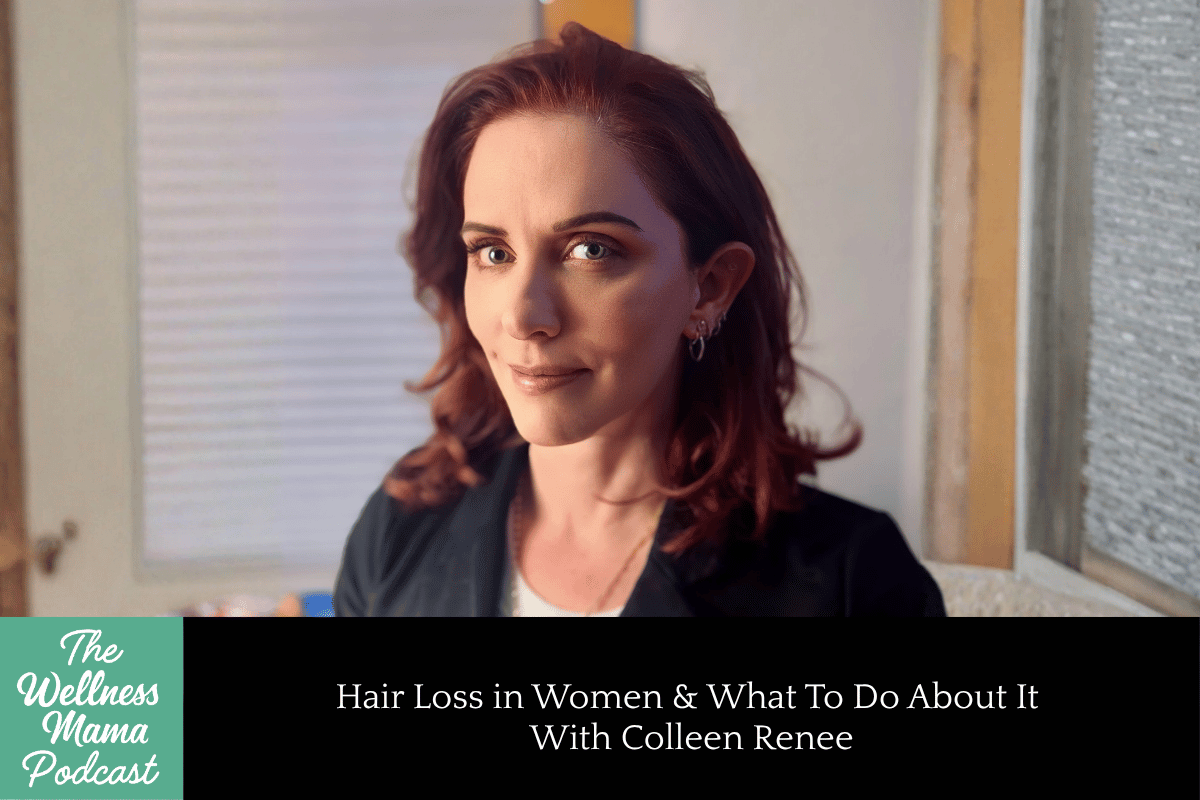
Katie: I am excited. We have a w- we had a wonderful conversation before. I’ll link to that in the show notes. But in this one, I’m really excited to tackle a topic that I get a lot of questions about and that you are an expert about, which is the topic of all things hair, but even more specifically for women when it comes to hair loss.
It seems like there’s some more nuance than there can be with men. And of course, with hormones, a lot of factors that come into play, and I know this can be very tough for women who are going through it. I experienced this when I was having thyroid issues in the past, and, got to do a deep dive and learn.
But then I feel like you know even so much far beyond what I’ve learned that can help so many people. So like I said, I know this is a broad and kind of nuanced topic, but maybe to intro, can you walk us through specific to women kind of the hormonal landscape that can be going on when it comes to hair loss?
Colleen: Yeah. So, it’s actually one of the most common things that I have women coming in for. You know, like I, you know, sometimes they even feel fine, and all of a sudden they’re getting these hair loss, a bunch of hair loss going on. it- it’s really typical in that perimenopausal type area, in the late 30s, early 40s when the hormones start to shift.
But it can be related to a number of things, including medications. As you mentioned, thyroid is another big one that’s, that, that’s true about. It can be nutritional deficiencies. There’s just a whole lot of things that can cause that and contri- contribute to it for sure.
Katie: That makes sense. And I feel like from the women I hear from, and as was my case with thyroid, it’s often they’ve had the same type of hair their whole life. It’s always been fine. They’ve never even really thought about it, and then something shifts, and now they’re noticing a lot more hair coming out in the shower, or they feel like their hair is a lot thinner. and like you said, it sounds like it can often be like a hormonal catalyst.
And I know there’s many other reasons as well, but to kind of just double-click on the hormone side, obviously women have cascading hormone cycles throughout the month, and certain ones are up and down at different times.
What are the big ones that seem to be really tied to hair health and that might be kind of out of range if someone’s experiencing hair loss more than they used to be?
Colleen: Well, the big ones that are, are tied to hair loss and, and, of course, just the opposite of being able to keep your hair, is estrogen.
And I think, any woman who’s experienced pregnancy can… most of us can attest to the fact that you know, during pregnancy, you’ve got this luscious hair. It seems to be growing longer. I mean- And then, you know, like four or five weeks after baby is born, all of a sudden your, your hair is, you know, filling up the sink and the brush and everything else.
So estrogen is, is very closely tied to being able to support, the hair staying in the growing phase longer, and keep it out of the shedding phase. And progesterone is also, super important for that. One of the, one hormonal factor, that we don’t often consider with women is the androgens or, the, testosterone hormone in, in particular.
Most of us know that women do produce, testosterone within their body and that, it, it’s one of the factors as our hormones shift, relatively our, our testosterone is, higher than our estrogen/progesterone. That testosterone in turn turns into something, dihydrotestosterone or DHT, which directly can, bind itself to the hair follicle and cause that to fall out too.
So it’s not necessarily an overproduction of testosterone, but the relativity towards the estrogen and progesterone as we start to go through perimenopause.
Katie: That makes sense. And I have experienced that certainly with pregnancy and then postpartum. though just purely selfishly, I’m curious, this time with my seventh, I had a big 10-year break in between, and during that time I reversed my Hashimoto’s, was very focused on micronutrients, protein, getting my nutrient levels back up, and I noticed much less shedding postpartum this time.
So I’m curious, is that, is that a thing that can actually be shifted even though the hormones themselves of course are gonna shift, but that we can do things with diet and lifestyle to help kind of minimize that being as big of a problem?
Colleen: Absolutely. So yeah, as, your, your body goes through, you know, so mu- so many changes in pregnancy, but also uses up so many nutrients in order to support the pregnancy, breastfeeding afterwards, all of that kind of thing.
And so the body will support the child, and take away from mom’s body in order to get the nutrients they need. So oftentimes the less important, things that it functions that our body take, take care of, like hair growth, kind of get put to the side while we’re using up these other nutrients for, more important things, if you wanna call it that, important to the body’s survival anyway. So certainly hormone balance. Another big factor for new moms is also stress and, and so that’s, that’s, the cortisol level’s another, are another factor with that as well.
Katie: I definitely wanna circle back to the cortisol levels, but I’m hearing…
Before we get there, I’m hearing so much about perimenopause right now. I’m so glad that it seems like this conversation has entered the more mainstream, and that we’re talking about perimenopause happening before actual menopause, and that there seems to be a lot we can do to make that experience, much more smooth and pleasant than we used to think.
But of course, there’s gonna be a big hormone shift here, and while that might not necessarily be a problem, it’s a thing to navigate, of course. So when a woman goes through perimenopause, which hormones are shifting the most, and understanding that, like, what does she need to know to be able to support her body through that, especially from a hair perspective?
Colleen: Yeah. So the, the interesting thing about perimenopause, it’s not an, a very easy thing to actually diagnose through labs. So we can draw, you go to your provider, they draw some blood. They can tell you where you are in your cycle. They will tell you right in that period of time where your hormones are.
And most often, in a perimenopausal woman, for most of us, that’s, they’re, we’re gonna see that they are in a normal, quote, normal range for wherever they are in their cycle. But that doesn’t, that doesn’t take into account the shifts that are occurring. And so with perimenopause, we’re seeing,, big, much bigger shifts in, the amount of estrogen, the rate of, the, so much higher peaks and lows if you wanna put it that way, and just a general decline, which our body in turn, is reacting to that through hair growth is one of those, and along with the other things that we talk about.
so as the estrogen declines, it’s not supporting the hair growth any longer as, as it used to. It’s not keeping that in the growth phase and letting it shift to the shedding phase much sooner, so then we tend to lose hair. Then progesterone is the other one that’s shifting, that one is more protective against the DHT that we talked about, the testosterone derivative. And so that can bind to the hair follicle and cause hair loss as well for women.
Katie: And I’d love to hear more about the androgen testosterone piece, ’cause like you said, this isn’t talked about as much for women. I know that seems to be the main piece when it comes to male pattern hair loss. But for women, I feel like this often gets discounted ’cause that obviously, like you said, is not our primary hormone that we think of.
It’s not the one we test the most often. Seems like for many women it can be low, though I’ve also met women where it’s high. So, like- Mm-hmm … obviously testing is how you find out what’s going on, but what does, what do different levels of testosterone mean for women? And is it in, in relation to progesterone and estrogen and other hormones that it matters, or is it a relative number?
Colleen: So it can be both. So we see, when we talked about before the levels of testosterone being higher relative to the estrogen, progesterone, because that tends to shift later in life. So, so it certainly can be. Now you have more testosterone than you did estrogen prior to perimenopause, which then produces the DHT and then locks that in.
But there are other hormonal imbalances that women can have. Big one is the PCOS or polycystic ovarian syndrome. women, with that, one of the primary diagnosis for that is the elevated testosterone that they have. And then there’s things like insulin resistance that we see in type 2 diabetes and pre-diabetes.
Those, release higher testosterone levels, which also contribute to hair loss. So it’s one of those things that can be either/or, and it’s oftentimes, and takes a little bit of, fact gathering in labs and things like that to figure out which one of the, it’s really is the problem.
Katie: And then you mentioned thyroid. This is the one I have experience with. and I would love to understand kind of more on a physiological level what’s going on when someone has a thyroid issue and then starts noticing, like I did, their hair thinning or a lot more hair loss. I even, in the thick of it, had like the outer half of my eyebrows went away, my eyelashes were thinner, even like my body, everything was thinning.
So obviously thyroid affects so much throughout the body, but how does it specifically affect our hair health?
Colleen: Well, interestingly enough, thyroid problems, either hypo, which, it, which you spoke of is, is the lower, having too low of, of thyroid hormones, which can be related to an autoimmune condition.
There’s other things that can cause that as well. There’s also hyperthyroid, meaning the, having too much thyroid, and both of those states actually cause hair thinning. So, thyroid is really closely tied to our metabolism, to the way, the way things grow. It’s a, hair follicles are- are fast turnover type cells.
So they’re- they’re one of the things that get affected first from thyroid, is having, just a decrease in the, the way the follicle, gathers nutrients and the way the several factors that, that just go into being able to keep that hair together, that thyroid hormone is, is directly related to
Katie: That makes sense. And obviously this is gonna be a puzzle piece where if someone is navigating thyroid stuff, they are gonna want to work with a practitioner specific to that in conjunction with anything they’re- else they’re doing to support diet, lifestyle, and supplements- Right … which we will definitely get to later on in this episode.
Yeah. Cause I’m wondering if, supplements are one of the other reasons I’m not seeing hair loss this postpartum. I’d love to go deeper on the growth phase versus the shed phase, cause I feel like I hear those terms on social media. It makes sense to me that, like, hair might be growing at some times and then eventually they turn over and you have new hair growth.
But it seems like there’s a lot of factors that can maybe influence whether, like, what percentage of your hair is in the growth phase versus the shed phase. I’m guessing there’s nothing that gets us to, like, only hair in growth phase and no, not losing any hair whatsoever. But, like, what’s a healthy balance there, and what factors influence our body in knowing how much hair to grow, how much hair to shed?
You said they’re high turnover cells, so I’m curious, like, how, how the body navigates that.
Colleen: So the, the growth phase that you, I mean, on average, you should be losing, it’s very, very normal to 1 to 200 hairs per day. That’s, that’s completely normal. Each hair follicle is kind of in its own phase, so that we always constantly have, you know, we have a new hairs incoming.
We have, ideally we have, have a lot of hairs that are just kind of hanging out there. And then the, the shedding phase should be the, the last part and the shortest part of that. There’s a big genetic component to that. I mean, you, you see there… Some women can, you know, grow their hair past their waist with no problems, other get to a certain point, and that’s as long as they can get it.
So there is a genetic component, but they… But as we talked about before, nutrition is a big thing. Having, those, the foundations and the nutrients and everything needed to go into supporting hair growth, that’s a big part of that. So yeah, really the, Iideally, we would lose 100 to 200 hairs per day, and that wouldn’t be that big of a deal.
And then we just kind of keep it in that growth phase. Does that kind of answer the question? Sorry.
Katie: It… Yeah, absolutely. And I know, like, there’s very specifics we’ll get to in depth in a few minutes, but from a nutritional side, I’d love to know just kind of broadly what are some of the factors nutritionally that influence hair health in general?
Like, I know when I had thyroid issues, I was also, like, chronic dieting, not getting enough nutrients, and that that was a big shift I made was just away from calories and restriction and into how do I maximize the both amount and variety of nutrients I’m getting from the food I’m eating, and then add supplements in.
So based on what we know of the science of hair health, what are the big categories that can influence how healthy our hair is and how our hair is growing?
Colleen: So big things that our body rely on is collagen, which is proteins. little harder to get in plant-based proteins, but there, there, that is a possibility if people are having a primary plant-based diet, supplementation is probably gonna be important for them for a lot of that because it’s difficult.
But collagen, biotin is another one, folic acid are all, all big deal. vitamins D and E are great, are important, and then B12 is another big one that’s important for people to kind of support their hair growth.
Katie: Yeah, I’ve seen the, some people posting crazy results with adding in collagen. And personally I would say also to me it makes sense, like go back to the kind of the way our grandmothers used to cook too.
Like if that’s a priority for you, I’m a huge fan of making inexpensive broths and meat stock and soups and things that naturally have that. Even if you’re also doing collagen. I’ve personally noticed my skin and my hair feel so much better if I’m getting food sources and the supplemental sources.
another big category right now that I see a lot on social media especially and that I get email questions about, obviously we are in a phase societally a lot of people are on GLPs of various types for the weight loss effect. And I know that there can be side effects with that, including apparently hair loss.
So I’m curious, like is anything mitigatable when it comes to GLPs and hair loss, and why are people seeing an increase in hair loss when they’re on a GLP, especially long-term?
Colleen: Yeah. That’s a good question because I do see a lot of that. People are, you know, it’s kind of a big trend right now, so I see, you know, probably half the people in my practice are asking about GLPs or have questions or concerns.
And hair loss is one of the big ones that I hear. Usually, it’s usually about the… most common see about four to six-month mark is when people start kind of reporting that that’s going on. And that is a certainly a variety of factors. I think the biggest one is the incomplete nutrition. Oftentimes these, these, the GLPs work by decreasing your appetite as well as a lot of other things.
It also decreases some of the absorption in certain, certain vitamins and minerals. So the hair kind of… It the hair reacts to a stressful situation, whether, you know, it’s a true stress or the stress of lack of nutrition in, It, it, it takes a little bit of time before that. So, so we’ve got that four to six-month mark where the body has just been kind of supporting itself and now we have a whole bunch more hair going in the shedding phase.
There I, adding those supplements, nutritionally and more importantly, I think it’s important to stress that on the GLPs eating is, is becomes your job to do. I try to tell my patients that all the time. “If you’re going to be on this, you’re, you’re going to have to eat whether you want to or not.”
‘Cause a lot of people don’t have an appetite, so they’re just like, “Well, I’m losing all this weight. I’m, I feel great. You know, I’m eating, you know a salad a day.” And, and that’s not, that’s not the way, that’s not gonna support your body. It’s not gonna re- support your weight loss either on the long term.
So, making sure, so with the GLPs, making sure that you’re eating well, talking about proteins is big, is really, really important, making sure you’re getting p- protein with all of that. And then oftentimes needing a supplement to kind of support the stress that your body’s going through taking these medications as well.
Katie: That makes sense, and that seems like good general advice anyway for someone who is using those as a tool. Like, I don’t have personal experience- Yeah … with them. It seems like they obviously can be profoundly effective. But it seems like I’ve also heard good practitioners like you explain it’s not that they’re good or bad, it’s how they’re used, and like you’ve got to make sure you’re still getting nutrients.
Even if you’re not consuming as many calories, you’ve got to get the nutrients the body needs also to avoid, I mean, beyond hair loss, muscle loss and bone loss, which are really problematic.
Colleen: As we get older … but besides hair loss, fatigue is a big one that I see on GLPs, and it’s all, it’s really related to nutrition.
It’s a big, it’s a big deal and I’m, you know, I’m… I don’t feel like that we have enough support for people doing, the, who are on the GLPs talking about nutrition, not just the weight loss portion of it, so.
Katie: Okay. And another thing I’m curious kind of side by side with that, but also in connection with hair health in general, is how things like move- like lifestyle factors like movement and light exposure can come into play.
I mainly ask cause I’ve noticed big differences in my life when I really dialed in those factors, and I’m a huge proponent of getting natural sunlight, having good circadian rhythm with interaction with nature. I’m just curious if there’s also a connection to our hair health here.
Colleen: Yes, absolutely. Our, one of the big things that we get from being out in natural sunlight is vitamin D. And if we’re all doing what we’re supposed to be doing and, and covering up and wearing our sunscreen and doing all that, we, it really prevents us from absorbing vitamin D the way we should. You know, 10 minutes of exposure just on, you know, on bare arms, that kind of thing, can really make a difference and kind of boost those levels.
In addition, they, the being able to exercise, movement, all of that kind of stuff, increases circulation, which in turn increases circulation to even the hair follicles. So, so all of that is providing the nutrients plus the blood supply and everything that’s important. So those two things are, a- and, and I, I, and as we know, exercise and being just out in nature helps us with stress, and so again, decreasing our cortisol levels and supporting our hair health as well.
Katie: Yeah. I mean, purely anecdotally, I would say really prioritizing morning sunlight as a lifestyle habit was one of the most effective things I did for my cortisol patterns, that mine were completely flipped at one point, and that was the first habit I started with, and then eventually worked into like that short burst of midday sun, watching the sunset as well, and then keeping lights low at night.
And huge difference in my sleep and my energy levels from getting my cortisol back in alignment with nature, and that one’s free, so I feel like that’s so overlooked sometimes because it’s free. But I highly encourage people to try it. Another cool fact I learned from you that I would love to understand more of is that apparently location can be a good clue when it comes to hair loss.
Like, there… I didn’t even think about this before, but like different parts of the head, I guess, depending on where the hair loss is more concentrated, can kind of give you an insight into what’s going on. So what do we need to know about location and what that can indicate?
Colleen: Generally when we are experiencing hormonal hair loss, there tends to be more of the pattern, it, that we see, like, along the part line, where as, where your hair is pulled back, like if you wear your hair up a lot of the time.
So, areas of stress, we’ll notice that there’s more hair loss. Women as a general rule don’t experience hair loss the way that men do, you know, that specific balding, kind of the male pattern baldness. But we do, experience more, like, the hairline, the part, that kind of thing. We can also experience, overall hair loss, so you may not notice, you know, specific balding areas per se, but just an overall, your ponytail is thinner, you know, more hair in the brush, that kind of thing.
So, that’s really a good clue that we’re experiencing some sort of hormonal thing going on.
Katie: And we’ve kind of circled around this quite a bit, but obviously, like, I think you’d probably say this too, like, get the lifestyle factors dialed in. Make sure you’re eating a nutrient rich diet. Those are kind of foundational things that apply to every area of health, and I’ve had so many people over the years talk about the various aspects of that.
But like you said, when it comes to hair health in particular, there’s, like, very specific nutrients that can make a difference and ways to kind of influence that growing versus shedding balance that’s going on. And I know you’ve done a lot of research and work around developing something very specific for this, and that it is also cleanly sourced and has good ingredients that are not harmful to the body, unlike…
I know I’ve heard some horror stories about medications people take for hair loss. Yeah. So I would love to start diving into that, and, like, what, what specifically are these, like, foundational things and that, that sets you apart? ‘Cause I think I’ve gotten to use this serum. It’s amazing, but I don’t fully understand all the components of it, so I would love to dive into that with you.
Colleen: Okay. Yeah, so one of the things that we looked at was that you can take things, that there’s over-the-counter medications that you can use. Most of them are topicals. There are prescriptions that you can get to, for hair loss, and what they do is they force the hair to kind of grow.
It’s one of those things that’s temporary. We add it on. Their chemicals are often harsh. But it does work, and it forces the hair to grow. The minute you stop them, they kind of stop working as well. We wanted to find something that supported the hair growth, that along with, adding those key nutrients in there that will actually support the hair without any harsh chemicals in there.
So we, with some research, they came up with a supplement, or a proprietary blend, if you want to say that, is something called Anagaine NEW is the name of it, and what it is a Swiss pea extracts. So it works, so we put it into our, a, a supplement that’s easy to take. It’s, it, it’s you take it by mouth.
You don’t, don’t have to put anything in your hair. That kind of… There’s, so, there’s some of them that cause the, the hair greasiness, that kind of thing. You are not gonna get that here because you’re gonna take this as an oral supplement. it supports the, the, the growth phase, by increasing the circulation within the scalp, and in sup- and providing the nutrients also to kind of support that, that growth phase.
Katie: That’s, yeah, that’s so interesting. I’d never heard of that ingredient before. And so this is a supplement. It’s serbut it’s oral, for people who are listening to make sure they understand. and how quickly do people often start to see a difference with this? like, how do you recommend implementing it?
kind of what to know about the supplement itself.
Colleen: So it’s super easy to take. It actually tastes really good, so you can actually just put it right directly into your mouth. It just, it, there’s eight, comes in a little pump bottle. You do eight little pumps. Tou can add it to juice, that kind of thing, but frankly, it, it’s great to just take first thing in the morning with any of your other supplements before you have some breakfast.
The difference that we have made… So there, there are other products that work in, kind of in the same way. With Purality, we wanted to take that ability and the concentration and make sure that is well digested, and we do that by using the liposomal technology. What that means is that we bind the molecule into a fat layer, which allows it to pass through the stomach to start with so that it’s not broken down by the acidity in the stomach, and into the smaller intestine, where it can be absorbed and actually used well.
And that liposomal technology is kind of what sets us apart from everybody else, that it’s actually absorbed, so what you’re paying for, you’re actually getting and using in your body that way.
Katie: And I will of course link to that in the show notes. I know you guys have kind of a special thing just for listeners, so you guys can check that out at in the show notes. And so like I would love to paint a picture of like a best case scenario. Like, if you could wave a magic wand to give women kind of like the full picture of how do you have the best hair you can possibly have. Obviously, I know the serum is gonna be a big piece of that.
But what other things can they do to support… I know we’ve touched on some of them, but to make sure it works absolutely amazingly, and that they can really see a difference in their hair?
Colleen: Well, I think it’s important for women to remember that kind of our hair is our, our body’s last, sort of place that it’s gonna put into, keeping itself healthy. So overall health is really important. I think it’s important to make sure that as… If you’re caring for your body as you should be, proper nutrients, exercise, all that, it’s really gonna show in your hair. So, making sure you have a balanced diet, making sure there’s protein in your diet. and, and make sure there’s, there, protein in every meal really.
And then just overall taking care of yourself, the things that you’ve talked about, lowering our cortisol, managing our stress the best that we can, doing the self-care that we need to. All of the, that shows up in our hair. And then adding the supplements that you need to. Sometimes it’s difficult to get enough protein, so adding the, the collagen and then this, the Anagaine NEW that we have here that’s gonna support the hair growth and support the growing phase of the hair.
Katie: And are there any other areas about hair loss that people either don’t know or that are often misunderstood that we haven’t touched on? ‘Cause I know I definitely see kind of all these products on social media, and just looking at the ingredients of some of them, I can see why they wouldn’t actually be that effective, or if they’re just topical, like you said, they’re not addressing what’s going on inside the body.
But are there any other areas we misunderstand?
Colleen: The women that I see that come in frustrated about their hair. I think that they automatically assume it’s just a hormonal thing, that it, it’s, “Well, it must be just perimenopause,” and that kind of thing.
So I think it’s important that we address all of the topics that we’ve talked here about what hair growth is, and I think it has to be it’s not a one-size-fits-all for everyone. We’re gonna have to address it on many levels to make sure that we’re doing all those things, because it can be a combination of all of those that are actually contributing to hair loss.
So I think it’s important that we address all of those areas when we talk about hair loss.
Katie: And then lastly, I know this isn’t, like, directly related to the serum you have, which I love that it’s internal, but are there any products or practices that we do often to our hair that can be counterproductive or that people might wanna stop doing?
Colleen: Yes. So, so any time, that we’re doing anything, any of the chemical processes, so, in, you know, hair dyes and the blow-drying and the heat product tools and all of those things, I think we all know those can be really damaging to our hair. So eliminating that as much as possible.
But in the times, you know, we all have, obviously I use to have the tools on my hair too, so making sure that you’re caring for it well. Scalp treatments, natural ones like argan oil, that kind of thing can be really good as, as kind of a stimulant. Scalp massage- so doing the argan oil along with scalp massage can really help that. Making sure we’re using,you know, heat-protective products if we necessarily have to put heat into our hair, and doing all of those kind of things to make sure that we are caring for the hair that we have already and, and preventing some of that breakage and that kind of thing happening as well.
Katie: Amazing. And lastly, where can people find… Like I said, I’ll put the link in there, but where can they find it? And I’ll put this details as well, unless you wanna mention anything specific, but I know there’s something special for listeners.
Colleen: Yeah. So we, for, for your listeners, we are doing a 40% off. It gives people a chance to try that.
I really recommend at least doing the, the supplement for at least a month, because it is a supplement and it takes a little while to start seeing the results, i- as those nu- nutrients get into the follicles and, and help them, stay longer in the growing phase. So I usually see people, start to notice a change about two to three weeks with, with this, that they’re seeing a little bit less hair loss, and then by a month starting to see some of that new hair growth on there.
So, using the 40% off will give you a chance to give that a try for a month or, and, you know, and, and see if you start noticing a difference, and then continue on with that.
Katie: Amazing. Well, it’s always so fun to get to learn from you. I feel like you have an incredible gift to, like, pack so much knowledge into a single episode, and you have beautiful hair yourself for anybody not watching on video.
Colleen: Thank you.
Katie: And I do use the supplement. And I can attest that it does taste good as well, ’cause that is one thing I will say with, like, some liposomal stuff. It has not been my favorite taste, and yours actually tastes good, so congratulations on that.
Colleen: Yeah, it does.
It was really easy… It, it, it feels like a little treat in the morning, so I don’t mind taking it at all.
Katie: Amazing. Well, Colleen, thank you so much. This was so fun, and hopefully we’ll get to chat again in the future.
Colleen: Thank you. I appreciate it. Have a great day, and thanks for having me on.
Katie: And thank you all for listening and sharing your time with us. We’re so grateful that you did, and I hope that you will join me again on the next episode of the Wellness Mama podcast.
Colleen: Thank you.
Katie: If you’re enjoying these interviews, would you please take two minutes to leave a rating or review on iTunes for me? Doing this helps more people to find the podcast, which means even more moms and families could benefit from the information. I really appreciate your time, and thanks as always for listening.




Leave a Reply