Read Transcript
Child: Welcome to my mommy’s podcast!
Katie: This episode is sponsored by BON CHARGE, and specifically one of my favorite things that they have, which is their PEMF mini mat. If you are new to PEMF, this stands for pulsed electromagnetic field, which is magnetic energy that’s being sent into the body via this mat. And these energy waves are fascinating.
They work with your body’s natural magnetic field to elevate your wellbeing in a multitude of ways. Similar effect that we would have from being in direct contact with the earth, which I also think is an amazing thing to do daily. I love PEMF mats to improve sleep, to ground me, to increase calmness.
I often say that sitting on one of these mats, I feel like a cat in the sunshine and just, like, so calm and cozy. Some of the reasons I personally like this particular mini mat, it is small enough to fit in any room, and it’s easy to move from room to room. I also have a larger one, but that one is more difficult to move around.
There are different settings, so you can find what works best for you, and it’s low EMF. Some of these are not. I feel like this is an important thing to pay attention to. Some easy ways that you can use a mini mat like this: it’s great on an office chair or on a sofa or on the floor, wherever you are sitting and reading, meditating, working, et cetera.
I love to use it before bedtime or after a workout or I’m actually doing yoga teacher training. I’ll often use it during restorative classes or when you need kind of like a creative boost or a brain reset. And like I said, I love how portable this one is. You can find out more about it and get a discount by using the code wellnessmama at wellnessmama.com/go/boncharge
This episode is sponsored by Just Thrive Health, one of my favorite companies, and especially their new Digestive Bitters. So I’ve been talking about gut health for years before it was so trendy. I love that everybody’s talking about it now, and the one brand that I have continuously used for my gut health is Just Thrive.
I started on their probiotic seven years ago, and my whole family uses it. I prefer their probiotic over any others as it’s guaranteed to arrive 100% alive in your gut, and it has a thousand times better survivability than most probiotics. It’s also one of the most versatile probiotics out there that we can take in capsule form and I can also add it to smoothies or even bake with it because it’s heat stable up to 450 degrees. So it survives all the ways I use it. I also love their newest product, their Digestive Bitters, and I got to record a fascinating episode on this because for centuries, traditional cultures turned bitter herbs into an ultimate digestive activator.
But in today’s world, these essential compounds have all but disappeared from our diets, and that’s why I am really enjoying their di digestive bitters. Which features 12 clinically proven herbs. It activates your body’s natural digestive processes and encourages healthy GLP one production naturally. So for you, that means smooth digestion, better nutrient absorption, and balanced cravings.
And best of all, the capsule design delivers the benefits of bitters without the unpleasant taste, which is a massive breakthrough. Just Thrive Digestive Bitters work with your body’s natural process to optimize digestion, nutrient absorption, and gut health, all backed by science and centuries of proven efficacy.
They can replace several digestive aids like antacids making instead of masking symptoms. These actually help acid levels and regulate bile production. Some of the many benefits of Bitters, they can ease occasional bloating and indigestion, support GLP-1 production, naturally help you break down your food better for better nutrient absorption, support your healthy blood sugar balance and appetite control, encourage and support optimal bile flow and enzyme production, enhance digestion of fats and proteins and without the bitter taste.
It can promote balanced gut microbiome, support healthy gut barrier function, and can be taken alongside probiotics for peak gut support like all of their products. These are microbiologists formulated, evidence-based and safe, as well as non-GMO and free of gluten, soy, dairy, sugar, and artificial ingredients with a 100% satisfaction or your money back.
I have been experimenting with these and really, really loving them. If you would love to check them out too, go to justthrivehealth.com/wellnessmama and use the code WellnessMama15 for a discount.
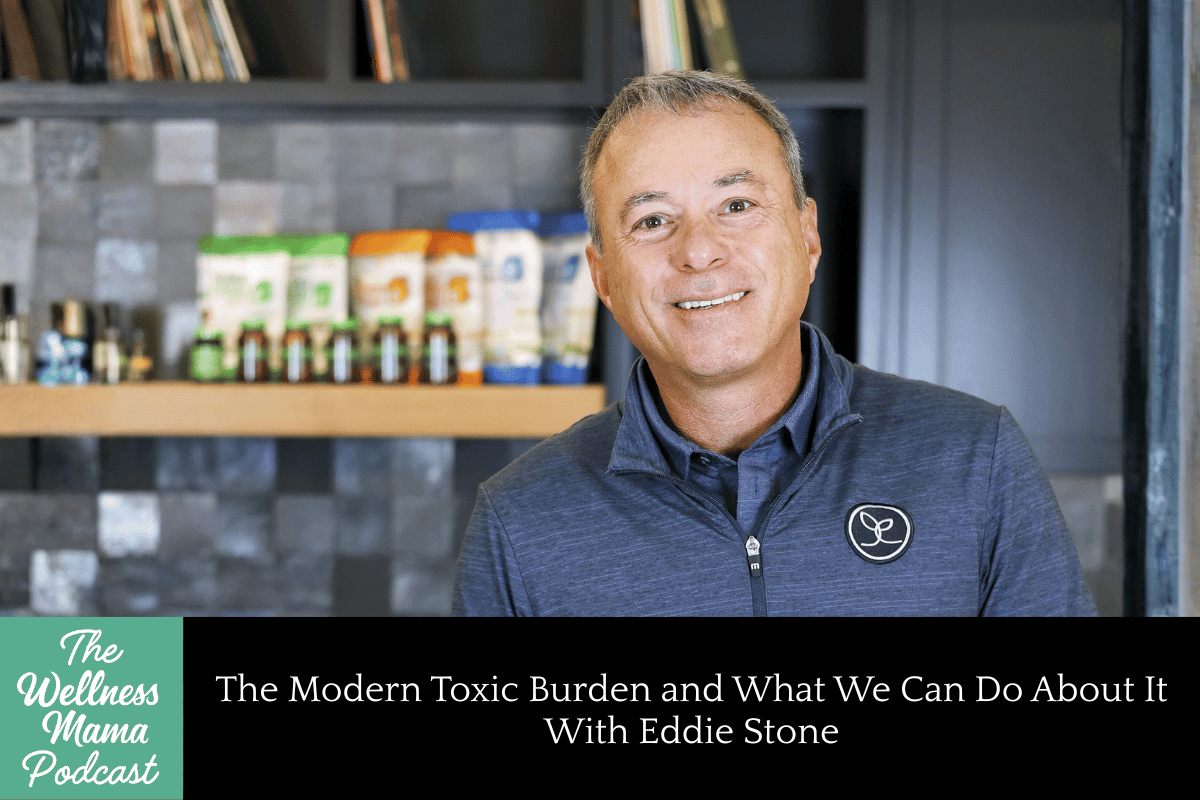
Katie: ?Hello, and welcome to the Wellness Mama podcast. I’m Katie from wellnessmama.com, and this is part one with Eddie Stone, and I was really excited for this interview. Eddie is the founder and CEO of Touchstone Essentials, which is a wellness company built around the simple idea that supplements should be as clean as the lifestyles they are meant to support.
And we’re gonna go into one aspect of that today, specifically using, advanced clinoptilolite zeolite for detox support, and that’s a huge word. He explains it really well. This is something I’ve been experimenting with, and you’ve probably heard me say before that detox is not something we do to our body.
It’s something the body innately knows how to do and something that we can support it in doing. And I personally find that zeolite has been a really gentle way to support my body’s natural detox movements and pathways and gentle enough for my kids, and that I’ve seen some really good results from it.
If you are interested in trying this, make sure to check out the show notes, and you can also on my social media this week and my email newsletter if you’re listening within a week of this airing there will be a special link there to save up to forty percent, for a very limited time. So definitely check that out if you wanna try it as well.
I loved getting to dive deeper on zeolite, and let’s join him now. ?Eddie, welcome. I’m so happy that you’re here. Thank you for being here today.
Eddie: Oh, delighted to have this chance to connect and talk a little more and be with the audience.
Katie: Me too. I think we’re gonna get to dive into something that has been recently very impactful for me that I have not even gotten to podcast or do a solo episode on yet.
And that I feel like it’s gonna provide a lot of really helpful and interesting nuance and backstory about the topic of detox for moms especially. At least I know this has been really impactful for me. And of course, my audience has heard me talk over the years about avoiding toxins in our environment in various ways, but I feel like you’re gonna be able to give us even more insight than I have previously covered.
So in this episode, we’re gonna talk about the modern toxic burden, which we know is increasing, but more importantly, what we can do about it. So to start off kind of broad, what do you mean by the modern toxic burden so we can make sure we’re operating from the same terms at the beginning?
Eddie: Yeah. And for me, there’s sort of two sides to this. One is that one of the dirty little secrets of modern living is there’s probably 105-110,000 different chemicals that have been sort of produced in the last several decades or even going back further that are just sort of a part of modern living in terms of industrial manufacturing or farming or whatever it happens to be.
And we can now throw things like microplastics, you know, sort of into that category, but there’s more than that. It’s also kind of a practical side of just everyday living. Oftentimes we talk about a fast food nation, right? There was a popular book several years ago about that, but kind of a fast food sort of idea or ultra-processed doesn’t speak to it just in terms of that entire way of living.
So that just mean maybe by the speed of demand of life or just how busy we all are or just how fast we live or how quick we need it, and so when we talk about a toxic burden, it’s more than just these physical properties of heavy metals and environmental pollutants that are in the air, the water, the food supply.
It’s also just generally the things we don’t think about every day that are likewise the same, just at the hurried pace of how we live.
Katie: Yeah, that’s a great point. And I would guess people who’ve listened for a while have heard me say, like, detox is not a thing we do to our body. It’s not an exogenous process.
It is actually something our body is brilliant at doing on its own. However, to your point, in the modern world, we are facing a much higher toxic burden than we have ever historically faced before. So even though we might be doing all the things, quote-unquote, “right,” our body has a lot more to deal with than it has historically in the past, and I think we see the outcome of that in various conditions that people have in the modern world at higher rates than we have before.
And I will say, just for anybody listening now, there’s something that I’ve been doing that seems to help a whole lot with this, and I will… I know we’re gonna have a special thing just for the listeners. We’ll mention that at the end. It’s also in the show notes, so if you guys drop off early, make sure to check that out if you wanna get what we’re gonna talk about.
But before we get there, I wanna go back to the topic of detox, because I feel like this word has become such a confusing and misunderstood topic, and I see all these, like, really harsh cleanses circulating on the internet, and some I feel like could actually do more harm than good, depending on where a person is when they are start doing this.
So maybe give us your insight on the topic of detox and what we need to understand before we just jump into some really, like, harsh protocol or cleanse.
Eddie: Yeah. And I’ll give this some context. So for yourself and the listeners, I’m 62, and I’ve really, I’ve kind of been in the health space really my whole life.
It kind of started in the mid-20s for me, somewhat motivated by my own lifestyle and, you know, went to get an insurance exam and my numbers weren’t great, you know, with blood reports and things like that, but then also what I saw with my family. So my sort of motivation is both personal as well as observational.
And what you quickly learn when you start to look at detox, particularly if you Google it or things like this, is just how harsh it can be. And so I think it holds people off or maybe stops them from going further ’cause they think they’re about to do something where they wind up in the restroom for two or three days, incredibly disruptive for life, cramps, uncomfortableness, things of that nature, or even exotic treatments such as different types of enemas and others that just seem so unpleasant no one’s going to deal with those things.
And so, you know, what we found is that it’s not just what you might do from that type of protocol, but it’s decisions you make with the type of food that you buy, whether that’s food you’re gonna prepare at your house, what you do in your outside, other sort of lifestyle-based decisions, but it’s also introducing protocols that support the body’s native abilities.
You said a few moments ago the body has a really incredibly genius ability to help detoxify itself, but in a modern world where the burden is so high, right, you can kind of overwhelm those native systems. So even eating things like green leafy vegetables, which we know support the body’s ability to detox, particularly cruciferous vegetables, with various chemicals and those that kind of support how that works at the cellular level.
There are other things you can do, such as products like zeolites, which we happen to be experts in. It’s really been a main focus of the work that we do, which work gently with your system and doesn’t cause this disruption. And frankly, I would make a very strong argument it should be a part of just health habits on a day in and day out basis, much like trying to get adequate amounts of fiber.
You know, that should be a daily health habit or a goal for someone, is to introduce these things on a daily basis so you’ve got this gentle, ongoing process supporting how your body deals with, manages, and gets rid of toxins. And so that’s my whole focus point has been for individuals and families, things that they can ease into their day, that are affordable, that make sense day in and out to deal with these burdens, because we don’t live in a bubble.
I mean, day in and day out the exposure is real, it’s daily. You’re not all of a sudden gonna walk away from it one day to the next, no matter how many lifestyle changes you make. And so that’s the whole point for me, is something that you can mix into your day easily without disruption.
Katie: Yeah, I think that’s an important point, and we’ll definitely get to deep dive really deep on zeolite in a minute ’cause like I said, this is a new topic I have not covered in depth here before.
But before we get to that, I would love to also just talk about obviously a big piece of this that I’ve talked quite a bit about in the past is also reducing our exposure. And like you said, there’s hundreds of thousands now of chemicals in our environment, so we obviously can’t avoid them all. But I would guess there are some big offenders and some categories that if we kind of 80/20 it, like some things we can remove or switch out that make a huge difference for our toxic burden.
So I’d love to hear what you have found and what you recommend as far as making those swaps or removing things before we get into the then let’s help the body recover.
Eddie: Yeah. So you know, for me it kind of starts with water. People being just conscious of the quality of the water that they’re consuming, and if they don’t really know much about their city water or the well water they’re using, just generally what’s available to them, take a few minutes to look online at what your local municipality might say about the water that you have.
There’s even probably ratings for groundwater in areas where they’re getting it out of a well. Or for not very much money, a person can have their well water checked, right? So the first thing to do is think about the food that we’re consuming and the preparation of the water or the cleanliness of the water that’s going into that, because almost all cooking, food preparation really starts with water.
The water that we’re showering in, the water that we’re washing our clothes in. Just so looking at the quality of water, not just that we drink, that’s sort of just a part of the environment that we live in. And if you find that the numbers are alarming or you’re not comfortable with what you see, you can buy simple filters.
I mean, you can spend a lot of money on filters, but even simple charcoal filters available at your local home, supply store, from Amazon, wherever it happens to be, you can find products that make a difference. Are they perfect? I think we could argue that very few things are perfect out there, but for just a few dollars a month, you can probably find something to help with, say, the shower head or what’s coming out of your sink.
And then you can go to entirely exotic systems if you’re looking for whole house filters, reverse osmosis, whatever that happens to be. And so I tell people to kind of start with what you’re consuming from a water standpoint, both externally and internally. And then I would think about the air supply.
People don’t think much about it, but if you look inside your home and you look at your HVAC system, such, you know, kind of whatever you have, most of us know or are knowledgeable about changing the filters in our home, right? But we don’t really think about the functionality of that for the most part. That filter in your home is taking air out of the living space, filtering it before it goes through your HVAC system.
And so when that’s dirty, one of the connections I want people to make is that that’s exactly what your lungs are taking in. Except you can’t take your lungs out and change them, right? That’s just not what happens here, right? You can change that filter, but you can’t change that. And so being conscious of the quality of the internal air inside your home.
Maybe you change those filters just a little more frequently than you would otherwise, or thinking about your exposure to, say, harsh cleansers inside the bathroom, if you’ve closed the door in a small bathroom, you’re cleaning the heck out of that environment, and you’re smelling those noxious chemicals, just remember, all of those things can damage the very, fragile, tissue inside your lungs.
And so there’s things that I think we all intuitively know. We just kind of plow through it and don’t recognize there’s sort of this cumulative impact that occurs over time. And so those are one of sort of the first places that I start. Get outside as much as possible. Do breathing exercises if that makes sense for you and your lifestyle.
A little walking in nature in as clean an environment as possible. I’m not talking about walking down Main Street where you’re smelling exhaust and things like that, if you can avoid it. So those are sort of the practical dynamics. And then you can get into food, and I am a big advocate for buying certified organic produce and foods as much as possible.
People have to weigh out their budgets. I certainly understand that. But if you look now in most grocery environments, there’s only a 1 to 3% difference in conventionally grown foods and organically processed foods. And yes, to the audience, all food’s probably way more expensive now than you want it to be, so I kind of get these dynamics.
But when you’re cooking and preparing foods, it’s just like the same with supplements. You tend to concentrate whatever is in there. And so if you’ve got something that has too much exposure to pesticides, herbicides, fungicides, you know, now that becomes a more concentrated form when you reduce it into a reduction for your risotto or whatever sauces you use on your chicken or whatever it happens to be.
And so some of this is just about some growing awareness in recognizing source now becomes important, and if you can’t source everything a certain way, can you source one-third of your budget? Because anything you do to sort of lower that temperature of exposure makes a difference in the functionality of both your immune system, your central nervous system.
It even impacts the health of your gut, right? And this gut-brain connection, which has a lot to do with the production of various chemicals from a, from an internal pharmacy standpoint. It can impact mood, biome. There’s just all kinds of dynamics at work. I mean, frankly, it’s a three or four-hour discussion that nobody wants to spend time on, but the bottom line is these choices, they accumulate over time, and the wiser you can be about the front end of that, even if it’s only a modest effort to begin with, I think they really see a difference over time in energy levels, quality of sleep, even how their immune system’s working
Katie: I love this, and I feel like this is a perfect segue into our discussion on zeolite.
I will say we’re gonna get to do a round two on the topic of supplements and the stuff that can be hiding in those that a lot of people don’t realize. So you guys stay tuned. That will air after this episode. But to your point, if, also, if possible, garden something. I’m a huge proponent of gardening ’cause then you know exactly where it came from.
You can fully avoid the chemicals, and it’s got the same microbiome and light environment as where you live. There’s just so many benefits to that, and I feel like we’ve become so detached from our food supply, and I know that’s not available for everyone. However, even if it’s a container garden on your back patio, like a little bit can go a long way, to your point.
I also love that you talk about the air and the water side because I think of kind of like triage effect. Yes, food is important and supplements, and we’ll talk about those in our next episode, and we breathe much more than we eat food. We drink water, hopefully, more than we eat food. So those are, like, very low-level constant exposures if we’re not aware of those and trying to, like, be really cognizant of what we’re consuming when we’re getting our water especially and in our indoor air, which we know can be much more polluted than outdoor air.
I’m a big fan of the term nature deficit disorder. I feel like many of our problems could be solved by simply spending much more time outside. And I realize-
Eddie: Love it …
Katie: -in the modern world, that’s not always available either. So then it becomes how do we best, you know, create our internal environment to mimic the benefits of nature or at least not work actively against it?
And I feel like that kind of brings us to the topic of zeolite because from my understanding, this thing is very unique in that, like we talked about in the beginning, it works with the body to kind of like, help the body’s natural detox pathways. It’s not doing something to the body. It’s working with what the body already does, and it, like, therefore, I feel like is much gentler.
Like, I didn’t notice any negative reactions from trying zeolite, and I noticed a lot of positive ones, but I also realize I don’t have a deep understanding of zeolite yet. So I would love for you to kind of give us a brief masterclass on what zeolite is and what makes it so unique.
Eddie: Yeah. I’m happy to because I, it’s one of these simple compounds that can really have a profound impact.
And the first thing I’ll say to the audience is it’s inert in nature, right? Meaning it’s not going to be active, which is really some of the challenges that can come from detoxification. zeolites, in the case of what we use, which is called clinoptilolite, there are several dozen different types of natural zeolites.
Ours is clinoptilolite, which is the most studied. It’s where the FDA, GRAS comes from. It’s sort of ubiquitous around the globe, and people understand its properties, particularly in helping to trap heavy metals and environmental pollutants. If you were to look at it, kind of get into the science side of it, this is a natural mineral that forms when lava, water, or lava, or I should say playa lake water, you know, connects and basically grows these crystalline structures.
And the structure itself, if you were to look at, it’s kind of porous. You might think of looking at a concentrated version of Swiss cheese in terms of these channels and tunnels that you see in it. But what’s critical is, in this case, the porous nature of the structure, those little hollow points have a negative charge And so when it’s in the body, and it’s in proximity to things like cadmium lead, mercury, other heavy metals that we kind of clearly recognize have a negative impact on the body, they all have a positive charge.
And so this, in this case, the function is much like, let’s say, the north end and the south end of a magnet. They come near one another, they kind of snap together, and that’s what occurs here, is those heavy metals actually wind up having a preference for attaching themselves to the zeolite. Now, this is happening on a very microscopic level.
You know, we have two sized zeolites. One is sort of a regular zeolite. We call it Pure Body, and that’s really more of a detox support in the gut, helps to balance pH, a few other things. And then we have a nano-sized zeolite. This is really critical. We have a proprietary process where we nano-size this.
Now, this is something that can escape outside of the gut, get into the soft tissue, get into the bloodstream, and really work at a cellular level. And one of the things we don’t think a lot about is really just how small a particle a cadmium, a mercury, these kinds of things are inside the body. You’re talking about things that can be angstrom in size.
You’re talking about smaller than the head of a pin, right? So you’re not gonna be able to see this unless you’re looking through a microscope. So to be able to have something at a cellular level that can do this same type of attraction that I’m describing is really critical because once those things have mated, so to speak.
Here’s the other thing to keep in mind. Zeolites are not essential minerals, and so they won’t stay or store in the body. They’re not capable of doing that from a biochemistry standpoint. And in fact, under sort of normal dynamics, they’re gonna process out of your body through urine, even through perspiration or, through a bowel movement in a four to six-hour period of time.
And so it’s gonna do its work and leave, and when it leaves, it’s gonna help escort those toxins out of your system. So you might think of your, your toxic burden kind of having a temperature level, and the higher that it is, you know, the more likely that is to negatively impact the function of your body.
If you’re using something like a zeolite on a regular basis, just as if you’re getting enough fiber in your diet, and things like that can have an impact on helping to manage issues of that nature, it’s gonna help lower that toxic burden and basically support how the body manage these toxins themselves, through perspiration, through bowel movements, through urine.
This is how our body manages these kinds of dynamics. Our kidney, our liver, it helps support those natural native abilities to do that. So it’s a support system for the body in this regard. When you consider that our bodies by design, all of these modern chemicals, right? They weren’t found in nature.
You’re talking about PFAS and other things of this kind that just were not there before. This is gonna give the body a little more freedom to try to manage this modern toxicity that’s just not as simple as finding basic minerals in the ground. And so it’s really profound in the way that it functions, and it’s been a part of human food supply and involved in supplements for decade upon decade.
In fact, zeolite histories go back several thousand years, and so we know about its safety. We understand what it can do. There are synthetic zeolites. We do not utilize those. Those have their own sense and, of challenge. But when you’re talking about naturally mined out of the ground clinoptilolite, which we do, we mine ours here in the United States, it’s even Prop 65 compliant out of the ground.
It’s exciting for us at least to be able to go out there to the public, we’ve been doing this for 14 plus years, and give people this tool they can use day in and day out. And we get a- I think we probably have, 50 plus thousand 5-star reviews, kind of across the board at Touchstone. And so we know a lot of people really see benefits from using the products.
Katie: Yeah, I was a slow adopter. I’m like a rebel and a skeptic at heart, and so I, like, definitely didn’t jump on this as early as I wish I had because I just am a skeptic of many things. And then I had so many people in my personal life and in my close circles that were raving about this and felt a difference, and I feel like that’s very unique when we’re talking about anything in the modern world, is like, that they actually felt a difference, ’cause often we’re just taking things and we have no idea if it’s helping or not, and we’ll talk about that in the next episode.
But I’m so glad I finally have started implementing this, and I love how gentle it is. To your point, it’s Prop 65 compliant, and I feel safe using it with my kids. And you mentioned heavy metals. I know it’s like there’s a lot of data on it helping the body remove those safely, as you explained. What else do people sometimes see?
‘Cause I know I’ve heard anecdotally about it helping with all kinds of other things in the body, including parasites, even though it’s not a parasite cleanse, so to speak. but it seems like it’s maybe helping the terrain of the body be able to kind of equalize that naturally once it gets its burden down, or what’s going on with some of these other use cases?
Eddie: Well, when you talk about parasites, I mean, you’re right, this is not a parasite cleanse. But one of the more important things any of us can do if we wanna sort of manage the microbiome and microorganisms in our system, is to have a healthy gut ecosystem, right? Healthy bowel, healthy biome. And essentially that means the more alkaline you are, the less of a hospitable host you are to negative microorganisms, even things like yeast.
So, you know, what we’ve learned over time, and there’s just a lot of research out there for people that wanna look at this, and there’s 300 plus pieces on PubMed, published about zeolites, both from a farming standpoint, veterinarian community, human beings. What we know is that the more acidic a person is, the more likely they are to be a great host, unfortunately, to yeast and other dynamics like that that are just unhealthy, difficult, challenge, create all kinds of havoc in our immune system as well as our bowel health, right?
The more alkaline you are, then the less those things can flourish and thrive. It’s almost like thinking about tending the internal garden. And so we know zeolites help to balance the pH. That’s one reason why it’s not a direct impact, but it is a completely an indirect impact in the same way your dietary habits that support an alkaline gut as opposed to acidic gut, same dynamic.
I mean, people get signals all the time, right? If your diet and behavior has you constantly having to use antacids, you need to really look at what else is going on, because that’s gonna invite other problems indirectly. In this same way, it supports healthy habits and supports an alkaline gut. The other ways that it impacts that we know is that the more unhealthy the gut is or the bowel, the more off it is from a chemical balance standpoint, that also affects mood.
You know, whether we’re talking about serotonin or other chemicals that affect our brain in a positive way, a lot of that is produced in the gut. And so it has this indirect impact by creating a healthy gut environment where it’s supporting other functions of the body. We can even go into obesogens and how weight is controlled.
The more toxic you are, the more likely you are to acquire weight, even if your habits aren’t such that from a caloric standpoint, your excess or an exercise standpoint, if you’ve got an unhealthy gut or heavy involvement with these obesogens, right, it’s just more likely to occur no matter what else you’re doing.
And so there’s a lot of thinking about sort of this balancing dynamic and achieving this harmony, if you want to support these other aspects of health.
Katie: I really like that ’cause I often say, like, our body is always on our side. It’s our best friend. It’s never working against us. So if it’s doing something we don’t want, it becomes a, an equation of trying to understand why it’s doing that and how to support it in doing something else.
And I feel like, like you just mentioned, when the body holds onto fat, this is not it working against us. This is often the body saying, to your point, “I don’t feel safe, and I am either storing toxins in that or I’m storing, like, neurotransmitters.” This is an emotional experience. For whatever reason, the body doesn’t feel safe, so it’s holding onto weight to be protective.
So it’s not about fighting the body and, like, trying to wrestle that fat away from it. It’s about how do I make my body feel safe so that it can just naturally do what it knows how to do. And I love that about zeolite ’cause it seems like it kind of works, like, multifaceted, to your point, in a way that’s very gentle, and it’s not gonna force something the body is not ready for, and it can help the body get to a point of more resilience and safety.
Though I’m curious, are there any cautions? I will say purely anecdotally, I have used it personally while pregnant. Maybe that’s not recommended. I use it on my kids. But are there any side effects or cautions to be aware of?
Eddie: You know, there really are no contraindications according to the regulatory bodies.
I say that, but I tell everyone, if you’ve got unique or special medical conditions and you’re under a doctor’s care, make… You know, always talk to whoever your healthcare professional is about something you’re gonna add to your diet, or just make sure you’re keenly aware and maybe you just start slowly.
But there’s nothing from a contraindication standpoint that has to be applied to a label, when you’re selling zeolites as a supplement. So. And that’s important for us as a company. We’re, here because we want to have clean, safe supplements, right? And so the very nature of our ethos and how we want to approach the public with solutions is to start with things that are, that are safe and known to be safe.
And so from my standpoint, I’ve worked this a long time, that doesn’t mean somebody on occasion doesn’t say, “Oh, my gosh, I’ve, you know, I’ve got a headache,” or something. Lots of times that comes from the fact that they’ve not been drinking enough water. Not that I think this requires more than a normal amount of water, but there are just some people that just don’t drink very much water or whatever it happens to be, and so they wind up dehydrated and other dynamics from that.
But generally speaking, we just don’t record or log challenges in that regard.
Katie: Got it. And like I said at the beginning, I know we’re wrapping up on our first episode, and you guys make sure to stay tuned. We’re gonna get to do a whole nother episode that I’m equally excited for. But if you are listening on the go, you will find a special link that explains more about zeolite and gives you the, the biggest discount I’m aware of that you guys even offer.
And that will be in the show notes. It will be on my social media if you’re listening within that timeframe, and it will be in my email this week. So if you are in any of those places, keep an eye out for that link. But for Eddie, for this episode, I’m so grateful for your time. Thank you so much for being here and for all that you do.
Eddie: Thank you for the opportunity.
Katie: And thank you for listening, and I hope you will join me again on the next episode of the Wellness Mama podcast.




Leave a Reply