Read Transcript
Child: Welcome to my mommy’s podcast!
Katie: This episode is sponsored by BON CHARGE, and I love so many of their products from their red light face mask to their sauna blankets and everything in between. They focus on high-end wellness tech, and if you’re interested in how light can help you, which I talk a lot about, BON CHARGE has so much to offer.
Studies have found that specific red light frequencies can help reduce fine lines and wrinkles when used at the correct brightness and strengths. And some products don’t get these correct. The frequencies of red and near infrared light stimulate cellular activity at a mitochondrial level, which I talk a lot about on this podcast.
This can create better energy efficiency in a given location of the body. For instance, red light on your face gives more cellular energy for biological processes. This can help to decelerate the signs of aging and lead to firmer, plumper skin. So the long-term results you can see when using an LED mask over time are things like, reduction in the appearance of fine lines, reduction in the appearance of wrinkles, reduction in under eye bags, firmer skin, tighter skin, reduction in signs of aging, scar fading, plumper looking skin, reduction in visibility of blemishes, and visibly clearer looking skin.
I’m always a fan of getting natural light from outdoors, but for people who are wanting to kind of tackle the aging process head on, this is in a way to kind of give your body some extra benefit from these specific wavelengths of light.
The safe, non-invasive beauty treatment is going to be around for a while, and for a good reason given the results people are seeing. If you wanna check out the BON CHARGE Red Light Face mask, and all of their products, you can go to https://boncharge.com/wellnessmama and use the code wellnessmama for 20% off.
This episode is brought to you by Just Thrive Daily Gut Detox. Here’s a hot take. Most detoxes are just an expensive way to feel terrible for a week, and this is because they force toxins out with laxative and harsh ingredients, which can result in fatigue and days of discomfort. And I’ve talked about before, how it’s not, detox is not a thing we do to our body.
It’s a thing we work with our body because it already naturally knows how to do it. And that’s why I love Just Thrive Daily Gut Detox. It’s different. It works with your body, not against it. It’s not doing something external to you. It’s powered by clinically proven immunoglobulins that act like a toxin magnet.
They bind to the bad guys in your gut and safely carry them out so there’s no extreme flushing or cramping. No shock to your system, and because daily gut detox is gentle enough for everyday use, it helps give you the support you need to stay healthy long term. So if you’re dealing with signs of toxin buildup like embarrassing bloat, or brain fog or fatigue, there’s finally a science backed detox that’s easy to stick with long term.
And it’s microbiologists formulated, gluten-free, dairy-free, and non-GMO. And as always, you can try it risk free with their hundred percent money back guarantee. Just visit justthrivehealth.com/wellnessmama. And use the code WELLNESSMAMA at checkout to save 20%. So again, that’s justthrivehealth.com/wellnessmama. Take control today with Just Thrive.
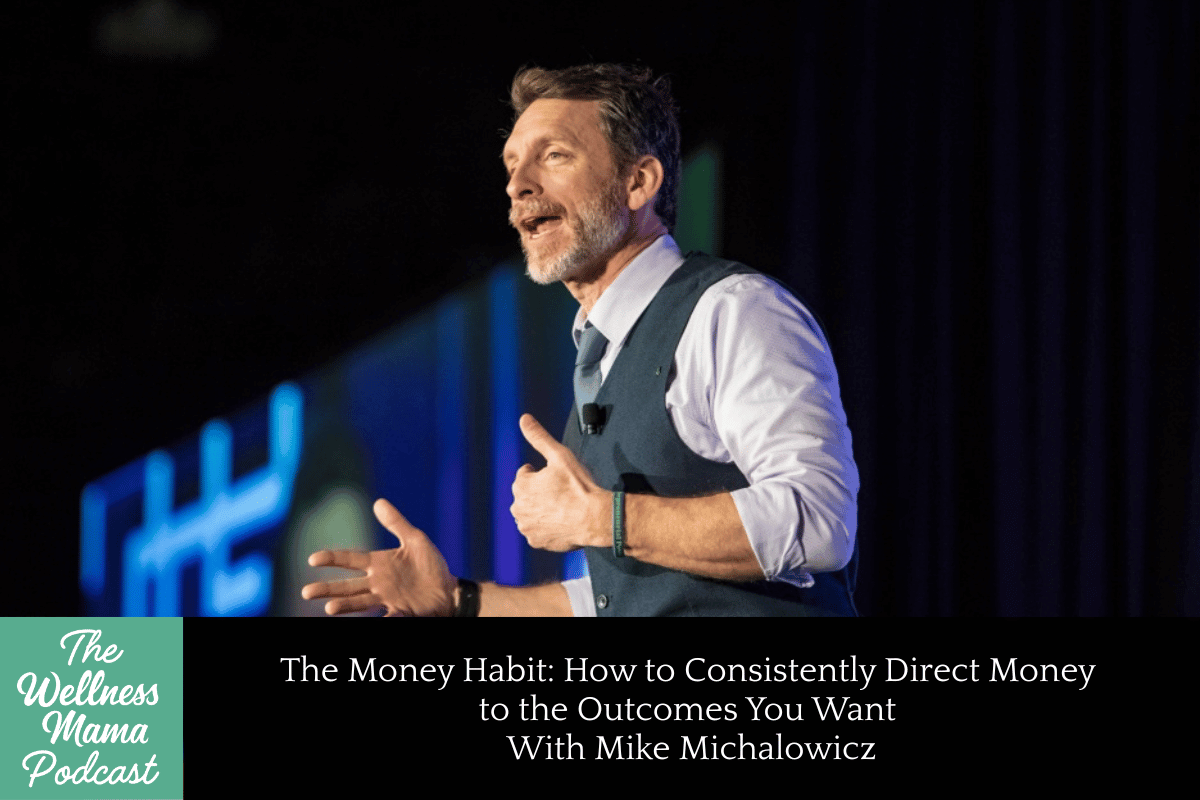
Katie: Hello and welcome to the Wellness Mama Podcast. I’m Katie from wellnessmama.com, and this episode is about the Money Habit and how to consistently direct money to the outcomes that you want. And I really enjoyed this conversation. I’m here with Mike Michalowicz, who is the entrepreneur behind four multimillion dollar companies and the author of bestselling business books, including Profit First, Clockwork, the Pumpkin Plan, and All In.
And he’s the creator of the Money Habit, which is a groundbreaking approach to personal finance. He’s hosted the hit podcast, becoming Self-Made and the television series Four Minute Money Maker, and he’s a former columnist for the Wall Street Journal. He now travels the world, helping individuals grow thriving businesses, and today he dives into how to create money habits and systems that don’t require ongoing effort and that help bring clarity and ease to your finances no matter what your budget and what your current systems are. And I actually feel like I learned a lot from this conversation and I feel like I already was doing a pretty good job of that. So I think you will enjoy it as well.
Money stress is a big factor for many, many people, and we all know that stress is also an important factor in health. So even though this is not specific to physical health and wellness, I feel like it’s very complimentary. And without further ado, let’s join Mike and learn.?Mike, welcome. Thank you so much for being here. I’m so excited for our conversation today.
Mike: I’ve been looking forward to this for weeks. So Katie, thank you for having me.
Katie: Oh, I’m so excited too, and I’m really excited actually, on a personal level to learn from you. I got to research your work in preparation for this, and I feel like your message is gonna be really helpful to people, even if they don’t think that they need to kind of look at their money habits. And we’re gonna really dive into kind of the Money Habit in general, what that even means, the psychology around it and how to, can sort of, consistently direct money to the outcomes you actually want. And so I think to start, maybe start broad, let’s define what the Money Habit is and how this is maybe dissimilar or different from things people might be familiar with, like traditional budgeting.
Mike: Yeah, so the Money Habit is a behavioral based, I’m happy you referenced psychology, it’s behavioral based money management system. And I’ll give a little backstory of how it came about, but I think this will give clarity on why a system like this can be so impactful. So it was about, I think about 15, 20 years ago I realized I was kinda getting outta shape and I wasn’t caring for myself physically the way I wanted to. And I said, I’m gonna get back into the gym. I’m gonna start eating well and all these different things. And to do that, I said, well, just, it’s willpower. That’s all. It’s all it takes. And I remember waking up the next morning and like, this is the big workout day. And I had a monstrous workout for an hour.
Came back covered with sweat and so forth. And I’m like, tomorrow I’m going out again. But the next day I didn’t. The next day I was like, really sore. And I was like, well, maybe I need a recovery day. And the third day, my gosh, it crushed me. And then the fourth day, I didn’t go back yet again. Well I realized, I very quickly reverted to my old habits, my old pattern, and what it would be, I’d wake up in the morning, use the bathroom, I’d go make a cup of coffee, scroll through the news.
There was some point there that I lost the concept of my commitment. Well, there’s a behavioral technique called commitment devices, and what it’s rooted in is don’t try to change your behavior. Instead, channel your existing behavior. Humans are far more successful in getting outcomes by just doing the same thing, but having a system that redirects us to the outcome we want. So what I did, I still do it to date. I put my sneakers on the toilet seat. So when I wake up in the morning, I would, couldn’t, use the bathroom without having to grab my sneakers to get ’em off the toilet. And with them in my hand, I’d say, okay, just put em on my feet.
And it was enough to get momentum and not necessarily have an exquisite workout each time, but to get a workout in. And so, and that’s kept me, you know, religious about it for 15 plus years now. Well, the same thing with money. What I realize, and I’m curious for your audience, Katie, is I would log into my bank account and based upon the balance, I would see, I’d make buying decisions. And when my paycheck came in, my gosh, I felt pretty good. And I had a lot of things I could spend the money on. But I would run out of month very quickly. And I’d run out of money even faster. And I’d be like, where did all this money go? And what it was, is rooted in behavioral psychology.
There’s this behavior that’s wired into all humans that when we see a large sum of something, we are going to consume it much faster. And often to our detriment. So the Money Habit system is a system that channels our natural behaviors. One is most people don’t run budgets. We don’t go to a spreadsheet or use some kind of fancy app. Most of us log into our bank account. In fact, that’s the number one app used in the world for finances is your actual bank. So I said, okay, I need a system for myself and for all of us that runs at the bank level. Your bank, not a specific bank, but any bank you want. And so what we do is we set multiple accounts at your bank with its pre intended purposes. One is to cover the essentials for living. One is perhaps for the mini luxuries and so forth. And now as money comes in, we carve it up before we even access ourselves. And you can do it through automatic transfers at your bank, and it goes into these different accounts. And now when we log into our bank account, we know what money is available for what purpose. It doesn’t ensure that we’re gonna have a great workout, so to speak.
It doesn’t guarantee that we’re gonna control and use the money appropriately, but it brings a subconscious behavior of, oh, I need this. Is there enough money to, I need this or want this? I see there’s this much money allocated to it, and then we have a decision to make. Are we gonna break the system, steal from somewhere else and put it in, or are we gonna abide by the rules? And most people abide by the rules, but even when we break the system we can no longer do this at a subconscious level. We say, oh, I’m stealing from my vacation fund, for example, to go out to dinner tonight. And yes, you broke the system, but at least you can no longer deny it. And it shifts our behavior in an extraordinary way because it’s a commitment device.
Katie: I love this and I love the analogy to fitness changes, for instance, or health changes, and certainly, I’m sure many people can resonate with that of having had all this willpower and determination to make a change and be so gung-ho in the beginning and then have it sort of change and then do that, like start over again.
And then on Monday I’m gonna… And then, and you touched on this a lot already, but are there any other reasons, I kind of just wanna really differentiate this from traditional… whether it’s the envelope system or traditional budgeting or other ways people might do this. Are there any other ways where that kind of falls short?
And then from there, I really wanna go deep on what you’re, you’re kind of system is. Because this is so fascinating.
Mike: Yeah, yeah. I’ll give you two other kind of elements. It is absolutely the envelope system blended with other techniques and modernized simply at our bank level and why I love to share that and why it’s so important is this has been proven historically, literally back to religious literature like the Bible, the Koran, all these different literature, biblical literature and religious literature states that reserving money for its intended purpose before using it for self is a successful model.
So the envelope systems lived since biblical times. So this is just a modernization of it. The other components is based upon B.F. Skinner’s work, he was a theorist from the early 19 hundreds, noticed that when we have small wins, we’re more likely to stick with something. So back to exercise. I had a friend and she wanted to work out, and we were just talking about it and she goes, well, what did you do?
And I said, well, I made this commitment device of putting my sneakers on the toilet seat. But the second thing is I reframed what a workout is. I used to think, well, it’s lifting a certain amount of weight or going for a certain run over a certain amount of time. I said, it’s, what a workout really is, is doing exercise to improve my health, even if it’s a modicum of work. So one pushup, if I just do one pushup that is a workout, it may not be the one I aspire to ultimately have, but it’s a workout. So it’s a reframing of small wins and B.F. Skinner points out that actually you’re more successful if your first workout is just one pushup or a short quarter mile walk.
Or maybe just putting your sneakers on and taking ’em back off again, because two things happen. One is you’ve accomplished something that’s an award mechanism. Dopamine comes out and we are likely to repeat it. It’s when we experience pain that we avoid it. So if you actually overwork out, you’re more likely not to do it than if you under workout, you’re more likely to repeat it.
So under workouts, beat overworkouts. The second component is, there’s this kind of theory of not break the chain. Once you have this small win and you repeat it again, you’re more likely to sustain a pattern by repeating it over and over again. And there’s actually a third component too, is when you complete something before you exhaust your desire to complete a thing, you desire even more the next day. So if you just do one, we’ll say pushup, the next day, you’re like, can I do two? But if you do like six today and you’re burned out the next day, you’re like, I’m sore. I don’t need to do more. So slow progress, small pieces, is usually better than big pieces.
And so with the Money Habit, the deployment of the system is not immediate. Traditional budgeting says allocate this and do that, and so forth. And we feel this excruciating pain the next day. Like, I can’t live this way. This is too intense and we’re likely to give up on it. So the Money Habit morphs slowly over time so we get momentum and are likely to stick with it. And the last thing, and I don’t mean to be too like talkative here, but the last thing I wanna share with you is the behavioral theory is rooted in what’s called optimal foraging theory. This goes back to nomadic times, the cave person.
Back in the day we were hunters and gatherers and if we were going for a hunt to say, you go for the big kill. And the reason you do that is because it’s very risky to go out there on a hunt and we gotta feed an entire tribe.
So if you’re gonna do this, you better do it, Quote, “right.” So we go for the Wooly Mammoth. So you go on the hunt, but once you get the wooly mammoth, the new challenge presents itself immediately the second that animal is captured and killed. Now we go into a gorge state because we know that every second that Wooly Mammoth is sitting there, it’s gonna rot away. So we have to eat as fast as possible, and that’s why those old cheesy movies of the Neanderthal Cave person, they gnawing away, there’s blood on their face, that was the reality. Because If I didn’t consume it, it was wasted. And this is true for gathering too. You don’t get like one berry and say, Hey, this is perfect for my yogurt.
No, you go wow! You get all the vegetation as fast as you can because you’re out in the wild. You bring it back to the safety of the tribe, but it is rotting away too. So we consume it fast. There’s more to optimal forging theory, but that’s the beginning essence. The interesting thing is fast forward today, our limbic system, you know, the reptilian part of our brain is still wired that way. The kill is not a wooly mammoth, it’s a paycheck. And for many of us it comes in once a week maybe, maybe twice a, once every two weeks or maybe once a month. But when that comes in, our mind lights up and says, you just got all that vegetation, we can have it all, but it’s gonna rot. We better gorge.
And so we are wired once we have the kill to start the gorge process. And that’s why we overspend immediately because this money’s gonna rot away. Now listen, logically, our prefrontal cortex says that’s not gonna go away. It’s money. It’s gonna sit in your bank account. But the reptilian part of our brain, which is the driver, says, spend this before you lose it.
So we’re oriented towards spending it away. The nice thing is with the Money Habit, we can leverage other parts of that Neanderthal mind to actually preserve money. So last thing I’ll share is once the tools were developed, cutting devices and so forth, cave people learned to carve up and portion the food they captured and then preserve it, burying it, sometimes smoking it. The exact same thing happens with money. Once we make the kill and that money comes in and that gorge wants to kick in, our mind is also wired to carve it up, and that’s why we need multiple accounts. It’s a preservation mechanism. It’s a portioning mechanism, and then we can even do further steps of locking and securing accounts in special ways.
You can do it at any bank so that it’s smoked or buried, so you don’t consume it all at once.
Katie: This is so fascinating to me, and the psychology behind that makes sense. And it’s good to know we can work with our psychology instead of against it once we understand it. I love, especially what you said about small wins and building on that. I’m very soon gonna be releasing my first course, and it’s kind of on how I resolved my own Hashimoto’s.
And it really, it’s a similar concept. I give people the smallest baby step that I would guess on the first couple days they’re rolling their eyes. Like this is nothing like, I wanna do all the other stuff. Like, tell me the fancy biohacks, the supplements, the whatever. I wanna do stuff. And what I realized was, especially when I was in a limited bandwidth window with chronic disease, that baby step was so important because I could actually do it and then I could build from that. So I love that you kind of explained the psychology of why that’s important and how we can actually work with that as humans. And you used the term commitment device and I would love if you could elaborate on that a little bit.
Because I’m thinking that might be a new concept for some people.
Mike: Yeah, I just gotta say, it’s so interesting you referenced Hashimoto’s. It’s pervasive. My wife has Hashimoto’s and until she diagnosed the disease, it’s interesting how we tried to do all these cures that actually aggravated it. I remember her going on the pill to control it, and it actually just blanketed it or covered it up and it didn’t fix it.
But that’s the blanket fix. And a lot of these financial systems are the same way, is that we are said, well, this is the blanket fix. I remember a very popular budgeting system, which was great and had all these different categories, but I’m like, one of ’em was tithing and like, is tithing appropriate for everyone? I’m not tithing. Should I be tithing? And it implies what you need. It says, here’s the pill, you need to be taking it. And so I think the first step is to identify what we actually need in our lives. So back to the money habit. Now that was just an interesting parallel. Because my wife and I, we went through that experience and it was years until, I wish your pod-, your course was out then because it was years before she found the baby steps that now has brought this to a resolution.
So in the Money Habit, what we do is we first to realize that based upon Maslow’s Hierarchy of Needs, there’s certain essentials that all humans need. We need food, water, shelter. These are the essentials. So without those nothing else matters. Like, we can be doing this podcast right now, but if you are starving for food or you’re so dehydrated that you’re gonna die, the podcast is over, like we got to immediately get water in your body. Well, money has to serve that component of life. Everyone needs that. So regardless of the income level you’re at, now if you earn more money you can allocate more toward other elements.
But regardless of the income level you’re at, the first thing we address is essentials. In the Money Habit system, I call this the needs account. So at your bank, we’re gonna have multiple accounts. The first account is gonna be called needs. The first account we allocate to. Now you are gonna have an income account too. I call this the cash turkey. We celebrate Thanksgiving at our house and we had 10 people over, we don’t put the turkey out and say, Hey, everyone, like grab a knife and fork. Whoever wants the most gets the turkey.
You carve the turkey and you carve it so every guest can have a piece of the meal. This is true with even serving trays. So we have to realize that when money comes into our household, if you’re a sole earner or maybe there’s multiple earners, when that money comes into your household, that’s your cash turkey. But it has to serve multiple financial guests. One is the essentials, so we’re gonna set up a needs account. Next one is a wants account. Wants is the mini luxuries of life and effectively it’s a release valve that humans absolutely need. We need reward. I did a lot of research around diets. Interestingly, a lot of physical fitness translates to fiscal fitness and what they found in diets is, think it was like 98% of diets fail.
Why? Because they’re just too regimented. Only eat this, only do that and stick with this for a long period of time and you’ll have transformation. But the reality is, when we are restricted in what we can do, it is human nature to retaliate, to get elbow room at a certain point. I hope I’m not overexplain this, but the classic story, I just rented a car.
I was at a speaking engagement and I went to the Hertz rental car agency, which ironically Hertz kind of hurts. And I was leaving and they said, you know, you gotta fill it with a tank of gas or you’re gonna get penalized like this ridiculous amount of money. No scratch or dents, of course. And it better be a clean interior. So I noticed when I left, what’d I do? I was racing that Prius up to the light skidding in and flooring when it turned green. When there’s constraint put around us, we retaliate by, in this case, I treated the car a little more aggressively. Well, when it comes to our finances, traditional budgeting says you must live within these confines and some traditional accounting system, or budgeting systems, tell us to deprive ourselves.
But just like a diet, if you deprive yourself, that day’s gonna come. The cheat day’s gonna come. It’s like, you know what? I’m going all in on these cookies or ice cream. And that is human nature. So the diets that are successful actually bake in a cheat day where it says, Hey, today’s the day to release the steam and enjoy whatever that treat is that you want. That’s why we have this Wants account. We have to cover our essentials for living, but a you also need to allow yourself to have something that is unrestricted that you can enjoy. So we’re gonna allocate money toward that. There’s another account called Dreams. This is the aspirational, longer term things, dreams vary by the person.
Some people could be, I dream of owning a house one day or an apartment, or a condo. Some people could be, I dream of going on vacation this year. I haven’t done it in five years or 10. Some people could be I dream of a second house. It’s all related to a person’s individual desires and income.
Now, the beautiful thing is anyone can achieve anything. I was talking to someone who was earning about 50,000 a year. That’s, by the way, the average earnings of an American. It’s 50,000 a year. And they said, I want to own a mansion one day. And I said, well, you can do it. And like I can. I said, absolutely.
How much is this mansion gonna cost? I said about $5 million. I’m like, you can do it. But we looked at your income and we said, how much shift can you allocate toward this dream? And it ended up being about $10 a week. So I said, okay, we’re gonna save $500 a year. You’ll have that mansion in about 500 years, or whatever the number was.
So I said, you can get there, but the trade off is time to get there. So now we have a conscious awareness. Is this really a dream that within our current means is something we wanna aspire to do? And if it is, keep working that way, but the trade off is gonna be time. So that’s what the Dreams account is. And then there’s two more. There’s a fix or future account, depending upon your current financial situation. Over 55% of Americans are maintaining what’s called unsecured debt. Credit card debt’s the most common version of that month to month. And we need to eradicate that. Because otherwise that will be more than a thorn.
It’ll be an infection in our financials forever. And that can, that can be disastrous. So we’re gonna allocate a portion of money to fixing and eradicating debt permanently. Once that’s under control, and I do believe some debt is actually very valuable asset-based debt. Home, owning a home, perhaps even a vehicle. And then what we’re gonna do is move that account renamed to future. This is reserving money for a massive future event outside of a dream. It could be retirement, it could be the kids are leaving the house and this is the last 18 summers that we’re gonna have together. We’re going big this year and we’re gonna activate those funds. And the last and final account is called emergency. And emergency is for the most predictable bill in the world, which is the unpredicted bill. That roof is gonna leak. That car’s gonna stop working right. And we’re gonna need to fix it. Someone’s gonna get hurt. We have to have an emergency fund.
Katie: Oh, that’s such a good explanation. And I feel like it also helps solve something, which I know is, I’m aware of being a thing for me, I test often on personality types in kind of like the rebel category. And one of them, the tagline was, you can’t tell me what to do and I can’t either. And so I learned early on that if I tried to like constrain myself into really tight systems without that like planning for the things you actually want or without the cheat day on the diet or whatever it was, I would rebel so hard against that.
Whereas if I could reframe it into like an experiment or curiosity or a fun game, I was so much more likely to like maximize that game and want to like do better at it versus feeling like I was constrained. So I think that mindset shift that you touched on and how to work with it is so valuable. And I love this whole, this whole theory and how it touches on the hierarchy of needs.
I guess the two questions I would have as follow up before we get into some other areas I wanna talk to you about are what about if someone is, say on the hierarchy of needs where everything is going towards basic needs, so they like would wanna increase their income, but for now it’s like, feels like they’re only covering their bills.
And also for someone who maybe is in any category, what is the simplest way to get this started? Because it sounds like it’s, once it’s set up, it’s relatively easy to continue doing and helps so much. But what’s the simplest way to jump in?
Mike: If you are at essential living, what we do is we still allocate a small percentage toward other elements. So the, in the book I have the breakdown, and you can get this for free online without signing up or anything. You can just say, type in the Money Habit charts, and you can just find ’em online or my website. But if you’re essential living, we may be allocating upwards of like 95% of your income toward essentials. But we are still gonna allocate a small portion toward wants and dreams. And the reason we’re doing this is we still need a relief valve. And your relief valve may be a coffee out at the local diner. But I will tell you, because I’ve lived that, I’ve lived that deeply. The first time I got coffee, and it’s a true story, I had $8 in my dream or my wants account. I went to the bank I said, I’d like to withdraw all the money in my wants account. It was $8. And I said, please put it in singles.
Because I want to fan myself. I then went to, there’s a Starbucks in town, I went to Starbucks and I plopped it down. I said, I want the finest drink you have, which at Starbucks is a small coffee black for $8. But I will tell you, Katie, that coffee was the most delicious coffee I think, of my life. And the reason was because for the first time I didn’t put it on credit card.
I didn’t have to worry about it. It was. I was finally asserting control over money as opposed to money controlling me. And I felt this freedom. That’s the irony or the most interesting thing, it’s not the “thing.” For some people, a new boat gives ’em tons of joy. For some people it’s a cup of coffee that’s paid for and cared for and you don’t have to put on a credit card, that will give you literally the equal amount of joy, it’s serotonin and dopamine that gives us that. So it’s not the thing, it’s the feeling and emotion. Once you start controlling authority, even if you’re living at essential, a little bit of a hand to mouth kind of situation, you will still experience that joy.
And I can promise you, because I’ve lived that, I lived both sides of it. Now, the other component was how to get started. This is probably the most important thing. We’ve had thousands of people in deploy system before the book came out and now it’s rolling. What we found is that the system, even as I told you, can be overwhelming. I have to call my bank and set up all these accounts, oh my God, it’s just too much. And then people say, I’ll do it tomorrow, which means I’ll do it never. So I came up with a real simple system and you can start experiencing the benefit or maybe it doesn’t work for you. It’s okay to be skeptical. I was, I’ve been doing this for myself for 20 years, by the way, and it’s been extraordinary, but I too was skeptical.
So I appreciate that and expect that. We do it by setting up one account. And the one account you set up is whatever financial worry or wonder you have on the most frequent basis is the account we’re gonna set up. So if you wonder, hey, can we go on vacation this year? If that’s the big thing that you think about most often, we’re gonna set up one account called vacation. If you worry, can we put food on the table today? Gosh darn it that’s the account we’re setting up a food account. And if it’s retirement, it’s retirement. But whatever it is, identify that most recurring concern or question you have in your mind about money. There was a study that came out from USA today back in 2025 in August that said, for Americans, financial worry has become a part-time job.
We are worrying on average four hours a day about something financially. And that’s devastating to our health among millions of other things. So what we’re gonna do is alleviate that. So set that one account. Let’s just pretend it’s retirement. I don’t know if I’m gonna ever be able to retire. So I’m gonna set up an account called retirement. Then we say, well, how much money do I think I need? And you don’t have to nail this down, but how much money do I think I need for retirement? So let’s just say I wanna have $100,000 saved up in the next, you know 10 years or 12 years, make it even easier. Because 12 years divide 100,000, 120,000 into 12 years would be 10,000 a year or now I’m getting the numbers messed up, but my goal here is to get us to a fixed number per month or per paycheck.
And let’s pretend it’s $500 per paycheck. That’s what I was trying to guess too. Well, now I know every time a paycheck comes in, I’m gonna put $500 into the retirement account. The power here is I am assured that my biggest worry is being actively addressed and that alleviates the worry. But that’s not the magic of the system. The magic is the remainder because whatever I’m earning, 500 is going toward retirement. I now have clarity on what’s available for every other aspect of my life. And with clarity comes conscious decision and control. So I say, oh, maybe I can’t go out to dinner every week or whatever. Maybe I do need to make some changes. But you start having clarity and by setting up just that one account, whatever that account is you choose, money starts losing its authority and control over you, and you start asserting your authority and control over it.
I love that and I’ll definitely link to your book and I know you have a lot of resources available. People can keep learning and really go deep on this and figure out how to implement for them. But I wanna bring in another variable into this discussion because I would guess this is statistically a big one for a lot of people.
Like I know from I’ve read books that money is one of the bigger tension points in a lot of relationships, and that when couples fight money is often the topic. In fact one of the top three, if not in some cases the top thing couples fight about. So I’m curious all the dynamics related to that when it comes to relationships.
I know often, or at least in, when I was married, it was, I often manage all the finances, so that always fell on me. And I know in a lot of relationships, one partner manages the money and this can create a lot of tension or even from reading your work like a parent child dynamic. And I resonated with that idea as well.
So when it comes to couples, what changes when it comes to implementing this and what are the things people need to know before starting if they’re in a relationship and managing shared finances?
Mike: Yeah, and with couples there’s a couple dynamics. There can be a sole earner or there can be multiple sources of income coming to the family. In most cases, one person asserts more control over the management of the money. So interestingly, like your scenario where you were controlling the money, that has been and continues to be the scenario that I’m in, that I pay our bills at the home and so forth. What was interesting was this parent child relationship that came out of it. So my wife and I, we’ve been married, we’re having our 30 year anniversary coming up this year. And from day one, she would say, Hey Mike, I’d like to do something. Say I was going out to lunch with a friend of hers.
She’d say, do I have enough money? And this, now, in retrospect, bizarre behavior would happen where I’d say, oh, I’m sorry you can’t go. And it was almost like this shame thing, like, we don’t have enough money. Don’t you get it? she’s not managing the money, but I would be like shame, shame, shame, shame. Other times she’d say, I’d like to go out with my friend.
I’m like, oh, here’s your lollipop, effectively. You can go out if there’s enough money in the account. Well I realized it became a permission-based tool and unintentionally I was leveraging it and sometimes making her the enemy for asking, you know, don’t you know how tight things are right now?
How, how dare you? When honestly, I was the person making things tight because I was the one who was acting with optimal forging theory, seeing money coming in and saying, oh, I can pay this, I can pay this, I can pay this. And I was gorging on the money. So it’s often not always the case, but the person managing the money, who’s actually the biggest offender in abusing that money but can’t even see it for himself or herself. Well, what happened is we deployed the Money Habit in 2008. So we, this is about almost 8, 20 years ago, but about 18 years ago. We set up the Money Habit system, multiple accounts, and what I shared with you is the essential setup, but you can expand this. I know this sounds crazy. We have now I think 12 accounts.
It sounds overwhelming. It’s not because it brings so much clarity. My wife Krista has an account called Krista’s Fun Money. I have an account called Mike’s Fun Money, and when Krista wants to do fun, however she defines it, she logs into, and she wanted to get a massage. This actually happened two days ago. She said, Hey, I’m going out for a massage with my girlfriend. We’re going to the spa. I’m like, oh, that’s amazing. Have fun. No question about is there enough money there? No worry from me being the money manager.
She has a debit card associated with her account and she has total freedom of choice. But I think the more exciting thing was this, is we were gonna go out with our friends to dinner just a few weeks ago. And my wife calls and says, Hey, we’re gonna skip dinner. We’re gonna do pizzas at the house with the Beauties. That’s her name. I’m like, oh, awesome. I said, why the change? She goes, oh, I logged into our dining out account, and we have one because we enjoy that very much, and she says, it’s, there’s not enough money there.
So the system’s telling me this isn’t the week to do it. Let’s do something else. And it was a blast, the activity. But what was great was it exemplified the fact that it’s not me and my wife trying to fight each other. It’s me and my wife against, if I wanna say, the system itself. The system tells us the facts and then we negotiate.
We actually team up to say, how are we gonna navigate this? Maybe we delay this, maybe we don’t do that. We have some vacation ideas we discussed and we said, okay, this is the one we can do this year. Because we see the trend of our account. How much is in there now. We can activate those funds and use it, but we’re not gonna do this. So the change has been from this parent-child relationship to a team.
Katie: I love that, and it seems like with the multiple accounts like it, once it becomes. Automated, it takes the mental effort of actually having to split things up. So it’s even easier than the envelope system used to be. And it frees up mental resources. That was the thing I realized years ago, managing finances and a household and everything is, it wasn’t actually the things I was doing that were causing me stress.
It was all the open loops of remembering what to do, when to do, who needed what, when. So when I saw for the variable of just having less open loops in my head by having more structure in whether it came to laundry schedule, meal planning, whatever it may be. It freed up so much mental bandwidth and I feel like this is the financial equivalent, equivalent of that.
And I love that you have ways to get couples on board together and to make it common problem solving. What about, because I see this in health often, like one person gets really into improving their health and the other one is not about it. So what about when one, one person and a couple is really excited about this and wants to do all the systems and the other one is like absolutely not.
Mike: Yeah, and we absolutely see that, right? So one comes along if they do, kicking and screaming the whole way or don’t believe in it. The deployment we’ve seen is the person who believes in the system “does it anyway.” Now I’m doing air quotes round for people listening to the audio because it sounds like we’re disrespecting or ignoring the desires of our partner in this. But what we do is we do it for ourselves anyway. It’s kind of like a health regimen. Instead of saying, you know, you and I are gonna have to go to the gym together. If that’s not for you at this stage, this is important to me, I’m gonna go to the gym by myself, so I’m gonna carve out a part. So when we set the system up at our house, I was the one who needed the system because, same thing like you, is total decision fatigue.
All these open loops overwhelmed, and I just, exasperated, say, okay, just put the money here to myself and not control the money. So I got rid of that decision fatigue. But my wife is like, Mike, we’re living so hand to mouth, you want to introduce a financial system, you’re effing crazy. So what I did is I started for myself, I set up one account, which I still have today, which is Mike’s fun Money.
It was called Mike’s Debit Account. And I committed that I would only use this debit card, for my own whatever fun thing was. Meeting up with a friend or I play guitar, so buying a new set guitar strings or something. And so I set up this one account. And what I realized was, wow, our actually available cash was starting to increase a little bit. Realizing that I was now working within this container, I had clarity on what to spend and what not to spend. And then I started setting up a separate account. I said, well, since I’m paying the mortgage and Chris doesn’t even know what our mortgage payment is necessarily, or even care, I’m gonna set up an account just called mortgage. And I started allocating the money to the mortgage, which gave me more clarity on communicating to her. So she’s still coming to me and saying, Mike, can I do so and so, do we have enough money? I could say with better clarity. Yeah. Because I know our mortgage is covered. I don’t have to have that open loop running in my head.
Then at a certain point I said, Hey, I’m doing something that’s been pretty miraculous. Would you be willing to try this out? And what I did, and here’s the little trick, I said what’s one thing you love to do and it frustrates you that you gotta ask me about it. She’s like, I love, she’s very social, she’s like, I love hanging out with my friends. I love when we have a lunch date or dinner date together. And she goes, I just feel uncomfortable coming to you, asking you. I said guess what? You’ll never have to ask me again, and there will be money allotted for this. She goes, really? And I said, here’s your brand new debit card.
We’re setting up an account called Chris’s fund money and let her start dipping the toe in the water with this. And she loved it. Here’s the greatest irony, Katie, and it actually gives me goosebumps. My wife said for the longest time, she’s bad with money and that’s why she avoids it. I am bad with money and I still am, but that doesn’t matter anymore because the system’s good with money.
We don’t have to be great at math. You don’t have to be this budgeter. The system just says, here’s how much money is available. You can spend it or not, but here’s what you have, and this is the container. So the excuse for my wife and for myself that we’re bad with money faded away. The system is really good with money and to see the confidence in my wife around cash control to see the confidence, this new confidence as opposed to responding in anger or disappointment, frustration, this confidence in myself, it’s been the biggest stress relief.
Katie: I love that, and I’d love to bring in another variable that I would love your take on, which is obviously in a romantic relationship, we want to avoid the parental child dynamic. However, a lot of people listening have kids, and this is something I think about often is like, how do I instill good habits in anything, but even in finances in my kids from a young age, like how can I shorten their curve on knowing these things foundationally that I had to learn in my twenties or thirties or whatever it was?
And I know I’ve like learned some of it as I’ve gone along. Like I pay my kids through my business and I fund their IRAs and I’ve done some of those things, but, is that something you also talk about? And if so, what suggestions would you have for teaching kids, especially older kids, as they start getting jobs and managing their own money, how to have these foundational systems from the time they get started. So it’s second nature for them.
Mike: So, my youngest is 25 years old and my oldest is 32 just to give context. But there was a day, and it feels like forever ago, that they were little toddlers and we started deploying a tactile system. This is actually important for any age group, but particularly kids. When you can touch and feel there is greater learning that happens. I happened, this is not pitchy, but I happened to write a children’s book called My Money Bunnies. And this is a system we set up and it’s for kids ideally that are like seven years or younger. But what you do is you get a JAR system. And like we shared earlier, this is not anything brand new. This has been around forever.
It works. But you make these jars and they represent little bunnies. You can decorate them accordingly with the ears and so forth. But there’s three primary bunnies and they have different intentions. One is the anytime bunnies. So anytime you have a desire, you can use it. One is the give back equivalent to give to community, or to be of service to others. And one is for the essentials. A give back may be to be a contributor in the household that, you know, if I’m earning money in some capacity, we actually never used allowances in our house, we had a worksheet from day one, and you could earn money.
What was so interesting as a little psychological experiment was my daughter, who’s older than my younger son, she could take out the garbage or clean the dishes. She would take the task and then assign it to Jake, our youngest son, to actually do it, and she would take a skim off the top. It was fascinating. But they always put their money in their little jars and it becomes a tactile experience. As my kids got older and I literally just got back from visiting my son.
He lives in Salt Lake City and I was out there. We went for a hike together. I said, tell me about your money. He goes, dad, I’m doing the Money Habit. Ever since day one, so he set up different accounts. Now, interestingly, and this is actually very important, he didn’t set up an account called needs. He didn’t set up an account called wants. He picked names that were very personal to him. So, for any age, but particularly as our young children become young adults, is to give meaningful context to these bank accounts. So go to the bank with them, or they can do it on their own, but say, what’s most important to you? Many kids have an aspirational dream.
Maybe one day I wanna buy a car, our children bought their own cars, maybe it’s I want to go on a trip or experience something, or whatever it may be. Allow them to set up an account with that name, but make sure they’re the ones who assign the name. When we assign something it becomes part of our identity. There’s behavioral psychology around this. It’s called psychological ownership. But basically if I said, you know, Katie set an account that says needs and it’s assigned to you, resistance often kicks in. But if you say one of the essentials for us is our groceries account, and I call groceries shopping at ShopRite. That’s a store here we have locally, call the account shopping at ShopRite, like give it a name that’s visceral and speaks to you, and so your identity is associated with it and you’re more likely to comply with it. So that’s what my kids did. And so I was meeting with Jake in Salt Lake City, and he’s sharing, he’s like, dad, I set up an account called New Wheels. I’m like, oh, you’re getting new tires? He’s like, no, no. Dad, that means a new car one day. I’m like, oh, okay. I get it. I get it. And so he’s teaching me how he set up these accounts, but there’s an affinity toward him because he named them and that’s how you get started.
Katie: I love that. That’s such a great tip and definitely something I’m gonna implement. And I feel like in the digital era, this is even easier than it ever has been. Not just to make separate accounts and manage them, but even to like run reporting and see where the money’s actually going and really get detail about that.
So I feel like this is so timely and I’m excited to implement it myself. And I would guess from doing this for so long you have seen common kind of pitfalls and mistakes that people make when they start implementing this. Similarly to how I have when people make nutrition or health changes. So what are some of those common ones that you would just give people as a caution to watch out for if they’re gonna jump in and get started?
Mike: The most common is too fast, too strong, that’s probably in exercise too. And it’s going all in. And the problem with this is you can overwhelm yourself. So it goes back to that process we’re talking about with, from B.F. Skinner’s work of incremental small wins to sustain the momentum. So people setting up 17 accounts on day one saying, this is how I manage my money now and I got this.
And they very quickly revert back to old habits because it just overwhelms them. So the solution to doing too many accounts in the beginning is just start off with one account, see how that serves you, start rolling it forward. The another one is over allocating to certain accounts. So that’s why I did the research of, based on your tier level, what the optimal allocation is.
But if you adjust it too quick, if you’ve been using your money and putting it all toward, we’ll say going out to dinner and the book guides you, you actually gotta move more toward essentials. If you do that drastic switch of doing reallocation, the resentment of loss or the feeling of loss may trigger you to go back to the old way. So, going all in too fast is painful, but also making too many switches to the percentages. So I show an incremental way to roll this out over time. The thing is there’s another…I think another thing is people try to circumvent the system and say, oh, I can do this in a spreadsheet.
I don’t need to do this at my bank. Lemme do this in a spreadsheet. That’s actually probably one of the most common failure points. And the reason behind that is it requires you to divert your natural habit. Remember, don’t change your habits, channel them. So if you’re the person who logs into your bank account once a day, once a week, hourly, awesome. This needs to be at the bank level. If you set something else that requires you to look over elsewhere and revert and avert from your normal pathway, you’re less likely to do it. So trying to improve on the system by doing some spreadsheets or whatever actually compromises the system, and that fails many people too.
Katie: Good to know. And I also have seen you talk about, and this was in our prep for the interview as well, just understanding the difference between financial freedom versus financial independence. And I felt like this concept was at least worth defining for people that it might be helpful in the implementation and understanding.
Mike: This, you know, and these are my definitions of terms because they’re, it’s a little bit nebulous of how they’re said, so I’ll define them. And I’ll predicate that by saying the Money Habit guides you to financial independence, which is different than financial freedom. So here’s how I define them. Financial freedom is where we don’t have to worry about the consequences of any cost, any bill. I can do what I want, when I want, and I don’t have to worry about the bills. The problem with financial freedom is it’s a moving target. So you and I, Katie, could say, well, I’d love to meet up at a beach. Why don’t we just hang out at the beach for a little bit and spend some time there? Okay.
That’s one thing. But now we say, why don’t we hang out at the beach and call all our friends together and pay for their trip down there? Well, that’s financial freedom too. Or why don’t we get a private jet, fly down to the Caribbean, get a thousand people to join us and have this mega party and not worry about the bills.
That’s financial freedom. So financial freedom is this constantly escalating thing. And so I know people who are truly making millions of dollars of revenue or income every year who are not financially free. And I know people who are making the average income of an American, $50,000, who are absolutely financially free. So financial freedom has that measurement of living within your means, and that’s where financial independence kicks in. Financial independence, as I define it, is where money no longer controls you, affects your emotions, that you control money. And, the Money Habit will bring you there because as income comes in, it is pre-allocated to its intended use.
And now you have conscious clarity of what’s available for what purpose. And once you have that control, you know what you can do with your money. You’ve achieved financial independence. It’s not controlling you anymore. You are independent. The best time to earn more money, if that’s what you desire is once you’ve achieved financial independence, the worst time to earn more money is if you’re still financially controlled and you’re just pursuing financial freedom because you’ll never get there. And I’ve seen, and we know the stories of like a celebrity or an athlete or something that earns all this money, because the movie she was in and now she’s broke. Well why? Because she never had financial independence in the first place. And as money went up, there’s a behavioral theory called Parkinson’s law, our consumption goes up, optimal forging theory, and we consume it and we end up bankrupt again. So we, regardless of where you are today, we need to assert control over it first. That’s what the Money Habit does. That’s what we talked about, financial independence. And then if you earn more money, if that’s what you pursue, amazing.
Because then you can allocate, on a percentage basis, money to other aspects of your life, but you’ll always have control over it.
Katie: I love that distinction and I also think of lottery winners and the data there being really striking on most of them do not maintain that long term or create, they probably don’t know to create systems at all around that. And so it’s like the same psychology just now at a bigger level and then they often go back to baseline or even, I’ve heard them like going kind of worse in the future because they now had this bigger problem that amplified when they didn’t have good money habits.
Are there any other things related to this, to anything we’ve talked about or to your expertise in general that people either often don’t know or misunderstand and get wrong?
Mike: Yeah there’s one more big one. But I first wanna predicate that by talking about lottery winners because I wrote about that in the book. You’re absolutely right. That lottery winners without financial control prior to the win, often end up in a worse case. And lottery winners who do have financial control end up in a better situation.
That was the interesting kind of duality in that, you know, does a lottery make you happier? And the answer is, it kind of depends. If you already have financial control, financial independence, and you earn more money, it is a tool to access different things in an easier way. And happiness is absolutely increased in that case. And that was actually a lot of lottery winners that we don’t hear. But we hear the stories of the other folks who don’t have financial independence or control over their money. This huge money comes in and they blow it.
There was a case of a guy named Jack Whitaker, is what I wrote about in the book, who I think he won, back in the day was massive, today is still huge. I think it was like $600 million. He infamously bought a outrageous car, a Lamborghini or something, drove around the neighborhood he grew up and was throwing money out the window, literally out the window to the neighborhood. He lost all that money within years. There was drug problems then that propagated throughout the family. It was a horrible circumstance and the argument is he had no control over the money. So be really careful about what you wish for when it comes to earnings. Without having financial control, we need to assert that first. Now, is there anything outstanding? There’s one thing I gotta be a little bit cautious about how I reveal this.
Because in the book, I don’t reveal it. I tell people, when you read this book, you have to email me 66 days from there and I’ll give you, there’s actually an extra chapter for the book that can’t be in the book. And this sounds absurd, but it’s because of human behavior. Humans, according to some researchers, can establish a new perpetual habit after 66 days of doing something.
So if you do the same thing 66 consecutive days, and that’s what the Money Habit will guide you to do, small, very manageable, bite-sized pieces, you will then achieve a habit that becomes ingrained. And other researchers say it takes less longer, but 66 days seems to be this kind of magical number. After 66 days, there is one behavior that almost everyone demonstrates in the book and they, in the, in deploying this process, and they think they’ve ruined it as a result. And it’s a behavior I’ve done too. I can’t tell you what the behavior is because if I tell you in advance, you start expecting that you’re gonna do this, and then you say it’s okay when it’s actually not okay. But the greatest irony is, while it’s not okay, what you will likely do actually is to be expected. And there’s a little hidden secret within the book in the process that allows you to do this thing.
And so that’s the, I guess the lesson is this, without trying to be too like kind of cloaky and mysterious about this, is I wrote the Money Habit and built the system all around how humans behave. And the thing is, we are imperfect beings and that’s okay. If you’ve done budgets before and you’ve broken them, there’s a word for that. It’s called being human. It’s normal. So the one thing missing from so many systems when it comes to your finances, when it comes to health, diets, and all these different things, it’s actually acknowledging the human within, and so don’t expect yourself to be perfect. The design is designed, I think, perfectly for the imperfectness that we are.
Katie: Oh, I love that. And now I’m so curious of in 66 days what that will be. Well, as we get near the end of our time, two last questions. The first would be, where can people find you and find your work? And of course, I’ll link to all of those in the show notes for anyone on the go.
Mike: Well, my name’s Mike Michalowicz and while I own that domain, it’s the impossible last name to spell. So I had a nickname, Katie, back in grade school. It’s the, I’ve had many nicknames and they’re all R rated, but there was one that’s G rated. It was Mike Motorbike, like the motorcycle. So I bought the domain, so mikemotorbike.com actually brings you to my website. And you’ll see all the books I’ve authored, but the money habits there. I also have a resources page at mikemotorbike.com. You don’t need to sign up or anything. You can just go right to it and get the resources you need that supplement the book and guide you through this.
Katie: Amazing. And then lastly, any parting advice for anybody listening today that you wanna leave them with after our discussion?
Mike: Yes. If you feel you’re not good with money and that’s why you’ve kind of struggled with it, I want you to realize you are perfect for money and good is just a judgment we place on ourselves. The reality is we need something that works with ourselves. It’s, if you’re not good with money, it’s not you.
It’s the system that you’re using, the process you’re using. And so I hope the Money Habit or something similar, it doesn’t have to be the Money Habit, but some system like this just allows you to naturally lean into who you are. The greatest irony, Katie, is if we can simply just be ourselves and have a system that channels us to the outcome we want, we can just be more of ourselves, which actually gets us to the results even faster. So don’t change who you are. Amplify who you are.
Katie: I love that. I think that’s a perfect place to put a pin in it for today, and I hope maybe we’ll get to have a follow up conversation one day. This was such a fun chat. Mike, thank you so much for your time and for all that you’ve shared today.
Mike: Katie, this has been an absolute joy. Thanks for having me.
Katie: And thank you as always for listening, for sharing your most valuable resources, your time, your energy, and your attention with us today. We’re both so grateful that you did and I hope that you will join me again on the next episode of The Wellness Mama Podcast.





Leave a Reply