Read Transcript
Child: Welcome to my mommy’s podcast!
Katie: This podcast is brought to you by LMNT, and this is a company you might’ve heard me talk about before, and I really love their products because proper hydration leads to better sleep. It sharpens focus, it improves energy, and so much more. But hydration is not about just drinking water because being optimally hydrated, a state called euhydration is about optimizing your body’s fluid ratios. And this fluid balance depends on many factors, including the intake and excretion of electrolytes, which many people don’t get the right amounts of. Electrolytes are charged minerals that conduct electricity to power your nervous system. I talk a lot about nervous system on this podcast.
They also regulate hydration status by balancing fluids inside and outside of our cells. LMNT was created with a science-backed electrolyte ratio of 100 milligrams of sodium, 200 milligrams of potassium, and 60 milligrams of magnesium with no sugar. Since electrolytes are a key component of hydration, here’s what happens when we get our electrolytes dialed in.
We have more steady energy, improved cognitive function, suffer fewer headaches and muscle cramps, we can perform better for longer, and especially the support fasting or low carb diet because when we stop eating carbs like during a fast, the absence of insulin allows the kidneys to release sodium.
So replacing that lost sodium with electrolytes can help you feel good on a fast. Since LMNT is zero sugar, it also doesn’t break up fast. Electrolytes are also important for maintaining blood pressure, regulating digestion and proper fluid balance. Keeping skin hydrated, which is a big one that I feel like often gets missed and so much more.
I feel like proper electrolytes is a missing piece for a lot of people and I love LMNTs new canned drinks, which are sparkling water with all the same ratios and minerals I just talked about, and they are delicious. You can check it out and learn more at drinklmnt.com/wellnessmama. And at that link you will receive a free sample pack with any order.
This podcast is brought to you by BIOptimizers. Do you ever feel like no matter what you try, you just can’t get a genuinely good night’s sleep? The real problem might be the hormone changes that come as we age. I learned that our body burns through magnesium faster than we can replace it, and magnesium is what our nervous system actually needs to wind down for sleep. And that’s why I’m a huge fan of Magnesium Breakthrough.
From BiOptimizers as part of my routine, I find I fall asleep faster and I’m not just laying there with my brain running and I wake up feeling really rested. But what I love most is it’s not just one form of magnesium, it’s a blend of seven important forms because magnesium touches everything in our body
Sleep, yes, but also stress, energy, even digestion, and so much more. Everyone who’s tried this talks about the same things, better sleep, feeling calmer, having energy, and I want you to join me in trying it together. So here’s my challenge to you. Try it. Track your sleep. Pay attention to how you feel, and see if you wake up more refreshed. You have nothing to lose and a lot to gain because BIOptimizer offers a 365 day, no questions asked, money back guarantee, for a free full year with zero risk.
So here’s what you do. Go to bioptimizers.com/wellnessmama and use the code WELLNESSMAMA to save 15% on your whole order. And get a free bottle of MassZymes, their bestselling digestive enzyme that I also use daily when you use that code.
So that’s a $20 product free on top of your discount. This is a discount you can’t get on Amazon and only while supplies last. So again, bioptimizers.com/wellnessmama and make sure to use the code WELLNESSMAMA
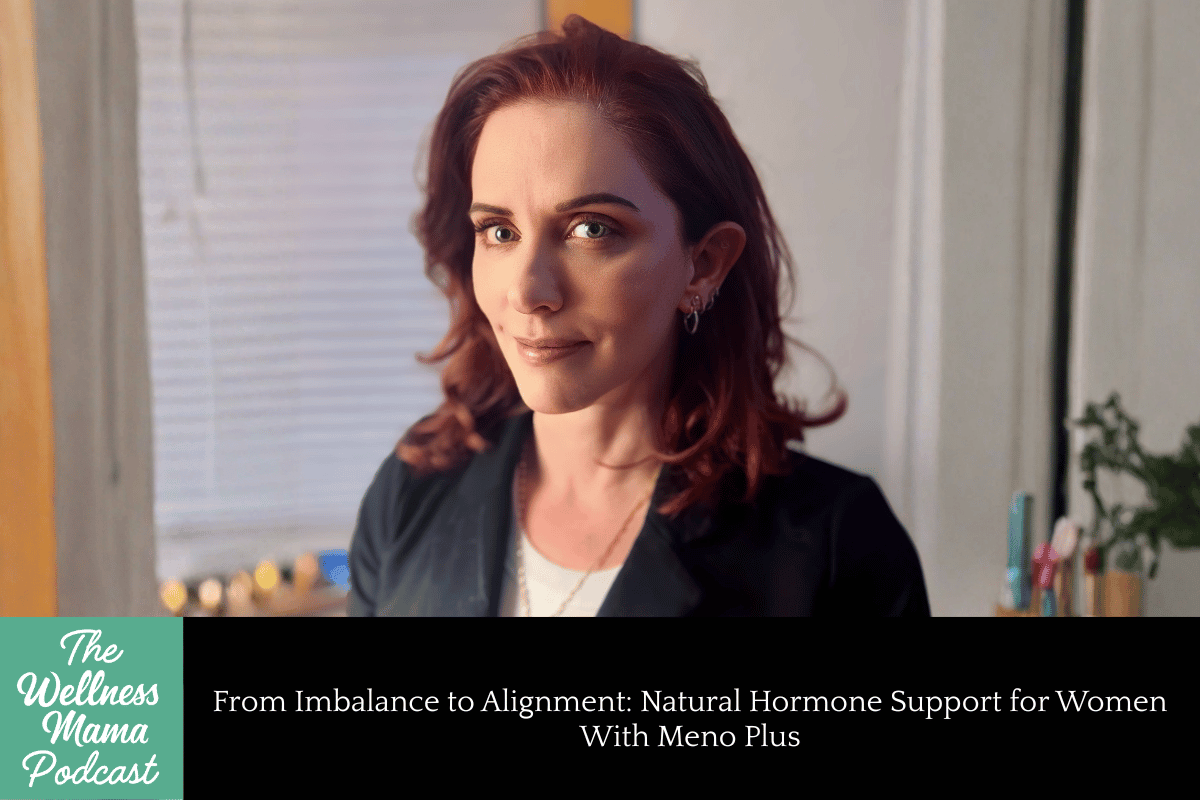
Katie: ?Hello and welcome to the Wellness Mama Podcast. I’m Katie from wellnessmama.com, and today I am excited to be diving deep on a topic I get a surprising amount of questions about. Which is the topic specifically of perimenopause, menopause, how to navigate it, what to do with or without hormones, kind of so much that goes into this.
And I’m here with Colleen Renee, who is American Board Family Medicine, certified nurse practitioner, and specializing in menopause specifically. She has tons of depth of knowledge on this topic and kind of walks us through how to navigate, like what’s actually happening on a root cause level during these hormonal shifts and why it’s not just about menopause itself, but all of the shifts that happen before, during, and after, as well as what the body specifically needs during this time.
We do touch on HRT. I know this is a controversial topic, and she shares some really important insight around that, as well as the factors that are within all of our control to support our bodies as hormones change, as we change, and as just things change in general, she’s definitely a wealth of knowledge and I really enjoyed this conversation with her. So let’s jump in. Colleen, welcome. Thank you so much for being here today.
Colleen: Hi. Thank you for having me.
Katie: Well, I’m really excited for this conversation. I feel like it could not come at a better time because I know this topic in general is a big one recently with some changes around recommendations around different things. But more importantly, I hear from so many women who are trying to navigate the perimenopause and menopause stage of life.
And feel like they’re just getting conflicting information or misinformation or it’s so hard to sort through and really know what even the right thing to know is. And understandably, like there’s some controversial topics within this. And I feel like a lot of women get pushed into pharmaceutical options first without really understanding maybe some alternatives that are available.
So there’s a lot of directions we’ll get to go in this conversation. But from your approach, I would love if we could start for background talking about the hormone shifts not only isolated to menopause, but as women that we need to understand kind of at all stages and how they sort of are connected because I feel like that bigger picture maybe gives us a clearer map of how navigating something like perimenopause or menopause can be navigated more gently as well.
Colleen: Well, yeah, I think it’s, I think probably it’s important to know that though we talk about menopause, what specifically that means. Because it is a medical term. Menopause truly means that you have no period, your menstrual cycle has ended for at least 12 months prior, without hormones or without surgery.
That, so that sort of thing. We all, you know, I think we’re forward to or dreading what, however, whatever your perspective is, that actual menopause time. But the important thing to know is that up to 10 years and sometimes longer prior to that actual cessation of the menstrual cycle, we’re experiencing what they call perimenopause.
And that oftentimes for many women can be more significant than the actual menopause state itself.
Katie: That’s so interesting because yeah, I think maybe a lot of people don’t even know that that like menopause is kind of a clearly defined date based on one particular metric. But it seems like even on social media, I see conversations of people like in their thirties even saying that they’re like noticing hormone changes and they’re still being told sometimes their labs are like normal by their doctor or that everything’s fine.
But it seems like women who, especially women who are like tuned into their bodies, maybe do start to notice these shifts earlier, like what’s happening in their bodies when they start to feel these differences far in advance of just their menses ending.
Colleen: Well, so what’s happening in the perimenopause state, there is a significant swing in the levels of estrogen that’s in the women’s body. This can be, sometimes if you were able to measure these, you know, continuously, they would see that there are times when the estrogen levels are actually higher than when they were prior to many perimenopause.
And what that means is that is, contributes to a lot of the side effects or the symptoms that women are feeling. If you can imagine we go through as, with our cycle, our estrogen levels vary as well, and we become, our body becomes accustomed to those things that when we start, first start our mental cycles when we’re young. And it’s sort, and it’s very predictable for most women, but once we hit that perimenopausal state, it’s not as predictable and there can be really huge swings in the levels of estrogen, which contributes to all of these, the side effects, the symptoms that many women complain of. And it really becomes for most women, more noticeable about the 40 year mark, but it can be earlier for some. And then it just continues until that actual menopause state where menstruation ceases altogether. So that’s, I mean, that’s you know, average age for menopause is right around 52. So that’s a long time for people to be experiencing these types of symptoms.
Katie: And that is a long time. And I’m guessing like with many areas of health, it’s probably one of those things where if we understand it going into it like when we first start to notice those changes, which I’m approaching that age level too, that we can have more, kind of, we’re more empowered and have more informed consent in what we do and how we navigate that rather than waiting till it gets really bad or waiting till it gets like staggering enough to show up on lab tests.
I know for me with thyroid for instance, that’s kind of, like I noticed, I felt off for a long time before I could get doctors to test the particular things to show that something was actually going on, but I knew it in my body long before that. And it sounds like many women kind of experience that same paradigm when their hormones start shifting because it can be, like you said, so subtle at first and maybe doesn’t show up immediately as a red flag on a lab test.
And yet that woman is feeling something and trying to get answers and help, and I hear that story so so much.
Colleen: Yeah, and that’s, it’s interesting that you mention that part because I tell my patients all the time, we can run lab tests, we can do check your estrogen levels, we can do all of these things, but that it may show that you are in a normal state depending on when, if you’re still having regular cycles, depending on where you are in your cycle, your estrogen levels will be different. And so it may show up on the test for that particular day that your estrogen levels are right where they should be, but you’re still feeling this tiredness and all the other stuff that comes along with that.
So I advise my patients that while we can test your hormones, there’s a reasonable chance if you haven’t reached the menopausal state, that it’s going to come back as “quote” normal. And even though you’re so, you know, we, then they feel like they go home saying, well, everything’s, you know, normal, I guess. But I guess I just have to live with this. And what we don’t discuss enough as healthcare providers is that it really is very subjective. And even the recommendations that have come out now are to treat women if, you know, if they so choose for these states based on their symptoms and not on what their levels are.
And there’s, I still find that there’s a lot of healthcare providers that don’t “quote” buy into that if you wanna say it that way. And so you’re like, well, you’re normal and send you on your way. And then you leave thinking, well, I guess I must be just be crazy that this is happening to me. So.
Katie: Yeah, I love that perspective and one of the reasons I was so excited to have you on especially is because you have some very actually tangible solutions for women in navigating this, and especially women who want to like support the body at a root cause level and go kind of the more natural route and we’re gonna get to that.
I’m a big fan of saying at the end of our day, even if we don’t have a doctor who’s willing to run the test, we wanna run, we’re still our own primary healthcare provider. And I feel like your message is so positive on like really putting that knowledge in the hands of women. Before we get to that though, I feel like it’s important to at least touch on hormone replacement because obviously this is a big part of the conversation for a lot of people and I hear from a lot of women who even though there have been reports that maybe it doesn’t cause cancer, like we thought they’re still really hesitant to jump in with hormones or certainly to at least start with kind of the typical hormone replacement therapy. And I know you’ve talked about that HRT can be a less than ideal option, at least for some women.
So I would love to get your perspective on that. And then we’ll get into kind of the alternative in our own hands as primary healthcare providers of ourselves, solutions that you have as well.
Colleen: Yeah, so there are, hormone replacement used to be pretty much, you know, you were, longest you should ever be on it was this very short period of time and they warned against all of these other things. They’re discovering that this isn’t, not necessarily the case, but that is not true for all women.
There are certain cancers that are, respond to estrogen therapy. So we can see an increased risk of cancers for certain groups in breast cancer and uterine cancers, that sort of thing. And there is, and there’s, they’re not all natural. There are some bioidentical, as they call them, but they’re not necessarily natural.
And certainly hormone therapy is not for everyone. I think that there’s ten… there’s starting to be a little bit of a swing towards pushing more towards the hormone therapy. And I don’t, I think that it’s really important that having a discussion with a trusted healthcare provider and making a decision that’s right for them. So if, there are ways that we can support the estrogen that is in our body and kind of help increase some of these natural estrogens that we’re already producing. Even in menopause, we do still produce a small amount, not through the ovaries, but, so I think just giving women the knowledge so that they can make the best choice for themselves on whether they want to go with a non-hormone replacement or a hormone replacement.
Katie: Well, and I think this like also just kinda approaching that from a first principal’s perspective and from that lens of being our own primary healthcare provider, I feel like very often there’s so much of course like nuance and personalization, especially when we’re talking about things like hormones, which are so multifaceted.
It also seems like sometimes hormones get painted as the only option. And I know from like researching for this episode in your work even that’s certainly not the case and it maybe isn’t even the like root cause kind of first principles approach to take because like certainly it makes sense, of course women might see lower hormone levels.
But I guess it brings me to the question, is it because they’re not supplementing with exogenous hormones or are there other kind of first principles reasons that their body might need support to make these hormones as they’re starting to go through these shifts? And I know you talk a lot about the like specific nutrients and kind of some targeted things that I don’t feel like most people are talking about.
So can you kind of walk us through what are some of the like impactful nutrients and vitamins and things women can do outside of just hormones to really support their bodies in continuing to make the hormones themselves?
Colleen: Well of course nutrition is important for everyone. But as we come into the perimenopausal state, menopausal state, we tend not to absorb nutrients quite as well. There’s also, and then things like the, you know, stress that all of us are going through, particularly as mothers and in just in general in the world we live in. Cortisol is a hormone that we produce is kind of the you know, emergency type hormone that keeping our body in this heightened state. That hormone actually can decrease the level of estrogen and our responsiveness to the estrogen that we make in which, of course, we’re hitting that perimenopause area, we’re already not having these fluctuations.
So having the cortisol on board is, it can make things even more difficult for the body to absorb properly. So probably the biggest vitamins that are important for women to have adequate amounts of, are vitamin, the B complex, B12 in particular is super important. And that is, normally can be, it’s pretty readily available in most diets. If a person is a vegan or a vegetarian that makes it a little bit more challenging to get those B vitamins in. But still very possible. And that’s why there are supplements. The other big ones are the vitamin D along with calcium, which are important for, we’re discovering more and more things that vitamin D in particular is important for, including bone health, mental clarity, gut health and heart health, all of these things.
And that can be difficult to get. It has to be supplemented either through exposure to sun is a great way, but if we’re doing what we should be doing and wearing all of our, the sunscreens and covering up as we should be to protecting our skin, then we’re not absorbing that through sun, through being in the sun. It’s high in dairy products, which also are not great for some people. So oftentimes we find that most, or a good number of people, are low in vitamin D. So taking a supplement for that is important along with calcium for bone health. And those are probably the top three that are the ones to kind of keep an eye out for.
Katie: Yeah, that makes sense. And it seems like a lot could be gained from even just like a small paradigm shift in the mentality around this. I know in that time of life, like a lot of us, I had to break this consciously was kind of breaking that diet mindset and the deprivation mindset and thinking in terms of like calories and macros.
And it seems, especially as we get older, like you said, we tend to not quite absorb things as well as we could. So obviously being aware of our gut health and being aware of factors like that can be really helpful. And realizing the body is requesting us to be really aware of nutrients and give it enough of these nutrients like you’re talking about.
So for me, even the, just the paradigm shift away from macros and into micronutrients and thinking how can I, even with my food choices, just like maximally nourish myself, was a really helpful and positive shift. And I’ve had many podcast guests talk about even in a perfect situation now with the way the food supply is and the soils depleted, like we could eat kinda like perfectly on paper and we still often kind of need to supplement just because unfortunately, categorically we’re not able to really get enough of certain things from food anymore, sadly. And you also talk about a couple other categories that I’m guessing sort of dovetail with this, which are exercise and sleep, and I know those also seem to potentially change or at least our response to them in this phase of life as well.
And as these hormones start shifting, so how can women understand these variables of exercise and sleep and use them to our advantage to kind of thrive through the hormonal shifts? Like what do we need to adapt?
Colleen: Yeah, so I know, many of us are chronically sleep deprived. I think that’s probably more true in women oftentimes. You know, we tend to be the caregivers for our families and so I, you know, we prioritize everyone else, but it, especially in this time of life, it becomes more important that exercise does a few things for our body. First of all, it’s really impactful for our bone health. We, as our estrogen levels decline, we don’t turnover bone as quickly as we used to.
So our body is constantly breaking down the bones that we have and then, and replenishing them when we’re younger. As we get older the estrogen kind of prevents some of that. You can positively impact that by weight-bearing exercises. Our heart health tends to suffer as our estrogen levels decline. So cardiovascular exercises are super important, you know, that we recommend 30 minutes a day, every day. And then just the idea of, as you said, mindfulness in our diet.
So, you know, not so much that I think we spend a lot of time earlier in our lives worrying about, you know, how many calories we’re intaking, whether we’re going to, you know, put on weight, that kind of thing. And this is not the time to be doing that, to worry. Yes, calories are important, but nutrients are the big thing.
So being very mindful of what you eat and how you eat it is important as well.
Katie: That makes sense. And I know I’ve like seen a lot of these stats of as hormones shift and even, I think it’s maybe not even so much the hormone shifts, but just being aware of, like you’ve talked about, if we’re absorbing nutrients slightly different, like if our sleep changes, like those things can dramatically impact us even if our hormones weren’t changing and those things are within our control to adjust as we go.
But just knowing how, for instance, every decade we do tend to lose muscle if we’re not being proactive about that. So I’ve loved when I’ve had guests on that really like, highlight, especially for women, the importance of things like moving heavy things when we can, like things that build strength, getting natural light exposure, being aware of our sleep and just how we get to be a little bit more proactive about those things than, for instance, we were in our twenties when we could get away with, you know, not sleeping all night and still thriving.
And I know for me, even like pre this kind of phase, but realizing that eventually I will be entering kind of that perimenopause time window. I know I feel a difference from some of these habits you’re talking about, like making sure I’m getting enough protein and strengthening, like really being aware of my sleep and my light exposure and getting morning sunlight and trying to like kind of calm down for a couple hours before bed.
Not doing screens and food right before sleeping. Like those little changes that can make a big difference. And as we’ve talked about, the kind of this nutrient support that a lot of women need in this phase. I especially wanted to have you on today to talk about MenoPLUS, which by the way, I love the name.
But I feel like this is one of those tools that really helps women to be in that kind of informed consent driver’s seat of their own health. Especially if they’re wanting to like delay or not go the hormone route or I would guess even if they decide to go that route. This is kind of like a both and. So I guess to start, can you walk us through what led you to formulate this and what makes it so unique?
Colleen: Well, it, the MenoPLUS kind of came about, just as a, I think probably the turning point was I, I’m also in that state. I have reached the perimenopause and now menopause state as well. And just finding out and educating myself because, as a healthcare provider, they really didn’t provide that much information about menopause in school, which is, you know, another topic in itself. So I had to go out on my own as a healthcare provider and find the information and it is available. So we looked at it that there was a problem of not a whole lot of different alternatives for those that don’t want to do hormone replacement. And so we came up with the MenoPLUS product that is well absorbed.
It’s one of the, it’s got the liposomal technology, which makes it more readily available. And it’s, it is really support for the estrogen that we have. It is non-hormonal. There are supplements on the market that claim not to be hormonal, but they do convert in the body. This MenoPLUS does not.
So it is a completely estrogen free product, but supports the estrogen that the body naturally makes.
Katie: That’s awesome. And I think that’s like an area that a lot of women are so interested in is like, could I rebalance my hormones naturally? But seemingly like, there’s not a lot of, that I’ve seen, great mainstream information about that and a lot of doctors they might encounter are gonna tell them like, hormones are kind of the only option to go.
And so I love this because I feel like you guys have actually done a deep dive on the science of this, and you have some pretty astounding case studies related to it too, which I also always love to lean on those because as I tell people often, we’re each our own N of one. And that is actually the most valuable study we will ever do is of ourself.
And so like double blind placebo, that’s great. And if it works for you personally, that’s actually more valuable. But can you talk about the like research you guys have really put into this, the intentionality and also the case studies of what you’re seeing? Because this is so phenomenal.
Colleen: Yes. So there’s several studies that we looked at before deciding to go with this product. The, it’s a, the herbs that are used within the product are, were first studied in Korea and Japan. And so there’s several studies coming out about how those affect and their availability.
But I think the more exciting thing is the people that have tried this product. We have one person who had been kind of had decided that she was just in the state that she was, she was in her late sixties and just hadn’t felt like herself in years and didn’t feel like that that would change.
So she tried the MenoPLUS and within four weeks she was already noticing a difference. Her energy levels had changed. She had brain, the brain fog that she had been complaining about that had started to clear up. She said that she used to be, prior to all of this happening to her, she was a very outgoing person and she pretty much had stopped leaving the house because she just didn’t feel social or any of those other things.
And it had completely changed that for her. So she was talking about just being able to get out with my friends and enjoying my time again and just having, she felt like, it felt like there was fog lifted from my brain. You know? So those are the things that are such a big deal and makes such a big difference to people.
And so really the, while you can read many studies that show, yes, we’ve seen a different, a decrease in inflammation with the brain, which affects the brain fog and sleeping and, but really talking to these people that have tried it and it’s worked for them, that’s the exciting part to me.
Katie: That is exciting and I love, I heard in other cultures too, like part of this seems like a, the way America approaches this concept of this hormonal shift also of like from a mindset perspective, because I know in other cultures this time is not looked at as like a negative shift, it’s actually looked at as like a beautiful empowering shift.
And it’s kind of more approached from a how do I support myself and my body through this as I kinda move into this like sage part of life versus a like problem to be fixed. It seems very western that we’re like, must fix it and every symptom must be stamped out to begin with. But I love the approach because it feels like it’s really supporting the body at that base level, like honoring the process that it’s going through and letting it be a gentle process that is nourished and supported versus kind of just like throwing hormones as the first line of defense, but not taking into account like, well, why is the body having more trouble making these hormones?
Like, how would I support the body in doing this naturally, at least first before I go to these more, you know, prescriptive pharmaceutical options.
Colleen: Yeah, that’s absolutely right. And interesting that you bring that up. I kind of anec, and so, sort of a side note, it’s, there are only a few species of animals that go through menopause, including obviously humans. And in all of the other species, the matriarch is the head of the family. And evolutionary wise, it doesn’t make a lot of sense for us to go through menopause.
You know, our, you know, the kind of evolution says that our job is to reproduce. And so it doesn’t make a lot of sense from an evolution perspective, but in societies where, in animal societies where the matriarch is the head, we, they rely on the wisdom of the menopausal female in order to support the community, support her offspring, that sort of thing.
And I think that’s important for us to remember as women that we’re coming into a time where we are, you know, no longer the bearer of children. We are the support of our community and the wisdom of our community. So I think that’s important to note as well.
Katie: Yeah, I love that as a mindset shift. It feels like this is a more beautiful process when we can approach it from that perspective versus kind of thinking something’s clinically wrong, which just feels very disempowering. And I know you touched on this…
Colleen: I mean you can spend a third of your life in… Sorry, you can spend a third of your life in a menopausal state, so we might as well be feeling good about it, you know?
Katie: Absolutely, and I’ve even heard it said in some kind of traditional cultures that like for the first part of our life, when we are in that like child raising phase, or at least in a fertility phase where our body could do that, it’s like very, so much of our energy pours outward. Even like we bleed, like our energy leaves us.
Whereas in menopause then we get to like retain that and then kind of go inward and enter that more sage energy and give. So I love that reframe so much.
I love this because I feel like you’ve given us so many tangible things to understand and to focus on and like these powerful reframes of how to like nourish and support the body and understand these shifts in a positive way versus view them as like a problem to fix. So I’m guessing for women listening, there certainly have been resonance with things that you’ve said, and I’m curious, what would be the first step that a woman could take if she’s listening to this today and is starting to feel that kind of like off hormonally, but maybe it is or isn’t showing up in labs. Maybe she doesn’t have a great practitioner to work with to even find that out.
So she like doesn’t know where to start, but she wants to start supporting her body in the ways we’re talking about.
Colleen: Well I think using a supplement like the MenoPLUS that comes from Purality Health is a great place to start with that. It is, it’s a, it has natural ingredients in there. The, there’s three different key ingredients in it that are herbal type supplements that support sleep, they support the heart health, it supports better utilizing the amount of estrogen that we are making in there and making it kind of even out some of those swings that we see in the perimenopausal time. The women that I know that have tried it have had, didn’t have any particular side effects, didn’t have any sort of GI upset, nothing along those lines.
And when, and a lot of them within four weeks noticed a big difference in their, the symptoms they had been experiencing.
Katie: That’s awesome. And I know you guys have a special discount for listeners, so I wanna make sure that’s linked in the show notes. For any of you guys listening on the go that’ll be at wellnessmama.com. But as we get kind of close to the end of our conversation, is there anything we didn’t get to touch on that you feel like we need to make sure women get to hear related to this and or what would you love for women to walk away from this conversation remembering most after hearing all the things we’ve talked about.
Colleen: Well I think the most important thing for women to know that, as you said, menopause is not something that we necessarily need to fix. It is, if you are a woman at some point of all of us will go through this. I think that it’s important that women continue to listen to their bodies. And even if you go to your healthcare provider, who oftentimes isn’t probably not even gonna bring up the case, you know, if you’re 40, 45, it’s not gonna be like, how are you feeling?
You know, and discussing menopause and perimenopause. It very rarely happens. So having that education, it’s self-education to say, Hey, I’m experiencing these things and just being upfront and honest with your healthcare provider. It’s a wonderful time. It’s not something to be feared.
It’s not something that we have to do anything to fix. We just need to have a little bit easier transition into it, I guess, is important. And listening to your body and knowing what’s gonna be best for you is important.
Katie: Amazing. Well, I think that’s a perfect place to wrap up for today. I’m so grateful that resources like this exist, so I’m like aware of them before I even enter these phases and I’ll link to, I know you have more resources around this as well as the MenoPLUS itself. Those will be linked in the show notes along with a super generous discount.
So all of that will be there. But Colleen, thank you so much for how detailed we got to get into this today. Like I said, I think this is very top of mind for a lot of women and there’s so much information out there that seemingly is conflicting. So I love that you were able to help us cut through some of that. Thank you so much for your time today.
Colleen: Thank you for having me. I appreciate it so much.
Katie: And thank you as always for listening and for sharing your time, your energy, your presence with us today. We’re so grateful that you did, and I hope that you will join me again on the next episode of The Wellness Mama Podcast.




Leave a Reply