Read Transcript
Child: Welcome to my mommy’s podcast!
Katie: This episode is brought to you by Just Thrive Daily Gut Detox. Here’s a hot take. Most detoxes are just an expensive way to feel terrible for a week, and this is because they force toxins out with laxative and harsh ingredients, which can result in fatigue and days of discomfort. And I’ve talked about before, how it’s not, detox is not a thing we do to our body.
It’s a thing we work with our body because it already naturally knows how to do it. And that’s why I love Just Thrive Daily Gut Detox. It’s different. It works with your body, not against it. It’s not doing something external to you. It’s powered by clinically proven immunoglobulins that act like a toxin magnet.
They bind to the bad guys in your gut and safely carry them out so there’s no extreme flushing or cramping. No shock to your system, and because daily gut detox is gentle enough for everyday use, it helps give you the support you need to stay healthy long term. So if you’re dealing with signs of toxin buildup like embarrassing bloat, or brain fog or fatigue, there’s finally a science backed detox that’s easy to stick with long term.
And it’s microbiologists formulated, gluten-free, dairy-free, and non-GMO. And as always, you can try it risk free with their hundred percent money back guarantee. Just visit justthrivehealth.com/wellnessmama. And use the code WELLNESSMAMA at checkout to save 20%. So again, that’s justthrivehealth.com/wellnessmama. Take control today with Just Thrive.
This episode is sponsored by BON CHARGE, and I love so many of their products from their red light face mask to their sauna blankets and everything in between. They focus on high-end wellness tech, and if you’re interested in how light can help you, which I talk a lot about, BON CHARGE has so much to offer.
Studies have found that specific red light frequencies can help reduce fine lines and wrinkles when used at the correct brightness and strengths. And some products don’t get these correct. The frequencies of red and near infrared light stimulate cellular activity at a mitochondrial level, which I talk a lot about on this podcast.
This can create better energy efficiency in a given location of the body. For instance, red light on your face gives more cellular energy for biological processes. This can help to decelerate the signs of aging and lead to firmer, plumper skin. So the long-term results you can see when using an LED mask over time are things like, reduction in the appearance of fine lines, reduction in the appearance of wrinkles, reduction in under eye bags, firmer skin, tighter skin, reduction in signs of aging, scar fading, plumper looking skin, reduction in visibility of blemishes, and visibly clearer looking skin.
I’m always a fan of getting natural light from outdoors, but for people who are wanting to kind of tackle the aging process head on, this is in a way to kind of give your body some extra benefit from these specific wavelengths of light.
The safe, non-invasive beauty treatment is going to be around for a while, and for a good reason given the results people are seeing. If you wanna check out the BON CHARGE Red Light Face mask, and all of their products, you can go to https://boncharge.com/wellnessmama and use the code wellnessmama for 20% off.
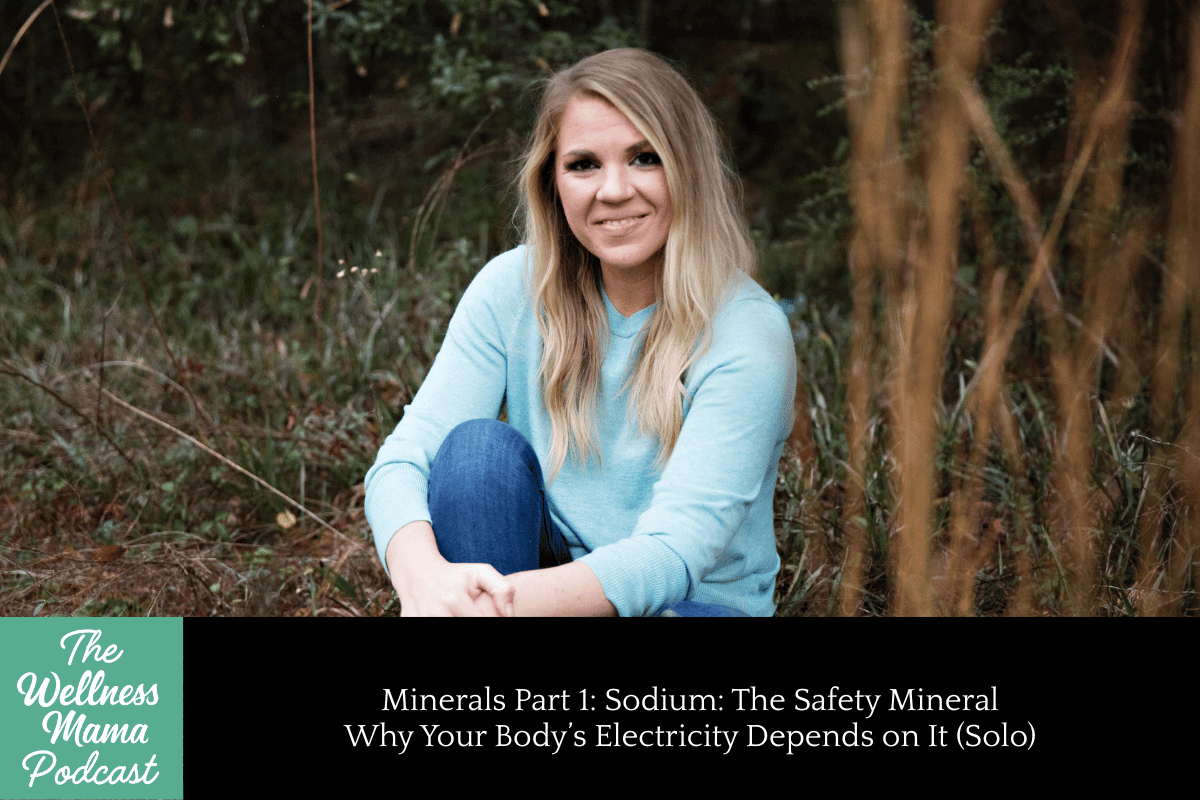
Hello and welcome to the Wellness Mama podcast. I’m Katie from wellnessmama.com, and this episode is part one of a five part series that I’m doing on minerals to cover a lot of questions that I’ve gotten related to minerals as a category and two specific ones. And this is a topic I’ve done a lot of deep diving on myself recently, because I have noticed are profound impact from really getting a nuanced understanding of minerals for my own body. And I often, I feel like this is often an overlooked piece for a lot of people. So in this first episode, I’m going to really dive into the topic of sodium, which I consider the safety mineral and basically why the body’s electricity depends on, among other things, but primarily sodium and how we can optimize this.
And I’ve had other podcast guests touch on various aspects of this, so I wanted to kinda synthesize and summarize today in this episode. I will also link to a few of those other episodes, in the show notes. So if you miss any of those, I have some experts that can explain pieces of this in a more detailed way.
Before we jump in, welcome and thanks for listening. I’m so glad you are here. And I just wanna reiterate that nothing I ever share is medical advice or honestly advice of any kind, including personal advice. This is all just my own experience, what I have learned from my own research and what I have implemented and noticed a difference from in my own life.
My goal is to offer inspiration for your own research and jumping in point. Never to be a place of comparison or pressure or prescription. As I say all the time, you are and always will be your own primary healthcare provider. I encourage you to always stay curious, to question everything, even, and especially me to do your own research, listen to your own body.
My deepest hope is that any of these conversations could serve as a starting point to deeper connect you with your body’s own innate wisdom and find your own next best steps. So with that said, let’s jump into sodium because I love this topic. And here’s why I wanted to start with sodium. Like I said, this will be a whole series on mineral mastery.
I think minerals are incredible, often overlooked, and a very powerful lever for health. And I feel like sodium is one of the unsung heroes especially, and that it got a bad rap over the last few generations or a few decades that has been very undeserved and possibly very detrimental in my opinion. I feel like it’s been the most demonized, in my opinion, completely wrongfully, and it’s one of my favorites.
So fun fact, purely from my own experience. I actually take tablets of pure salt daily and notice that this is really helpful and has made a big difference in my energy levels. Also, as caveat, of course, we’re talking about sodium. I’m also using this mainly to refer to salt, sodium chloride, obviously pure sodium on its own, we would never, never consume. But so talking about sodium in the electrolyte category related to salt. But in understanding it’s always gonna be bound in something like sodium chloride. I also want to kind of call out the elephant on the room, in the room, when it comes to salt, which is that most public health messaging around this still is on the salt is bad.
Even if this is a subtle message, it’s still on the salt is bad bandwagon. And the idea that Americans eat too much salt and that salt equals high blood pressure and therefore it is bad. My opinion is that, it’s true that excess sodium in processed foods amongst other problems with processed foods and low potassium and a low movement context raises blood pressure for many people.
I do not think the salt personally is the reason for that. In fact, I’ve had a podcast guest that said for 75% of people, actually the reverse is true. We’ll get to that later. But he said for 75% of people, getting more salt, more sodium absent of processed foods, actually lowers blood pressure. And he recommends 8 to 10 grams per day of salt and he consumes much more than that.
So in this episode, I’m gonna talk about what I feel like is not often talked about in the context of sodium and salt in general, which is that what sodium actually does in the body electrically. So most of the conversations are still talking about biochemically or focus more on blood pressure. I want to talk about the electrical component and what happens electrically in the body when we don’t get enough, because I think this actually like really shifts the paradigm when it comes to minerals and helps us understand what our body actually needs.
As I said, this is not medical advice. This is my education plus my own opinion. Of course, do your own research. You can have a nuanced conversation with this, with your practitioner. Question everything. And this is from a lot of research and a lot of personal experimentation, my understanding. So I view sodium as an electrical mineral and a safety signal.
Here’s what sodium, and salt, within the way we consume it in human form actually does. It’s actually one of the major electrolytes. I would say the primary one in the body. And if, I’m sure you’ve heard that term, but electrolytes are minerals that carry an electrical charge in water. So if you try to run electricity through distilled water, it’s not very conductive at all.
Salt water will conduct electricity. We are electrical beings. We need to conduct electrical signals throughout the entire body to function optimally. So when we don’t have enough electrolytes, we don’t have optimized electrical communication within the body. There’s more nuance of course than that, but that’s kind of a starting point for understanding this connection within the body.
Our cells use this electrical charge to do almost everything from move water around in the body, fire nerves, contract muscles, run biochemical reactions. The body is also biochemical, but in my mind, that’s a downstream effect of the electromagnetism of the body. What we do know is that there are some key roles of sodium in the body, one being fluid balance. And I feel like this one’s actually gotten confused in the mainstream narrative, and I wanna kind of dispel some of the myths as I understand them in this episode.
The main positive ion of extracellular fluid is sodium. What this means is this, that it helps keep the right amount of water outside of our cells. And we’ll talk about other minerals and internal and easy water and other things in future episodes, but too little sodium relative to water can cause the cells to swell.
The brain is especially sensitive to this, so sometimes feelings of confusion or feeling off or headaches can actually be signals of low minerals. This also means sometimes if we’re retaining water weight, it’s actually not from too much water. It’s from too few minerals, and I’ll get back to that again later.
There’s also the element of nerve conduction, which is of course a very electrical process within the body. Nerves fire by opening channels and letting sodium essentially rush in, creating an electrical signal. The signal passes from nerve to nerve until it reaches a muscle or organ where it’s supposed to be going.
If we don’t have enough sodium to rush in, that electrical communication is blunted. Same thing with muscle contraction. So muscles including, remember the heart is a muscle as well, change their sodium, potassium gradient to contract. So we’ll get to potassium in another episode, but sodium is half of that equation.
And when we don’t have enough, muscles don’t contract optimally. And again, I’ll go a little deeper on that in a few minutes as well. There’s also something called the sodium potassium pump, which I personally find fascinating. But these are within our cells and they constantly use ATP to push sodium out and pull potassium in.
And this is part of the electrical communication of the body. This pump alone uses up to half of our brain’s energy because maintaining this electrical gradient is so important. And I’ll elaborate again more in the potassium episode on this too and touch more on the sodium potassium pump later in this episode.
But the short takeaway here is without enough of those two building blocks, that communication is not functioning optimally. And these are some of the reasons that I consider sodium a safety mineral. Because adequate sodium in the body, again, we don’t want too much or too little. I would personally say most people are getting too little thinking, they’re getting too much.
But when we have adequate sodium, we have good blood volume, the brain feels like there’s enough for circulation and pressure. Low sodium can be correlated with low blood volume. Which can correlate with dizziness, racing heart when we stand up and anxiety symptoms. I will say I actually notice some of those things if I don’t get enough sodium.
I think my body’s pretty mineral sensitive, especially now that I have dialed these things in. But to who the nervous system, and I’ve done episodes on nervous system as well, not getting enough of these key minerals and electrolytes is a danger signal. So even if we’re doing everything else right, if we’re not getting enough minerals, the body feels danger.
This is definitely not a place for diagnosis of course, but some symptoms that according to the literature, are correlated with not enough sodium within the body, for some people, are things like dizziness or lightheadedness when we stand up, salt cravings, which makes complete sense. And often women will have more salt cravings during pregnancy, this can be why. Headaches, fatigue, especially around the feeling of wired but tired. So if you’re not resting well enough and you’re really tired, but you’re also wired and have trouble sleeping. Muscle cramps could be a big cue. Brain fog and feeling worse with hydration if with plain water, but better with enough salt or electrolytes.
I also will insert my own experience here. I’ve read that people who do certain habits and activities will lose more minerals in the span of a few years than people who don’t or who are sedentary do in their whole lifetime and have an especially, a bigger need for replenishing minerals and electrolytes.
And these are things like, we know that sauna, intense exercise, pregnancy, living in a hot climate, those things all can deplete minerals pretty rapidly. In fact, I’ve read the statistic recently that during pregnancy, baby may use as much as four pounds of minerals from the mom’s body. We lose a lot of electrolytes and minerals when we sweat, whether it be from exercise or from sauna.
So people who do any of those things are losing minerals more quickly than the person who is not. And as someone who does a lot of those things, who lives in a hot climate, saunas often, exercises oftens and has had many pregnancies, minerals are something I’m very cognizant of and I do notice I feel much better when I get more salt.
I wish I had known about this when I was pregnant with my kids and breastfeeding. I think I hear from so many women who have a much easier time in those phases when they really optimize their minerals as well.
All right. I also wanna now get into something that’s perhaps a little bit more controversial, but the idea of kind of the sodium paradox. And calling out this kind of discrepancy between the idea of not getting enough sodium and the idea that many of us are apparently getting too much and why I feel like this is flawed.
The standard guidelines in the US suggest that adult limits, adults limit sodium to less than 2,300 milligrams or 2.3 grams per day. This is roughly a teaspoon of salt. Here’s why I don’t necessarily agree with that. For one, average intake is around 3,400 milligrams or 3.4 grams per day. And most of that comes from processed packaged foods and restaurant meals, not from the salt shakers.
In fact, if you eat an unprocessed diet, you are likely below that average intake because most unprocessed foods, unless we’re adding a lot of salt, are not naturally high in salt. High sodium intake, especially in those with hypertension, is said to raise blood pressure and cardiovascular risk.
But again, I think there’s more to this story and potassium is part of that, and as researchers have explained on this podcast before, that is actually only true in a small subset of the population. And people can actually, he recommended figure out their own response by consuming more salt and taking one’s own blood pressure and seeing what happens.
But he said for basically three fourths of people blood pressure tends to go down when we get more sodium, not up. So that data was kind of flawed to begin with. I think there’s also more to understand with the roots of hypertension and what else is going on within the body. I certainly don’t think it’s as simple as salt raises blood pressure, and like he said, in three quarters of people, that’s actually overtly not true.
The nuance here is that the sodium story is not one size fits all. There’s also controversy around very low sodium diets and long-term mortality. And the data here was really eye-opening when I looked into this. Some studies suggest a J shaped curve, where both extremely high sodium intake and extremely low intakes can be problematic depending on the population.
I think this is an area certainly of nuance in that whether you’re finding out, if you’re in that 25% of people that have blood pressure go up, or the 75% who have it go down, and what subset of that you are in. As I said, this one researcher, who’s one of the leading salt researchers in the world, recommends upwards of eight grams a day, which is several multiples of the recommended amount.
I’ve also heard anecdotally from many, many people who drastically increased their salt intake and saw their health improve. I personally, this is not medical advice of course, but I personally consume over five grams per day, sometimes much more. Especially if I sauna and exercise. I even take tablets of salt daily to make sure I get enough and I notice a difference when I do this.
I feel like extreme restriction can be more problematic and that especially if we’re just salting our food, it’s actually hard to get too much ’cause the body has very tightly regulated feedback loops with this. We also know that extreme salt restriction can be correlated to insulin issues and lipid issues in some people.
I think this is an area worth the very least, personal research and personal experimentation. I also think this is a place where context matters greatly because high sodium, especially from processed food, plus low potassium, plus not getting enough movement is not great for blood pressure. That’s pretty well established. And I would guess most people in the studies that they’re doing were largely more sedentary and maybe they were not taking potassium into account. Higher sodium intake in the context of real food diet, adequate potassium intake from fruits, vegetables, roots, and supplements when needed. Adequate magnesium, which I’ll do a whole other episode on that. With regular sweating for detox, so sauna, exercise, or if you live in a hot climate and without, of course, any significant issue or contraindication like kidney or heart disease looks very, very different physiologically.
I’ll say for me, and I’ve seen this in family members that I’ve worked with as well. That actually dialing those factors in: real food diet, much more salt, the right movement patterns, the right light patterns, they saw blood pressure go down. I saw blood pressure go down. I even have a family member who had a mini stroke type incident where they were advised to go low salt and to take certain medications: increased their salt intake, saw blood pressure go down and saw this trend very clearly over time.
I feel like for many health conscious people, and especially women, I hear from a lot who have removed processed food. So we’ve actually removed our main source of sodium. We’re told we need to hydrate, so we’re drinking lots of plain water. We’re doing all these healthy habits like saunaing, working out a lot, sometimes are low carb, all of those things deplete sodium.
So we’re often under mineralized relative to our output of minerals. This is a topic I plan to talk a lot more about in the future about being under mineralized. So my framing is we need to differentiate between toxic sodium sources from processed foods and the lifestyle factors that go along with that, and supportive sodium from quality salt in a nutrient dense diet with adequate movement levels.
Because I believe those are actually two entirely different scenarios and we’ve only studied one, and we’ve given healthy people living lives with these health factors the advice based on people who were not in an optimal state of health, who had some of these risk factors to begin with.
I also wanna address how many of us, especially if we’re trying to live in a healthy way and we’re doing things that are considered usually healthy habits might be quietly losing sodium over time. Because in my understanding, the modern lifestyle actually drains sodium quite a lot, and as I explained, the active person who lives in a hot climate or exercises or saunas can lose more minerals in five years than a person who does not exercise or sauna or live in a hot climate will in their whole lifetime.
Because of course when we sweat, we lose minerals. These all increase sodium loss, so exercise hot climates, sauna use, et cetera, those all use minerals. What a lot of people don’t know is that chronic stress and high cortisol also deplete minerals because these alters how, it alters how the kidneys handle sodium and water.
And so sometimes in states of stress we actually lose more sodium, we urinate out more salt and that’s part of our adaptive stress response. Also people who have done low carb or ketogenic diets can lose more minerals than the average person. This is because as insulin drops, the kidneys excrete more sodium.
This is also tied in if you’ve ever experienced the keto flu, that’s partially why, if electrolytes aren’t replaced. So there’s a case to be made for anyone doing those particular diets, which I personally think should be cyclical, rotated and or temporary, not like a long-term application. I’ll go deeper on that and the times and the places I personally use those as tools in future episodes.
But long-term ketosis is another way that minerals get depleted. And or another very easy way that minerals get depleted is people who think they’re hydrating properly, who are drinking lots of plain water without minerals. Because this dilutes our sodium concentration in the blood, which it’s about the concentration relative to hydration, so that in this case, we can feel off even if we’re hydrated.
I also wanna just briefly touch on, since a lot of moms listen, the pregnancy and postpartum context. Because we know, of course, that blood volume expands dramatically in pregnancy, mineral demand goes up, and often pregnant women are not told this or given the advice to increase their mineral and electrolyte consumption.
In fact, many pregnant women are told to restrict salt automatically. Even when their blood pressure is normal, which may not be appropriate. Again, this is an area of course, during pregnancy, to work with your own practitioner. But I found personally, and I wish I had actually known more about this at the time, but that I needed more minerals and more salt during pregnancy.
And I’ve heard from many, many women who had easier pregnancies and much better milk supply when they really amped up their mineral consumption, especially salt.
All right. Now I wanna talk about getting salt sodium from the right sources because this makes a big difference. And this is where some of the nuance comes into play. So, there’s difference in the availability of these sources. There’s processed table salt, which is just sodium chloride, but often with anti-caking agents and often iodine added in.
It’s typically highly refined with other minerals removed. And as I said, it’s often iodized. I’ll talk about iodine in depth in a future episode. But briefly though, I have written about this some before, in relation to thyroid health. We do need trace amounts of iodine, we don’t need too much iodine. And salt is not my preferred source, especially when iodine is added to salt because we often need more, in my opinion, more salt than we do the iodine proportionate that’s added to salt. There’s also unrefined mineral salts. These would be things like Himalayan pink salt, Redmond real salt, and high quality rock salts. There have been concerns on some of these lately about microplastics and heavy metals, so if that’s a concern, research those and make sure you’re getting those from a source that feels safe for you.
They do often contain small amounts of trace minerals, though I wouldn’t consider these significant amounts that I would count as actually consuming those minerals myself. And these are often mined from ancient seabeds, so they’re generally lower in microplastics compared to modern sea salt and more on microplastics in a second.
But I will link to some of the brands that I’ve used that test for heavy metals and microplastics because I consume a lot of salt. So this is something I’m aware of. But on the note of sea salt and microplastics. Multiple studies have found microplastics at a lot of common commercial sea salts, sometimes hundreds of particles per kilo. Plastic is now unfortunately everywhere on the planet. Salt is one vector, is one place we find it. Mined salts from ancient deposits may have less modern plastic contamination, still not perfect, but often better. Again, I’ll link to the ones that I have found safest in the show notes.
Do your own research here too. Also going back to the iodine note for a minute. So this is again, a nuanced conversation. I personally choose non iodised salts and use trace iodine from other sources. Iodine is essential for thyroid, fertility and pregnant brain development of the baby and pregnancy.
Many countries started adding iodine to salt to help with those things and to prevent goiter. But often in the health world, iodised salt is avoided for various reasons. My take here is that I prefer to get it from real food or from very specific supplementation where I can dial in the dose versus from processed table salt.
The key here is I wouldn’t ignore iodine altogether. I’ve gotten into some nuanced conversations with thyroid experts on both sides of this, and seemingly we need not too much, just enough in a very narrow range for optimal health here. And you can find some blog posts and podcasts I’ve done about that topic, if that applies to you.
Some practical ways that I prefer to get enough in the right type of sodium. The first is salting, hopefully real food, hopefully seasonal, local real food, to taste with high quality mineral salt. Also, I like to have mineralized water, so I add real salt to water, especially if I’m exercising or saunaing. Or use simple electrolyte mixes or trace minerals, and I’ll link to some of the products I use in that.
But adding salt to foods and beverages regularly as well as to, I make a lot of broth and stock from real food ingredients and I add salt to that as well. I also love like naturally salty foods like olives, fermented vegetables, et cetera, which are typically natural sources of sodium. Also if they’re traditionally fermented,
I love pickled juice for the same reason. And then personally, I also take salt tablets at times when I feel like I need it and I can link to some of my sources for all of those things in the show notes. So how to experiment safely should you choose to, here’s what I did. Again, this is not medical advice, I’m just sharing my own experience.
Because there is data of people with underlying health conditions needing a much more nuanced and overseen approach to this. I want to especially say if anyone has certain conditions, they do want to be very cautious and work closely with a doctor before tweaking anything related to health, including salt consumption.
That would especially apply to anyone with already known uncontrolled high blood pressure, kidney disease, heart issues, certain endocrine conditions, or on medications that affect sodium balance, or where sodium balance is critical. If that applies to you, work with a practitioner who can actually give you medical advice, please. For generally healthy people, this is my understanding. I think it’s worth paying attention to context, not just numbers when it comes to salt. And looking at other factors like are we eating mostly whole foods that are not high in sodium from processed sources? How much do we sweat and are we drinking a lot of plain water relative to our mineral balance?
We can notice actually pretty rapidly because of the electrical aspect of this in the body, do we feel better when we consume more salt and electrolytes? Does brain fog or dizziness improve with salt water? If so, that might be a clue to up our salt. Some gentle experiments that you can try yourself and talk to your provider about would be things like swapping out processed foods for whole foods plus mineral salt, adding a small amount of salt water before or after intense movement or sauna, this has been a big one for me, and I find it fascinating to track blood pressure if we increase salt, just to see how the body responds.
Like I said, I myself and a lot of family members and other people I’ve talked to have seen people drastically increase their salt, feel a lot better, have better electrical communication in the body, and notice their blood pressure go down, not up. So to reiterate, to me the goal is we’re aiming for mineral sufficiency. We are not, I wouldn’t say that it’s worth the trade off to eat lots of processed food just for the sodium intake, of course.
This is within the context of maximally nourishing the body, supporting the body in other ways, understanding the body as an electrical being and supporting it with light as well, which more episodes from that topic soon. But I think it just requires a both and more nuanced approach. And then briefly, also a note on sodium safety and nervous system regulation. So I wanna go back to the core premise from the beginning of this episode that sodium is a safety signal.
It’s my understanding that adequate salt helps maintain our blood volume and blood pressure correctly so that the brain feels supported and supplied and safe. When sodium is too low it can actually mimic anxiety in the body. We can see things like palpitations, dizziness, fatigue, and weakness. And if we’re overstressed or undernourished, the nervous system can feel like it’s always on the edge and the proper mineral balance can be a safety signal here. In the context of this Mineral Mastery Series, which I will continue for four more episodes, sodium is the foundational charge. Potassium and magnesium refine how that charge is used so much more on those in future episodes, but without enough sodium the rest of the entire mineral orchestra struggles to play in tune.
So that’s why I started with sodium. I think this one is widely available that many people who are trying to live a healthy life aren’t getting enough. This was my case for sure. And that the cascade of understanding minerals and correcting this for me really starts with understanding sodium. So in closing, some key takeaways and summaries.
Sodium is not just about blood pressure. It often gets reduced to this in the conversation, and I think this is a disservice to understanding the electrical nature of the body. Sodium is about electricity, about nerve impulses, muscle contraction, and fluid balance. When we… We need to differentiate how we think of too much sodium from processed foods in the context of a sedentary low potassium lifestyle and how that can be harmful and how this is very different from the sodium we would get from other sources and how getting too little sodium from eating a real food diet, exercising, saunaing, and doing all these healthy habits can also cause problems and be a stress signal to the body. Quality matters. Choose one that doesn’t have heavy metals or microplastics.
And think in terms of context and foundation. So not fear, but how do we give the body the building blocks it needs? A real food, minerals, movement, light and safety signals. I felt like this episode was an important place to set the stage for the rest of this mineral series. Next up is magnesium, which I call the great Relaxer, and has been a favorite of mine for a very long time.
I’ve written about magnesium for probably over 15 years now, so that one is coming next in the series. Then we’ll also go into potassium to humic and fulvic minerals, and then to understanding them in full symphony. For today. Thank you so much for your time and presence for being here. I’m so grateful that you did, and it means the world to me that you spent your time with me today.
If this was helpful to you in any way, it would mean a lot to me. If you could take one minute and leave an honest rating overview wherever you listen to podcasts, which helps other moms and families find this podcast and join the community. And if you wanna stay in the loop with all the episodes I release with other resources and behind the scenes as well as my wellness tips, join my VIP email list for free at wellnessmama.com.
And as always, thank you for listening. I’m so grateful you did. I hope you’ll join me again on the next episode of the Wellness Mama Podcast.




Leave a Reply