Read Transcript
Child: Welcome to my mommy’s podcast!
Katie: This episode is brought to you by BIOptimizers, and I love this company. And specifically today I wanna talk about one of the favorite things that they make, which is called Masszymes. So let’s be real. We all kind of start this part of the year saying, we’re going to eat cleaner, train harder, feel lighter.
But it’s not just what we eat and what we do, it’s what we absorb. And if our digestion is sluggish, the body just can’t keep up. And this is why I love Masszymes all year, but especially this time of year because it’s a simple digestive ritual that’s made a huge difference for me. It’s loaded with 18 enzymes, including four times more protease than top competitors, to help us break down dietary protein, carbs, and fats efficiently.
And I’ve shared before, I’ve done a whole episode on enzymes and how this was really, really impactful for me personally. But this means that we get better nutrient absorption, less bloating, and more real energy from the food we’re already eating. I’m also a big fan of nutrient loading and really maximizing that in our food too.
And enzymes help us get the maximal benefit from this. It’s this hardworking, yet smooth enzyme blend, and it’s been a favorite of mine for years, and a customer favorite for over 20 years. It’s a ritual that your stomach will thank you for anecdotally. I feel like I really don’t get sick now that I have made these a regular part of my routine.
A lot of people find they don’t have post-meal food hangovers or bloat after taking these, just clean energy to crush goals all year long. For a limited time, you can save up to 26% off their products and bundles during the New Year New You Sale by using my code wellnessmama15 at checkout.
And select bundles are on sale for up to 45% off, so you can get a massive discount there. Visit bioptimizers.com/wellnessmama and use the code wellnessmama15 at checkout. To get the best deal on Masszymes and all BIOptimizers products. So that’s bioptimizers.com/wellnessmama and the code wellnessmama15.
So start 2026 with a stronger gut, more energy, and better digestion.
This episode is brought to you by Just Thrive Daily Gut Detox. Here’s a hot take. Most detoxes are just an expensive way to feel terrible for a week, and this is because they force toxins out with laxative and harsh ingredients, which can result in fatigue and days of discomfort. And I’ve talked about before, how it’s not, detox is not a thing we do to our body.
It’s a thing we work with our body because it already naturally knows how to do it. And that’s why I love Just Thrive Daily Gut Detox. It’s different. It works with your body, not against it. It’s not doing something external to you. It’s powered by clinically proven immunoglobulins that act like a toxin magnet.
They bind to the bad guys in your gut and safely carry them out so there’s no extreme flushing or cramping. No shock to your system, and because daily gut detox is gentle enough for everyday use, it helps give you the support you need to stay healthy long term. So if you’re dealing with signs of toxin buildup like embarrassing bloat, or brain fog or fatigue, there’s finally a science backed detox that’s easy to stick with long term.
And it’s microbiologists formulated, gluten-free, dairy-free, and non-GMO. And as always, you can try it risk free with their hundred percent money back guarantee. Just visit justthrivehealth.com/wellnessmama. And use the code WELLNESSMAMA at checkout to save 20%. So again, that’s justthrivehealth.com/wellnessmama. Take control today with Just Thrive.
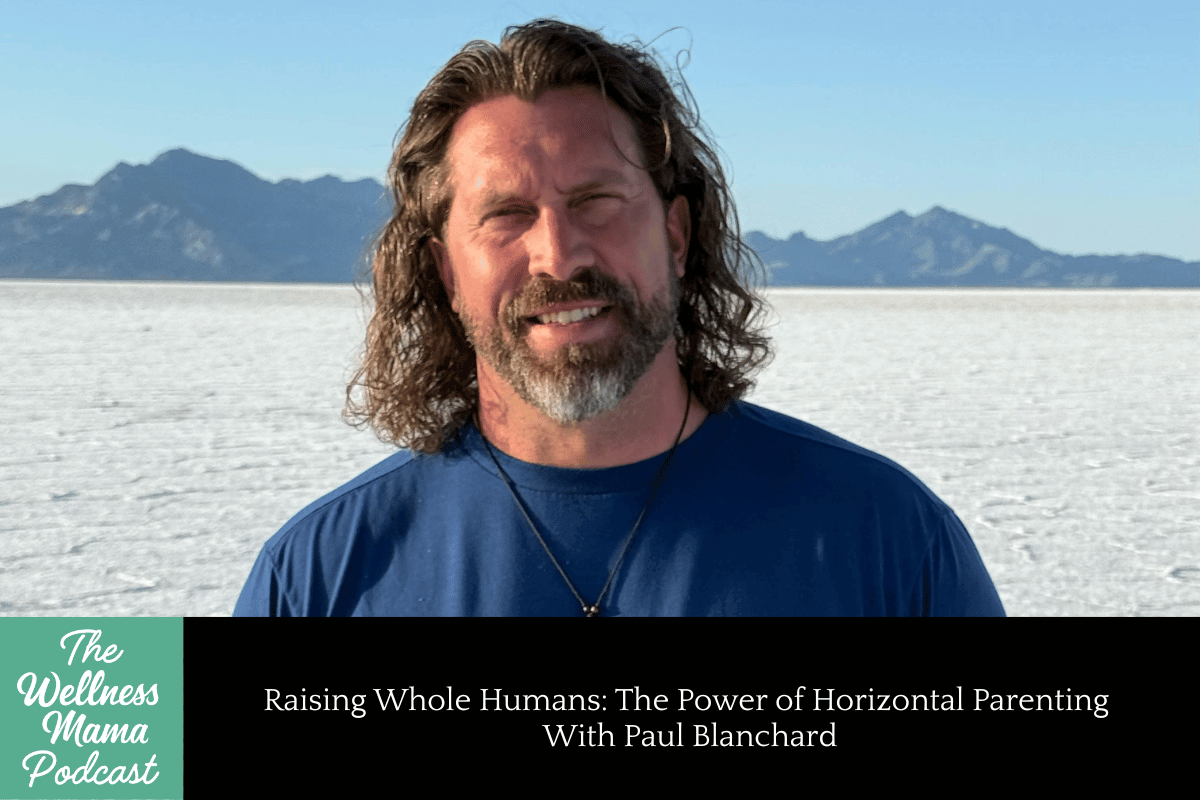
Katie: ?Hello and welcome to the Wellness Mama Podcast. I’m Katie from wellnessmama.com, and this might be one of my favorite conversations I’ve ever gotten to have on this podcast. And it goes very much into the realm of parenting and relationships, more so than physical health, though I think there’s of course a lot of benefit and crossover here as well, but more specifically into the topic of raising whole humans and the power of horizontal relationships in our parenting.
If that’s a new term, it was for me until recently. We go into what that means, what the difference between horizontal and vertical relationships are, and just some places to question, ponder and see if any of these things feel relevant or helpful to you. And today’s guest is so, so wonderful at making it known that nothing in this is meant to be explicit advice. And neither of us would consider ourselves parenting experts. These are simply kind of helpful exploration and excavation and questions that could lead to better connection with our children. Some small shifts. I know his work has been tremendously helpful to me and I found a lot of alignment in the things he said today.
Things that some of which I had learned myself over the years and wished I had learned sooner, but tremendously enjoyed this conversation. The guest is Paul Blanchard, who I’ve had on before. I’ll link to our other conversation and we actually barely tiptoed into this topic at the end of our last interview, and I knew immediately I wanted to have him back on to really go deep on this topic.
He is a transformative guide, an executive coach. And an unapologetic dismantler of superficial success. Most of his work is not in anything to do with parenting, although he is a devoted parent himself, and that’s why I’m also so honored to have gotten to have this conversation with him. He has over two decades of experience.
He has immersed himself in the study and lived experience of what it means to be fully human, integrating developmental psychology, somatic experiencing, entrepreneurship, leadership dynamics, trauma-informed coaching, business building and deep wisdom that only comes from repeatedly walking through the fire yourself.
So truly, I really enjoyed this conversation. I hope you enjoy it as much as I did. Let’s begin. Paul, welcome back.
Paul: Thank you. Super glad to be back. This is awesome.
Katie: Well, I am so excited and honored to have you back again so soon. And actually this interview I wanted to record immediately when we finished our other interview because we got a little bit into today’s topic at the end of our other interview, which I will link to in the show notes. And I wish we had more time to go deeper on this topic because I think it’s so vital for all the parents listening and could be really paradigm shifting and help a lot of families.
And that topic is largely parenting, but more specifically the idea of horizontal relationships in parenting. And I have a feeling for some people listening at least that might be a new term or perhaps like people might not be familiar with the difference between what a horizontal relationship is versus a vertical relationship.
And so before we even get into the more specifics of parenting, can you kind of give us some background on that term in general and understanding the dynamics that come into play with horizontal relationships versus vertical relationships?
Paul: Absolutely. Absolutely. And I, it was funny, as I was, dropping in thinking about our conversation today, something came up that I wanted, I felt very impressed to make super clear right off the bat. And that is that I am not here trying to purport some kind of authoritarian expertise on any of the topics that we’re talking about today. I was actually just messaging my wife. I was like, I get to go chat with Katie again. This is gonna be so fun. I thoroughly enjoyed our conversation so much the first time. And I told her, I said, although I don’t consider myself an expert on parenting, I do consider myself very experienced with the nervous system, with deep human connection and the human experience on a neurological, psychological, spiritual, phenomenological level. Which I think qualifies to have some really fun conversation about parenting.
And that’s more what I hope this gets to do is not say you’ve been doing it wrong, do it this way. Which is oftentimes the intentional and or unintentional implication of an expert. Versus, Hey, have you considered this before? And more importantly, when you consider this, what do you feel? What do you notice? So if any time in our conversation I say something, you’re like, no, that’s not okay. Cool. That’s great. If we were in a room together, I would so want to hear that and I would hope that you would be willing to hold that consideration in a way that it isn’t, wall up shut down, that’s not okay.
Versus, Hmm, I wonder what’s behind that for me. I wonder what’s underneath that for me, because that alone can make a huge enhancement to what we’re talking about today in horizontal relationships and parenting is what are the things that cause our walls to go up that we’re so sure are for appropriate protection.
That are so, we’re so sure are for the right way to do something. and we lose the agility and the, and the uncertainty and the unpredictability that actually makes the human experience as fulfilling as it can be. So, I just wanted to say that upfront. That I’m very aware that that the majority of what experts talk about is made up. And I believe in making stuff up or learning made up stuff that’s helpful.
So I’m hoping that the made up stuff we talk about today is helpful and allows people to either soften their grip on their current position, but not have to change it. And in some small ways, possibly make some tweaks there. So as far as the idea of horizontal and vertical, this was really acutely introduced to me.
I had heard similar things for quite some time in understanding human connection and communication and being able to understand the difference between a clerical hierarchy in your company versus, you know, that feeling that we’re kind of all stakeholders on an emotional, spiritual, energetic scale. But it was acutely introduced to me in studying Adlerian psychology. So, Alfred Adler was kind of there in the three horsemen of modern psychology with Carl Jung and Sigmund Freud. And then there was Alfred Adler. And Jung was more of a protege to Freud. But Adler kind of parted ways at one point because of some really specific differences around this particular topic, horizontal relationships and also around the perspective of trauma.
Whereas Freud put a lot more investment in the story of the trauma, in the pathology of the trauma. Adler had more of a, it happened, it was a real event, but oftentimes we hang onto it for when we need it. When life doesn’t go our way or we feel threatened or we need a conscious and or unconscious excuse. Traumatic experiences are the easiest thing to grab onto, to justify not doing something or justifying why we did do something. And that’s, that can be a very confronting thing to dive into. That’s not really where we’re going with it today. But the other piece was the horizontal relationship, which is also very confronting, but more in a surrender kind of way. In that we’re getting to a base level of connection, of understanding that you are an autonomous human being.
I am an autonomous human being. And regardless of just about, I wanna be careful about absolutes in this conversation, but just about, regardless of age, just about, regardless of education and affluence and whatever else, it’s a pretty level playing field out there as human beings. And in fact, Adler’s contestation is that if we can start to see each other on horizontal levels, that is the best medicine for us personally to be able to work through the things in us that make it difficult to see someone, like a client or a customer, or as we’re gonna talk about today, a child of yours, on a horizontal level, at least energetically.
And there are nuances throughout this conversation. That’s why I wanna be careful about any absolutes. There are absolutely nuances to what we’re talking about, which is why I hope people will consider loosening their grip on their perspective of parenting, not necessarily just totally taking their hands off the wheel.
That’s not something we would be implying at all. And so vertical relationships are what most of us are used to in society. There’s a superior position and there’s an inferior position. However, it’s been dressed up with more nobility lately, like the, in the last, you know, couple hundred years if you will. And in certain societies throughout the last few thousand years. That the superior position is not superior because you’re inferior. The superior position is superior because they have things you don’t, and they’re going to help you. They’re going to serve you, but it’s still implying that you are inferior. It’s still implying that you don’t have enough to be your own person. You don’t have enough to have your own human experience, not really, at least in this niche, this industry, and in parenting in this stage of your life.
And for that to be a blanket element, it serves the person in the superior position far better in terms of control, in terms of leverage, even to the point that the person in the inferior position appreciates it so much because if they’re convinced that they’re in the inferior position, whether they realize it or not, they’re gonna feel so blessed and so grateful that someone in a superior position is willing to mentor them, is willing to save them, is willing to guide them. But the challenge is, that’s a cycle as we are pattern based creatures that you are teaching yourself that anywhere you get in life is because of the person in that superior position.
So you’ll always be vulnerable to needing someone else that you deem in a superior position to feel safe. You’ll need someone else that you deem in a superior position to feel like you’re doing good enough, like you’re making the right decisions and all these different things, and it robs you of feeling deeper into you. Now, if my objective in running a society is control. I want conformity in what I believe is the best way for human beings to believe, even at the rejection and echo chamber of my own biases and my own issues. Then I’m certainly going to want to establish a vertical order of things. I’m going to want to establish the need for society to prioritize self-sacrifice, which is kind of the more noble sounding, the more noble term of self abandonment.
And this doesn’t mean that everyone should be out for themselves. See, that’s the argument that vertical makes. Is that you should be self-sacrificing. You should be giving up to a larger cause because if you’re not, you’re super selfish and everything falls apart. It’s very common for the vertical argument to use extreme circumstances to convince people to stay in a vertical place because it is an unbelievably confronting to the ego, especially.
To consider that this person across from me, regardless of what I’ve been taught to evaluate in their education, in their articulation, in their appearance, and in their age and whatever else, to establish some kind of vertical order. Are they, are they inferior to me or are they superior to me? Versus the beautiful wonder and awe and curiosity of what do we have to enrich each other with on a horizontal level, you know?
And that I think is right there, one of the beautiful themes to walk away from this conversation in parenting, is imagine looking at your child as, what does this unique creature, and I mean that in the most beautiful way, bring to the table to enrich my life? And as I welcome that, what then naturally reciprocates in the enrichment of their life and vice versa, versus this is my responsibility. And there are certain primal responsibilities of protection, certain primal responsibilities of providing food when this, when this creature, this child comes into your life and cannot fend for themselves. But being, erring on the side of assuming they are way more capable. And they have way more to contribute in general, lends itself to getting to a horizontal position sooner and sooner.
You could learn unbelievable things from a baby with that kind of bias rather than just assuming, because it can’t fend for itself, I’m superior to it. In that one area. But I mean, I believe even biblically, you know, out of the mouths of babes and that kind of element God was trying to say like, Hey, there’s an enriching relationship at any level as human beings. And also I believe contextually, biblically, like pointing out like, Hey, none of you are better than somebody else.
You know, I’ve always loved to remember that at the end of this life, I believe that the equality of our human experience will be unbelievable. We, hard to fathom, that if someone believes in God and using that context, whether allegorically or as a myth or as a truth that someone holds, I don’t believe anyone will be able to stand before their creator after this life and say, my life was harder than his, or my life was easier than hers.
I think we have to get very tunnel vision heuristics to create that kind of inequality. But as we zoom out and consider the full scope of the emotional, the spiritual, all the phenomenological elements, let alone the molecular, the biological, that we just don’t understand the full scope that actually lends itself to a more cohesive and harmonic horizontal relationship. And yeah, there’s certain parts that fit into this part in a way that you could say is superior. And certain parts that are inferior, but seeing it more as rollers in a lock rather than as some kind of superior position. I’ve got certain things that can unlock you. You’ve got certain things that can unlock me, but that’s a big difference between I’ve got things you need. I’ve got power or knowledge that you are less than until I provide them to you. And most of us don’t, aAs I’m being dramatic with this, get into that space.
It’s more like service. It’s more like giving, but at the end of the day, it’s still trying to have an inferior and superior position. And we lose the co-enrichment of this human experience. And to set that tone with a parent and child, will set that child up to be in a place where they get to co-enrich the human race and their society and their community and their family, rather than trying to quickly assess whether something is a threat or something is an ally. And to establish whether it’s appropriate for them to be the inferior or the superior. And all the, the things that that cuts out emotionally, the things that cuts out spiritually, the things that cuts out in a fuller human experience. Just because someone along the way wanted to control some things and felt like they couldn’t do it without establishing that vertical relationship. And so it’s not easy to start to lean into a horizontal position.
It’s scary. It can feel like a sense of betrayal in certain ways. It can feel irresponsible in certain ways. It can feel like taking your hands off the wheel on the freeway and closing your eyes at times. But its, I believe that it, it allows for a more full experience. It allows for us to co-enrich each other as human beings rather than satisfy my ego, while also convincing myself that it was in your best interest. So anyway, that a bit more of a preamble than, than probably needed, but I think there’s some important stuff in there.
Katie: Oh, I love that. And like to DoubleClick on several of the things you said. I think even just those little shifts that I, to your point might be simple but not always easy, but into more curiosity. And I loved the word co-enrichment that you used. I’m sure people listening can think of examples of how having a more horizontal relationship could be so beneficial.
And for instance, romantic partnerships, in business relationships and also how this could be so beneficial in parenting. And perhaps maybe even the most challenging in parenting where there seemingly are so many ingrained patterns around just sort of becoming a more vertical relationship because we’re the parents, because we said so, because et cetera.
And I think from, to your point, there seems like there could be tremendous power if we’re able to get more curious and step more into this kind of horizontal dynamic in modeling it. Because then that becomes, as we know, like our voice often shapes our children’s inner voice as they get older. And so that could influence how they speak to themselves internally and how they think of relationships.
So how they might enter even romantic relationships in the future based on the modeling we have for them in childhood. And also just echo what you said, I like to reiterate often in podcasts as well. I’m certainly not a parenting expert either. And nothing I ever say is meant to be medical advice or any type of advice actually.
It’s more, I share these things as my own very much imperfect journey of learning and the things I’ve found along the way for inspiration, but never prescription. In fact, very in line with what you said, I encourage people, including my kids, actually, to question everything even, and especially me.
And to discard anything that doesn’t feel relevant. And I just am so grateful that you’re willing to have this conversation because I think it will help create some fun questions for parents to ask. And possibly some small shifts that can lead to really profound connection and deepening in relationships with our children.
And kind of more connection over control. And then lastly, I just wanna touch on, you mentioned the words, wonder, awe, and curiosity. And those words have been recurring words for me this year, along with the word play and how children are so innate with these. And many of us, or at least me, get to adulthood and have lost elements of those.
So I have been trying to re-cultivate this year, wonder and awe and play in my life. And I, my kids have been amazing teachers of that. And you already touched on this a little bit, but I would love to go a little bit deeper in how it, seemingly, a lot of parenting advice just seems by nature to fall more into the vertical category.
And a lot of the things, even if we read parenting books, it’s like I’ve not seen any that I can think of that kind of address this specifically. A lot of them just immediately fall into the advice that seems like it would fit more in the vertical category of, because I said so, or the control aspects or the superiority in a relationship.
Or how control can often be fear disguised as guidance. I’d love to just kind of pick a little deeper into the kind of vertical programming that seems to just like almost show up across the board when it comes to parenting.
Paul: And I think a couple of things that are helpful in the endless nuances to this conversation is that again, there are certain heuristics, certain compartments where a vertical utility is important. What we’re talking about is the relationship, you know, like talking about how a baby, it doesn’t have the capacity to feed itself.
That’s a utility that requires a vertical, I can provide food, I can feed whatever, whether naturally, biologically breastfeeding or other types of formula or whatever, all the way on up. But what we’re talking about is noticing the energetic dynamic between two beings. What we’re talking about is the actual intrinsic relationship and oftentimes systemic relationship to another being here and the very disarming capacity to separate utility verticality and relational verticality.
That’s, I think, that’s a really important differentiation that we’re talking about. And the other is, I tend to be someone who likes to do the punchline and then build the joke afterwards. And I think one of the punchlines for us and your listeners, is reputation. I think we grossly underestimate the puppet strings that reputation has on us as human beings. And that is, at its primal sense, is the, the watchfulness of, am I doing it right so that I’m still accepted by the tribe? And I mean that term loosely. That could be by broader society, could be by your spouse, your family you grew up with. Am I doing it right so that I am worthy of love existing within the tribe? Which if you want to understand why that’s so powerful in reputation, because what we call reputation today, our reputation in the community, our reputation in our home with our kids, whatever, that ties all the way to systemic survival.
Because if you have a bad reputation, if you’re not accepted by the tribe, if you’re not doing it right, then you get kicked out and you die. You know, the majority of our human history, that was the reality. Like if you didn’t stay with the tribe, you would die. You know, there’s the, the strong survive. That’s actually not biologically correct. The connected survive. We are not the top of the food chain. We are not the, you know, the the strong that survive in the animal kingdom. We became connected in ways that other animals that thrived were able to do.
And then beyond, we’ve been able to develop parts of our brain in certain ways that have added to our ability to create community and connection and all these different things that’s extraordinary. And as that came into play, preferential distortion created the need for verticality, to have control. Not only do I have a preference, but I think the preference is more important than your preference. And so I need to be the superior one to guide this tribe and whatever else. But so much of this comes down to reputation.
So much of the poor decisions that we make, whether we realize they’re poor or not, as parents, comes down to the puppet strings of not what is actually best for the child, but how will the tribe view whether we’re doing a good job or not. And that creates some very fast decisions like punishment, for example. So much, so much no matter how you package it. So much of punishment, we’ll use a strong term here a little bit just to get people’s attention. So much of punishment is laziness on the parent’s part. It is the fear of reputation, creating the speed of punishment, and it’s very ineffective.
And so then we need to double down on stronger punishment. It becomes like a drug. We need more and more to get the same high. And you can get fast results from punishment. That’s why it’s so tempting to use. And when we’re so exhausted from the concerns of our reputation and the projected concerns of our parents’ reputation on us, and the rest of society’s reputation all bumping into each other, it makes sense that we’d want a place we could be lazy. And why not take the opportunity to be super lazy with the place we feel most justified in being vertical, in being superior.
And that’s with a child. Now, whether you’ve been the parent to say, because I said so, or just because it is. And even if it was only in brief moments, that’s a glimpse that that programming is under the surface. We’ve got a lot of parenting books that have just taught us how to do verticality in nicer ways, but it’s still verticality because it’s very difficult to go in there and change it. A lot of parents want to change their behavior. My parents acted this way and I’m never going to do that. But more often than not, they just create a different version of the same issue. It’s just a different character, same play. Because if you really want to not pass down something, it’s not necessarily about changing the behavior.
Because more often than not, we create a different version of the same thing. It’s about actually feeling what the previous generation or what your parents didn’t have the capacity, not because they were inferior, but just because of their environment, didn’t have the will because of what they were taught and what, and their different programming to be able to say. Hey, time out, what if I actually felt this? What if I actually forgave this? Which gets misunderstood a lot. Forgiveness isn’t the letting go of what happened. Forgiveness is the softening of the blame to send the pain at the person that we believe caused it. And once you’ve forgiven them, now the work actually begins. Now you can actually feel what you experienced, because you’re not diverting it at them. You did this to me, you made me feel this way. You, you know, abused me.
And this is where, you know, Adler got really confronting to say, yeah, that happened and you are the one making it what it is in your life. And the way to actually process that and let go of it, like we hear all the time in mindset and personal growth and development, is you can’t actually let go of it. You either fully feel it and it, and it processes it out of the body. That actual atomic energy that can get passed down in the womb. You know what we’ve learned about epigenetics, thinking about that when your mother was in her mother’s womb, you were in your mother.
Right. You know, and so we get these overlapping, actual energetic, like step downs that kind of mind blowing in the last 10, 20 years have been learning more about that. That we start understanding just how predisposed and set up we are for some of these puppet strings of reputation. And for the comfort food of verticality. Which just like comfort food today, fast food, whatever feels really good because of its convenience and its quick emotional impact, but overall it has some pretty detrimental effects.
Especially, the more often it’s used. And so I share that both as like kind of a little bit of a wake up call possibly, as well as tremendous amounts of empathy. Like you’re dealing with generations of programming and patterns and if we don’t start with, you’re doing a great job, like genuinely not as like a patronizing pat on the back, like, wow, you’ve, you’ve done you perfectly considering all these things.
That’s the place we wanna start looking at what we might be able to shift and soften. Because otherwise we’re just gonna be perpetuating, what did I do wrong and how do I do it right, which is a very fight flight survival response. And what we actually want to create is room to witness. When you can get into a horizontal relationship and start to introduce that, you can start to witness the other person.
You can start to witness yourself. You can start to differentiate my stuff, your stuff, and then the space between that might have some our stuff. Most people, parents and children, spouses, family, that’s all a big jumbled mess that has all these strings of reputation pulling on it versus being able to lean into it.
I heard a famous psychiatrist share once that there are over 400 unique characteristics that will emerge in your child from age zero to 25 that we know of, that have nothing to do with how you parent them. I’m gonna say that again because that’s a big deal. There are over 400 unique characteristics that are from a kaleidoscope of generations that came before you, that will emerge in your child, regardless of how you parent them. If that’s not an invitation to take a little bit more of a, as this psychiatrist said, a little bit more of a bowl of popcorn and a glass of wine perspective to some of your parenting.
Like hey, watch the show, soften some of those tethers, some of those harpoons of like, I’m responsible to make sure that this child is satisfactory for society. Why? Because that means that I am satisfactory for society. And that means my parents were sat… and the strings go on. You wanna find horizontal relationships, which are more appropriate today than they ever were. They’ve always been helpful, but it’s never been safer to be human across the board.
There are still some very dangerous places and dangerous things that human beings experience. But 50,000 years ago it was, you know, it was way less convenient, way scarier, and way harder to be human, to be alive, to stay alive than it is today. And so we get to take advantage of that. We don’t need to feel shameful that in some of those survival aspects, we have it easier than previous generations. But we also have tremendous existential challenges. So it’s not necessarily easier at the end of the day, it’s, we’re horizontal to our ancestors as well. It’s just different buttons and different stimulations and stuff. But we do have some conveniences that make the benefits of a horizontal relationship that much more expansive and that much more beneficial than when, say, you know, you couldn’t be outside your cave for more than an hour or you’d be risking being eaten alive. So.
Katie: So many good points, and it seems like, I love that you enter this topic with grace and so much understanding. And it seems like this is, like you said, there’s times and places of course where a parent is in the practical role of feeding the child, protecting the child, that there’s elements of that. But it seems more about out the equal dignity within different roles and that this is like an energetic shift that guides the practical in maintaining that like respect and dignity and curiosity around our children, which lets us get more insight into them. And I love that you brought up the reputation piece and the punishment piece.
I feel like I’ve been on an inner journey this past year, getting to excavate some things related to reputation and some wounds there for myself that I might eventually open up more about on this podcast. But definitely I have, my heart goes out to anybody who feels those things. Because I have gotten to feel them acutely this year.
And also when the idea of letting go, I think you worded it perfectly. It’s like that balance of not resisting it, but also not bypassing it that is found in the fully feeling it. And how even though simple, how difficult that can be and how excruciating it can seem going into it sometimes. So, just wanted to echo those things that you said. And I loved also that you brought up the idea of punishment and kind of the like long-term consequences of a short-term solution like that.
That’s an area where I’ve, I’ve noticed that in parenting books before and also had disagreements with my co-parent in the past related to that. And you’ve put words to it better than I’ve been able to in the past. I’d also love to kind of go into the layer of seemingly when, when we get more curious, when we bring this horizontal respect into our relationship with our children, we get the beautiful opportunity more often, seemingly, to face our own generational and childhood wounds, to your point.
And it seems like this is a beautiful opportunity and a tough one to face a lot of our own inner work. So I’d love to speak a little bit more to that for the parents, because I also think that’s super relevant in parenting. Our children become these beautiful teachers and mirrors and kind of reflect back some things we might not otherwise have gotten to encounter, or at least not as easily.
Paul: Yeah, I think one of the things that comes up for me, right, when you share that, that I’ve worked with a lot in my practice. I work with a lot of really amazing women that are powerhouse entrepreneurs and executives and business owners and moms. And I think that brings a very unique element to things.
It feels like an important one to highlight, just considering your audience and what you represent naturally. And that is, in a horizontal relationship. It’s the best way to navigate you getting to live your life and live as a parent for your child and not a trade-off, not a compromise. I think of Annie Thorisdottir.
Okay. Annie Thorisdottir’s from Iceland. She’s a, I believe, a three time CrossFit games champion. And she’s also, she’s very unique because she’s very tall and most CrossFit champions are not tall human beings. They’re short and stocky and amazing endurance athletes. But Annie’s blonde, tall, beautiful, and just stacked. She won it twice. Then she got injured, then eventually she got pregnant down the road and never thought she’d come back and compete. And she was being interviewed after she won the third time, I believe. And I’ll, I’m paraphrasing here, and this is not about total 100% chronological accuracy, but the gist of the points I believe are correct. But she’s getting interviewed after having won the CrossFit games after thinking she’d never come back from this injury.
And then having a child and being like, oh, I’m a parent now. Like, it’s time to move on. And I believe her daughter was about two years old, and she could feel she wanted to compete again, but she’s looking at this child, this is my whole world. I hear this a lot. This is my whole world. That agitates and inflames a vertical relationship by the way. That agitates and inflames those poles and those tethers of reputation.
And I’m sharing this, not as this is what everybody needs to do, but regardless, even if you believe that being a mom is your whole world, lean on the other edge. And for a couple of reasons I’ll share as kind of the punchline to this. But Annie said, I realized in that moment that the last thing I wanted to do, this is one of the most powerful things I’ve ever heard in parenting from a mother, she said, I couldn’t imagine when my daughter gets older telling her that I didn’t pursue my dreams because of her.
Whoah. Not as an either or. Not as a, I’m gonna leave her to nannies and whatever, but like, what if, what if I could soften the concern of my reputation? What if I could soften the pressure of a vertical relationship of I have to do everything for this child, and then convincing myself that I want to do it all? Even though, you know, I’ve met mother, after mother, after mother, that genuinely loves being a mother. But there is this deep soul exhaustion that they have convinced themselves comes from being a mother that’s a contributor. But a deeper part of that is, they put themselves on hold as an autonomous human being, to do everything.
And that’s even to, like it doesn’t mean you need to go win the CrossFit games, but like go to a movie in the middle of the day. You know? Or you know, like it could be little things that just go off the table and we’re putting more energy into convincing ourselves that that’s the right thing to do because I’m in such a vertical position to this child that if I ever consider doing my own thing, I’ll do that later.
I’ll do that when I’m older, more tired, and don’t have as much energy as if that makes sense. The challenge there is what are you teaching your children? You are putting your, your unique gifts, you’re putting your life and your contribution to this world on hold. That’s what she, what she did and very appropriately for the first couple years of her child’s life.
And I’m not here giving a prescription of exactly how this should fall, just the idea that what if you were allowed to not just show up in those vertical utility places for your child, but you are also there to show them how to live their life, to model that for a child at even a very young age. So that Annie Thorisdottir gets to grow up and go, wow, I don’t need to put me on ice for my children because then my children are gonna put themselves on ice for their children and so on and so on.
And whoever gets to live a more fulfilling life? Whoever gets to explore what’s possible for them? And for some that might be professional pursuits. For some that might just be being allowed to like take a day off. You know, I’ve worked with women that if they can be with their kids, they deeply believe they should be with their kids. The data on that is really disturbing. Okay. Like in terms of like co-dependence, and some of the societal fragility that you can create by convincing yourself that you should be with your kids all the time. We’re robbing quality over quantity more often than not in that place. But I love Annie’s perspective and not because that’s an exact prescription. But what if you were allowed to lean into just giving yourself some time off?
The challenge is, or giving yourself your own projects or whatever, and that’s gonna be messy and have calibration. But what you’re gonna run into more often than not is guilt. And that guilt is perpetuated by reputation and by verticality. If I’m not there, what kind of a parent am I? And then that plays into reputation, you know. If I wasn’t there and they made a bad choice, the first selfish response for most parents, and especially moms, is it’s my fault. It’s my fault. Well, as a horizontal relationship, there isn’t fault. It’s hey, how was that experience? How can I show up for you right now? Versus the instinctual, I did something wrong, I didn’t prepare them as a parent, blah, blah, blah, blah, blah. That comes from that verticality. And then they, we just pass that along over.
We rinse, lather, repeat, rinse, lather, repeat. And none of us actually get to have a more full human experience to own the name of control and verticality for the fear of our reputation. So that’s, that’s where you’re gonna wanna soften it. And you’re gonna know, you’re headed towards softening it because you’re gonna run into some big pillars of guilt and even some roots of shame and some of that. And that’s a landscape we want to navigate and soften and even pull up some roots very slowly. Because if you go too fast on that, you’re just gonna hit your threat response and you’re going to be perpetuating the problem in a different direction.
Katie: I can certainly look back and see I was a slow learner in some of these places, certainly, and I’m grateful to be learning some of these lessons while my kids are still young. But to your point, it seems like there’s so much of course, like guilt and shame that gets wrapped into mothering. Especially for moms I see this so often and kind of these pervasive ideas that like, if my child is behaving well, I’m a good parent. If my child is struggling, then I’m a failure. And like so much of our own identity gets wrapped into this and that untangling process can be seemingly quite difficult. There’s like a whole excavation that gets to happen there.
And to your point too, it’s like recognizing this, even having awareness of that, this helps us maybe navigate the energy of the relationship, the practicality of the relationship and the seasons of the relationship a little differently. Like to your point, perhaps it is we, from what we know of psychology, like really important for parents to be very hands-on with their newborns and to be very present and to be an attachment figure when their nervous system is still developing outside of the mother’s body.
And often maybe if we hang on to that a little too much for years beyond when it’s actually required. Not that we don’t wanna prioritize that when there’s a newborn who really does depend on us for nervous system entrainment. And a 12-year-old doesn’t have that same need to be with us 24/7 for nervous system entrainment.
And often maybe we’re becoming a crutch when we maintain too much of that verticality, to your point. And I’d love to get a little bit to like the first principles of kind of parenting and what we understand about what kids need actually in order to develop into a self-aware, responsible adult who’s capable of hopefully having horizontal relationships in their own adult life as well.
Paul: Yeah, great question. Great question. The first three months are neurologically significant. If you’ve never read, I believe, What Happened To You. Oprah Winfrey and Dr… blanking on his name right now. Amazing book. And it talks about several of these things. Really beautiful. Going from the question of what’s wrong with me versus what happened to me, I think is a really beautiful step in the right direction and softening some of the undercarriage of what we’re talking about in verticality and reputation management and different things like that. So rather than just giving strategies and language sets to address it in a manipulative, temporary way. So you’ll, you’ll learn some beautiful things to kind of soften the undercarriage of that, the deeper roots of it. But the first few months especially, but let’s just say for simplicity, the first couple years of a child’s life, the nervous system entrainment as you, that you were talking about is the top priority.
Is being as present, as authentic in what you’re experiencing and as soft with yourself as you can to emulate a grounded nervous system with your child. Not using your child to soothe your nervous system is really important. Gabor Mate talks about this amazingly. He’s one of my favorites. He’s absolutely amazing in terms of parenting and being able to provide some perspectives that soften you up and open you up enough to be able to invite more of a horizontal surrender in parenting relationships. But he talks about how it’s impossible to like over coddle a child. A lot of what we assume was because a child was treated too soft and too over coddled was actually the projection of the parent’s anxiety onto the child, and a lot of times the mother.
The mother feels so anxious and so needs to pull in and take care of the child, not to take care of the child. It’s actually to take care of the mother’s own anxiety. That’s what creates a lot of problems down the road. Not being very gentle, being soft, allowing them to feel their feels and holding space. That’s actually shown to allow a child to be so much more secure, so much stronger, as you might say, not stronger, tough, arghhh, you know, fight or flight. Stronger in terms of secure and present and knowing themselves and trusting themselves is when we get to be soft and present and open with our children. Rather than teaching them the world is this difficult place that’s going to rock them. We were taught that illusion and our parents were taught that illusion. But the world hasn’t been that harsh for quite some time.
Not as harsh as we are led to believe it’s going to be once we get out there in the real world. Well you’re, you’re creating the illusion of a harsh real world because you create the illusion of a harsh inner world in the raising of the child. And so those first couple of years are really important for emulating a present and calm nervous system. Then from about two or three, depending on the child to about seven, you continue to provide the nervous system regulation, kind of by osmosis, by being in proximity to the child with a, with your regulated nervous system. And you start to add some guidance, the utility guidance of simple choices of utility goods and bads. Not necessarily how to flow through society because it’s still very important as a very sensory creature that they get to express themselves.
That we see their expressions as signals to be curious about not behaviors to shape from that two to three to seven years old. A tantrum, if the child needs to have a tantrum, that could be a really important signal to be curious about and to allow them to experience that. That can be difficult in our domesticated society, especially if it happens like at a restaurant or something like that.
And if it happens over and over and over again, you deserve to get some support and some insight and whatever it might be. But a lot of that also has to do with how regulated your nervous system was as the parent with the child for those first couple of years. And so, and we’re generalizing here.
Again, lots of nuances here. But after seven years old, I think this is super important to understand. After seven years old, your priority as a parent is to be a safe place for their exploration of themselves. It is far less about dictating the direction of their life, dictating the right or wrong. That’s pretty set in them by seven years old. Okay? And so there might be some nuances, but after about seven, eight years old, especially today, where, you know, kids are exposed to so much more by that age through their iPad and whatever else than we could possibly imagine. I’m not here to make a case for or against that. I think there’s interesting points all around.
But after that, you are there to be the safe place that they get to come back to after experimenting with their siblings in expression and exploration of self. After experimenting with other kids at school or whatever. And the, we talked about this last time you and I spoke, the more advice you give, the more unsolicited direction you give, the more you, the less of a safe place you become and more of an “I told you so” place you become. Even if you aren’t, even if you aren’t perpetuating the I told you so perspective, because you told them before it happened and then it happened. Whether you rub it in or not, you’re now the, I told you so person. Not the safe to come back and examine the wounds or the celebrations or whatever, and you being able to provide witness and presence for that. And that’s also a place where codependence can get perpetuated because we feel like we know better.
And yet it continues to be demonstrated that a child with a more regulated nervous system that is allowed to express themselves however they want to, in that order. A more regulated nervous system, and then is allowed to express themselves however they want to, becomes a way more secure and available and healthy human being for the rest of their life, in ways that are even difficult to track in terms of the benefits of relationship society and parent rearing or child rearing it and everything else. And I think that’s really difficult. And especially as a teenager. As a teenager, you’ve got certain survival evolutionary things kicking in that are teaching that child from puberty on to start to reject you.
That’s a very natural thing to do. Okay. Biologically a teenager after going through puberty is supposed to reject you. Because 50,000 years ago, okay, not a few hundred years ago, it hasn’t, it’s not as recent as people think, but at least tens of thousands of years ago after puberty, you were meant to go start having kids.
You were meant to go start perpetuating the species when that was the primary priority, was the survival of our species. Whereas now, you know, we’ve got 8 billion plus of us and we’re pretty good at perpetuating our species at this point. But that is built in biologically. And that’s not to say that we should go back to that.
Not at all. We have a completely different society, completely different norms and have had for thousands of years, but at least to be a little bit more compassionate to you to realize you’re not doing anything wrong if your teenager wants nothing to do with you. That’s built into their biology. In fact, feeling like you’re doing something wrong, getting into that angsty place or that angry place will only perpetuate, will only inflame that biological response and push them further away or make them more codependent on you.
Making them more to codependent on whoever they see as their superior. Heaven forbid, they get married and see their spouse as their superior, and they’re the inferior and they perpetuate that verticality in a, in a husband wife relationship, either direction. We’re seeing both happening in society today where the man feels like the inferior, or the woman feels like the inferior or vice versa. We’re really shaping that significantly by trying too hard after seven years old. Versus being available, being their safe space to express, to explore themselves, to hear themselves.
Most children after seven years old really get messed up because they, they don’t have a place they can hear themselves. They have places they can shout, they can have, they have places they can prove who they should be. But that’s different from having a safe place to actually hear your own voice because you feel safe enough to actually hear yourself. I mean, how often have we heard children talking or adults for that matter and been like, can they hear themselves? Geez, like, wow, drama or victim or whatever. No, on a certain biological level, intrinsically they can’t hear themselves. You know, even the societal norm of like, oh, they, they’re just feeling sorry for themselves.
They’re a victim. No, actually, what’s interesting is a victim can’t feel sorry for themselves. That’s why they’re a victim. That’s why they’re looking for someone else to feel their sorry for them. Because they don’t know how to feel sorry for themselves. They don’t know how to feel a lot of things for themselves. And oftentimes because parents were so overreaching, so giving so much unsolicited advice. And convinced, and it is very convincing that it’s what they had to do.
It was the right thing to do for the child. But at the end of the day, it came back to that reputation, their own nervous system dysregulation and just wanting to manipulate the change that they weren’t gonna let get passed down from previous generations rather than actually feeling it. And none of these things require perfection. None of these things require you to be anything else but human. But that’s the problem, isn’t it? Is our parents didn’t feel like they were allowed to be human with us. Because it would’ve affected their reputation poorly. And so we don’t feel like we’re allowed to be human with us, nor do we feel like we’re allowed to be human with our kids.
And it just continues to roll down. But starting to lean into, not imperfection, not in totality, but just starting to lean on the edges of our verticality. Starting to lean on the edges of noticing just how influential our fears around reputation because it’s a fear of life or death when you get to its base level, is having. We might just be able to soften our grip around being able to see how much stuff we didn’t realize was influencing our decisions of punishment, our decisions of advice, our fear of our child’s acceptance in society, which also feels like life or death, which also impacts our fear of acceptance into society.
And the challenge is we have an opportunity in this stage of humanity to create a new way, a new expansion of being human. And we’re not gonna do it. We’re not gonna be able to take advantage of it if everything is just about status quo, about being acceptable to society. And then picking these little pockets where we find a manipulated, compartmentalized self-expression.
So if we can allow the child to lean into whatever their unique expression is, 2, 3, 4 or 5 years old, and then after 7 really shift gears into I am a witness and a safe place. I’m here to let my child know over and over again, Hey, I am available to you, I’m not here to push you. A child that after seven years old and even before then, that isn’t pushed, but has parents or even a parent that is present and available will do more with the rest of their life, and in a more fulfilling way.
There’s plenty of kids that were pushed that have done a lot of things that are dead inside, but sure, on paper they look like great kids. I raised my kids right. Oh my gosh. The number of people I have heard justify the antithesis of what you and I are talking about that I have met with personally as a coach.
Thousands. I’ve worked with tens of thousands of people on brain pattern levels, not just in fun conversation. Under the surface, they are not as okay as we think. Under the surface they’re very much not connected to themselves. They’re cogs in a wheel because that’s what was emulated for them. And they’re terrified to go down and feel that.
It’s not safe to go down and feel that because it goes against the verticality, the fear of reputation and all the things that have been emulated and perpetuated. What if we started to unravel that and what if it was scary? What if we got to have moments where, we actually celebrated what our kids are sharing with us without the instinctual knee jerk reaction to be, what does it mean about me? Like when my oldest was 11 and came in late at night and said, mom, dad, I have something scary to share with you. I’m not sure I can share it. And said, sometimes I think about hurting myself. Was that heartbreaking? A hundred percent. I’m not a machine. It was a hundred percent heartbreaking, but my knee jerk reaction was, that’s amazing. That’s what I told her. I was like, that’s so amazing.
And she looked at me very confused. I said, that’s amazing that you shared that with me. It’s amazing that you felt like you could tell us that. That’s so amazing. And you could just see the shame wash off of her, like she was covered in mud and stepped into a shower. Then we got to talk about what was happening without me assuming what was happening. Just allowing her to get to be heard and witnessed. And that regulated her nervous system. That helped her realize she didn’t need to perform for us as a child. She could come and share with us. Verticality doesn’t leave that room.
Verticality causes the person to perform. When you are working for a boss, you see a superior, you perform. Whereas with a child, we want them to feel witnessed. We want them to feel like they get to explore who they are. Ad this fear of this giant moral dilemma that that will create is simply the argument of control that some portions of society have tried to create to prevent the autonomy and the full expression of humanity that may go against some people’s insecure preferences.
But if we really want our children to thrive, and ourselves, we’re gonna wanna start leaning against society’s insecure preferences. Not some of the deep stuff. I think there’s amazing, like let’s not kill each other. I think that’s a really great preference to keep established and firm. But there’s so many other things that I think we could loosen our grip on, that we’d actually find things getting more and more healthy. There are certain things we can blame for mental health these days. Even children ending their lives and those rates going up and up and up.
There’s a lot of things we can acutely look at and blame, but at the end of the day, a nervous system not feeling safe, and then a child not feeling like they’re allowed to express themselves in a safe place and be supported versus being dictated and directed to meet the status quo. That oftentimes is the beginning of the end. Even if they don’t actually end their life. I believe there are as many children, and I mean children like us, like you and me, Katie, that in some way, shape or form at different times of our life, we did end our life, even though we didn’t stop breathing.
And because we thought that’s what we were supposed to do. We thought that was the only way to stay safe. And so I think this can run really deep, but at the end of the day, this is a slow journey.
And what’s beautiful about these deeper journeys in the nervous system is there isn’t an a nervous system. There isn’t an inventory or a checklist you have to totally mark off. Just starting to lean in, just listening to this conversation and not totally rejecting it, but also not totally embracing it, starts to unravel some things. You know, that starts to allow us to feel like we’re allowed to be a little bit more human.
And what if all of us were allowed to feel just a little bit more human? What spaciousness would that create? Because so much of our discontent, our pain, our suffering comes from not feeling like we have enough room for each other and for ourselves. Willy Wonka, Gene Wilder, is one of my absolute heroes, I think one of my favorite human beings to ever walk this earth.
If you’ve never seen his biography that came out this last couple of years, it is extraordinary. It is so good. But one of my favorite songs of all time is Pure Imagination. And if you’ve, if you want to hear all the secrets to Living the Greatest Life you could, it’s in that song. But one thing that that song always reminds me of is the most intense part of the show, other than when they’re in the tunnel in the boat, that’s just creepy, intense. But because some of the visuals and stuff that are coming through, but is when they’re all in the hallway that’s getting smaller and smaller. And they all start getting catty and fighting each other. And then, and then Willy Wonka plays the little diddy on the keyboard and they open up the door, seeming like a little door, and it turns into this huge vault door.
And now they’re in the chocolate room. And it goes from caddy and intense, get us outta here, this is horrible, to wonder and awe. And you could make an argument it’s because there’s a chocolate waterfall and there’s edible plants and whatever else. I believe at its core nervous system level, it’s because there wasn’t room for everybody and then suddenly there was room for everybody. And horizontal relationships… vertical, you think of like climbing tunnel. There isn’t a lot of room for everybody. But in verticality or in horizontal relationships going, spanning in all 360 degrees, there can be room for all of us. And when there’s room for all of us, it gets better. When there’s room for all of us, healing naturally occurs.
You don’t need prescriptions, both philosophically and physiologically. So that’s what I hope people will, will consider is, what would it be like for it to be more spacious in me? What would it be like for that spaciousness to be emulated to my child? What would it be like for that spaciousness to be emulated to my spouse? And what if I was able to come back to my spaciousness when it didn’t feel like the world was being, it was able to provide spaciousness to me? And then when I’m ready to be able to go out and emulate that again. But me getting to be the top priority, that’s one of the most confronting things about horizontal is I get to be my top priority. My child gets to be their top priority, and we get to co-enrich each other with some utility verticality along the way. That becomes less and less, a lot quicker than parents realize.
Katie: Oh, that’s so beautiful and I’m so grateful that conversations like this get to happen and that parents in this generation are considering these topics and like going deep and doing the work within themselves. And even just making, having those questions, having a little bit more awareness. Having these, these little shifts that can, I think, make such a tremendous difference.
Because to your point, I feel like the work of my thirties was largely kind of the inner child work related to some of these things. And I had very loving, amazing parents who I’m very grateful for. And I still got to kind of unravel some of those things internally and realize how much some of these things you’re talking about had showed up even in my inner speak and my relationship with myself. That in some ways I would say it was a vertical relationship until I started to do some of that work. And just to like reiterate a couple things you said, I love the idea of becoming a safe…
Paul: I just want to underline what you just said, because it was a, it was my favorite part of our whole conversation. You discovered the vertical relationship with yourself. Whoa. Like it gave me like chills and goosebumps all at the same time. That, I mean that’s really what inner child work is, is and we whitewash it.
We get, I had great parents, so there isn’t any way that I could have had any trauma. That doesn’t mean that it was intentional. But that’s, that also means that you have a pure place to start with it. Because you’re not gonna start with the blame. But at the same time, that can blindfold us to seeing what you started to discover.
Like, oh, I can have great parents and still have had trauma and still have shame and attachment wounds. That I think are kind of a part of the diversity in the kaleidoscope of this experience. But finding the vertical relationship in yourself that was, oh, that was so good.
Katie: Well and to your point, I think that it shows how many layers there are related to this. Like those things can simultaneously be true. I can have amazing parents and still have things that I need to work on because of the way I was parented. Which also I feel like actually gave me some spaciousness internally to realize I can do everything quote unquote right, which is a fallacy to begin with and love my kids to the best of my ability.
And I’m still not gonna be able to perfectly show up for them in every way that they need. And they’re gonna still have their own work to do and I can’t do it for them. And like I feel like that’s where all these layers come into play in our own parenting. How we hopefully get to like translate this in our relationship with our kids and more connection there.
And I love that concept you brought up of becoming a safe place for them to discover who they are, not to dictate who they are. I think some of these little energetic shifts alone can probably drastically change how we show up with our kids and the energy they feel from us. Even if nothing necessarily changes in the practicality of day to day.
I think it’s also worth reiterating the teens and like that was the thing I read a lot about when my teens started entering that phase. And admittedly, I still had moments where I’m like, am I a bad mom because my teens don’t wanna spend time with me anymore? And it was helpful to realize like, oh, this is psychologically appropriate.
This is an important phase for them to go through. And how do I get out of their way? How do I support them? How, how can I actually be the most loving in this phase that they’re psychologically, appropriately going through? And I think to me, it came back to being at whatever phase they are, learning how to be, like you said, a witness in a safe place.
And I always kind of gave it the categories of how can I show up with curiosity and presence in a way that’s appropriate to this phase of who my child is right now? Like this child who’s in front of me, who I love unconditionally. How do I show up with curiosity and presence? Yeah. And I think, I mean, I could talk to you about this for hours, but as we get close to the end, I wanna respect your time as well.
I would love to just touch on where can parents go from here? What would be maybe either some action steps to start with or places to learn more if this is resonating and parents are like wanting to make these shifts internally.
Paul: I think that the first thing that actually came to mind right as you asked that in real time was, start to lean into being open to the belief that you deserve support. For you. Not for your roles, not for your commitments, for you. You deserve support. You deserve to have someone to be able to witness you. To be able to be a regulated nervous system with you in some of the stuff that dysregulates you. And there’s lots of different places you can get that from therapists, from you know, from spiritual counselors and whatever else, and coaches. And it doesn’t, it doesn’t have to be me.
And, but like, that’s the first thing is just be open to, I deserve support. Not, I need support. That can perpetuate the guilt and the problem.
But I deserve support. I deserve to be witnessed. I deserve to find a nervous system that can reflect mine. The second are there are tremendous resources out there. Peter Levine, Bessel VanDerKolk are amazing insights into the somatic experience of your child and the somatic experience of you. The Body Keeps the Score, Waking the Tiger. Gabor Mate is one of my favorites as well.
And then, aside from that, being able to learn more about you and loosen the grip on who you’re so convinced you are. You know, Alan Watts beautifully said, to figure out who you are and define it is like biting your own teeth. Like you, your teeth don’t bite themselves, they’re what bite. You know? And anciently, people would track down gurus at, in, you know, huts at the bottom of, or tops of mountains. And they would ask a very common question, who am I? And the gurus would classically answer, who’s asking? Like, stop trying to define it.
Stop trying to figure it out, to interpret it. And all these different things. And the support and the nervous system regulation allows the spaciousness of who I am to be a wonder and an awe. And then we get to guide it with curiosity, which are, are different things. Curiosity is a softer way of getting to an outcome. Wonder and awe, there are no outcomes. There are no finish lines, and we want both in our lives. And sometimes the play is wonder and awe, sometimes the play is curiosity and has outcomes and just beautiful to play in that. The last thing just came to me as you were sharing. One of the most common counter arguments I get to talking about stuff like this is, it’s a slippery slope. We’ve heard this before.
Like, oh, to let, to loosen our grip on that, to allow that, to give consolations here and there, it’s a slippery slope. It’s like the most common argument in politics right now. Like, oh, we let them do that and it’s a slippery slope. I want you to think about literally a slippery slope. Is that more significant in verticality? How on earth can you get a slippery slope horizontally? That, it just hit me, like it’s huge. In horizontal you can, it can be slippery and you could slip and fall, but you’re not gonna slide down into oblivion, which is the argument made in verticality of a slippery slope.
Whereas in horizontal, you can take a step, a different direction without being worried about it sliding you off into oblivion, which is the fear used for control. So just being able to pay attention to any slippery slope arguments you may have made in our conversation today that Katie and I are not offering as experts, as prescription, as whatever.
It simply as, what if? Did you find a what if? And it’s, that what if is gonna matter more in something you feel in your body from this conversation than an idea you’re gonna go try and integrate or institute. So yeah, I think this has been a really fun conversation. I appreciate the, the space you hold. I appreciate the brief but very poignant reflections that you provide in the topic that gets discussed in these. It’s been fantastic.
Katie: I love your work. I’m so grateful you were willing to go deep on this particular topic because I think it can have ripple effects that are so positive for families, for moms, for so many of the things we got to touch on. And I love that metaphor you just brought up of the slippery slope. That’s such a great point.
And if in a horizontal way, if it’s a slippery slope, it’s, we’re going ice skating. And yes, there’s still might be things to learn and we might not be sure on our feet in the beginning. But to your point, it doesn’t end in oblivion falling off a mountain in the same way. So I love that. I could talk to you all day, but I think that’s a perfect place to wrap up for today.
I am hopeful we’ll get to have future conversations. And I will link to your website, your Instagram, and your online work so people can find you and learn from you in the future. But Paul, thank you so much. It’s always a joy to chat with you and I so much enjoyed this conversation.
Paul: My pleasure. Likewise, Katie. Thank you so much.
Katie: And thank you for listening and for sharing your time and your attention, your presence with us today. We’re so grateful that you did, and I hope that you’ll join me again on the next episode of the Wellness Mama Podcast.





Leave a Reply