Read Transcript
Child: Welcome to my mommy’s podcast!
Katie: ?This episode is brought to you by BIOptimizers, and I love this company. And specifically today I wanna talk about one of the favorite things that they make, which is called Masszymes. So let’s be real. We all kind of start this part of the year saying, we’re going to eat cleaner, train harder, feel lighter.
But it’s not just what we eat and what we do, it’s what we absorb. And if our digestion is sluggish, the body just can’t keep up. And this is why I love Masszymes all year, but especially this time of year because it’s a simple digestive ritual that’s made a huge difference for me. It’s loaded with 18 enzymes, including four times more protease than top competitors, to help us break down dietary protein, carbs, and fats efficiently.
And I’ve shared before, I’ve done a whole episode on enzymes and how this was really, really impactful for me personally. But this means that we get better nutrient absorption, less bloating, and more real energy from the food we’re already eating. I’m also a big fan of nutrient loading and really maximizing that in our food too.
And enzymes help us get the maximal benefit from this. It’s this hardworking, yet smooth enzyme blend, and it’s been a favorite of mine for years, and a customer favorite for over 20 years. It’s a ritual that your stomach will thank you for anecdotally. I feel like I really don’t get sick now that I have made these a regular part of my routine.
A lot of people find they don’t have post-meal food hangovers or bloat after taking these, just clean energy to crush goals all year long. For a limited time, you can save up to 26% off their products and bundles during the New Year New You Sale by using my code wellnessmama15 at checkout.
And select bundles are on sale for up to 45% off, so you can get a massive discount there. Visit bioptimizers.com/wellnessmama and use the code wellnessmama15 at checkout. To get the best deal on Masszymes and all BIOptimizers products. So that’s bioptimizers.com/wellnessmama and the code wellnessmama15.
So start 2026 with a stronger gut, more energy, and better digestion.
This episode is brought to you by Just Thrive Daily Gut Detox. Here’s a hot take. Most detoxes are just an expensive way to feel terrible for a week, and this is because they force toxins out with laxative and harsh ingredients, which can result in fatigue and days of discomfort. And I’ve talked about before, how it’s not, detox is not a thing we do to our body.
It’s a thing we work with our body because it already naturally knows how to do it. And that’s why I love Just Thrive Daily Gut Detox. It’s different. It works with your body, not against it. It’s not doing something external to you. It’s powered by clinically proven immunoglobulins that act like a toxin magnet.
They bind to the bad guys in your gut and safely carry them out so there’s no extreme flushing or cramping. No shock to your system, and because daily gut detox is gentle enough for everyday use, it helps give you the support you need to stay healthy long term. So if you’re dealing with signs of toxin buildup like embarrassing bloat, or brain fog or fatigue, there’s finally a science backed detox that’s easy to stick with long term.
And it’s microbiologists formulated, gluten-free, dairy-free, and non-GMO. And as always, you can try it risk free with their hundred percent money back guarantee. Just visit justthrivehealth.com/wellnessmama. And use the code WELLNESSMAMA at checkout to save 20%. So again, that’s justthrivehealth.com/wellnessmama. Take control today with Just Thrive.
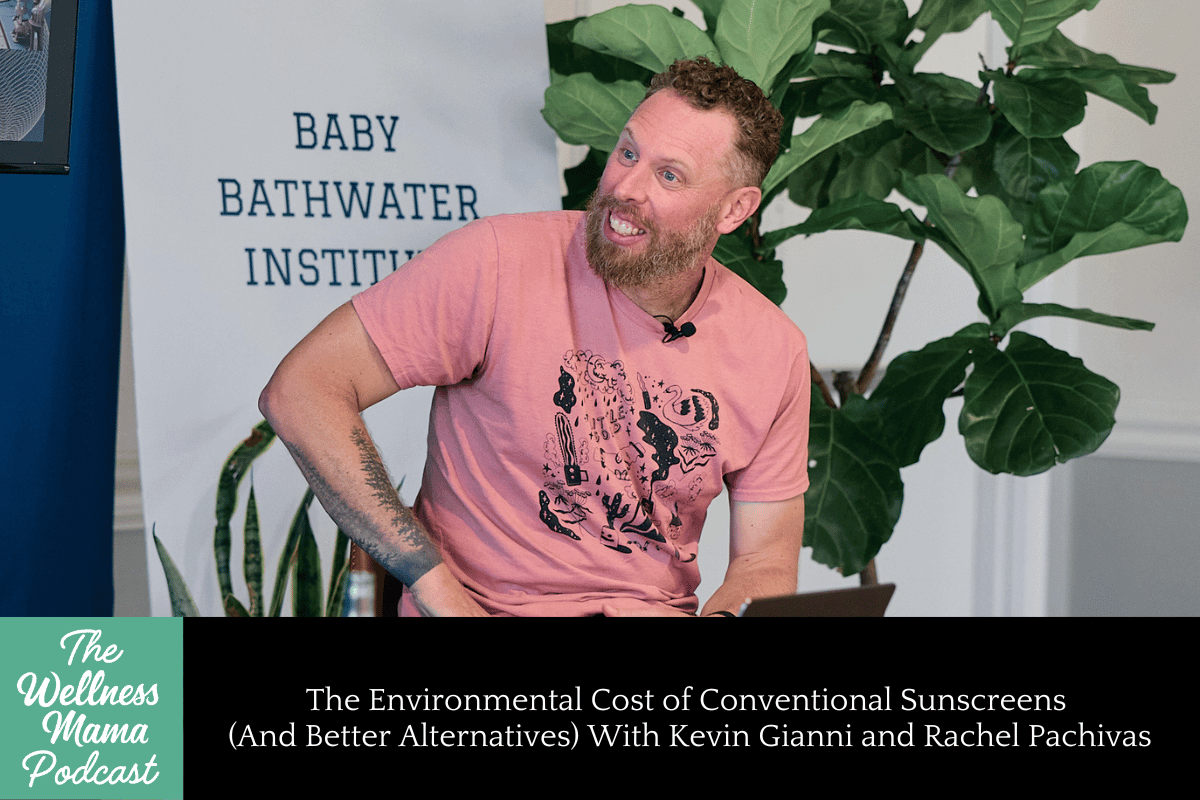
Katie: Hello and welcome to the Wellness Mama podcast. I’m Katie from wellnessmama.com, and in this part two with Kevin Gianni and Rachel Pachivas, we dive into the environmental implications of many sunscreens, especially chemical and conventional sunscreens and how these are impacting our reefs, our waterways, marine life, the fertility rates of animals and humans and so much more.
And I did not know even that there are over 14,000 tons of these products put into our waterways each year and that downstream effects that this is creating. And they really explain what to look for in sunscreens, define ones that are safe for both you and the planet, and things to make sure you avoid for the sake of both yourself and the planet.
And this is part two. In our first episode, we talked about the physical human body implications of chemical sunscreens, and I will link to that conversation in the show notes. Let’s jump in. Rachel and Kevin, welcome back. Thank you for being here again.
Rachel: Thank you.
Katie: Well, if you guys missed it, I will link to our first episode where we got to really dive into a lot of the nuance and some of the problems related to a lot of the sunscreens that you might find on the market today. And in this episode I wanna do the same for the environmental Implications related to this because this is very near and dear to my heart as a diver and understanding some of the massive problems that our waterways and our oceans are facing right now.
And of course, those aren’t just limited to sunscreen. However, I do feel like this is a massive factor and one that’s just not talked about very much when we’re spraying our skin with these chemicals sunscreens while we’re on the beach or boating or whatever it may be. And I feel like to start broad, most people maybe aren’t even familiar with the idea that chemicals in sunscreens can impact our waterways and our reefs and our ocean life in quite a big way.
So can you guys kinda just intro us into the environmental implications of certain sunscreen ingredients?
Rachel: Kev, do you want me to start?
Kevin: Sure you can go.
Rachel: Okay. Like you, I definitely, I feel like the environment has been the biggest push for me in this realm. Where to start. So all of ’em, all the chemical filters that we see in common commercial sunscreens today have some sort of impact on the environment, to the point where Hawaii and Kev, you can speak on this a lot, but Hawaii has banned quite a few where the US mainland has not. And do you wanna touch on that a little bit now? The Hawaii ban?
Kevin: Yeah, sure ok, I can run with that. So when we were developing this product, I wanted to really go to the scientists who were studying these chemicals and figure out, you know, what’s real, what’s not. It’s kind of how we’ve always operated. And so I had a chance to talk to Lisa Bishop who runs the Friends of Hanauma Bay in Hawaii. And what they did, back in 2018 I believe, was they tested, with Dr. Craig Downs, who’s another scientist, they tested the levels of some of these chemicals in Hanauma Bay. And at the amount, it was about 100 to 28,000 parts per billion, they found that that is super dangerous even at parts per billion for the coral.
And in Hanauma Bay, they had been seeing the whitening and the damaging of the coral over the years. So they went to the government and decided to set up a coalition to help ban some of these chemicals. Oxybenzone is the main one. And they managed to do it in 2000, I think they banned it in 2018, and then they, then it went into action in 2021. Around the same time COVID happened and the coral, because there was no one visiting Hanauma Bay, the coral actually started to recover then they did the ban in 2021, and they also limited the number of people going into the bay as another kind of way to mitigate the risk of the chemicals in the area, because I can get into that, I can get into the problems with the, officiating the law. There’s some issues with that too.
But the coral has rebound and Lisa now is, has a whole coral photo, kind of a database that she’s creating to show how it’s rebound and getting better. So real life damage. Real life mitigation. And so, you know, that really motivated us to get into this and really just focus more on this part of sunscreen and its environmental impact.
Rachel: I also mentioned, so when I was, it was probably like 20 years ago now, I was in Australia at the Great Barrier Reef. And a lot of people at the time, 20 years ago were talking about how we’re seeing impacts on the Great Barrier Reef and what sunscreens are doing because there’s so many visitors going there.
And I didn’t really, I was, you know, 21, 22, so I didn’t really think about it. And then just, I think it was, I don’t know, a few years ago we were working on a project and diving deeper into learning about the chemical implications and what’s happening. These are just some stats that maybe everybody knows, but just to cover for your viewers, you know, over 14,000 tons of sunscreen enter waterways every year. And that’s including, what, any type of sunscreen, whether it’s including oxybenzone, which has now been proven to cause this damage, octinoxate, avobenzone, different chemical filters. And what was being found was that not only was the DNA of the coral being changed, the bleaching of the wreath, entire destruction of the wreath, but the fish were actually being affected.
So fish were having, they were seeing the tissue of the dolphins being impacted to where their birth and their young were also being impacted. Reproduction rates, fertility rates, the gender of fish were changing. So they were slowly turning from male to female. These, the things that were happening was just absolutely alarming and disgusting and awful.
The fact that we’re, our regulatory agencies aren’t really putting much effort into protecting our waters and our life form on this ocean and on this planet. So that alone is enough motivation to do something and to speak about it, you know?
Katie: Yeah, like I realized this was a big problem, but I don’t know if I’d even heard that statistic, but 14,000 tons is an astronomical amount of these entering the waterways. And obviously, like you guys just explained so well, these are impacting ocean life and animals. Not even just the reefs, but the reefs too, which are also kind of a barometer of the health of the planet in some ways.
So this is like not just a small thing of like, oh, we can’t look at pretty reefs anymore, but like actually this is kind of instrumental in like indicating what’s happening on a much larger scale. And I feel like people might not also realize even outside of the ocean so you’re not wearing these in the ocean, there can actually be problems with these chemical sunscreens, even if we wear them in pools. And from my understanding there’s like some interactions with different chemicals with the sanitizers used in, for instance, water parks or swimming pools that can lead to toxic byproducts. So can you guys go into those as well?
Because I feel like people might think, oh, okay, if I don’t wear these in the ocean, then it’s fine.
Rachel: I mean, if we see that, I don’t know much about the pools and the chemicals and the sanitizers and the chlorine and the implications. I would imagine there’s some problems there just because every single chemical out there has some sort of impact with another one and reaction. But if we’re seeing what’s happening to reefs and to fish and to dolphins. I mean, don’t we think that that possibly is happening to humans? That we’re seeing disruption in our reproductive rates, our fertility, all of these things. So if we’re putting it, I mean not pools specifically, but going to the river, it’s not an ocean, but going to the river, I go there in the summer and people travel in and they’re just spraying, just slathering themselves.
And I’m like, grabbing my daughter, going upstream so that we don’t have to get the runoff. And I’m just like, we need to ban this here. Not because of just the environment, because the environment is a big factor, but also I don’t want it touching her. I don’t want it touching me. If it’s impacting the environment, it’s definitely impacting us and little kids and babies and humans, you know.
Kevin: Yeah, I can speak a little bit on the chemicals. Oxybenzone and avobenzone, both can react with chlorine, bromine, you know, traditionally used in local pools or your own pool at home. Some of the science says that it’s even worse on an indoor pool because of the chlorine gas that’s in the air. And they can create phenols, benzines, Rache touched on benzines in terms of it’s a carcinogenic. So yeah, so it’s, you know your chemical, your chemical sunscreen can react with the chlorine in your pool to create worse compounds. And then in terms of like the human body, oxybenzone has been found in human breast milk.
So we know that that is, that that’s there and it can act as an endocrine disruptor. And in the health world, we talk about endocrine disruptors and mimicking estrogen and all that. And oxybenzone can show up in that same way just as soy or, you know, other things that we talk, plastics, that we talk about a lot.
Katie: Yeah, when, Rachel, to your point, like if we are seeing this impact marine life and like their fertility rates and even their gender, and we’re putting these on small children. We also know, statistically I keep seeing kind of more and more dire statistics about human fertility rates and what those are gonna look like in even 10 years from now and especially in 20 years from now.
And certainly that’s multifactorial. It’s not caused by any likely single cause. And to me, that also like indicates this is something we need to probably pay a lot of attention to and start asking a lot better questions about, really quickly for the sake of not just our kids, but actually our ability to keep interacting with our planet and to live here.
And I know, like I said, this was my initial entry into kind of questioning the narrative on sunscreen was understanding the ocean implications when I started scuba diving. And there are labels like Reef Safe for instance, that you can see on sunscreens. To my understanding that’s actually not a regulated term, just how like certain terms on sunscreens related to physical health might not be regulated very well either.
But what does reef safe actually mean? And if someone’s trying to like actually choose responsibly, is that a term to look for or is there more to understand?
Rachel: You can speak to it Kev.
Kevin: Yeah, so Reef safe is actually, we can’t use it. It’s actually been triggering lawsuits. So people can’t, people who produce sunscreen can’t use reef safe without potentially being sued because there’s really no way to prove, at least what the people who are starting the lawsuits are saying, that there’s no way to prove that it’s actually reef safe, that it does not damage coral.
And, as we know, anything that’s gonna not have these chemicals in it is going to be much safer for the reefs, but you know, that’s just kind of the way it is. Reef friendly is what you can use. Any sunscreen product that doesn’t have some of these chemical blocks in them, oxybenzone, some of the other ones, avobenzone, though they can say that they’re reef friendly because they are, because they contain zinc and titanium dioxide, I mean that’s what, was what they do. So the, you wanna look for a reef friendly product. It may be reef friendly, even if it doesn’t say it. And that would be just looking on the label and looking for zinc and titanium dioxide and not some of the other, the other chemicals. And that’s, you know, there’s only three, four or five of them that really are a major contributor to some of the damage of the reefs.
Rachel: Another thing just to keep in mind is also look for non nano, so you don’t want a nano zinc or a nano titanium dioxide. And titanium dioxide specifically, you also want an uncoated one, or no, a coated one. So you might have to, titanium dioxide’s another tricky one. You might have to reach out to whoever you’re buying your sunscreen from and ask them some questions and dive into it.
Zinc is a little bit more of a safer bet. It’s more of a broad spectrum, as I had mentioned before. And definitely you wanna look for non nano.
Katie: That seems like an important caveat because I know a lot of brands I’ve even seen like advertising nano as if it were a good thing and I feel like a lot of people like this is kind of emerging important stuff to know is like, so what would be the reason not to look for Nano or what’s the problem with nanoparticles of these things.
Rachel: Yeah. Marine wildlife harm. It’s been known. It’s not proven safe. It’s not, there’s implications on what it can do and how it can break down also on your body and going into your bloodstream. The way that it’s produced, the way that it’s created.
Kevin: It’s not even fully safe for people who are manufacturing it.
Rachel: Inhalation, like all of it. It’s just, yeah.
Katie: I would guess that kind of applies broadly. Because some of those are also used in like natural cosmetics in different, other places people would encounter them. So kind of across the board you’d wanna look for non nano formulations.
Rachel: For sure. Yeah.
Kevin: Yeah.
Katie: Awesome. Yeah, I’ve encountered that in the toothpaste world as well. And I know there’s a lot to do with like nano hydroxyapatite and understanding like micro versus nano. So I’m glad this is becoming a wider conversation and people are getting to make more informed choices. And to that note, like what would people, what would be good things to look for on an active ingredient label?
To know both if a sunscreen’s gonna work for what someone’s wanting it to do for their body, and also to make sure it’s safe for the waterways?
Rachel: Yeah. So if they have it labeled as reef friendly, that’s one indicator. But also read the ingredients, you know, look for, and I think I take it a little bit further, like I don’t want a non-organic glycerin, because that also has contaminants. I don’t want non-organic ingredients that possibly have pesticide residue.
So there’s other things to look for. But in terms of your sun protection alone, I think looking for zinc, just zinc. Zinc is your active ingredient according to the FDA, you have to list it as an OTC. It has to be listed out what you’re using as your OTC. You can’t use other ingredients that aren’t registered with the FDA, like red raspberry, different things like that.
So what you’re looking for is just non nano zinc. And that is your sun protection that is in the formula. And then also looking at your secondary ingredients, the inactive ingredients, making sure that they’re up to your standards, you know? So if you wouldn’t use a non-organic glycerin or you wouldn’t use certain ingredients, then don’t use it in your sunscreen.
Katie: Yeah, that makes sense. Are there, I know we’ve talked about this in the human health perspective, and I know you guys are like, you go very deep into the safety and the benefit to the body and making sure it’s safe for humans, for waterways, for all of it. Are there any natural ingredients that you guys are especially excited about right now? Because I know you guys get to like really dive into the weeds of these a lot.
Kevin: This is Rachel’s wheelhouse. Yeah, go. This is your wheelhouse, yeah.
Rachel: I, you know, this formula that we created a, we try to incorporate ingredients that are really great for sun care and karanja oil was one that I had never known about. And then diving into it and learning about it and just what it does and looking up the history of it and the medicinal properties of what it can do is great.
So I think that one’s a fun one to look for in a sun protection product.
Kevin: Yeah and I think when we started to formulate it, we know a lot of companies will just do the bare minimum in terms of, you know, whatever base, you know, formula and then put the zinc in and then be good with it. And it’s just not how we’ve operated for the last 17 plus years with our skincare line, we wanted to do something that was just so much better and so much more nutritive to the skin.
And so, you know, the way that Rachel formulated this is just really, really well thought out in terms of not just sun protection, but skin nutritive ingredients that can assist in the, in that process.
Rachel: And, you know, taking it a step further beyond the formulation, I mean, since we’re talking about the environment, one other thing to think about is plastic and bioplastic and plastics ending up in the water. And we were going to use a bioplastic. And I just had this moment and I was like, our ocean. Like I had watched some documentary about the ocean and I was talking to a couple of people in the industry about how the recycling systems for it, the infrastructure, all these different things.
And so we decided to launch with an all aluminum tube and an aluminum cap and aluminum puncture thing, I don’t even know the name, and everything in it is aluminum and steel, and really making that effort to reduce plastic, even though it increases our price and it changed our launch and it pushed things back and it made things more challenging as a business.
But it is the better decision for what we’re doing and what we’re trying to accomplish, which is really acknowledging that we need protection for the ocean, for the planet. Admiring the sun, like kind of creating a symbiotic product that everybody can feel really good about using.
Kevin: Aluminum is one of the most recyclable, up to 90% recyclable. So it’s really nice to have that product in that container because we know that when you put it in your recycle bin that there’s a high chance that it actually will be recycled and not feed the big plastic island in the Pacific Ocean.
Rachel: And we have a blog post we can share with you on that one if you want.
Katie: Perfect. And I’ll link to that in the show notes. And I’m so glad that you guys even considered that aspect. Because that’s something else I’ve been writing about for a long time. Is this, like kind of plastic crisis that doesn’t seem to be getting any better. And we’ve now found plastic residue under meters and meters of ice in the Arctic Circle, for instance.
So this is now something that’s like on a planetary scale affecting us in tremendously. And I feel like we, when we don’t have great solutions for. So I love that you guys, really put such intention there and I’m gonna link to both companies in the show notes. But I really wanna call out. How that level of care really extends, I feel like, to everything you guys make.
And I’ve been a huge fan of the Annmarie products for a really long time now. And I love that that same level of care and depth and thoughtfulness of every piece of formulation and every ingredient has come into play here as well. But to get self proportional for a second, will you guys just speak to kind of the level of intention that goes into both of these brands and into creating things that are not just like, not harmful, but like so beautifully nourishing on every level.
Rachel: I guess I’ll kick this one off. Yeah, I mean, you said it, so it’s, yes, we can create a brand that’s just not damaging our bodies, damaging the environment, damaging everything else, but we wanna create something that has a positive impact as well. So taking nutritive rich oils, urban fusions, pure ingredients, made safe ingredients. All of our products go through a made safe verification. This is for both brands. And taking it to that step further, and then also the energetics of it, you know, so geometric shapes being incorporated, whether it’s into the production and the manufacturing process.
Crystal infusion, positive intention being set. The packaging with salt and blue specifically, you know, incorporating sacred geometry in there, like the womb of the universe, the interconnectedness of the worlds and the interface of the worlds. So taking intention and putting it into every layer of the products, whether it’s through the creation and the research and development to manufacturing, to shipping, to connecting with our team at our shipping centers and our co-packing centers so that we can really put positive intention into the products. So that what you’re getting is a higher experience.
Kevin: We’re activists. I mean, we don’t, we don’t, you know, post. Go down the street with signs, but we do it through commerce, you know, and Rache, Annmarie and I met in Berkeley and we met when we were trying to get GMO labeling. And so it, that channeled into the skincare. You know, we saw something in the industry that was really awful and wanted to forge a better path. And so we did that with our skincare, and then we saw this opportunity and we’re like, you know, we did it with skincare. Let’s do it with sunscreen too. Let’s really take what we know and the principle, the level of principles that we have, and make something that’s better really, you know. I’ll stand by that for sure.
Rachel: It’s interesting because my husband was like, well why is your product different, salt + blue? And he was just asking me like, you know, talking about it. And I was like, well, like yeah, there’s some clean products out there and there are zinc blockers out there, but they don’t have the nutritive rich oils. They have plastic tubes, they have excessive packaging. Like there’s nothing that’s really taking that intention into every level and thinking about the formula, thinking about the impact on the environments, thinking about the packaging, thinking about action as well. You know, that’s something we wanna do as a brand, is get more involved in action and action steps like what Hawaii’s doing.
So seeing what we can do in terms of supporting different bans or regulations or. Things to make a change because it’s not gonna happen overnight. It’s not gonna happen with just pushing. I think we’re up against a massive chemical industry that’s making a lot of money off of one, their product and two people getting sick. So it’s gonna take a lot and I think there’s not another, there’s not another brand doing that as far as I’ve seen. So, yeah.
Katie: I feel like education is a big part of that too, and I love that you guys are doing that side as well. And I’ve long believed that moms are an incredible force for good in the world and that when moms create change, we create societal change. So I feel like the more people that understand this and that, the more of us that on a grassroots level make better choices for our own families, for our own waterways, for our own, just our own purchasing decisions, that over time that will create ripples and hopefully also we’ll see regulation in big companies coming online as well. But I do feel like small groups of dedicated people, I believe there’s a quote around that, can make tremendous change. In fact, they’re the only ones who usually do so. I love that you guys are honoring the education side as well.
And I’ll link to all the things we’ve talked about in the show notes, but just briefly, where can people find your new sunscreen and try it out?
Rachel: Salt.blue
Katie: I love it. Well, thank you both so much. It is always so fun to get to chat with you and I love that we got to kind of dispel some myths about commercial sunscreens and chemical sunscreens for our bodies, for the environment and present like deeper questions and better questions to ask that hopefully will create positive ripples.
Thank you so much both of you for your time today.
Kevin: Thanks Katie.
Rachel: Thank you. Thanks for having us.
Katie: And thank you as always for your time and your presence today. We’re all so grateful that you are here, and I hope that you will join me again on the next episode of The Wellness Mama Podcast.




Leave a Reply