Read Transcript
Child: Welcome to my mommy’s podcast!
Katie: This podcast is brought to you by LMNT, and this is a company you might’ve heard me talk about before, and I really love their products because proper hydration leads to better sleep. It sharpens focus, it improves energy, and so much more. But hydration is not about just drinking water because being optimally hydrated, a state called euhydration is about optimizing your body’s fluid ratios. And this fluid balance depends on many factors, including the intake and excretion of electrolytes, which many people don’t get the right amounts of. Electrolytes are charged minerals that conduct electricity to power your nervous system. I talk a lot about nervous system on this podcast.
They also regulate hydration status by balancing fluids inside and outside of our cells. LMNT was created with a science-backed electrolyte ratio of 100 milligrams of sodium, 200 milligrams of potassium, and 60 milligrams of magnesium with no sugar. Since electrolytes are a key component of hydration, here’s what happens when we get our electrolytes dialed in.
We have more steady energy, improved cognitive function, suffer fewer headaches and muscle cramps, we can perform better for longer, and especially the support fasting or low carb diet because when we stop eating carbs like during a fast, the absence of insulin allows the kidneys to release sodium.
So replacing that lost sodium with electrolytes can help you feel good on a fast. Since LMNT is zero sugar, it also doesn’t break up fast. Electrolytes are also important for maintaining blood pressure, regulating digestion and proper fluid balance. Keeping skin hydrated, which is a big one that I feel like often gets missed and so much more.
I feel like proper electrolytes is a missing piece for a lot of people and I love LMNTs new canned drinks, which are sparkling water with all the same ratios and minerals I just talked about, and they are delicious. You can check it out and learn more at drinklmnt.com/wellnessmama. And at that link you will receive a free sample pack with any order.
This episode is brought to you by Just Thrive Daily Gut Detox. Here’s a hot take. Most detoxes are just an expensive way to feel terrible for a week, and this is because they force toxins out with laxative and harsh ingredients, which can result in fatigue and days of discomfort. And I’ve talked about before, how it’s not, detox is not a thing we do to our body.
It’s a thing we work with our body because it already naturally knows how to do it. And that’s why I love Just Thrive Daily Gut Detox. It’s different. It works with your body, not against it. It’s not doing something external to you. It’s powered by clinically proven immunoglobulins that act like a toxin magnet.
They bind to the bad guys in your gut and safely carry them out so there’s no extreme flushing or cramping. No shock to your system, and because daily gut detox is gentle enough for everyday use, it helps give you the support you need to stay healthy long term. So if you’re dealing with signs of toxin buildup like embarrassing bloat, or brain fog or fatigue, there’s finally a science backed detox that’s easy to stick with long term.
And it’s microbiologists formulated, gluten-free, dairy-free, and non-GMO. And as always, you can try it risk free with their hundred percent money back guarantee. Just visit justthrivehealth.com/wellnessmama. And use the code Wellness Mama at checkout to save 20%. So again, that’s justthrivehealth.com/wellnessmama. Take control today with Just Thrive.
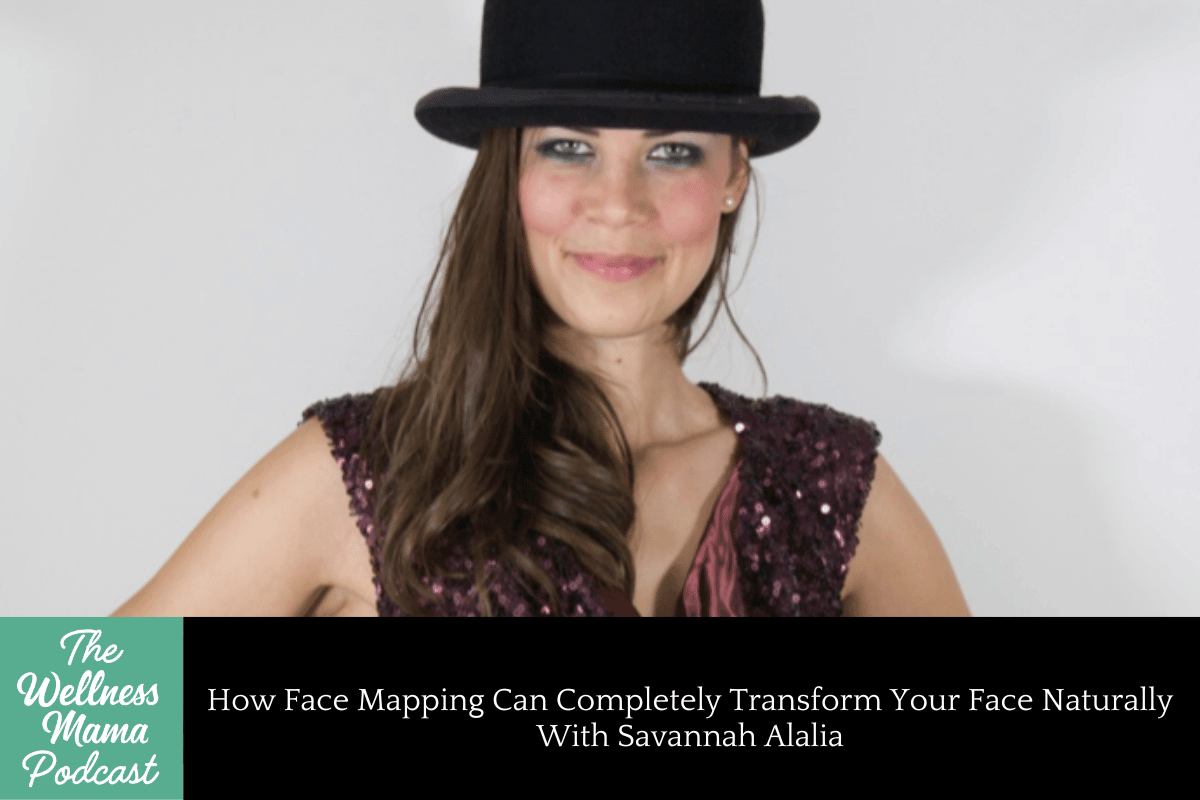
Katie: Hello and welcome to the Wellness Mama Podcast. I am Katie from wellnessmama.com, and I’m back today with my friend Savannah to learn about a topic she developed called Face Mapping and how it can transform your face and your body, including her incredible journey of how she discovered this. The results she’s had and how anybody can learn this and do it at home.
And I have been learning from her because she seemingly does not age, and she does it through addressing fascia and face mapping. And as I’ve made this part of my routine, I’ve loved how relaxing it is and how much of a difference I notice in my face. And as someone who is not wanting to go down the road of Botox or a lot of the conventional methods, I was so excited to find a really effective and body supportive alternative.
And she explains the link between the face and the rest of the body, between fascia and how this all connects and so much more. So let’s jump in. Savannah, welcome back. Thanks for being here again.
Savannah: I am so happy to be here. Thank you for having me.
Katie: Well, if you guys missed it, I will link to our first episode in the show notes because we did a really deep dive on fascia. Got to touch on some fascinating aspects of it. I learned a lot. And in this conversation, I’m excited to build on that one and talk about something that I have learned about from you and really only ever heard from you, which is the idea of face mapping and what that is and how it can be such a profound tool.
So to start off maybe walk us through your personal journey and what led you to develop the face map. Because when you first explained this, when I met you at a conference, it like, it blew my mind.
Savannah: Oh, bless you. Well, I’ve been working with Fascia for nearly 30 years and I really wanted to, I’ve always had a passion to really support and help people, and for me personally, I had a situation where I cracked my sacrum and I cracked my sternum. I was dealing with like five migraines a week. It was pretty debilitating.
But having worked previously with like thousands and thousands of people, I’d seen similar things happen and I’d seen patterns showing up in their body and in their faces. And I was interested to observe what was happening in myself because as I mentioned in the previous episode that we did I began to notice that I had some lines appearing on my forehead out of nowhere, and I could directly correlate them to beginning probably about 18 months after I’d had these injuries and things had started to lock in my body and I could feel that I wasn’t, things weren’t moving properly.
I could feel that I didn’t have my usual vitality and I really was curious to figure out how to open out what I was dealing with. I went to lots of different practitioners. I tried lots and lots of different things, but I couldn’t really find anybody specifically to help me. Things would kind of, different things would help ease my symptoms for a short period, but then it would come back and I realized that I’d had an injury that had shifted.
There was an impact in the sacrum, but it actually shifted some stuff in my face, and so the symmetry in my face had all of a sudden changed. I’d gone from having perfectly straight teeth to crooked teeth. Now, initially I didn’t really think anything of that. I just thought, oh, it doesn’t really matter.
I’m not really that bothered. I’ll just leave them. But as I left it, it continued to change and it was from there. That all the migraines began, and it was a literal twisting that began in my face. So I went from being very symmetrical to becoming very asymmetrical in my face. And again, you might say, well, does that matter?
It’s just aesthetic. However, I would say that your face, as I began to learn and explore and go deeper, speaks to what’s happening in all of your body. It’s like a map for what is happening in all of your body. And I’d worked with enough different traditions with the body work that I’d done to be able to dig a little bit deeper and look into different practices from Vietnam, from China, from Italy, all to do with the face.
And whilst I could also say that, you know, I could read what was happening in the body through your hands, through your ears, through your feet, or just look at your body and say, there’s this twist, there’s that twist. We need to get this pattern moving differently in your body. What I really, really feel is that for most people, that is, there’s too much focus on me having that conversation with them about it. And to me, health and wellbeing and vitality is something that you own. And you know, if something’s not right in your face, you see it, you know that, oh, you might think of it as, oh, maybe I’m aging a little bit. You might think of it as, you know, this is just, this has changed.
Like all of a sudden, like, my cheeks aren’t the same shape or whatever it is. Like you can see what’s happening in your face. And so to me, the face was a really obvious place to explore and go to. And it was, from me working on my own face that I began to unpick and unravel what was going on through the rest of my own body.
But it’s, it was also, it really came to me that the face is the spearhead for me to share my work with people, to share the understanding so that they would be able to have ownership of, okay, like I need to go into my jaw, and working on my jaw I know that means I’m gonna need to also do some work on my hips and the soles of my feet.
So you can take ownership of your own process through that format. So yeah, the faces, the face speaks literally, I like to say your body talks, and you can be in a conversation with your body through what’s happening in your face.
Katie: Yeah, this was the part that was so fascinating to me when I first heard you explain this and the idea that you could literally tell by looking at someone kind of what was going on in their body and you did this at this conference with people and you were spot on. And it was so fascinating because I had heard of before things like reflexology and how we can, like in our hands and feet for instance, like there’s things that mirror other parts of the body. But I had never heard someone explain this connection in the face. And the beautiful thing about the face is that for almost all of us, we have access to our own face. And that’s something we can work on. Like you said, we can see it, we get feedback and it’s something we see often. So if there’s a change, we likely notice it.
And because it’s so aesthetic also, we care about it. So it might be motivating enough for us to actually start to address those things. And I feel like this is exciting because not just is this helpful from an aging perspective, but like you just explained, it goes deeper to the whole body. So can you walk us through some examples of maybe things you’ve seen where something was going on in the face and what it mirrored somewhere else in the body?
Savannah: I did something the other day and I really, really loved it and I think I might do more of this. Again, I’m gonna reference Jill Miller because I love that lady’s work. But what I did with somebody is I showed them where things were a little bit wonky in their face, and it’s very literal. Like if you have a look at any of my post on social media, or we can do it maybe through Katie’s. If you just comment, face map, then you can get access to the map that goes over the face and you will be able to see for yourself, like, if one of your eyebrows is higher, then that means there’s something going on through that shoulder on that side.
Like it’s the same side that it relates to. If you can see that there’s a twist in your, where your nose sits in your face, that’s something happening in the hips, probably stuff going through the hips, cross lines and cross sections that will be tight, even into the pelvic floor there. If you, if there’s things happening like lines in the chin, then we need to look at your ankles.
I did a thing with a lady the other day where I read her face. And she was going, well, yeah, I know I’m tight on that right here, but I’m not like the other things you’re saying I’m not sure about. So I walked her through a process with Jill Miller’s balls and had her do the rolling herself, and she was like, oh my goodness.
Like everything that I’d highlighted were the areas that were tight and stuck, and this is the beauty of what you can find in your face, and that you can then translate into helping the rest of your body by saying, hey, I’m hearing you. I’m gonna help you. And then I find that the body, when you acknowledge it, it goes, oh, okay, I don’t need to hold onto this anymore. You’ve heard me. Thank you. And it is much more easy for the body to let it go, which maybe sounds very simplistic and I realize that, but I actually think the body’s much simpler than we realize. It’s us that tend to overcomplicate things. And of course, yes, there are other things you can do to support it, including hydration, including detoxing, including eating healthy, like of course saunas and, you know, sunlight and grounding.
All of those things will make your body work better. And it can also be very simple to help your body to let go of something that it’s holding onto.
Katie: Yeah. And I think that the letting go of something it’s holding onto is also such a metaphor for life. And I love, I love that there’s, like you, I’ve made this such a clear system and understanding what’s going on by working through the face. And I’ll also say, I’ve done this some myself, and I’ve gotten to work with you once at a conference, which was a really cool experience. It’s also incredibly, in my mind, relaxing, like we talked about in our first episode, for me, there’s been places where I have found discomfort. And when I didn’t resist that discomfort, it did melt eventually and then was not uncomfortable anymore. But there was like this kind of nervous system response that happened after I think, or like some form of deep relaxation.
And so now I often will make this part of my evening routine because it’s so relaxing to my nervous system. And I know we touched on this in our first episode but I felt like that was worth revisiting a little bit because I feel like this is also a form of self care, that I was shocked at how much I relaxed from.
Savannah: Yeah. It’s so simple, but it does so much, like you say, I kind of like to think of it a little bit like a glass, like a glass of water. And as we go through our days, the glass gets fuller and fuller and fuller. And it would be, and so therefore, the bit that’s at the top, the bit that’s still empty is smaller.
And I see that bit at the top, the smaller bit as our, where our capacity is at. And so when you then take the time to go into the areas that’re tight, it’s like you start to bring the level of the water down, and as the level of the water comes down, that space that’s above then becomes your capacity.
And it, that’s the simplest way I can think to explain it because also, you know, you have, on an anatomical level, you have so many major nerves that run through the face and the back of the eyes. And again, anybody who’s interested, I highly recommend the work of Gil Headley because he’s done like a nerve tour and a dissection of the entire nervous system.
And it’s fascinating to see where all the nerves go to how much of the nerves are behind the eyes and how they run into the heart, and how that then continues down all the way down through the body. And they’re almost like one really long piece, rather than lots of little things, which is how I think people often think of nerves.
Like our nervous system is an entire system that is huge. And it’s also, most of it you can find like the beginnings of it, all of it really starts in the head. So what you can do in the face and what you can touch on the outside of the face and how you can move to activate the nerves in that area helps all the way through the rest of the body.
Obviously other work also helps moving it through the rest of the body, but I like to think of it as, like I said, like a glass. So as our day goes on, our capacity gets lower and lower because our experiences are filling up and it’s great. Like we want a full glass. It’s lovely to have that in life.
And then it’s really nice to be able to go, okay, now I’m gonna create space again. So it’s like allowing your nervous system to enjoy the tolerance of sensation of all the amazing things or maybe wonky things that you experience in a day. Life is life. Like, there’s so much pleasure I think that can come from just really showing up and being truthful to what you are feeling.
Even if it’s, you know, unhappy or angry or frustrated with different things. Like there can be benefits from allowing the honesty of those emotions to come out and through you rather than letting them get stuck in you. And then it’s really powerful to empty back out again so that the next day you can start afresh and start anew rather than trying to maintain a perfect state the whole time. Because again, that’s a way of being stuck also.
Katie: Yeah. And it was so interesting when you were showing me this and explaining it, how even on my face, like there would be spots that you would show me where like parts would move and then the other side or something that was stuck and it would just not. And to get to feel that and feel that connection and realize, like with face mapping, I always just thought I had like a tight jaw and that was because of my jaw.
I had never considered that that was maybe a mirror to other things going on in my body and that like understanding that both and would let me kind of address both rather than just kind of like trying to like spot treat my jaw. And so I feel like that’s what’s some of the beautiful power in this.
And I’m welcome to be the guinea pig. If you wanna explain anything deeper on the jaw and how that, because I wonder if this is a common thing for a lot of women, perhaps. But also to touch on the idea of can anyone do this? Like it, I feel like that’s what another beautiful thing is. It’s so accessible and pretty much from my understanding, anybody can do this.
Savannah: Anybody can do this. It really is just about showing up for yourself properly. And at any point, you’re welcome to be a Guinea pig with all of this work. So you just say, and we will do. But yeah, for sure, I think a lot of women, I feel like as a woman, and again, it’s one of the things that really helped me.
I’m gonna go very slightly off topic. But because I’d cracked my sacrum, one of the things that, it took me I think about two or three years to get to, but was physio pelvic floor work. And as women, what happens in our pelvic bowl, whether it’s because we’ve carried children or because of impact or because of things that have happened in our experiences, you know, in our sexual lives that have been uncomfortable, I feel like we hold a lot of tension through our pelvis for many, many different reasons.
And it wasn’t until I began to have some physio with pelvic physio, physio pelvic floor, that I began to realize how like when I relaxed my pelvic floor, between my shoulders was relaxed, and, you know, underneath my chin was more relaxed and therefore how my jaw sat was better. You can work both ends, you know.
So yes, absolutely. If you’ve got something going on in your jaw, you want to work on your jaw, but you also want to explore, again you could either roll on Jill Miller’s balls on the side of the hips and she’s got training videos to show you different ways in which you can do that safely. Or you can hang out in the jaw and you can do it from the outside of the body, but you can also do a lot from inside the mouth.
And I think often we are nervous, reluctant to touch our own bodies, like we might make a mistake, but the only person who’s living in your body is actually you. And as long as you are slow and attentive to whatever it is that you do, you’ll probably find that you are capable of much, much more than you realize.
Your body should be the most familiar thing that you have around you. And so if you find an area that’s tight specifically, like if it’s one side, then I would recommend exploring the hip on that side from the inside and the outside ideally. I would also recommend working on the other side as well, because sometimes the bit that’s stuck isn’t always where we’re holding the most tension.
It’s just the bit that we can feel the most. The other thing I often speak about is how pain is our friend and numb is our enemy because if something’s numb, like for me, I had a whole section of my left side of my body literally was practically numb and I didn’t even realize it for a long time. All the pain I was feeling though was on the right side.
And so I ended up doing loads of work on the right side and didn’t realize until I began to switch the numb side back on that actually the left side was way more stuck than the right side was. The pain had just been my friend on the right because it was going, oh, go here, do this work on that, this hurts, now let’s do, let’s do here. But numb is what you want to be looking for almost. It’s like the little patches where you don’t feel very much, but you can tell that something’s not moving properly. And just a simple thing that people can do, especially for the jaws as women is just putting your fingers at the opening of where the jaw goes, just underneath the kind of bone that sticks out and just opening and closing and just feeling like is, does that feel even, does it look even when it opens? It’s really nice to do a lot of these things in the mirror because we are so much more, we are naturally, we, I think we’re naturally oriented to look for symmetry.
And so we will be able to identify, you know, which side’s moving better, which side’s got more tension in it. And yeah, there’s just, there’s just so much power from being able to see it for yourself I think when you’re, when you’re working on yourself. Because I do believe literally anybody can do this.
And I also believe in actually writing down the areas where you find tension, rather than just going, oh yeah, now that feels better. And then ignoring it. I think it’s really powerful to actually track the areas yourself. Because also, I talk a lot about your body’s history and how your history of your body can show up in your face.
And what that means often is patterns, thought patterns, I tend to find that, and again, I’ve seen this so much with clients over the years. I tend to find that if somebody has a particular tension pattern through their body, it engages when the thoughts kick in around a particular thing. So I remember there’s a family that I’ve done a lot of work with, over the years, and I’ve worked with, I think their youngest was, I think she was three when I first started working with them.
Now both, I worked with both the parents and the siblings and the aunts and the grandparents. So I was working with multiple different people from the family. But what I found particularly interesting was working with a three-year-old consistently over many years, and noticing at which point her body started to mimic what her parents or her siblings bodies were doing in terms of how she would hold tension in her body.
Now some people might say, oh, that’s genetics. But what I found interesting was none of those tension patterns were there until she hit seven or eight. But she started saying certain things around six, five and a half, six, and there were certain phrases she started saying and repeating that all of her siblings and parents also would say, and it was only 18 months later, that the patterns then showed up physically in the body, and it almost went from like squidgy and nice and open and mushy to then held.
In a very particular line. And so I like to map, I call it a thought knot. It’s literally like where the brain knots, the physical body. But I like to help or support people with mapping their body’s history so that they can really look at like when certain tensions began. And yes, sometimes it can come from an injury, but I’ve got like another family that I’ve done work with three people in that family, all the same gender.
They all had the same line of tension, but they all had it from different accidents or injuries. One of them had done it in a skiing accident. Another one had been done a car crash. Somebody else had fallen off a bike and broken their arm. But the line of tension was identical in every single one of them.
So there are situations that will happen that our body will then be prone to an injury or more prone to a particular injury. But that’s a whole other conversation. But it’s interesting.
Katie: It is interesting. It makes me think of the book, It Didn’t Start With You, and the author, Mark Wolynn, who I’ve gotten to interview, but about the genetic trauma that can be passed down and the patterns and how those things can show up at similar ages, even if there’s not even conscious knowledge of that happening in the past.
Such an interesting topic, but I love, related to what you just said. The idea that you can kind of see the history of the body in the face and what we can learn from that. And like, as you said, I feel like this is awesome because anybody can do it. And I wanna make sure we go into like, what do people need to do this most effectively?
Because I have some really cool tools that I got from you that are really fun to work with. But I would love for you to touch on kind of how can people do this most effectively and how can we learn it? Because it’s so profound. I feel like it can seem like it would be complicated and you make the barrier of entry so low and how well you explain it. So maybe touch on those two things.
Savannah: Thank you. I feel like the most important thing is to put this as a tool into everybody’s hands. The most simple tool that we all have is our own hands. And so if you have nothing else, begin with your hands. And as long as you are slow, attentive, loving, intentional with what you are doing. I mean, I have so many free resources.
I can’t even remember how many, a hundred videos, I’ve got on Instagram and YouTube, but all of them are exercises that you can explore and practice or if you want to be more coherent and how you are looking at it, I highly recommend a one week program I’ve got called Your Face Symmetry, and that basically walks you through learning each of the different areas of the face and what they relate to.
And I have many people, although it’s only a seven day program, I have many, many, many, many people who loop around and redo it and redo it and redo it. And they begin just by doing it with their hands for the first week. Even though in some of the videos it shows certain tools that I’m using. But they begin with just doing it with their hands the first time around.
And then they begin to add in the tools, like for example I have a face stick. Which is, I’ll show you just so that you can see. It’s a very simple thing here, and it’s matte, and that’s quite important because it means that you don’t slip when you are using it. It means that when you are working on the fascia, you could easily create pinning and then you can work into the area.
And that’s a really simple, easy entry point which again those are on my website. I, we can get you some links, Katie, if you want those for your followers. And then the second tools that I have, I’ve got something called a face spoon. It comes in a little pouch, but actually one of them is slightly larger.
And this is the one that I tend to go to first. There is another one, but it’s much, much finer and I would recommend that people only start using this after about three or four months of working with this one. Because it’s just a lot sharper. And the key thing is really understanding the speed at which you’re working so that when you are getting into an area, you are being really, really patient with it.
Because sometimes when you’re releasing fascia, you might be here for a little while and it might be that it has to happen over an extended period of time, rather than I’m gonna just push through all of it and open it all up. Unless you are connecting to something that moves slowly, you are probably just stretching your skin, which is the opposite of what we’re trying to achieve here.
So really having that intentional, slow approach is key to working with your fascia. And I really believe that the more time you can take hanging out with yourself. But again, as I said in our previous episode, like 10 minutes a day is enough. And you’ll find especially with the program, I’ve made it so that the videos themselves are around the 10 minute mark.
I think the longest one is 12 and a half minutes or something like that. So everybody can find 10 minutes in a day to learn a little bit about themselves, give themselves that self-care practice and connect to their bodies and see what their face is telling them about what they most need at this time.
And it will, it will show patterns and it will be consistent patterns enough for you to be able to go, oh, okay. It’s that again. And then you might be able to think about like, so what have I done today? Like, who have I been around? What have we been talking about? Like, what’s been rolling through my head?
Because I feel like we work on the face and the body in layers and layers and layers as we unpeel and unpeel, whatever it is that we’re working through. I just love it. I feel like it’s a very exciting way to live, and it’s very fun to be in a process with, with yourself. But the simpler I think you can make it, the easier it is for you to do it, which is what is the most important thing, I think.
Because otherwise there’s many, many, many, many, many things that are out there, and you could get caught up in, oh, I should be doing this, I should be doing that, I should be doing the other. But actually, most of the information that you need starts inside of you. And if you have access to that, I feel like you have a better barometer as to what you might need next.
Because what I’ve noticed is that when my fascia is open, or when I’m around people whose fascia is open, they have like a full body yes, or a full body no, to certain things. And it’s a much more distinct, directional piece for where to go next and which step to take next, whether that’s a book to read, a course to take, a supplement to try.
It could be all sorts of different things, but I feel like if your barometer here is sound and good and clear then you will find it much easier to move through the world generally.
Katie: Yeah, I love that. Like I said, I love that this has become part of my routine. I love the tools and I love that you make it so accessible. I’ll make sure I link to both the course and the tools in the show notes for any of you guys listening on the go, because like I said, I think you make it so affordable, so accessible, and as someone who personally is not gonna go down the path of things like botox and facelift and filler and all the things that are kind of the common approach to aging.
I’m so excited to have something that both works and that feels so good and that has benefits to the rest of the body as well. And one last thing I wanna touch on with you that I feel like also ties back into our first episode a little bit is from the research for this episode when you said that you believe an overfocus on positivity can be as harmful as an overfocus on negativity when it comes to our human experience and what it does to the body.
And I feel like this is a kind of an unusual perspective, and I love the nuance of this. If you don’t mind, I’d love for you to just explain your insight there.
Savannah: Yeah, I feel like I, so I had a really interesting experience. I have, my background, as I said before, although it’s in fascia, I also did a lot of work in meditation and spirituality and all of these things. And what I noticed is that, yes, I am all for, you know, focusing on what you’re choosing to create and having intentions and having goals, however, if you are under the surface feeling angry, frustrated, stuck, irritable and you are dishonest with those emotions, those emotions still live inside of you. They’re just stuck inside of you because you’re not giving them an expression. And so they stuck and get compartmentalized somewhere. And then that part of the body gets all a little bit funky and screwed up until you are ready to open it and let it go.
And I went and I did some work with, I mentioned him I think in the other episode, Josh Pais. And he works with all sorts of different people, but mostly for me it was, I wanted to learn how to be more comfortable on video because I found that I was so stiff. And I, it’s because I had so much mental chatter going on in my mind and I was almost like attacking myself from the inside.
And so it used to take me like to do, like an hour worth of footage I could use, it would take me 70 hours to film it because I’d be so interrupting myself the whole way through. And so I looked at the videos that he was doing and I loved what he did, and so I was like, I’m gonna go and work with this guy.
Now he’s somebody who worked with, sorry, his father worked with Einstein, so he grew up with an understanding of like atoms and molecules and how they work in the body. His background is he’s an actor. He’s been in like 150 plus films and he’s phenomenal. He’s great fun to work with. But his workshops really focus on the principle of hanging out with whatever is going on in your body.
And I had this, he, one of the things he gave me, you have like a script. Everybody’s got like a two, two minute script. There’s like 20 people in the class. Two minute script, there’s like only four scripts in the whole room. It’s not that interesting in terms of what’s being said, but everybody’s given a different quality to embody and for me, he gave me chaos and I’m like, why have you given me chaos?
Like I feel so chaotic inside, like, why are you making me do this thing that feels so uncomfortable? And he’s like, I want you to really get into it and like hang out with it because that is your fuel, your emotion of whatever it is that you are experiencing. That honesty of that emotion is the fuel for what will give you something that’s interesting for people to watch first and foremost.
But for me, it was like, it blew the lid off the spiritual training that I’d had of like, I, oh you have to always fixate on like where you are going and the positivity and the goal and all of these things. And I was like, what if I was just honest about where I found myself and I hung out with it and I was as constructive as I could be in the expression of it.
Like if I was enraged by something, I don’t go and take it out on somebody. I’ll go do something constructive with that energy. But I’d be honest about it and I would voice it, whether that’s written, whether that’s spoken, whether it’s digested partially before I speak it, however it goes, and it unlocked something enormous in me.
I realized I’d been restricting myself as to only living in one way of being and seeing that as the right, the perfect, the proper way of approaching life when actually we are human beings having a human experience and we have such a huge array of emotions and all of that richness in our lives is what makes life interesting.
It’s how we are creative, it’s what, how we cross pollinate each other and inspire each other to do different things. And so to me, if you are too only positive, it’s like you are only breathing out. And if you are too, only negative, it’s like you’re only breathing in. And to me it’s like either way you’re gonna suffocate.
You need a little bit of both. And if you’re being honest, you are a little bit of both. No one of us is all only, happy, happy, happy all the time. And no one of us is only ever sad the whole time. Like we have the potential for all of this array of human emotions. And that to me is a very, very exciting and a much more interesting way to live.
And also I feel a way that is more, makes for a more comfortable fascial experience because you are, you’re getting comfortable with the capacity for whichever emotion you experience, whether it’s big happiness or big sadness or big shame or whatever it is. Like all of these things, especially if they only last for 12 seconds, which eventually they do, why wouldn’t you?
Why would you, I would only want to experience all of those things, if that makes sense. Like it’s interesting.
Katie: I love it. Well, I will make sure I link to the tools, the course, to your Instagram, to your website and your work, all of that in the show notes. I think that’s a perfect place to wrap up this conversation. I hope we get to have more in the future, but these, I feel like were long overdue and I’m so, so glad we finally got to chat. Thank you so much for everything you’ve shared today and for your work. Like I said, it’s been a tremendous help to me personally. I’m excited for people listening to get to try it. Thank you for being here today.
Savannah: Thank you so much and I look forward to many, many more conversations. It’s always a joy to chat with you, and I look forward to whenever the next time is.
Katie: And thank you for listening, for sharing your time, your attention, and your presence with us today. We’re both so grateful that you did, and I hope that you’ll join me again on the next episode of The Wellness Mama Podcast.




Leave a Reply