Read Transcript
Child: Welcome to my mommy’s podcast!
Katie: ?This episode is brought to you by BIOptimizers, and I love this company. And specifically today I wanna talk about one of the favorite things that they make, which is called Masszymes. So let’s be real. We all kind of start this part of the year saying, we’re going to eat cleaner, train harder, feel lighter.
But it’s not just what we eat and what we do, it’s what we absorb. And if our digestion is sluggish, the body just can’t keep up. And this is why I love Masszymes all year, but especially this time of year because it’s a simple digestive ritual that’s made a huge difference for me. It’s loaded with 18 enzymes, including four times more protease than top competitors, to help us break down dietary protein, carbs, and fats efficiently.
And I’ve shared before, I’ve done a whole episode on enzymes and how this was really, really impactful for me personally. But this means that we get better nutrient absorption, less bloating, and more real energy from the food we’re already eating. I’m also a big fan of nutrient loading and really maximizing that in our food too.
And enzymes help us get the maximal benefit from this. It’s this hardworking, yet smooth enzyme blend, and it’s been a favorite of mine for years, and a customer favorite for over 20 years. It’s a ritual that your stomach will thank you for anecdotally. I feel like I really don’t get sick now that I have made these a regular part of my routine.
A lot of people find they don’t have post-meal food hangovers or bloat after taking these, just clean energy to crush goals all year long. For a limited time, you can save up to 26% off their products and bundles during the New Year New You Sale by using my code wellnessmama15 at checkout.
And select bundles are on sale for up to 45% off, so you can get a massive discount there. Visit bioptimizers.com/wellnessmama and use the code wellnessmama15 at checkout. To get the best deal on Masszymes and all BIOptimizers products. So that’s bioptimizers.com/wellnessmama and the code wellnessmama15.
So start 2026 with a stronger gut, more energy, and better digestion.
This episode is brought to you by Just Thrive Daily Gut Detox. Here’s a hot take. Most detoxes are just an expensive way to feel terrible for a week, and this is because they force toxins out with laxative and harsh ingredients, which can result in fatigue and days of discomfort. And I’ve talked about before, how it’s not, detox is not a thing we do to our body.
It’s a thing we work with our body because it already naturally knows how to do it. And that’s why I love Just Thrive Daily Gut Detox. It’s different. It works with your body, not against it. It’s not doing something external to you. It’s powered by clinically proven immunoglobulins that act like a toxin magnet.
They bind to the bad guys in your gut and safely carry them out so there’s no extreme flushing or cramping. No shock to your system, and because daily gut detox is gentle enough for everyday use, it helps give you the support you need to stay healthy long term. So if you’re dealing with signs of toxin buildup like embarrassing bloat, or brain fog or fatigue, there’s finally a science backed detox that’s easy to stick with long term.
And it’s microbiologists formulated, gluten-free, dairy-free, and non-GMO. And as always, you can try it risk free with their hundred percent money back guarantee. Just visit justthrivehealth.com/wellnessmama. And use the code Wellness Mama at checkout to save 20%. So again, that’s justthrivehealth.com/wellnessmama. Take control today with Just Thrive.
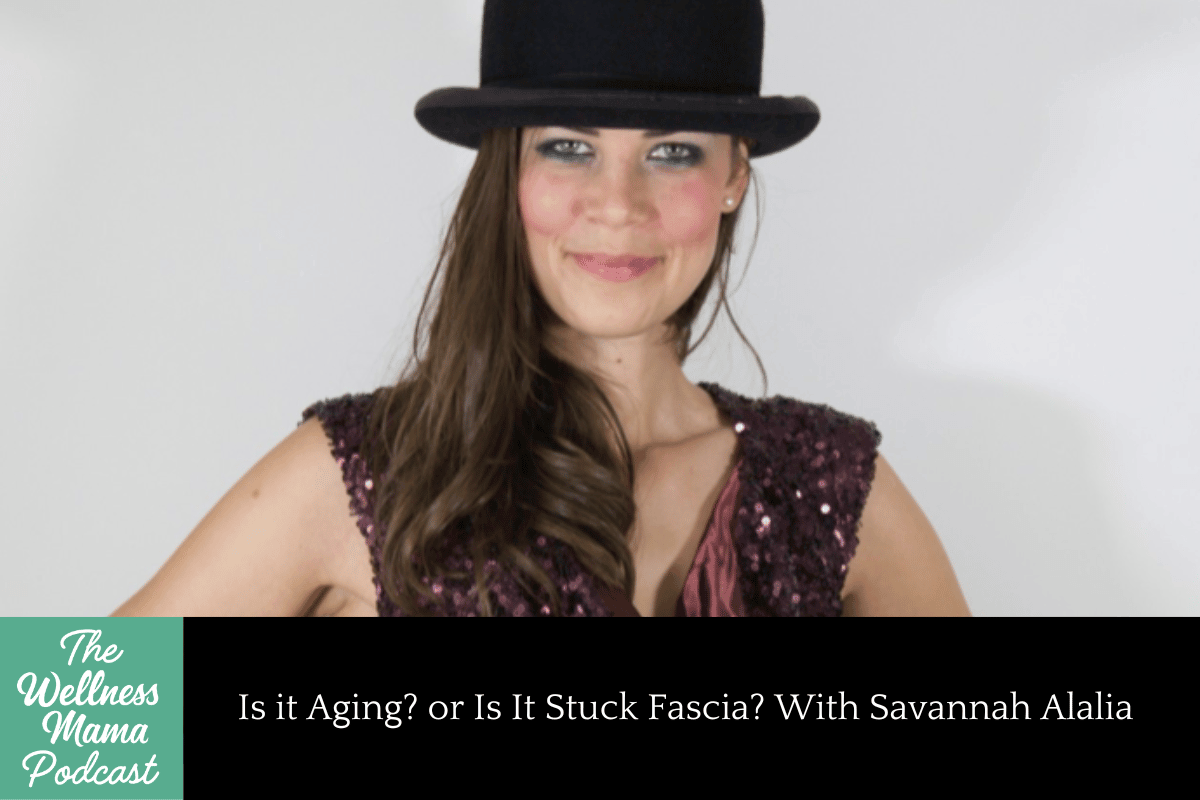
Katie: Hello and welcome to the Wellness Mama Podcast. I’m Katie from wellnessmama.com, and I am so excited to finally interview today’s guest. This topic, we’re gonna go deep on the topic of fascia and especially how it relates to aging. And how to get it unstuck. And I’m here with a friend, Savannah Alalia, who is absolutely, I’ve learned so much from her both on fascia and on the topic of something she developed called Face Mapping, which is stay tuned for our second podcast about that.
But she has, I love her fascially focused work, that it blends practical anatomy with clear and accessible teaching. And I love, you can see if you’re watching this on video from her face, like how well this stuff works. She looks phenomenal. And I have been learning recently her at home face mapping and fascial releasing methods, which we talk a little bit about today.
But her approach brings together gentle fascia release, breath led movement, lymph supported techniques, nutrition, detox and more. And in this episode, like I said, we go deep on the magic of fascia and is it aging or is it actually just stuck fascia? So let’s jump in.
Savannah, welcome. I’m so, so excited that you’re here today.
Savannah: I’m so excited to be here with you.
Katie: Well, we have gotten to meet in person. I have gotten to experience some of your work hands-on, which was incredible, and we’re gonna get to talk about that, especially in our second episode. But I feel like I’ve already learned so much from you, and I know that’s gonna compound even more today. And for our first topic, I would really love to dive deep on the topic of fascia because I have been personally interested in this for the last couple of years and just like researching it as a hobbyist.
But your knowledge on this actually goes so deep and I feel like this is maybe like a huge, massive, overlooked area of health, and at least to me personally, such fascinating one. I also know there’s a lot that go, kind of falls under this umbrella in this topic, but to start off broad, can you maybe just define for us what is it and where is it?
Savannah: Yes, I, first of all, I love fascia. I am, I have been fascinated by fascia for about the last 30 years. And fascia is something that honestly, I think it’s the magic when it comes to the body because it is the web of connective tissue that covers your entire body underneath the skin, but all around your organs, around every single muscle.
And it’s often when we’ve, when we look at anatomy, photographs for example, it’s often the bit that’s been taken out. So all you can see are all the muscles and ligaments and tendons, but actually the fascia was long thought to just be the packing, when in fact it’s something completely different.
It’s made up of collagen fibers and it’s in, I always say this word wrong, it’s in hi, which makes it highly hydro hydration dependent, which means the more hydrated you are, the happier your fascia is. So when it’s hydrated, your fascia slides really easily over itself and it glides, letting your tissues to be, letting your tissues move freely, basically.
And when it’s dehydrated or if you’ve been injured or it’s been stressed, it can glue up and it creates what’s called adhesions. I like to say stuck fascia, to help people picture it. Just because it’s actually something that you can unstick. And often if you think of an adhesion, sometimes people are like, oh, that’s it then I’m kind of, that’s the only thing that it is. Whereas it is in fact that’s untrue basically.
Katie: Yeah. I am so fascinated by this topic, and I’ve been wanting to understand on a deeper level for a while, like how do we directly support our fascia? Because I first encountered the idea of starting to understand fascia when working with athletes actually in the concept of kind of their muscle driven athletes versus fascially driven athletes and how smooth and connected fascially driven athletes are in their movement.
And kind of going down the rabbit hole of realizing that fascia has an electrical communication system that, from what I’ve read, is actually superior to even neurotransmitter communication in its speed and in the way like the whole body can communicate so rapidly electrically, which is fascinating to me. And for the past few years I’ve been thinking more and more of a voltage first kind of perspective on health from the body is that if we like electrically support the body and understand it as an electrical organism, not just a biochemical organism, we get such a different perspective on health.
And I feel like fascia is kind of a key here that we don’t talk about enough.
Savannah: I love that you brought this up because I think the reason I initially got into fascia as passionately as I did was because I began by working with energy. And so my whole thing with helping the body open was how can we help the body open to have more energy move through it? And there is, like you’ve said, in fascia, it has I think 250 million nerve endings, which is more than 25%, which is over 25% more than what the skin has just on the surface.
So the fascia inside the body and the lines of fascia, because they go from the top of the body all the way through, which is what you are speaking to with the athletes that you’ve mentioned. Athletes who understand those fascial functional movement patterns basically can put so much more power behind anything that they do and ease of movement through their bodies rather than being restricted in multiple different joints. It’s really quite humbling when you start to first get into understanding what it does, where it is, how it works, and recognizing the power that comes from unsticking it, and then strengthening around and through the body with your fascia, whether that’s through hydration, whether that is through, some people are, there’s so much research with fascia generally, but some people are doing a lot of research into sound and fascia at the moment.
And so therefore sound is obviously frequency and what’s possible with that.
Katie: Yeah, I feel like this is a, at least a topic, a lot of people don’t know a ton about, including me. And so I’d love to understand on a deeper level when we’re talking about adhesions or stuck fascia, like what are some of the factors that come into play with fascia getting to that point and or how do things like our more sedentary lifestyles many of us have in the modern world, or aging or hormones, like how do different factors we would encounter in daily life affect our fascia?
Savannah: That’s a great question. So stuck fascia, as I mentioned before, it gets glued basically, and it often happens because we’re sedentary because something hasn’t moved or because we’ve had an impact or an injury. Some people, some people sometimes think, oh, you know, if I go and I go to, I don’t know, I’ll go and do cycling, or I’ll go and do just one specific type of movement and only that movement and that means that it, I’ll keep my fascia moving. And yes, it will help certain ranges of movement, but if, ideally what you want to be doing is you want to be moving in multiple different layers from low down to high up to make sure that you are really moving the entire line of your fascia.
And it’s really important to unstick, I like to call it, Gil Hedley calls it fuzz when a fascia becomes adhered, and I really like that as a phrase because I think it’s a really easy way to visualize something that, especially when you’re trying to first get your head around where it is and how it works makes it very easy. Because you can feel like, oh, my shoulder feels like it’s sticking a little bit or my lower back feels like it’s sticking a little bit.
I know for a lot of people it’s, you know, between the shoulders and in the lower back because they are sitting so much, and so to mobilize all of those areas you do need to, you need to be a little bit more directed with what you are doing. The key thing with fascia is actually speed. A lot of people think, well, I’ll just go and get like a deep tissue massage.
That’s movement. Surely that’s going to completely open up any adhesions. It can help, it will be supportive. But the most powerful fascial release that I’ve come across is actually the slower you go, the more you engage the nervous system, the more you can connect to allowing your body to drop into rest and digest, the easier the adhesion will release.
Because the nerves and the fascia and the lymph, they all work really, really, really closely together. And so trying to force the fascia to do anything is one of the worst ideas you could have. Instead, you want to kind of focus on what I like to call melting the fascia. And think of it like a sponge, I suppose, where when you apply pressure into it and squeeze out the water or liquid that’s in it, then as it slowly rehydrates with the new liquid that comes into it, it means that its motion and its ability to move is improved. I’ve done recently some work with the amazing Jill Miller who I highly recommend and her work is just fantastic for supporting self, a self massage practice basically for your body through really helping open the fascia and all her stuff’s available online as well, digitally.
Katie: I love that and I’ll link to her as well. And one thing I’ve also noticed anecdotally, and I’m curious if you know any reason this might be correlated is that, especially in these fascially driven athletes I’ve gotten to work with, they across the board have had very high HRV, which you mentioned there might be a possible nervous system connection there and kind of the like, the slower you go and the more in tune with your nervous system, you are more regulated in parasympathetic you are the more the fascia’s able to melt. Which makes sense to me that there’d be a safety component here. But I thought that was an interesting correlation that I’ve noticed just purely anecdotally. But in the hundred percent of athletes I’ve worked with that are more fascially driven is that they also have seemingly, a really solid nervous system foundation.
Savannah: I think it’s really key, mainly because your fascia responds to your emotional state and there’s science and research now. I mean, there’s so much research still going on for fascia because it’s a little bit still, although we know where it is and we know it’s like a scaffold structure. It can also be more static or it can be more fluid.
Like it can change form, it can be more crystalline. It swaps between all of these states. And so there’s so much research going on around fascia at the moment, but one of the things that researchers have been working on or looking at or exploring to your point with the nervous system is they’ve been exploring what happens when you put fascia into chemicals that mimic, say, happiness or joy versus when you put fascia into chemicals that mimic stress or anger or sadness. And what happens as they’re in joy is they expand and open and as soon as they go into the stress, they tighten and constrict. And so you’ve got this very clear connection between what you are feeling and what happens with your fascia, and especially in the world in which we’re living, where stress is a real thing for most people who are, especially if we’re in the online space but just living in the world.
There are many things happening in our world that can cause the nervous system to feel unsafe. And I feel like fascia is one of the most important things we can be focused on at supporting our nervous system to be able to increase sensation and capacity to learn how to hang out with something that might feel more uncomfortable and move through it so that you can learn that actually, oh, oh, no, I am still safe.
My fascia is safe. I’m safe and I can open my body. Which I think most people don’t realize that emotional component and that emotional connection piece. So that feels quite important.
Katie: Yeah, that’s fascinating to me. It feels like it might actually help explain some of how I personally experienced and heard from so many readers and listeners who have experienced, when they had an inner shift or an emotional or spiritual or mental shift, the body responded in a very profound way. And so I’m curious if this over time is gonna help us understand that link, which feels very real, but which science often still kind of discounts and even to the extreme levels of that, how there’s terms like, you know, spontaneous remission because we can’t say miracle healing in medical text.
But I’m so excited to continue to watch this research around fascia. And you mentioned like the discomfort element. And I would love to also go a little deeper on the mindset around this because I’ve heard you talk about before about, you know, people thinking pain is the enemy and we have this mindset, especially in the west of trying to get rid of pain, kind of viewing that symptom quote, unquote as negative and trying to eliminate it. And I love your reframe of this, about it being kind of information or a messenger or a teacher, and especially maybe when we’re working with fascia, where we have stored emotions where we have maybe not nourished in the best way we could have through our lives.
It’s like that pain maybe is a great messenger, but I would love your explanation on that. Because I’ve heard you speak so beautifully on this.
Savannah: See, I think pain is a language that we need to learn to understand. I, some pain is bad pain. Like if you burn your hand on something, you know, that you know you want to avoid something that’s hot so that you don’t burn yourself anymore. But some pain, especially. I’ve had an experience where I cracked my sacrum and my sternum and I had a series of things happen where I had some things lock in my body.
And a lot of people say, you know, oh, it, that’s it, you know, once something shuts down you know, it’s aging. You just have to accept it. And I knew as soon as these things began to shut down, that something was going on. I wasn’t quite sure exactly where it was coming from initially, but as I started to open it all back up I realized that actually it was nothing to do with aging.
It was purely fascia. And I had this very experiential process around pain as well. And so I’d started to learn that my body would show me the next place it wanted me to go, and it would highlight the area. By it being painful. And most people, when you connect to something that’s painful, the automatic approach is, I need to get rid of this pain.
I need to like, get rid of it by taking something, or I need to go and see a manual therapist to help me get out of pain. And yeah, of course, ideally we wanna be living in a place where we’re feeling comfortable in our body. But the reality is that if your body’s showing you something it’s more important to hang out with it and figure out what it needs and how you can best support it.
I really feel like, and this is one of the reasons I do a lot of the work that I do, I really feel that if people can connect to the journey that their body is taking them on and that they’re with and in, in their body, as they go through life, they will be able to own that journey much more powerfully and take the symptoms that they’re experiencing to a practitioner and say, hey, this is coming up in this area, in this area, I’d really appreciate some support to help me open or mobilize this area. So pain I feel is more, it’s misinterpreted. It’s important of course, but it’s something that should be a signal for you of where next to go. And pain changes as well. Some pain is sharp, some pain flickers, some pain is like a deep, dark, dull ache.
And this is also very similar to what happens as the nerves will switch back on in areas perhaps when they’ve been shut down. So all of these pieces, it’s just about learning the different types of pain and learning to hang out in them, but then also learning how to move through and be beyond them.
Because if you can pay attention to that, you can unlock your vitality and you’ll access what you are actually hoping to create, which is a body that feels free and open and healthy and vibrant. It’s almost like energy packets. I like to think of it, that kind of get held in a particular area in the body that you need to just un pop and then it’s like you, you’re good to go again.
Katie: I love that so much, and I feel like that’s such a metaphor kind of across the human experience of like navigating that without getting stuck in the experience and or without bypassing it or resisting it, which at least in my experience, tends to actually like delay it, but amplify it, if anything. And it ties in so beautifully with something I say so often, which is at the end of the day, we are each our own primary healthcare provider. And that the beauty of that is the responsibility and the autonomy lies with us.
And we can work with practitioners to have amazing outcomes when they have specific knowledge we don’t have, as long as we maintain that responsibility and stay in the driver’s seat of making the changes ourselves. And I guess this is a little bit more into the realm of the esoteric, but I feel like it’s relevant here, which is kind of that idea of pain being a teacher.
And an experience I had this year more on an emotional level, but kind of with a dark night of the soul experience and realizing in that experience that while pain is maybe an inevitable part of life, pain, physical pain, emotional pain, whatever it may be, we experience those things, but at least for me in that experience, that suffering was a choice I was making by actually refusing to be with my pain. And it kind of reframed so many internal things for me. And I wonder if that is actually also our body’s message to us in that is like the pain is trying to tell us something. And when we refuse to go into it and to understand it, it actually just compounds and builds up and shows up in more places.
It’s like a downstream effect later on.
Savannah: It’s exactly what you’re saying. It’s that fight. If you get into that fight space with it where you’re going against it, you stop it from being able to finish moving through the body, and so you then suffer because you become stagnant and locked into that particular area. I love that. I love that story.
I know that was very, that’s exactly what was happening for me. I actually read, I read and I’ve worked with an amazing guy called Josh Pais who talks about emotions. He’s got a book called Lose Your Mind. I saw him a couple of days ago, actually in London. But he talks about, I’ve worked with him for about 10 years and he talks about how when you really go into an emotion and hang out with the atoms and the molecules that you can feel like buzzing around inside you, there’s really only about 12 seconds that it’s there for. And I think it’s really similar with pain. Like if you can go into it and really be present to it and hang out with it and kind of observe it and see where it’s going, rather than, oh my goodness, what is this?
I’m frightened, I dunno what to do with this. Which is a normal response. It’s what we’ve been trained to do. But if you can help relax into it and it, and be witness to it, rather than moving into an emotional, like idea of what you think it means, it can take you somewhere. And it doesn’t actually take that long for something to un, like, unping itself almost, if you can relax into it.
Katie: Well, and I definitely wanna get into fascia release and understanding that more in a minute. But before we get there, I also wanna highlight something else you mentioned kind of in passing, but really the connection between aging and stuck fascia. Because I feel like this is often overlooked in a culture where people are so willing to just inject or cut or do these harsh treatments to our body in the name of aging. And I’m curious, like the reframe around if we understand a fascial first kind of perspective how does that reframe how we think of aging? And I will also say for anybody who’s not watching this on video, to me, you are a perfect example of this because you, like, I don’t even, I’ve, you’ve told me your age and I don’t even believe it because you are so beautiful and look so phenomenal.
So I feel like you are the perfect shining example of this, but I would love for people to get to understand it on a deeper level. Because it seems like it’s often overlooked in the aging conversation.
Savannah: I feel like it’s the hugest thing that’s overlooked in the aging conversation. And thank you so much for your kind words. I feel like that about you. Like you’re such a living, breathing example of all the work that you do. It is just, it’s a pleasure to know you. It really, really is. For me I have seen, and I’ve watched people’s bodies because I’ve worked with people’s bodies for nearly 30 years. And over time what you start to see is you see patterns and often when people’s bodies are stuck, frozen shoulder, a hip that’s not working, a knee that’s sticking, an ankle that’s not quite firing properly, lines that start to appear on the face, things that start to sag in different areas.
I have always been fascinated by why, how, what does it mean? How, why is it doing that? Is it just that it, we’re going past a certain age? Now of course, different things change as we age. Hormones change, our ability to create the amount of collagen shifts that the body needs. But what I would say is that every, in every case of people that I’ve worked on, when you open up an area that is stuck and you can literally feel, you can find stuck fascia very easily. It’s something, it’s an area that feels stiff.
It’s a way in which you are unable to move any longer. That used to be normal to you. It’s lines or areas of your body sagging that is more than just aging.That is stuck fascia because our bodies are this incredible piece of engineering where everything has like a counterpart that works with it. And if you can maintain mobilization of the joints, of the fascia around the joints of the fascia through all the muscles and tendons and ligaments and around your organs and keep your organs moving freely, the vitality and the strength in the body stays.
And I’ve watched people, especially with wrinkles as well. A lot of people will say, oh, well that’s just, you know, I’m getting on now. I’m in my mid forties. This is me personally and I have still yet to have anything sitting in my face wrinkle wise at this time. But I will say that when I was having the issues before where I had a whole load of stuff stick from cracking my sacrum and cracking my sternum, that I started to have stuff appear in my forehead, which is now gone because I’ve opened it back out and I think people are too quick to cut, nip, inject, because they are wanting to maintain their vitality when in fact all they need to do is to get present to their bodies. Learn to figure out which areas are stuck and then remobilize those areas. You know, oftentimes when people get lines, for example, in their forehead, it means that the scalp is not moving properly and that then leads to the whole back line of your fascia through your body.
And so that’s a huge process that somebody can go, right, okay, I’m gonna work on the back line of my fascia at the moment and this is what I’m gonna go and do. I’m gonna go and work with this practitioner and this practitioner, and they’re gonna support me with this, this, and this. And you’ll be surprised at the areas where you’ll be like, oh, wow, I didn’t even realize like I was stuck underneath one of my shoulder blades or like underneath my right hip.
Because that whole back line isn’t moving properly. So it can be. I feel like people were too easy to jump on that, oh, it’s just aging, bandwagon when in fact it’s just stuck fascia.
Katie: Which to me is a really exciting concept. And you guys stay tuned because we’re gonna get to do a follow-up episode all about something that I have only ever learned about from you, which is face mapping and this fascinating concept of how the face can kind of mirror the whole body and what we can both learn and how we can affect change from that. But I’d love to at least touch on the idea of fascia release, and you talked about it a little bit and the importance of going slow and the nervous system connection. But I just feel like this can be so paradigm shifting.
And if we understood this from, even from birth for our kids all the way up through our ages as adults, like in aging, entering the aging conversation and even longevity, this could really shift things for people in a profound way. So if we think from this fascial first perspective like what is fascia release? How do we accomplish that and how do we like remobilize those areas that maybe have been stuck for decades?
Savannah: So I love this question and I agree. I think this could change the whole of how we look at our vitality as human beings. And I, the one thing that I’m most excited by, I was recently at the Fascia Congress in New Orleans this year, and one of the speakers there poke about from the research that they’d done, that you can have effective fascial mobilization in as little as 10 minutes each day.
And that was really exciting to me. Because a lot of the time when you start to do things with the body, you sometimes think, oh, I need to do like at least 90 minutes. So for it to have an effect and I need to do it every single day. Now, yes, you do need to be consistent, but you could do like three lots of 10 minutes in a day.
And if you’re honing in on the particular areas that you know you are stuck on or stuck in or around. And this is one of the things I love about face mapping, which I know we will speak about, but face mapping for example, is the way that I found to help people connect to where they’re stuck in their bodies.
And I think when you can begin to feel and become aware of like, oh, maybe I need to go and hang out with my right hip or my left hip or my lower back, or maybe there’s stuff happening like around my chest that I need to be more aware of or no, it’s definitely all in my neck. Like when you can learn where you need to go because your body’s saying to you, this is the next area for you to go to, then you can start to have small practices. Whether it is, you can see a practitioner who does myofascial release. You can see a Rolf or a structural integration practitioner, all of whom are fantastic. You could go and work with somebody with Feldenkrais that will help.
There are multiple different ways that you can address this. I love always doing some stuff myself because I feel like having that ownership of what’s happening in your own body is just so much more powerful, especially if something stressful has happened and the fascist tightened. Like, I want to be able to like, get on my, my balls and roll and open it back out quite quickly.
So that’s, I will always point people back to Jill Miller’s work for that because I love that. But yeah, you can do a lot in as little as 10 minutes a day. And I feel like that is incredibly liberating, especially when it’s something that can feel daunting when you first start to look at opening fascia.
I think the biggest, one of the biggest things with it as well with fascia is about being kind to yourself. Because the whole way in which you approach your fascia, like I said earlier, the speed, but also the intention that you have is you start to open an area is very easy when something feels like it’s not working properly for you to get angry about it or to be irritated that your body is letting you down.
And in fact the quickest way for you to get your body to respond, to get the fascia to open is coming at it from a way of, I’m doing this because I love myself, I’m showing up for myself rather than disliking your body and almost being in a battle with it. So I feel like that is really, really key as well.
Fascia is actually very simple. It’s the way you would hopefully treat your children or the people that you love around you. With kindness care, love, attention consistently. If you can offer that to yourself and your body, then you will have the most incredible results.
Katie: Yeah, I think that’s so important and that like learning to befriend our inner experience for me was so, so profound. And I used to have those stories of if only this, then I would be happy and learning to like kind of flip that on its head. But I had to learn the hard way that I couldn’t punish myself healthy or thin, that the befriending came first.
And I’m so, so excited, like I said, to keep following our understanding of fascia and especially how, like you mentioned, we might, we see a connection with sound therapy, with light, with the fascia responding to things in the environment in a really profound way. And I would, at least I would guess at least that there’s probably like a nature element of fascia as well that like I put so many things under the category of nature deficit disorder and I would guess that spending time in natural light, in fresh air, in normal human movements, even if it’s just walking and slow, gentle movements, probably are supportive of the fascia in some way, but especially the light and sound connection makes me curious about something else I’ve heard you mention in passing, which is maybe this connection between physical body and the energy body and how fascia might be part of the link there.
So if you’re willing, I would love for you to just explain your understanding of that. Because I’m really excited to learn more about this.
Savannah: I love that you’ve asked that. Thank you. I feel like fascia might be, and I’m looking forward to science proving this statement, but I feel like it might be the interface between our physical body and our emotional, energetic bodies, the things that we feel outside or slightly away from ourselves, that that feeling when you walk into a space and maybe it gives you the heebie-jeebies or it’s so sacred that you are humbled by it or it’s so, it’s such natural beauty that you almost feel like you explode from your chest because it’s just like humbling. Like I feel like the fascia is a key part of what that is.
And I actually, when I first started working with fascia, I didn’t even know that that’s what I was working with. As I started to work on people’s bodies, my background had come from working with energy. So my focus was always, let’s get everything open so that the energy can move better so people can feel more.
And it was almost by default that I noticed that the slower I went with somebody and I allowed their body to show me when it was ready to let go rather than kind of very vigorously moving the tissues, the slower I went, the more I breathed with it, the more I helped them relax into it, the more that they were able to open and feel more and more and more.
And so seeing that consistently over 25 years, because I stopped working hands-on about five years ago, really made me see that this, there’s so much more here than just, fascia as one single thing in the body. Like it’s the conversational piece between the energy piece and what’s happening physically.
I’d watch people as we would open areas have these huge emotional explosions where they cry for no reason or they start laughing uncontrollably. Or they’d get really agitated. But it would, it was like we were popping it out of them. Because as soon as we moved out and through, it was like, oh, that feels better.
And it, and it would be gone. And so I feel like it’s through the experience of what I’ve done, that I’ve really seen this applied. And then as I began to try and unlock the things that were stuck in my own body when I was dealing with five migraines a week and, you know, I was having 20 to 30 hours of work done on me from different people.
Like I reached out for help. But it was only really when I took the driving seat in my own process that I was able to really pinpoint the next step of what I needed personally to unlock all the different parts of my body. And I feel that that’s what I try to support people to connect to in themselves through their fascia, to begin to understand how the fascia works, to begin to understand where it is in their body and how they can work with it to create a transformation for them personally.
The more I, the more work I did with what I was unlocking, it became very clear that even acupuncture and all the channels from acupuncture were working with the fascia, like there’s studies that are beginning to show the impact of what happens in fascia through acupuncture and how that can release the fascia.
There are so many ways you can open the fascia. It’s really about finding what’s a way that you can work with consistently and also keep exploring. But I mean, I, I’m so excited right now at the level of research that is out there and the research that’s continuing in so many different areas, and I love that it’s something that we’re seeing in the medical community as well as the sort of personal training community as well as massage.
Like it’s all coming together and we’re, we’re kind of opening out a whole new paradigm of what’s possible through fascia with your body.
Katie: It really is incredible. And to your point, I feel like this is a beautiful, when we understand this, it’s like we can create a positive flywheel, like a positive feedback loop, where the body helps the mind and the emotions and the mind and the emotions help support the body. And of course those can go in a negative direction as well, but when we understand them, we get to create this beautiful kind of growing positive charge by understanding these things.
And as an anecdotal example of what you’re saying, I had an unavoidable C-section with my third baby that was lifesaving. I had placenta previa. However, I medically died during that C-section for a couple of minutes. He was in the nicu. So it was a very highly stressful day of my life. And when I had myofascial work much later on and scar release on my C-section scar, it was like a lot of those emotions came back up.
And then I was sort of like, I felt my nervous system exhale in a different way kind of since that time. And it like opened my eyes to how profoundly those experiences are connected as we navigate life. And like you, I’m really excited for what we get to keep exploring and learning related to this topic in the next few years and decades. And I know you talk about this online as well. I love following you on social media because you’re always sharing so many things that I’m always learning so much from you. Where can people find you on social media to learn from you? And then of course, we’re gonna get to go deep on face mapping, which is a whole nother topic I’m so excited to go deep on with you.
Savannah: Thank you and I love putting stuff out on social media. I am at SavannahAlalia. So just my name on social media and yeah, you can come follow me on Instagram and just yeah, check out anything that you would like to and ask any questions that you’ve got as well. This is a journey for all of us, so I’m just excited to share it and be along alongside it with all of you.
Katie: Amazing. Well, I will link to all the things we’ve talked about and to your online world so people can find you and keep learning. And like I said, you guys definitely tune into our next episode about face mapping because I feel like this is extremely unique. I love it personally. I’ve gotten to explore it some and I keep learning from Savannah about it. But for this episode, thank you so much for your time and for being here today.
Savannah: Thank you so much.
Katie: And thank you for listening and I hope you’ll join me again on the next episode of the Wellness Mama podcast.




Leave a Reply