Read Transcript
Child: Welcome to my mommy’s podcast!
Katie: This podcast is brought to you by LMNT, and this is a company you might’ve heard me talk about before, and I really love their products because proper hydration leads to better sleep. It sharpens focus, it improves energy, and so much more. But hydration is not about just drinking water because being optimally hydrated, a state called euhydration is about optimizing your body’s fluid ratios. And this fluid balance depends on many factors, including the intake and excretion of electrolytes, which many people don’t get the right amounts of. Electrolytes are charged minerals that conduct electricity to power your nervous system. I talk a lot about nervous system on this podcast.
They also regulate hydration status by balancing fluids inside and outside of our cells. LMNT was created with a science-backed electrolyte ratio of 100 milligrams of sodium, 200 milligrams of potassium, and 60 milligrams of magnesium with no sugar. Since electrolytes are a key component of hydration, here’s what happens when we get our electrolytes dialed in.
We have more steady energy, improved cognitive function, suffer fewer headaches and muscle cramps, we can perform better for longer, and especially the support fasting or low carb diet because when we stop eating carbs like during a fast, the absence of insulin allows the kidneys to release sodium.
So replacing that lost sodium with electrolytes can help you feel good on a fast. Since LMNT is zero sugar, it also doesn’t break up fast. Electrolytes are also important for maintaining blood pressure, regulating digestion and proper fluid balance. Keeping skin hydrated, which is a big one that I feel like often gets missed and so much more.
I feel like proper electrolytes is a missing piece for a lot of people and I love LMNTs new canned drinks, which are sparkling water with all the same ratios and minerals I just talked about, and they are delicious. You can check it out and learn more at drinklmnt.com/wellnessmama. And at that link you will receive a free sample pack with any order.
This episode is sponsored by BON CHARGE, and I love so many of their products from their red light face mask to their sauna blankets and everything in between. They focus on high-end wellness tech, and if you’re interested in how light can help you, which I talk a lot about, BON CHARGE has so much to offer.
Studies have found that specific red light frequencies can help reduce fine lines and wrinkles when used at the correct brightness and strengths. And some products don’t get these correct. The frequencies of red and near infrared light stimulate cellular activity at a mitochondrial level, which I talk a lot about on this podcast.
This can create better energy efficiency in a given location of the body. For instance, red light on your face gives more cellular energy for biological processes. This can help to decelerate the signs of aging and lead to firmer, plumper skin. So the long-term results you can see when using an LED mask over time are things like, reduction in the appearance of fine lines, reduction in the appearance of wrinkles, reduction in under eye bags, firmer skin, tighter skin, reduction in signs of aging, scar fading, plumper looking skin, reduction in visibility of blemishes, and visibly clearer looking skin.
I’m always a fan of getting natural light from outdoors, but for people who are wanting to kind of tackle the aging process head on, this is in a way to kind of give your body some extra benefit from these specific wavelengths of light.
The safe, non-invasive beauty treatment is going to be around for a while, and for a good reason given the results people are seeing. If you wanna check out the BON CHARGE Red Light Face mask, and all of their products, you can go to https://boncharge.com/wellnessmama and use the code wellnessmama for 20% off.
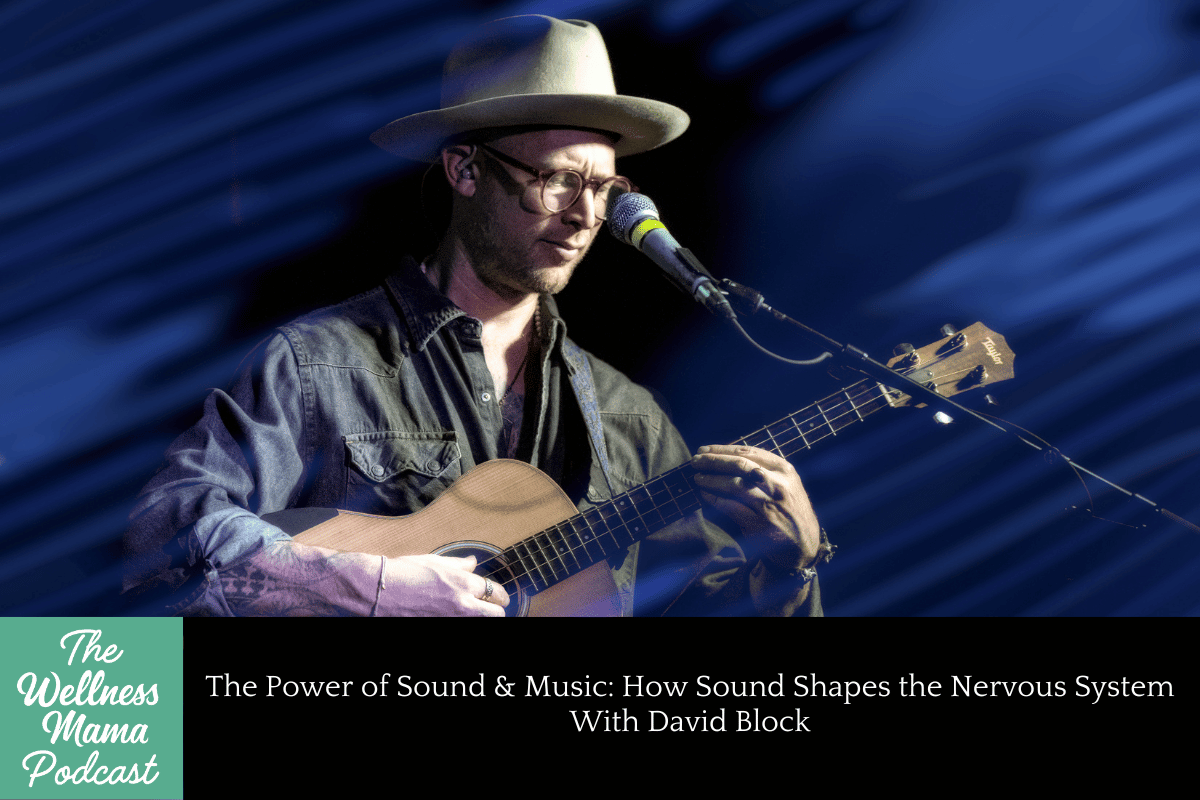
Hello and welcome to the Wellness Mamma podcast. I’m Katie from wellnessmama.com and I am back with David Block, who goes by the Human Experience as his recording title online. We had a conversation about accessing the creative spirit, and he’s back today to talk about the power of sound and music and how it can shape our nervous system.
And we talk about frequency, vibration, how sound impacts the body. How it can help us access things called hypnagogic states, which are kind of the states between sleep and wakefulness. And how those can be states of healing and creativity and inspiration and how also sound can help us tap into the meditative states in a way that we might not be able to access just by our mind, and the physiological ways that we know that sound impacts us.
So, fascinating conversation. I enjoyed it very much. It’s a fun deviation from the normal talks on just health and wellness and something I believe that can be profoundly impactful to our health and wellness. So without further ado, let’s join David. David, welcome back. Thank you for being here again.
David: My pleasure, love talking to you.
Katie: Oh, it’s such a fun conversation. I’m so grateful. We finally got to connect and record it. And I’ll link to our first conversation in the show notes because it was a beautiful dive into accessing the creative spirit and you had some really powerful, I feel like reframes and paradigm shifts that definitely resonated with me.
So that conversation is linked there. And in this conversation I would love to explore the topic of sound healing. Because I feel like your music does something really special when it comes to this. And you and I briefly got to chat before, and you talked about kind of the special space that can be created by music and how sound can allow us to sort of access things in a different way.
So I would love to kind of dive in by maybe you defining what that state is and maybe going through like what’s happening in the body and the brain when we encounter sound in this way.
David: Yeah. Well this is a very interesting topic for me and I would say, well first when I think sound healing, I’ve been sensitive about that because I’ve been calling my experiences sound journeys because I don’t wanna force anybody to heal. If they wanna heal, then that’s great. Or if they want to just explore different alternative states of consciousness, that’s great. If they want to cry, that’s great. My invitation is just for people to feel deeply and explore and expand their consciousness.
I’ve been making music, I started playing music when I was six, and I remember when I went to my first giant rave when I was 16 and that was at Coachella at that time. And someone, if you were to say that that was sound healing, I would, most people would be like, no, going to a giant like crazy rave and dancing with 60,000 people is not sound healing. But if I was to look back at that experience, was the first time I experienced unity consciousness dancing up and down with 60,000 people.
I would say that was probably one of the most healing transformational moments of my entire life still. So I think just when I think about the power of sound and music, the power of different frequencies and how they work together in harmony to create different states of consciousness.
I think that sometimes people think about, you know, all the gongs and singing bowls and tuning forks and things, which I use as sound healing tools, but you know, it’s gonna be different strokes for different folks I guess. But for me I think I have always loved science and spirituality, rational materialism and the unexplained. Like how Einstein really loved the power of imagination and science. And so I’ve had a lot of interesting experiences, some that I’m like, can’t possibly explain how that is happening.
And others that have some really incredible hard science behind them. I’ll give you an example here. I’m gonna come grab this. Just happen to have a bunch of stuff behind me here. This is a tuning fork. If you’re not familiar with the tuning fork, let’s hit it here. Very high pitched here. I can’t even hear it with the headphones on, but, so we will hit it with this. So anyway, this is a tuning fork. Interesting thing about this tuning fork. This is resonating at, and vibrating at, 2,675 Hertz. What does that mean? That means a wave, a sound wave, which is just like a light wave. Like for example, if you kept having light down, eventually you’d be able to listen to that light, right?
It’s the same thing, like a light and sound are not different. They’re just frequencies and they have different Hertz. Hertz are the amount of time the wave goes up and down and crosses a line, and it’s how many cycles per second, okay? So if we think of this going up and down, 2,675 times per second, okay, follow me here. If I put this tuning fork next to this tuning fork and I hit it, nothing will happen.
But if I put this tuning fork and I hit it next to the same tuning fork. It will vibrate without touching it. That’s called sympathetic resonance. When someone’s like, I really resonate with what you’re talking about, I really resonate with you. That’s real. We are everything in our reality is a frequency. Everything has a frequency. Some of it you can hear, some of it’s electromagnetic. Some of it you can see some of, there are a lot of different frequencies, but they’re all frequencies, right? This is vibrating at a certain frequency. This is vibrating at a different frequency.
It’s not a good or a bad frequency, it’s just what it is. If you put this one next to the same one, it will literally vibrate the other one without touching it. So when I start to think about things like that, I start to think what is happening at a concert? How can music tune me? Why does a scary movie soundtrack sound scary if I’m not watching a scary movie, but if I watch a scary movie on mute, not so scary. Like the power of music, the power of sound, and the power of frequencies. So I like physics stuff like this. And then I also like some of these singing bowls, like this one here, like this singing bowl is over 400 years old.
There’s such a complex, rich, amount of sound coming from this bowl. There’s not just one tone, not just one note. But one of my favorite things about these bowls, like these meditation bowls, is this wasn’t even general, essentially created for meditation. People used to eat out of these bowls, or like for like 600 years, they would feed animals out of the bowls. The most beautiful thing about these bowls, which can be used for healing and transformation, for example, is that the universe is full of things that vibrate whether you want them to or not. Like we didn’t invent math. We discovered math. We discovered some of the beauty and mystery of the universe.
We didn’t, I didn’t tell the tuning fork to vibrate another object by sympathetic resonance. It just does that. I didn’t tell the singing bowl, which is made out of these metals to vibrate and emit some of these frequencies that we’ve now studied that can transform our brainwaves from alpha to theta to different brainwaves, they just do that.
There’s no ambiguity or woowooness necessary to understand that if you listen to some of these certain frequencies that they will induce meditative states in your brain whether you want them to or not they generally will, if you listen to theta waves, they will induce, they will entrain your brain to create a theta wave. So anyway, lots of cool stuff out there in the world of sound and music.
Katie: Oh yeah. So many follow up questions, especially about these like ancient singing bowls that you have. But I, like you, I love, Einstein’s focus on imagination and his idea that either there’s two ways to live. We can either live as if everything is a miracle or if nothing is a miracle, but you can’t be in the middle.
Like kind of gotta pick one. And also when it comes to like frequency and vibration, which Einstein ironically also has a quote around that, so did Nicola Tesla, but how humans can only see and hear a tiny fraction of the visible and audible spectrums. However, like seemingly we can sense and feel beyond what we can see and hear. And seemingly, maybe this is like what comes into play sometimes with that vibration. And so I’d love to explore more of these meditative states that we can access through sound and how to get there. And also the nervous system impact because I’ve at least experienced that anecdotally, and it seems like it can be quite profound.
And I know in science we’re actually exploring in a research capacity the healing effects of sound, which I know is outside the scope of, you know, music. But I think it just speaks to how profoundly sound can actually influence us.
David: Yeah. So, I was in India in February, March, and I kind of received this transmission to do these sound journeys, that, it was basically came to me in a name and it was like, oblivion. Oblivion. And I’m like, I’m not sure what’s happening, but I’ve received a lot of transmissions and I’ve brought them through, and I think, when I think of, when I think about human beings as like an antenna, like transmitting and receiving information from, let’s call it the Akashic field or something that is not just like the rational materialist, like meat sack reality, where I just like, I’m just like a floating blob of meat and blood with where my consciousness is in my brain and I just, I don’t really feel that way.
That’s not my experience of reality. So I got this hit, oblivion. I was like, I don’t know what this means. And I had like 20, 16 to 20 singing bowls at this point before I had been collecting them. Because I lived in India and I lived in other places where I was exposed to them. Anyway, about a hundred singing bowls later and now collecting some of these ancient bowls and these giant gongs, you can see one behind me and all these pretty crazy interesting tools and things like that. I started these oblivion journeys, which were, these, are, I’m doing them now, and now has become a cool album, which I would invite you to listen to, these two hour explorations of non-ordinary states of consciousness. For me, they were kind of like somewhere between a puja and a ceremony.
And an invitation to not necessarily just heal, but just explore alternative states of consciousness induced by sound and music, not necessarily assisted by other things. Which is another topic. This was how can we access and explore non-ordinary states of consciousness with our internal pharmacy? How can we do that? And one thing I noticed is I would take people on these journeys and a couple people started coming and they were wearing Oura rings. I was like, oh, cool. I’m curious what kind of biometric data we can collect about what’s happening. And so I had this one person come to me and they’re like, oh, it was really beautiful, I really enjoyed the experience.
I said, oh, that’s nice. I said, can I see the data from your Oura ring? And they said, yes. I said, well, tell me about your experience first. He said, it was really enjoyable. I enjoyed every part of it. I said, well, did you fall asleep? They said, no. I said, are you sure? They said, absolutely, 100 percent I did not fall asleep. I said, let me see your Oura in data. It logged a one hour nap, including 45 minutes of REM sleep and 15 minutes of deep sleep. And I said, well, that’s weird. Do you remember this, this and this? They said, yes. I said, well, okay. What’s happening here?
There’s something happening. And that took me down this path of exploring what are called hypnagogic states. State between sleeping and wakefulness. This is not a possible, not like a, maybe does or maybe doesn’t happen, or kind of like a woowoo kind of statement. It’s just a thing that has been cultivated by everyone from Thomas Edison to Mary Shelley and writing Frankenstein. I mean to Salvador Dali, where they would like fall asleep. Dali was famous, he would fall asleep with a key in his hand and when he would fall asleep, the key would fall out of his hand and hit a metal plate and he would wake up and he would paint from that state.
It’s a state between sleeping and wakefulness. It’s between alpha and theta waves. It’s a measurable brainwave state. Alpha waves being our creative state. Theta waves being our meditative state. And that, how can we cultivate these alternative states of consciousness to ultimately have a more, I don’t know, maybe joyful life. Maybe more creative life, maybe more peaceful, graceful life. So yeah, I’ve been, I’ve been exploring a lot of these things and it’s been an interesting process to say the least.
Katie: Yeah, that’s fascinating to me. I’ve actually had that same experience with your music. Because I play it often in a wellness center that I own and as like background music and my Oura ring will register like deep rest or sleep or restorative time, even if I’m not at all asleep. And so it’s so fascinating to me this concept of, through sound, we can endogenously enter this, alternative states of consciousness or meditative states without anything chemical happening in our biology other than that which is innate to us.
And it seems like sound also has the ability kind of to the point you just explained with these hypnogogic states to like bypass our analytical mind. And I know for many people that’s kind of the barrier when it comes to meditation in general. And so perhaps like sound is an entry into that. I know for years and years I was not great at meditation and would say I couldn’t meditate.
And I have learned more in that. But it feels like sound might be kind of a way to bypass the analytical mind in a way that lets us kind of enter these states. Even if we like quote, don’t think we’re good at meditation.
David: I mean, I would definitely, I moved over here to charge, by the way. But yeah, I would say that sound really helps our mind focus on something, especially as, that there are so many forces distracting us all the time. You know, we’re constantly bombarded by information that we may or may not have consented to receiving, like on a billboard or on a commercial or on an advertisement, and it’s just constant bombardment of stuff.
So. You know, it’s not like a very surprising thing that people have a hard time meditating in silence or in stillness with nothing happening. It’s super reasonable that that’s the case. So I would say that having a tool, whether that’s a mantra or a yantra or sound or something to focus on, can be very, very helpful. The other thing is, is, you know, depending on what we’re using to meditate, you know, as you, as I said, you just said, you’ve heard certain parts of my music and you found it very soothing or meditative.
There may or may not be a specific frequency in there, like a theta wave or an alpha wave or something like that from like some of the more medical approaches to sound healing embedded in those. Those are more the relationships between notes, which is one thing that I think is just so beautiful. Like if you were to look at a map of what’s called the Harmonic series, if anybody is watching this, if you wanna see something beautiful, you want there to be zero ambiguity anymore ever again in your life, that the universe is amazing.
Just Google picture of the Harmonic series. Google it. You tell me that the universe is not divinely orchestrated. That the distance between an octave and then having that and looking at the harmonic series, just look at it and just, it just, what does it awaken in you? It’s just so beautiful. You know.
Music is so incredibly beautiful when we think about harmony and how harmony works and how there are certain things that sound discordant and, but how you could also use discordant things as tension. I mean, there’s so much beauty in how music works. It’s a bit different than some of the sound healing stuff, but it, it all, they all play together. They all play together. You know, it’s gonna be different than if you were to go online and if you wanted to have something more meditative happen in your life, just put on theta waves. You can do what’s called brainwave entrainment and play a theta wave and it will help do what I showed you with the tuning forks, and it will entrain your brain to be in a more theta state. You can do that. It’s not a, maybe it works, maybe it doesn’t. It just does.
You can do it. They’ve tested it a lot. That’s gonna be different than when you listen to like a piece of music and you’re saying, this music makes me feel happy or sad, or, but those things are also reasonably measurable too. They’re more subjective. But I mean, if you put on kids’ music, it generally sounds pretty happy. I don’t think anyone, you know, it might sound annoying, but, uh, it might, uh, it’s, you would probably agree that you’re like, oh, these are like de de de. like, you know, they’re happy sounds. Very rarely are you gonna put on like kids’ music and it’s like, DU DU DUN DUH. Because different pieces of music evoke certain emotions and there’s a reason for that. So.
Katie: Well and speaking of that, I would say I’ve listened on repeat lately to your album, I remember this place, and I would love to hear a little bit of the, kind of the inspiration and the story and the process behind that one. Because I’ve personally enjoyed it a lot.
David: Yeah. Thank you. Well, this is my new house as you could see there are singing bowls. Well probably almost a hundred of them in the living room these days. And it was an interesting journey creating that album. I had a very traumatic experience from the fires this year in LA and didn’t lose my old house.
I haven’t moved since then, but was very close. And ultimately at the end of that I decided to go to India, where I think I told you a little bit about this story earlier in our discussion about receiving the idea for oblivion. And as I was doing these sound journeys I realized that it was very hard for me to scale the experience that other people were having, which were these like really crazy states. And I was like, wait a second, you know how to do this, you’re a music producer. Like, let’s make an album. And I decided to make an album of different configurations of the singing bowls.
One of my favorite things about this album and what I think is the most interesting thing is although each of the pieces on the album, it feels musical, in a way, is that, you know, multiple bowls are being played together, they were not designed to be played together. That’s purely by chance. I mean they were made over the course of hundreds of years. I think that the oldest to the newest bowl is 600 years apart.
There was no standardized tuning, like for example, what’s called the equal temperament scale, like that, C, like middle C on a piano is the frequency it is, or A above C is 440. That was not the case when they made these bowls. They just made bowls that happened to make sounds, right? They didn’t, weren’t like, this one’s gonna be an A and this one’s gonna be a C, and A and C go together like this. That’s not how this happened. So I had to select out of thousands of bowls, ones that played together in a beautiful way. Then intuitively, I went through my collection of bowls and found different ones that I felt evoked different feelings. And when I started the recordings I didn’t have the name yet.
I was just making the pieces and exploring and being like, wow, like this one makes me feel like beauty and this one makes me feel joy and this one is a bit more mysterious, makes me feel curiosity or wonder, or magic or these different things. And kind of going back to our previous podcast, I realized that it’s not something that, it’s not healing. I don’t, I mean, maybe it’s healing. I don’t know. I don’t know what it is. For me, it’s remembering. That’s what people are doing. They already have it. I’m not doing anything. I’m just helping them remember. They’re, everyone, they’re doing it. You know, the frequencies are just getting things out of the way so they can remember the healing that they, the healer that they are, you know, it’s like I’m not doing anything, I don’t think. And so this name came, I remember this place because, because in the album you’ll notice there is a sound, a nature sound that happens.
And one of my things and my little secret that I’ll tell you about this, the place that you hear, because it’s the same sound throughout each of the different pieces of music is that place doesn’t exist. Like I took a, I took a recording of a place and I pitched it down. So the bird sounds are lower frequency, the rain is lower.
It means everything slowed down. The rain is like 30% slower than the rain that happened at that place. The birds are like 30% slower. And so I created a place, a mystical place, a place that’s not here on Earth. And I, my intention was to take people to a place. It’s here, but it’s not here. And that they would remember this place in themselves where they’re not their job, they’re not their body, they’re not their identity. They’re not the things they tell themselves about themselves. They’re not the constructs of who we think we are, that we’re more than that. And that if you listen to this album, hopefully you’ll remember that. You’ll remember your joy, grace, trust, beauty, magic, wonder, all the titles of each individual piece of music.
Katie: And I feel like that’s a perfect tie in and a perfect place to put a pin on this conversation. Because it goes all the way back to the beginning of our other one of remembering creativity and wonder and awe and joy and these things we come into life innately with and kind of get trained out of us over time and the beauty of remembering them.
And so I hope that thread has woven through both of these conversations. And I’ll put links in the show notes for a lot of people who listen on the go, but where would you encourage people to find you and to listen if they wanna listen to your music or to learn more from you? I know you’re at a lot of places on the internet.
David: Yeah, you can follow me on Instagram. There’s a pretty wide palette of things that I do there from art and jewelry and photography and sculpture and music and all sorts of stuff. That’s a cool place to follow along with my life. I would definitely encourage you, yeah, do a deep dive on some of the music. Some of the sound journeys are happening all over the world. I’m actually gonna come to Florida. Come to do, they’re gonna bring me to do some of my sound journeys at Okeechobee, which is gonna be really cool. That’s a cool festival out there, because I know you’re there.
But I travel all over the world and I would say if you do have an opportunity to come to one of the oblivion journeys in person, those are really, really special. Maybe I can come do one out at your wellness center. Yeah, and otherwise I hope the music inspires you. That’s my, if you do find something, just know that, that’s my intention with it, is that it inspires you to create something beautiful, to be a more loving, kind person, to help alleviate the suffering of other people and have compassion and joy and gratitude and beauty and that hopefully the music can be some kind of catalyst to do that. So you can find it anywhere on the internet and all my music is available for free and high quality on my bandcamp or and you can stream it on Spotify and stuff like that too.
Katie: Amazing. Well, I will put all those links in the show notes. You guys can find those at wellnessmama.com. And David, I hope we get to meet in person sometime soon and I get to experience your music in real life one day. But for today, thank you so much for all that you create for your time and for all that you’ve shared today.
David: Yeah, thank you so much for having me. Thanks for listening.
Katie: And yeah, thank you guys for listening, and I hope you join me again on the next episode of the Wellness Mama Podcast.




Leave a Reply