Read Transcript
Child: Welcome to my mommy’s podcast!
Katie: This podcast is brought to you by LMNT, and this is a company you might’ve heard me talk about before, and I really love their products because proper hydration leads to better sleep. It sharpens focus, it improves energy, and so much more. But hydration is not about just drinking water because being optimally hydrated, a state called euhydration is about optimizing your body’s fluid ratios. And this fluid balance depends on many factors, including the intake and excretion of electrolytes, which many people don’t get the right amounts of. Electrolytes are charged minerals that conduct electricity to power your nervous system. I talk a lot about nervous system on this podcast.
They also regulate hydration status by balancing fluids inside and outside of our cells. LMNT was created with a science-backed electrolyte ratio of 100 milligrams of sodium, 200 milligrams of potassium, and 60 milligrams of magnesium with no sugar. Since electrolytes are a key component of hydration, here’s what happens when we get our electrolytes dialed in.
We have more steady energy, improved cognitive function, suffer fewer headaches and muscle cramps, we can perform better for longer, and especially the support fasting or low carb diet because when we stop eating carbs like during a fast, the absence of insulin allows the kidneys to release sodium.
So replacing that lost sodium with electrolytes can help you feel good on a fast. Since LMNT is zero sugar, it also doesn’t break up fast. Electrolytes are also important for maintaining blood pressure, regulating digestion and proper fluid balance. Keeping skin hydrated, which is a big one that I feel like often gets missed and so much more.
I feel like proper electrolytes is a missing piece for a lot of people and I love LMNTs new canned drinks, which are sparkling water with all the same ratios and minerals I just talked about, and they are delicious. You can check it out and learn more at drinklmnt.com/wellnessmama. And at that link you will receive a free sample pack with any order.
This episode is brought to you by Hiya Health. Everyone’s talking about their New Year’s resolutions, and while everyone else is promising to hit the gym in 2026, I am focusing on something much easier that’ll actually stick (gym’s already pretty well a habit for me) which is better nutrition for my younger kids.
And that is exactly why Hiya exists, to give parents a real solution in a market flooded with products that prioritize candy-like appeal over actual nutrition. Some children’s vitamins on the market have up to seven grams of sugar per serving and are stuffed with additives and petroleum based dyes.
Hiya took the opposite approach. Zero sugar, zero gummy junk, just clean nutrition. And the crazy thing is kids actually love them. The taste, the experience, all of it. It’s thoughtfully designed. They looked at what modern kids are eating and not eating, and formulated around those specific nutritional gaps.
Working alongside pediatricians and nutrition scientists, Hiya created a superpowered chewable vitamin that packs 12 organic fruits and vegetables, plus 15 essential vitamins and minerals, including B12, C, zinc, folate, and more. The ingredient list is clean with no GMOs. It’s dairy free, allergy free, gelatin free, nut free.
They’ve thought of everything. Plus, they’ve earned their clean label projects, highest purity award certification, and they put every batch of product through third party testing for heavy metals and contaminants. So it’s the kind of transparency that actually means something. They are designed for kids 2 and up, shipped straight to your door in a reusable bottle with refills that come every month.
We have worked out a special deal with Hiya for their bestselling children’s vitamin. Receive 50% off your first order. To claim this deal go to hiyahealth.com/wellnessmama This deal is not available on their regular website. So again, go to hiyahealth.com/wellnessmama and get your kids the full body nourishment they need.
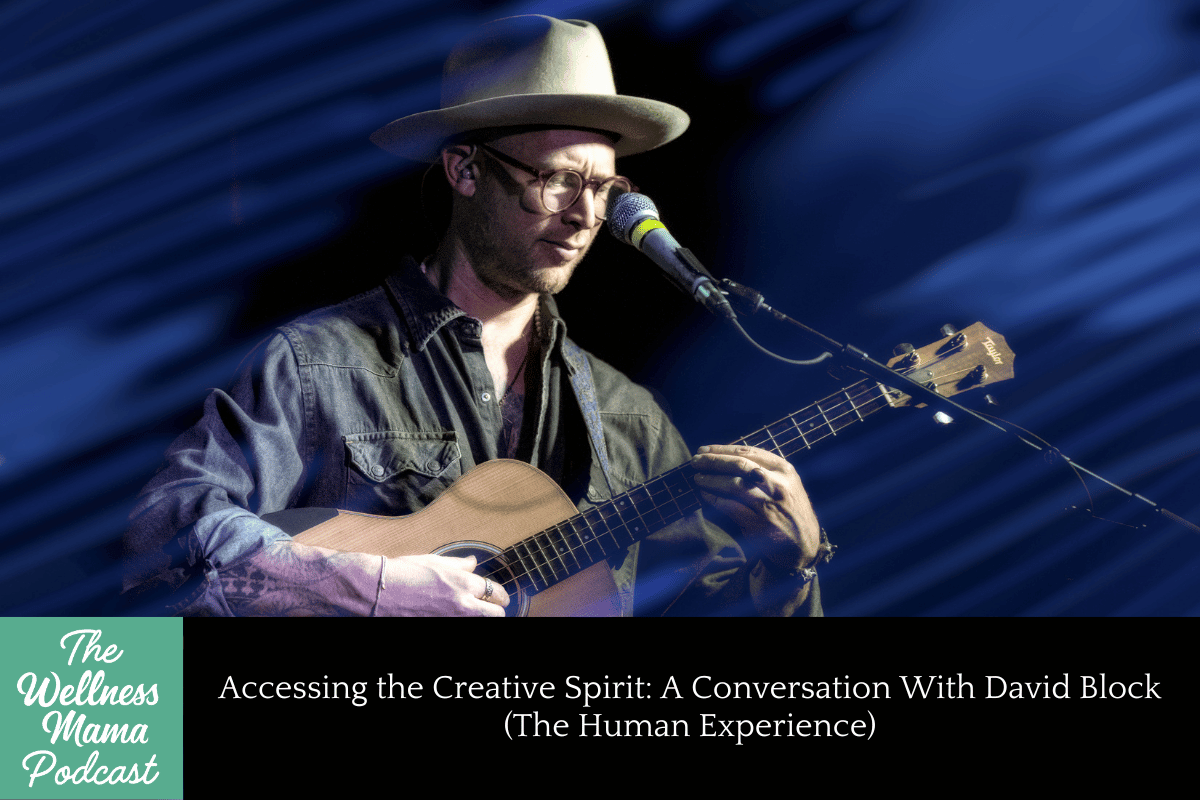
Katie: Hello and welcome to the Wellness Mama Podcast. I’m Katie from wellnessmama.com, and today I’m excited for this unique conversation that deviates from just physical health and wellness that I think is very interesting and fascinating about the creative process accessing the creative spirit. I’m here with David Block, who is known online as the Human Experience, and he’s an LA based recording artist who, and a multi-instrumentalist, a producer, a songwriter.
His entire life is art and music, and I have enjoyed his music recently. And also the kind of the way that it can touch the nervous system and the body in ways that other modalities might not be able to. And I wanted to have this conversation specific to the role of creativity in our lives, how this is actually something we remember that we’re born with, even if we have the story that we’re not a creative person now, and how we can nurture this in our kids and in ourselves. So deviation from the normal, I found it very fascinating. Let’s join David.
David, welcome. It is such an honor to finally have you here for this conversation. Thank you for being here.
I am excited. We’re actually gonna get to record two conversations, and in this first one I am excited to really go deep in the idea of accessing the creative spirit and all that that comes into that. Because you have quite the incredible journey and career related to this. Before we jump into that though, I just wanted to say I love how much I resonate so deeply with your name, the Human Experience online, because my personal journey these last few years after having quite an intense spiritual experience and kind of focusing on the spiritual side so much was a reminder that yes, we’re spiritual beings, but we’re having a human experience and to not forget the human part. So when I first saw your name and encountered that, I resonated so much and I just, I loved it. So I wanted to let you know.
David: Oh, thank you. Yeah, that’s kind of how the name came about actually, is when I was first starting to do music and I had this realization that creativity comes through me, not from me. I think creativity comes through everybody and not necessarily from everybody. And I wanted something that resonated universally with everybody. And I tried so many names and there were some horrible names, and all of a sudden I was reading this thing and it was, we’re not human being, we’re not spiritual beings, we’re not human beings having a spiritual experience. We’re spiritual beings having a human experience. And I was like, oh, everyone has one of these, this is perfect. And that was how I got that name.
Katie: Well, I love it. I feel like that’s actually like the perfect jumping in place. Because in researching for this episode, I would love to hear a little bit more of your story, but the little bit I could find and read, you perhaps didn’t always consider yourself an artist or necessarily like as a in tune with the creative spirit as you seemingly so obviously are now.
And so I would love to hear kind of your personal transformation and how you went from Mr. Potato head drawings I think you said it in your bio to now you are an artist in various mediums, not even just music.
David: Yeah, well, I think I’ve always been very creative. I just didn’t know that that was really an opportunity, there was an opportunity to do that professionally. Just because it’s so challenging to be a professional artist, takes just an enormous amount of courage and patience and persistence and passion and a little bit of luck. And I don’t feel that the world necessarily rewards artists for pursuing the arts. There just, It just feels like there’s so many odds against creatives for being professionally creative.
There’s so many systems in place that can support you to be a, like a cog in the wheel. There’s a lot of ways to go to school and learn how to get a job that you hate. So there’s a lot of supportive systems to keep humans in a place where we’re not our like our free liberated God self. And I think that that took me a while to realize that I was able to author my own destiny. And it took a lot of really challenging experiences in my life. I was thinking about it this morning, you know, why bad things happen to good people and that maybe, maybe those bad things are never bad things.
Maybe they’re just opportunities to learn how to overcome challenging experiences and how to move through adversity so we can be like a blade that can cut through anything. You know, you, you just, you don’t pull a real blade out of the stone. You really have to fold it in on itself and pound it out and smooth it out to get a solid blade that can cut through anything.
So, I think my life has been full of a lot of beauty and also a lot of adversity. That’s helped me create a really sharp blade, so yeah.
Katie: I love that metaphor and that like reframing around that, because you’re right, I don’t think society naturally sets us up to lean into creativity. And at the same time, in my experience, at least as a mom, babies kind of are born with this beautiful innate curiosity and creativity that we kind of program out of them.
And so this is actually part of the reason I years ago decided to homeschool my kids, was I realized kids come into the world with all of these incredible qualities that make them amazing artists or entrepreneurs or whatever they wanna be. And then school kind of deprograms these gifts they come out of the box with.
And so what if we didn’t do that? What would that look like? And I think you’re right, A lot of us maybe you have to relearn some of those things as adults versus getting to preserve them from the time we’re born. But I love your concept of you said creativity comes through you, not from you. And so kind of this idea of creativity is something we access that’s more of like a field versus like an achievement within us.
And I would love if you could go deeper on that concept. Because I think that also helps people maybe reframe and instead of it thinking it as something I don’t have and I can’t do, or I’m not creative or I’m not artistic, as something that maybe universally we all can tap into in some form.
David: Yeah, absolutely. Well, I’m recently an uncle. I don’t have kids, so I’m now Uncle David and I have a gorgeous 1-year-old niece who loves dancing. She loves playing, she loves exploring. She loves banging on things and tapping. She’s got some great rhythm. She’s got Uncle David’s rhythm and we are born into this world, boundlessly, creative, exploring and playing. And we unlearn that. So I, for me, the word is remembering. We already have it. It’s happening all the time. Every single act that we do in our life is a creative act. I mean, everything that you do, every decision is the choice to create or do something, you know, and as our thoughts become actions become reality, you know?
Unfortunately, a lot of things we’re creating are not necessarily the things that many artists find valuable. Or you might look at it and be like, oh, I created lunch today. Would you say, like, you’d say, no, like I, made some lunch or like, I created a spreadsheet. You know, I mean, you’re still creating. I think it’s more just reframing and remembering what brings us joy. I mean, and that’s a super wide palette of things. There’s, you know, there’s people that enjoy doing electrical engineering, and there are people that enjoy, there are people that enjoy spreadsheets, bless their heart, I love those, thank you for helping me exist.
But I think, yeah, it’s a lot of remembering and I like to look at children as your shining star example, because there’s a point in every child’s life where we experience one of three things that remove our creativity in the worst way. Guilt, blame, shame. It’s usually in the five to seven range when we start to have a, develop a personality, our per, like our personhood of who is our how, what is our way of existing in the world?
And you would say, oh, this kid is like this. You’re very, you are very like this and you are very like that. And then we start to say, I am very like this and I am very like that. And we develop a, our personality. And at some point in time, you know, you might like singing or maybe one of your kids likes to do something and maybe occasionally you find it annoying that they do that thing.
Like I bang on stuff all the time. I’m just always banging on the table constantly. I still bang on the table. I’m 39 years old. I’ve always like, ding, ding, dink, dink, dink, ding, dink, ding, ding, ding, ding. Like all the time. But as a kid that was really annoying for my parents. So, do you, you know, there’s, it’s not a, I wouldn’t fault my amazing parents for being like, stop banging on the table, that’s annoying.
Opposed to, ooh, why don’t, what kind of rhythms are you banging on the table, David? Those are cool poly rhythms. Maybe we should explore banging on drums, or maybe you should explore banging on, you know, it’s hard to fault humanity for sucking the creativity or schools for killing our creativity because the systems that we’ve built to have a functional society are not the ones that are like, oh, you know, what I should do is, I should have everybody be fully liberated and fully expressed all the time.
It’s like, would that be the same world we’d be living in? Absolutely not. However, I would say if we look at those points in time where we feel guilt, blame or shame and what we feel the guilt, blame, or shame about, I think that’s usually a really good North star to figure out what might be nice to double click on what is that thing that I feel guilt, blame, or shame about? Oh, I have a bad voice, I can’t sing. Or, ooh, my drawings look like Mr. Potato Head. So did mi, so did Basquiat’s. Basquiat’s drawing looked like Mr. Potato Head. He sells $180 million paintings now. So, I mean, he’s dead, but, you know, but I mean, there’s, so many ways to access that spirit.
And I would say first it’s like, look at your inner child. Look at the thing that people used to have to drag you off the playground. You know, it’s not, you know, when kids are playing or, and being curious and exploring, you don’t have to say, hey, keep, keep playing. They’re like, of course I’m gonna keep playing. We’re playing, we’re not doing, we’re not working. We’re playing. You wanna know how elastic time is? Start playing. You know, when an hour goes by like this. You know, you wanna know how elastic time is? Try working. Like it’s been five minutes. I hate this. So anyway. Look at, look at, look at the inner child.
Look at the things that you love to do. Look at the things that are, that make us feel alive and joyful and playful and curious and start to cultivate those things.
Katie: I love that especially the idea of like wonder and awe and play. Those are actually some of my words for this these past couple of years and lessons I’m getting to learn from my kids. And actually in my personal life I realized, so for context, I grew up with two hard of hearing parents. So most of my childhood was silent.
So I early on loved the visual arts and I loved drawing. But because audio wasn’t really much involved in my first seven years of life, it wasn’t my focus. And I had these stories about even just speaking with my voice was something I grew into as an adult, but singing seemed like the most terrifying thing I could possibly do.
So I had this practice of every year I have to do something that terrifies me. And one year I decided to make it voice lessons and the inner work that got to happen through the metaphorical finding of my voice and the experience of not being good at something and being able to A, do it anyway and B, improve and C, enjoy it despite not being great at it at first.
There was so much beauty in that lesson. And I also realized, and maybe this will resonate with other parents listening. For years, I encouraged my kids to take music lessons because I wished I had done that as a kid. And then I eventually realized I am pushing them into this because I have an unmet need and I have a place where creativity feels blocked in my life.
So what if I took the voice lessons instead? And the irony was as soon as I started doing it and faced my own comfort zone. They got interested in music. So it was just such an interesting reframe. But I would love for you to kind of touch on this concept of people who have stories maybe about not being a creative person, I hear that often. Or that they’re not a good artist or they could never sing or whatever it may be of just ways to kind of confront those edges or to delve into the creative spirit, even if it isn’t perfect or even if you don’t have to be a amazing performing artist to do it. But just to like face our own edges a little bit.
David: Yeah, I mean the first thing I recommend for people is to just give ourselves permission that we don’t need to be professional or the best in the world at something to enjoy doing it. I’ve had a lot of experiences where people, and we’ve been trained this way, right? We’ve been trained to be like, you should be the best at something. And you’re like, oh, great, I mean, that’s nice. That’s a beautiful, you know, frame of mind to have. I should be the best at something.
But a lot of that time we’re not gonna be the best at something, and you might still really enjoy doing it. Is life to be the best at some… Is the purpose of it to be the best at something or is the purpose to be joyful? I think redefining our metrics of what we want out of our life is something just to start, be like, okay, step one, I don’t need to be the best at this. My goal is to have the best time doing it. That’s my goal. I want to have an enjoyable time doing this.
Am I gonna be the best in the world? Maybe, maybe not, but number one, so reframing our our goals and saying, I don’t, yeah, I wanna have fun. I want to enjoy this. And you can also want other people to enjoy it too. I mean, of course it’s a, I enjoy that other people enjoy my music or my art. That’s a great, beautiful feedback loop there. But I think giving ourselves permission to just not be good for a little bit and to allow ourselves to improve is a good, is a good step one. Step two, I would say just two big words for me are accept and allow. That, I think that goes into the permission slip that we have to give ourselves.
It’s like, accept and allow that at some point in time in our life that we probably have felt some guilt, blame or shame, and that our stories around our limiting beliefs are okay. There are nothing, there’s nothing wrong that, you’re not, there’s nothing wrong with you if you think I’m not gonna be a good singer, or I’m a bad artist, or I could never do this. That’s okay. You’re a human being and at some point in time you’ve encountered one of those three things. Every single human being on planet Earth has encountered that.
That’s just how it goes. So giving ourselves permission by accepting and allowing it, good foundation. Then we can get into the mix and start playing and exploring. I would say there’s two fundamental parts of the creative process for me. There’s the mind and then there’s the no mind. It takes a bit of time to get into the no mind. I’ll break those down for you really quickly. Your mind is your toolbox. It’s having sharp tools. It’s saying like, if you want to go cut something and you have a dull blade, don’t be surprised that it’s kind of hard or really, really hard to cut something. Because you have a dull blade, what do you expect?
But if you sharpen the blade, you can cut. So the mind is learning. It’s taking lessons, it’s practicing 20 minutes a day or an hour a day, or five hours a day, depending, you know, whatever you want to get into, or 10 hours a day. It’s learning from other peoples. It’s finding mentors. It’s asking other people that are not necessarily a hundred steps ahead of you, but like two steps ahead of you. It’s all of those things that you can define your mind, so that way when you go to sit and make a, write a piece of music, then I don’t think about anything at all. I very rarely, I’m like, I’m gonna write a piece of music and it’s gonna be the best music that’s ever happened. Usually I’m picking up a guitar and I’m like, do do doo do doo.
I’m like, this is really nice. And I, and it’s more of like a feeling than thinking. It’s a no mind. It’s a, I think many of the greatest artists of all time, you’d say like, oh, where do your songs come from? Where do your paintings come from? I very rarely would be like, well, I thought about it really hard. I thought really hard about exactly what I was gonna paint and write about. It’s like, no. It’s like, why beautiful songs come out of heartbreak or joy or, you know, like having kids or, you know, I mean, it’s feeling. So having the sharp tools so you can get into the state of not needing them at all, so they happen automatically.
Katie: I love that. I feel like that’s like a metaphor for lots of areas of life in some ways, and I love the reframe. About a year ago I decided, what if I reframed my metrics of success instead of being monetary or metric related? What if like, grace, ease, and joy were the things that I defined as success in life?
Like what would be different? How would it feel different? And it was completely paradigm shifting. Even just the energy of it, even though I still, you know, keep track of finances and pay bills and all those things, it just shifted my energy around it so much. And I’m also so curious because I read in your, well like in the podcast prep, that you have ultra detailed dream recall, and I’m so curious if this comes into play in the creative process for you and or I’ve heard you talk about the link between mindfulness and creativity, and I love this in your music that I’ve listened to, but I would love for you to speak to that connection and you internally and how that comes into play in the creative process.
David: Well yes, I am a dreamer. My dream life is pretty full on. I don’t really lucid dream very much. I’ve had a couple lucid dreams, one in particular which changed my life dramatically. And I would say the big way my dreams, and why don’t we say, let’s define dreams here as like, I go to sleep and enter an alternative universe dreams, not like my aspirations in this life dreams, my go to sleep, enter, alter dimension, alternate dimension, dreams, and having like ultra detailed recall of these places.
And then when I started exploring lucidity and the role that dreaming has played in indigenous cultures throughout time, and that like the Tibetans had the yoga of dream and sleep and that the Aboriginal people from Australia call this reality the dream time. I mean, there’s so much, there’s so many interesting ways that our dreams and dreaming have shaped reality in the past and that many people just go through their life and I’m like, you dream every night. Everybody dreams. Just, you might not remember your dreams. And there are different kinds of dreams, but how many people just were like, oh, that was a dream, and they just kind of forget about it.
And for me, I was like, well, what, what, why? Or tell me about these dreams. Why am I dreaming this and what’s happening in these dreams? And the big one for me was the reality that we call like base level consensus reality. Like you and I having a podcast right now and then like me going to do another thing in like a time, in a linear way, doesn’t exist in that way in my dreams. And what it did for me was start to, I started to think, well, how might reality, base level reality, actually be? Is it really just happening like, like plots on a line? Is that what’s really happening?
Is the subjective nature, of my thoughts about things, is that the objective truth of reality? And that brought me down to studying Buddhism, Taoism, Hinduism, Gnostic teachings, Kabbalist teachings, Sufi teachings, many of the Mystic Branch and indigenous wisdom from around the world.
And it happened because every single night I dream. Every night. Sometimes I remember more, sometimes I don’t. But then I came to realize that maybe everything I think about things isn’t the way they are. Maybe there’s another layer. Or like infinite layers. So that’s some of my relationship with dreaming.
Katie: That’s so fascinating. And I know you’ve also talked a little bit about, and I would love to like delve into this world a little bit, kind of the idea as creativity as a tool for personal transformation. Because likely most of us listening will never perform at the level that you do, or like creativity will not endure.
Or maybe we will, we’ll have an, an outbreak of moms as performing artists.
David: Surprise yourself!
Katie: That would be awesome.
David: Plot twist!
Katie: However, I have definitely seen the various ways that like, certainly music and art, even if we’re not good at either of those things, can be so transformative emotionally and help us process emotions.
And in my own healing journey, even the voice lessons, like there was so much both somatically and singing and finding my voice and actually that helping my thyroid physically, but also of the emotions getting to process through my body instead of being stuck. And I know people do various forms of art therapy to help move through the body feelings that are too hard to put it into words or to talk through with a therapist. And seemingly creativity, because it comes from this early like innate place in us, can also help like break through some of these identity wounds that we got with the guilt and the shame and the fear.
And in this sense, I feel like is almost kind of a spiritual practice. So I would love any insight you have into how do we integrate this into our lives in a way that like helps us reach those layers of ourselves and helps us transform on a personal level, even if we’re not trying to do this at the level you are, like it can be such an incredible tool.
David: Yeah, well, maybe there’ll be a easy parallel here because if there are a lot of moms watching this, and if there are moms watching this with like doubts of creativity, just maybe remember that by being a mom, you are actually the most creative being that you, can exist. Because you created a life that came, birthed and cultivated a being inside of you and brought it into the world.
It’s the most creative act that we can, we can do. So maybe there’s like more of a layup to remember that like that happened, you know? And that somehow we’ve thought, we’ve forgotten that like that is what creativity is. It’s the same. It’s the force that brings life out of something that was just an idea or the ethereal realms and brings it into this world for other people to experience. It’s the same force that creates a human being is the force that creates art. It’s the same thing.
I think that somewhere along the way, because we, most of us have grown up in like a capitalist western mindset, even if you grew up in the east, that our, the idea of capitalism and that our metrics of success are monetary, is how we define something as being like a successful thing for example, that we’ve married our creative process many people have with making money, like having to sell the thing that they’re making.
They’re, I think, first step we have to separate those things. I would invite everybody to look at creativity as an intrinsically spiritual process like birthing a child. There’s an opportunity to look at creativity and the creative process and imaginative thinking through that lens instead of, I’m making something so I can sell it. And I think that that’s an important thing to separate. Take those things apart and you can still sell the thing that you make from that place, that sacred place. But there’s an, the invitation is to start to look at is the force that I am cultivating that comes through me to bring an idea out of the ethereal realms is the force that I use to create life. That I birth life. I would, especially for all the mothers, really invite a redefinition of what creativity is and the power of imaginative thinking.
Like if you think of like the power of a human being to give life, that we have that power in when we’re creating our art. And that can be like, whoa, that’s kind of heavy, bro. Like, that’s a lot to do, but it is, it is that. Yeah, I think that that’s a really important distinction to make. And to remember that like, it doesn’t need to be so serious, but it is that powerful. Like it is fun and beautiful and playful and but it is that powerful. You know, like, like thoughts become, actions become our reality. Like we get to author our story by cultivating beautiful thoughts and imagining the life that we wanna live in and imagining the things that we wanna create, and having those things become actions become reality. So yeah, I think that that’s a very important to make, that your creativity is sacred, and whether you think it is or it’s not, it is.
Katie: Yeah, I heard someone say recently and I wish I could remember where, but they said it’s sacred, not serious. And I loved that. It’s like a reminder for life in general. And I love that we’re gonna get to have a second conversation about sound healing in particular because you do some incredible things with your music that I’m really excited to dive into with you.
And I’m gonna put links to the show notes because you’re all over the internet. People can find you and experience your art in various ways and I’ll put your link tree in the show notes as well. But any places you would encourage people to interact with you first or to find you in and learn from you?
David: Well, I’m exploring a lot of things these days, so, come to a concert, come to a workshop. I am exploring turning this into an online course, accessing the creative spirit. So maybe this will be just one more nudge and the next time we get together we can talk about this course. Because I just feel like it’s the most important thing that we can do to cultivate our imaginative thinking and our creativity.
And I really do believe and have experience that everyone can do it. But you can listen to my music everywhere on the internet, and yeah, come see me in person some time.
Katie: I love it. Well, all those links will be in the show notes. You guys stay tuned for our round two, which is gonna go deep on sound healing. But David, for this conversation, thank you so much for your time.
David: My pleasure, thanks for having me.
Katie: And thank you for listening and I hope you will join me again on the next episode of the Wellness Mama Podcast.




Leave a Reply