Read Transcript
Child: Welcome to my mommy’s podcast!
Katie: This episode is brought to you by BIOptimizers, and I love this company. And specifically today I wanna talk about one of the favorite things that they make, which is called Masszymes . So let’s be real. We all kind of start this part of the year saying, we’re going to eat cleaner, train harder, feel lighter.
But it’s not just what we eat and what we do, it’s what we absorb. And if our digestion is sluggish, the body just can’t keep up. And this is why I love Masszymes all year, but especially this time of year because it’s a simple digestive ritual that’s made a huge difference for me. It’s loaded with 18 enzymes, including four times more protease than top competitors, to help us break down dietary protein, carbs, and fats efficiently.
And I’ve shared before, I’ve done a whole episode on enzymes and how this was really, really impactful for me personally. But this means that we get better nutrient absorption, less bloating, and more real energy from the food we’re already eating. I’m also a big fan of nutrient loading and really maximizing that in our food too.
And enzymes help us get the maximal benefit from this. It’s this hardworking, yet smooth enzyme blend, and it’s been a favorite of mine for years, and a customer favorite for over 20 years. It’s a ritual that your stomach will thank you for anecdotally. I feel like I really don’t get sick now that I have made these a regular part of my routine.
A lot of people find they don’t have post-meal food hangovers or bloat after taking these, just clean energy to crush goals all year long. For a limited time, you can save up to 26% off their products and bundles during the New Year New You Sale by using my code wellnessmama15 at checkout.
And select bundles are on sale for up to 45% off, so you can get a massive discount there. Visit bioptimizers.com/wellnessmama and use the code wellnessmama15 at checkout. To get the best deal on Masszymes and all BIOptimizers products. So that’s bioptimizers.com/wellnessmama and the code wellnessmama15.
So start 2026 with a stronger gut, more energy, and better digestion.
This podcast is brought to you by LMNT, and this is a company you might’ve heard me talk about before, and I really love their products because proper hydration leads to better sleep. It sharpens focus, it improves energy, and so much more. But hydration is not about just drinking water because being optimally hydrated, a state called euhydration is about optimizing your body’s fluid ratios. And this fluid balance depends on many factors, including the intake and excretion of electrolytes, which many people don’t get the right amounts of. Electrolytes are charged minerals that conduct electricity to power your nervous system. I talk a lot about nervous system on this podcast.
They also regulate hydration status by balancing fluids inside and outside of our cells. LMNT was created with a science-backed electrolyte ratio of 100 milligrams of sodium, 200 milligrams of potassium, and 60 milligrams of magnesium with no sugar. Since electrolytes are a key component of hydration, here’s what happens when we get our electrolytes dialed in.
We have more steady energy, improved cognitive function, suffer fewer headaches and muscle cramps, we can perform better for longer, and especially the support fasting or low carb diet because when we stop eating carbs like during a fast, the absence of insulin allows the kidneys to release sodium.
So replacing that lost sodium with electrolytes can help you feel good on a fast. Since LMNT is zero sugar, it also doesn’t break up fast. Electrolytes are also important for maintaining blood pressure, regulating digestion and proper fluid balance. Keeping skin hydrated, which is a big one that I feel like often gets missed and so much more.
I feel like proper electrolytes is a missing piece for a lot of people and I love LMNTs new canned drinks, which are sparkling water with all the same ratios and minerals I just talked about, and they are delicious. You can check it out and learn more at drinklmnt.com/wellnessmama. And at that link you will receive a free sample pack with any order.
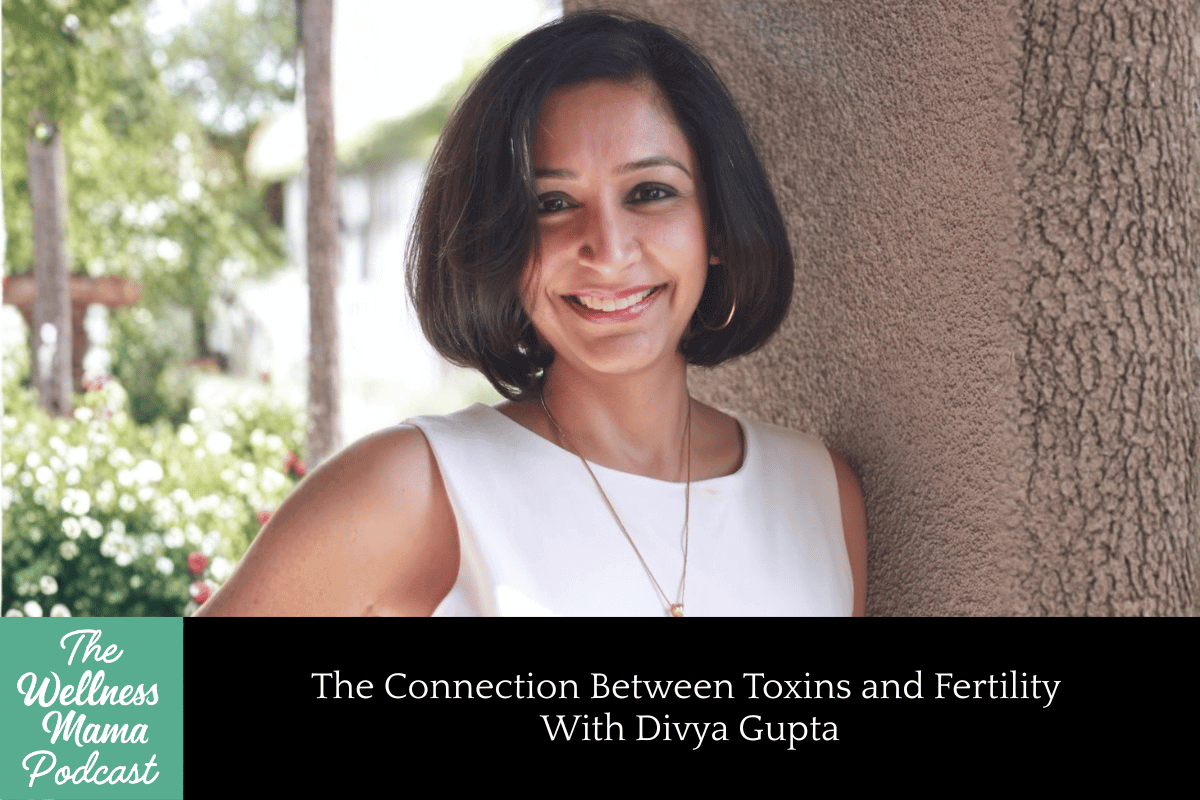
Katie: Hello and welcome to the Wellness Mama Podcast. I’m Katie from wellnessmama.com, and this episode is all about the connection between toxins and fertility, and secondarily how the thyroid comes into play. And I’m here with Divya Gupta, who is a seasoned functional nutritionist, but she specializes in helping busy professionals to transcend familial health patterns and especially working with people on the fertility side.
She conceived and naturally had a baby at 42 and got to do a lot of deep dive research on her own into these links that we’re gonna talk about today with toxins, fertility, safe ways to detox, what to avoid, some big pitfalls, the testing to look at, how long it actually takes to resolve some of these things and so much more.
She’s definitely a wealth of knowledge. I’ve put a lot of links in the show notes for follow up. If you want to go deeper on any of these topics, let’s jump in. Okay.
Katie: ?Divya, welcome. Thanks for being here again. I’m so excited to chat with you again.
Divya: Thank you, Katie. I’m so excited to be back as well.
Katie: Well, I feel like this is an increasingly relevant topic. At least I keep seeing headlines that seem to point toward this topic being increasingly, increasingly important for all of us, potentially, even those of us who are not. Actively trying to conceive, which is the topic of fertility and how a lot of modern factors come into play here.
Especially including our increased exposure to kind of an onslaught of toxins from all sources in the modern world and how this impacts other systems within the body that then in a way affect fertility as well. I know this is a very broad and nuanced topic, but also a lot of really fascinating emerging research from my understanding.
But I know I see some crazy statistics floating around about infertility rates and what they might look like in 10, 20, 30 years. So maybe to start broad, kind of like introduce us to the current sort of atmosphere we’re facing when it comes to fertility in the modern world.
Divya: Oh, absolutely. Like you know. You know, fertility is one of the most natural, you know, that’s what we are here for it to reproduce. But as you as rightly said, the fertility rate over the last couple of decades have been significantly declining. And it’s not just women, right? It’s also, there’s a male fertility factor in play as well.
Sperm counts have reduced as well. And the latest stat, you know, when I was looking this up, it says one in six couple are facing fertility issues, challenges, as well. So that’s around 12 to 15% of, you know, couple, adult population that is facing this. But here’s the alarming rate, right? You know, it, there has been over the past couple of decades, the significant, there has been a significant drop in fertility. And, you know, and what doctors call, as you know, it’s unexplained fertility and you know, women are experiencing more ovulation disorders or early menopause and, you know, and that’s exactly what I was told as well, and it just isn’t about age.
And so what has changed, and you know, yes, our genetics haven’t changed over the last 50 years, but our environment has changed dramatically. So since the World War 2, you know, we have introduced around 80,000 chemicals and synthetic chemicals into our environment. We are exposed with pesticides in our food, plastics in our water, and packaging flame retardants in our furniture, chemicals in our personal care products, and on average, a woman is using 12 products a day.
So now she’s exposing herself to 160 unique chemicals before she even leaves the house in the morning. So, and here’s something that we know that’s alarming, right? A lot of these chemical that we know are endocrine disruptors, and they mimic and they just are, block oour natural hormones, and these very hormones that control ovulations, form production implantation.
So maintaining and healthy pregnancy. So it’s just a bit alarming and what we are seeing these days just with a lot of chemicals, right? None of them in study for safety, for reproduction safety. And we don’t know what happens when we are using like hundred of these chemicals together, you know?
How do they interact with each other? It’s called something like the cocktail effect. And so there, if you sit, if you take a step back and think about it, like our environment is what’s changed and how could these toxins playing a significant huge role in the declining fertility rates that we are seeing these days.
Katie: Yeah, I feel like we definitely see those stats and it’s crazy actually the number of things that we encounter in just normal daily life now than our parents did and certainly than our grandparents did. And I feel like the good news here is that this means much of that is in our power to shift when we become aware of it and that it doesn’t, even from my experience, take like huge, massive changes.
Like yes, it does require some intentionality, but it’s not like we have to become all or nothing or like overnight, shift every single thing. Like there’s some really impactful needle movers that can make a tremendous difference here. And certainly I always come back to a few ones people are probably getting tired of me talking about, but things like, for instance, Nature Deficit Disorder and how things like the thyroid, our hormones, so much as at least very heavily impacted by our light exposure and our movement and our exposure to nature.
And so even just building in a little bit of intentionality around our light environment and spending time outside can make a big difference in our hormones. But I know from our past interview, and from knowing you in person, that you talk a lot about how the thyroid comes into play as kind of the master conductor and the orchestrator of a lot going on with hormones.
And I love understanding it from this approach because it seems like when we understand that, A, we give ourselves a tremendous amount of power to start to shift to outcomes, but we can also understand how the body’s actually on our side by suppressing fertility when certain things aren’t working optimally in the body.
This is not the body working against us. This is the body doing what it does to protect us, to protect a future child by alerting us that something’s going on. So can you explain that the thyroid hormone connection and how this is kind of like a cascade that goes downline into so many other places.
Divya: Absolutely. Yeah, you’re right. You know, I love talking about the thyroid. I’ve, I have, you know, hypothyroidism, I was diagnosed at 25 and yes, you’re right. It’s not the root cause, but it definitely plays a huge role in maintaining, getting pregnant and maintaining a pregnancy as well.
Because, you know, I’ll address one thing is, getting pregnant is one thing. Staying pregnant is your immune system regulation. I mean our immune system needs to be working. And you are absolutely are right. Our body wants to work for us in a way it’s taking care of us, you know, it’s taking care of the host it wanna ensure that we have, we are, the environment is perfect for the host and for the baby to develop. So yeah, when it comes to the thyroid, you know, one of the, if you’ve been here, you know, I’ve had, I was always on thyroid medication even during my pregnancies, but the amount, the thyroid connection with pregnancy, especially earlier on.
If you think about each of the eggs has like a hundred thousand mitochondria. And mitochondria is our, you know, our engine, it produces energy. And the amount of cell division that takes place during the initial phase of a pregnancy, it requires a ton of energy. And what do we need for energy? One of like, if your thyroid is dysregulated or underperforming, we, as you said, it controlled, it’s a master conductor. It controls the metabolism, it controls our body temperature.
Similarly, it also controls our reproduction. You know, it has, so the amount of energy, the T4 that we need, thyroid hormones, we need for the first phase is, really goes up. So that’s why, you know, we want to ensure that you have optimal thyroid function during pregnancy. And more often or not, our doctors are not even checking completely. They’re just doing a thyroid panel, TSH and moving around. So when we do come across these, you know, if your taking from the toxins and the thyroid, right?
So when we are exposed to these toxins, they can and they are, can disrupt your thyroid hormone production, you know. And then when you have thyroid dysfunction, even if it’s subclinical, it can affect your estrogen and progesterone balance. And we know how critical and how important that is for pregnancy. You know, your estrogen needs to rise at the right time. Your progesterone needs to rise to maintain a pregnancy.
And now once you have these in, hormonal imbalances going on, you start seeing the impact of irregular cycles. Maybe implantation issues, maybe anovulation or, you know, not ovulating at the right time. And then you deal with fertility challenge. So your thyroid is playing like this master conductor, trying to get signals and raising the alarm when something is off, hey, something is off, we need to start paying attention.
It’s like the yellow canary in the coal mine. It’s not the root cause of fertility issues, but it’s definitely one, is one of the key players that we need to start paying attention to.
Katie: Yeah, that makes sense. And like I said, to me, this is great news because it means that when we understand this and listen to the body’s communication and start supporting, we can actually see big changes very quickly. And that’s been my journey as well with recovery from thyroid and I actually learned so much in that process.
When I started doing my own research after being told I would have this for life, there’s nothing that would help improve it at all. I found that was indeed not the case, at least for me. And so I got to deep dive into a lot of these things that you’re talking about and I know that toxins play a big role. This is something that for me was like a year’s long journey of kind of overhauling everything in my house.
And it seems like there are categories that are, like certain categories that are big offenders. So when it comes to the things we’re exposed to in our environment and in our daily lives, what are some of the kind of biggest offenders out there that people maybe even don’t even realize are creating havoc for their systems?
Divya: I love this question, and you’re so right. It can feel overwhelming at first and like, oh my God, we need to change everything. But it can be done slowly, one by one. And Katie, as you said, it’s, it, it sometimes takes years, but we start seeing impact, the benefit of it right away. For me, the biggest offenders, daily life of folks are not even realizing is number one, it is your water.
You know, we are gonna be, drink gallons, hopefully, you know, a liter of water or more depending on your requirement. Your cooking in your water, your, you are showering, you know, your skin absorb it’s, you know, absorbs everything that you put on your skin. So, and we know our water is, you know, you can go to the EWG Tap water database is, has ton of forever chemicals, chlorine, fluoride, a ton of different hormone disrupting chemicals in there. And municipality or as your city water, they treat it to, you know, ensure there is no infectious disease, copper water, it takes care of that, but it really doesn’t clear all of these different aspects, you know, or, you know, chemicals in our water. So that’s the number one piece.
You know, it’s like the biggest bang for the buck is really filtering your water, you know, filtering your shower water, getting, you know, cleaning that up, you will just reduce your exposure to these harmful chemicals like chlorine or fluoride, which is in our water, which we know can displace minerals, can iodine, especially for your thyroid. It’s needed, you know, it has, again, forever chemicals in it as well. So that’s number one. Easiest piece number two. I know, you know, I, if everyone who follows you, you know that, the personal care products, it’s just sad. A lot of women are marketed so many skincare products. There’s a daytime routine, nighttime routine using on average 12 different products.
And these products have, you know, parabens, which are used as preservatives, which can be endocrine disruptors, you know, it, the fragrance, anything called fragrance can hide, again, a dozens of different chemicals in it that you’re putting on your skin. And your skin is so absorbent. Everything you put on your skin gets absorbed right away, gets into your bloodstream. So, you know, taking care of your personal care products is number one easiest way you can clean that out. And you know, that goes into similar category of, you know, what do you use for your house cleaning, you know, personal care products and house cleaning products as well. And number three, which this is something people may not be thinking about, but for me it’s like, I love my coffee, but I don’t want my coffee to be filled with toxins again.
You know, not just different pesticides that are sprayed on coffee beans, but also, you know, mold as well, that you, you know, coffee has been, know, the way it’s stored can grow mold. So really cleaning up, you know, having, or they’re using curing machines. When I hear my clients using curing machines, I mean, that’s the first thing you wanna throw out.
You know, the aluminum and you know the hot water is going through that plastic. You’re just taking in those, those are some simple, easy swaps that we can start making is your water, your personal care, cleaning products and your coffee to begin with. There’s ton more, but that’s something we can start with.
Katie: Yeah, I feel like it’s, that’s helpful to have just like broad categories and kind of almost also like the triage effect of, I think of like, think of the inputs going in and how often, and like typically if something’s an input more often, it’s a bigger category to focus on. So like water for instance.
Hopefully we’re all drinking water throughout the day. That’s a big one. And so cleaning up your water can be like one change you make with a water filter or something that then now you don’t have to think about and that can pay dividends going forward. And I know for me, a big part of that also was really dialing in my mineral levels.
Seemingly for me that was a big factor in supporting my hormones and my thyroid that I didn’t understand super well early on. And so now it’s something I’m very intentional about and have various sources of minerals that kind of rotate throughout the day, which also helped me remember to stay hydrated.
Because I’m drinking more water to take all those minerals. Same thing with like, hopefully we’re breathing all day. So small things like going outside and getting fresh air or being aware of our indoor air quality. Even just opening the windows more often can make a measurable difference. And then I love your point from there, kind of like triage, the biggest offenders, the things you’re interacting with most often.
Even things like the laundry products, because that’s on our skin all day. We’re breathing any like VOCs or fragrances from that all day. And that can be as simple as just simply choosing a safer option when you’re buying that and now there’s no effort required going forward. So I love that you make this doable and actionable without seeming overwhelming. Because like I said, truly it isn’t all or nothing like small steps can probably make a huge difference. And I would guess you see this all the time in working with people that it actually isn’t like the drastic, like must throw away everything you own, every piece of plastic, clothing, every whatever, it’s like these little changes add up really quickly, actually.
Divya: Oh, absolutely, because you know the reality is our, no, there’s only so much we can control. We live in a environment, our world is quite toxic, you know, when we go outside. The air we breathe, what we coming in contact with so we can control our home environment. And yes, it doesn’t have to be all or nothing. Do I- Is everything in my house completely natural and free of all chemical? Probably not. I’m still in the process of switching out products, changing. It takes years.
But, you know, yes, starting small, and I see it in my practice, you know, like, you know, go for, that’s why I go with water. Like, you know, that’s the biggest offender because that’s what we get, we use a lot of. Like changing that and what you’re putting on your skin, just reducing the number of products that we put, can have the biggest impact. And again, as this building, you know, it’s like it is building from there.
Even the food we eat, you know, buying, you know, I know organic can be hard. It’s difficult, and so, but you know, but, you know, maybe it’s a, focusing on the dirty dozen and buying clean food, eating whole natural foods, reducing your exposure of what you’re putting into your body. It’s just starting small, step by step, and you will absolutely, your body, because our bodies are resilient. They want to heal. They’re working for us and not against us.
So it’s just giving it the right environment and reducing that, you know, exposure, like if you think of a body as like a bathtub, that faucet, those are the toxins and the drain, you know, our, that’s a drainage system, that’s our liver, our kidneys, our gut, our skin. Just reducing the faucet a bit. Like, you know, reducing the exposure, making sure the drain is working so even if you get exposed toxins, it’s fine. But our body is able to really deal with it and get rid of it. That’s a goal. It, it’s can’t be all or nothing. It’s just hard that, and if you’re gonna chasing perfection, then we are not gonna make any progress and it’s gonna hurt us in the end.
Katie: Yeah, and I feel like this is a helpful category really for all of us to address because likely all of us are dealing with this on some level. It’s just. Maybe not that kind of to your point, bathtub level where it’s overflowed yet, or at least affected fertility yet. But this is something we’re all facing in the modern world from food, from air, from water, from across the board. But for a couple who is specifically trying to conceive, how might they know if toxin exposure is directly affecting their fertility? Are there like specific tests for this? Are there signs and symptoms that are pretty much like really big giveaways, or how would they know?
Divya: Absolutely. So this is a great question. Like, you know, I get, you know, how do you know, even for me, how did I know, like, you know, was toxins behind because just a little, you know, backstory, set the stage is after I had my first child, which was super easy, like 10, almost 10 years ago. Easy pregnancy, stayed pregnant, had a healthy baby, you know, I just took for like a lot of people, I took pregnancy for granted, like, you know, and fertility for granted. Oh, it just, I know my body can do it, but when, about the time when I was thinking of having a second child, we dealt with a couple of miscarriages, some as late as 12 weeks and 10 weeks. And we, and I, it was a very humbling experience because that’s what, you know, I’m like, gosh, so much has to align in our body for us, our body to reproduce.
And I had trust in my body that it can do it. Getting pregnant was easy, why isn’t my body staying pregnant? And yes, I was doing everything that you can think of. I was eating healthy, taking care, you know, I’ve done, you know, taking care of my gut health. You haven’t used plastics, eating, you know, everything was out.
I’ve done everything. So it was very mind boggling, like, what’s going on? And, you know, you do all the tests and the doctor says everything looks good. There, I was almost 40, so, but oh, you have great egg reserves. Nothing. They couldn’t really explain it. So one of the symptom or one of the pieces where for couples who are, where they can think toxin could be behind. There, when the doctor says it’s unexplained. They can’t really pinpoint why you are not able to get pregnant or stay pregnant. That could be first sign.
Could toxins be playing a role? Because in conventional system they’re not really testing for toxins and how they can really interplay and really, you know, disrupt your hormonal balance in your body. Number two is, you know, especially for women, because we can, women can, we get a cycle so we see a lot of symptoms. If your periods are getting irregular or heavy bleeding, you know your cycles are off. You know that, hey, what could be good behind the scenes? You know, you’re getting tired, fatigue, you know a lot of the hypothyroid, symptom fatigue, your hair loss, you know, your thyroid is struggling at that point.
You know, you’ve gained weight without, you haven’t really changed much, but you keep gaining weight and you’re not being, you’re not even able to lose that weight. So those could be signs of, okay, maybe my thyroid is struggling, maybe adrenals are struggling, good toxins be behind the scene because we know they all, that has a domino effect. It all plays a role.
So that could be one sign or symptom to start thinking about, hey, where could, there could be toxins and even for men, right? You know, it takes two to tango. They are equally responsible for a healthy pregnancy so, and but on, for men it’s harder, right? They don’t get a cycle. So it’s very hard for them to know what could be going on unless they test. And if you’ve had your partner tested, you know what, what is a sperm count? Sperm motility, you know, the morphology and you know, are they getting tired, dealing with brain fog as well? Because thyroid hormones can also impact, you know, sperm count. You know, thyroid hormone and testosterone also has a really tight connection.
Like, you know, all of these, endocrine hormones play together. So those could be some signs even for men, subtle, to start testing and looking at your environment. So, and other like, you know, very tangible guidelines could be, you know, you’ve been trying for six months and you haven’t had a pregnancy, or you haven’t had a, you know, you haven’t been able to stay pregnant.
That could be a sign to, hey, start looking at toxins. Because in convention system they say, oh, wait for a year. You know, if you’re under 35 or six months, if you’re over 35. But why wait that long? If you are unable, if you’re seeing some of these signs and symptoms and if you are not being able to get pregnant after doing everything right, it could be time to start looking at toxins. And if they, they could be playing the role behind your unexplained fertility, which, yeah.
Katie: Yeah, and I’ll definitely, I know you have a ton of resources on this, so I’ll make sure a lot of those are linked in the show notes because it seems like often, these are not topics that every fertility specialist or OB might be especially versed in, like, I know certainly in the past I’ve brought up different topics with doctors and not gotten much positive feedback.
But these are like, like you’re saying, things we can address at home anyway, so you don’t have to wait for a doctor or specialist to kind of give you the roadmap. I also know that there are like so many options if you start trying to research detoxing from different things on the internet and that from firsthand experience, some are safer than others, and some are kind of in areas you don’t wanna go.
So if someone has determined that toxins are a factor for them, where do you recommend they start from a detox perspective and or any cautions to avoid within that or things that are especially effective within detox?
Divya: That’s such a great question, and thank you for asking because Instagram can have a lot of BS at times. Sorry guys. There’s a lot of detox teas out there. There are, you know, miracle supplements that you can, you can take or juice cleanses or that will detox. And it can be, it can sound too good to be true than it is. Maybe it’s not true. So it is really hard. So just don’t rely on some magic pills or pills to just, you know, take care of this. Yes our body wants a detox and it can efficiently done it, but it has, we have to be strategic about it and do it carefully and safely. Right. And especially one thing of, one caution is, you know, there is, timing is important too.
You do not wanna be detoxing or doing these heavy protocols if, in case you do get pregnant, right? Because when you don’t wanna pass all those chemicals, those toxins to your into, to your fetus as well. So timing is really crucial. So the best time to start looking into toxins and working on a detox protocol was yesterday.
So I would say, you know, if anybody, even you are planning to have a child in the future down the road, it may not be, this year or next year, you can start working on your toxic load today. Start reducing your exposure today and your future fertility, and your baby’s health will definitely thank you. So, but let’s now talk to your question about, you know, what does detox look like once you determined, you know, you’ve got to do this. Number one is you got want to test, you know, test, don’t guess. Yes. You know, we are exposed to different toxins, but which ones are those that our body is holding onto?
Because a lot of the toxins are, they love to get, you know, they love fat, so they get stored in our fat tissues, in our bones, in our liver, right? So we want to know what’s being stored and the body is also beautiful, right? They, it does that to protect our organs so these toxins are not directly going into our organs. But once they get stored in our fat tissues, they, they won’t just stay there.
They are leaching out a little bit and circulating and you know, causing all kind of disruption. So you really do want to test, figure out which heavy, you know, there’s, and it’s such a simple, you know, that’s what I did. Simple at home urine tests that you can do, that you can figure out, you know, what kind of heavy metals, environmental toxins, or even mold toxins that you could be getting exposed to. And once we have the test results, and that’s what will be the basis of what does detox look like. And you know, more than, you know, detox, it’s supporting the organs in your body that does the detox. So it’s your liver, it’s your kidney, it’s your gut, it’s your skin. it just needs a, just asking for support.
We don’t, you know, so it’s, A, Number one, I love things you know, that are foundational and that you can do lifelong, right, than just taking a few supplements is ensuring that your, these drainage or these detox organs are working and open. You know, just going back to the bathtub analogy, just making sure the drain is not clogged.
We just wanna make sure it’s open. So supporting your liver with, you know, B vitamins, you know, antioxidants, you know, really having a whole food diet, eating enough protein, you know, the number among, when I see the food journal on my clients, I’m like, gosh, start eating more, you know, we are not eating enough as a society.
Like, you know, eat more proteins, you know, clean water, making sure you get staying hydrated as well. So, you know, that’s, you know, just making sure you’re supporting these organs, you know. Dry brushing, getting into a sauna, sweating or exercising, that our skin can help us detox as well. Supporting your kidneys, right?
That’s with hydration and the right electrolytes, so your kidneys are working as well. So just making sure you first setting up the environment, that terrain in your body to start mobilizing these toxins. So once these, once, so once you mobilize these toxins, the drainage is open to get rid of them. And you know, your diet is important, hydration, all the lifestyle pieces. And then there are certain, you know, supplements, depending on what comes out, you can take, like having the right binder, you know, which just binds to these toxin and ensure it gets out. You know, basic, make sure you’re pooping every day, period. Like, you know, pooping is one way of our getting rid of toxins.
So if you are constipated or not pooping, please don’t start on any detox because you’ll be just recirculating things back into your system. So it just goes back to foundations of ensuring your drainage pathways are open. You’re eating a really nutrient dense whole food diet that’s supporting your liver.
All the bitter foods. You know, exercising, sweating, whether it’s using infrared sauna, red light therapy, ensuring, you know, keeping inflammation down. And then, you know, having those targeted supplement that binds to the toxins, gets rid of it, replaces some of the minerals that we lose because a lot of these heavy metals, if you talk about heavy metals, they like to displace minerals. Period.
You know, one of the main heavy metal that came out of MI test was cadmium. I was, when cadmium can displace zinc and selenium. And zinc, we need it for equality. Zinc is so crucial for DNA synthesis, right? And selenium for thyroid health, both needed a thyroid health. So we need to make sure we are replacing those minerals efficiently. So those would be the steps. And then taking care of your gut, you know, our gut is a foundation of our health. Ensuring our gut is healthy, we have the right microbiome to help support us and digestion.
So, it sounds very unsexy and it sounds very boring, but detox is, for the most part, it can take some time. It’s long and it is not cool like doing a three day juice cleanse or taking some supplement pills, but that’s what a safe detox is where ideally you don’t have a lot of detox reactions. Your body’s able to handle it.
Katie: Yeah, and I love the point you reminded us too of like, detox is something the body knows how to do naturally. So this is not about something you do to your body. This is about something you work with your body to do more effectively. Because like I always think of it in terms of like if we’re having symptoms, those are messengers, especially when it comes to toxins.
And it’s your body trying to tell you either I need something that I’m not getting or I have too much of something I don’t need. So it’s learning how to listen and work with what the body already knows how to do. So this is not, like you said, a juice cleanse you’re doing to yourself. This is how do I support my detox pathways naturally with nutrients, with sweat , with movement? Because, like, our lymphatic system doesn’t have a pump. It only moves if we move. So how do I support that with movement, with sleep? Because so much detox happens when we’re sleeping and so many of us get it as a mom, struggle with getting enough sleep. But I love your reminder of the body already knows how to do this beautifully.
It’s about becoming partners with our body in that process and having the space and the patience and the grace to let it happen naturally without overloading our detox pathways. On that note, what do you see in practice and how often, how long does it often take to start to address these things and then to really see big changes?
Because I know for couples who are, who fertility is top of mind, this can be a very timely and sometimes kind of urgent feeling situation. So how quickly, if people are really on board and addressing all these things, might they start to see changes?
Divya: Great question. I know it’s hard, you know, we want it done. We live in a society of instant gratification. We want it done yesterday or within a short period of time. But you know, the body is again, we re- a cell to regenerate, right? For eggs, for, it takes 90 to 120 days for our eggs to mature. So, you know, as we start addressing this our toxin exposure and reducing our toxic burden, we can see improved equality, you know, three to four months. For men it’s even sooner. It’s 70 to 120 days even. So even two, between two to three months for men. So once we, if a couple is on board and, you know, I will at a minimum, at a minimum, I would say three to four months.
Which may seem like a lot of time, but if you think of it, if you, you know, getting a healthy pregnant, staying pregnant, and ensuring you’re not passing the toxins to your baby. It’s worth it, at least at a minimum three to four months. It took six months for me personally, before my, I had my baby earlier this spring. I gave myself six months to really do this, you know, go through all the phases of doing the detoxing and I got pregnant the following month and stayed pregnant. So that’s how for couples who are looking to do it, you know, if they’re looking to start planning for a baby, I would say give yourself at a minimum three to six months. And again, it’s so hard to say a number because we don’t know what your tox bur… their personal bio individual toxic burden is.
How will your body start reacting or, you know, reacting to once you start making the changes and how your body reacts to the process. That’s where the individual, in the individual, biochemistry comes into place, but it can be done. It can be three to four months, for some people it can be a little longer, but be patient and it’s so worth it. And that’s why I, I’m like, you know, trying to talk to everyone.
I wish I’d done this before my first child is to do the detox because I think in 2010 there was a study done where they found 287 chemicals in the umbilical cord of babies and they were not even exposed to the outside world. It’s from the mother’s womb that you know, of what a mother is getting exposed to. So by doing this work, you are just giving the best possible chance for your baby to, you know, for your baby’s health. That’s, you know, it’s hard to put a, to weeks, we got it done, you know, three months, but anywhere from anywhere from three to six months.
Katie: And seemingly addressing these things ahead of time can also, at least anecdotally make pregnancy a lot smoother when you do conceive. So I feel like, to your point, it’s worth doing. And especially now I’ve seen some interesting data come out lately too. Like you talk about like egg quality and how long eggs take to mature, but I’ve seen at least a couple studies that show like eggs don’t decline as much as medicine thought actually.
Like they’re quite protected. They have that super high mitochondrial density and of course the body would want to protect them and preserve them for as long as possible. So I’ve seen at least some evidence that they don’t decline actually as quickly as other cells within the body. So I think perhaps that’s also great news that we have a lot more time than we think we do, especially if it’s not age so much as a lot of these factors that are coming into play to reduce fertility early. Because certainly it doesn’t seem like the conventional story that like at age 35, your eggs just sort of like turn to dust is actually accurate.
Divya: Not for everyone. I had my second child at 42. I had a, had it naturally. You know, was it, you know, everything healthy. So it, age is just a number honestly. Age, you can have a baby, of course, there are certain, maybe of 50, 60, maybe not, but the con, the 35 being college, geriatric pregnancy, I don’t, we want to, I wanna change that. It’s, I was, I certainly don’t feel geriatric. But absolutely. And you know, for folks who are looking for a baby down the road, you know, start doing the work now. Because whether we like it or not, or where we are, we are living in a toxic world. We can’t live in a bubble. Even if you go to an outside countryside in a jungle, I’m sure we are still getting exposed to toxins. So it’s always a good idea if, for your health. Even if you don’t, even if fertility, even if it’s not fertility, to ensure that you are reducing your toxic burden and supporting it for your longevity and for, to being able to have your vitality for as long as you live.
Katie: Yeah, I love that. And fertility is, like you said, it’s a marker of health. So even if you’re not immediately trying to conceive, these things are beneficial in like literally every area of life. And I also know there obviously is so much personalization and nuance within this category specifically. So for someone who is in this and really like focused on fertility, wanting to conceive. I know you have a tremendous number of resources available around this and that you work with people. So can you let people know where to find your work and where to find you if they want to really address this and delve deeper into the things we’ve talked about today?
Divya: Absolutely. So I have a great resource on, you know, like all the thyroid symptoms and, you know, what is a full panel of thyroid tests looks like. So if you go to my website, divyagupta.net, you can go grab that. Because you know, thyroid influences every single function in your body. So it’s not always just weight gain.
It’s not always just low energy or fatigue, though those are the most common ones. Even if you have irregular periods or PCOS related symptoms, heavy bleeding, your thyroid could be playing a huge role. So just go look at that and just demand and advocate for yourself to get a full thyroid panel, not just TSH. So so often clients come to me with just a TSH and I’m like, okay, that’s just looking at one, well, just looking at one scene of your movie and figuring out what the rest of the movie looks like.
You need to get a full panel. And not just the standard ranges, but you want optimal ranges. So the guide also has, what does optimal ranges look like. Also checking for autoimmunity, right? But that again, as I said, staying pregnant is an immune system function. So we want to look at if there’s an autoimmunity playing a role as well, so we can grab that guide and they can find me on my Instagram. I do share a lot more there, like helpful tips, what I’m seeing in practice and that, you know, trying to ensure that little changes that they can make.
And that’s at @_divgupta is where they can find me as well. That’s where I hang out quite a bit.
Katie: Amazing. Well, I will make sure all of those are linked in the show notes at wellnessmama.com and I, you have so many great resources available. I feel honored to know you in person and to get to benefit from your work. Thank you so much for your time today. Congrats on your precious little one who I’ve seen pictures of. At 42 you are definitely walking the walk and such an inspiration. Thank you so much for your time.
Divya: Thank you so much Katie and for the work that you do and I always look at your resources of how to swap, start swapping products, as yours is one of the first resource I go to, so thank you for doing this for us.
Katie: Thank you and thanks to all of you as always for listening, for sharing your most valuable resources, your time, your energy, and your attention with us today. We’re both so grateful that you did and I hope that you will join me again on the next episode of The Wellness Mama Podcast.




Leave a Reply