Read Transcript
Child: Welcome to my mommy’s podcast!
Katie: This podcast is brought to you by LMNT, and this is a company you might’ve heard me talk about before, and I really love their products because proper hydration leads to better sleep. It sharpens focus, it improves energy, and so much more. But hydration is not about just drinking water because being optimally hydrated, a state called euhydration is about optimizing your body’s fluid ratios. And this fluid balance depends on many factors, including the intake and excretion of electrolytes, which many people don’t get the right amounts of. Electrolytes are charged minerals that conduct electricity to power your nervous system. I talk a lot about nervous system on this podcast.
They also regulate hydration status by balancing fluids inside and outside of our cells. LMNT was created with a science-backed electrolyte ratio of 100 milligrams of sodium, 200 milligrams of potassium, and 60 milligrams of magnesium with no sugar. Since electrolytes are a key component of hydration, here’s what happens when we get our electrolytes dialed in.
We have more steady energy, improved cognitive function, suffer fewer headaches and muscle cramps, we can perform better for longer, and especially the support fasting or low carb diet because when we stop eating carbs like during a fast, the absence of insulin allows the kidneys to release sodium.
So replacing that lost sodium with electrolytes can help you feel good on a fast. Since LMNT is zero sugar, it also doesn’t break up fast. Electrolytes are also important for maintaining blood pressure, regulating digestion and proper fluid balance. Keeping skin hydrated, which is a big one that I feel like often gets missed and so much more.
I feel like proper electrolytes is a missing piece for a lot of people and I love LMNTs new canned drinks, which are sparkling water with all the same ratios and minerals I just talked about, and they are delicious. You can check it out and learn more at drinklmnt.com/wellnessmama. And at that link you will receive a free sample pack with any order.
This episode is brought to you by BIOptimizers, and I love this company. And specifically today I wanna talk about one of the favorite things that they make, which is called . So let’s be real. We all kind of start this part of the year saying, we’re going to eat cleaner, train harder, feel lighter.
But it’s not just what we eat and what we do, it’s what we absorb. And if our digestion is sluggish, the body just can’t keep up. And this is why I love Masszymes all year, but especially this time of year because it’s a simple digestive ritual that’s made a huge difference for me. It’s loaded with 18 enzymes, including four times more protease than top competitors, to help us break down dietary protein, carbs, and fats efficiently.
And I’ve shared before, I’ve done a whole episode on enzymes and how this was really, really impactful for me personally. But this means that we get better nutrient absorption, less bloating, and more real energy from the food we’re already eating. I’m also a big fan of nutrient loading and really maximizing that in our food too.
And enzymes help us get the maximal benefit from this. It’s this hardworking, yet smooth enzyme blend, and it’s been a favorite of mine for years, and a customer favorite for over 20 years. It’s a ritual that your stomach will thank you for anecdotally. I feel like I really don’t get sick now that I have made these a regular part of my routine.
A lot of people find they don’t have post-meal food hangovers or bloat after taking these, just clean energy to crush goals all year long. For a limited time, you can save up to 26% off their products and bundles during the New Year New You Sale by using my code wellnessmama15 at checkout.
And select bundles are on sale for up to 45% off, so you can get a massive discount there. Visit bioptimizers.com/wellnessmama and use the code wellnessmama15 at checkout. To get the best deal on Masszymes and all BIOptimizers products. So that’s bioptimizers.com/wellnessmama and the code wellnessmama15.
So start 2026 with a stronger gut, more energy, and better digestion.
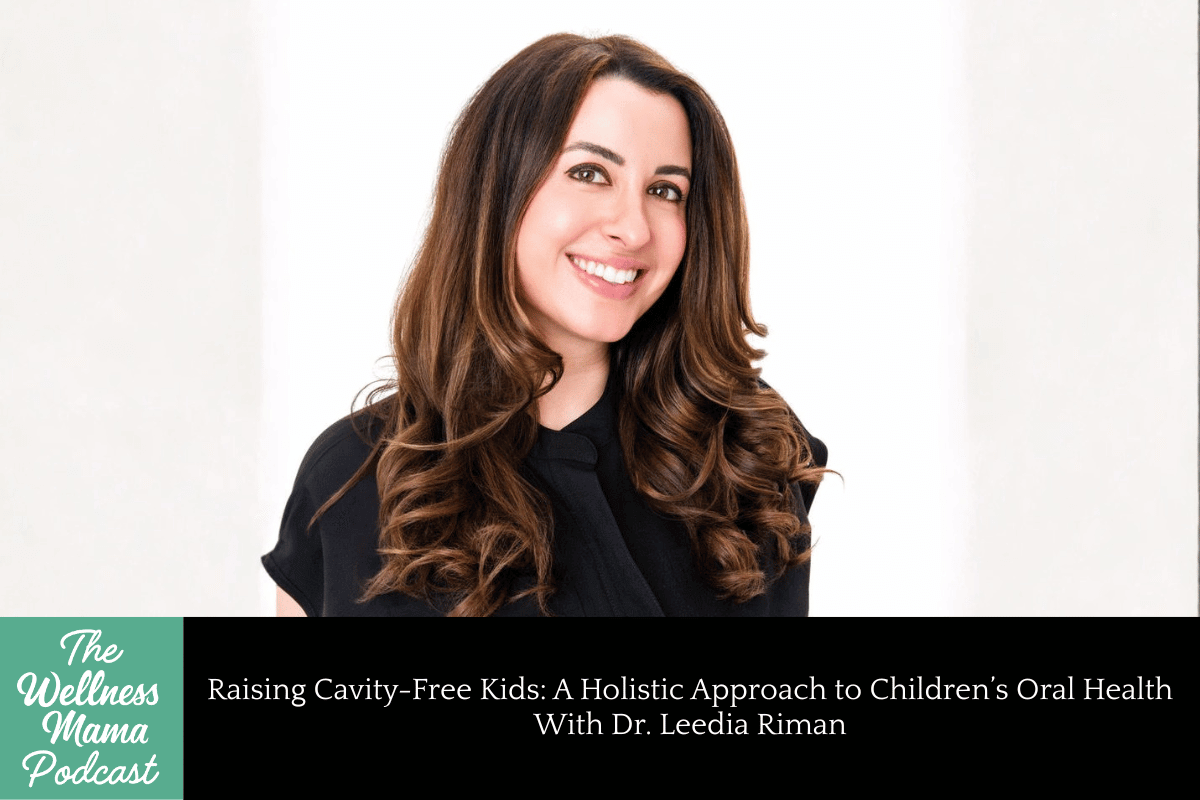
Katie: Hello and welcome to the Wellness Podcast. I’m Katie from wellnessmama.com, and this episode dives deep on the topic of raising cavity free kids through a holistic approach to oral health.
And I’m here with Dr. Leedia Riman, who is a mom, a holistic dentist, and an absolute wealth of knowledge. You’ll hear both her passion and her knowledge and her voice immediately, and she really goes deep on this topic, giving tips for every age of parenting. And ways that we can help our kids have a solid foundation for oral health.
She addresses the airway questions, how we can build a solid framework so they can avoid early dental work, what to do, when to introduce different things, when to let them take ownership of their oral health. Things to look out for when it comes to early oral health problems and airway problems, and so much more.
She even has a course on reversing minor cavities in kids. I’ve written about this and I get asked all the time questions about this. She has the whole protocol, so I’ll link to all those things in the show notes. I really enjoyed this episode. I love to geek out on oral health, so let’s join her now. Dr. Leedia, welcome back. Thanks for being here.
Leedia: Thank you for having me.
Katie: Well, if you guys missed it, we had a really fun first episode together that dove into the link between oral health and pregnancy outcomes in the womb and fertility and so many fascinating tidbits in that episode. I got a lot of takeaways, took a ton of notes. I will link to that. If you guys missed it, highly recommend listening and I think this episode is gonna be equally or even potentially more relevant to the parents listening because I’m excited to dive in with you on the topic of raising cavity free kids and especially the holistic approach.
I love that you seemingly combined the best of dentistry and what’s available with understanding of nutrition and minerals and all the ways we can support from a kind of whole body perspective to have the best oral health. And I know like for kids especially, like I remember being a kid and having to have a tooth pulled, but early dental work was terrifying to me and I felt like I, I literally did trauma work about it later. So anytime we can help minimize that in our kids and give them a healthy oral health foundation from day one, I’m a huge fan. So I know there’s a ton in this topic.
As a broad diving in spot, I know we talked about some of the nutritional stuff in our other episode. We can recap this here, but I feel like for kids especially, maybe it’s best to start with debunking the most common myth I personally hear when it comes to oral health in kids, which is that sugar is the only problem.
And I know from your last episode there’s a lot more that goes into it than that. But for anybody who hasn’t gotten all that context yet, can you dispel the myth of why sugar is the only problem?
Leedia: Sugar isn’t the only problem. So, such a great question. It’s definitely not the sugar, it’s the microbiome for our children.
So when I’m working with a mom, a new mom, or a mom of a 4 or 5, 6-year-old, of course we don’t want to be building. I don’t want to build my child to have fear around any food. I want our children to grow, grow up to be conscientious young adults that understand the difference between something up-building their body and their mouth and their teeth and something not being up-building.
So I focus a lot on empowering our kids, but we gotta start with the moms, right? So sugar most definitely isn’t. It’s things I would say probably like pretzels and, and the goldfish and things with flour like that, those are a lot worse, equally as bad as sugar. And I don’t like to label it as good or bad, but a lot of moms think, okay, the, the, the goldfish or pretzels are healthy foods.
Those, those aren’t very healthy foods. And if, if you are at the park and you’re giving them some of that, that’s fine. Just make sure that, you know, that… these create pasty white plaque and it sticks to their teeth. And children have much thinner enamel, so their, their enamel is more weaker than ours, for example. When their permanent teeth come in, those have thicker bits of enamel. The, the, the, the, the baby teeth have much thinner enamel, so they’re more fragile, if you could say, and more receptive to the acidic influxes. And it’s not just the sugar or the food, it’s also snacking frequency. Snacking frequency, I find to be one of the number one reasons why somebody’s getting a lot of decay.
If you’re frequently snacking constantly throughout the day, especially processed foods. You’re not eating great meals. So the reason, so a lot of patients, a lot of followers on Instagram ask me like, Hey, Dr. Leedia, how do you get your children to eat healthy? I make them hungry. Like I let them get hungry before I, before I, before I be, because if they’re constantly snacking, even if it’s something healthy like seaweed or a date, which I’m gonna get to like dates and dried fruit next.
If they’re frequently snacking, they’re not going to be hungry for the good stuff. Like the…. I’m a huge believer in Weston Price. I try to focus on getting all the fat soluble vitamins, A, D,E,K, minerals, et cetera. So I want them to eat their salmon. I want them to eat their steak. I want them to drink their broth so they’re not sipping on juice all day.
My kids rarely have any juice. We’ll have juice at birthday parties. I’m not going to say no. But it’s what, what matters is what you bring inside of your house. So it’s the 80/20 rule. I feel like my kids can enjoy their time outside at birthday parties, but inside the house, they don’t need to be drinking the Honest drinks.
They don’t need even fresh squeezed orange juice or carrot juice. Juices are not necessary for kids. I like water. I like coconut water. I like to stay away from anything processed. The crackers, the, the, the goldfish…goldfish all belong in the trash. I’m like a very, I’m not very anti, a lot of things that I feel very passionate about, but that company and that, that product is just, there’s nothing good about it.
I’d rather them have literally Sour Patch kids than goldfish, because at least with Sour Patch kids, they’re like, oh, this is candy. They’re more likely to go and, and drink water after, and they know that it’s not the greatest for their teeth. But it’s not just the sugar. We need to look at how they’re breathing, how they’re developing.
And I just wanna take it one step back that your children’s caries risk will drop by 70% if the mother’s oral health is taken care of. 70%. And dental decay is the number one chronic disease in our nation, probably the world, but in our nation for sure. That’s a big number. And if what we have been doing works, that number wouldn’t be so high. So that’s why I ove to focus on mothers and the kids. And also mothers need to be taking care of themselves. Beause when you learn about how to take care of yourself as a mom, you’re going to help your kid automatically. And I think anything that you wouldn’t be eating, your child shouldn’t be eating.
Like Goldfish and those are just not necessary. Anything processed. Of course, if you’re on a plane, you know, en route traveling somewhere, they wanna have a snack, that’s fine. But it’s about what you do most of the time. That was…yeah.
Katie: So many good points. And I think a lot of parents don’t realize about things like goldfish being like literally worse than sugar for teeth.And like I know when I was a new mom, like I didn’t learn until later the whole nutritional aspect of this. I remember reading Nutrition and Physical Degeneration by Dr. Weston Price. Which I linked to the book in the show notes, it’s dense. I feel like give you give us a much very dense, easier roadmap. Dense.I mean he explains it so well, but it’s very dense.
But it definitely opened my eyes to thinking about that in a different way. And I feel like you just gave us so many great strategies already. I’m curious for moms of kids with different ages, what is a good way to think about building out a solid oral health framework with them at different ages?
Like at what age do we start introducing some of these different things, having them take more ownership for it? Like I know brushing their teeth versus them brushing their own teeth. Like how do we handle that switch off? Like what are some good foundational habits we can have as parents that help set them up for success?
Leedia: This is such a great question, and I think it’s one of my favorite questions because it gives such a great overview. So you want to start cleaning your baby’s mouth when they’re born, a few weeks later. Okay? So babies are born with a sterile mouth and they’re getting the microbiome from their surrounding.
So whether it’s a care… any caretaker that comes close to my kid, I make sure I clean their mouth before they start helping me with my kids. I am, it’s, it’s very important. Some people may think I’m being a little extra, but they’re literally getting that microbiome. So whoever’s holding, whether it’s your husband, caretaker, et cetera, that’s impacting your, your baby’s microbiome. Your grandma, grandpa, cousins, et cetera.
So we want to start something called swabbing. Swabbing your baby’s mouth. Clean the baby’s mouth before the teeth even come in for multiple reasons. First of all, you wanna, you wanna continue the balance of the microbiome. Obviously their mouth isn’t going to stay sterile. They’re in the world, they’re integrating in the world, especially during the fourth trimester, whether they’re breastfeeding or not, they’re getting introduced to bacteria that they didn’t have in the womb.
So you want to just keep that balance. Okay. And what I recommend, a finger wipe, like you can get a gauze or a small baby wipe, like for the body. Wrap it around your finger, clean the gums, clean underneath the tongue, clean above the tongue, clean the cheeks and clean inside the lip and the palate.
This is so important not only to keep the microbiome balanced, but also once the baby’s little teeth start coming in, you want that environment to be balanced and you want the transition from swabbing to brushing to be very smooth. And babies are more likely to accept something that they’ve just been kind of trained on from when they, or before they could remember.
Right. So, my assistant who’s been with us, one of my head assistants, she’s been with us for 10 years and she’s had a, she had two babies before she started, and she had another baby while she was with us. And her first two hate brushing their teeth. It’s like, it’s a struggle for them to brush their teeth.
The third one, baby Richard. I’m like, start, you know, swabbing his mouth before teeth come in and this little kid loves brushing his teeth. He doesn’t have cavities. He’s it, it… the earlier we start, the better. So now once the baby has teeth, you wanna start introducing a, a, a toothbrush. I really like soft bristle toothbrush, ideally with no plastics. That’s you wanna try to minimize the plastics. So I like bamboo toothbrushes, and I always get two, right? I get two. One for the baby to hold and one for the mother or the caretaker. And you, all you do is just, you just brush his little teeth or her little teeth really beautifully.
You can put a little bit of saline. You don’t even need toothpaste right away. And I can continue to swab the areas that don’t have teeth because those, those areas are still exposed. And, and the reason by the way I swab the tongue and the palate is if you’re breastfeeding something called thrush can occur.
Not breastfeeding, not, just during milk consumption. And it’s a really, really painful candidal infection that can happen in the baby’s oral cavity. And even if you’re breastfeeding, it’s very painful for the mom. So that is, that prevents that completely if you’re able to keep the microbiome in check.
So you start brushing their little teeth, but you always give them something to play with and you make it really fun. You dance and you sing, and this is the way we brush our teeth. You want positive association with their oral health. The world is filled with so much negative association with the dentist and oral health.
And I don’t blame people. It’s a very intimate area. But if we start positive associations and we’re very fun and friendly and we’re laughing and I include my daughters when we’re doing our sons, when my my sons’ teeth, it just makes it very happy, very happy. And you just continue brushing as the teeth come in.
I say you continue brushing your baby’s teeth until they’re able to comfortably tie their shoelace and write their names in cursive. That’s kind of when you can give them the full independence. And even then, so for my 9-year-old, I brush her teeth once or twice a week just as a check and hands down I find plaque in places I shouldn’t find plaque every single time.
So I like to give the kids independence. They have the opportunity to choose what type of toothpaste, what color toothbrush, whether to brush in the this room or this room. But brushing is a non-negotiable. And if their teeth are touching, flossing is a non-negotiable. They can choose the type of floss, the color of the floss pick.
So we gotta reign, reign it in, is that how you say it in English? Reign it back in and show them that, Hey, I am the mom. You have choice, of course, but there are certain things I, I need to keep you safe. Because dental care for children is very traumatic. Them being in that dental chair, getting drilled on, getting sedated, it’s not even emotional.
It’s emotional trauma. It’s financial trauma, it’s energetic trauma, and it’s so preventable and it, it’s so preventable that I actually created a course to teach moms on how to reverse dental cavities for our kids, small dental cavities and help the progression of larger ones. And we talk about the five pillars of dental health, and I’m gonna go through that ’cause it’s so important.
The first pillar is at home hygiene. So what you do at home, which is kind of what I described, right. The second pillar is nutrition. I kind of described that a little bit before. What you feed them really, really, really matters. If you are constantly giving snacks, that is a detriment. But also, not only is it a detriment because of the constant acidity in the mouth, it’s a detriment because they’re not hungry for the good proper meals.
Breathing habits is extremely important. So if I had one thing to tell a new mom, ’cause we, you hear about, you know, nutrition and brushing and flossing, right? But breathing is so important. It’s very cute to see a baby with their mouth propped open while they’re sleeping and they’re breathing through their mouth.
It’s like the cutest thing ever. But when I see it, I cringe because I just want to shut that mouth so that the baby can get a nice lip seal. And I always say breastfeeding is the first orthodontic treatment. And I’m saying this as a mom who didn’t breastfeed my first two as long as I would’ve liked because I didn’t have the right support about me around me.
So there’s no judgment there if you can’t breastfeed for long. I think every woman can, if she has the proper support around her. But I’m still breastfeeding my 16 month old son and it’s just, it’s incredible on all ways. But the suction process, them being able to grab breast, seal their lips, use the tongue to suction the milk out.
That is a workout for them. And you want them to work out like that because it strengthens the oral muscle, the tongue muscle, the oral, oral facial muscles, which include the tongue and all, all the muscles around their mouth. And also checking for tongue tie and lip ties. It’s very, very, that’s very important.
So I, I know now that my first daughter had a pretty, had a, had a bad lip, tongue tie. And that’s why breastfeeding was so painful and miserable for me. So our, our journey was cut short. And then having a, a dental home, that’s the fourth pillar. It’s very important to have a dentist that you trust and feel good with.
That respects your opinion and your desires. And you know, if you don’t want fluoride and you tell your dentist that you don’t fluoride, they should respect that. Even if they continue to offer fluoride to somebody else, we don’t in our office. But not everybody has access to biological dentists and people who really understand the microbiome. They should be like, okay, these are our beliefs that I respect what you need to what you say.
So find a dentist that respects your wishes of parenting to say. And then the last is supplementation. So if your child isn’t getting all the proper nutrition, even if they are right, our soil is so depleted, that’s another podcast of like five hours. But, you know, look into supplementation specifically.
Like things like cod liver oil, D3, K2. You need vitamins D3 and K2 to uptake the calcium and to put it in the right place of the teeth. Culturally we’re all about calcium, calcium, calcium, everyone’s just talking about calcium, but K2 is probably just as important if not even more important than calcium. So those are the, the five pillars of dental health for children that I talk to moms about.
Katie: So many good points. And I know from the nutrition side, which was my background, like most of us in the western world are not deficient in calcium. ’cause it’s added to a lot of things.
Leedia: Yes.
Katie: Fat soluble vitamins are a very common deficiency in the western world. So I love that you talk about that and I’ll definitely link to your course in the show notes because I’ve written blog posts about my own experience with remineralizing cavities and learning it was even possible.
But it sounds like you have the whole protocol to walk people through and can answer questions people have related to that. So I’ll make sure that’s linked. And you touched a little bit on the airway stuff, and especially in babies. And I know this is something that has kind of a far reaching impact into like airway health in general to how much oxygen we’re getting later in life to like full palate development. Like a there’s a lot that goes into that. What are things parents need to watch for at different ages to know if mouth breathing might be an issue with their kid? If there’s airway obstruction, if they need to do something more like an expander or something even more advanced to try to deal with that early.
Leedia: Okay. Such a great question. So if your baby is snoring, if your baby is grinding. So, most pediatric dentists and pediatricians, I have a dear friend, she’s a pediatrician, and she told me that she went to her pediatric dentist for her son, and they said that they’ll outgrow the snore, the, the grinding and the snoring.
They’re not gonna outgrow the grinding and the snoring. I could, that I couldn’t be more opposed to that. If your baby’s grinding, they probably have something called sleep disordered breathing. Okay. And that’s very important to find an airway centric pediatric dentist to help you with that. For example, both of my kids have gotten expanders.
They wore their pacifier, they used their pacifier for a little longer than I would’ve hoped. And when I’m talking to you, Katie, like, you know, I’m like Dr. Leedia in one sense, and then I’m mommy in one sense, right? So it’s a fine balance between the two, and I think it’s really important. So I needed the, they needed the pass, they got addicted to the pacifier.
And the reason that a child gets addicted to the pacifier, there’s, there’s a nasal palatine, there’s an incisive nerve right here behind. So babies who thumb suck, they suck on a blanket or, or, or pacify. It’s literally the same addiction as like cocaine and sugar. It creates that beautiful endorphin rush and they, they need that to soothe and calm down.
So that’s, that’s kind of the history of not history, the explanation why babies can get attached to their thumb or their pacifier. So if your child is snoring, if they have bad breath, if they’re getting dental decay and you’re like, Hey, I’m doing everything right, like I’m, I’m doing everything right.
Why is my child getting dental decay? I would look into mouth breathing. If there are no gaps between your baby’s teeth. That’s also a red flag because if you look, my adult teeth are a lot bigger than my baby’s teeth, they’re like probably double the size. So if there are no gaps between baby teeth, our permanent teeth underneath them are not going to have enough space to grow.
And that is almost an automatic prescription for orthodontic treatment when they’re adults. So what I recommend, so with Julia, my firstborn I expanded her. Once I expanded her, she started nasal breathing consistently. And right now she’s just in these trays that just help with her development.
But her teeth are coming in so beautifully in her mouth that we’re gonna avoid braces when we, when, when she’s older. So to answer your question, spacing between the teeth, snoring, grinding, and also major behavioral issues, chronic bedwetting. I dealt that with my second daughter. They, they, your mouth is so related to your systemic functions.
And when you’re breathing properly, your hormones are optimized even as a baby. As a child. And when your hormones are optimized, your hormones are your messenger systems in your body. And it’s like, you know, giving FedEx a package to take somewhere. You’re either going to go to the right address or not.
And when your hormones aren’t working well, it’s like you’re delivering a package to the wrong address. Things are not gonna be functioning properly. So these are the things that I look for for, and also open mouth posture. So if you notice your, your child’s like this all day or the tongue sticking out, that also these are red flags.
Like, let’s see, why is the tongue, why do we have open, open mouth posture? know not everybody may have access to that airway centric pediatric dentist, right? Something as easy as myofunctional therapy can help so much. Myofunctional therapy is therapy for the oral facial muscles. And you can do that online.
So there’s easy access to that. You can even go on YouTube and look for myofunctional therapy for kids, and you can do that with your kids. So I always like to give little bits of like little, little tips for moms that don’t have easy access to all this because a little bit of myfunctional therapy can go a long way because when you have your tongue in the proper position as the baby’s growing. So the proper position for your tongue, everybody, this is everybody, not just kids, but everybody it’s at the roof of your mouth, it’s at your palate.
So if you heard that right before you hear the sound, the the tongue needs to seal the palate. And when you do myofunctional therapy, you strengthen your tongue and you’re able to get a better seal. When you have a better seal your tongue is one of the things that pushes your palate forward and outward.
You want your palate to be wide and forward, so forward growth, and that will help a lot with, breathing and just, or overall oral health function. But of course, if you do have a dentist that’s guiding you with the process, that would, that is more optimal.
Katie: Yeah, that’s super helpful and hopefully, it seems like there’s more access to this, like a lot there, I’m seeing more dentists who are aware of the expanders and the airways and even looking at airway size in kids.
Also in our other episode we talked about mouth taping and you mentioned not during pregnancy, because you can have more progesterone and breathing can be more difficult. What about for kids? Like, I’m thinking obviously little ones you probably wouldn’t wanna do that, but I’m guessing there’s some age where that could be beneficial. And especially I know there’s benefits with mouth taping and deep sleep and recovery. So I’m thinking for like my high school athletes for instance, what age do you feel like is safe for mouth taping?
Leedia: So, it’s a great question. And I think one of my most, interacted with reel that I posted on Instagram was me mouth taping my 4-year-old. And I got a lot of love and a lot of hate for that. So it’s very important that, so you can, you can mouth tape your kids. I I, if your child is constantly… it’s, it’s a little nuanced because it’s very important for you to get the clearance from like your ENT or your doctor to make sure that your baby can properly breathe through their nose. That they don’t have any obstructive obstructive structures like adenoids, tonsils, kissing tonsils.
So if there’s no obstruction in the tube, then you can mouth tape. Okay. But if there’s any obstruction in the tube, I don’t want you mouth taping. Let’s take care of that obstruction and then we can mouth tape. So that’s why I’m such a huge proponent of nasal hygiene. Like even my baby, even when he’s not sick, once a week I’ll clear out his nose.
I’ll just put a little bit of saline. It does not hurt. It’s not hurting him. It bothers him a little bit, but not that much. He’s like, he squirms and he’s, and I clean his nose and that, that’s been really helpful ’cause he’s gotten sick twice. And both times I’ve been able to comfortably nasal hygiene, like nasal spray him, clear him out and, and he’s been able to be breathing through his nose.
But I just had a total mom brain moment. What was your question? Oh my god.
Katie: Oh, about the mouth taping and the age.
Leedia: Yes, yes. Yeah, so I’ve mouth taped my 4-year-old, so I made sure that she’s able to to nasal, so I make sure she’s able to mouth to nose, nasal breathe and she’s, since I know that she can, and I feel comfortable with that.
There is a mouth tape brand, it’s called Myo Tape. I am not affiliated with them, but they have a really nice tape that goes around the baby’s mouth. So what it does is positions the muscles in the right place. So if they do need to mouth breathe or they need to gasp for air, because I got some crazy comments on that reel. I’m like, they’re able to open up their mouth like they’re, we’re not, we’re not duct taping them shut, duct taping their mouth shut.
So it’s a very gentle approach and it just helps with the positioning of the oral, oral, oral muscles for kids. So, but for sure, athletes. Yes, I would highly…I treat ath… like a, if you’re in high school or middle school after sixth, seventh grade, I treat you almost like an adult there. I like, I need to respect your microbiome, your teeth.
Most of your adult teeth have come in by then, but for sure if all of your adult teeth have come in, you’re an adult to me. So I treat your mouth like I treat mine and yours.
Katie: That’s awesome and probably psychologically actually very helpful for them. ’cause then in that age, they’re meant to be sort of psychologically becoming more independent and really value being treated with that much respect and autonomy.
So I’m sure they respond really well to this. And I love that these are all things you gave us so many tools that we can do at home with our kids as well as how to collaborate with our dentists to have really good outcomes for our kids. And I would guess the earlier we do these things, the better foundation we can build,not only does that prevent that early dental trauma when they have to have work, but it also builds a really solid foundation.
And especially if we’re addressing expanding and airway, like for their jaw, for their bone development, for things that are going to benefit them throughout their whole life. Are there any other tips for parents, especially of any kids at any ages that you would recommend and or what resources would you point parents to for getting to go deeper on this and learn more and really build these habits with our kids?
Leedia: I love it. The, the one, one key tip that has really helped. So you hit the nail on the head. They’re very responsive when you give them autonomy and like give them responsibility that I’m treating you the same way I’m treating your mom and your dad. The big thing, especially in the teenager or the preteen, is breath.
So if you wanna avoid bad breath and not get cavities and gum disease, this is something, this is something that’s very low hanging fruit. Clean your nose and shut your mouth at night. Also, I did wanna comment one thing that is very important, ADD medications, anti-anxiety, medications, behavioral issues.
These prescriptions are at an all time high. And if somebody is prescribing any of these, any of these medications for your child, please, please, I call you to check that they’re not mouth breathing at night. Because when a child is mouth breathing, they’re not getting properly oxygenated, their brain isn’t getting properly oxygenated, and that can cause them to act up.
So before you put your child on any pharmaceutical drug like that, because these medications can also further dry out their mouth even more. And I’ve seen a rampant decay in children with these sorts of medications and it’s just heartbreaking because it’s so preventable. So, I’m not telling you to put them or not to, but before you accept any prescription, make sure there’s no sleep disordered breathing going on, and they’re breathing consistently through their nose.
I think that is an extremely important point to take very seriously before we start having our children take pharmaceuticals. That’s number one. And to answer your question, so if you wanna dig deeper there are a few books. There’s a book called Breathe. There’s a book called Sleep Wrecked Kids that is specifically for children.
So if you have a child that’s mouth breathing, this is such a great book. Like what we spoke about Katie, is really, really the tip of the iceberg. This is a great book called Sleep Wreck. It’s an older book, but it’s so easy to read and it’s so well written. It’s, it’s a great book. So I’d recommend those two because Breathe is mostly focusing on adults, but whatever we need to do on adults, we need to do for kids.
And the sleep wrecked kids for the, the sleep wrecked kids is for the children of course. And knowledge is power. Just keep seeking, keep asking, ask your dentist questions. And a lot of times moms know sometimes more than the conventional dentist, with all due respect. I used to be one like 10 years ago. So when you kindly and, and respectfully ask your dentist, I just pray that dentists are open, you know, and tell them like, this is what I feel.
And so you can be part of that ripple effect that I’m trying to create because so much of dental disease is so preventable, and when we start with our children and ourselves as mom, we can really make a difference in the, the crazy statistics that are out there.
Katie: Well, I love it. I feel like this was so practical and had so many actionable, immediate things that parents can do. I’m gonna make sure I link to our other episode, to the books you mentioned, the course that you mentioned, and to your website and your Instagram so people can find you and keep learning from you.
I know you post a lot of these kinds of tips all the time, so I encourage people to make friends with you on Instagram and keep learning. But Dr. Leedia, thank you so much. This has been so fun. You’re just a wealth of knowledge and obviously caring, loving mom as well, and I feel like you brought that perfect balance to this episode.
Thank you so much for your time and for being here.
Leedia: Thank you so much for having me.
Katie: And thank you as always for listening and sharing your most valuable assets, your time, your energy, and your attention with us today. We’re both so grateful that you did, and I hope that you’ll join me again on the next episode of The Wellness Podcast.




Leave a Reply