Read Transcript
Child: Welcome to my mommy’s podcast!
Katie: This podcast is brought to you by Hiya for children and especially I love to talk about their new greens line for children. Now, I have tasted these vitamins and they’re delicious, and my kids are the ones who really love them though. And I love that they’re getting the nutrients they need without the sugar because most children’s vitamins are basically candy in disguise with up to two teaspoons of sugar and dyes and unhealthy chemicals or gummy additives that we don’t want our kids to have.
So Hiya created a superpowered children’s vitamin that’s chewable, without the sugar or the nasty additives and it tastes great. My little ones love it. They especially are designed to fill the most common gaps in modern children’s diets to provide full body nourishment with a taste kids love. And it was formulated with the help of pediatricians and nutritional experts and pressed with a blend of 12 organic fruits and vegetables, then supercharged with 15 essential vitamins and minerals, including vitamin D, B12, C, zinc and folate among others.
It’s also non-GMO, vegan, dairy free, allergy free, gelatin free, nut free, and everything else you can imagine. I love that they test every single batch with third party testing for heavy heavy metals and microbials in a qualified GMP compliant lab using scientifically validated testing methods so you can be completely at ease knowing it’s safe and nutritious and it’s designed for kids and sent straight to your door so you don’t have to worry about ordering.
My kids really like these and I love that refills show up on schedule with no stress. Also, again, honorable mention to their new greens because if you are tired of battling your kids to eat more greens, their Daily Greens Plus Superfoods is a chocolate flavored greens powder designed specifically for kids and packed with 55+ whole food ingredients to support kids’ brains, their development, their digestion, and kids actually like it. We’ve worked out a special deal with Hiya for the bestselling children’s vitamin. Receive 50% off your first order. To claim this deal you must go to hiyahealth.com/wellnessmama. This deal is not available on their regular website. To get your kids the full body nourishment they need.
This episode is brought to you by Native Path creatine, and this might be the most important creatine benefit that we don’t talk about enough, which is its impact on mental health. See, research shows that creatine supplementation can improve our mood, particularly in women, and our brain needs energy to produce neurotransmitters like serotonin and dopamine. And creatine helps on a cellular level.
Some studies suggest that creatine may be particularly beneficial for women with persistent feelings of sadness. And of course, while it’s not a replacement for professional mental healthcare, it’s an additional tool that might help us feel like ourselves again. So if you’re struggling with low mood and mental fatigue, talk to your healthcare provider and consider if creatine could be a helpful addition for you.
Quality matters though, so look for the most studied form, which is creatine monohydrate. I personally use Native Path creatine, and most research says to aim for three to five grams a day. I sometimes go as high as 10 for the mental benefits. But you don’t need a loading phase despite what you might have read on the internet.
As always, of course, talk to your doctor or healthcare provider before starting any new supplement or protocol, especially if you have an underlying health condition. But for many of us as women, creatine is one of the safest, most researched supplements available. And its time we stopped thinking of it as just for men. Save up to 56% and get free shipping at wellnessmama.com/go/nativecreatine That’s wellnessmama.com/go/nativecreatine
Katie: ?Hello and welcome to the Wellness Mama Podcast. I’m Katie from wellnessmama.com, and this podcast is going to go deep in hopefully a quick and concise way on a topic that I have found really interesting recently. Which is the data backed ways to catch certain diseases early in a very noninvasive way. In fact, this is something that I have gone deep on and gotten to invest in, actually, because I believe in it pretty strongly. But the idea, we know that there’s the concept of the four horsemen, which are the four big killers and why 85% of people over 50 will die from one of these conditions. And I’ll get into those later. But there’s a lot of things that these share in common that are actually understandable and detectable years before problems begin.
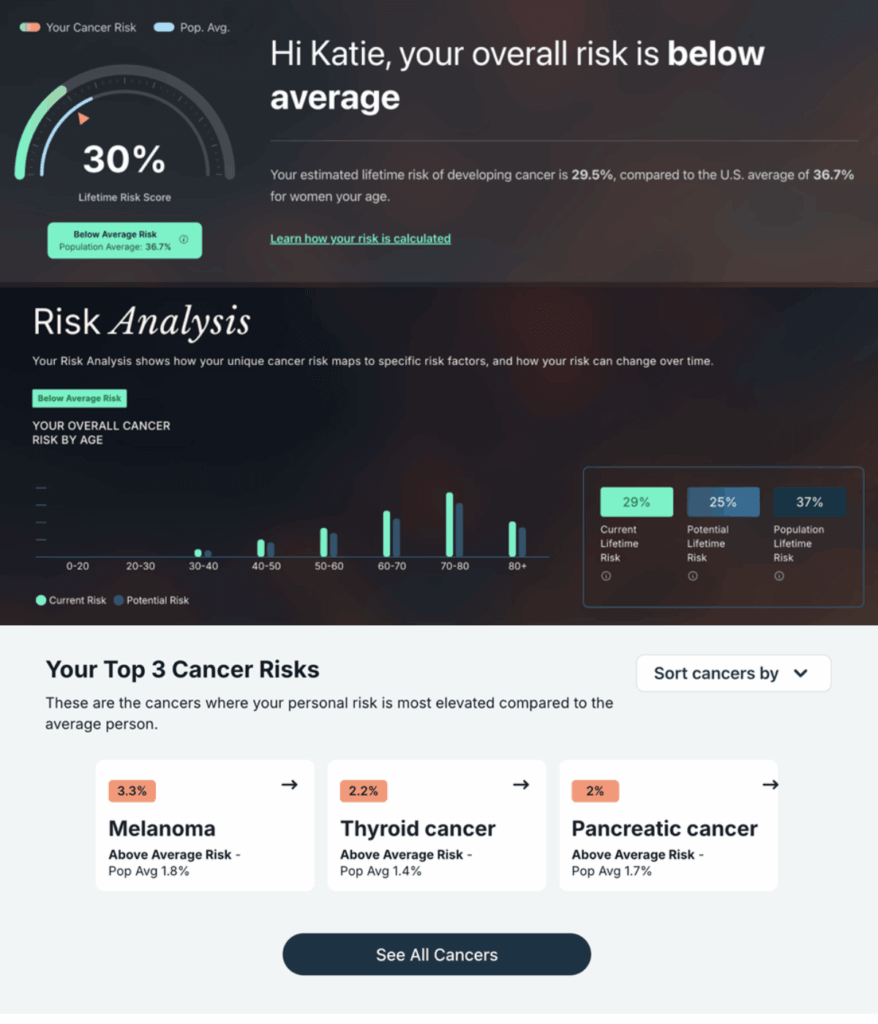
And a lot of traditional screening waits until there’s already an active disease process before figuring out something’s wrong. And now with the rise of data and AI, we actually have the ability to predictively understand our risk far in advance and modify it in a way that is statistically significant and that can really be beneficial for our health long term. So, I’ll put a link in the show notes to specifically where I’ve gone deep on this personally. As well as just some photos of my personal analysis and risk related to, for now, cancer. But I wanted to go deep on my understanding of this because I find this fascinating and I think that data can be power, especially when it’s individualized.
And I’m explaining how I’m using this in my own context and also my understanding of data variables, as a whole and why a tool like this can be so effective. I also have a special link in the show notes if you wanna try it, so that you get it. And with a free trial and heavily discounted. So, before we jump in, I want to reiterate something important, which is nothing I share is ever medical advice, health advice, or even personal advice. Nothing I share is advice at all. I’m simply sharing my own experience, things I’ve learned, my anecdotal experience of life, and ideas that have been helpful to me on my journey with the goal of offering information and inspiration, never comparison, pressure or prescription.
You are and always will be your own primary healthcare provider. I feel like tools like the one I’m gonna talk about today actually help in that journey. But at the end of the day that both power and responsibility lie with you. And I encourage you to be curious, to do your own research, to listen to the deep wisdom of your own body and to question everything, even, and especially me. If something resonates, wonderful. If it doesn’t, please feel free to completely discard it. My deepest hope is that these conversations help you connect with your own wisdom and your intuition around your own next best steps. So with that said, let’s jump in. So kind of for some broad context, the reason I’m doing this episode now is that I feel like we’re seeing a shift in health.
Which I’m really excited about, from reactive to proactive or protective as we have availability of significant insight and data into our own bodies. I say so much, they’re probably sick of it, that we are our own primary healthcare providers. And this is especially true around our daily choices and how those relate to our cumulative risk of any condition. I do feel like avoiding problems and heading them off by understanding what contributes to them, is extremely powerful. And now with AI and data, we have more insight than we ever used to, however, because of that, it can also be data overwhelm and there can be a lot to cut through. So today I’m gonna talk about some ways to cut through that noise and also just some key takeaways of statistically valid data that I think are universally applicable.
But here’s a shocking reality that most people don’t know. 85% of people over 50 will die from one of what are called the four horsemen. Which are, in order, heart disease, cancer, type two diabetes or metabolic disease or Alzheimer’s. And those are all on the rise. These are not sudden diseases. You do not catch them, you don’t get them overnight. These take years or decades to accumulate. And we have a lot of data around things that contribute. And yet most of our current medical approach is to wait until these diseases are actually in disease state to do anything about them. So for me, I’m gonna go deeper on some of these particular things today. In my own experience, autoimmune disease was my lesson into looking deeper into health and risk.
And as we learn more, being able to modify that risk. And I’m so glad personally that I experienced autoimmune disease. And because some of these things that I learned in my own recovery process from that are strategies that I have found now actually reduced my risk of cancer when I did these assessments related to relative and actual risk today. So, I’ll of course mention some of my personal fundamentals and what I did from an anecdotal perspective, that I feel are helpful in any health conversation. Things like addressing Nature Deficit Disorder, getting our light and circadian cues correct, dialing in our sleep and the nutrient focus with food as well as the right type of movement.
And then I’ll get into a little bit more of the nuance of things we can only learn from these more detailed and personalized assessments as well. But, this is the empowering truth. So I mentioned the staggering statistics about 85% of people experiencing one of the four horsemen. But the empowering part is we now have the data and the tools to predict and see risk early and 60 to 90% of most chronic disease risk is modifiable. So we know very little actually is directly related to genetics in a way that cannot be changed. And we now know the vast majority. And up to about 90% of risk is changeable. So the four horsemen, and the problem with our current approach, here’s what they have in common.
They begin decades before any symptoms. The early symptoms and changes are silent, so it’s hard to listen to them. I talk often about symptoms being messengers, but often if we’re not aware of them, they’re not, we’re not able to hear their message. Standard care only looks at diseases once it’s a diagnosable disease. And outside of even these four horsemen, many of us have had experience, I know I have, of having something going on, going into the medical system, asking for testing and being told everything was quote, normal, and then it being a long time before something actually showed up on a test that met their diagnostic criteria, even though I knew years in advance of that, that something was off in my body.
For this reason, most first signs, especially of these four horsemen are catastrophic. For a lot of people, the first sign of a heart disease is a heart attack. In fact, that’s for 50% of people. The first sign of cancer is often a late stage diagnosis, which is scary because the earlier it’s detected we know the better the outcome. And Alzheimer’s typically begins 20 to 30 years before actual memory loss, but we’re not detecting it then. So the way we currently assess risk is… Heart disease risk is assessed with a narrow 10 year event risk calculator. Cancer risk for the average person isn’t actually looked at or assessed at all.
Alzheimer’s risk isn’t assessed unless there are symptoms, and screening is often just age-based or general and not personalized. And what we’re seeing are the consequences of taking a reactive approach to health, which is we’re seeing rising rates of health problems across the board, including in people under 40 and now including in children as well. We’re seeing late stage diagnosis is still the, kind of, the common norm. But we’re seeing younger ages of onset for some of the bigger and more prominent and more dangerous cancers like colon and breast. And despite spending a trillion dollars on curing cancer. We haven’t meaningfully, meaningfully improved incidents or mortality at all.
Most people walk around with unknown risk factors, think there’s nothing they can do to shift it and don’t find out if there’s a problem until it is late stage. So what I feel like is helpful and empowering is to understand the paradigm shift when we understand something we now have access to in early risk factors. Here’s why this is so important and paradigm shifting. We know that 65 to 90% of cancers, our risk can be modified and then we can avoid entirely through shifts in our lifestyle that are within our control. Less than 10% of cancer is genetic. Early detection offers a 90% survival rate compared to less than 10% when caught in very late stage.
And lifestyle is the most powerful lever we have. And as I often say, the benefits of compounding daily choices we make compound to drastically either positively or negatively affect our risk factors. So some examples of lifestyle factors, just to give you an idea that this AI driven data model shows that I find especially fascinating. So some of these are instinctive, but there’s data also around them. So adding even just a little bit more vegetables to our daily consumption reduces the risk of nine types of cancer. A serving of oily fish per week reduces stomach cancer risk by 15%. One extra serving of fruit a day like berries reduces lung cancer risk by 17%.
This one is surprising to me. Asthma or allergy history surprisingly reduces brain cancer risk by 30 to 40%. And I have some ideas from an immune perspective of why that’s the case, but I feel like that one’s counterintuitive a little bit. I love this one. Regular coffee consumption lowers the risk of four different cancers, so yay me for coffee consumption. Multivitamins can be associated with, depending on them, with a lower risk of lung cancer. And we also know things like having a severe concussion can actually double our lifetime brain cancer risk. So there’s a lot of variables that we just don’t think about and that we can do things if we understand them to shift our risk factors over time.
There are some surprising environmental and lifestyle contributors that people never think about. For instance, this is actually one I did think about because I used to live near caves, but many people never even consider, which is the radon levels in our homes, concussions and head trauma injuries, which I’ve had both skull fractures and concussions. We know our sleep patterns relate to our cancer risk. Food consumption of course, but especially highly processed foods are linked to higher risk of certain cancers, environmental exposures, which I’ve talked in depth about, especially in a home environment, how indoor air can often be more polluted than outdoor air and how those exposures are linked to cancer risk. Even viral history, kind of in both direction.
And I’ll share some of my own personal data on this. It’ll be in the show notes as well. Some screenshots of my own risk portfolio and some like interesting key takeaways that I learned from doing this. But what I find really interesting is I think data and AI are really changing early detection in a really statistically relevant way. The old system couldn’t do this because it was too many variables for a human doctor to track. And each disease we know has dozens or hundreds of contributing variables and risk changes over time as we change these variables. So population level guidelines are not personalized and don’t give a person any indication of their actual risk factors.
So I got to a couple of years ago or a year ago become involved with a company that’s really spearheading using this data in a way that is relevant and predictive and helpful to an individual person. And the company’s called Catch. I’ll link to them in the show notes as well as a special way that you can try it. And so I got to be involved. I feel like this is a pivotal tool in that thing I talk about often of becoming our own primary healthcare provider. They are able to analyze hundreds of risk factors from over 10,000 studies in light of an individual. And then create personalized lifetime risk scores for 21 of the major cancers.
Like I said, I’ll share mine so that you can see. They also show which factors increase risk and which decrease it, and give suggestions based on the individual of things that can be done that are within our control to shift our risk. They also build a personalized screening plan. If risk factors are high, that can be something that people take into account. And they also give guidance on which test actually would matter for our own unique risk factors versus just more broad screening. That, like I said, often misses things until they’re in advanced stage. Their goal is to actually tackle all of the four horsemen eventually, but the reason they started with cancer is it’s the second leading cause of death.
Half of us will get it statistically in our lifetime right now. And risk isn’t assessed currently, so people rely on chance or assume it’s genetic. And until now there have not been tools other than diagnostic tools, which I said like often don’t detect things till later or which are invasive, to test or screen at all. And we know that statistically the earlier this is, where we find out about it, the earlier detection basically, the higher their survival rate. So up to a 90% survival rate women found early. We also know with cancer, and they have proven this with the data, that lifestyle impact is massive. So there’s actually a tremendous amount within our control that we can do to shift our risk.
So, like I said, everything I share on here is strictly my own experience, research, opinion. So I wanted to share my experience of using this risk calculator. The things that surprised me, what I learned, what was expected and what wasn’t. So I found out, like I said, that less than 10% of our cancer risk is genetic, which is for me good news because I’ve had quite a few relatives who actually experienced some form of cancer. I found out that my risk is lower than the population average. But there were some surprising things for me. So having my kids young and having, multiple kids reduce my risk of certain cancers like breast cancer as well as breastfeeding reduced my risk. My blood type, which is A+, slightly increased my risk of certain cancers.
My coffee intake statistically lowers my risk, which is yay, because I wasn’t planning to give that up. And like I said, breastfeeding contributed to a lower risk of several types of cancer, I believe, including breast cancer, uterine cancer, and cervical cancer. Another surprising one, I don’t even consider myself tall, but I’m slightly taller than average and my height increased my risk, but my weekly activity level balanced it out by reducing my risk. Some things I took away from my assessment is that I could drink more organic tea and increase my consumption of fatty fish in my diet, even though that is something I consume. I will say going into this, so one area that I feel like deserves a little bit more nuance is that when it comes to skin cancer risk, their system recommends sunscreen.
I think there’s nuance here, as my personal opinion is there are sunscreens that are universally harmful chemical sunscreens that I feel like do not reduce cancer risk and in my personal opinion, might increase it, and that are harmful to the environment, to reefs and our hormones. I personally, again, just my personal opinion, will not wear sunscreen, period. I’m not, even though I have fair skinned, I’m not concerned with skin cancer risk, personally. You have probably heard me talk about this before and I can link to some podcasts I’ve done on this, but that is one thing I disagree with at least the recommendation around sunscreen on.
And one thing I did confirm with them, before being involved with this company and investing in them, is the data actually shows, and I’ve mentioned this before as well, there is not a correlation between moderate healthy sun exposure and skin cancer risk. There is a correlation between sunburn and skin cancer risk. And we know that having healthy vitamin D levels, which I personally can only get from sunshine, supplements do not do anything for me, but having good vitamin D levels reduces the risk of other types of cancer. So I know that’s a controversial one. That is by no means the Catch recommendation or perspective. My personal opinion is that I will get as much healthy, moderate sun exposure without sunburn as possible throughout the year at all times throughout the day, morning, bright, midday, and sunset.
And I find this is actually incredibly health supportive. However, just a caveat that if you do go through Catch, they may recommend sunscreen. I personally differ an opinion about them, but they’re looking at data there as well. So this is a perfect place. Do your own research. Ask deeper questions and do what works for you. I also like that Catch explains the science of the recommendations on each factor. So, like I said, my risk was lower than population average and pretty close to as low as it possibly could be based on variables I can’t change like my age, my height being a woman, et cetera.
And my elevated risk came from family history. From sunburns when I was younger, from having thyroid disease in the past, though, I would guess the model doesn’t have a lot of examples of people who had thyroid disease and then now don’t. Considering the conventional system says it’s not reversible. So I’m curious how that comes into play and what will happen in my lifetime. But it gives a lot of things to be aware of and to modify. The empowering part of this is you don’t need to change everything, which is beautiful news. You can, it helps you kind of prioritize a few big levers that are not actually like high energy demand and some small shifts can lower our lifetime risk by as much as 60%.
So I feel like this was very helpful, like actionable information and that didn’t seem stressful or, like, out of my control to understand. So examples of some small shifts that I made, based on my Catch analysis, were increasing my vegetable intake, especially fermented vegetables. I was already consuming vegetables, but I increased that slightly. Added more colorful plant foods. I mentioned before, but more weekly oily fish, so yay for sardines. And then now I will know if I choose to get screenings at what intervals and what types are going to be most effective. I’ll also say because they are focused on eventually addressing all of the four horsemen, that what is next for Catch specifically is heart disease and Alzheimer’s.
And I love this because they’re taking a different approach that I think is very overdue and very important and warranted. Which is, their approach to heart disease will be very different. HDL and LDL are only part of the picture, which I’ve also said this four years as have some really educated podcast guests. And I believe our current diagnostic model even is actually not nearly nuanced enough or helpful. And that doesn’t provide a full understanding. Personally I think light and minerals come into play here in a huge way. However, so Catch is looking at things like calcification, inflammation, metabolic markers.
And statistically validated clearer risk indicators than just cholesterol, which I could do probably a series of podcasts on why I don’t think that is an accurate predictor. But 50% of people who have heart attacks have normal LDL. So I’ve said for years it’s not about cholesterol. It seems like they have actually really gotten into the deep data around this and can help people modify their risk on what actually can make a difference. Their AI powered risk modeling will help identify and shift risk decades earlier. When it comes to Alzheimer’s, like I said, the disease progression starts 20 to 30 years before symptoms and lifestyle is the biggest driver of Alzheimer’s as well.
We do have early brain scans and biomarkers that are emerging, but AI can help us identify risk patterns way before those even come into play. So my conclusion here, kind of key takeaway. I know this is like a very nuanced, a very nuanced topic and one that I find particularly fascinating personally. But, I love tools like this that are emerging because we don’t have a lack of access to data in today’s world. But it can be overwhelming to sort through the data and to sift through what is relevant and what’s not, what’s true, what’s not, and what applies to us personally. And I feel like they’re helping with that in a substantial way because our health future is not random.
Like I say, so often we are our own primary healthcare provider, and I feel like really relevant and expensive tools like this help us to step into that role in a more powerful way. Especially because we know from a data backed perspective that we can massively reduce our risk before disease begins versus waiting until things are already on fire to try to shift things. I personally think data plus lifestyle is one of the most powerful prevention tools we’ve ever had and very needed in today’s world where we have more negative inputs than we’ve ever had. But I feel like this empowers us to not have to wait for symptoms or assume that these are random or genetic, but allow for early detection and proactive lifestyle choices that can literally extend and save our life.
So, some personal steps, I think kind of universally beneficial. However, I do think, like, tools like this that give us more personalized data are really, really powerful. But based on the data that I saw from Catch, things like, extra vegetables, adding those in daily, adding a serving of fruit like berries. Especially adding more oily fish per week. Getting daily sunlight and movement, knowing our family history, knowing a screening schedule if needed for us. And then knowing our own personalized risk based on this kind of data. So I wanna wrap by saying I feel like this is both hopeful, empowering, and accessible. That when we can understand our own data in a meaningful way this actually lets us kinda shift and avoid disease before it begins, versus waiting until it’s a big problem.
When we catch things early, we can change outcomes entirely. And for the first time, we have tools that let us actually do that in a personalized way. And when we change our habits, we change our future health story. So I’m very excited for tools like this. Like I said, there’s a special offer just for people who listen to this podcast that will be linked in the show notes at wellnesswma.com if you wanna check it out. Whether you do or you don’t, I hope this has provided some fuel for thought, and I’m always so grateful to you for joining me and listening to this podcast for sharing your time and your attention and your presence. It means the world to me that you are here and that you listen.
And if you have found this episode helpful, the very best way you can support the Wellness Mama Podcast is to leave an honest review wherever you listen to podcasts. This helps other moms and families find us and be part of the community. And if you want to stay in the loop with episodes, resources, my behind the scenes updates and some of my favorite wellness tips, be sure to join my VIP email list at wellnessmama.com. But for today, thank you for listening and I hope you’ll join me on the next episode.




Leave a Reply