Read Transcript
Child: Welcome to my mommy’s podcast!
Katie: This podcast is brought to you by Native Path. If you’ve ever felt like you’re hitting a wall during your workouts or just don’t even wanna workout, creatine might be what you need. It increases your muscle’s ability to produce energy during high intensity exercise, which means more reps, better performance, and faster recovery, which is a huge component.
For women doing high intensity training, strength training, or any intense activity, creatine can be the difference between struggling through and achieving your goals. And the best part is, better workouts lead to better results, more muscle, improved metabolism, and getting stronger every day. But when it comes to creatine, quality matters. So look for creatine monohydrate, which is the most researched form. And most research suggests starting with three to five grams a day.
I personally sometimes take up to 10. And the form that I use is Native Path creatine, which I will link to in the show notes. As always, talk to your healthcare provider before starting any new supplement, especially if you have a health condition. But for many of us, creatine is one of the safest most beneficial supplements available. And it is time that we women stopped thinking of it as just for men. Save up to 56% and try it yourself and get free shipping at wellnessmama.com/go/nativecreatine That’s wellnessmama.com/go/nativecreatine
This podcast is brought to you by Hiya for children and especially I love to talk about their new greens line for children. Now, I have tasted these vitamins and they’re delicious, and my kids are the ones who really love them though. And I love that they’re getting the nutrients they need without the sugar because most children’s vitamins are basically candy in disguise with up to two teaspoons of sugar and dyes and unhealthy chemicals or gummy additives that we don’t want our kids to have.
So Hiya created a superpowered children’s vitamin that’s chewable, without the sugar or the nasty additives and it tastes great. My little ones love it. They especially are designed to fill the most common gaps in modern children’s diets to provide full body nourishment with a taste kids love. And it was formulated with the help of pediatricians and nutritional experts and pressed with a blend of 12 organic fruits and vegetables, then supercharged with 15 essential vitamins and minerals, including vitamin D, B12, C, zinc and folate among others.
It’s also non-GMO, vegan, dairy free, allergy free, gelatin free, nut free, and everything else you can imagine. I love that they test every single batch with third party testing for heavy heavy metals and microbials in a qualified GMP compliant lab using scientifically validated testing methods so you can be completely at ease knowing it’s safe and nutritious and it’s designed for kids and sent straight to your door so you don’t have to worry about ordering.
My kids really like these and I love that refills show up on schedule with no stress. Also, again, honorable mention to their new greens because if you are tired of battling your kids to eat more greens, their Daily Greens Plus Superfoods is a chocolate flavored greens powder designed specifically for kids and packed with 55+ whole food ingredients to support kids’ brains, their development, their digestion, and kids actually like it. We’ve worked out a special deal with Hiya for the bestselling children’s vitamin. Receive 50% off your first order. To claim this deal you must go to hiyahealth.com/wellnessmama. This deal is not available on their regular website. To get your kids the full body nourishment they need.
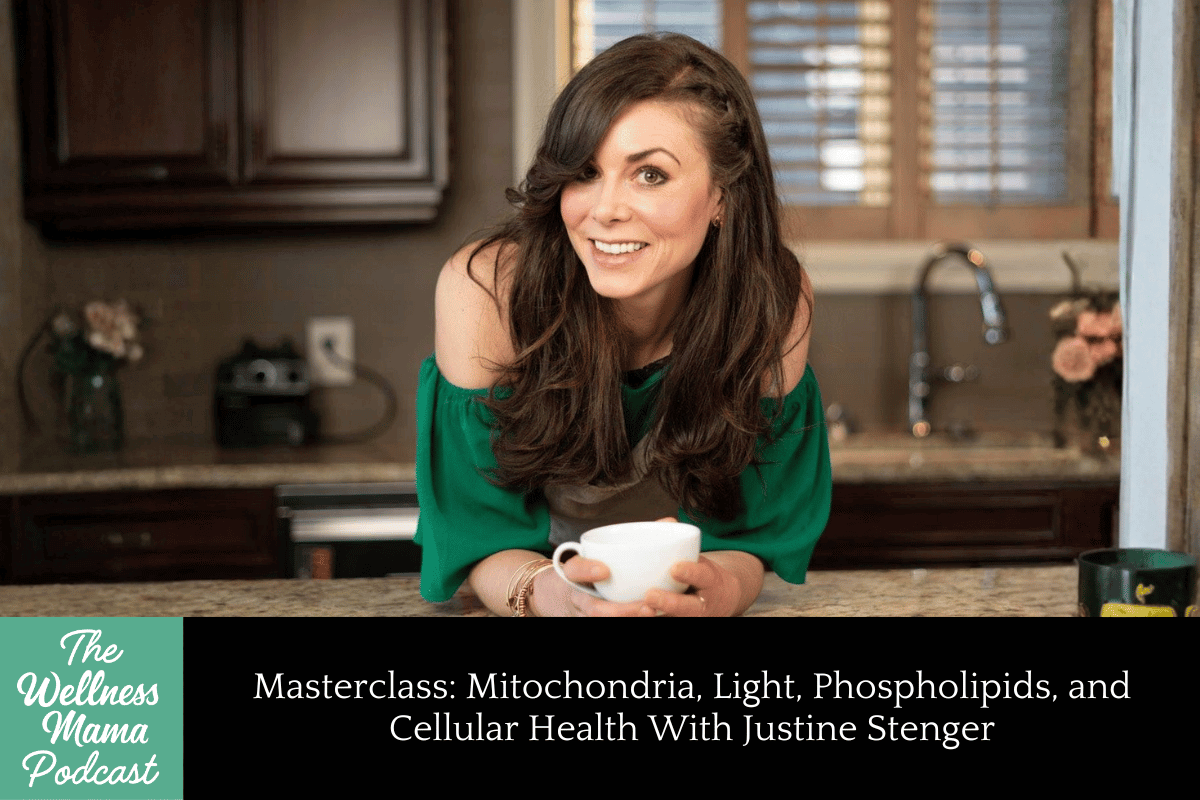
Katie: Hello and welcome to the Wellness Mama Podcast. I’m Katie from wellnessmama.com, and this was one of my favorite episodes to record. And if you listen, I know that you will quickly see why. I am here today with Justine Stenger, who is absolutely brilliant. And you will hear this when she starts explaining things. I love her really first principles approach to explaining things. I love how deeply she looks at the science and how she can so clearly explain the kind of myths and misconceptions behind a lot of more commonplace health advice. As well as kind of what to do about it.
And she has an amazing Instagram page, and a course as well I will link to both, where she kind of offers a deeper understanding of a lot of things related to health and sort of dismantles a lot of the myths that we hear often, but maybe are not complete stories. And she also trains doctors actually. And a lot of the things she’s speaking about today and has just recently also made her programs and information available to people who want to be their own primary healthcare provider, as I often talk about on here. She has a lot of functional medicine training. Her resume is quite impressive.
But what I love is she specializes in phospholipids, fatty acid science, mitochondrial medicine, and teaches a comprehensive roadmap to mitochondrial restoration. And she explains in this episode how much that really is kind of the cornerstone to so many things when it comes to health. Her clinical focus includes neurological conditions, mast cell activation syndrome, Lyme disease and autoimmune disorders. And she has spent 13 years working alongside Dr. Bruce Hoffman, supporting hundreds of his complex chronic illness patients through targeted and nutritional and mitochondrial interventions.
Like I said, she is brilliant and an absolute joy to learn from. I know you will see why instantly. So let’s join her now. Justine. Welcome and thank you so much for being here.
Justine: Oh, thank you so much for having me. I’m very excited about this conversation.
Katie: Me too. I am thrilled to finally get to have face-to-face time with you. I’ve come across your work so many times and I absolutely love how you challenge a lot of the conventional conversations around different topics, but you do it in a very fact backed and evidence-based way, and also with this like kindness and gentleness in your teaching that I feel like helps people really understand. And so I’m excited to tackle some of the topics I hear you talk about today. And of course we’ll link to your work because you go so much deeper than we could cover in one podcast. I also love that you’re willing to like, keep questioning and even reevaluate your own opinion about things as new information becomes available and as you learn more.
I think that’s a mark of an educated mind. And I love that you are so open, of your own learning as you go. And like I said, so many of your topics are ones I am excited to learn more from you about today and especially under kinda the umbrella of mitochondrial health. I’ve used the term before Nature Deficit Disorder as a kind of an umbrella for a lot of the things we’re experiencing in the modern world. And whereas we’ve tried to like treat things with a supplement or a quick fix or symptom treat, I feel like it’s actually indicative of a much bigger issue. Which is that we’re meant to live in harmony with nature, or at least in alignment with the light cues and the rhythms of nature, and we don’t anymore.
So again, this is a huge topic, and you’ve talked about this, I think you said that coherence is born for relationship with light, with water, and with the earth and the unseen field of intelligence that governs every living thing and how that relates to mitochondria. So, maybe as a background, can you kinda give us a primer into mitochondria and how they’re influenced by these nature factors.
Justine: Yeah, so my background was really in cell membrane medicine. I studied phospholipids and fatty acids, and so it’s been absolutely so fascinating to learn more about the mitochondria. And then integrate all of the things that I’ve learned about phospholipids and fatty acids into mitochondrial medicine. But mitochondria are way different than I originally thought they were. We were taught that they’re the powerhouses of the cell. They’re these little energy factories, so very robotic, right? Just pumping out ATP. And the more and more that I learn about the mitochondria, the less I see them through that lens.
Yes, they do make ATP, but they do so many other things and they really are these little sentient organelles. So they’re always sensing the environment. They’re these electromagnetic sensors and so it’s really opened my eyes to see, and Einstein actually said this. The particle determi- or the environment determines how the particle behaves. And so that tells me that these chronic illnesses that we see today, well, I think that these are, the majority are coming from an environmental issue. This is not a supplement deficiency, like you said. It’s not going to be fixed by a pill or a potion or a powder. It’s really gonna be fixed by changing the environment that you’re in.
And included in all of that is the light and dark cycles. Of course we wanna make sure that we are drinking clean water, we are connecting with the earth, we are walking barefoot. We are outside in nature. We are mitigating exposure to artificial light. You can see I’m outside on my computer. I really strive to make sure that when I’m on technology, I take it outside so that I’m not getting blasted with artificial blue light. And when you start to see health through that lens, you, it becomes very obvious, just like you said. It’s a disconnection from nature. We’ve lost the ability to connect with these natural vibrations the earths electromagnetic field, the electromagnetic spectrum, that really controls everything that’s happening on a cellular level.
We really are, you know, a body of water that’s regulated by light, and we put ourselves into an alien light environment that is creating chaos on a cellular level. So the mitochondria are really those sensors and depending on what they sense is going to determine how all of the organelles within the cell also behave. And this is something that I’ve been studying more and more intimately lately. Just because, even when you understand fats that are made in the body, in the ER or the endoplasmic reticulum, that it’s really the mitochondria that are regulating ER function. It’s the mitochondria that are regulating the peroxisomal function, it’s the mitochondria that are regulating, you know, the function of all the organelles.
So they all tie back into the mitochondria. And Katie, if you look at, Dr. Doug Wallace, so he’s the lead researcher in the field of mitochondrial research. And he shows that 95 to 99% of the conditions that we see today are of mitochondrial origin. So between one and 5% of the diseases that we see are of true genetic origin. And so it’s interesting to observe this hyperfocus on studying genetic snips and treating snips and studying nuclear DNA. Trillions of dollars are put into studying nuclear DNA when the majority of the diseases that we see today are really stemming from the mitochondria.
Katie: That’s fascinating. And that was a higher number than I would’ve guessed by a lot, but also to me really encouraging because seemingly that means we have a lot more within our ability to affect change than if it were more genetic based. So I’d love to kind of explore, it sounds like this is a complete paradigm shift, likely for a lot of people listening to think from kind of this mitochondrial first perspective and understand them as sensors versus just like little batteries in our cells. And so if we come from that perspective and we can like make this paradigm shift, what do we need to understand about our environment and about our mitochondria as far as like kind of maybe biggest offenders.
Things that they can sense in a bad way that are negative or, and or, what are the most like positive things we can do to send positive signals to our mitochondria?
Justine: Yeah. So I would say that the biggest assault to human health today is definitely the exposure to non-native EMFs and blue light would be included under that umbrella. And so when you think about the- uh, I could talk about the pathways for the full hour, Katie, but when you look at how detrimental blue light is to our health from damage to melanopsin receptor lens, also, POMC and how that impacts your immune system, your gut health, your brain health. Leptin, how it’s really, impacting how your ability to detect energy within the whole entire body.
So osteoblast and osteoclast activity, this is hormone health, this is liver health. This is, it’s just connected to everything and your body runs on a 24 hour light and dark, 24 hour-ish light and dark cycle. So if we are not getting synced with the sunrise first thing in the morning and getting access to, or getting that light in our eyes first thing, and we are not getting synced with the sun throughout the day because the wavelengths of light are changing all throughout the day and giving us information through those photons, and then watching the sunset, and then making sure that our environment is completely and totally dark after the sun goes down, our cells are not going to know what to do.
Because every single thing that takes place on a cellular level, there’s over a hundred thousand biophysical reactions that take place every single second within a cell and these are all dependent on timing mechanisms. So when your cells lose the ability to know what time it is, they, It turns chaotic, right? They don’t know what to do or when to do those things. So the light and dark, cycles, I would say are most important. That’s the foundation that’s kind of setting the foundation for everything. And then of course we wanna make sure that we are getting outside and getting exposure to sunlight. And this is for so many reasons.
First of all, as human beings, we were designed to be connected to this infrared light, really 24-7. So we were designed to be bathing in infrared light. And infrared light plays so many different roles within the body because it is supporting cytochrome c oxidase, so it’s supporting your ability to make metabolic water and supporting ATP production. It is involved in hydration on a cellular level. So it’s expanding that exclusion zone water in your cells. There’s so many benefits to infrared light and when we… Subcellular melatonin. Your mitochondria actually make subcellular melatonin when we’re exposed to infrared light.
And when we put ourselves indoors, Katie, and we don’t have any exposure to infrared light because when we’re inside and we’re on a computer and we’re sitting under LED lights, we’re looking at our cell phone, there’s no… the windows are closed, the air conditioning is on, there’s no infrared light in that indoor environment. And so our cells are deprived of this essential nutrient that’s required for energy production, for cellular hydration. And so that’s a massive assault. And then we have UVB. You know, UVB, when UVB light hits our skin and we are able to synthesize vitamin D from the cholesterol in our skin, that vitamin D is activating I believe that it’s over 10,000 different genes.
And UVB light has many, many other benefits as well, specifically on a mitochondrial level. So when you start to study all these different wavelengths of light and how they only come from the sun, because we don’t want them in isolation, It’s the amount, the frequencies of light, and in those optimal concentrations from the sun that are having that biological effect on us, that you really can see that of co, I mean, it’s obvious of course we see all this chronic disease. Because we’ve taken this living system that was designed to be outdoors under this light all day and really all night.
Because we’re still getting infrared light from moonlight. Designed to be connected to the earth, collecting these electrons from the earth all day, and we put that living system indoors. We removed them from connecting with the earth. We put them under artificial light. We’ve taken away these healing wavelengths of light that are critical for cellular health, and then we wonder why people are sick. And then, you know, of course I could go on and on. We have people that are watching tv, after sunset, they’re looking at their cell phone, they’re working on their computer, they keep their lights on.
So we’ve completely ignored these laws of nature. We’ve moved away from them. And then we go to our functional medicine doctor and we get put on a parasite cleanse because it just doesn’t make any sense when the things that we need to change are the way that we are living and breathing and moving in the world, and reconnecting back from the source that we came from. The more and more that we separate from that, the sicker and sicker we’re gonna become, and we see that today.
Katie: Absolutely. And I think the light piece gets underestimated often because of its simplicity. And I definitely have experienced firsthand how when you do this consistently, it can make such a drastic difference. And when I was, before I understood a lot of this and I was trying to reverse my Hashimoto’s, I was so tired and fatigued often. This was one of the first steps I did, was just to make myself get up at sunrise and I would just go sit in a lounge chair in my backyard, but in the natural light and hydrate. And just that little baby step over time, I started noticing changes and noticing more energy.
That gave me more bandwidth to start doing the other things. And I feel like to your point, I would love to expound on this more, we’re often told by functional medicine doctors, you know, our vitamin D is low. Take a supplement. But a supplement can never replicate all the things you just talked about. And at least in my anecdotal experience, my vitamin D was always super low. I took supplements. It did absolutely nothing. Like it didn’t raise my vitamin D levels at all. And it wasn’t until I got some of these things that you talk about so well and explain so well on Instagram that I’ll put some of those videos in the show notes.
But I got my healthy fat styled in. I got light exposure dialed in. I got the co-factors and things that I needed to actually be able to synthesize it myself. And I spent a lot of time outside in the sun. Now my vitamin D is 86 and I don’t take any supplements. But I would love for you to expound of why it’s so much more than just a supplement or just about vitamin D and how a supplement can never replicate this.
Justine: Well, yeah. And I love how you had that personal experience as well. Because I mean, there are a handful of people that I’ve talked to that say, oh, they feel so much better when they are taking vitamin D supplements. And I think that it’s probably because it’s silencing certain pathways that wouldn’t be silenced without that exogenous supplement. But it’s so important to remember that vitamin D is a photoelectric signal that your body makes under very specific conditions. So it requires sunlight. It requires hydration, it requires redox and it requires nitric oxide production and it requires sulfation.
So it’s not just about getting D into your bloodstream. It’s about your body knowing exactly how and when to make that vitamin D and when you take a pill, you’re bypassing all of that. So you’re not fixing a deficiency, you’re actually ignoring the entire operating system. And then a lot of people will say that taking K2 with D3 is what’s important. And so as long as you have combined D3 with K2 then you’re covered. But that is, that doesn’t make it neutral. Right? It just, it actually makes, I think, the marketing just look a lot smarter and convinces a lot more people that the D3 K2 supplement is superior.
So it’s really important for people to understand that our body doesn’t run on those isolated inputs. This is like a beautiful, magical web of intelligence. And when we are making vitamin D through sunlight exposure, you know, we’re making cholesterol sulfate. We’re supporting nitric oxide production, we’re expanding that exclusion zone water. We’re activating all of these genes. So it’s, you know, it’s improving our genetics epigenetically, which is why you see so many improvements in health long term when people move to like the equator or to Florida, where you live.
And they’re getting so much more of that sunlight. So yeah, you can’t replace all of those things that are taking place through a synthetic vitamin D supplement, unfortunately. I wish that it was that easy.
Katie: Yeah. Well, and I love that because it gives us that broader perspective. And I love how well you explain of those things and how it’s kind of this beautiful symphony that works brilliantly that our bodies know how, exactly how to do when we simply support them in the way that they are asking to be supported. and it brings up a couple smaller questions I would love to tackle. One being that you hear often like, oh, we, it’s not good to get in the sun too much because then you can get cataracts from the UV. And also like every time I post about getting sunlight I get the people saying, I hope you’re wearing sunscreen and sunglasses and all these things.
So I would love for you to touch on those briefly.
Justine: Yeah, so I am actually vehemently opposed to both sunscreen and sunglasses, except for a couple of isolated situations. If you’re skiing, of course, the glare from, you know, the snow into your eyes can be damaging. So I would recommend wearing goggles, when skiing, and then also when you’re on the water, the glare from the water can be a lot brighter than just the sun. But we want that light to come into our eyes. So it’s been interesting to study, you know, this whole narrative that UV light is harmful when we actually have like these neuropsin receptors that are absorbing this UV light and that’s intimately connected to our circadian regulation.
And then you see all these other benefits to UV too. You know, we have been told that it damages DNA, but that little damage to those DNA strands are actually upregulating all these repair processes. So I do believe that UV light in isolation is definitely hazardous and we wanna avoid that. So, tanning beds and these, I guess tanning beds would probably be the most common exposure to that isolated form of UV light. Because in the sun we are never getting isolated UV, right? We have between 43 and 50% of the light that comes from the sun is red and infrared.
And then we have all these other wavelengths of light and the UV is maybe eight to 10% kinda depending on the time of year. So it’s a very, very small percentage of the full spectrum of sunlight and it’s absolutely necessary that UV light. So that is why I don’t recommend wearing sunglasses. Also, when we’re wearing sunglasses, we’re blocking out those wavelight… so I mean, we’re regulated by light. So it’s basically, you know, Dr. Jack Cruz uses this analogy and it’s excellent. It’s basically like putting a tarp over an orange tree and expecting orange to be produ- oranges to be produced.
And so it’s the same thing with us. Like if we’re putting a tarp over our eyes, we can’t expect to have optimal thyroid function, optimal hormones across the board, optimal energy, nitric oxide production, optimal gut health. Because that light that’s absorbed through our skin and through our eyes is, you know, responsible for activating, really, I mean, I would say everything that’s happening within the body it’s really, light is regulating all of it. And then with sunscreen, you know what concerns me a lot with sunscreen is that… so I prefer, just so that everybody knows, obviously we don’t wanna go out and get burnt like a lobster.
But you have probably had this experience when you go out for sunrise and you provide that information through the light that you’re exposed to. Your brain knows, oh, we, it’s getting hot. We need to make sure that we start making melanin so that we can, you know, protect from the UV light or use that UV light more efficiently, I should say. I shouldn’t use the word protect. And when we put sunscreen on, we’re really blocking, like we’re creating an alien sun that’s hitting our skin, right? Because we’re blocking specific wavelengths of light and we’re not blocking other wavelengths of light.
So I think that that is incredibly problematic. And, you know, we, through a conventional lens, they kind of reduce that down to, well, if we block the UV which we’ve claimed is harmful, and you’re letting in the other wavelengths of light, then sun exposure is not gonna be dangerous.
But I believe that it’s the opposite of that because we weren’t designed to block out specific wavelengths of light and not block out others. We were designed to full, to absorb, the full spectrum of sunlight. So I say go in the shade if you’ve had too much sun. Put a shirt on if you’ve had too much sun. Put a visor on if you need to block the sun from your face. But we wanna absorb as many of those photons as humanly possible.
Katie: That was such a good explanation of that. And my understanding, I haven’t gone super deep on this, but a lot of those studies that showed that UV was damaging were done with UV in isolation in a lab setting with isolated cells in a Petri dish, whereas like you said, in the sun, that’s only a small percentage even
in the bright part of the day, you’re still getting that full kind of symphony of light that our bodies know how to play music with. And so if we block part of it, like we’re making a disharmonic music with the natural light that’s there and available.
And you also mentioned, and I feel like this is a perfect springboard into another topic that you cover so well that often people will have a light problem or a, like a more base mitochondrial problem and then they get put on a parasite cleanse or a detox. And those are certainly all the rage also on social media right now. But I would love for you to talk about detox in the context of the body actually already knowing how to do that perfectly and how do we support that versus thinking of it as an external thing that we like do to our body.
Justine: Mhm. So, I just wanna say quickly, just going back to the light, that every single study that I’ve read, Katie, on UV light being harmful is done on isolated UV light. And they’re either blasting like hairless rats with this light in a lab setting, or yeah, it’s in a Petri dish. But often it’s, they’re blasting this light into mice or rat’s eyes or onto their bodies, and then they’re saying UV light causes cancer. So, just so everybody understands that we never receive light in that way from the sun. So it’s really, you can’t even translate that to sunlight exposure. Now, I will say that because of… we have really weaponized our environment against us, right? Because of the current environment that we live in it’s so riddled with non-native emf’s and we are up against a lot. So when it comes to, you know, burning and the oxidative of stress that comes along with that, that is something that I do believe that we wanna make sure that we’re avoiding and we are building that solar callus, that’s another word that Dr. Jack Cruz uses, to really make sure that we have that resilience, to that strong sunlight exposure. Now when it comes to detoxification, this is such an interesting one to observe in this whole, you know, field of wellness functional medicine, integrative medicine.
Because I believe, I mean, this is just how I see it. Whether or not it’s true for everybody or not, we have kind of gotten to this place where we think that we need to force healing. That we need to give these external things, whether it’s some sort of protocol or all these different pills and potions, to force things outta the body. And not that I don’t think that there’s a time and a place for some detoxification support, the idea that the body doesn’t know how to detoxify on its own is just absolute lunacy, right? This really comes down to a redox issue. If you’re not able to detoxify that is because you’ve lost your voltage.
You have poor redox. And that is why you’re not detoxifying. This has nothing to do with being, you know, charcoal deficient or, you know, all these herbs and tinctures that are taken for these parasite cleanses. These toxins that have accumulated in your system are just going to accumulate again once you finish whatever protocol you’re on if you don’t work on the very foundation, and ultimately that is building mitochondrial function, building up that redox potential, improving that voltage. And this is one of the many reasons why I am such a huge supporter of not only all of the circadian biology principles, making sure that we are mitigating non-native emf’s and we’re protecting our, you know, environment from these really harmful, those are, you know, mitochondrial toxins.
And we are, you know, nourishing ourself with food that is locally grown and is seasonal. And, you know, we’re really providing, everything that we do we wanna make sure that our mitochondria are sensing safety, right? And when they sense safety, the cell, and the cell is healthy, we have no issue removing these toxins from the cell and making sure that they don’t even get into the cell. So when you have a healthy membrane… So, I was gonna say that this is where I’ve been really, interested in understanding the synergistic relationship between the phospholipids and fatty acids that are found within the membrane.
And that exclusion zone water that builds inside the cell. And the voltage. And how when we have strong voltage and we have this good structure and good fluidity within the membrane, and your membranes are vibrating at this really, really high frequency, that, you know, toxins are not able to penetrate that area.
And then we have this really incredible ability to get nutrients into the cell and to escort waste out of the cell as well. So it’s about flow. Detoxification is about flow and healing is about flow and regaining coherence. It’s not about force.
Katie: I love that. And I feel like this ties into the late conversation too, because I’ve seen you say that melanin plays a central role as well, not just like a pigment. Which is what we sometimes reduce it to as like, oh, it’s a pigment that makes your skin look darker. But as, I think you called it a biological semiconductor, which I loved. Because you often hear that myth, at least I think it’s a myth that like any tanning, any sign of your skin darkening is a sign of skin damage from the sun, which I don’t agree with personally at all. But I would love to talk a little bit more about melanin because I feel like it’s so misunderstood and gets a bad rap.
Justine: Yeah, so melanin is really interesting and the more and more that I learn about melanin, the more fascinated I am about that as well, because I really think that getting a good tan is probably one of the most protective things that we can do in the current environment that we live in, because of all the properties. And yes, it is a heavy metal chelator. So if you want to support detoxification and preventing those heavy metals from accumulating, build that strong tan because that’s your number one protection. but there’s so many properties to melanin, I mean when, you know, light hits melanin, it generates electrons.
And so this is like a direct redox support. You’re directly supporting your ability to make energy. You’re supporting the ability for your mitochondria to make that metabolic water that is ultimately where we’re getting hydrated. Right Katie? This whole hydration conversation to, that started, around drinking water. Drink, you know, eight glasses of water a day or half your body weight in ounces per day is pretty arbitrary. It’s that hydration is ultimately coming from how well your mitochondria are able to make metabolic water. And how, and then how you’re living and breathing and moving through the world.
The environment that you’re in, is going to determine how well that water can structure and stay structured. And so, you know, that’s the role that melanin plays in helping to support mitochondrial function, ultimately. And then protecting you from, even when it comes to exposure, to non-native emf’s, right? Melanin is protective. So the more tanned you are, the more resilient you’re gonna be against the environment. Again, like I said, that we’ve weaponized against us. So, like I said before with UV light, yes there’s that, you know, slight DNA damage that occurs. And that upregulates all kinds of repair processes. So it’s hormetic. It’s not pathological.
Kaite: That seems like such an important piece to understand and it’s often misunderstood and that we miss kind of the forest with the trees when we avoid tanning because of that like mild DNA damage that happens and ignore the fact that is the cascade that then leads to all these positive things that our body’s designed to do. And you’ve mentioned a couple times phospholipids and cell membranes, and I know this is something that you are deeply researched in and probably one of the topics experts in the world on. So I would love to learn from you on this because I feel like this is not even hardly talked about, much less understood and kind of ignored in a lot of the conversation related to health.
When people are just taking supplements and throwing things at like kind of in a symptom based approach. so I know this is a massive topic, but can you kinda walk us through a background of phospholipids and fats within the body and cellular membrane?
Justine: Yes. Yes. And I will say Katie too, if anyone’s interested in learning more about this, I do have a two and a half hour webinar that’s free on my Instagram page and my link in bio. So, it’s for anybody that really wants to do a deep dive in this. But phospholipids are basically what, we are 37 trillion cells in the body. We have about 200 different cell types and, you know, 500 trillion mitochondria, and trillions of organelles. And, the, every single membrane on every single one of those cells is made of phospholipids and a phospholipid molecule. If I go through phosphatidylcholine, it has a polar head group, it has a phosphate group.
It sits on a glycerol backbone, which is a three carbon backbone, and then it has two fatty acid tails. And those two fatty acid tails are coming from the dietary fats that we consume. So we have essential fatty acids that are required that we cannot synthesize endogenously. So that would be linoleic acid, omega-6 and alpha linoleic acid, or the plant-based form of Omega-3. So those are called our two essential parent oils. Those are signaling molecules. Linoleic acid is one of the main fatty acids found within the membrane. So it’s a structural component.
We are making all of our eicosonoids through those parent oils and they’re also signaling molecules. So phospholipids, when you look at the different cell types, depending on the cell type, it’s gonna determine the concentrations of phospholipids found in that membrane. But on the outer membrane, say of a liver cell, we’re looking at about 70% phosphatidylcholine. When we look at a neuron, it’s a roughly 60% phosphatidylcholine. The epithelial cells that make up that gut mucosa, 90% phosphatidylcholine. So depending on the cell type is gonna determine the concentrations of these phospholipids.
And then in the inner membrane… So every one of our cells has two lipid bilayers. So the outer membrane is mainly phosphatidylcholine. The inner membrane is mainly phosphatidylethanolamine, phosphatidylinositol, and phosphatidylserine. And those are making up the structure of the membrane. So if you have a, if we have a breakdown of those phospholipids, because we have poor redox, we have high levels of oxidative stress, we have lipid peroxidation and we’ve lost reserve capacity so our body’s not able to keep up with the demand in synthesizing those lipids fast enough to repair that damage, we’re gonna end up with really poor cellular health.
And then when we think about this on a mitochondrial level, where we make energy, that is happening on the phosphatidylethanolamine membrane, and so the mitochondria also has two lipid bilayers. The outer membrane is rich in phosphatidylcholine. That inner membrane where oxidative phosphorylation occurs is rich in phosphatidylethanolamine. There’s another phospholipid that sits on top, which is called the cardiolipin, which is housing our protein complexes, complex one, complex three, complex four, and ATPase. So if anybody’s not familiar, those protein complexes are the complexes that move those electrons through the electron transport chain so that you can make metabolic water and you can make energy.
And like I mentioned before, the mitochondria do so many other things. They’re involved in your innate immune system, your adaptive immune system, their epigenetically regulating your nuclear DNA, the list goes on and on. Fission and fusion and mitophagy. So we wanna make sure that we have the lipids intact in those membranes in order for us to efficiently move those electrons through the electron transport chain. Because when the membrane becomes damaged and those protein complex no longer have that nice home to sit in, they become more susceptible to damage as well.
And then we have a deficiency in bioenergetics and a deficiency in bioenergetics, based on Dr. Doug Wallace’s work, is what determines your susceptibility to disease, right? As soon as we start making less energy we’re more likely to develop disease. And that’s gonna depend on, you know, the tissue or the organ or the system in which we have that energy deficit. So the lipids are everything. They’re incredibly important.
Katie: And I love that explanation. I feel like that was like masters or PhD level but you explain it so well that it’s understandable. And it seems like understanding that as the foundational, totally reframes also how we think of things like supplements, like fats, like dietary, like what we’re consuming in our diet and how much of each one. And I know there’s a lot of nuance that you talk about online and I’ll link to your Instagram, and to that webinar so people can find it. I’m definitely gonna go through that webinar myself. But I would guess there’s a lot to understand within that realm that people maybe get wrong.
Especially when it comes to things like fish oil and supplemental choline and what breakdown of dietary fats actually is supportive of our body. So I’d love to kind of start delving into that world of like, when we start to understand these phospholipids and the phosphatidylcholine and all that, like how do we actually support these in the body knowing that the body knows what it’s doing, how do we offer it the best support?
Justine: Yeah. So I mean all the foundational things are key, right? This is, Katie, where I’ve struggled a little bit in merging these two fields of expertise because I don’t want people to think, you know, we have this whole field of people kind of in a quantum biology that are preaching that all we need to do is go, this may be a little bit simplistic, but, basically saying all we need to go and do is sit outside in the sun, right? And we’re gonna be healed. And that’s one piece of it for sure. We definitely, like we’ve talked about, it is absolutely imperative for us to be, you know, outdoors and getting exposure to that sunlight, for, you know, as much of the day as possible.
Whether that’s in the direct sun or that’s in the shade, whatever feels best for you. And we wanna make sure that we have got those light and dark cycles on point. So we are getting up for sunrise. We’re outside every morning. We’re watching UVA rise. We’re activating all of those aromatic amino acids so that we’re making all of our neurotransmitters, all of our hormones, we’re supporting our circadian regulation, optimizing all of those biophysical reactions that are taking place on a cellular level. So that’s, you know, foundational. And then when it comes to supporting our cells with the right fats is, I would say, next.
Because that is truly, if we, especially when we look at the essential fatty acids, Katie, because the essential fatty acids and, you know, poor linoleic acid has got such a bad wrap because of what we’ve done to linoleic acid in the food system. But there’s so many people that are, you know, following a low fat diet because their doctors told them that they have high cholesterol and or high LP little I. And so it’s important for them to eat low fat. And so now they’re actually depriving their cells of the very structural components that they need to build healthy cells and to have healthy energy production.
And so really focusing on the essential fatty acids first. So we wanna make sure that we are getting in those essential nutrients because those are a non-negotiable, right? Our body can’t make those. So if we are lacking those we have a deficiency or we don’t have them in the optimal quantities, then our body’s gonna be really compromised. And I won’t go too much into the weeds around this but there’s, you know, things happen like we get this production of an omega-9 fatty acid called mead, which is really categorized, or renegade fatty acid, it’s not, you know, really biologically active.
We’d basically just make that as a compensation of a fatty acid deficiency, and then that gets slotted into membranes where essential fatty acids should go. That’s gonna change the quant behavior of the membrane. That changes the semiconductive properties in the membrane. That changes the voltage of the membrane. That changes the ability for that water to structure properly along the surface of the membrane. And so, you know, when we start to look at fatty acids through this lens, we see, okay, we wanna make sure that we’re giving our body the essential nutrients that it requires to do the work that it was designed to do.
And this is a lot of what I teach, Katie. It’s like, let’s not try to target every biochemical pathway with an exogenous nutraceutical or a peptide or whatever it may be. Let’s just actually look at, okay, what does the living system need to thrive? And let’s make sure that that living system has all of those things that it needs to thrive because the body is so much more intelligent than we will ever understand or give it credit for. And it knows exactly what to do when you give it what it needs. And so we wanna start with those fats. Of course, we always wanna be consuming raw, pure forms of these essential fatty acids.
So whether that’s from raw seeds, sunflower seeds, pumpkin seeds, sesame seeds, hemp seeds are all excellent sources of those essential fatty acids, specifically linoleic acid. Egg yolks are an excellent source. Organ meats are also an excellent source for people that are not eating, you know, an abundance of seeds. And then on the Omega-3 side alpha linolenic acid, we’ll find that in flax and chia in walnuts, those are the most abundant. We also find that in cruciferous vegetables and some other leafy greens. So if you’re eating locally and seasonally in the summertime we’re gonna be getting lots of alpha linolenic acid, and we actually don’t need a lot of that fatty acid.
It’s not abundant in the membrane. Its main roles are signaling and, you know, very low conversion, but to convert to EPA and ultimately DHA. So we wanna start there. And then we wanna make sure that we are eating locally and seasonally and focusing our diet around bioavailable animals so that we’re getting in all those structural fats, palmitic, stearic, myristic, palmitoleic, those fats that come from animal foods that are providing our membranes with structure. So the saturated fats provide structure. The polyunsaturated fatty acids provide fluidity and flexibility to the membrane, so that we are able to proceed with all of those incredible cellular functions that take place.
And a lot of people, Katie, forget that the membrane, if you look at Dr. Bruce Lipton’s work, he explains this beautifully, the membrane is the brain of the cell. Everything is happening on the membrane. So we have all of our proteins, all of our peptides, all of our ion channels, all of our receptors, everything is on the membrane. So if we have a breakdown on a membrane level, we need to think of that as we are gonna have a breakdown on every level within the body when the membrane breaks down. So the fats are so, so, so key. And then of course, when it comes to, all the, you know, when I go back to the beginning of our conversation when we were talking about, just the mitochondria and the characteristics of the mitochondria.
And I mentioned that the mitochondria are really signaling to all of these organelles how safe it is to proceed with all organelle function. When the mitochondria have those fats in the membrane, we have optimal levels of those phospholipids in the inner membrane. We have optimal amounts of linoleic acid in the cardiolipin because linoleic acid is the main…
Katie: It was an amazing explanation and it brings up two topics that are a little bit controversial that I would love to delve into. The first one, I know you’ve covered this on Instagram, I’ve seen your videos, but the first one being fish oil. Because certainly a lot of people are told by health practitioners to take fish oil and that omega 3’s are very important, and I know there’s more to the story than that. But when it comes to fish oil, how does that come into play with fossil lipids and everything you just explained?
Katie: Well I think people can understand why I’m such a fan of you when you like explain things so well like that. And I think what you just said just now is so important to reiterate is like healing is not a thing we do to our body. Healing is a thing the body naturally knows how to do. And the more we can understand that, the more we can befriend our body in that process and support it versus trying to like, from the outside in, force this process that then now it has to like mitigate on other levels. And I know another area, again, this could be its own whole podcast probably is the topic of cholesterol.
And it seems like we’ve gotten so many things backwards when it comes to we think fish oil equals good, cholesterol equals bad. And I love this quote you said that total cholesterol over 200 isn’t pathological. It’s often a signal of metabolic competence. It’s a marker of a nervous system with reserve. A mitochondria is still making enough pregnenolone and steroid hormones and brain lipids. And I would love for you to just briefly kind of give us a primer on cholesterol because my parents are now hitting that age where they’re being told like cholesterol is bad and they clearly, they’re not open to taking any kind of medication that would alter that.
But I feel like people aren’t given the whole story here either.
Katie: That’s such an important point and I literally, I could talk to you all day. I hope we actually get to do some future episodes because there’s so much more we didn’t even get to get into. Like I would love to go into insulin and leptin at some point and to even go deeper, especially on phospholipids because that’s such a core part of your body of work. But for today’s episode I’m gonna link to these in the show notes. I know you have a course and you also have a membership available. If you can like, give us a brief overview of those, I’m definitely gonna take your course because I love all of your videos that you released and I’ve am very excited to go deeper on these topics.
But where can people find you if they feel like they just kind of had their mind blown and wanna understand on a deeper level, like, okay, what does this mean? What then do I actually eat? How do I actually support my body?
Katie: Amazing. Well I will put both of those links in the show notes, or I know they’re available on your website and linked on your Instagram as well. All of that I will link to you at wellnessmama.com that I’m sure everybody listening can now understand why I am such a fan of you and why I was so excited to have you on. Like I said, I hope we get to have more conversations in the future, but for today, you are just an absolute wealth of knowledge. I loved this conversation. Thank you so much for your time and for sharing.
And thanks to all of you for listening and sharing your time with us. We’re both so grateful that you did and I hope you will join me again on the next episode of The Wellness Mama Podcast.





Leave a Reply