Read Transcript
Child: Welcome to my mommy’s podcast!
Katie: This podcast is brought to you by LMNT, and this is a company you might’ve heard me talk about before, and I really love their products because proper hydration leads to better sleep. It sharpens focus, it improves energy, and so much more. But hydration is not about just drinking water because being optimally hydrated, a state called euhydration is about optimizing your body’s fluid ratios.
And this fluid balance depends on many factors, including the intake and excretion of electrolytes, which many people don’t get the right amounts of. Electrolytes are charged minerals that conduct electricity to power your nervous system. I talk a lot about nervous system on this podcast.
They also regulate hydration status by balancing fluids inside and outside of our cells. LMNT was created with a science-backed electrolyte ratio of 100 milligrams of sodium, 200 milligrams of potassium, and 60 milligrams of magnesium with no sugar. Since electrolytes are a key component of hydration, here’s what happens when we get our electrolytes dialed in.
We have more steady energy, improved cognitive function, suffer fewer headaches and muscle cramps, we can perform better for longer, and especially the support fasting or low carb diet because when we stop eating carbs like during a fast, the absence of insulin allows the kidneys to release sodium.
So replacing that lost sodium with electrolytes can help you feel good on a fast. Since LMNT is zero sugar, it also doesn’t break up fast. Electrolytes are also important for maintaining blood pressure, regulating digestion and proper fluid balance. Keeping skin hydrated, which is a big one that I feel like often gets missed and so much more.
I feel like proper electrolytes is a missing piece for a lot of people and I love LMNTs new canned drinks, which are sparkling water with all the same ratios and minerals I just talked about, and they are delicious. You can check it out and learn more at drinklmnt.com/wellnessmama And at that link you will receive a free sample pack with any order.
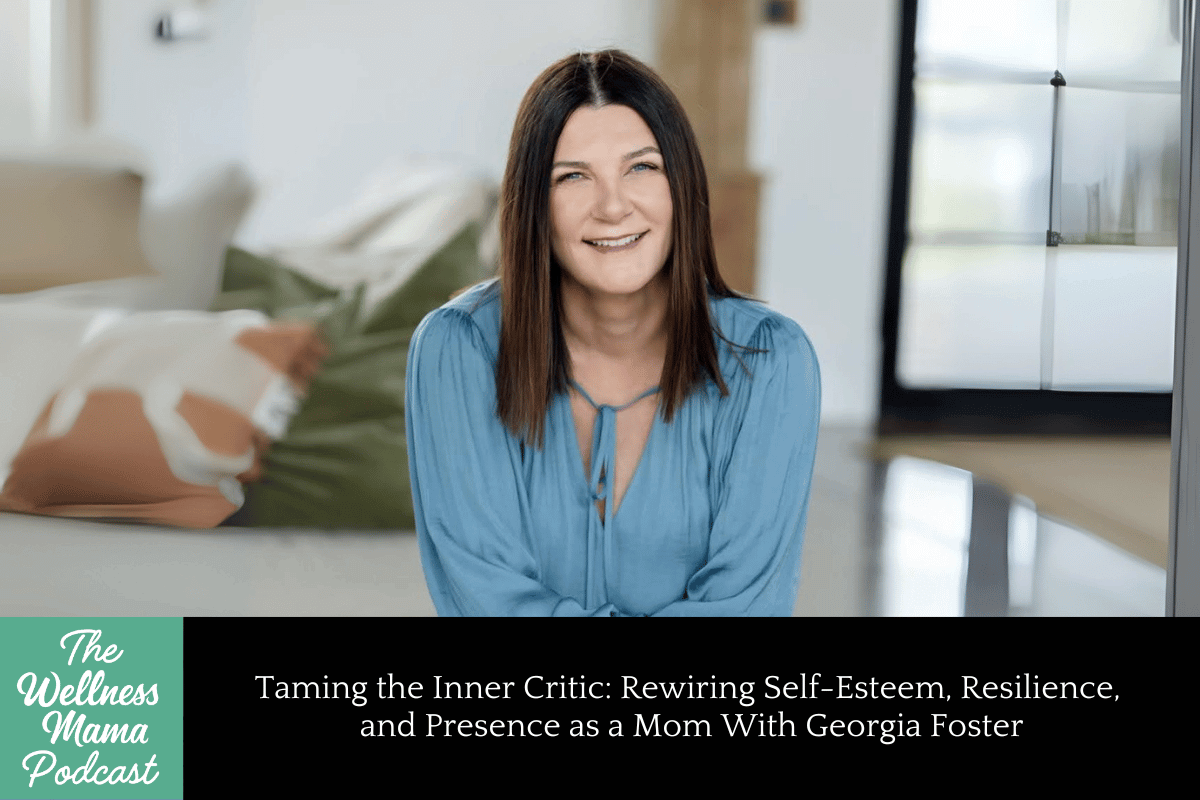
Katie: Hello and welcome to the Wellness Mama Podcast. I’m Katie from wellnessmama.com and I am here today with Georgia Foster to talk about taming the inner critic, rewiring our self-esteem for more resilience and presence as a mom. And if you’re not familiar with Georgia, she is incredible. Georgia Foster is a clinical hypnotherapist and a voice dialogue trainer.
She is known as the go-to expert in the UK and Australia for food and alcohol issues, as well as inner critic and people pleaser, and some things that felt especially relevant to me. She has written many books and developed a number of online self health programs about self-esteem, anxiety, emotional overeating, and emotional drinking.
And we touch on some of those topics today, and especially about the inner critic piece and about how we can actually develop self-esteem. She says, we’re not born with that, we must develop it, and so much more. And she gives some very practical tools that you can use starting today. So let’s jump in.
Georgia welcome. Thank you so much for being here today from the other side of the world. This is amazing. We get to chat literally across the planet.
Georgia: Well thank you for having me I’m very excited.
Katie: I am also very excited. And the topics we’re gonna get to dive into today, I feel are especially relevant to our listeners, many of whom are parents, and especially moms. And I feel like anytime we help moms, we of course send ripples throughout the whole family and impact future generations as well. Which is one of the reasons I even started Wellness Mama to begin with.
And I, when I came across your work I felt like it was so resonant and so impactful and couldn’t wait to share it with the Wellness Mama audience. In this first episode together, I really wanna go deep on the topic of taming the inner critic because that seems like something all of us can really have experienced at some point in our life. Or still experience or have some kind of struggle with, and that can get seemingly passed on to our kids as we experience it.
So I know this is kind of a broad topic, but maybe can you walk us into the topic of the inner critic to begin with and maybe talk a little bit about self-esteem as the foundation for resilience. I know there’s a lot that goes under this topic.
Georgia: Yeah well the inner critic, I’m trained in this amazing psychology and the psychology is they were all made up of many parts or sub personalities. And what’s really interesting is, well when I discovered that my inner critic had been running my show. It took me a while to figure it out. But what’s really interesting now being trained in this particular theory, is the inner critic, originally it was there to protect us when we lived in caves and there were bears around the corner kind of thing.
But now life has got in the way and obviously moms in particular you could… you know we say that self-esteem is something we’re not born with, we need to learn it. It’s like a language. It’s emotional language we need to learn. And I know personally being a mom and also the impact of clients and people who I’ve worked with through my programs, is that the inner critic is the part that creates anxiety, self-questioning, retreating, not feeling good enough.
And it actually causes a lot more damage than we often think. Because I say to people if you could hear what you were saying on the inside. If people could hear what you were really saying to yourself, you wouldn’t treat your worst enemy like that. And the thing about the inner critic, it can creep up with us when we’re feeling vulnerable. When we’re feeling tired or sick or when we’re just feeling overwhelmed. It can creep in and say you’re not coping. Look at the mums at the school gates. They’re so slim and fitch.
And you know all of those things that make us feel incredibly vulnerable. And when that actually happens is, the inner critic, because it’s part of the fear-based part of the brain, we then produce stress chemicals, cortisol and adrenaline. And can cause anxiety. It can cause depression. It can cause as I said retreating and not feeling good enough. It can cause a lot of, as you said, that domino effect that energetically our children pick up on that.
And our language starts to be “oh well they think this about me.” Or “they think that about me.” And you know the irony is that everybody’s inner critic is is saying similar things, right? But we’re not kind of voicing it. So I truly believe that the inner critic is, it’s unfortunately the voice that we have to learn to manage. It doesn’t go away, but we can learn to tame it as you said. And taming it is really the key to that. Obviously I’m a qualified hypnotherapist and I find it’s a very quick, effective tool at training the deeper part of the mind to tune out of negativity.
But more importantly is, the inner critic is the part within all of us that will sabotage. It will, it will cause us lot of propaganda in our head and will stop us from achieving things that we really want to achieve. And that little bit of inspirational motivation that we might have to do something really good for ourselves, can be squashed in an instant by that inner critic. And then we think, “oh we’re not good enough, I can’t do this.” But in actual fact, the part that had that inspiration, the part that was really really motivated to do something, whether it’s going on a course or it’s deciding to say no to people.
Because there are other, there are other friends of the inner critic that if we’ve got time I’d like to share with you too. But the inner critic is the main culprit. And the ultimate goal is to have that beautiful charismatic person that really wants to come out. But because of a time repeatedly of negative thoughts ,then we start to think that’s our normal thinking. That it’s actually not at all.
Katie: Mmm, that makes so much sense. And it almost seems like, so you mentioned self-esteem, you were not born with it, we have to develop it. And it seems like we probably also sort of develop this inner critic through life experiences and probably childhood experiences. I’d love for you to go deeper and explain kind of the friends of the inner critic that you mentioned.
Because I would guess these will feel very relevant to people listening as well. And then from there, maybe delve into as kind of a counterpoint, how do we nurture our own self-esteem or kind of whatever the antidote to the critic would be?
Georgia: Yeah sure. We have the pleaser personality, and this is the part that likes to look after everybody else and is very much the nurturer. I’m not saying it’s necessarily a mom trait, but it is more common I find in women than within men. But you know, men have it and it’s a very beautiful quality to have. But what’s interesting about the pleaser, the inner critic loves somebody who, the inner critic will say, you should have done this for this person or why didn’t you do this? And It makes us run ourselves ragged. And look, being a mom you put your kids first right? So that, okay put that one aside.
Maybe there is times that you should say no to your children, of course. But ultimately the pleasers deepest fear is not being liked or loved and they’re worried about rejection the whole time. So they tend to, they would tend to overcommit. Can often feel that they have this sense of, I’ve gotta do more. And then what they can do, and we’ll probably cover this a little bit later as well, but they tend to retreat into, they can retreat into food and alcohol as a way to take time out. Because they can’t find a way to nurture without feeling guilty.
So once the doors closed the kids go into bed, they maybe open up the cookie packet or open up a bottle of wine and say right, “ I’ve done everything for everybody else, now it’s my time for me.” And the issue with pleasers, they’re beautiful people. They’re warm, they’re loving, they’re very caring, so people are very drawn to them. But the downside of being a strong pleaser is you can also attract bullies. And bullies can be narcissistic in nature, critical, judgmental. And pleasers really feel they wanna fix everybody, right?
They wanna be this free therapist. I mean, I’m a pleaser by nature. But you know I’ve had to really tame my pleaser because the, and obviously from a perspective of when I became a specialist in this area, it was one thing I really had to monitor. And I think that the word no is really important, but we are too scared often to say it. But when you say no people know exactly where you stand. Whereas often if you’re a pleaser, you might procrastinate and kind of try and avoid it. But really having your voice is really important.
And I think as well with the pleaser they’re, because they want to be liked and loved they always kind of… like if you put a pleaser in a party, they’ll make sure the person in the corner who’s not talking to anybody has someone to talk to. So it’s really lovely to have that personality trait. But it can get you into some tricky situations when you know it’s time to, “actually hang on a minute. Like no I’m not gonna do that.” And that could be whether it’s a partner or a child.Could be a colleague or a friend. And I’ve had many many clients. I used to have a clinic in London for 23 years. I’m Australian, but I lived in London for 23 years.
And it was extraordinary when I learnt this particular technique and worked with people, how beautiful the skill of a pleaser starting to nurture themselves. And being a little bit more discerning about how they wanna spend their time. Who they wanna spend their time with, and when it’s time to retreat. So that’s one of the personality traits. And the inner critic and the pleaser get together and they can fester and make people feel that there is really something wrong with them. Where in actual fact, when you start to train your mind to be more discerning, then you can start to recognize when you want to do all those things or not.
But there’s another part that is called the perfectionist and it’s the all or nothing type personality trait. And the perfectionist is the part that, it’s really good at doing things a hundred percent. Whether it’s going to the gym, whether it’s going on a diet, whether it’s going to get a degree in something. It’s a fantastic personality to have, like the pleaser. But because it’s all or nothing, what can actually happen is that when when somebody tries to achieve something, they don’t achieve it, they feel that they’ve failed.
So often they will get depressed, they get angry, and it comes down to also eating and drinking. They’re either on a diet or overeating or over drinking. So really what I’m saying is that the perfectionist is great because it achieves a lot. But the problem is that sometimes they get exhausted from trying to achieve so much. And they can get into high levels of anxiety, retreat into depression. But under that is really about… it’s a bit like the story with the holiday. You want this perfect holiday, right? And you have it all planned and you think, I want everything to go exactly as it is.
But actually when the holiday doesn’t go to plan, you’ve always got some funny story to tell, right? That you share through families or whatever and something good comes out of it, right? And I always say to a perfectionist you know what, just because you weren’t perfect at that situation doesn’t mean you weren’t amazing. And I think that a lot of people, high expectations, as you said before,from family members of trying to be the best. And trying to to be seen as the person who is excelling and a high achiever, can cause a lot of self-esteem issues deep down that can really cause a question, who am I?
Because if you’re driven to please others, if you’re driven to be perfect, then who are you? Like, and so that’s why we talk about that charismatic authentic self that I like to train somebody in to experience. Because charisma isn’t about being the slimmest, the richest, the smartest, the funniest. It’s actually about having a beautiful sense of being humble and grounded, and of course being funny. But knowing when to be vulnerable. And so that people can really warm to you, but also know when you need to be shielded and guarded so you can continue to protect yourself.
And all of these things can happen when you train your mind to tune out of the inner critic. And you know it bites you on the bum like it will now and again, but learning to know the signs are really important. And one of the easiest ways to do that is to start to to keep an emotional diary, and write down what your inner critic is saying. You know, I’m not good enough, and then writing down the opposite so that you can start to… because it’s a really lovely saying that one of my colleagues in one of my clinics in London said to me once.
We were talking about the inner critic and he said to me, “ you know, what’s really interesting about the inner inner critic is that the mind listens. The mind hears what you say.” And I’m like yeah, I know that. And but I walked around and thought, well he’s absolutely right. Because what we don’t really think about is, even though it’s silent to the outside world, but what we hear is real inside. And so that negative propaganda that we start to believe to be true, the goal is for it not to be a self-fulfilling prophecy.
And that’s really important because I feel extremely passionate about the fact that what you think is not you, it’s a habit. And it’s a habit you can unlearn. And self-esteem is, I think is paramount when it comes to… and we all want our children to have self-esteem, don’t we? I mean that’s the biggest goal for me for my kids. So I taught them very early in their life about the Grumpy Monkey and the Happy Heart. That was how I translated it into childhood conversations. And then when she went into some schools to talk about it.
And for me it’s, if we can start early, the better, right? So I hope that can be of value to some moms out there who wanna start looking at the children and and their inner dialogue quite. Because it starts around about the age of seven. The inner critic starts to really develop around about seven, so a good time to start doing some mind positive thinking training with children.
Katie: That makes sense the age wise, as I’m thinking back of all of my kids at different ages. And it seems like in those early few years they’re just pure like imagination, and their confidence is through the roof, and like they’re living in almost like a magical world. And it does seem like around 6, 7, 8, somewhere in there they start to become more aware of what is going on around them and what other people think.
And then maybe that internalizes into that critic that… And I loved your explanation as you were saying that I can, like I’ve said before, I’m a recovering people pleaser. I’m not recovered yet. But I’ve definitely made progress because I used to be, it sounds like, like you, a very extreme version of that.
And like you said, the downside is you eventually can burn out by trying to keep everyone else happy all the time, but ignoring yourself. And when you’re a giver, you can often attract takers. And that was, for me, it came to a kind of an inflection point when I got so exhausted that I simply couldn’t keep pleasing people, pleasing everyone else at the expense of myself anymore. And I slowly had to learn, have a little bit of balance there. And I also resonated with that kind of ingrained, perfectionist tendency. And even in adulthood learning that I tend to not wanna do things I’m not already good at because of that perfectionist tendency.
And so I’ve learned with myself to sort of gamify that or to make it, like having kind of fun ways to push my comfort zone. Since I’m aware that that’s something I don’t naturally want to do typically. And I love that you explain these kind of archetypes of what’s within us so well. And I love that tip about an emotional diary and writing the opposite as well to kind of like retrain. It seems like retraining our inner dialogue is such a powerful tool.
First we have to like tune in, but once we can start to retrain that, it can become such an ally. And you mentioned that you are a hypnotherapist. I would love to delve into this because I’ve gotten to do a few hypnotherapy sessions before and I found them deeply, deeply impactful. So I would love for you to explain for anyone who’s not familiar, what that is and how you work with people.
And then I believe you also help people do something called self hypnosis, which is a new concept for a lot of people. So walk us into the world of hypnosis.
Georgia: Yeah I discovered hypnosis, I was, I had the privilege of training with these psychologists in California before I became a hypnotherapist. And I realized then that my inner critic had been driving my life. And I went to London and my family isBritish so I could live therewith a visa, et cetera. And I stumbled across this training program about clinical hypnosis and I thought oh that’s interesting. And when I went into this experience of hypnosis, of training with the college, and then I went on to lecture in hypnosis with the universities.
The one thing I discovered with the hypnosis was that it was a really good quick way to train the emotional part of the mind. And I was so shocked that for me it was so quick and effective. And I’m not saying that people shouldn’t do any sort of talking therapy, I think it’s a really important therapy. But what is really good with hypnosis, and this is neuroscience based. Now there is so much, so much research out there now about hypnosis. But what’s really interesting about this particular form, this modality of therapy, is that we’re talking about the brain has neural pathways. And the ones that you could…imagine like you wanna make a change consciously. So right on a Monday , today’s the day I’m going to lose weight. Today I am gonna be better to myself. Today I’m going to do this. Today I’m gonna, whatever, do that.
And by midday, two o’clock in the afternoon, those great plans have gone out the door. And that frustration that, you know, what’s wrong with me? People say Georgia, I don’t have any willpower. I’m like actually, willpower does not exist. What really is going on is the deeper part of your mind, which manages your emotional life, runs the show. So your conscious wishes, says on a Monday morning, I wanna do this, I’m gonna do that. And then the stresses and the strains of the daily life come along, and all of a sudden you think, I’m gonna have to cave in and have that chocolate.
I’m gonna have to whatever. And it might feel like you’re self-sabotaging yourself, but the irony is, the mind is very lazy. And what it does, it will retreat, default, to what emotions you experience in the past. It will say, well the last time you felt stressed or you felt anxious or lonely or bored or overwhelmed, what did you do? Ah, let’s get some chocolate.
Okay let’s retreat, let’s get angry, or let’s be fearful. And so we automatically go into that zone, not because that person is lazy, but the brain needs to learn new coping strategies. And some people say unfortunately, but I say fortunately is, the conscious mind’s not clever. So if you’re working with a conscious mind to create a change, it’s gonna be very difficult. Because the deeper part of the mind will always override those wishes. So what’s beautiful about hypnosis is like 25 minutes or less. What is magical about when your eyes are closed you naturally go into an altered state.
Now hypnosis is the same as meditation. It’s the same brainwave activity. But the neuroscientists have studied people in hypnosis, what they call brain training. And what is interesting when you pair or match or marry certain emotions that are highly positively charged with a new imagining, a new experience, and imagining a new outcome. And you repeat that and you rehearse that over and over again, your mind sees that as real. Now, this may seem hocus pocus, but there is so much research.
And what more importantly is the facts are there, that the quickest way to change a habit is to communicate with a deeper part of your mind. And hypnosis is such a really relaxing way to do it because as you are experiencing, you know people say sleep on the problem. The answer will come to you in the morning. That’s exactly what it’s about, you know, my program’s about emotional eating, or drinking less, or anxiety, is that the mind at that point in time genuinely thinks that over consumption or anxiety or panic attacks is the coping strategy. But it’s only because that’s what it’s familiar with.
So hypnosis can train the mind to tune out of that, and tune into… it’s like going to the same train station every day and expecting to see something different. It’s about changing the train tracks and allowing the mind to go to another neural pathway.
That in fact the sages and meditators of the world… and and they’ve studied the brain when people are anxious. And they go to the fear-based part of the brain, which is the amygdala, which is at the back of the ears. But when you’re in a calm space, you go to the prefrontal cortex, which is in the middle of your forehead. Now the sages and the meditatives used to call that, they call it the third eye. And people used to poo poo it and say, that’s just crazy. But in actual fact now, there’s absolute evidence that when the neuroscience study the brain and people are in that magical, calm, beautiful space, this part of the brain lights up. So in hypnosis we’re literally training the mind to tune out of the amygdala and to come into here. And it takes… it’s very quick, it’s very effective.
Katie: Yeah, this is so fascinating to me. And obviously you have a tremendous amount of experience with this. The limited experience that I’ve had with hypnosis, I also felt like it was dramatically effective compared to talk therapy. And I later learned, especially if you’ve had like severe trauma, it can often, talk therapy can be ineffective or sometimes even counterproductive at first if your subconscious is actually still trying to protect memories.
And that was my experience as well. And I found hypnosis was fascinating for me when I did it with practitioners. I would even say things about the roots of things that as they came out of my mouth, I was like, oh wow, that’s where that comes from. Like, I never connected that. And it was amazing how dramatic and how impactful that was for me.
And I love this concept that you teach on self hypnosis because I also know not all of us can work all the time with a hypnotherapist. Though that would be amazing if we could, but I love how you make this tangible and available, and especially for moms and stay at home moms. I feel like this is really an impactful tool that you help so many people with.
And I’ll put your links in the show notes, of course. But can you speak a little bit to the resources that you have available and the ones you would recommend starting with, especially for people who are maybe resonating with the things we’ve talked about related to the inner critic or the people pleaser, or that guilt complex of trying to be a perfect mom or whatever it may be.
Georgia: Sure. Well, what I… when I trained in the hypnotherapy and the psychology together, I realized that there was a way to move on quite quickly and train people to have a a healthier inner dialogue. And there are a number of ways to do that. The first thing is in terms of tools and techniques, I… well actually how it happened was I had quite a lot of people where I had a few…I was… I had a clinic in the financial district of London. And a lot of people in the really big banks were coming to see me. And a lot of them are big party people and big drinkers, and they didn’t want to quit drinking. And I’m like well I’m an Aussie. We like our drink, right? I like my Chardonnay. I like, I don’t wanna quit my Chardonnay. I know a lot of people do want to quit, but I’ve really believed that a lot of people are emotionally conditioned drinkers. They’re not alcoholics, they’re not park benches. They’re fully functioning people in society.
And so I started to get a reputation for helping people drink less alcohol. I had quite a lot of media coverage in the UK. And it became a big passion of mine, but it really came off the back of people coming to see me about the relationship with food. I have a program called Seven Days to Drink Less. Then I have a more intensive training the bootcamp program, six weeks. And then I have this program, a new program called The Pajama Diet. Which really came out of all the lockdowns when people were really trapped and couldn’t exercise and were emotionally overeating and over drinking.
And I had a lot of people who were saying to me, “Georgia, everything I’ve done has gone out the window. What can I do?” So, because what’s really interesting, they’ve done, there’s been a lot of research on muscle development. And your brain can literally… because when you’re in hypnosis, your brain really thinks you are there, right? So you can train your muscles to be fitter or stronger. But more importantly, in terms of weight loss… well the weightless mind is a really good program to talk about the inner critic and the pleasers and the perfectionist.
But emotional overeating is a conditioned response. Over drinking is a conditioned response. And I always say, it’s the thinking before the eating and drinking that’s the problem. Because nobody wants to overeat. Nobody wants to over drink. Nobody wants to have panic attacks. I’ve got a great program called Emotional Resilience Training for those that I really feel that their negative state and their dialogue really does hold them.
I know a lot of moms over the years that I’ve worked with in my clinic and it’s just shocking how they treat themselves. And anxiety is rife. And I had this really interesting, this client who’s used come to me from New York. And she used to come and see when she came to London on business. And she said, “I’ve decided Georgia the difference between America and Britain is in Britain there’s a pub on every corner in Britain there’s, and in America there’s a pharmacy on every corner.”
And I think that you know we all have a… we all understand a lot of people may be medicated, and not saying go off your medication, but a lot of how we feel is driven by that inner critic. And hypnosis can really very quickly train the mind to moveout of that negative state. And emotional resilience takes practice, right? It’s not something that you, once again you’re born with. A little bit of courage is important as well of course. But I just think that everybody has incredible resources.
And who you are when you’re in your negative state is not real. It’s a thought. It connects to a feeling and then produces the chemicals that that’s not set in stone. That’s what’s good about it. And that saying, you can’t teach an old dog new tricks, is completely unfounded when it comes to hypnosis because it’s… And I think that this question does come up a lot, so I just wanted to talk about this.
That people say, You know if I go into hypnosis am I going to regress to whatever when it happened? And you touched on that before Katie about the fact that you know… I mean some people… I am trained in regression, but I’m very much a progressive therapist in my style of work. Because like the neuroscientists say is, your brain is malleable, pliable to change. It just needs the right messages. So if you feel that something happened in your past that is really holding you back, you don’t have to go back there to heal. That’s what’s really important.
You train your mind to let.. to move on, to let go of the energy of it, because it’s the energy that’s holding you back. Whether it’s fear of flying, whether it’s… You know, certain people say to me, “you know, Georgia I’ve I don’t have a fear of spiders, but my mother does.” We do mimic a lot of our parents behaviors. So it’s a really good way of saying, that’s not me, this is who I am, and I’m going to start to learn to do something differently. But like all things it takes practice. And that’s what the hypnosis is all about. It’s really about connecting to the deeper part of your mind. And the deeper part of mind loves change. It just needs to know what to do. It just needs to be guided. And hypnosis is a is a great tool for that.
Katie: Yeah, I feel like this is so fascinating. And I’ll make sure I link to your website and that you’ve even shared a really generous discount for everybody listening. I’ll put that in the show notes at wellnessmama.com. And I know we’re gonna get to do a second episode and to go even deeper on the topic of, especially related to emotional eating and or, emotional drinking and how those can show up, especially for moms.
But for this episode, thank you so much for your time. I love hypnosis as a tool. I love your approach to this, and I’m so grateful for your time today.
Georgia: Thank you. It’s much appreciated.
Katie: And thank you for listening, and I hope you will join me again on the next episode of the Wellness Mama Podcast.





Leave a Reply