Read Transcript
Child: Welcome to my mommy’s podcast!
Katie: This episode is brought to you by Just Thrive Daily Gut Detox. Here’s a hot take. Most detoxes are just an expensive way to feel terrible for a week, and this is because they force toxins out with laxative and harsh ingredients, which can result in fatigue and days of discomfort. And I’ve talked about before, how it’s not, detox is not a thing we do to our body.
It’s a thing we work with our body because it already naturally knows how to do it. And that’s why I love Just Thrive Daily Gut Detox. It’s different. It works with your body, not against it. It’s not doing something external to you. It’s powered by clinically proven immunoglobulins that act like a toxin magnet.
They bind to the bad guys in your gut and safely carry them out so there’s no extreme flushing or cramping. No shock to your system, and because daily gut detox is gentle enough for everyday use, it helps give you the support you need to stay healthy long term. So if you’re dealing with signs of toxin buildup like embarrassing bloat, or brain fog or fatigue, there’s finally a science backed detox that’s easy to stick with long term.
And it’s microbiologists formulated, gluten-free, dairy-free, and non-GMO. And as always, you can try it risk free with their hundred percent money back guarantee. Just visit justthrivehealth.com/wellnessmama. And use the code WELLNESSMAMA at checkout to save 20%. So again, that’s justthrivehealth.com/wellnessmama. Take control today with Just Thrive.
This episode is brought to you by Hiya Health. Everyone’s talking about their New Year’s resolutions, and while everyone else is promising to hit the gym in 2026, I am focusing on something much easier that’ll actually stick (gym’s already pretty well a habit for me) which is better nutrition for my younger kids.
And that is exactly why Hiya exists, to give parents a real solution in a market flooded with products that prioritize candy-like appeal over actual nutrition. Some children’s vitamins on the market have up to seven grams of sugar per serving and are stuffed with additives and petroleum based dyes.
Hiya took the opposite approach. Zero sugar, zero gummy junk, just clean nutrition. And the crazy thing is kids actually love them. The taste, the experience, all of it. It’s thoughtfully designed. They looked at what modern kids are eating and not eating, and formulated around those specific nutritional gaps.
Working alongside pediatricians and nutrition scientists, Hiya created a superpowered chewable vitamin that packs 12 organic fruits and vegetables, plus 15 essential vitamins and minerals, including B12, C, zinc, folate, and more. The ingredient list is clean with no GMOs. It’s dairy free, allergy free, gelatin free, nut free.
They’ve thought of everything. Plus, they’ve earned their clean label projects, highest purity award certification, and they put every batch of product through third party testing for heavy metals and contaminants. So it’s the kind of transparency that actually means something. They are designed for kids 2 and up, shipped straight to your door in a reusable bottle with refills that come every month.
We have worked out a special deal with Hiya for their bestselling children’s vitamin. Receive 50% off your first order. To claim this deal go to hiyahealth.com/wellnessmama This deal is not available on their regular website. So again, go to hiyahealth.com/wellnessmama and get your kids the full body nourishment they need.
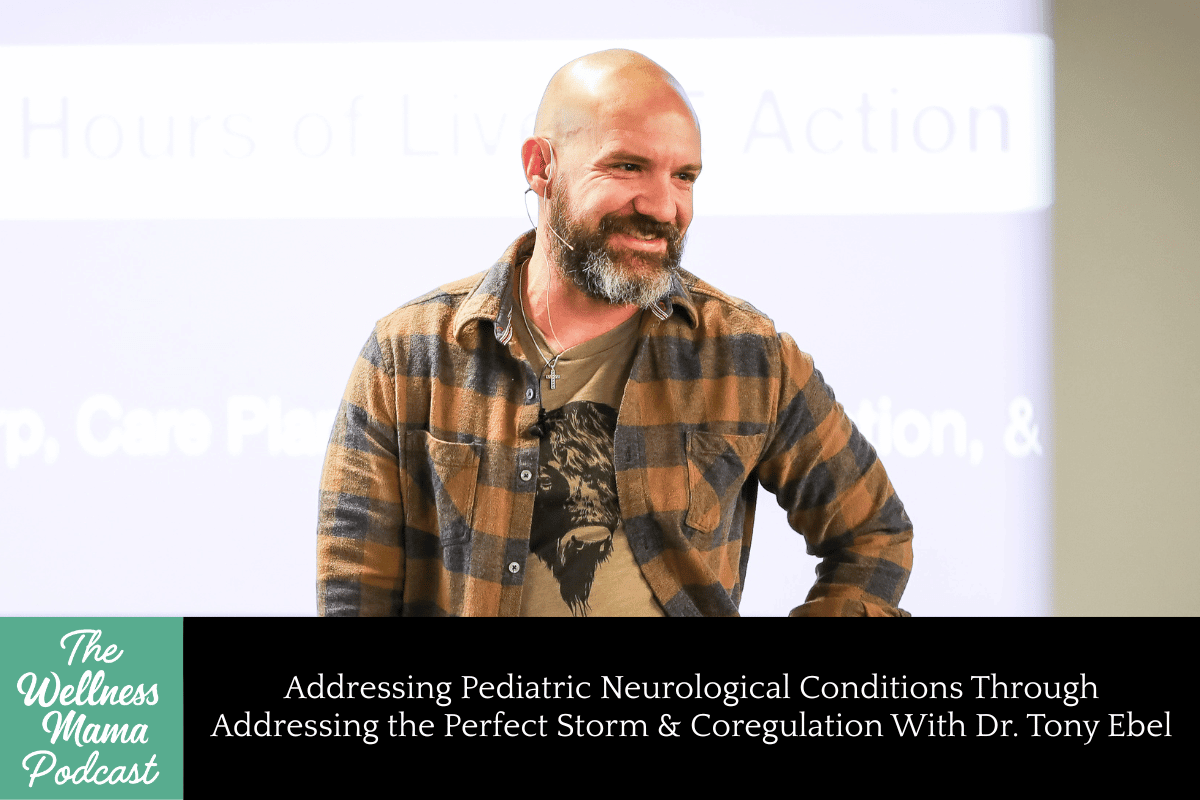
Katie: Hello and welcome to the Wellness Mama Podcast. I’m Katie from wellnessmama.com, and I really, really enjoyed today’s conversation. I am here with a friend, Dr. Tony. I recently got to be on his podcast and that same day knew I was, I had to have him on my podcast and share his knowledge with you guys.
He’s absolutely phenomenal. He talks about neurological chiropractic and addressing pediatric neurological conditions through addressing the perfect storm. And he has a very unique and nervous system centered approach to this that I think might be a missing piece for a whole lot of people. And I think you’ll hear that immediately in his approach.
Dr. Tony Ebel is the lead writer and educational guide for PX Docs, which I’ll link to in the show notes. He’s a certified pediatric and wellness chiropractor with over 15 years of experience. And he has been teaching and training other pediatric chiropractors for the past 10 years on his clinical protocols, specifically for pediatric neurodevelopmental challenges such as autism, ADHD, sensory processing disorder, epilepsy, anxiety, and more.
And you will hear how unique his approach is in this episode, as well as some very practical and I feel like profoundly like impactful things that he does, as well as how to find someone who might be able to help your family with that in your area. I anticipate having hopefully many future conversations with Dr. Tony. So for today, let’s jump in.
Dr. Tony, welcome and thank you so much for being here.
Tony: Thank you for having me. Anytime I get started with a new project, God calls me to do my homework. Who’s out there really serving kids and families in this way? And when we got into the podcast world, Katie, it was, I landed right on your Wellness Mama podcast. Got right to your Instagram. I probably sent you a DM right on the gates without even thinking. So to be here learning and teaching and sharing alongside you, seriously, a blessing and I can’t wait. Thank you.
Katie: Well, I’m so excited and honored to have you here. In fact, I got to be on your podcast recently. I’ll link to that in the show notes. And I think that same day was like, I need to have you on my podcast because it was such a great conversation and you are such a wealth of knowledge and I feel like we’re gonna get to like tiptoe and then deep dive into a really important topic for a lot of parents today that you, I feel like are such an important voice on and give such tangible, practical, and like really cut through the noise, key takeaways when it comes to.
And so, there’s a ton underneath this topic. To start off broad, maybe kind of walk us through the basis of what you do, the perfect storm of like all the things that you’re addressing. Because I often say on this podcast that we are each our own primary healthcare provider. And as parents I feel like that extends to our children. And so I know there are a lot of parents navigating the very exact thing that you do day in and day out. So with that kind of broad and vague start, kind of walk us into the value we’re gonna talk about today.
Tony: You know, truthfully, everything I’m about to talk about today, while there probably will be some like, oh my goodness, you know, why didn’t anybody tell me that before? It’s probably the top phrase we get, you know, one, I used to get it in the office, right, because we would get into this on a consultation and initial conversation, and now we get to send it far and wide.
But the truth is, all these answers I’m about to go through, they were found from digging deep, knee to knee, with moms. It really is. And it’s the mom’s stories that as a chiropractor, we always joke, DC stands for Doctor of Cause, being just so obsessed with digging in all the way to their stories and really asking questions that no one had asked before.
Deeper, earlier, more intentful, and then really, truly listening. What the actual answer is, or the truth is, is that moms do know. Dads do know they just had it all shut down and quieted by, like you said, all the distraction and all the noise. And so we’re gonna cut through that. So my path to find the perfect storm came with the same sequence that parents probably are gonna land in this conversation today.
First, we’re all kind of defaulted to conventional medicine and they say, oh, whether it’s autism or asthma or ear infections or colic, it’s just bad luck. It’s genetics. Well, my undergrad degree is in molecular biology and genetics. Because I’m a super nerd. And so I studied genetics. And I’m a farm kid and so genetics were kind of in that world and it was just nothing. You know, you can read and read and read and research and you just, you draw blanks, literally. And so I knew that from my scientific study. And then when I was digging into kids’ case studies 15, 16, 17 years ago, there was no autism, ADHD, anxiety autoimmune.
The family tree didn’t have that. So that was an easy move it to the side. Where this really gets more interesting though, with the perfect storm is, I then got into the chiropractic, the wellness, the natural, the functional biomedical world. And God had me there way earlier than Instagram and Facebook and AI.
So. I’m sitting at these seminars and I’m in these classes and I’m relentless. I just can’t wait to learn. And what happened is I feel like I, this was our conversation on the Experience Miracles Podcast. I feel like for a season I learned too much and I was like, I have all these answers and I know they all go together somehow.
And I know one or two of ’em must probably, you know, that parent gut instinct I always tell our folks to listen to, I had to listen to it as a young provider and be like, this is the answer to all this stuff, but there’s one or two things that matter most. So in the wellness world, I was told it was toxins and it was all these interventions, and it was all these things.
And I certainly saw that in case histories. But I landed on the real sequence and foundation of the perfect storm because case history after case history for a kiddo, and parents do not get hung up on the diagnosis. It doesn’t matter whether they had it, whether they do what it is or what it wasn’t.
Kiddos struggling. With their nervous system, with their gut, with their health, with their development, with their quality of life. That’s been my specialty forever, and I continue to find strike one or a kind of trigger one, if you will. There was just a ton of stress, a ton of medicalization and anxiety and neurological stress on mom’s nervous system, on the fertility and the pregnancy journey.
So I found that in about 60 to 70% of cases, I’m, I maintain my super nerd status all the way through, because I track all this very numerically and everything else. And then the second one was birth interventions. On my clipboard, because I’m in my mid forties, so I still actually print out my patient’s case histories.
I know there’s iPads available, but I still love pens and highlighters, and so I just continued almost like it was jumping off the page to me. Forceps, vacuum, induction, C-section, preterm, cord wrap, breach presentation. And so these birth interventions. So conventional training told me to look for genetics.
Didn’t find it. Holistic biomedical training told me to look for toxins. Did find it, but it was always third. It was that kiddo who had, had maybe a stressful pregnancy journey, had a very physically to the brainstem neck, we’ll break this all down, you know, injury. I would call that to the brainstem and the neuro spinal system and the vagus nerve.
Well, then they struggled to latch, then they struggled to soothe, then they struggled to breastfeed. Then they struggled to co-regulate. So now different nutrition is coming in, formula is coming in. They’re not sleeping enough to heal. They’re constipated, they’re refluxy. They’re getting chronic ear infections.
So the toxins would come on third to this perfect storm sequence and set the whole thing. You know, the fire was already brewing, and then that would be the kerosene or the gasoline on the campfire, and then that kiddo would regress or then that kiddo would get worse. But if you really dig deep into case histories, and now we have this with neuroscience and research too, you find earlier factors within how the nervous system is altered and disrupted in its function. And that comes from things during pregnancy and at labor and delivery. And so we’ll just continue to be as loud as can be about getting information and awareness about that. Because once you know, then you can do something, you know, then we can turn it into action.
Katie: Oh, I love this, and so many follow up questions because I feel like even that intro kind of gives the insight that there’s a lot we could do about this. And I know a lot of parents have been told there isn’t much they can do about it. So I love that you challenge that and give really actionable things parents can do. Like you, I also went through a phase where I really dove deep into genetics and I’m still fascinated by that world, but also like you, I’ve realized that is such a small actual percentage. Even for me it was more in like chronic disease and, with adults, and I feel like if anything, it’s a both and where there can be some really helpful levers you can use once you’ve addressed all the foundational things.
But genetics alone aren’t going to your point to address these other things like you can’t out genetic also, these lifestyle things that have happened, and I love this because I feel like nobody else is really talking about the birth interventions in the same way. And I’ll even give an anecdotal case study of this. I was always in my head, gonna be the natural birthing mom. I never even read the books about c-sections because I was like, I’m never gonna have one of those. And then with my third had undetected placenta previa, hemorrhaged at 35 weeks and had a very necessary C-section that saved my life and his, but I didn’t know about things like microbiome seeding or how to recover properly for him and for me.
Because I never even researched it thinking I’d never have a C-section. So I would love for you to talk about in a little bit more depth some of these birth interventions. And I know moms can carry a lot of guilt related to those. So not from a place of wishing we could have done it differently, but from a perspective of understanding this, how can we make shifts going forward too?
Tony: Oh, this is why we get along so well. You said right there both and. Those are my two favorite words. None of this is, or, you know, there can be genetic predisposition in some kids and families to certain conditions. And c-section, my goodness, millions of times over is lifesaving for mom and baby. And anecdotally and personally as well, I had been studying this and kind of found this perfect storm, you know, hidden in plain sight, neuroscientific truth in the first two to three years of my practice. And our first baby girl, Addison, was born full term. You know, healthy, natural pregnancy.
Just caught, not pulled, not yanked, you know, no intervention of any kind and everything just, it was the antithesis of the perfect storm, meaning it was like perfect. If you could kind of draw it out, you would that way. Well, as God would have it, knowing that I myself have a healthy dose of ADHD and I always joke, maybe he would’ve had, maybe I would’ve led myself onto the next thing instead of continuing to stay on this thing for a lifetime, on Memorial Day of 2009, our son was born five and a half weeks early, traumatic birth, brain stem injury, and again, I brought, you know, that’s my job as a dad is print off the birth plan. Grab the bag, bring it in, get ice strips, get outta the way. That’s my role in our family’s verse. And it didn’t say any of that.
It didn’t say transport him from one hospital in a helicopter to another, you know, put him on all these machines, these medications. And my son had heart lung bypass surgery. My son is a medical miracle who then, because of their awesomeness of intervention, becomes a chiropractic miracle, becomes a natural health nervous system miracle.
So he’s an and. Right. He’s a both in this way. And so I love that we get to get here early because there can be a lot of, huh, right. I mean, that is a parent’s default, neuro emotional mechanism is, if I’d only known, if I could have. The coolest thing about getting this information out to the world is right now most parents have gone down the exact same sequence I took us through.
But not that last step. So they know, okay, the genetic thing maybe isn’t everything. They know that when the pediatrician and the neurologist says there’s nothing you could do, just get used to it, except it, that, I’ve not met a parent really who’s, who said, okay, you know, I’ve met a thousands of parents who have been like, ah, I’m gonna figure this out and do everything I can.
And so you do. And in today’s world. There’s so much information that we’re able to, you know, bring to our communities. And so now I meet patients who have cleaned up the diet, cleaned up the lifestyle, cleaned up everything, but if that physical intervention or that neurological stress got stuck on that kid’s nervous system, and the term for that is what’s called subluxation, nervous system dysregulation, dysautonomia sympathetic dominance, vagus nerve dysfunction.
These are all kind of a bunch of nerd terms that if you hear me say them today, they all mean the same thing. Deep beneath the surface the nervous system is out of bounds. It shifts into sympathetic fight or flight mode, and it’s physically like neuro structurally stuck there, which is why a pediatric chiropractor is having this conversation because not only can we know about it, we can actually do something about it.
I know that’s not a diet change. It’s not a supplement. That’s not an essential oil, that’s not a massage. There’s certain interventions that handle certain parts of the storm, right? And help our kids heal. And so. What got me so excited to bring this work to the world all those years ago was not just like, Hey, let’s talk about this.
It was, we can help, we can literally, and so that led me down to the clinical part of my job, which is, I kind of found this, if you will, within chiropractic too. And so we needed to develop very specific protocols and I had been working on these adjusting techniques and these clinical care protocols those first couple of years, and I had been applying them, Katie to kiddos who were 17, 19, 21, Asperger’s, epilepsy, tried every medication, every detox, every chelation, even back then, and they were getting better.
And so I knew without a doubt that if a kiddo, quote unquote, 21 years old could get better with nervous system focused chiropractic care, what an advantage God had blessed me with to be there adjusting Oliver in the ambulance on the way to the hospital. So I’m probably jumping cart before the horse here. I just want every parent to know that if you go through this conversation, you find, oh my goodness, that’s one stone we haven’t even looked under and done anything.
There’s nobody’s nervous system that can’t heal. No age, no severity. No limitation on nervous system healing. If there is a system that has reprogramming, recalibration, repair, and restoration available to it. Oh my goodness. It’s the nervous system.
Katie: I love that, and I’ve seen this firsthand in my own life, anecdotally, and we talked about this a little bit on when I interviewed on your podcast, but about the nervous system component being absolutely huge for me because I was already doing a lot of the other things people know to do, like the supplements, the protocols, the dietary stuff, the exercise. I had all of that stuff dialed in. In fact, I had worked with some really like top practitioners related to thyroid health, and I had access to amazing help within that. And it wasn’t until I addressed the nervous system side that all of those things were able to actually be impactful. And I really started seeing massive, massive changes. And it seems like kids respond even more quickly, which is beautiful. And I love, like you, I think one thing we agree on is the body’s infinite capacity to heal. Like that’s what it is wired and designed to do. And it’s so often if it’s not, it’s giving us clear messages about how we can support it in getting it back to a state of being able to self-heal.
Because it already knows how to do that. It’s not something we have to do externally to it. But I feel like this brings us to the question of what are some of these things that we can do to it specifically, like nervous system related, because I feel like this is not really talked about that much. There are all the conversations about gut healing related to neurological disorders, which is great and like both and let’s do that too. And sleep and avoiding toxicants. I think with my son with the C-section, thankfully I was already, he wasn’t exposed to a lot of those kind of third line things that you mentioned, and still he did end up having some eczema and some gut things and some nervous system things that we did address going down the road.
So I’m sure many parents listening are wondering like, how do we begin to address this? Like what are these tools that are within our ability to help our kids?
Tony: Yeah. Oh, so you’re saying nerd out on nervous system healing. Buckle up, buttercups. This is, I think I might sleep talk, speaking of sleep. I think I might talk nervous system healing in my sleep. I don’t know. Because I just, I’ve seen the powerful transformation of this and then we’ve structured it. Then we’ve put it into a simple start here way.
Okay, so let’s go back into case histories. And the best part of being on the podcast world, in the podcast world and the digital world is that we can get all this information out. The thing that I’m always like, oh, this stresses my nervous system is when you get to work with patients, you go right into their individual customized, personalized story, right?
So you get to really put it together and that’s easier than this. And in a good way though. So I wanna start there. I can give parents a little bit of identification for their own kiddos as to say, okay, well would this be something that’s super important for us? What would be a tell? What would be a sign of that?
Well, all three of those stressors, so if we go back real quick and just summarize the perfect storm. So you have emotional stress. Because now pregnancy, in the medical world, right, where most of us, again, we kind of default there, and so we get on out of there. It’s like you’re diagnosed with pregnancy, and so they just layer on all this anxiety and all this stress and all this fear, and they’ve medicalized it, and that affects mama’s nervous system.
So now mom’s nervous system is more sympathetic dominant, less parasympathetic tone, rest regulation. Well, the umbilical cord is the power cord to baby. It’s the nervous system cord. And so babies are very plastic, neurologically. They’re going, their nervous system is gonna mold in the direction of its environment, internal and external.
So we’ll call that emotional stress. The birth trauma, the physical components, physical stress. Then all the toxins, antibiotics, and, you know, all that parents know about that later on will be chemical stress. Well, they all, the nervous system responds to all three different types of stress the same, it gets locked into this fight or flight flexion protection sort of posture.
So whether your child’s case history was primarily emotional, physical, chemical or and an and it’s going to show up in the neuro spinal, neuro somatic system. That’s just how God designed us and whether we look at anatomy textbook, nervous, you know, it, there’s no denying that, that’s where stress lands and gets stuck in the body.
And so If there’s the physical birth interventions, well then for sure we need to intervene with physical care, with chiropractic care, adjustments, manual work in that way. And what you’re looking for in the Healing sequence is this, and if there’s one thing I can say that I think really transforms healing interventions for parents to know to go after this, and then even other providers, we’re so advanced with our brain-based understanding and brain-based healing and everything nowadays, we just skip the basics Katie.
Most families are trying to get their kiddos or themselves to heal by working on sleep routines, by taking out, you know, bad carbohydrates and sugars and foods and preservatives, by getting outside and being, you know, active and doing movement-based therapies. But when that nervous system foundationally is locked into sympathetic dominance, it can’t fall asleep and it doesn’t stay asleep and it doesn’t get good sleep.
When the nervous system is in sympathetic dominance before there’s a gut brain connection, there’s a brain gut connection. The autonomic nervous system controls digestive motility, absorption, so that’s getting good nutrients in. That’s actually a neurological mechanism. Assimilation is a nerd word for Hey magnesium, you go over here, serotonin, you go over here. So assimilation is coordination, integration. All done by the nervous system, whether you have a great diet or not. And then the fourth one, which I know everybody is all about, rightfully so, is elimination, detoxification, also under the governance of the central and autonomic nervous system.
So you have sleep, you have gut health. And then in breathing, immune health, respiration, diaphragmatic expansion, oxygenation into the brain is crucial for nervous system regulation and healing. So how many of us where our kiddos deal with high stress, anxiety, overwhelm? We’ve tried to teach ’em deep breathing.
Well, how many of us as parents have downloaded the call map? On our phone, and it’s the one that never gets used, you know, and we go right to the social media one. So all of this is basic for the nervous system, and all of it’s actually really hard for the nervous system to access when it’s subluxated, when it’s locked into this sympathetic dominant tone.
And so you have sleeping. You have eating, digestion, you have breath, so pooping would be in there, as a pediatric chiropractor, I get to talk about poop all day. It’s fantastic. And then you have breathing and respiration and immune function and inflammatory modulation. So the reason that we have such hypersensitivity of inflammation is not because toxins are brand new.
Because our neuroendocrine immune systems are on edge all the time, so they can’t handle even a whiff of most of anything. So what, we put this all together when we first start to make adjustments and put a neurologically focused care plan in for a kiddo who’s non-verbal, having epilepsy and seizures, and has all these brain-based challenges, for months, often I don’t ask, Hey, are they talking yet?
Are their seizures gone yet? I ask, how’s sleep? How’s eating? Are they trying new foods? Are they breathing easier? What’s their movement, tone, coordination, posture, fluidity, like what’s their poop motility like, how’s their immune system doing? We call those the neurological soft signs or foundational signs of healing, and I got so excited to get kids brains better When I first got into this neurological functional integrative work that I often would mess up and I would, first mistake, I would try and do everything at once. We chatted about that a ton on our podcast. Second, I would try and start on third base. I would try and get the prefrontal cortex and the amygdala and the thalamus, like, do what I’m telling you to do. And I know that’s super nerdy that I just said it that way. Because you know, like who talks about the brain in these ways.
But we know how to access these things. Through adjustments, through and if you’re thinking like, this is not at all what I thought chiropractic is. It’s not at all what regular chiropractic is, but there’s very specialized nervous system focused, you know, neurotonal kind of chiropractic. We know exactly how to access the cerebellum.
We know exactly how to, you know, stimulate the prefrontal cortex, get the amygdala to chill out. So there’s a lot of clinical updating and advancements we needed to do to a profession and an intervention that had been around for a hundred plus years. And man, when we did and we put it all together, and I know that’s a lot that I just shared, but you first personalize it based upon a child’s case history. And if birth intervention and stress is there, there’s no diet change, there’s no supplement, there’s no detox that’s gonna get the nervous system outta sympathetic dominance. We need to physically hit reset with that. So it’s somatic or it’s manual chiropractic work that can do that.
Then you look for the soft signs. To review and we say, man, we’re sleeping. We’re moving better. We’re, our gut motility. We’re trying new foods. We can now take the supplements. We can now be in a ready state for PT and OT and ABA and get so much more, and speech, and get so much more out of it.
And now it just starts to exponentially, you know, sequentially get better, where the nervous system heals foundationally first. Then it will get to the brain. It will get back on track developmentally and the behavior and the emotions and the speech and the communication and the socialization, all of those healing components will come as long as we fix the foundation first.
Have, my least favorite thing said through gritted teeth, patience through this sequence of healing. And man, you just watch it unfold. And even the toughest of cases, which is my specialty, you know, we see kids through what we call our intensive program who come from all around the world. And that’s not to make light of anything, but those aren’t colic and ear infection cases.
You know, they’re level three and, and everything else. So hope that made sense. Because there’s a lot of nerdy neurological layers to that. But, um…
Katie: Well, I love that and I’ll definitely link to where people can actually find you. Because I know people do travel from all over to work with you. I also know that you being one person can’t work with everyone in the world. So I’ll also try to put some links in there. Maybe you can give us some wording on if someone’s in a different country or a different state, how do they find someone in their area or like what would they even look for?
But before we get to that, I love that it seems like, from what you’ve said, it’s almost never too late, like you’ve worked with even adults who had birth injuries and then it still helps. But how early can this be started for parents who have very young kids or even like if moms are pregnant, is this something that can be started very quickly after a baby’s born to like screen and address almost immediately to kind of like head off some of these issues?
Tony: It’s the best thing ever. I won’t stop. I’m just gonna work, work hard, you know, with a regulated nervous system for the rest of my days, as long as God gives me here until one of us, so a PX doc, a neurologically trained chiropractor, and there is now over a thousand of us over the world, and we have it on our, our website and our directory.
And the final, not final, stop, just the place that I just dream about and we have a lot of work to do, is to be at the place where Oliver had me in the hospital. He spent six weeks in the nicu. Right. And they were saving his life. But that’s the worst place to heal a nervous system. Just be, you know, call a spade a spade it, you know, the, they wake you up every two to four hours, there’s flashing lights, there’s, it’s just the worst place for healing to actually happen. It’s a great place for lifesaving, but neurological healing…
So the earliest, our favorite patients by a million miles, my friend are, here’s the Tony way of saying it, draw it up just right, you know, if you could, which, when can we, but, a little beautiful baby, born in a tub at home, Bob Marley playing, incense burning, midwife, doula, no pressure, you know, no physical intervention. And as, but even with that, you know, and I’m, remember everybody, I’m a dad talking about this. I’m a dude talking about this.
So as that beautiful Baby’s head and neck, skull, all the cranial bones, the sutures, the cervical vertebrae, the neurospine system as it makes its way through the birth canal, that is not the easiest pathway that somebody’s skull, spine and nervous system will ever enter through. So I have checked babies because we have this huge perinatal, we’re doing everything we can to prevent the storm because and Right.
We wanna be there to get ahead of the storm and then if, because it was for Oliver, we tried to prevent it. And we didn’t. So, but the beautiful blessing was we knew exactly what to do to get to work. Like he was getting adjusted within the first seconds of life to start to reset and restore his nervous system, not in the absence of medical intervention in addition to it.
And so that’s why at age 16 this spring, he just made state in cross, he was a pulmonary, he was a hypoxic brain injury. You only get a hypoxic brain injury if your heart and lungs get full of fluid and you’re not breathing. And he now at age 16, runs a 4:45 mile and cross country. And so, point being, sorry, that’s such a long Tony answer, the best way is right at the beginning, earlier, the more neuroplastic runway you have. So what happens is if kids are older and they’re, or they’re adults or they have a more severe case, you just literally, neuroplasticity is dependent upon time, repetition, duration, and depth, okay? So time and duration, kinda the same thing.
Repetition means the more stuck into a sympathetic storm, the more dysregulated a kiddo is. We might have to adjust ’em two to three times a day. At first to be able to change the nervous system in the positive direction when it’s been so hardwired for the not positive direction. And whereas you can get an infant struggling with nursing and colic and eczema and constipation, you could probably get them all the way better in a month or two.
That’s not the case for a three-year-old level three nonverbal that might take a year or two right of continued care. And so neuroplasticity stays on the job throughout life. You just have to do the job differently with more intensity or frequency, depth and duration based upon the clinical presentation.
Katie: That makes sense and I’ve been personally excited to see, it seems like in the last few years there’s been even like news reports about how they used to think like neuroplasticity went away when we became adults or at a certain age and now they’re like, no, it turns out actually amazing how we’re designed, that’s actually possible throughout life. Like you said, it just changes as we get older, like there’s more different ways to address that or it can take a little bit longer. And you also in the beginning mentioned the vagus nerve. And I love this as one of my like nerdy research topics, and so anytime I get to deep dive here, I love to take the opportunity.
And I know a lot of people are aware of their own stress levels as adults. They might be aware that they have some vagus nerve challenges and or be aware that at least this is something to address, but not really have a clear understanding of how, and I know there’s actually a whole, like, it’s very multifaceted.
There’s a lot of ways, like an obscure one that I personally experienced was I took voice lessons and singing actually turned out to be very vagus nerve stimulating and great for my thyroid, side note.
Tony: Vocal cords. Yep.
Katie: But I would love your take on the vagus nerve because I feel like this is something kind of universally as humans, we can support and see really positive effects from.
Tony: We sure can. And we are not in a current world, we, you know again I think a lot of our audiences have always listened, like they learned everything about gut health. And then we look at the supermarket, we look at the world and we’re like, well, this isn’t very, you know, the average places we go, thank goodness nowadays it’s way different, but like it’s not very gut health supportive. Well, if when you learn about nervous system health and the vagus nerve, you’re like, what shot does my vagus nerve have in this kind of crazy, chaotic world? Well, that’s the cool thing about learning how powerful it is. How to access it, how to activate it.
So let’s go to basics. I remember in undergrad, when you go to any kind of doctor’s school, they suggest you take Latin classes, right? We all have to take a foreign language in undergrad. And I remember sitting in Latin class in undergrad thinking like, what life choice have I made? This is awful.
Nobody even speaks this. And, but vagus is a Latin word that its root means wandering. So vagus nerve is actually a cranial nerve. There’s 12 cranial nerves. Okay? The 10th, which is the vagus, it’s the boss. It’s the superstar of the cranial nerve system. The 10th and the 11th are the only two nerves that leave the cranial vault, which means you can kind of picture anatomically your brainstem is the bottom back part of the brain.
And there’s a little opening there called the Foramen Magnum. And these two cranial nerves actually branch from the brainstem, and then they go down through the cervical spine. This is why chiropractors are the most potent vagal nerve stimulators. Like if I really nerd out with the Katie, I would be wearing a shirt that says Vagus nerve stimulator.
That would be my job title. And so you have these two nerves. The 11th is the spinal accessory. It runs and controls the muscles of the neck, especially the SCM. So when kids get torticollis and they have cranial nerve or just neck issues, that’s often that and so they run together.
But vagus nerve is the boss. Nicknamed the wandering nerve because other than one nerve in the leg, it’s the longest nerve in the body. The vagus nerve goes all the way down to the thorax, it goes to the heart, and it goes to the lungs, and it goes to the upper two thirds of our digestion, pretty much all the way down, almost to large intestine and colon, and it goes to our diaphragm.
And it goes to our thymus and it goes to our thyroid, and it goes to our vocal cords and it goes to our tongue and it goes, the vagus nerve also goes up into the eyes and it, we now know there’s a social vagus, there’s an emotional vagus. So that’s kind of the anatomy of the vagus nerve. Now the job is the coolest part.
The vagus nerve is 85% afferent. So it’s sensory. It’s a satellite. It’s an internal, primarily. So it’s going to the heart, it’s going lungs, it’s going to the gut, it goes to the immune system, it goes to the thyroid thymus, and then it goes to the eyes and the ears, and it’s this sensory air traffic control input system.
And the vagus nerve is primarily parasympathetic, so it’s the brake pedal to the gas pedal. If we did not have a parasympathetic system and a vagus nerve, every one of us, our blood pressure would be 180 at all times. Our heart rate would be 150 at all times. Like we need breaks. We’re defaulted for protection.
That’s why it triggers so quickly and so easily. So the sympathetics don’t take much to activate, the vagus nerve is it’s governor. It’s baseline. And so because the vagus nerve branches from the brainstem and comes down through the neck and shoulders, it’s why every one of us feels emotional stress, physical stress, and chemical stress.
Those of us who are healthy in our forties and don’t have margaritas too often, I walk by a tequila bar and my neck hurts, you know, and you just go into this like inflammatory… and so what happens is anything you can do to increase respiration and oxygenation is vagal nerve stimulation.
Anything you can do physically. So especially in the neck and the thorax. So all of us sit at computers and we sit in carpools and we sit in bleachers, and we’re just stuck in this rolled in posture. So when you do chest opening, heart opening yoga, mobility sort of exercises, it’s vagus nerve stimulation.
When you do hum, gargle, sing. I love that you brought vocal lessons. That’s, it’s exactly what it is. And so you stimulate the vocal chords and you’re getting muscular input to the vagus nerve, and that’s where I want to finish. Movement. So the vagus nerve is very connected to the sensory motor system, so it actually comes back to birth trauma and neck injuries and us as adults, it doesn’t need to be that we had birth trauma.
We’re just stuck at a computer all the time. Our posture sucks. We carry all of our stress on our neck and shoulders. All of that chokes off and shuts down the vagus nerve. So the most potent and important vagus nerve stimulator for most of the population, and I know this sounds like a homer answer because it’s what I do for a living, but I, if it was something else that scored more points and got you more better, I know it’s not great English, but Iowa farmer coming out in me, I would say that.
But my goodness gracious, you get the right kind of neurologically focused chiropractic adjustment, specifically upper cervical cranial, your neck and shoulders, your upper thoracics. I experienced this, and I’ll finish with another anecdotal study. Last Friday, tough day for me. We had our beautiful heart-centered, life-changing miss Jackie, who’s run our office for 10 years, just been a warrior for me and this mission, and her kids and her babies. Well, she’s in a season where she’s gotta be home more, right, with her boys and do that. So Jackie’s celebration of her service with us was there.
And then one of our PX docs, you know, who I’ve been mentoring and training from the beginning, passed away in a car accident on the same day. I had a terrible day. I had a terrible day neurologically. You know what I did over the last couple of days? I got adjusted every day. So I went in and I got very specific adjustments. It wasn’t this big chiropractor in a van down by the river, you know, hook up to a thousand machines.
It was one or two adjustments, very specific vagal nerve activation, and I could tell over the weekend that was moving me in the right place. A lot of prayer, a lot of time with my kids and families. And then as I was telling you before we started recording, I’m always outside. I live on a farm. I go right…
I have been outside just walking. I didn’t do my CrossFit workouts last couple of days because they would’ve put me into sympathetic tone. I just went out, I did a ruck, but I lightened the load so I could open my chest and so I could breathe and be out there. And so super nerdy wise, my last five days has been really focused on stimulating the vagus nerve and getting healing and activation to that side of my nervous system.
Because otherwise I just felt myself stuck. You know, which most of us do 24/7, 365 in that sympathetic fight or flight spot. And so there’s more. We have some really cool resources we could send your tribe about our favorite ways to stimulate the vagus, those are my kind of four or five favorite, that get out there.
I didn’t even think about vocal lessons. I am not good at singing, but I’m willing to try anything to get my vagus nerve bumping, so.
Katie: Well, that’s the funny part. It didn’t start at all for the health reasons. I have this pact with myself where at least a couple times a year I have to do something that’s outta my comfort zone. So that’s why I even attempted voice lessons in the first place. I’m certainly not a good singer either. But highly recommend it.
And it did anecdotally line up with my thyroid also improving, which I’ve heard thyroid doctors now say too, like the stimulation of the vocal cords right next to the thyroid, whether you’re singing, you’re yelling, you’re belting, you sing in the shower at the top of your lungs, whatever it is, like that’s really beneficial, especially for women. But inspired by you…
Tony: Can I nerd out there for just, just a second?
Katie: Go for it.
Tony: So having a pediatric practice, you take care of stressed out, wound up, worn out moms 24/7 365. So that’s another set of neurology I know inside out. All moms, I’m, you’re not supposed to do this, I’m putting it everybody, kinda like most of us carry all of our stress neck and shoulders, you know, right at the base of neck, right? So C5, C6, C7, the lower cervical, those are the direct nerve supply to the thymus and the thyroid, okay?
So the reason so many moms, a hidden in plain sight reason, that so many moms have so many thyroid challenges is their lower cervicals carry all their stress. There’s also a little nucleus of sympathetic fibers in there, so when you carry all this stress, your thyroid, neurologically, short circuited. Your thymus, neurologically short circuited. So now your thyroid shuts d… It can either go suppress or go haywire, right? Kind of a Hashimoto sort of situation. Or you can have your thymus just constantly ticked off so you’re just sending inflammatory signals at all times and then it further drives the sympathetic dominance.
So when we adjust the moms, we call it the mom zone. I have for 18 years. We call that neck and shoulders, the mom zone. The amount of women I’ve been able to help, and chiropractors that do this work across the world, get off of thyroid medications, anti, you know, on steroids all the time for the inflammatory system, like the endocrine system is more intimately connected to the nervous system than perhaps any other system, even though I kind of nerded out on the gut earlier.
And so when you get these adjustments, and again, the vocal cord simulation, the vocal cords are governed by C5, C6, C7. So in neurology there’s something called a spillover effect. If you, because all of the afferent input goes into the dorsal horn of the cord in a similar area. So if you stimulate the neighbor, you know, it can go two ways. If your neighbor’s always making a noise, it’s annoying. If your environment is calming, it’s helpful. So when you did vocal lessons, of course as a chiropractor I would read this. You’re adjusting, you’re putting the neuromuscular input into the exact right conduit to hit reset on the nervous system. It’s brilliant.
Katie: I love that. Now I understand the why and not just that it seemingly had a big impact for me. And inspired actually by the episode we did together on your podcast. I wish I was your neighbor, that would’ve been easier. But instead I found someone local that does similar, like the neurological side of it.
And I was really curious to try it and I noticed instantly I felt a downshift into parasympathetic almost like I was so tired. I was like, oh, my body wants me to take a nap or at least rest right now. But the really cool part is my mom ended up going to this chiropractor also, and she had, she broke her neck when she was in college and had never, she had been scared of chiropractors because she’d had a couple that like twisted her neck. And it freaked her out after breaking her neck. So she had never really kind of fully addressed it and she had a similar effect, but to like the nth degree, like I would guess my mom, poor thing, has probably not downshifted into parasympathetic very many times in her lifetime in general.
Tony: Decades.
Katie: And seemingly this actually like helped her start that process. Because afterwards she was calling me saying like, I don’t know if this is helpful. I’m so tired after I just wanna go to bed. I was like, mom, do it. Take some magnesium, lay down, take an Epsom salt bath. Like, your body is, that’s awesome. And she’s continued to see good results, but I, to me, that also brings us to the point you mentioned the moms and the tightness in the neck and the head.
And that, even the metaphorical, of how much we carry the weight, kind of the weight of that. But we also know, at least from what I’ve read, moms especially kind of set the nervous system tone of the house. And I know moms have trouble sometimes, like prioritizing their own regulation and nervous system health.
And it seems like this is actually one of the most impactful things we can do, even for our children. But can you speak to that from like your perspective as a clinician and what you actually see? Like is there actually science to back this up, that when moms are more regulated, their kids are also more regulated?
Tony: This is my favorite conversation. I’m not, I am not singing, pun intended to the choir here Katie, this is my favorite podcast conversation of all time. Just the way this is layering out in sequence. These are my favorite topics and we’re just going down them one by one. So the nerd term’s called co-regulation, and it’s again a hidden in plain sight answer to get your kiddo healing.
It’s either, and this is for all of us as parents, it’s, and moms, yes, definitely the chief in this place neurologically for the family and setting the tone of nervous system regulation. So we get to be, sometimes we can find ourselves as parents in the way or sometimes we can lead the way. What a powerful blessing.
Right? You know, and what a great conversation to have to give us the choice. Give us you know, some action that we can go do that. So another case study, and I love this because I always have done this. I teach science through case studies as well. We had this beautiful kiddo, we just reviewed this with our team yesterday at our clinical meeting and I was nerding out with our young doctors and we’d talk about co-regulation all the time.
This guy was thriving. He was driving out there, coming down from Wisconsin to see us. There’s a great PX doctor in their area, but she came down to a workshop and she just felt like, you know what? Coming to PWC, coming to our practice was the right place for her and her family and for her son. And so he’s been getting adjusted for a year and we’re ecstatic with his results.
Don’t get me wrong, we have so much better sleep. We have so much better digestion. He is trying new foods. He’s every, like, all these soft signs are really in a good place. But I also said it’s been a year and I’m a parent too, right? And so, and he is a little bit older kiddo, so we knew the speed of recovery for him would be at his pace as each kid has their own pace, and of course, with a kiddo not having many words, he’s got an autism diagnosis and some challenges there.
And so mom’s just big hairy, audacious goal is speech, right? Well, we did a check-in. We do every month, every, well, you start kind of a couple days then we do, we’re constantly doing these progress scans and we’re loving the progress we’re seeing on this kiddos scans, but we’re at an impasse, you know, and we could just tell.
And there’s nothing left in this family for supplements, diet, nutrition. I mean, they’re homesteaders. Like they’ve who you would want to teach the class, right? Of how to change your lifestyle. But mom was fried. Mom’s sympathetic dominant, no vagal nerve tone. Just haaa. You know, and so with love, what we do at our practice, Katie, is we say, Hey, good day.
You’re getting scanned and adjusted today. And that was, and it’s not a question, it’s like. Good day. Today is that day. You know, like, and I honestly don’t care because I, in parent to parent, you can usually get away with this. It’s harder for our young doctors who don’t have kids yet. But I will just literally take ’em by the arm, give ’em a big hug and say, walk with me to the scan room where we run our scans.
HRV, it’s where you find the nervous system stress. A month ago she started getting adjusted. His speech and communication has exploded. He has just hit another gear of it. And so your nervous system, so a little bit more on co-regulation and why this works. So the number one thing the nervous system is sensitive to is emotions.
Now, when I first started learning about this, I’m a dude, guys, I was like, ah, whatever, you know, let me guess, now this presenter’s gonna say the words hold space or something. I don’t even know what those mean. So, and so I’m like listening to the class slash not listening to the class, and I’m like, tell me about physical trauma in the somatic system.
I love anatomy. Tell me about the microbiome and toxins. I grew up on a farm, you know, down with corn, and so I was always very invested in those, and it took me too many years than it should have Katie, to really, really tap into the power of co-regulation and emotional healing. So when a kiddo has gone through their own perfect storm and trauma, the parents have gone through and both with that child, and it tends to lock in on us. I have a kiddo with a traumatic birth injury. I’ve got three daughters.
My other daughter went through an injury at her school that led to this whole big thing, tough thing. Super tough thing we’ve gone through. The catalyst for so many things we’ve done to heal are chiropractic neuro structural, yes. Nutrition, yes. Lifestyle, yes. When Christina and I, my rockstar wife and I, when we would get our nervous systems and get access to this neuro emotional type of healing, always the catalyst to have our kids. Because, and if there’s one certain set of emotions and nervous system function that a child is connected to, it’s mom, it’s where literally God and biology programmed us to look for safety, calm, strength, and I’m just gonna leave it at those safety and calm, you know, actually, I would leave it at those two and plenty of other things, clearly from the mother to child relationship.
But if there’s two that the trump card in mom’s nervous system are safety and calm that she can represent and bring to the table that really no one else can at that level. It’s those. And so when we adjust moms and then give them the nervous system regulation care, like we talked about on our podcast, and give them, and they start to do even, gosh, buddy, if they start to do 10 to 20% of it, the last thing they need to do is be perfect, right?
That’s not very nervous system healthy. But they just start to dabble in getting adjusted, taking care of their nervous system, putting themselves first just opens up this massive portal of healing for the whole family.
Katie: Amazing. And as I mentioned before we even hit record today, I have a feeling we’re gonna hopefully get to do some follow up rounds in the future because I feel like this has just spurred 12 more whole conversations I wanna have with you eventually. But I would guess there’s also a lot of people listening who either want to know where they can work with you directly and where you are and or how to find someone who can do this particular type of work.
Because I knew it was new for me. I’m guessing it is for a lot of the parents listening and certainly like I’ve seen its impact already. You’ve made a case for like how profoundly impactful this can be for so many people. So what are some of those resources? I’ll of course make sure they’re all linked in the show notes as well.
Tony: Yeah, we got some cool stuff. We got our directory. So when I first started out to do this work, teaching science, teaching everything, and then we’ve just been able to, God has blessed over the last 15 years to take it full circle. So there is a full training curriculum, certification course, for PX doctors, that stands for the pediatric experience.
We want your kiddos experience to be the antithesis of the perfect storm. We want your experience as a parent to be the best, you know, the most blissful, joyful, fulfilling. So it’s a whole family care thing. And so anybody at www.pxdocs.com that is on that directory is literally trained by myself and our team.
And you’ll see it’s real easy on there, there’s layers. There’s initial training and then there’s certification training. It’s all clearly demarcated there. And we have, I believe, just short of a thousand. We’re in 15 countries and it’s happened, and I’m so ecstatic, and I also know we’re not batting a thousand, that means somebody somewhere or some buddies are gonna not find, you know, that zip code or that country or that that place fulfilled just yet.
We’re coming for ’em and we’ll be there for your family as quick as I possibly can training these doctors. But the other thing, the things to look out for, kind of my little cheat code, when you get on Google and you get on Instagram and be, this is your family, moms and dads listening, with love, kind of using this word so it sticks, be judgy, be choosy in a good way. Okay. We’re not talking about, you know, where you’re gonna get your silverware. You know, we’re talking about nervous system health here. And so first thing you wanna look for, if they have a pediatric and perinatal brand and you’re moms, you know how to tell if one is real or not.
You know, do a little depth, do a little scrolling, do a little Instagram investigation. So if they see a ton of kids and families, and you can just tell like that’s an expertise for them. You don’t get to see kids and families unless you get results. Okay? You just don’t, moms, you can, that’s not a fake it until you make it sort of way.
So my mentor taught me this. Dr. Cody, God bless him, he just taught me so much and that was way before PX docs had a directory, he would have me call as an intern and he gave me these three questions. What percentage of kids do you see? If they see a lot of kids, you’re okay. We’re moving down the list. We like this place.
Second, you know, if you focus on subluxation, on the nervous system, if the website and Instagram has a bunch of spinal pictures, motor vehicle accidents, decompression, rehabilitation. It’s awesome for back pain. It’s not great for nervous system regulation. You can’t be a jack of all trades, right? And so you’re looking for what are called nervous system scans.
So it’s called the Insight Technology. And we’ll send the article so you guys can see these. And there’s more doctors out in the world who are pediatric and family focused and have the insight scans. So you want to ask, Hey, do you use technology like HRV Thermal and EMG? I want to know that I know my nervous system is at this place.
And then the coolest thing about the scans is they’re not just a starting plan. They are our blueprint for adjusting and care plans that come from it. Those we run on a regular basis to make sure that objectively, functionally your nervous system is healing. Because this isn’t medicine, we’re not chasing symptoms, we’re making actual functional change to the nervous system, the boss system.
And then the third thing, this one is really deep, but it’s, I think it’s a great question is, Hey, what’s an, and it actually also teaches what we talked about earlier with neuroplasticity, so that nobody’s ever surprised you kind of wanna ask the question like, what’s an average care plan? Now I’m not talking cost.
I know that that’s part of everything too, but like, what’s an average care plan and in today’s world, our nervous systems, including our babies and including our kids, are fried. So if somebody says, oh, it’s once or twice a week, or it’s monthly maintenance, it takes a lot. And I don’t wanna sugarcoat it.
It’s a good thing to know that real full transformational nervous system healing can happen. So if a practice is kind of wussing out or watered down on care plans and, oh, it’s so what your insurance covers, or we do this, the cool thing about getting nervous systems better is there’s a science to it.
And so you should be able to talk to their staff, talk to their team, send ’em a DM and get some really clear answers on those three things. And so even if they’re not on the PX docs directory, that’s a guaranteed stamp of, you know, run, put that minivan, put that Chrysler Town and Country in Overdrive, put it on two wheels. Get your family in there to that office. PX Docs offices are not only clinically at an amazing level, we build partnerships. We build empower, we build community.
It’s just a healing space. It’s a hope dealership. We are different kinds of people who wear t-shirts that say expect miracles, like you just, your nervous system if you just rolled in, grabbed a coffee, we usually have coffee and snacks, you just grabbed a tea and hung out, didn’t even get adjusted, your HRV would improve just being inside the four walls of a PX office. And so, but those are the tips. Those are the strategies we use. Standard spinal chiro. Awesome. Amazing. Not this. And so you want to be able to differentiate between those.
Sorry, I give long answers my friend.
Katie: Awesome, no that was perfect. I will make sure those are all linked in the show notes for any of you guys listening on the go, you can find that as always at wellnessmama.com. Like I said, this is a newish topic for me and what I’m love getting to learn more about. You are such a wealth of knowledge.
I feel like this is such a really helpful tool for a lot of families, so I’ll make sure you guys can find more and keep learning in the show notes. Also link to the Instagram resources for this and all the other resources you mentioned. But Dr. Tony, I hope we get to do more follow up conversations in the future.
But for today, thank you so much for your time, for your enthusiasm, for everything that you’ve shared. This has been such a joy.
Tony: You know what amazing timing. Today as we record this, the, our podcast dropped. The Experience Miracles podcast with your interview and I was sending text and DMs to so many moms today, and I was like, Hey, I, you know, I’m sure you already are a big fan of my podcast and all this, but this is the one you’ve just gotta listen to because I just, I’ve learned so much from you over the course of this journey into all of it.
And so everybody listening, you’re in the right community right here with the Wellness Mama podcast and everything you do and anything and everything, our community, our podcast, our platform, our Docs can serve you with. You can also just send us a DM and just ask. I’m an Iowa farm boy. My favorite thing to be is helpful.
So if we can help, please reach out, ask, and we’ll give it our all.
Katie: Amazing. Well, again, thank you so much. All those links in the show notes to be continued for future conversations, but for today, thank you for your time and thanks to all of you for listening, for sharing your most valuable resources, your time, your energy. Your presence with us today. We’re both so grateful that you did, and I hope you’ll join me again on the next episode with the Wellness Mama Podcast.




Leave a Reply