
Homemade Remineralizing Toothpaste Recipe (Natural + Simple)

Katie Wells Avatar

Reading Time: 5 minutes

This post contains affiliate links.

Read my affiliate policy.

remineralizing toothpaste
Wellness Mama » Blog » Natural Home » Homemade Remineralizing Toothpaste Recipe (Natural + Simple)

I’ve mentioned before how I stopped tooth decay and helped remineralize teeth. For healthy tooth enamel, it’s important to focus on good nutrition and have a great oral care routine. If you’re dealing with sensitive teeth, this homemade remineralizing toothpaste helps reverse and prevent demineralization!

When I was actively working on my cavities I used a two-part approach. First, I addressed my mineral levels through what I ate and drank. I also used a natural remineralizing toothpaste for enamel repair. I’ve since noticed a huge improvement in tooth sensitivity and no new caries!

A Remineralizing Toothpaste

There’s a lot of information about tooth remineralization, a process many dental health professionals previously thought impossible. This article details the science behind tooth remineralization and which foods to eat (and avoid!) for success. You’ll also learn why most toothpaste ingredients, even those with natural ingredients, aren’t the best.

Conventional formulations like Sensodyne reduce tooth sensitivity with fluoride and potassium nitrate. While I’m not a fan of fluoride, there are other issues with some brands that claim they’re remineralizing.

Silica, especially in whitening toothpastes can sometimes be too harsh. The SLS added for foaming can cause mouth and gum sensitivity. Nano-hydroxyapatite toothpaste has recently gained popularity as an alternative to fluoridated toothpaste, but it presents problems too. You can read more about that here.

Over the years I’ve uncovered a lot about having a healthy mouth. What I’ve found mirrors my own experience with natural, fluoride-free toothpaste and a remineralizing diet.

Don’t want to make it? Try the remineralizing toothpastes at Wellnesse!

Natural Toothpaste

I’ve definitely noticed major changes in my teeth after using this toothpaste. It gets rid of buildup to help with teeth whitening and makes them feel really clean. Others who’ve tried it have told me the same thing.

The most surprising change in my teeth was that they’re no longer sensitive to cold! For as long as I can remember, biting into anything cold (or even thinking of it!) made me shudder and hurt my front teeth. After changing my dental care I noticed I could eat cold foods without my teeth hurting. I’ve never been able to do that before!

This toothpaste recipe is kid-approved, and since it has no fluoride, it’s safe for babies, toddlers, and those with thyroid problems.

Ingredients and Substitutions

I’ve made several toothpaste recipes over the years with varying ingredients. All of them have ingredients that help strengthen enamel (and improve sensitivity) to some degree. Here are the ingredients and what they do for a healthier mouth

  • Calcium – I used to use calcium carbonate in this recipe to help rebuild enamel. While it’s still a good option, calcium phosphate is even better. You can even use finely powdered, dried eggshells for calcium if preferred. A coffee grinder works well for this.
  • Baking Soda – A gentle abrasive that helps clean teeth and reduce plaque buildup.
  • Diatomaceous Earth – Mineral rich and full of silica for strong teeth and bones. It’s also slightly abrasive to clean teeth.
  • Xylitol – Adds some sweetness to balance out the mineral taste. Xylitol also has a lot of oral health benefits and helps prevent cavities. If you prefer not to add it though you could replace it with a little stevia to taste.
  • Coconut oil – This helps pull everything together and turns it from a powder into a toothpaste. Coconut oil also helps reduce plaque, prevent gingivitis, and balances mouth bacteria. If your house is colder you can replace half of the solid coconut oil with fractionated coconut oil or MCT oil.
  • Essential oils – These add antimicrobial properties for oral health and freshen breath. Some good options include cassia cinnamon, clove, peppermint, spearmint, myrrh, or sweet orange. Start with a little and increase as desired in the recipe to avoid any irritation.
  • Mouth oil – Instead of adding essential oils, try a premade healthy mouth oil. I like this one from Wellnesse that features ingredients like manuka, and organic cinnamon and mint essential oil.

A note on abrasiveness: There’s been some concern diatomaceous earth or baking soda can be too harsh on teeth. While we don’t want to wear away enamel, DE and baking soda can be gentle options. Baking soda rings in at a 2.5 on the MOHS hardness scale compared to silica at 6 or 7. DE is even gentler than that with a score of 1 to 1.5.
remineralizing toothpaste
Print
4.17 from 266 votes

Remineralizing Toothpaste Recipe

Make a remineralizing toothpaste to freshen bad breath and strengthen teeth with enamel healthy ingredients.
Prep Time10 minutes
Total Time10 minutes
Yield: 4 ounces
Author: Katie Wells

Equipment

Materials

Instructions

  • In a bowl, mix together the calcium, diatomaceous earth, baking soda, and xylitol.
  • Add the coconut oil a little at a time until you reach the desired consistency.
  • Add essential oils or Balanced Mouth Blend if using.
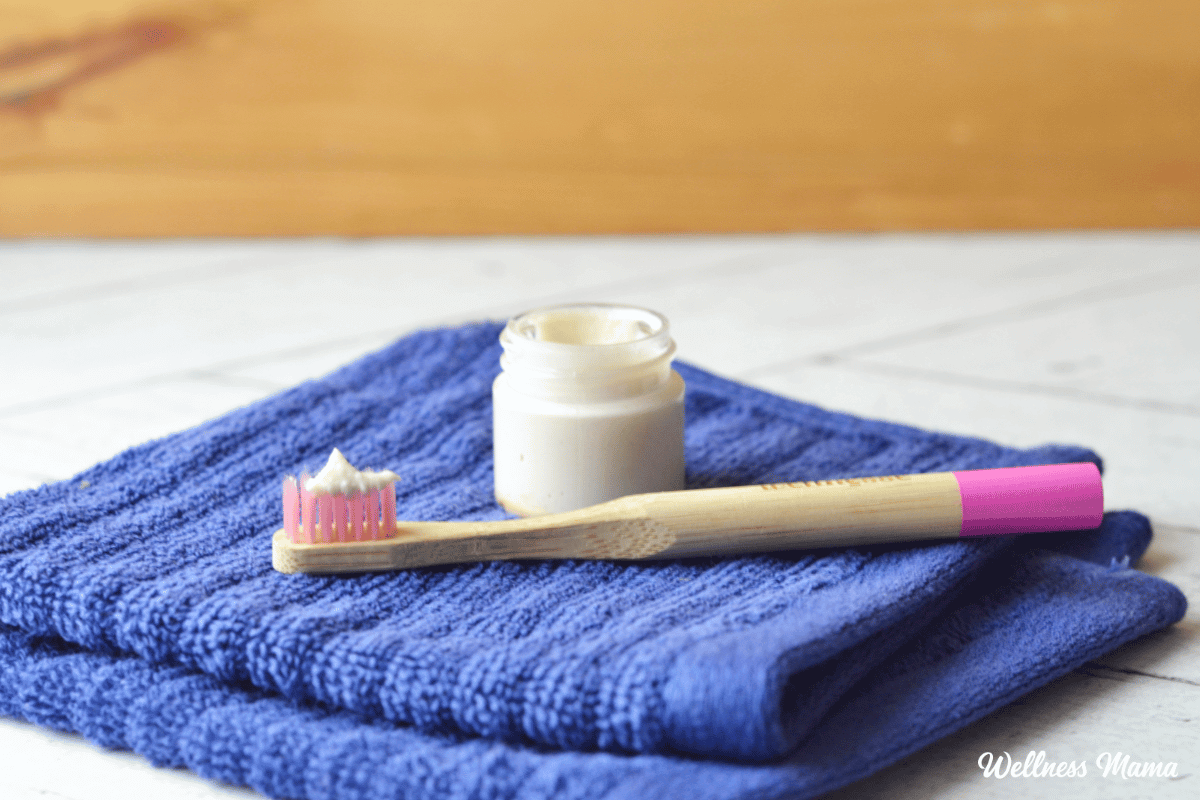
  • Store in small glass jar.
  • Use a clean popsicle stick or spoon to scoop some out and onto a toothbrush. Do not dip the toothbrush into the jar as this introduces bacteria and cause it to spoil faster.
  • Storage and Shelf Life: Store in a cool place away from direct sunlight for up to 2 years. Replace it if it starts to smell off or look discolored.

Notes

  • The amount of coconut oil can vary you need to form a paste consistency can vary from 1 and 1/2 TBSP to 2 and 1/2 TBSP coconut oil. You can also replace half of the solid coconut oil with fractionated or MCT oil if your house is cold. This keeps it from getting too hard!
  • If you don’t have a 1/2 Tablespoon measuring spoon, it’s the same as 1 and 1/2 teaspoons.

More Natural Oral Care Options

Oral hygiene involves more than just toothpaste! Here are some more healthy mouth products to make or buy. I’ve included my brand Wellnesse for those who are too busy or just want a premade option.

The Internal Side of Remineralization

Remineralization doesn’t only happen in the mouth. Simply using a toothpaste with a higher concentration of minerals likely won’t be enough to help teeth. Remineralization is a whole-body process. In order for it to happen we need enough of certain nutrients, especially minerals and fat-soluble vitamins.

When I was actively working on remineralizing my teeth, I focused on a specific nutrient-rich diet. I also avoided foods with sugar and phytic acid and added other lifestyle factors to boost nutrient levels. You can read my daily oral health routine in this post.

Getting enough minerals and fat-soluble vitamins are important not only because they support the body as a whole, but they create more mineral-rich saliva. Our bodies need healthy saliva to deliver the necessary nutrients to teeth.

I saw the best results with this two-pronged approach: eating for oral health and using this remineralizing toothpaste!

Ever made your own remineralizing toothpaste? Let us know how it worked!
This homemade remineralizing toothpaste uses all natural and safe ingredients to naturally clean teeth and provide necessary minerals to the mouth.
Sources
  1. Dodds, M. W., Johnson, D. A., & Yeh, C. K. (2005). Health benefits of saliva: a review. Journal of dentistry33(3), 223–233.
  2. Valkenburg, C., et al. (2019). The efficacy of baking soda dentifrice in controlling plaque and gingivitis: A systematic review. International journal of dental hygiene, 17(2), 99–116.
  3. Reade. (2023). Mohs Hardness (Typical) of the Abrasives.
  4. RTS Tools. (2019). MOHS Hardness Level.

Become a VIP member!

Get access to my VIP newsletter with health tips, special deals, my free ebook on Seven Small Easy Habits and so much more!

Easy Habits ebook on ipad
Katie Wells Avatar

About Katie Wells

Katie Wells, CTNC, MCHC, Founder of Wellness Mama and Co-founder of Wellnesse, has a background in research, journalism, and nutrition. As a mom of six, she turned to research and took health into her own hands to find answers to her health problems. WellnessMama.com is the culmination of her thousands of hours of research and all posts are medically reviewed and verified by the Wellness Mama research team. Katie is also the author of the bestselling books The Wellness Mama Cookbook and The Wellness Mama 5-Step Lifestyle Detox.

Comments

1,493 responses to “Homemade Remineralizing Toothpaste Recipe (Natural + Simple)”

  1. Kirsten Fern Avatar
    Kirsten Fern

    5 stars
    I accidentally order (NOW Brand) Calcium Magnesium Citrate, instead of just Calcium Carbonate. Is the CM Citrate okay to substitute for the Calcium Carbonate or will that do harm to my teeth? Thanks in advance!

  2. Clare Avatar

    Hi,
    I was wondering if you could use Bentonite Clay instead of the DE in this recipe. Also, could you just use coconut oil, baking soda and peppermint oil for a toothpaste?

    What’s the shelf life? Thanks so much

  3. Crystal m Avatar
    Crystal m

    Just wondering if the toothpaste is still beneficial if I use equal parts of calcium and xylitol for my kids? They don’t like the baking soda taste.

  4. Carla Pshebylo Avatar
    Carla Pshebylo

    Ive been making a lot of your products and LOVE them all! Thanks! I see GSE in the picture for this recipe but it is not listed in the ingredients. How much should be added?

  5. Priya Avatar

    Thank you so much for this and all your other posts- I have learned so much from your site!

    The one thing I am concerned about is the trace minerals. The drops I found show to contain fluoride as one of the minerals. Since fluoride is one of the main things we are trying to avoid in toothpaste, is it still ok to use because the concentration is so small? What else could we use as an alternative to trace minerals?

  6. Calcium Avatar

    Hello there. I have read several different remineralizing toothpaste recipes and I have notes that some people used calcium carbonate instead of calcium powder. Would you, by any chance, so happen to know the difference in using each one?
    Additionally I am using Earthpaste, which does not have calcium/calcium carbonate powder. Although it has the clay, the calcium trace content is quite low. Do you recommend I still add some calcium powder to my Earthpaste and brush with that, or is it fine to leave it out?
    Thanks so much, and your toothpaste looks awesome! 🙂

  7. Kacey Avatar

    5 stars
    Hi, I just wanted to thank you for your recipe. I have been using it for over a year and my teeth are fabulous. I sometimes use the toothpaste in tandem with active charcoal and it works great. I have had fifteen cavities in my lifetime and since I have been using this recipe I have had none. I have also noticed my teeth sensitivity has been diminished.

    I have had about five people ask me for this recipe and I always get comments on how white my teeth are! Thank you again! Seriously the best toothpaste ever!

  8. Susanna Avatar

    4 stars
    Hi there,

    Just thought I’d share my recipe. It is very close to yours, with just a couple of tweaks, including my homemade calcium/magnesium powder* and avocado oil instead of coconut oil. Toothpaste recipe:

    Ingredients:
    1/8 cup calcium/magnesium powder
    2 tsp. baking soda
    2 tsp. stevia powder
    few drops of tea tree oil and sweet orange oil
    Enough avocado oil to make up 1/4 cup total
    Optional: One humangear GoToob to store the finished product, or

    First, I combine all dry ingredients in a coffee grind and make sure everything is ground extra fine. I scrape the dry mixture into a 1/4 cup measuring cup. I then add my essential oils, and use a small spoon or lobster fork to carefully blend the oils in with the powder. Then, while stirring constantly, I drizzle in enough avocado oil to finish filling the 1/4 cup. I pour the resulting mixture into my GoToob. It stays soft and squeezes out perfectly in all temps.

    *(Homemade Calcium/Magnesium supplement: I save the egg shells from our pasture-raised chickens. I bake the clean shells at 325 degrees for 30 minutes, then grind them very fine with a coffee grinder or high powered blender. I combine with equal parts powdered magnesium and store in a Ball jar. I add 2 tsp. of my calcium/magnesium supplement to my smoothies in the morning.)

  9. Robin Avatar

    Is calcium lactate alright to use? Is that the same as the other calcium supplements?

  10. Olly Avatar

    5 stars
    Hello,
    I made this toothpaste although I skipped some of the optional ingredients, and I love it! I wish I grounded the xylitol into powder before mixing it in (mine was in crystals). I have one question: I’m currently 6 months pregnant. I have added some peppermint essential oil and some orange essential oil (around 15 drops of the mint and 8ish of the orange). Also, each of your parts was equal to 2 teaspoons. So as a result I got the amount of paste which filled up 2/3s of a small jam jar. Today I found out that peppermint is very unrecommended during pregnancy (which is too bad because my previous toothpaste, Earthpaste, also contained it). So 2 questions for you:
    1) How bad is it for me? Can I still finish this batch or should I make a new one without the mint oil?
    2) Which oils would you use instead? Are orange and tea tree oils safe? And what should be the approximate amounts?
    Thank you!

  11. Juliane Roeder Avatar
    Juliane Roeder

    Cure Tooth Decay (Ramiel Nagel)

    for positive results following this book, approximately 6-8 weeks.

  12. Justin Avatar

    I have just been to the dentist and have 21 areas of decay (five of which I was aware); many of these are around previous fillings; he is recommending crowns with the possibility of root canals on 4 teeth which I am strictly opposed to having root canals.
    I have been brushing with sea salt about 2 x/week, msm about 1x/week and the rest of the time with baking soda.
    I am planning to use black oil pulling using EVO olive oil and activated charcoal.
    I had a previous dentist that recommended adding xylitol to your diet and I use xylitol gum but I know that is not an adequate source for cavity prevention; does anyone have any information or experience in this area?
    I am also interested in knowing the size of reversed cavities and how long to achieve the reversal.
    TIA 🙂

    1. Arlene Avatar

      I have not reversed a cavity, but just from Katie’s blog, I would say to not give up and try for at least a month. Make one of her toothpastes and do oil pulling, coconut oil. Also eat an alkaline forming diet. Lots of organic celery after each meal will help clean the teeth.

  13. kaitlyn s Avatar

    Is this recipe safe for young children? If not, do you have a safe alternative?

  14. Willow Avatar

    I was wondering the same, I know dogs can eat coconut oil and food grade DE, so maybe just brush with that. Xylitol is very toxic to dogs. It can Kill them. I am always mindful not to have it in my house, just in case my dogs get into anything that contains it, like a pack of gum. I order food grade DE from Earthworks in Omaha.

  15. Juliane Roeder Avatar
    Juliane Roeder

    Katie, you say to use essential oils. I’ve purchased some, but on every bottle it states the oil isn’t for internal use. Also I am breastfeeding and want to be cautious. I bought essential oils that are ok to use for air purification, especially when lactating in my case. I’m not sure whether to use these oils in my toothpaste, for when I’m brushing my teeth, some of the toothpaste I will swallow. What do you suggest?

  16. Jamie Avatar

    hello I made the original recipe with your generic calcium tablets (in food processor) with the DE, cinnamon and cloves (powder not oil) —will this be ok for my teeth? Now I am scared to use it after reading some of the above comments.

  17. Cindi Anderson Avatar
    Cindi Anderson

    I have been oil pulling for a couple weeks and then just brushing with coconut oil. I would like to add calcium for remineralization, but I have veneers and am concerned about the abrasivity. Has anybody used calcium long term with veneers and can you comment?

    Thanks!

  18. Holly Avatar

    Sorry if it’s posted somewhere but I’m not seeing it. How much GSE, myrrh, and trace minerals do you add?
    Thank you 🙂

4.17 from 266 votes (223 ratings without comment)

Leave a Reply

Your email address will not be published. Required fields are marked *

Recipe Rating