Read Transcript
Child: Welcome to my mommy’s podcast!
Katie: ?This episode is brought to you by NativePath and in particular, something I have been experimenting with and really, really loving lately. And here’s what you need to understand. A lot of us think calcium is important for our health, especially for our bones. But is this actually true? Bad news. It turns out maybe not, or at least there’s more nuance here.
One of the largest bone health studies ever conducted followed thousands of women taking calcium and oral vitamin D daily, and the results were surprising, but not in the way you would think. They saw no significant reduction in their risk of fractures, and they saw no improved bone density. So all those calcium pills might not be doing what we think, and it turns out they might actually be counterproductive.
But here’s where it gets interesting. A brand new study found that women who did one thing every morning consistently for six months gained 7% bone density, which is massive. This is the same amount of bone mass the average person loses over the course of five years after a certain age. So what did they do?
It was not a medication or even a workout. It came down to one simple thing added to their morning routine. And that’s why a lot of people, especially people over 50, are making this one simple change and seeing massive results. I’m sure you’re probably curious what it is, and it’s a particular protein from one of my favorite brands called NativePath.
And they’re offering all of you up to 45% off of this, plus free shipping and a free gift. Right now you can visit savewithnativepath.com/wellnessmama to find out what it is and how to implement it and save up to 45%. So again, that special site for 45% off is savewithnativepath.com/wellnessmama And see why people are adding this to the routine with amazing results.
This podcast is brought to you by LMNT, and this is a company you might’ve heard me talk about before, and I really love their products because proper hydration leads to better sleep. It sharpens focus, it improves energy, and so much more. But hydration is not about just drinking water because being optimally hydrated, a state called euhydration is about optimizing your body’s fluid ratios. And this fluid balance depends on many factors, including the intake and excretion of electrolytes, which many people don’t get the right amounts of. Electrolytes are charged minerals that conduct electricity to power your nervous system. I talk a lot about nervous system on this podcast.
They also regulate hydration status by balancing fluids inside and outside of our cells. LMNT was created with a science-backed electrolyte ratio of 100 milligrams of sodium, 200 milligrams of potassium, and 60 milligrams of magnesium with no sugar. Since electrolytes are a key component of hydration, here’s what happens when we get our electrolytes dialed in.
We have more steady energy, improved cognitive function, suffer fewer headaches and muscle cramps, we can perform better for longer, and especially the support fasting or low carb diet because when we stop eating carbs like during a fast, the absence of insulin allows the kidneys to release sodium.
So replacing that lost sodium with electrolytes can help you feel good on a fast. Since LMNT is zero sugar, it also doesn’t break up fast. Electrolytes are also important for maintaining blood pressure, regulating digestion and proper fluid balance. Keeping skin hydrated, which is a big one that I feel like often gets missed and so much more.
I feel like proper electrolytes is a missing piece for a lot of people and I love LMNTs new canned drinks, which are sparkling water with all the same ratios and minerals I just talked about, and they are delicious. You can check it out and learn more at drinklmnt.com/wellnessmama And at that link you will receive a free sample pack with any order.
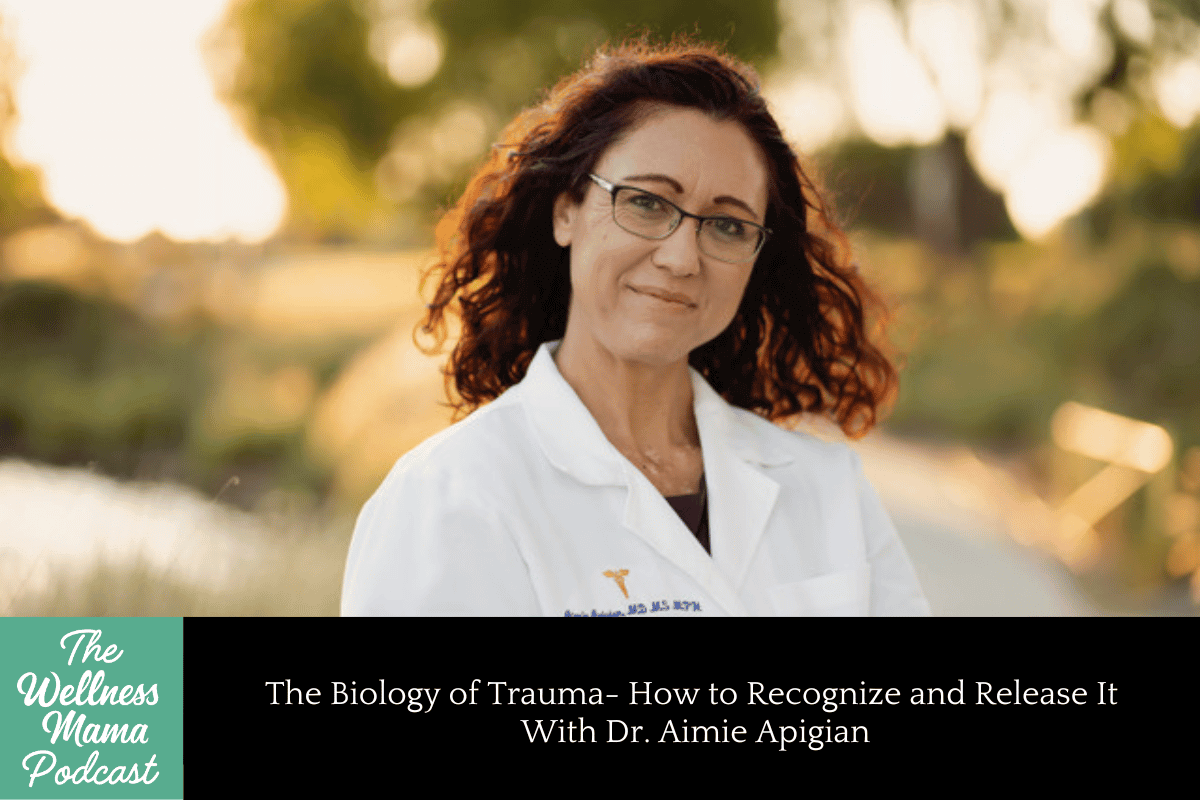
Katie: Hello and welcome to the Wellness Mama Podcast. I’m Katie from wellnessmama.com, and I am here today with my friend Dr. Aimie Apigien, who is amazing. She, I think, we’ll learn a lot from this episode. She’s incredible. And you will see why she’s board certified in preventative and addiction medicine.
She’s the author of the book, the Biology of Trauma, as well as a podcast and a course by the same name. And she bridges science and healing as a double board certified physician with advanced degrees in biochemistry and physical health. And, as founder of the Mind Body Biology Institute, she pioneered the biology of trauma methodology, transforming how we understand the biological impact of trauma and the path to recovery, which we talk a lot about today.
Her approach combines rigorous medical expertise with compassionate insights gained as a foster and adoptive mother, creating a revolutionary framework for healing that addresses mind, body, and biology. Let’s learn from Dr. Aimie. Dr. Aimie, welcome. It is such a pleasure to have you here. Thank you for being here.
Aimie: Oh, thank you Katie. I’m really looking forward to this conversation.
Katie: I am too because I’ve shared my story of how doing some of the inner work and addressing the emotional side of healing actually was one of the most impactful things I did, even for my physical health and how life changing that was. And I feel like your work truly is insight and explanation as to why that was the case so strongly for me and might be so much the case for so many other people as well.
I feel like you connect some really important dots when it comes to this topic and you do it in a way of having so much love and compassion and understanding and walking that path with people. I know I got to read some of your work in research for this episode, and I had heard of you even before that, and especially the idea of the biology of trauma. And I would love for you to kind of, to start off broad, maybe give us a little bit of foundation by what you mean by the biology of trauma and maybe some baseline understanding of the physical connection. Because I think often it can be easy to assume trauma is more of a mental and emotional thing only.
And I feel like your work really shines insight into how this is like, very holistic, and connected to our bodies as well, which to me seems like good news. Because that means we can actually enlist our body in the healing process as well.
Aimie: Well, I feel like you’ve just summarized my whole entire work so well, so, that’s exactly it. Where I actually started this line of study became my research after I foster parented. And I foster parented while I was in medical school. I had just finished my master’s in biochemistry, and all of a sudden I had this 4-year-old who had been through a lot of trauma and I was looking for answers to be able to help him rise above his childhood.
I had no idea that this would completely turn my own life upside down and change my career. And in the process, I realized that my assumptions about trauma were all wrong. My assumptions had been that you change people through love, through stability, and that’s what I did. I gave it my all and it wasn’t working.
I then tried all of the evidence-based therapies and I had access to some of the best child psychiatrists and therapists there on my medical school campus, but that wasn’t working as well, and it really drove me to a place of desperation. Of, I need not just information, like, I need something to do. As a mom, that was what was driving me.
And over time, what I started to notice was that his desperate attempts to push me away, to guard his heart, were ones that I could recognize in myself. Not to the degree that he was acting out on them. I was not destroying property, threatening to kill people. I was not acting out on that level.
But I noticed, wait a second. I think I guard my heart too. I think I’m afraid of opening up and people seeing the real me and not liking the real me. But at the time I didn’t have any time to look at myself because I was very busy with this 4-year-old who had turned my life upside down. But then I started seeing it in my patients and as I would in the wards, on the hospitals and in the clinics, and especially seeing chronic health symptoms, I would hear my patients say things.
And I was like, wait a second. That’s kind of like what Miguel does. That’s kind of something like what Miguel would say or if he were able to be honest what he would say. So I started to see it all in my patients and that’s what started to clue me in, this whole idea of trauma being connected to our physical health is more than just an idea.
It’s more than just a theory. There’s something going on, I don’t understand it yet, but there is clearly a connection. Again, I didn’t have time to lean into that because I was busy with my son and then I was in residency at that point, and it wasn’t until 2014.
And I will say that I went through the hardest thing that I have ever been through. I’m assuming it will be the hardest thing I will ever have to go through. And my body crashed. And all of a sudden, it truly wasn’t all of a sudden, but it felt all of a sudden. I was on two mood medications for anxiety and depression. Being told I had burnout.
I had chronic fatigue. I couldn’t get out of bed one morning because the fatigue had gotten so bad and I just continued to push through until it got that bad. And then labs showed autoimmunity and that was my wake up call. And so here I am as a physician, as an adult, realizing that my body has something going on.
I know from the studies, from the adverse childhood experiences that these are connected to childhood trauma, but I didn’t have trauma. I never would’ve looked at my childhood and said, oh, I have trauma, and so it again opened my eyes to the fact that there’s something that I’m missing about my understanding of trauma.
Because whether or not I understand it logically, my body seems to be storing trauma. My body has a trauma burden. And that burden has become so heavy, it’s broken my physical health. But the question for me, of course, was not just, well, how did this happen? At this point, I’m laying in bed. I can’t even get out of bed to go for a walk to go into work, and so I have to go on another journey, to figure out how to get my life back.
And that was when I started asking the question, given that this is where my body is at, given that I’m already sick, I’m already having a disease burden from trauma, is there any hope for me or is this the rest of my life? I didn’t know the answer. I didn’t know if I could undo and reverse a lot of that.
And that’s what I spent the next several years studying and doing and figuring out. That’s actually how I found functional medicine. That was where I started, and then from there it just progressed into different advanced studies, and then I started doing trauma therapy trainings and as a physician sitting in on all these trainings with these trauma therapists, learning, just learning, learning, learning.
What can I do for myself? Can this actually be undone? The good news, as you’ve already alluded to is that there’s so much that we can do. I am just amazed at the body and what is in our power to do. And that’s what changed my career, is that I no longer was satisfied with my medical career. I was now an addiction medicine physician running a detox clinic and loving my work, but also feeling like there’s more that I could be doing.
There’s more that I could be doing to actually change people’s lives forever. Not just be doing a seven day detox off of alcohol, opiates, or pain pills for them. And that’s what ultimately led me to change what I was doing for work and go to the people directly and say, here’s what you can do for your own health, given that your body does hold trauma, it has this trauma burden, and there are so many things that you can do about it.
Katie: Well, your story really to me is so incredible. In all aspects, much like being a foster parent while in medical school, I can’t even fathom, much less, I mean, you were balancing so many things and seemingly still had this very strong core passion of helping people. Even when you were helping yourself, you were also still focused on helping others.
And I think of that quote of those who can like walk through the fire while carrying a bucket of water to help those still in it as well. That quote just makes me think of you. Especially like you, I tried all the therapies for a long time and I realized I had gotten really good at still guarding my heart while doing all of the therapy check marks, at least for a long time.
Like I knew in talk therapy how to say all the right words and talk to my inner child and do all the things without ever actually getting vulnerable or going to those deep places. And you also mentioned that you also had autoimmunity show up at one point through this. And I find it interesting that autoimmunity affects women in a much larger percentage than it does men.
And even the language around autoimmunity. I’ve shared before how I had to learn how to rewrite my language, but I used to say things like that my body was attacking itself. And I find it so interesting, especially when there’s a trauma history that autoimmunity often shows up. And to me now I view it as a great messenger and insight into what might be going on and what our body might be asking for. But I just feel like you touched on so many incredible points in that one answer, and I would guess many people listening can really resonate with different parts of that. And maybe wondering, okay, if I am aware of trauma or even if I’m not, but something is there or something I’m still guarding or something is off, or I have autoimmunity, what does that path look like?
I know it’s different. For everybody. But I also know that you’ve done this work with now so many thousands of people. Like where might someone begin even in that process of beginning to unguard or beginning to actually go down the road of befriending their body and unraveling this trauma?
Aimie: Yeah. Where do you even start? Because by this time it’s so big. And where to start is a really important question and like you, we can be in therapy for years and still need to sort of start over, still need to go back and do one of the basic foundational skills that people need to have, which is creating inner safety.
And while that sounds so simple, I really resonate with what you said around I could say all the right things, I knew all the information, but I was still guarding my heart. Which means that I still did not feel safe. If I’m having to guard, if I’m vigilant, if I’m on edge, because I’m just waiting for the next shoe to drop, that’s not actually feeling safe.
And I realized in this process that I had never actually truly felt safe inside. I had always felt insecure. I had always felt like failure was just around the corner. And I’d always felt a degree of feeling unlovable. And that I had to perform in order to be worth anything. And this idea, you know, that relationships are then more transactional.
Where if I give you this, if I feel this need for you, well then you must give me love and you must not abandon me. And knowing that that has always been in the background made a lot of sense. For as I came to my new understanding of what exactly is trauma and how does the body hold onto it. Realizing that then the first step, once I’ve identified that, the first step is how do I actually make my body feel safe?
I’ll say this as well, which is. As a, you know, as a high functioning individual who goes to medical school and has a couple master’s degrees, I was a pro at living in my head. What I mean by that was thinking about everything, analyzing everything.
That was my strength. That was my superpower. And what I thought that I could do then, or maybe it was what I’d always done, so I didn’t know anything different yet, was I thought that I would just be able to tell myself that I was safe. And even, you know, there’s mantras for that. You can put little inspirational notes around the house on sticky notes.
You can put a rubber band around your wrist and every time you have a thought that represents fear or insecurity, you can snap yourself and sort of punish yourself. And I thought that I would be able to create inner safety through these mindset approaches working with my brain and my thoughts because that’s the only thing I had ever really known.
And to have to undo that was a big shock for me. And it was also sad for me to realize that as a physician, I had also been the one to tell all of my patients to do those kinds of things. I had sent my patients to talk therapy, been like, you know, you should talk to someone about that.
And realizing that I had given a lot of bad advice over the years with good intentions, but actually set them in the wrong direction.
Assuming that I knew how to actually create inner safety, but that is not how you create inner safety. You actually have to feel the feelings. You actually have to learn how to read these messages from your body that it’s giving us and be able to then know how to respond. A big phrase that’s become popular is this mind body connection.
Sounds cool, but actually what is that? And it’s not going to be enough to just connect your mind to your body, meaning put your mind’s attention on some sensation in your body and connect the two that is not going to be enough. You do need to be able to learn how to listen and understand the messages from your body and respond to those messages for it to have any chance of actually feeling safe moving forward in the world.
Katie: That makes sense and it kind of ties in perfectly to what I was gonna ask you next, which is essentially how do we even begin to recognize these signs of trauma in ourselves? Or I know a lot of people listening are parents and this for you originated with your foster child and wanting to help him.
Like how do we begin to recognize those signs? Especially when I know sometimes they can show up pretty subtly. And sometimes they can be pretty big and easy to notice, but how do we start to learn to listen? And then I would guess from there, how do we then begin to create that feeling of safety in our body?
Because that resonates so deeply with me, what you said of like, I also used to think I could just, mentally will myself into that. And it turns out that doesn’t work at all. But how do we begin to recognize those signs in our bodies?
Aimie: What a great question. I feel like as a physician, this would be one of the most important things that I would want people to know. And we look for patterns. Now granted, this is how I was trained in medical school to look for patterns. And if someone comes in with a right upper quadrant pain in their belly and they’ve got a fever and a high white count, well then this is the pattern of a gallbladder infection.
And so I look for patterns and it’s the same thing with trauma. And this is… iIt really helped me simplify what had seemed very complex and vague is just to realize no, like the body is still the body. These are still principles and trauma can be seen as just another condition and a syndrome that has patterns that we can recognize.
The patterns that we recognize are ones that are based on survival. And as I looked at my life, I could see many ways in which I would do things just to survive. It wasn’t healthy. It certainly wasn’t promoting my best health and my best self, but it was helping me get through. It was helping me get through the day.
It was helping me function. It was helping me survive. So anytime that I realize that I’m doing something to just help me survive, that is trauma showing up. Trauma stored in the body will always trigger survival mechanisms. And so we can look at, well, what are the ways in which we survive? These can be so subtle, as you said, they can be the coping mechanisms that we use.
They can be the sugar and the chocolate that we reach for in the middle of the day when we start to feel a little tired. But we’ve been programmed to feel that it’s not okay to feel tired. We’ve been programmed to think that we have to always be productive, and so I can’t allow myself to rest. I can’t allow myself to relax.
I can’t allow myself to have just a moment of not doing anything but just being. And so when I notice myself engaging in these activities that help me push through and ignore my body’s sensations and messages, then that’s a survival pattern. We also have patterns of disconnection. Disconnection is a big form of how trauma manifests and continues to be stored and held in the body.
What does disconnection mean? Can mean different levels of disconnection. Certainly one level is dissociation, where especially in the middle of a trauma experience, one can dissociate to the degree that sometimes they feel like they’re out of their body and they’re watching what’s happening to them.
They’re that disconnected from their self. But there’s so many other more subtle forms of disconnection. I see this a lot in those who multitask, in those who zone out during conversations or meetings where their mind just drifts. Their mind drifts. And I noticed myself having this pattern quite strongly.
And I, thankfully was able to get curious about it and I started realizing that whenever my mind drifted, it was because something had just been said. That was a truth for my body, and it had hit home in such a way that my body was like, whoa, let’s not feel that. Let’s not actually look at that.
We need to create some distance, and my mind would drift and it would think about a trip, it would think about my to-do list, it would think about anything else other than what was actually being said at that moment. So these are the more subtle ways in which these trauma patterns can show up, especially in the form of disconnection.
There’s others, there’s the dysregulation. So dysregulation can also show up in our physical health and our emotional health. If we talk about the emotional dysregulation, this is where you just kind of fly off the handle relatively quickly, relatively easily. This was one of the hardest things for me as a mom working with Miguel, was I would tell him no, he couldn’t play with his Legos right now because we had to go to the store.
And just that word no was such a trigger for him that he would go into a rage and now it would be several hours of having to hold him ’cause he would be harming me, harming himself. And it was all because I had said, no, we can’t do that right now. So this idea of having a bigger reaction than what the situation actually calls for, that’s dysregulation.
But one of the fascinating things for me is that we can see this in our physical health and rather than an emotional reaction, our body can turn that into a physical reaction. And all of a sudden we are having a rash, we’re having our skin erupt, whether psoriasis or some other form of skin rash. This is a common one.
People have related it sometimes to the stress, but it’s actually not stress. If stress is causing that degree of physical dysregulation, it’s at the degree of trauma for your body. Digestive issues are a really common one. This is because of the vagus nerve. The vagus nerve comes out of our brainstem.
It’s the longest nerve, and so travels down behind our throat, down into our stomach. The tips are in the pelvis, which means that the vagus nerve is so intimately connected with our gut that when we are experiencing a physical dysregulation response, it’s going to show up often in our gut and people can feel maybe nausea or pain.
Some people describe a knot forming in their gut, or people will talk about the knife twisting in their gut. This is all because of the physical changes that are happening in response to something. But those changes then create imbalance. And all of a sudden now we’re not releasing as much stomach acid or we’re not releasing the enzymes, and so we’re not absorbing well, and now we’re gonna develop leaky gut.
Because stress and trauma, both of them, actually impair our lining of our intestinal wall creating leaky gut. And now there’s inflammation. That inflammation travels up our vagus nerve and causes the brain inflammation. So now we have brain fog as well. Brain fog and brain inflammation are actually one of the most intimately connected physical manifestations of a trauma response in the body.
And I’ll end with this where. If we have a trauma response, it causes such a impact on our immune system, the microglia, those immune cells in our brain, that it will create brain inflammation. It’s part of the protective nature of disconnection. Let me just help you zone out so that you don’t really feel what’s happening.
Because it’s so unbearable and unbelievable. But here’s the crazy thing, and this was what really led me to this idea of the biology of trauma, is when we have brain inflammation that’s caused by something else. For me at this point, my microglia have had so many hits that it’s just a few nights of not sleeping well and my microglia get activated or eating something that I have a food sensitivity to, and that again, triggers the microglia.
If I have a trigger of that brain inflammation that has nothing to do with anything emotional, that will still cause a trauma response in my body. And I will feel myself reacting and shutting down and realizing that, oh, like I feel overwhelmed. I’ll kind of usually tend to look to the people in my life like, who’s causing me pain right now?
What are they doing to me when actually has nothing to do with anybody else other than my immune system is having this response and that degree of inflammation, especially in the brain around the neurons that will cause a trauma response. It’s so fascinating to see that to our body, it does not differentiate between emotional trauma, physical trauma, like inflammation, psychological trauma.
It doesn’t differentiate it. Trauma is trauma. There’s one trauma response that the body has, and it does not differentiate between the different types like we tend to do.
Katie: Yeah, that’s so fascinating and I definitely wanna circle back to that and go deeper on, because the great part of that is that the body’s having that one response and that it kind of encompasses the emotional and the physical and the psychological. To me what it seems like is then we can use kind of all of the levers available to us to help that either become from a negative feedback loop to a positive feedback loop if we understand how to fully support the body.
Before we get though there, I wanna also just touch on the idea of generational trauma. Because we haven’t gotten to talk about that yet, and this was a fascinating concept for me to learn, but can you kind of walk us through briefly what generational trauma is and how it gets passed down?
Aimie: This is one of those fascinating topics where, again, I stand back and I’m just amazed at the body. Generational trauma is this idea that ancestors can go through trauma experiences. And it changes their biology to such a degree that it’s passed down. And we haven’t always clearly understood how, but we have definitely seen the effects of it.
Those who have gone through the Holocaust, for example. We can see the ongoing impact psychologically, emotionally in their children. But it wasn’t until Rachel Yehuda really did a fascinating study that showed that actually those children still had changes in their epigenetics. Epigenetics, what does that mean?
Epigenetics refers to changes to our DNA. Trauma changes our DNA. And the way that it does that is through something called oxidative stress. Oxidative stress is a byproduct of our body’s natural activities to stay alive. Oxidative stress is even something that is a byproduct of making energy. And so in our cells, we have mitochondria.
They are the factory houses that make all of our energy. As a byproduct of making energy, they also create oxidative stress. So oxidative stress by itself doesn’t mean anything. But what we wanna look at is, is the body being able to clear it out? Our body does have natural mechanisms to clear out oxidative stress.
Of course it would, because if it’s something that’s naturally made, we would naturally have cleanup mechanisms. But here’s where we start to then talk about, again, the biology of trauma. There are two ways in which that oxidative stress can become so big that it starts to damage and change our DNA in such a way that will be passed on to generations.
One is that the amount of oxidative stress that’s being created is far too much for our cleanup mechanisms to be able to filter. And this is when we are in a experience that is so overwhelming and there’s no return to a sense of safety. If our body holds on to that fear, then it won’t be engaging the cleanup strategies because cleaning up only happens when we feel safe, when it’s time to restore ourselves, when it’s time to rest and recover.
And so as long as our body is stuck in danger mode, the cleanup mechanisms are not going to be as effective. This will then tend to create a buildup of the oxidative stress, and when it builds up, it will go into our nucleus, damage our DNA, and the repair enzymes are not going to be able to keep up with the volume of damage that is being created.
I am sure we’ll swing back to this later, but this is why it is so important to be able to complete our trauma responses and return to a sense of safety. A trauma response is normal. It’s natural. In fact, it’s part of life. There’s no human being that can avoid a trauma response. But what we want to do, and especially what we wanna be teaching our children, is the resilience part of how to complete those responses so that they’re not staying stuck in that danger mode because of the impact that it will have on their body and their physical health.
The other way in which the oxidative stress builds up though and damages our DNA is, as I’ve mentioned, we can have a biology of trauma. And in this case we can have a biology of trauma that predisposes us to trauma’s impact on our body. In this case, I’m referring to genetics. We can have the genetics that are cleanup mechanisms.
Our repair enzymes are not as effective. We can run a 23 and me and see what our genetics are for our oxidative stress repair enzymes, and some of us have snips or those single nucleotide polymorphisms, which means that these mechanisms are not going to be as effective. And so if I am going through life and I have enzymes that aren’t able to work as well, I’m only able to experience so much stress, so much trauma before my body’s like, whoa, this is too much for us, because we’re just not as good as cleaning up as other people perhaps.
And so this is a fascinating topic that as we look at generational trauma, there can be a genetic component in the sense that. We can have genetics that we pass down to our children that make them more predisposed to overwhelm. I’ll give one more example, which is neurotransmitters. Neurotransmitters are the brain chemicals that help us feel and do different things in attachment and bonding.
Serotonin and dopamine are essential for healthy attachment formation. And we can have genetics, for example, I have an undermethylation status. As an undermethylator, oftentimes, not all undermethylators, but many undermethylators, we have lower activity of serotonin and dopamine. What does that mean?
That means that my system, my nervous system, is not as available for attachment and bonding. So we can have had the best mothers in the world who were very good at attuning, but we can have low serotonin and low dopamine. That as a baby, it made us more predisposed to developing an insecure attachment or attachment trauma simply because our nervous system, our own biology, is setting us up for that unavailability because I don’t feel as well, or I don’t get as much joy from connection that dopamine gives us.
So there’s this idea of generational trauma that can be certainly passed down through epigenetic changes, through the oxidative stress and that damage. And there’s this whole world of what imbalances, what deficiencies are we passing down that will also in a sense, create generational trauma because I am setting my child up for having a biology of biochemistry that makes them more predisposed to overwhelm.
I mean, this topic is so huge, Katie, like.
Katie: That was such a good explanation.
Aimie: Just the idea of the in utero experience. And is a mother taking enough folate or is she taking too much folate? Is she being exposed to toxins? And we now know, I don’t know, I’m assuming you saw this study because you see everything, but there was this latest study that came out around microplastics being found in the umbilical cords.
And so our toxic world and environment can be part of the generational trauma that we’re passing down to our kids. Not intentionally, it’s just the environment that we live in.
Katie: Yeah, and as you just explained, so beautifully, like there’s so many factors that come into play into this. And of course especially with trauma, it’s very personalized and very individualized. And I feel like one lesson I’ve gotten to learn very personally these last 10 years especially, and I would guess might feel very true for you as well is I believe the body is infinitely and amazingly capable of healing.
I’ve learned that the body’s always on our side, so even if we’re having symptoms that are uncomfortable, it’s actually the body doing whatever is in our best interest to keep us safe, to protect us, to help us. In fact I got to learn to rewrite that whole, my body is attacking itself, to realize if my body were trying to kill me, it could do it literally in less than a second instantly.
My body’s always on my side. So instead, if I can get curious, what is it trying to tell me? And I feel like this ties in really well with your approach and you really actually help people very practically learn and go through this. And I love how you talk about, kind of that, creating that inner safety and learning to listen to your body.
And what stood out to me and what you just said as well was, completing the trauma response. I think that’s a really important piece that maybe gets overlooked often because trauma responses are uncomfortable and negative emotions aren’t very much fun and we wanna like just resist them and get rid of them as quickly as possible. So I would love to hear more explanation from you on that. And just to share vulnerably my own experience with that. So I had… I was sexually assaulted in high school and I thought I had totally dealt with it. I had really just like shut it down and built walls. And then years later I was actually preparing for a podcast. A guy did somatic rolfing therapy on me.
Didn’t expect that to have any impact whatsoever. And immediately, like I went back into the relive the trauma like all over again, like it felt like a psychedelic experience. No psychedelics were involved. After that I shook, like nervous system shook, for hours. And I realized animals do that naturally if an animal almost gets killed.
When they get to safety, their body immediately processes it and they don’t go walking around with PTSD. I had as a human been able to override that response and instead internally, subconsciously go, I will never feel emotions again. I will never feel helpless again. I will never let myself be hurt again and suppress all that for like a solid over a decade.
While I lived in pure sympathetic nervous system response thinking I was perfectly well adjusted. And it, my body, my body processing that day actually began the healing cycle for me and it showed me, oh this was actually in my body, even though I was ignoring it. So I would love to hear you talk about how do we actually complete the trauma response?
Because I didn’t even know I had suppressed it until it came back. And how can we be aware of that in little ways, in our day and in our kids, so that we can hopefully not create that same thing I did for a decade.
Aimie: It is amazing that the body holds onto this and it holds onto it until we’re ready. And one of the key concepts that I teach those who come to my courses is that we don’t have to be archeologists. We don’t have to go excavating our past and looking for what else needs to be healed. Because when it’s ready, our body will bring it to the surface.
That’s how wise our body is. What does it mean then to complete a trauma response? Because as you’ve just said it, we can complete it years later. We don’t have to do it in the moment. However, the sooner that we can do it, the less impact it has on all aspects of our life and health and body. When we go into a trauma response, that means something very specific.
It means that we felt powerless, alone, and trapped. And trapped in the face of something that felt like it could kill us. And so this comes directly from Steve Porges and the polyvagal theory. Where this trauma response is going to be used by the body. Whenever we feel that we are up against an inescapable life threat. As long as that life threat feels escapable, we will be in the sympathetic mode and working to escape.
But the moment that our body, and by our body, I mean our autonomic nervous system, there’s a specific skill that it has called neuroception, and it is perceiving everything, perceiving the size of the danger and our capacity. So the big concept I share in my book around our capacity and the perception of the size of danger is what makes a trauma response a trauma response.
And so as it is sensing this danger, it will decide when it moves from feeling escapable to the moment that it feels inescapable.
At that moment, our body shuts down in order to protect us. And there’s no amount of willpower or logic that can override that. It is more powerful than even our adrenaline. We can have adrenaline pumping through our blood, but our body has shut down, and that’s communicated through the vagus nerve. So if this is where we’re at, how do we complete that and get back to a sense of safety?
We have to undo all of those three things that we just talked about. You need to no longer feel trapped. You need to no longer feel powerless. You need to feel like you have your power back, your agency, your ability to say, no, I don’t want this. You need to be able to not feel alone. How do we do that?
There’s very scientific aspects that are involved here. If I cannot move, well then I don’t have my power back and I’m still trapped, which is why the movement is really important. And for some that will look like shaking. What is really important is at some point to be able to go back and actually do the self-defense that you would’ve wanted to do.
Do the self-defense movements that you would’ve wanted to do. Even though this is years later and I work with people who are doing this decades later and still we go through the actual movement. So it can’t just be something that you imagine, it needs to be the actual movement. So maybe the movement needs to be pushing someone away. Or, for me, I also had a sexual assault story when I was 12, and there was all of this idea of like the self-defense movement that I would’ve wanted to do included, like biting and clawing and pushing and kicking him away.
So whatever self-defense movements that we could not do because we were trapped, we now need to do. Because that forms a muscle memory in our body that actually creates learned helplessness if we don’t go back and complete it so that anything that reminds our body of that moment, and whether that is a smell, a sound, something that we see or hear, like all of these sensory information is associated in these memories, in these implicit memories in the body.
So anything that feels closely associated with it, and our body is going to be like, oh, we know what that means. That means that this is an inescapable life threat and we should shut down to survive. And it will shut us down, rather than being able to stay engaged and stay curious and move into action to solve the problem.
So we don’t want that learned helplessness to stay, as a memory in our body, which means we need to actually do the movements. This is why talk therapy will only go so far because if it’s not involving the body level and those movements that were blocked that were, we were not able to do to defend ourselves, it won’t reach that level of implicit memory in our body.
But let’s talk about the mind for a moment. Because we have these beliefs that form during these experiences. And these beliefs can be ones of, I’m different, I’m broken, I am now forever flawed. And these beliefs become self-evident truths. They’re not just something that we think, they become a truth for us, which also means that whenever anything hard comes our way, we fall back to those beliefs and say, oh, well I can’t do hard things.
Or maybe we have the belief that everyone is always against me. Or maybe we form the belief that our body is attacking us. And this is the lens through which we see the world. And so that needs to have a reset where we do a form of art narrative therapy. If we’re doing it years later where we rewrite that story, it’s the same story, but now we put it into its context.
Oh, I didn’t do anything wrong. I was just in the wrong place at the wrong time. Oh, I didn’t do anything wrong. They were just high on substances and lost control of themselves. I just happened to be in their way. And we reframe it so that those beliefs can be reset so that they’re the proper context and understanding of the story and not these ongoing beliefs about how we are broken and defective.
But there will be one more way in which we need to reset to safety and complete these trauma responses. And this last way will depend on how soon or how much later we are completing these responses. And that will be looking at the impact of trauma on our biology. Because our body holds on to pain and fear from the past, it will hold that on in the nervous system, which is connected with every other system in our body.
Whether it’s the metabolism, the endocrine system in our hormones, the immune system, the digestive system. It is connected with all of that. So the more time that we have gone holding onto these experiences, the more it will have impacted our biology. And like you say, the body has such an incredible ability to heal itself, and what I started to do was teach my patients some very basic, simple somatic exercises.
Somatic just means body base. So they’re more involving again, movement or touch in such a way that I’m creating a different experience and sensation inside. And that was allowing their body to experience moments of safety, and even just that was changing their biology.
Because as much as I still will need to repair the immune system and let’s look at the digestive system, we may need to take some enzymes, we may need to take some lion’s mane. We may need to do these things. N-acetylcysteine is great for that brain inflammation, and one of the most important things is also to get our nervous system out of that danger mode and back into a sense of safety.
We call this ventral vagal, or parasympathetic or rest and digest. That is the state in which our own body can recover. And if we can shift our nervous system into that state, it will be able to do so much of the work by itself. It’s just not able to do that when it’s still stuck in danger mode, whether that’s the sympathetic anxiety or whether that’s the trauma and shut down.
And so, being able to show my patients, no like, you can, you can shift your nervous system and you can even do it within 60 seconds. And having them do these somatic self practices throughout the day, because I didn’t even want them to depend on me. I wanted them to be able to be in their home, be out in the grocery store, be driving, feel that trigger and be able to do something about it right here, right now.
Shift that nervous system back to a place of safe enough. That by itself started changing their health more than any other medication that I was prescribing. They started experiencing 26% decrease in their daily physical pain. Just after 21 days of doing these somatic self practices, their depression and anxiety went down by 30%.
They started sleeping better. 28% decrease in insomnia issues, digestion. Their system was working better. They had 28% less digestive symptoms, whatever those symptoms were, 28% less just after 21 days of these basic, yes, a certain, very specific sequence of exercises, but it doesn’t take as much for the body to shift back into healing and safety then all the years that it’s taken us to get here, living in in danger mode.
Katie: Yeah, which is definitely encouraging and I think of that idea of, especially when it comes to trauma and the nervous system, it’s not even so much just what happened to us, but actually those beliefs that we adopt based on it, like you talked about that become part of our identity and part of our story long after the event itself is far past. And it like really impacts us so deeply in daily life.
And I love how you talked about like, yes, there’s things we can do to support the body and the brain in this. Like NAC or like for me choline was really helpful because I have a lot of genes that need a lot of choline and I didn’t eat eggs for a solid decade. Or whatever those things are, those are great switches.
But for me, for a long time, those were the only ones I looked at and I was doing all of the supplements and all of the biohacks and all of the things I could possibly think of to support my body. And it wasn’t until I did these pieces that you’re talking about and the nervous system work and felt the emotions and made peace with my body and my emotions and my mind that actually anything started to actually heal.
And that was when all the physical things also shifted for me without changing any of those physical levers I was pulling. And I know this is really truly like your passion and your life’s work and that you have so many resources for people in all of these things that we’ve talked about in this podcast today.
And of course I will link to all of them in the show notes. But can you briefly give us some starting points for someone who might want to begin to do this work and to make friends with their body and their nervous system from all the resources you have available in front of you guys listening on the go, they will all be linked in the show notes as well.
Aimie: One of the most comprehensive resources that they can grab is my book. So my book is coming out for those who know Gaber Mate, he wrote the forward, and so this is this manual for the nervous system of understanding, how does the body experience trauma? What does our definition of trauma need to be?
And then why does it hold on? And then what does it need to heal? So it’s broken up into those three sections. And we’ll walk people through these concepts and help them see how much of a trauma burden their body’s holding. But be able to move into a solution and say, here is practically what we need to do.
Because as you’ve said, like we need to do all the levels. We need to do the minds level and the beliefs. We need to do the body level and these somatic movements and self-defense movements. But we also need to do the biology. If we miss one of those pieces, we’re not gonna be able to experience the healing that is possible for each of us.
I also have a few guides on my website, biologyoftrauma.com for those who wanna check that out, and I now run a 21 day journey for those who wanna take that with me. And happy to provide you that link, Katie, for people to be able to check out the 21 day journey and these specific sequence of somatic self practices that I taught my patience and now bring to the world.
Katie: Amazing. Well, like I said, all those links will be in the show notes. I know that you have a tremendous number of resources available, including your book, including your podcast. You have so much out there. I’ll make sure those are all linked. I also know how busy you are. Dr. Aimie, thank you so much for the time and for all that you’ve shared today.
This has been truly phenomenal and I know very helpful to many people, so thank you.
Aimie: Thank you for the work that you do, Katie.
Katie: And thank you as always for listening and for sharing your most valuable resources, your time, your energy, and your attention with us today. We’re both so grateful that you did, and I hope that you’ll join me again on the next episode of The Wellness Mama Podcast.





Leave a Reply