Read Transcript
Child: Welcome to my Mommy’s podcast.
This episode is sponsored by BON CHARGE, and specifically one of my favorite things that they have, which is their PEMF mini mat. If you are new to PEMF, this stands for pulsed electromagnetic field, which is magnetic energy that’s being sent into the body via this mat. And these energy waves are fascinating.
They work with your body’s natural magnetic field to elevate your wellbeing in a multitude of ways. Similar effect that we would have from being in direct contact with the earth, which I also think is an amazing thing to do daily. I love PEMF mats to improve sleep, to ground me, to increase calmness.
I often say that sitting on one of these mats, I feel like a cat in the sunshine and just, like, so calm and cozy. Some of the reasons I personally like this particular mini mat, it is small enough to fit in any room, and it’s easy to move from room to room. I also have a larger one, but that one is more difficult to move around.
There are different settings, so you can find what works best for you, and it’s low EMF. Some of these are not. I feel like this is an important thing to pay attention to. Some easy ways that you can use a mini mat like this: it’s great on an office chair or on a sofa or on the floor, wherever you are sitting and reading, meditating, working, et cetera.
I love to use it before bedtime or after a workout or I’m actually doing yoga teacher training. I’ll often use it during restorative classes or when you need kind of like a creative boost or a brain reset. And like I said, I love how portable this one is. You can find out more about it and get a discount by using the code wellnessmama at wellnessmama.com/go/boncharge
Today’s episode is brought to you by LMNT, which is my go-to electrolyte drink for staying hydrated and feeling my best every day. I have used this for years, and unlike many sports drinks which are loaded with sugar, LMNT delivers a science-backed blend of electrolytes with the sodium your body actually needs, especially if, like me, you live in a hot climate, sauna regularly, or work out regularly.
Whether you are working out, walking the dog, traveling, or simply trying to keep your minerals and your energy levels up, LMNT makes this simple and delicious. I keep their canned ones in my fridge all the time now, and their convenient salt packets are perfect for tossing in your purse, your gym bag, or your carry-on, so you are never without electrolytes when you need them.
My kids are also a huge fan, especially of their new pink lemonade. What I especially love about LMNT that they have so many flavors now, so it’s easier to drink throughout the day. If mixing isn’t your thing, they also now have what I love, their new sparkling canned beverages that give you the same electrolyte benefits but in a ready-to-drink format. And those are a favorite among people who visit my wellness center as well. Adding LMNT to your daily routine is one of the easiest ways to support hydration and help your body perform at its best. I also find very helpful if you’re a breastfeeding mom.
So if you’re looking for a simple upgrade to your wellness routine, give LMNT a try and experience it for yourself. They have some delicious new flavors like lemonade iced tea and pink lemonade, and they always have their happiness guarantee. Go to drinklmnt.com/wellnessmama for a special offer.
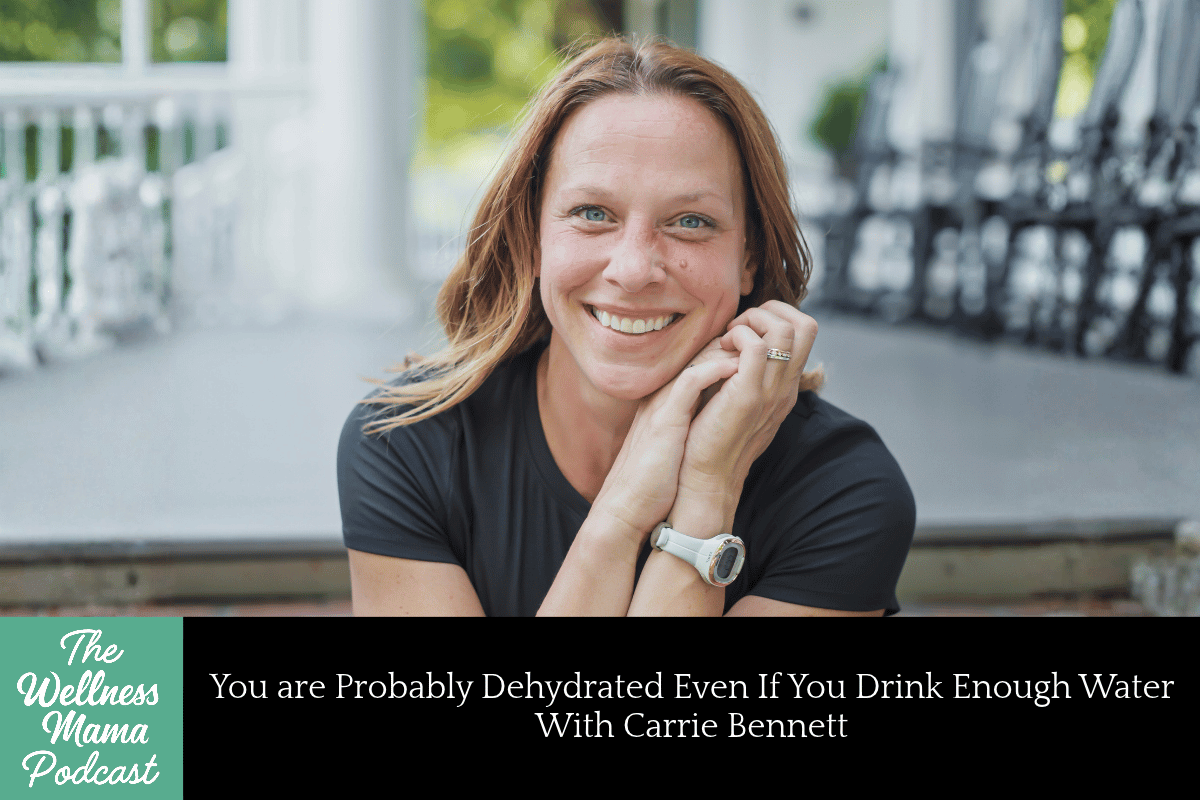
Katie: Hello, and welcome to the Wellness Mama podcast. I am Katie from wellnessmama.com, and I am back with Carrie Bennett. We had an amazing first episode about the healing effects of winter, and if that sounds wild to you, check out that episode.
I learned a lot, and I have seen the benefits of doing some of these things myself, and I’m excited to implement more this year. In today’s conversation, I am equally excited to jump into the topic of hydration because I think there are, are a lot of myths circulating about what hydration even actually is and how to accomplish it, and I know that you bring so much insight to this topic. So Carrie, welcome back and thank you for being here again.
Carrie: Thanks for having me, Katie. Yeah, this is like a passion of mine. I love all things water and hydration, so I’m thrilled to be here.
Katie: Well, I’m so excited to jump into this because I would guess most people listening, if you’re human on this planet, you know that hydration is important. And we’ve seen all the social media challenges of drinking a gallon a day and all these things circulate and how that’s supposed to help keep us from aging and fix everything else going on with us.
And from reading your work before, I know there’s more to this story than we sometimes see in those social media memes. So to start with, can you walk us through what true hydration actually is and why it’s about more than just water?
Carrie: Absolutely. So true hydration, we have to look at it, we have to ask where are we looking to be hydrated? Well, certainly we need to be hydrated inside of the cells. And I think it shocks people to realize that the vast majority of the hydration that happens inside of our cells isn’t because of the water we drink. It’s because the mitochondria inside of our cells make water for us, and we’re gonna talk all about that if you want to, to dive into.
Because I think the vas- again, a misnomer is, “Oh, my mitochondria are important because they make ATP.” And that’s, that’s what I learned throughout all my schooling. It’s like, “Mitochondria make, make energy for our cells in the form of ATP. Oh yeah, and by the way, they make a byproducts called water.” And that byproduct I think is far more i- important than we realize.
So we talk about how can we optimize mitochondrial water production and what might be harming it in the first place. We also have to ask about the hydration that’s happening both, in the blood. Okay, so the blood has to maintain a, an appropriate hydration level. If it doesn’t, then the blood, the body’ll start to turn on a drought management program that’s, that, raises histamine.
And so literally the body says, “Okay, what’s essential? Okay, that muscle’s not essential to hydrate, that’s not essential to hydrate.” So it’ll close off capillaries in certain areas so that it drives water to, say, the brain. And, and like basically the, the more quote unquote vital organs. Well, we talk all the time, like histamine issues, his- MCAS, histamine intolerance, it is huge.
I see it all the time, and no one is tying it to the fact that we are, are potentially chronically unintentional, unintentionally dehydrated, and I see it all the time. So we have to ask then how do we hydrate our blood? And believe it or not, blood is not just water. So water is not the best way to hydrate our blood, and that’s where I think those challenges of drinking a gallon of water, they fall short.
Yes, we are water. Our body is 99.9% water if we were to count it by molecules. So 99 molecules in my body would be water, one molecule would be something else. That is true. But in my blood, it’s actually much more like the ocean. So we have to talk about kinda how to, how to hydrate the blood. And then we have to talk about what’s happening in the interstitial space, the space around the cells, right?
Because hydration there can get very stagnant. That’s where we can even talk about things like, how do we support flow and movement through the lymphatic system so that hydration can, can, can go from the capillaries, hydration leaks out of the capillaries- And bathes that space around the cell. And that’s super important because that’s where we are moving waste.
We’re diffusing nutrients into the cell, you know, waste out. We’re hoping to process that. Our immune system can become really reactive and inflamed if stuff gets stuck in the interstitial space because it doesn’t flow appropriately. And so that is a more complete picture of hydration in my opinion.
It has nothing to do with, you know, drinking X amount of ounces of water based on your body weight or a gallon of water a day. It’s much more comprehensive than that.
Katie: Yeah, this topic is fascinating to me, and especially because I feel like it ties in the light piece from our past episode as well as the movement piece, which we didn’t even get to talk about in our episode about the benefits of winter.
But I would guess to just double click on what you said, most people probably have that still drilled in their head from high school biology. Mitochondria are the powerhouse of the cell, and I have been fascinated as I’ve learned it’s so much more than that. In fact, like, that’s almost like a minor thing compared to all the other-
Carrie: Yes
Katie: …things it does or at least one of the cascade. But you mentioned histamine, and I hear from a lot of people who have this. It seems like this is something that’s on the rise. So I would love to hear more from your clinical experience what happens when people figure this piece out, and are they able to, like, see improvement with their histamine issues since this is seemingly so popular, especially in women right now?
Carrie: Yes. Hands down, yes. I had my own experience with this, that I love to start with, lead off with. I feel like I’m very good at staying hydrated. How- and I never have allergies, right? No seasonal allergies, never had them. Even in spite of the fact that there could be pollen that’s just thick on the car and the kids are, like, drawing pictures in it, right?
It’s, it’s that thick. I still don’t get allergies. Well, a couple years ago, I left to give a talk on this topic, on, on intracellular hydration over in San Diego. To get there, it was a whirlwind, right? Take the kids to my in-laws. Like, you know, hop on this flight, that flight, that flight. Get there, stay a night, hop back, boom, boom, boom.
So over the course of that two-day period of time, I was on six different flights to basically get where we everyone needed to go. And when we left, there was a really thick pollen on the car and, and I was not experiencing allergies. When I got back, my eyes started watering, and I started sneezing like crazy, postnasal drip.
And I thought to myself, “I just dehydrated myself.” And so, clearly, all that air travel was highly dehydrating for my body, and potentially the time zone, zone shift was you know, basic- harming my mitochondria temporarily as well. And so I came home, and I thought, “Let me see if I can, you know, basically put my money where my mouth is and take care of this from my, my strategies.”
And I started to hydrate my blood first because I know that blood hydration is critical when it comes to decreasing that histamine burden in the body. And as I alluded to before, our blood is not pure water. It actually is very much like diluted ocean water. So I started taking Quinton Isotonic, which is diluted ocean water, basically, that’s a- an exact ratio for the blood, and I started taking it in increasing quantities and also adding soleil to my water. Little drops of basically concentrated saltwater into my glasses of water and then drinking approximately, making sure I was getting about two to two and a half liters of water.
Over the course of four days, my allergies went away completely, right? From, like, sneezing every 20 minutes to nothing, and they’ve never come back. And so that’s my experience with it. But I’ve also had people hear me on podcasts or people in my community try these strategies of increasing, ocean-based minerals to hydrate the blood, and I’ve had people email me that they’ve had lifelong psoriasis or lifelong eczema or, some very debilitating POTS, which can also have an, histamine component to it as well, and it goes away, when you’re appropriately hydrating your blood.
And like I said, that’s water and that’s ocean-based minerals. Turns out that the areas in our body that flow the liquid water in our bodies are diluted ocean water. It’s very much of, exact mineral ratio as diluted ocean water. So that’s the blood, the cerebrospinal fluid, the fluid around our cells, and the amniotic fluid as well.
Whereas the cells themselves, I call them our, internal earth, our internal earth land masses. What they require are very much more so like the soil-based mineral support. The fulvic minerals, things like that, have an affinity for the cell. So when I started to teach people how to take care of their body from an ocean-based perspective and an earth-based perspective, those earth-based minerals go into the cell and help…
The minerals inside of the cell, they help hold hydration. So mitochondria make the water. The water can stay put if we have adequate intracellular minerals. Did I even answer your question?
Katie: Yeah, absolutely, and I think this brings such important nuance to the topic ’cause also we see those debates of, like, what type of minerals are best.
And from reading your work, it seems like it’s actually, like, a both/and, and that across the board many people are not getting enough in general across the board. And I know magnesium can also fall under this category as well. And so I’d love to hear you talk about magnesium a little bit because that one I feel like people have heard of, but they might still not be really optimizing.
Carrie: Yes. I love magnesium in a couple of different ways. Magnesium’s really important, for a lot of different reasons. It can act both intra and extracellular- extracellularly. And m- our, I think our soils are just mineral depleted in general. So that’s why I like to try to find liquid-based delivery systems to get minerals in.
The ocean-based and earth-based, those are broad-spectrright? We’re talking 70 to 90 different minerals and trace minerals, whereas magnesium is obviously just a mineral. But I do think it’s highly needed, and it’s harder to get it in in a large amounts, let’s say even in supplemental form, because we have a bowel tolerance for magnesium. Meaning if we take too much in a given, at a given period, our, we’re gonna flush.
We’re gonna get loose stools, right, diarrhea. And so I like a more comprehensive pers- intake when it comes to magnesium. I – get it from food if you can. I also like a specific magnesium called magnesium bicarbonate, which you can get from companies like Mitigate Stress or Crucial4. You can make your own magnesium bicarbonate.
It’s basically magnesium and bicarbonate dissolved in water. That is beautiful because the magnesium and bicarbonate work together to actually, bicarbonate helps to pull the magnesium into the cell. Magnesium helps to pull bicarbonate to the tissues, where they really act as a buffer. Bicarbonate acts as a buffer for acid and metabolic waste in that interstitial space.
So that’s a beautiful way to get magnesium where it needs. And then I love transdermal magnesium. I think absorbing it through the skin is a powerful way to build our magnesium stores in the body with- without the side effect of loose stools. So you can do Epsom salt baths. We can do, like miner- like magnesium chloride sprays.
You can do magnesium lotions, things like that. And that gives our body a more well-rounded way to receive magnesium and then hold it appropriately.
Katie: I love that. And I would love to go deeper on specifically related to hydration, the light and the movement piece, ’cause you touched on those a little bit, and I had a, another recent guest who explained that, like, if we’re not getting enough light exposure from natural light, it’s kind of like think of our phone not getting enough actual charging from being plugged in, and we- then we’re just trying to add more, like, apps and add more cases and add more things to make it better.
But we’re operating in, like, low power mode, which felt so true for I think a lot of people who listened to that one. And so I would love to talk about the light and the movement pieces of how do we optimally hydrate, ’cause I would guess most people don’t have those completely dialed in.
Carrie: Yeah, this is a great, these, these are great strategies I think that people are surprised about, but it, easy to implement once we know, right?
So this goes back to what’s happening with the water being produced inside of the mitochondria. Those mitochondria, in order… So little mini science lesson. Mitochondria take what are called electrons and basically funnel them through various steps, and at the fourth step, water is made, and water actually can only be made if we are able to send oxygen to the cells as well.
So I tie in dysfunctional breathing mechanics as a hydration strategy as well. Breathing through the mouth, we lose more hydration, and breathing through the mouth we don’t build up carbon dioxide enough to get that oxygen into the tissues. So that’s just a side note on that. But that being said, at step four in the mitochondria, we make water.
But in order for that step to be optimized, it requires red and near infrared light exposure, meaning that actually make the, the, that step literally, it’s a protein that literally absorbs light, and when it has the correct light absorbed, it allows water to be made at a, at a highly effective rate. If, if, if there’s no red and near infrared and instead there’s blue light, blue light inhibits that water production.
So you can imagine what modern lighting is doing to the, that step of the mitochondria in terms of its ability to, to be functioning as a highly efficient intracellular hydrators for us. We’re around blue light all the time. We have no red or near infrared indoors or it’s very, very lacking. So that is the creating a recipe for intracellular dehydration.
You add onto that that non-native EMFs can also be dehydrating both by creating mitochondrial dysfunction and are just inherently vibrating our water molecules in, in a way that’s also dehydrating our physical bodies. And we’ve all experienced, like I said, being at altitude when flying and in high non-native EMF environments in an airplane.
That’s very, very dehydrating of the body. But we’re just around it all the time, and it, it is what it is, but we, i- if we know better, we can do better. And so how do we support this? Well, I love to give my body bouts of red and near infrared light all day long. In fact, there was, there have been studies that have shown that if you pre-treat someone both full body or just via their eyes with red and near infrared light in the morning, their mitochondria are more efficient all day long in spite of being in a heavy blue-lit environment, a blue dominant LED environment.
So it just means that our mitochondria, we need those signals. So I say in the morning, s- you know, before sunrise, you know, can, can you get a little red light therapy or, you know, there’s these heat bulbs that you can get at, like you would heat up a chicken coop. I usually have them on, I, not typically during podcasts, but I usually have it on just as ambient light that is basically coming into my, into my room to have that red and near infrared light in my office space.
What about going outside throughout the day and getting that red and near infrared light again through the eyes and on the skin that you can expose? That- allows your mitochondria to be more optimized in terms of providing, high quality intracellular hydration. Any follow-ups on that? And then, or then we can talk about the movement piece.
Katie: I think that was great. I’ll… I know you have guides on a lot of these things we’re talking about, so I’ll make sure those are linked in the show notes. But let’s talk movement now, ’cause I feel like this is one s- statistically Americans especially are not great at optimizing currently.
Carrie: Yeah. So there’s a couple parts of movement.
Let me go back to that intracellular hydration, that water. Why is it so important to be i- intracellularly hydrated? Well, that water inside of the cell actually holds electricity for us. It holds a negative charge. This is Jerry Pollack’s work. So if anyone’s interested, read the book The Fourth Phase of Water.
He goes into a ton of detail on this. But we now know that, that, that water that stores charge for us, the cell has a certain capacity that it needs to keep, and if we’ve got plenty of that s- exclusion zone water, w- that, that easy water, that structured water inside of the cell, then that cell can run all of its programs.
It’s got 100,000 tasks it has to run at any given moment, and it’s got enough energy, electrical energy, to do so. What research has shown is is as you start to drain that water, you start to have less and less of that structured water inside of the cell. It’s like a cell phone battery draining to a critical threshold, where instead of being able to run all of its operations, it, like, the, the background screen’ll go dark, and you cannot download anything.
You can’t, you know, watch that video. You can’t use a flash on your camera. It’s just literally an energy conservation mode. That happens inside of our cells. And so picture that, that, that, that analogy, right, of our cells draining of that, that electrical water, that structured water. Critical threshold is reached, cell goes into survival mode.
Drain it even further, believe it or not, that you drain that, that, that charge out of the cell, d- to be de- depleted enough, the cell gets the signal to divide uncontrollably. What do we call that? Well, that can be cancer. That can be tumors. And so this is critically important to understand.
It’s not just about having that water in the, with the mitochondria making it, but holding that charge. And I said the minerals help hold that charge, that water inside, but so does infrared light, specifically heat-based sources, Katie, of infrared light, which will, will help that to stay full, to help the body hold that structure.
So again, I’ll talk about exercise and movement, but I think a part of the movement piece that we don’t think of is that when we move our body, we generate two things. It, and it’s not about burning calories. We generate heat in our body, and that heat is internal infrared that can keep that water battery inside of our cells structured and completely charged, and our muscles and connective tissue have a very cool property about them.
It’s called piezoelectricity. It’s a fancy way of saying that when our muscles and connective tissue move, we generate our own electricity, and that electricity can then funnel into where our body holds it, such as our cellular environment, and store that electricity. So- Again, hydration is so much more than I ever imagined.
But, but being sedentary, I think, it’s inherently dehydrating us because it’s, I mean, the, the low-hanging fruit is we’re not moving our lymph. We are, you know, creating maybe tension in our fascia, and so we’re getting blocks in fluid flow throughout our fascial system and throughout our, our lymphatic system.
But then we’re not generating infrared, so we’re la- we’re lacking that structured water inside of the cell or we’re not supporting it, and we’re not generating that piezoelectric current that can also support that intracellular hydration and charge
Katie: Yeah, that’s so fascinating. I feel like fascia could be its own whole, like, series of podcasts and its electrical nature that I feel like we’re only beginning to understand.
I’d love to talk on the practical side now. If someone is realizing from hearing this, like, “Oh, I have not been doing a lot of these things optimally,” what would be some practical steps or, like, a sample day if someone was like, “Okay, I’m gonna really prioritize hydrating my cells properly, what do I do?”
Carrie: Okay, this is great. So, you know, piggybacking on what, if you wanted to listen to the previous conversation or probably what you’ve talked about before Katie, right, is blocking artificial light at night and during, before sunrise, but also during the day. If you are under blue dominant light, give yourself regular exposures to infrared.
It might be as simple as getting a little incandescent bulb and setting it next to your desk so that infrared from the incandescent bulb, in the lamp is allowing you to have some of that exposure. So getting that infrared exposure and minimizing the blue, step one. Mitigating EMFs. So like as soon as I started to realize that EMFs are, are potentially dehydrating me, I control what I can control without flipping into full on like nervous system dysregulation, right?
So what can I control? I can control always having my cellphone at an arm’s length away. I can control hardwiring my workstation, you know, m- because I work from home. I can control not driving an electric vehicle, right? I can control, unplugging things. I can control not using a microwave. I mean, there’s a lot of things that I can control in my environment.
The main ones being keeping the wireless radiation down to a minimum in places where I extend, spend an extended amount of time. Which for me, workstation, in the car, and at night in the bedroom. So unplugging my Wi-Fi router, again, phone on airplane mode or at a f- a far distance if I, if I need, if I know a loved one might need to call me in the middle of the night.
And then with the actual hydration, I always tell people to wake up and start your day with ocean-based minerals. So that means something like you, you… There’s pre-made brands like Aussie Trace Minerals, for example, is a brand. But you can wake up and, start your day off with maybe 10, 12, 16 ounces of water, and then a good teaspoon to a tablespoon of those concentrated minerals.
It’s also called Soleil Minerals to add into the water. So that off the bat, that type of hydration with ocean-based minerals is automatically nourishing and hydrating to my blood. So now if I built up any sort of dehydration because I was a mouth breather at night or, you know, I just didn’t have good sleep or I’m stressed and, and I wake up in a dehydrated state, then all of a sudden I am, hydrating that pathway to lower the histamine burden in my body.
So that pathway is flowing. Now my capillaries are able to take the other water that I drink throughout the day and then start to bathe that interstitial fluid. Some of it will get into the interior of the cell as well, but a- remember, a lot of that cellular, hydration is about mitochondrial function and their exposure to near-infrared light, red and near-infrared light.
And then like I said, I take frequent movement breaks throughout the day. So I’ve had clients who do beautifully with s- a simple 55 and five strategy. They set a timer for 55 minutes. At that mark- at that 55-minute mark, so they’re working, working, working, they literally just move for five minutes. I tell them to go outside if you can, take a little walk around the building or walk around the block, come back- And work again.
And those little bouts of natural light exposure and movement make a big difference. Lastly, in terms of infrared, because as I said, that infrared really keeps that fourth phase of water, that electrically charged structured water in the s- in the cell, it keeps it to its vital state. Then adding in infrared exposures that we feel as heat throughout the day.
In the summer, it might just be going outside and bathing a little bit in the sun. Winter, it might be a hot shower, a sauna, a bath. It might be a foot soak. It might just be cuddling with… Like, you know, really cuddling with our kids and our family. It might be exercising until we feel, feel more heat. But recognizing infrared as a key input to the whole totality of the hydration strategy and utilizing it throughout our day and throughout the week, especially in the winter when we tend towards being colder and more deficient in infrared in modern living, I think is a very key strategy.
Katie: I love it. And like I said, I know you have a, a guide on this as well, so that’ll be linked in the show notes for any of you guys listening on the go. And in our last couple minutes, I would love to just kind of like rapid fire get your take on a few more topics that I would love to become whole episodes in the future.
The first one-
Carrie: Okay
Katie: … being you touched on EMFs, but what are kind of the key points to understand about EMFs? I know there’s like a, a spectrum of people, of camps on this, of people who avoid it completely to people who think it’s no big deal. I tend to be more in the range of like control what we can, don’t stress about what we can’t.
But I would love your approach and what do you think are the biggest factors to pay attention to?
Carrie: Yes. So I’m of that camp, control what I can, but recognize that they can be impactful. So I control what I put on my physical body, so I no longer wear a smartwatch. I no longer, like I said, put my phone on my physical body whenever possible.
If I’m on a walk and it’s a possibility, I download a podcast or download some songs and then put my phone on airplane mode as I’m going. So controlling what’s on my physical body. With EMFs, distance are your friend. So any time you can create distance between you and the source of EMF, the EMF, the EMF readout g- goes drastically less and less.
It means if your Wi-Fi router is located right next to your desk, maybe it’s worth it for you to get someone to wire it to another portion of the house, or if it’s in your bedroom, to put it somewhere as far away as possible. So control what you can control, but what’s on your physical body matters, what distance you have, and the duration of the exposure are all things that matter.
People used to freak out about the fact that they would have an EMF meter, and as they were blending up their shake in the morning, the, the EMF meter was off the charts with an insanely high exposure. And that, yes, that was a very high exposure. But they were blending for 20 seconds. So that was not gonna make or break their EMF exposure, and instead what would make the- make or break possibly their EMF exposure throughout the course of their day, their week, the rest of their life, is the fact that they always had one AirPod in an ear, and that’s how they were listening to things.
And so that right there, yeah, the EMF output’s not gonna be as high as a blender per se, but at the same time, the duration of having that in all day long mattered much more. So I, I mean, I love to kind of hone in on where it matters most in our lives.
Katie: I love this. Also another one that I s- I wanna put a bookmark in to do more– a whole episode on in the future is the topic of leptin.
I’ve talked about this a little bit. I feel like this is often misunderstood. It’s not commonly tested for, and it’s one that I found mine was very, very low when I first-
Carrie: Yes
Katie: … started looking at it. So tell us about leptin.
Carrie: So leptin is a hormone that is produced in our body fat, and it, it downloads information into our brain.
So the leptin, essentially the amount of leptin circulating in our blood sends a signal to our brain about how much energy we have stored in our bodies, and then based on that download, which happens at night when we’re sleeping, is the main download. It also happens between meals, but if we’re constantly snacking all day long, it’s more difficult for that leptin signal to get heard.
So if we’ve got that leptin download in the brain, the brain says, “Okay, Carrie’s got this much stored body fat. Let’s make her hungry like this n- tomorrow, and let’s then…” Say that she does have, like, you know, she’s not in a state of famine, we can pull body fat from storage at night when we are sleeping and run our repair programs.
Without that regular signal or if that leptin signal is, is out, quote, unquote, “out of range,” meaning if it’s low or even if it’s high, the brain assumes we are in a threat mode, a starvation mode, and it starts to pull back and conserve. It’s like a broken, gas gauge, right? It’s like, oh yeah, I, you know, let’s not necessarily, like, burn fuel, like, at a high rate, and in fact, let’s give Carrie the signal to eat more frequently or to st- store fat more easily because we just aren’t pr- we’re- we don’t know when she’s gonna run out of gas.
So we need to just make sure we kind of go into that conservation mode. I see low leptin a ton these days, because I think that there’s also a component of stress and, and trauma and nervous system dysregulation and things like that that can really come into play and drive that signal lower because the body does feel like it’s in a more threatened or scarce state.
Katie: And then lastly, another one that could be its own whole book and series of podcast episodes is the topic of hydrogen, which I also have not talked about much here, so maybe we can do a future episode. But can you just rapid fire give us some highlights?
Carrie: Yeah, so I mean, hydrogen’s an atom, right? But when we talk about hydre- hydrogen and its use therapeutically in the body, we’re talking about a specific type of hydrogen.
It’s actually two hydrogen atoms stuck together, and when two hydro- hydrogen atoms stick together, they form a gas, and it’s called molecular hydrogen. And it turns out the body uses m- We can generate our own molecular hydrogen inside of our body. Our gut microbiome can generate it. We can make it on our skin.
When l- a light strikes the melanin in our skin, we can actually start to generate our own molecular hydrogen. And this hydrogen we now know is highly therapeutic in terms of it supports mitochondrial function. It also acts as something called a selective antioxidant, meaning if there is an aggressive inflammatory cascade going on anywhere in our body, it will calm it to an appropriate threshold.
We never wanna fully suppress the inflammatory signal because the inflammatory signal is a signal that the body still needs to tend to, to repair, to rebuild, to do something. But we bring it to a manageable threshold so that we can repair and still get that signal without cr- creating a lot of aggressive continual damage that we’ll also then need to repair.
So hydrogen is a really cool one that I’ve used clinically a lot. You can get it. You can, inhale molecular hydrogen. You can drink hydrogen-rich water. You can consume tablets that generate hydrogen in your gut. I’ve seen people use hydrogen gas over their eyes, and literally there was a story of a young man who did that.
He had an, injured eye from, from an accident that he was blinded. Then he started seeing again. I’ve had, I’ve had people use goggles, which sounds so weird, to pump hydrogen into their brain, and it’s shut down. It’s completely stopped seizures. So it’s a really fun one to talk about.
Katie: I love this. Well, hopefully much more learning to come. I learned so much in both of our episodes together. I really respect your work, and I’m so glad we finally got to chat. Thank you so much for everything you shared. Where can people find you if they wanna keep learning from you, and I’m sure many people do.
Oh, thanks for having me. This was so much fun. Yes, so carriebwellness.com is my website.
So you can see, like Katie was saying, I’ve got protocols and things like that there. I have a private community. I run a couple of, yearly, like, transformation cohorts to really implement this stuff as a lifestyle. My teaching hubs are on Instagram @carriebwellness and on YouTube at Carie B Wellness as well, where I just let put out fun stuff because I think this message needs to get spread far and wide.
Katie: Amazing. Thank you so much, and I hope we get to chat more in the future. Thanks for being here.
Carrie: Yeah. Absolutely. I’m excited. Thank you.
Katie: And thank you for listening, and I hope you will join me again on the next episode of the Wellness Mama podcast.




Leave a Reply