Read Transcript
Child: Welcome to my Mommy’s podcast.
Katie: This episode is brought to you by Hiya Health, which I have a now extended and renewed interest in, especially with having a baby around who will be starting solid foods pretty soon. Because here’s something that’s kept me up at night as a parent, and I’ve talked about before. Our kids are the first generation growing up on not just ultra-processed foods, but foods that don’t have the same nutrient content that they used to due to soil changes and so many other factors.
In fact, we’re just beginning to understand the extent of this problem. And this is why Hiya exists and why I’m glad that they do, which is to give parents a real solution in a market that is flooded with kids’ vitamins that are actually contributing to the ultra-processed foods. They have candy-like appeal, but not actual nutrition.
In fact, some children’s vitamins on the market contain up to seven grams of sugar per serving and are stuffed with additives and petroleum-based dyes that I go to great lengths to avoid in my kids’ diet. So Hiya took the opposite approach with zero sugar, zero gummy additives, just clean nutrition. And the great part is kids actually love them.
My younger kids are a huge fan. I have tried them, and the flavor is actually great, although obviously I don’t take them daily. But what makes them different is how thoughtfully they are designed, formulated to meet very specific nutritional gaps that modern kids face. And they worked alongside pediatrician and nutrition specialists to make a chewable multivitamin that packs a blend of twelve organic fruits and vegetables and fills the common nutrient gaps that kids face.
They’re also non-GMO, vegan, dairy-free, allergy-free, gelatin-free, nut-free. They really have thought of everything to make these ideal for kids. And they are NSF certified and receive Clean Label Project’s Highest Purity Award. So when it comes to something I feel safe giving my kids, they are definitely on the list.
It’s designed for kids two and up. They ship straight to your door. And I love that they send you a reusable bottle and stickers with your first order. So this helps you keep up with the refills, and they send refills every month as well. I am a big fan of these as well. And Hiya just launched something new.
If your kids are active and growing, you can add a clean protein powder with minerals designed just for kids to be exactly what they need. Their new Kids Daily Growth Plus Protein is a game-changer. It’s more than a protein shake. It’s a purity awarded clean protein powder with added minerals and healthy fats that can mix right into water or smoothies and support muscle development and cognition and fuel everything else they’ve got going on.
So, we worked out a special deal with Hiya. You can receive 50% off your first order on any of their products. To claim this deal, you must go to hiyahealth.com/wellnessmama. This deal is not available on their regular website. So again, that’s H-I-Y-A-H-E-A-L-T-H.com/wellnessmama, and get your kids the full body support they deserve.
This podcast is brought to you by BIOptimizers and their Magnesium Breakthrough product. Our bodies need seven different types of magnesium. Each one has its own unique purpose. One form helps muscles recover, another supports heart rhythm. A third supports the nervous system and so on.
Most supplements, even the high quality, expensive ones only contain one to two forms at best, and that’s like trying to build a house with just a hammer and a screwdriver. You need the complete toolkit, and that’s why I started taking Magnesium Breakthrough from BIOptimizers, which contains all seven forms.
No other magnesium supplement on the market offers this complete approach. I have looked, and BIOptimizers is so confident in their formula that they offer a full year, 365 day money back guarantee. So you can try it for up to a year and still get a refund if you’re not happy. So if you wanna try this, go to bioptimizers.com/wellnessmama. And use the code WELLNESSMAMA for 15% off your order.
Plus, when you subscribe, you’ll enjoy exclusive discounts, free gifts, and a guaranteed monthly supply. All natural ingredients, no synthetic additives or preservatives and always vegan, gluten-free, soy-free, and lactose-free.
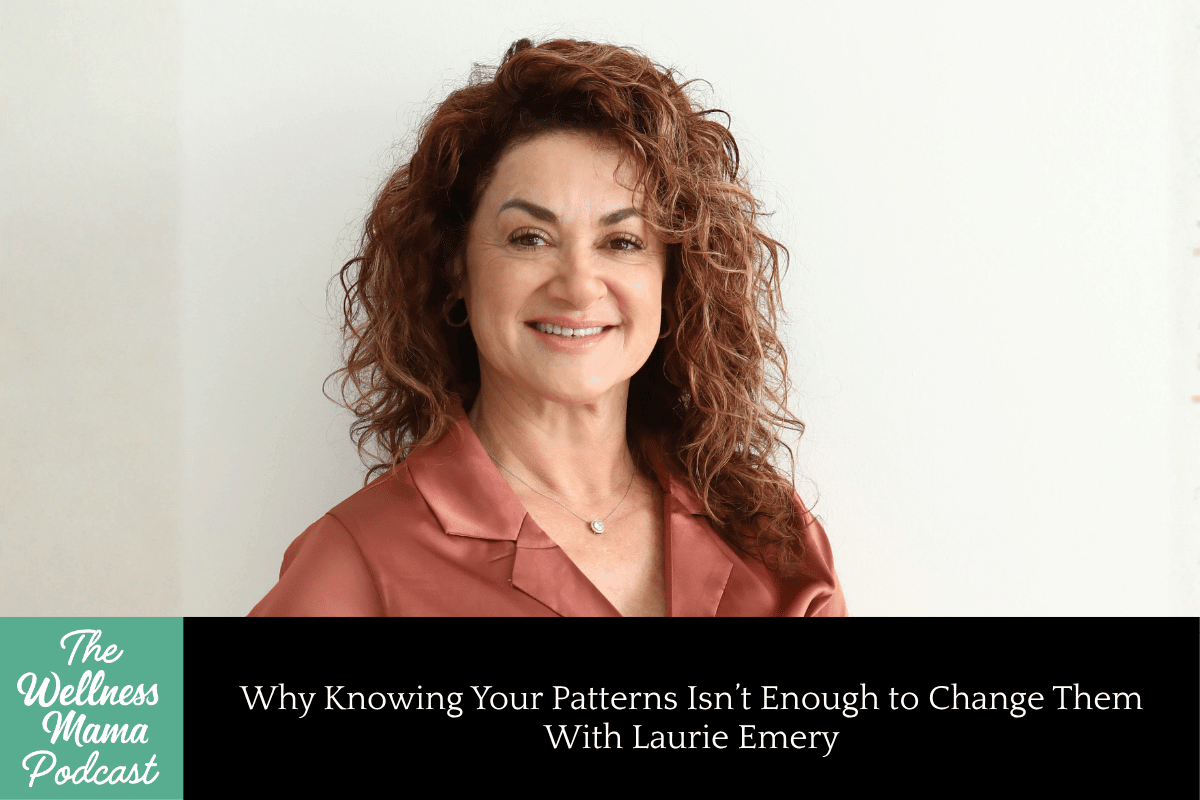
Katie: Hello, and welcome to the Wellness Mama Podcast. I’m Katie from wellnessmama.com, and I am back today with Dr. Laurie. We had an incredible first conversation that I will link to in the show notes about how just knowing our patterns is not often enough to shift them and what actually does, and her really amazing tools for creating lasting change in that area.
And in this conversation, I’m so excited to shift the focus and build on what we talked about into something that is so near and dear to my heart. I talk a lot about how we can give our kids better foundations than we sometimes had, whether it’s in physical health or mental health, emotional, so many areas.
And I’d love Dr. Laurie to really dive into this with you today about what are we teaching our children about being human through our actual parenting, through our modeling, through our own patterns, and how these things show up in our lives. I know many moms can relate to the experience of wishing we could do things a little bit better with our kids or losing patience and then being so hard on ourselves.
And as you explained in our first episode, a lot of these activations are things that come from our own childhood or from earlier patterns. And how to create more space there so that we can choose our response more appropriately. And I feel like nowhere is this more important than in how we raise our kids.
So I’m really excited to dive into this conversation. Building from where we started before, can you kind of walk us through what is showing up in our parenting? Where does it come from, and how do we start to be aware of it in a way that leads us into the ability to shift it?
Laurie: Yeah. I, I’m like you, Katie. I, I love being a mom. I have five children and, it… There, there is nothing more important to me. It’s one of the most important things, for parents to understand, is that our children are not only learning from what we teach them, they’re learning from who we are, like, in the moment, right, while we teach them.
Who are we being? And they’re watching what happens when we’re frustrated. They’re watching what we do when they disappoint us. They’re watching what, what… whether sadness is welcome in the house, whether anger is safe to express, right? Can we make mistakes or does it create shame? Or, you know, whether it can conflict happen, but, does it mean disconnection, right?
Does love disappear when somebody gets something wrong? And I think this is where parenting becomes such a profound work, because our children are constantly bumping into the places in us that- May still be unresolved, right? And maybe my child’s messiness activates my need for control, or, their disappointment activates the part of me that learned I have to keep everybody happy.
Or maybe their struggle activates a part in me that believes a good mom prevents their children from feeling pain. Or maybe when they’re angry, it activates something inside of me that was never allowed to be angry. And now I can very easily believe that I’m simply responding to my child when in reality I may be, I may be also be responding to everything their behavior is waking up inside of me, right?
That doesn’t make us bad parents, it makes us human, by the way. This is true for every parent. And the opportunity is not to try to be perfect and perfectly regulated, ’cause that’s not even possible, right? We… It’s not that we, we are looking to never lose our patience. We get to teach our children that we’re human beings too, but the opportunity is to become parents who notice, right?
Something in me just got activated. What belongs to my child right now, and what belongs to me? Because when we can separate those two things, we can stop requiring our children to manage our nervous system for us, and that’s enormous, right? Because now my child’s allowed to be disappointed without me needing to fix it, or they’re allowed to struggle without me deciding that I failed and making it about me, right?
They can be angry without me believing that the relationship is in danger. And I get to, I get to stay connected, to them while also staying connected to myself. And to me, that’s one of the most powerful things we can model for our children. Not perfection, but what it feels like to be fully human and still remain inside the relationship.
Like, I remember, like, when I, when I go to fear, I tend to turn it into what sounds like anger, right? And so I’ve taught my kids, like, “I’m feeling really scared right now because you told me you did that. I just need to be with this for a minute. I’m okay, right? And then we’ll get back to what’s happening,” right?
If I need a minute, I’ll take it. But, my kids know. I’ll say to them like, “So how do I do sadness?” And they’ll tell me. And, “What, what, how do you know if I’m mad?” And they’ll tell me. “And how do you know if I’m mad and fearful?” And they’ll say, “Oh, because you get, you sound mad.” Right? So like I’ve taught them like I’m a human being too.
And so, and if I mess up, I go back and tell them exactly what was happening so that they know it wasn’t them. And so there’s some really profound ways to, heal in relationship even with our children. And it’s really powerful. And the choosing part where choice becomes available and we know how to stay with ourself is, and this is something I, I do in my parenting work, is I begin by saying to parents, “What are the values you wanna run your household out of?
What’s the context you want that environment to be? And what are the skills you think, the ways of being that you think will have your children be the most successful when they leave your home?” And, you know, you’ve heard this phrase a lot probably out there, we parent with the end in mind, right? And if I want my children to be respectful and responsible and, independent and capable and resourceful and loving or kind, then if that’s, we call it a family code that my kids and I created when they were, like, four, then I parent out of those distinctions, and I guide my behavior and what, how I teach them out of those distinctions.
That’s where I’m gonna choose from after I’m able to see, breathe, and stay with what’s happening inside of me, communicate clearly so my kids get it, so they see that I’m human, and stay with them and let them have their feelings, their thoughts, their responses as they navigate through it, and then choose my response based on that commitment to my family. I know that was a lot in one breath, but it’s, I love this topic so much, I get excited about it.
Katie: Yeah, I love that. I think it’s such an important conversation, and I’ve said so often my kids truly are my best teachers because they, they bring up those things from childhood. Or I’ve, like noticed as I’ve stepped back and, like, tried to watch the responses, like, sometimes the immediate thing I feel when I’m being present with them is actually a sadness for the times when I wanted that so badly in childhood from my parents and it wasn’t there.
And I have amazing parents and I’m so grateful for them, and I know all of us do our best, and still there are gonna be things that, like, I know I interpreted in childhood that was certainly not what they meant, but those experiences were real to me. And I often hear it talked about, you know, like, when we, with our kids, they’re still learning emotional regulation, so of course they’re gonna learn a lot of that from our example, not just our words.
But I see on social media these examples talked about of, like, when we lose our patience or, like, fly off the handle or get angry, if we don’t have the context of, like, what you’re talking about and the repair and the understanding around it, then essentially we’re asking someone with a less developed brain and emotional system to be the regulated one in that relationship.
Laurie: Right.
Katie: And so I feel like your work-
Laurie: Yeah
Katie: … is allowing us to find that regulation with- within ourselves. And I know as a mom, even on a very subtle subconscious level, when we regulate, somehow the whole house gets more regulated. Like, it’s like that ripples very profoundly. And you talked about, like, modeling this, being a human without making them responsible for our nervous system.
And as someone who, definitely I internalized on my own in childhood that I was somehow responsible for how my mom felt and not making my parents disappointed and not letting people get angry. So I think this is a really important topic. How do we learn to show our humanness, not hide from our emotions, and not give them to our children to be responsible for either? Because I think this is so vital.
Laurie: Oh, I love, love, love that question so much, and for the same reason you do. I know what I grew up with and how I interpreted. You know, I had a dad who was undiagnosed bipolar and very out of control. And, yeah, I, I think it- the distinction is my child can know what I feel without becoming responsible for what I feel, and those are two very different things, right?
I can say, “I’m feeling really scared right now,” or, “I’m frustrated,” or, “I need a minute,” because I can feel myself getting activated, right? And this is me being human and letting my kid- my child know an honest emotional experience inside of me, right? ‘Cause if the message becomes, “Look what you’re doing to me,” or, “You’re making me so upset,” now my child has to change or calm down or perform or apologize or take care of me or think that they have to be a good child to be okay, right, for me to be okay.
And then I’ve handed them the responsibility for my internal state. And so, I think… And I think children, as you mentioned, take that job very seriously. They’ll become a good kid or the easy kid or the high achiever or the peacemaker, and the one- or the one who reads the room, right, the one who never needs too much, or…
And those can become beautiful strengths later, but they can also become the exact protections we’re talking about in the first episode. So for me, the work is can I let my children see my humanity while still making it clear that my humanity is my responsibility. It’s mine to hold. So I can say, “I’m upset, and I’m okay.”
Right? “I’m disappointed, and you don’t have to fix that for me,” right? “Because I noticed I wanted something different, and it’s completely okay that you,” right, “that you, that you are feeling the way you’re feeling.” Or, right, “I need a minute, and I’m coming back,” right? That pla- that part matters so much because children don’t just need a parent who never gets activated.
They need to learn that activation doesn’t mean they’re gonna be abandoned, or there’s gonna be disconnection, or that they suddenly have to be responsible for the relationship, and that when I do mess up, because I do and I will, I repair. I go back and I say, “I raised my voice, and that wasn’t how I wanted to handle that.”
Or, “I was scared, and I turned that into fear or anger. I turned the fear into anger,” or, “And that was mine,” right? “You’re not responsible for my feelings. That was completely on me.” And it teaches them something incredibly powerful. It teaches them that people can make mistakes and relationships can survive them, right?
We can tell the truth, we can take responsibility, and we can repair, and love doesn’t disappear because somebody was imperfect. And I actually, added one more thing to what I taught my children, which was how do we listen and communicate in a way that each person is taking responsibility for their perspective?
I don’t know if, moms out there have… We all know The Three Little Pigs story. But then I don’t know if everybody knows the story written by the wolf, and I read the version, the regular version that we all grew up with of The Three Little Pigs, and then I read my kids the three little pig version of the story written by the wolf, and it’s called The Real Story of the Three Little Pigs.
And I read it to them because it was about perspective and saying, “When you each have an argument, you see it one way. The other person sees it the other way, and that’s why you’re having a disagreement is because, of course, you see it differently.” And I taught them to listen one person at a time, reflect back to what each other’s saying, try to understand their perspective as if you’re walking in their shoes, and then, have empathy for them, and then you share how you saw it while they do the same for you.
And that has been invaluable in teaching my kids how to see what’s happening, how to go into their body and communicate what happened for them, how to have, how to be able to touch their feelings and stay with them, and then they’re able to choose a response with each other based on how do I create a win-win for both people.
And, and that one tool alone, along with see, breathe, stay, has taught my kids such amazing and emotional intelligence.
Katie: I love that. I didn’t know there was a flip side to the Three Little Pigs story. I would love to find that for my kids. And, oh, so much just stuck out, stuck out in what you just said.
One thing I read a while back was before we consider engaging in an argument with someone, like the criteria for that should be that we can deeply understand their perspective so well that we could actually argue it back to them, and they would be like- “Oh, yeah, that’s exactly what I meant.”
And that one thing shifted, A, the number of even just tough conversations that I entered from an argumentative perspective, because I realized like, oh, if that’s the bar, I was then immediately in a much more place of curiosity around their story versus what I was gonna say back.
And I also in that process realized like, oh, there’s much more constructive ways to engage in this than an argument to begin with. And I love that that makes it tangible for kids. And as you were talking, I can think of all the ways my childhood patterns showed up in early parenting, especially for me, in ways that I didn’t even realize. And it, what made them so interesting for me is it wasn’t always the bad ones. I was actually the mom that never yelled, because I learned to shut down emotions and regulate to keep everyone else happy, and I learned to like people please and overgive.
So I had to actually learn to very consciously and uncomfortably at first shift into allowing my emotions to be felt without letting them drip over into my kids, but also holding them responsible for things, and giving them responsibilities in the house, and not just doing everything for everyone to keep everyone happy.
Laurie: Yeah.
Katie: Even though on the outside that would look like a good mom pattern, if that makes sense. So I’d love to talk a little bit more about the ways our childhood patterns can show up in our parenting that we might not even necessarily tune into at first.
Laurie: Absolutely. And o- and one thing I want to attach to what you said, if it’s okay, is I wanna make sure parents who are listening don’t hear it like understanding my child’s perspective doesn’t mean that my child gets to do whatever they want or that I don’t have boundaries, right?
Empathy and boundaries can exist in that exact same moment, and when we do everything for our children, it’s because it makes us feel good. It actually gives them the message that I don’t think you can do it. I always, I use the phrase, “If they can,” my children, “If they can, they should.” Because when my, when our children do things like clear the table or they’re responsible for their own, their own mess or helping around the house and being part of the team, it actually builds their self-esteem.
So, I, I think that’s a really important piece to what we talked about as well. And let me go back to your question, Katie. It was, how our childhood patterns show up when we’re, when we’re, with our chil- correct?
Katie: Yes, exactly. Especially like in those like more subtle ways where we might not, like we might be able to more easily connect like, “Oh, I got angry. My dad used to get angry.” But we might not connect the flip side of like, “Oh, my dad used to get angry-
Laurie: Got it, got it.
Katie: … so I self-abandon.”
Laurie: Thank you. I’m with you. Yeah, I think it’s so important. It’s an important piece because not every childhood pattern looks dysfunctional from the outside, right? Some of them look amazing. Like, maybe I come in- become incredibly patient because anger didn’t feel safe growing up, or maybe, I’m the mom who does everything because, being needed feels like love, or I become hyper responsible because chaos feels dangerous.
Whatever it is, all of those things can look like really good parenting from the outside. The question is, I’m always asking myself this, is, am I choosing this, or am I compelled to do it? Because if I cannot tolerate my child being disappointed or creating boundaries with my child or watching them struggle in a way that’s important for them, if I have to keep the whole house happy in order for me to feel okay, right?
This is where some of our greatest strengths can quietly become the very thing that limits our children. So like you said, when I do everything for my child, it may feel loving, but if they’re capable of doing it and I continually do it for them, I’m unintentionally communicating, it’s like cutting their legs off, right?
And so that’s why I always say, the part that I just said, if they can, they should, because responsibility builds self-trust. So being part of a family where everybody contributes creates belonging, is important, and understanding that we do have an effect on each other. And I think as a parent, we can teach our children that you’re not responsible for each other’s feelings or my feelings, but we do have an effect and a, and a responsibility to the relationship, right?
Being part of a family where everyone contributes is important, and I think this is where parents have to get really curious about themselves, right? Am I helping because I… helping is needed, or am I helping because I’m uncomfortable watching my child struggle, right? Because if, if that’s, if it’s my stuff, then I’m getting in the way of their growth, right?
Those questions start showing, showing us whether our own history may be, may be parenting right alongside us right now. Did I answer your question in the way that you wanted, wanted me to answer it? I wanna make sure I was comprehensive enough there.
Katie: Yeah, that was perfect. And I think like that paradigm shift gives us a different perspective and so many hands-on tools when we understand it that way to shift things.
And like I said, this was one I did not learn right away. It took me a while and a lot of experimentation, so I love that you talk about this so well. And I know you s- you touched on this, but I’d love to just really speak to what happens to the child when the parent re- feels responsible for keeping everyone happy or keeping there from ever being kind of like chaos in the house or negative emotions or anger.
’cause I definitely had that example in my own early parenting, and I feel like understanding it while we talked about the first one, understanding doesn’t fix it, but understanding it is important, I think, to shift the perspective and start to shift it.
Laurie: Sure, sure. I, I think what can happen is a child starts learning very subtly that certain emotions are not safe, like they’re dangerous either within themselves or to a relate- to the relationship, right?
Not… And not because a parent actually says, “You’re not allowed to be angry,” but because every time anger enters the room, mom gets anxious or fixes or shuts down or over-explains, right, and tries to make it okay. And children are brilliant observers, just as we were when we were kids. They start adapting very early in childhood.
Like, and so there’s a child that, that might become an easy child. Another child might become the peacemaker. One might become the one who’s funny a- and, and the, the clown, right, to make everybody laugh. One might disappear into their room and avoid. You know, some might become incredibly successful and become the hyper-achiever, right?
Or one might learn to never need too much. And again, those adaptations can become strengths, but underneath them can be the message, “My full emotional experience is too much for the people I love.” And that’s the part we wanna interrupt, right? Because I don’t want my child learning, “I’m safe when I’m happy, agreeable, successful, and easy.”
I want them learning, “I can be disappointed. I can feel anger. I can feel hurt. I can be messy and still belong here.” And that doesn’t mean that there’s no boundaries. It means that the feeling is welcome even when the behavior is not. So you can be furious and not hit your brother, right? You can be disappointed, and you still have to go to school, or you can hate the boundary, and the boundary can stay, right?
You can have your feelings and still know that the boundaries exist, and that teaches emotional freedom and responsibility at the same time. So you know, sometimes good parenting creates a disappointed child, and it doesn’t feel good. I think that’s the hardest part of parenting is I think a lot of parents think our job is to make our children happy, and our job is not to make our children happy.
Our job is to allow them to struggle, when they’re in, in f- when they’re frustrated and teach them that they can tolerate it. Our job is to teach them that all parts of them are welcome as long as they don’t react inappropriately, and you teach them to be strong inside of themselves. Because if I make all of their discomfort mean I’m doing something wrong, I’ll keep rescuing them from experiencing what they need to experience in order to grow.
Katie: That was so beautifully said. I think that you probably perfectly summed up the actual work of parenting and how it can be such a profound growth experience for the parents right alongside our kids. And this dovetails into, you mentioned a little earlier, like, the idea of family values and a family code, and I feel like this is some of the practical work of, like, how does understanding this, how do I actually do this in my family so that my kids do learn their emotions are okay and they still can’t hit someone else?
Or it’s okay to feel frustrated, angry, disappointed, whatever the things are, you’re still always loved no matter what. So I’d love for you to kind of walk us through maybe examples of what your values and family code are, and also how you work with people to build this in their own families with their own unique situations and values and codes.
Laurie: Oh, absolutely. I love this so much. It’s so fun. So, such a fun topic for me. Yeah, and so, you know, this is where parenting stops being reactive and it’s, and it becomes intentional, right? So when my kids were little, we cr- ca- we, we created what I said, the family code, and it’s not a list of rules on the refrigerator, right?
It’s not a behavior chart. So the family code is who are we committed to being as a family? And for us, what, what… And I, and what we did is we sat down, and, and I teach parents this and I say, “Have your kids imagine they’re, a superstar professional soccer team,” or if your, if your kids like dance or football or whatever the sport is, speak their language, right?
And ask them, “What makes it, what makes a team successful?” And they’ll start giving you the kid version like, “Oh, well, you have to bring your equipment.” Okay, great, you write that down. “You have to look out for each other.” Great, you write that down. “You have to cheer each other on.” You write that down.
Anything they say, you write it down, and you, and if your partner is with you, also participate in giving answers. Underneath those answers are ways of being, like respect, responsibility, honesty, kindness, resourcefulness. And you wanna start to teach your child the distinction between doing and being, ’cause our way of being generates everything, right?
And so in my child- when we came up with the family code, like I said, we started it when they were four, and we would revisit it every year. So we sat down at the table, we talked about the successful team, and then we brought in the words of, “Oh, I think that means being responsible when you bring your own glove or your own equipment, or when you bring an extra glove for your, for your teammate. Maybe that’s, being team,”
Right? And so our family code ended up being responsible, respectful, loving, honest, which we later turned into integrity, which is a deeper, juicier, distinction than honest. And then we added team as the underlying word, right? A, as a way of being. And those become the context we be- we come back to when something happens.
So it, and it keeps us from micromanaging the household, especially as you know, Katie, when we have more than one child. So if one of my kids is, is angry, the question isn’t how do I stop the anger? The question is how do we allow the anger and still be respectful? And if somebody makes a mistake, the question becomes, how do we take responsibility without collapsing it into shame, right?
Or if someone’s hurt, we don’t just punish the behavior and move on. We repair, we reflect on it, we understand what happened, we listen to each other’s perspective. We ask, what do you need to do now to restore the trust of or, or connection with your sibling or with… Right? And this is something that I really encourage families to create together.
I’ll ask them, you know, “What are the qualities you most want your children to leave your home with?” Right? And then when they create that list, and you, and you go back, you go to be with the children, and you create it together, you don’t tell them what the list is. You create it together so they feel like they’re part of the team, right?
Then I’m not solving every problem for them. My parenting is actually working with my values instead of being hijacked to my old triggers from, from how I grew up, right? And so if I say I want it, my children to be independent, then I won’t do everything for them because it’s faster and easier for me.
Now I’m, I’m working- because that would be working against my values, right? So we create that family code, and it becomes the compass in the household. And at that point then, it’s they leave their shoes out, and you say, “Oh, your shoes are there. If you were being responsible, what would you do with them?”
And it’s, “Oh, I would put them in my closet.” Right? And when you’re creating the code, you come up with real-time examples with them. So in the activated moment, after I see what’s happening, breathe into it, stay with what’s going on inside of me, I ask, what does… And now, now I’m guiding my own behavior. What does the mother I want to be choose here?
What am I trying to teach right now? And, and I do the same with them. It’s, it- it’s very different than asking how do I want them to behave, right? I think it’s a deeper question in parenting, and it’s not how do I control this moment. It’s who am I helping my child become, and who am I choosing to be while I do it by guiding with the family code.
And then if they have an argument, you’re doing the same thing. As they see, breathe, stay. It’s okay if we were choosing from our family code in our– we choose our behavior. Our choice becomes from our family code. You can, you can communicate from what happened inside of you in a way that still creates respect, responsibility, and love in the relationship.
Katie: Yeah, and what a tool to have as they go into adulthood. Like, how much would that shift even adult romantic relationships if both people entered with that perspective? I feel like we would see such a different context for all kinds of relationships. And one more thing I’d love to touch on some specifics around is how do we repair when we don’t handle things perfectly?
‘Cause like you said, that inevitably is going to happen. We’re all human. So what are some tools for repairing well, and I think actually, like, having a stronger relationship even if we handle something less than ideally?
Laurie: Yeah. I think repair is so important, and I think this is such an important thing for us as parents, ’cause you mentioned this in the very beginning.
You know, we make a mistake, and then we’re so hard on ourselves, and we beat ourself up. I think repair is one of the most important skills we can model for our children, so that we can show them that, you know, we’re messy human beings. And I remember saying moments to my kids, they’d be like, “Mom, why do you,” blah, blah, blah.
I’m like, “Because you’ve got Laurie for a parent, and I’m a messy human being, and I’m doing the best I can, so bear with me,” right? So, you know, the goal isn’t when I get it wrong, to try to be perfect, right? It’s just how do we come back. And so repair has a few parts. First is I’m willing to be responsible without defending myself.
Like, I’m not giving a reason, to excuse my behavior, right? So instead of I yelled because you weren’t listening, that’s actually defending, it’s putting the responsibility on them. I say, “I yelled, and that wasn’t how I wanted to handle that,” right? I was scared. I was overwhelmed. I got activated. And that just gives them context, but it doesn’t turn it into an excuse.
And this is not just with our children. I think this is with everyb- these are relationship tools, Katie, right? With everyone. Then I make sure that they know what belongs to me and what belongs to them. So, you know, you may still need to take responsibility for what happened, and I need to take responsibility for how I responded to it, right?
So when my youngest was, and my oldest are four years apart, they’re both boys, my oldest was very, very, very energetic, very impulsive. He would do a lot of things that would hurt his brother, and my nervous system would get activated very quickly ’cause I grew up in an abusive household. And so when I would yell, I would, you know, or, or react, I would say to him, you know, “I got activated, I got scared, and I yelled, and I, that’s not how I wanna interact with you. And it’s important that you look at when you’re around your brother being careful because he’s four years younger.”
So both and, right? It exists at the same time. It’s such an important distinction because I think sometimes parents think apologizing means giving up a boundary or saying that what the child did was right, and it doesn’t, right?
I can repair my behavior and still hold the limit. And then I listen, right? Like, what was that like for you? What did you make it mean, right? Is there anything you need from me right now because of what happened? And, and I don’t allow them to use that to manipulate me out of the boundary or out of them not having to be accountable for their behavior, right?
I don’t correct their experience while they’re trying to tell me what happened for them. So if I say, “You, you were mean here,” right? My first job isn’t to explain… I’m sorry. If they say to me, “You were mean to me,” my first job isn’t to explain why I, why I wasn’t mean, right? My first job is to understand what, what it felt like for them in the moment.
And then if there’s something to restore, we restore it. Like, maybe that’s an apology. Maybe it’s a hug. Maybe it’s changing what we do next time. Maybe it’s simply staying in the conversation long enough for them to feel that the relationship is still intact, that we can be upset with each other and we’re okay.
And I think that’s the beautiful thing about repair, is that it teaches children something, that perfectionism can’t, can’t ever teach, right? It’s relationships can rupture and still be safe. and people can take responsibility. Love can survive disappointment, and we can come back to each other when there’s, an upset.
And I think that’s just teaching them to be, a real human being inside relationship, you know? And I think, I think we can teach children to repair with each other the same way, right? Not just say you’re sorry, because kids can learn to say sorry without actually understanding anything. I want them to slow down and understand the impact, right?
“So what happened for you? What do you think happened for your brother or sister? Can you reflect back what you heard? What part of this b- is yours, and what, you know, what would repair look like right now?” Because sometimes repair isn’t an apology. Sometimes it’s replacing something that was broken, or it’s giving space, or it’s changing the behavior for next time and creating a new agreement.
But the le- the deeper, message is that conflict doesn’t make you bad, and conflict doesn’t have to, end the connection. And you’re responsible for the impact you have. You’re also capable of repairing it, and that’s a relationship skill that they’ll get to use for the rest of their lives.
Katie: Yeah, I can only imagine if everybody got to enter all the future relationships of their life with that from childhood, like how amazing would that be?
And even just those things that you just said of like, you know, rupture, things can rupture and still be safe, or love can survive disappointment. I feel like that touches on so many, perhaps, of our own childhood wounds where we learn maybe those weren’t the case. And to be able to repair those things within ourselves and model them to our kids, and then for them to have that as their foundation is just absolutely incredible, and I love the way you speak to this.
I love so much of your work. And I, like I said in the first episode, I’m gonna link to a lot of resources in the show notes because I think your work is really amazing. And where can people find you and keep learning from you if this really resonated and they wanna bring this into their families or their relationships?
I know you have some resources specifically for people listening.
Laurie: Yeah. So, o- one i- so my, my personal… And thank you, I appreciate that, by the way. The easiest place to find me is through my website and social media, and I know you’re linking everything in the show notes. And for anyone listening who wants to actually experience some of this work rather than just hear about it, we actually created something special for all of you, which is we’re calling it The One Thing Underneath Everything, specifically for your listeners.
And it’s just a short assessment that helps you identify where something may be asking for your attention right now, and then you’ll receive a private audio from me, that’ll walk you through an experience based on what comes up. And then if someone wants to go deeper, we have the Return Experience coming up, which is the, the three-day experiential weekend I mentioned in the first episode.
And more than anything, I hope people come away from this conversation with a little more compassion for themselves, and a little more curiosity about what’s happening underneath their reactions. Because when we can stay with ourselves differently, we don’t just change our own lives, we change what our children get to carry forward in theirs.
And I also think when we learn this skill, a lot of relationships, interpersonal, intimate relationships could actually be saved, and we could break through that survival knot that often happens in coupleship. So, yeah.
Katie: Well, I love it. I’m so grateful for your time today. Like I said, I really value your work and the amazing things that you’re doing.
Thank you so much for your time and for all that you’ve shared. And I will make sure all those resources are linked so that people can find them, but thank you so much.
Laurie: Thank you so much for having me.
Katie: And as always, thank you for listening and sharing your most valuable resources, your time, your energy, and your attention with us today. We’re both so grateful that you did, and I hope that you will join me again on the next episode of the Wellness Mama Podcast.





Leave a Reply