Read Transcript
Child: Welcome to my mommy’s podcast!
Katie: This episode is sponsored by BON CHARGE, and specifically one of my favorite things that they have, which is their PEMF mini mat. If you are new to PEMF, this stands for pulsed electromagnetic field, which is magnetic energy that’s being sent into the body via this mat. And these energy waves are fascinating.
They work with your body’s natural magnetic field to elevate your wellbeing in a multitude of ways. Similar effect that we would have from being in direct contact with the earth, which I also think is an amazing thing to do daily. I love PEMF mats to improve sleep, to ground me, to increase calmness.
I often say that sitting on one of these mats, I feel like a cat in the sunshine and just, like, so calm and cozy. Some of the reasons I personally like this particular mini mat, it is small enough to fit in any room, and it’s easy to move from room to room. I also have a larger one, but that one is more difficult to move around.
There are different settings, so you can find what works best for you, and it’s low EMF. Some of these are not. I feel like this is an important thing to pay attention to. Some easy ways that you can use a mini mat like this: it’s great on an office chair or on a sofa or on the floor, wherever you are sitting and reading, meditating, working, et cetera.
I love to use it before bedtime or after a workout or I’m actually doing yoga teacher training. I’ll often use it during restorative classes or when you need kind of like a creative boost or a brain reset. And like I said, I love how portable this one is. You can find out more about it and get a discount by using the code wellnessmama at wellnessmama.com/go/boncharge
This episode is brought to you by Hiya Health, which I have a now extended and renewed interest in, especially with having a baby around who will be starting solid foods pretty soon. Because here’s something that’s kept me up at night as a parent, and I’ve talked about before. Our kids are the first generation growing up on not just ultra-processed foods, but foods that don’t have the same nutrient content that they used to due to soil changes and so many other factors.
In fact, we’re just beginning to understand the extent of this problem. And this is why Hiya exists and why I’m glad that they do, which is to give parents a real solution in a market that is flooded with kids’ vitamins that are actually contributing to the ultra-processed foods. They have candy-like appeal, but not actual nutrition.
In fact, some children’s vitamins on the market contain up to seven grams of sugar per serving and are stuffed with additives and petroleum-based dyes that I go to great lengths to avoid in my kids’ diet. So Hiya took the opposite approach with zero sugar, zero gummy additives, just clean nutrition. And the great part is kids actually love them.
My younger kids are a huge fan. I have tried them, and the flavor is actually great, although obviously I don’t take them daily. But what makes them different is how thoughtfully they are designed, formulated to meet very specific nutritional gaps that modern kids face. And they worked alongside pediatrician and nutrition specialists to make a chewable multivitamin that packs a blend of twelve organic fruits and vegetables and fills the common nutrient gaps that kids face.
They’re also non-GMO, vegan, dairy-free, allergy-free, gelatin-free, nut-free. They really have thought of everything to make these ideal for kids. And they are NSF certified and receive Clean Label Project’s Highest Purity Award. So when it comes to something I feel safe giving my kids, they are definitely on the list.
It’s designed for kids two and up. They ship straight to your door. And I love that they send you a reusable bottle and stickers with your first order. So this helps you keep up with the refills, and they send refills every month as well. I am a big fan of these as well. And Hiya just launched something new.
If your kids are active and growing, you can add a clean protein powder with minerals designed just for kids to be exactly what they need. Their new Kids Daily Growth Plus Protein is a game-changer. It’s more than a protein shake. It’s a purity awarded clean protein powder with added minerals and healthy fats that can mix right into water or smoothies and support muscle development and cognition and fuel everything else they’ve got going on.
So, we worked out a special deal with Hiya. You can receive 50% off your first order on any of their products. To claim this deal, you must go to hiyahealth.com/wellnessmama. This deal is not available on their regular website. So again, that’s H-I-Y-A-H-E-A-L-T-H.com/wellnessmama, and get your kids the full body support they deserve.
Hello, and welcome to the Wellness Mama podcast. I’m Katie from wellnessmama.com, and I absolutely loved this episode. I really, really liked today’s guest. Apologies in advance, I am a little bit under the weather. I’ve been fighting a cough for a week now, and so I have to kind of bow out a couple times, and I know you’ll hear it in my voice a little bit, and I hope that that does not take away from how phenomenal this guest was.
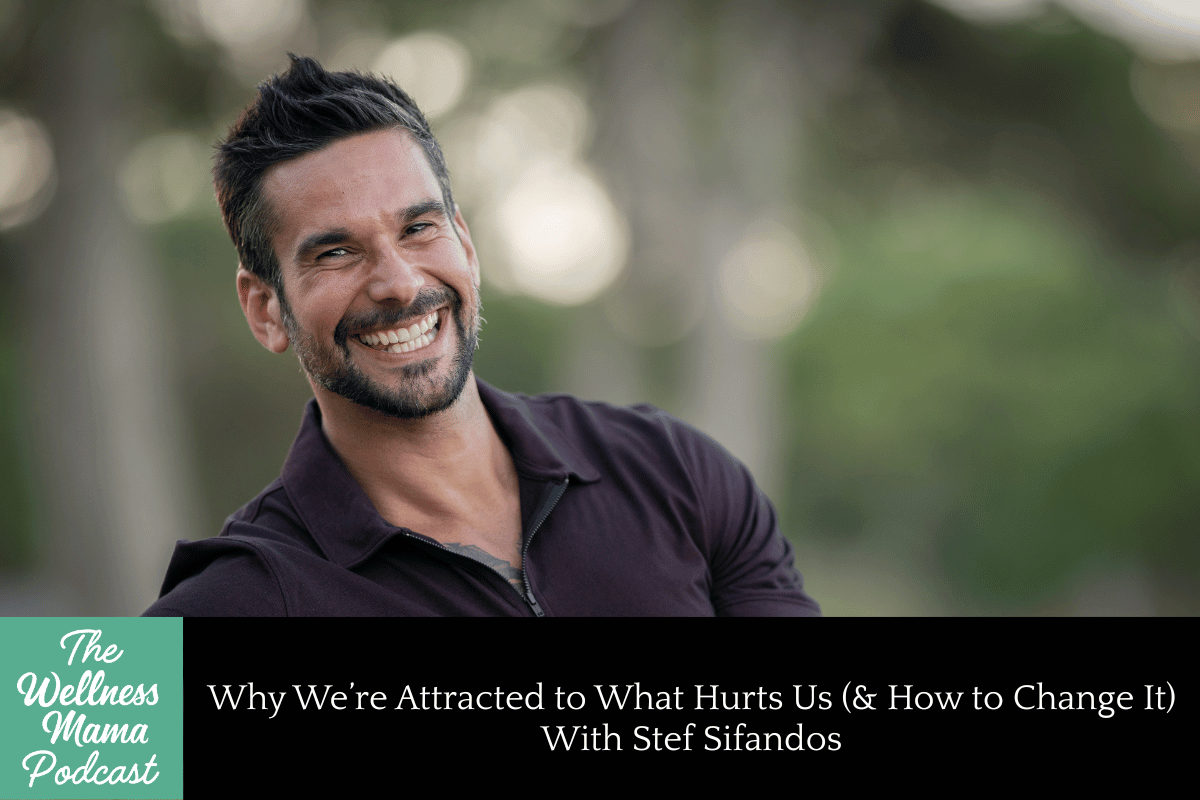
The topic today is why we are attracted to what hurts us and how to change it with Stef Sifandos, and I really, really love his work. He’s an internationally recognized author, relationship expert, and educator devoted to helping high-performance individuals, entrepreneurs, and people in general confront the parts of themselves that success cannot hide.
So for more than two decades, he’s worked with Olympic gold medalists, world champion fighters, specias- special forces soldiers, entrepreneurs, executive, and couples who have built impressive lives, yet quietly feel the cost of what it took to get there. Because often beneath achievement lives our emotional armor, our relational distance, and patterns formed long before the success arrives.
And he– we got to go in some really amazing directions in this episode. Specifically, why we’re attracted to what hurts us, why people confuse intensity with compatibility or chemistry. How our early attachment patterns shape our attraction in adulthood, some signs that we’re choosing from familiarity rather than alignment.
He talks about how we’ll choose a volatile familiar over a safe but unknown, and so much more. We talk about the nervous system, and I learned a lot in this one. You’ll hear me share pretty vulnerably of where I’m coming from on a couple of these points and get his perspective on that. He does push back on me on that point as well, so fascinating interview I enjoyed very much despite not being able to talk some of the time.
I hope you enjoy as well. Let’s join him now. Stef, welcome. I’m so excited for this conversation. Thank you for being here.
Stef: Likewise. Thank you for having me.
Katie: I’m so glad I came across your work. This was a really fun episode to research for even, and I think we’re gonna tackle a topic that’s gonna be really both fun and maybe a little confronting for some people, which is the idea of why we are attracted to what hurts us, which I would guess even that alone might be raising some defenses.
But before we get there, as people heard, your bio is quite astounding, and you work with Olympic gold medalist, special forces, elite entrepreneurs, people who by every metric are very, very successful. And you talk about wounds that still keep showing up despite someone having all these external metrics of success.
So I would love to, like, actually kind of jump in there and hear a little bit about, your background and also the, the commonality among these super high achievers that you work with as kind of the basis for what we’re gonna springboard into.
Stef: Yeah. So brief background. From, from an early age, I was very, very fascinated with the, the human mind and how we relate to each other and ourselves, how we can minimize pain and just increase, our quality of life.
And largely that was because of the environment that I grew up in, and also just what I witnessed, whether it was through media, whether it was through my own community, through traveling. And it, it really, it perplexed me as to how there’s just so much disparity and dissonance in our society, right?
There’s, there’s so, there’s so many– there’s just an extreme gap, not only in, in wealth and the way we live our lives, but also our own mental health and our own emotional wellbeing. And so that propelled me to, to study psychology at university. A little later on in life, I, I traveled a fair amount. I traveled to, you know, get away a little bit from, from, from home, just because of my, my environment.
But nevertheless, that was a wonderful experience. I studied psychology and behavioral science and trauma and, and, and really, and developmental psych, and they were the foundations. But at the same time, I, was part of a business called CrossFit. Now, CrossFit is a, is a fitness brand, boutique fitness brand, but it really blew up.
And I was there at the inception of very early stages, and because of that, in Australia back then, I live in the US now, but back then, got a lot of exposure to the military. We had the SAS barracks just down the road from our facility, me and my business partner. We got exposure to professional sporting teams, and the Australian Institute of Sport, and that really opened up, avenues and, and, and, and I got to work with amazing human beings.
And I coupled that obviously with the psychology that I was practicing and had been practicing from a, from a younger age as well in, in other courses that I had partaken in. And it was just a really amazing bed for high performance. But what I learned in, in working with people that live in extremes was how we function as humans and where there’s– where we can find our own sweet spot, and how we can find our own equilibrium and balance and actually move out of so much of the trauma or the intense experiences that we have usually during our formative years that then shape our adult lives, sh- shape our adult relationships, how we give and receive love, how we see ourselves, so our confidence and our self-worth and our perception of that.
And all of it’s interconnected, and it’s, it’s quite nuanced, and it’s can be very complex, and so we need time to unpack that. And I just started learning and developing and learning from obviously giants, standing on the shoulders of giants way before me, but also developing new techniques to actually access these unknown parts within us that were still driving how we behaved and how we showed up in the world that was very unpleasant for so many people.
Katie: Yeah, this is fascinating to me ’cause I had heard, like, some parts of this a little bit, like, to your point, standing on the shoulders of giants, of how often we will, like, marry our parent, for instance, or patterns can show up in a relationship. But I feel like you offer such, like, really clear context around points of this that I didn’t understand as much until, like, b- coming across your work.
And you talk about kind of the idea of the, like, the nervous system almost as a hidden matchmaker when it comes to this marrying your parent idea. And you- you’ve said that what most people call chemistry is actually nervous system dysregulation, and I would love to double-click on that and kind of break down the reasons as to why.
‘Cause I do feel like most people actually kind of navigate by that chemistry feeling, and I also have a whole lot of teenagers who are gonna be navigating relationships in the near future, and so this is something I’m very aware of as they enter that part of life.
Stef: Mm. So what is familiar within us, whether it’s neurologically, physiologically, psychologically, relationally, emotionally, all, all the layers that make us being human, human. What is familiar we move towards, and we move towards it quite simply because it feels safe because it’s familiar.
It’s like a circular conversation. There’s n othing– that’s nothing too complex. The complexity comes in that just because something is familiar doesn’t mean it’s, quote-unquote, “good for us” or it’s healthy for us or sustainable for us at a relational level, at an emotional level, mental health, et cetera.
But the force, the pull towards what’s familiar is so strong that we will often neglect the fact that it’s not healthy for us. So for example I grew up in a very vol– I’ll use my own life as an example, right? I grew up in a volatile, violent, physically and emotionally violent household. So for me, chaos, unpredictability, volatility, the unknown is very familiar.
And so if I’m not living a familiar life, it feels extremely uneasy, and that’s for all of us, right? And so I want to recreate circumstances that are familiar to what I’m accustomed to, because that’s where I feel safe. Now, why? Because in that activation of being in chaos, what will happen is the protector parts of me that were formed psychologically, relationally, and physically during those intense times get to come online.
They get to come online because they’re being stimulated by an environment that is familiar. Without the environment being stimulated, the protector parts don’t come online. If I don’t have the protector parts coming online, and this is for everyone, by the way, in their own version of this, then I don’t feel safe.
If I don’t feel safe, I’m dis– I’m starting to dissociate from my identity. It’s very scary, and it’s extremely confronting. So it’s almost like better the devil you know than to be in the unknown. And so we will recreate certain environments because of that. That’s one part. The– And, and we’ll do that relationally.
Actually, I’ll, I’ll touch on this as well. We’ll do that in a relational context. And the, the, the early childhood experiences that, that during our formative years where we’re imprinted upon dramatically and deeply – doesn’t mean we can’t change our lives and can’t change our circumstances, but we’re imprinted upon profoundly from our primary caregivers, the relationships that we form, the way that we learn to give and receive love, the way that we learn about ourselves, the way that we’re reflected back, the way that we learn how to do conflict, the way that we learn how to communicate, the way that we learn how to get our own way, can be either forged in healthy ways or unhealthy ways.
And for– not everyone, of course, but for so many of us, it’s forged in unhealthy ways, largely because, you know, we’re humans and we’re fallible. Like, we, we don’t– we’re not perfect, and we’re going to pass on stuff unknowingly unless we’re really, really working on ourselves. And even then, like, you’re still gonna pass on stuff, and that’s okay.
It’s part of being human. We get to work through that. But for so many of us, it’s very unconscious. There’s a lot of projection happening. All of our unfiltered, unprocessed wounds and pains and fears, we project that onto our children. They carry that, right? So now the second part to this is why do we keep recreating and matching in these chaotic ways our version of chaos, right?
Or our version of instability, is because our bodies are actually really intelligent. Our minds are really intelligent. And so what we’re attempting to do is have a redo. And why are we attempting to have a redo? Because sim- again, simply put, I try and distill these very complex nuanced, ideas and realities of, of relational realities into simple form.
We are attempting to move from disempowerment to empowerment. That, that’s basically it. So when we experience being abused, or we experience being neglected, or being criticized, or being bullied, or our parents divorcing, or moving around a lot, or being lost in a sea of siblings, and we weren’t paid attention to, and we thought we didn’t matter, and we made all these things mean something because trauma isn’t just what happens to us or the experiences that we have, it’s what we make them mean.
It’s how they imprint upon us and how we process them, metabolize, digest them, and then play them out in the world in these protective patterns, right? We’re moving from disempowerment to empowerment to actually just have a redo in a more empowered, sustainable way to grow out of a pattern that is dense, that is fearful, that is contracted by nature, and move more into growth and expansion, because that’s a prime directive of being human.
Now the paradox is you can’t really grow and expand without contraction. Park that conversation. It’s more of a, a philosophical one, let’s just say. But the point is, we don’t know that we’re constantly attracting… Like, you may have– If you’re listening to this, you may be attracting an unavailable partner.
They’re emotionally unavailable. They can’t meet you in the, in the emotional depths that you want. Maybe they’re physically unavailable. They’re avoidant. They run at the face of conflict. If you disagree with them, they take it really personally, so their, their response or reaction doesn’t really match the situation.
And this is a constant pattern in your life, and you’re attracting these kinds of, we’ll just call them men, right? You’re at- attracting these kinds of h- of humans in your life, and you’re like, “Why is this happening?” ‘Cause maybe that person reminds you of your father, right? And when you were little, having an avoidant, having a, having a, a father that wasn’t present was really hurtful.
It’s also really familiar, right? Again, another paradox. And so as a kid, we’re usually pretty disempowered because we’re so over-reliant on our environment, on the people in our environment, you know, our teachers, our aunts, our uncles, our parents, our grandparents, our primary caregivers. And so we’re tending to move out of that disempowered state into an empowered state.
And fortunately or unfortunately, depending on the purview you take, it’s going to be challenging, but we don’t realize we’re doing that. It’s all unconscious. And until we make the unknown known, and that’s what I really support people in doing, is making the unknown known, now it becomes tangible and malleable.
Now we can work with it. Now we can make different choices, and different choices orient us differently in life. We start setting healthier boundaries as an example. We communicate differently. We notice when someone is being hyper-selfish and just there for themselves, and we can say, “Well, I’m not going to be a people pleaser.
I’m not going to overextend and overcompensate,” or, “I’m not going to, overgive.” And over-function, which is a, a problem for so many or a challenge for so many people. And you start to break those patterns, but when you break those patterns it can be really scary because you’re also losing part of your identity because they’ve been entrenched.
They’ve been an, I call it an unsustainable or what, what’s known as a maladaptive, coping strategy or maladaptive protective part of you. So now you’re reorienting your whole internal world. And that’s why we need support, like whether you join a peer group or you work with a therapist or, you know, y- you, you have people in your life that can support you through your transition and transformation, which can be very scary for those closest to you because now their world is being ruptured because they’re accustomed to relating to you in a very specific way, and that’s changing now.
So there’s a lot that happens when we move into transformation and we, we have that spark and that fire within us that lives with us and says, “I don’t wanna live like this anymore. I need a change.” And it’s a big commitment because there’s a lot that’s, that’s breaking down and changing, and your whole world is falling apart.
But it’s very possible, and it’s very accessible. You just need to, y- you, you need to first have the spark and the fire to do so, and the willingness to traverse some discomfort.
Katie: Oh, so many parts I am excited to go deeper on. I love that the body always being on our side and why it wants for a redo, and I feel like the identity piece is a really big one as well.
And I see this in, for instance, the Hashimoto’s world. Like, it’s hard to heal from Hashimoto’s if you’re in all the groups and your identity is, “I have Hashimoto’s.” And I’m sure that shows up here as well. But, I think what I wanna start with is, like, that making the unknown known.
Like, how do we learn about these protector parts so we can start making better decisions?
Stef: More often than not, we, we can’t see the forest for the trees, right? We can’t actually do it ourselves. We’re relational beings, and so we need each other. So I have a… I don’t think it’s my theory, per se. I just have a, a very strong belief that one of the ways, the, one of the critical ways in which we have evolved as a humanity, as a, as a global community, as a, as a group of people that, are, you know, carry a herd mentality, so to speak, and, and, how we’ve advanced intellectually cognitively, emotionally, relationally, et cetera, has not just been through, discovering fire, cooking meat, maybe, discovering psychedelics or, you know, plant medicines and so forth, and the, the development of our prefrontal cortex, but it’s been, it’s been the way that we’ve related and the way that we’ve had to depend and rely on each other and give feedback to each other in a social setting.
And this, I believe, has been paramount to how we grow as humans, right? And so with that said, there’s so much value in spending time in solitude, being self-reflective, spending time with your interior self. In fact, I would say for most of us that that needs to be the first port of call is check in with yourself, learn how to access your layered intuition, how you can learn to trust yourself, how you can move deeper into your own self-worthiness and self-value.
And sometimes when we’re in the thing so much, we can’t see beyond the thing. We can’t take a 30,000-foot view. And so we need someone that’s less attached because that person or those people are not in our bodies, they’re not in our minds, they’re not conditioned in the way that we are. They’re not feeling the, the big emotions and the, the fear that’s being projected into the situation, the risk, like, “If I leave this person, my life will fall apart.”
And you, you so firmly believe that, right? Because of your own attachment styles, for example. But then your friend comes along who’s mature and relational and connected and says, “Hey, I hear you, and here’s another perspective.” Or you work with a coach or a therapist who has, in, y- you know, very specific insight into understanding the human mind and also is empathetic and understanding, ’cause that’s another thing.
It’s not about the advice. It’s not about even the perspective. That, that, that helps, but it’s about being witnessed. It’s about being empathized with, being understood, being seen in your vulnerability, in your pain, in your fear. There’s something that happens in a, in a relational way that shifts us from despair and destitute, and, “I’m so scared to make this big change in my life,” to, “Oh, maybe it’s possible.”
It helps shift us, again, from disempowerment to empowerment, from fear to courage, from a lack of confidence to greater confidence, because someone believes in us. And for so many, for so many of us, our, our greatest wounds are, the core of our greatest wounds are, “I don’t belong. I’m not seen by anyone. I’m not understood.
My mom never understood me. She was alcoholic,” or, “My, my father never got me. He was a narcissist. I don’t know where I belong in the world.” And then all of a sudden, as adults, we’re witnessed and seen maybe by a partner. A romantic partner, but maybe by just another human. And it can be confronting at first, but it’s deeply healing if we allow that in and we can receive that.
Everything changes. Our self-worth increases. The choices that we make from there change. Instead of looking at the world like this through a very narrow lens, we start to widen our purview of the world. Right. The aperture is widened. It changes. More information comes to us. We can deal and cope with more because we’re more able and capable because someone believed in us.
That is the power of, of relationality. So being witnessed very much matters. So to answer your question, like, how do we, how do we make the unknown known? It’s often not completely by ourselves. It has to be done in a relational way.
Katie: And I would assume, like, relational way could of course include, like, romantic relationships, but also I would guess that could include therapy or coaching of some sort, or community in general, like just other humans as a feedback m- and a, like a way to work through those things?
Stef: Absolutely. And the more intentional and deliberate all people or parties are in that process, the more, the higher the chance of us advancing beyond that limiting pattern that we have or that we’re playing out in the world.
Stef: I love that. I feel like this opens up the potential of, like, a tremendous amount of possibilities for community or at least, like, structures built around that. And definitely later in this episode wanna get to, like, as parents, how can we help create some like, healthy foundational things for our kids around this, and I know you’re a parent as well.
But before we get to that, I love that you talk about that, like, that belonging question. That seems so pivotal and core for, I see it in my children, like, for, for every child I feel like that leads to these perhaps either statements or questions as adults of, “Am I good enough? Am I lovable? Am I worthy?”
Or the statements of, “I’m not good enough, I’m not worthy, I’m not lovable.” And so I love that you brought that up and brought up the idea of a witness. And I- I’ve also seen in your work you’ve talked about being deeply seen feels both terrifying and irresistible. And I would love to go into that concept a little bit.
I would guess that resonates maybe a lot with, with people listening. And also, speaking of your work, you have so many amazing resources. For anybody listening, those are gonna be linked in the show notes, so you can definitely keep going deeper on all these topics we’re talking about. But I, I would love to bring that one in, that, like, being deeply seen, what does that even actually mean?
Why does it feel both terrifying and irresistible at the same time? And what happens relationally what- w- in whatever relational form when we’re able to access that?
Stef: Yeah. This, this is a concept that I unpack in, in my, my latest book, Tuned In and Turned On. This notion of- This intersection of irresistible yet terrifying.
The irresistible piece is it is so natural, and I believe inbuilt within us to want to be seen, to want to be desired, to want to be loved, to want to be held, to want to be not judged and met with compassion and empathy. To, to be seen and understood, like it’s, it’s so innate within us. And at the same time, if we haven’t experienced a healthy version of that or a healthy interaction of that compounded over many years during our formative years It can be simultaneously so scary, so terrifying.
We want to repel it. We want it because it’s innate that we want that and, and yearn for that. But at the same time, it’s hurt us before. Intimacy has been unsafe. Closeness has been unsafe, and maybe we’ve been invaded upon. The statistics around physical and sexual abuse are so high w- as, as children, and so when your, your body and your spirit is invaded upon, especially by people that we’re meant to trust, it becomes very difficult to let that in as an adult.
Yet the part of us that yearns for it doesn’t completely shut off. It lives within us, even in unconscious ways, and so now we’re in this internal tug of war, and that can come across as disassociated. That can come across as hot/cold. That can come across as I’m gonna hurt people before they hurt me. That can come across as avoidant.
First sign of conflict, I’m out ’cause I’m threatened. Hypervigilance. That can come across as I’m going to cheat in the relationship and seek excessive pleasure when there’s pl- when there’s pain. This is how I cope with it, right? Everyone has their different coping strategies. I’m gonna submerse myself in work.
I wanna be in relationship. For some reason, I really want it. I’m sort of sharing the reasons as to why it’s so important for us, right? We’re relational beings. But at the same time, there’s pain in that relationship, and it reminds me too much of the unprocessed stuff that I’ve gone through in my past that I haven’t really dealt with.
I haven’t equilibrated. I haven’t closed the loop on that trauma, and it’s not about reliving it. It’s about feeling what was unfelt in the disempowered state, right? And completely reorienting not only your story, but your relationship to that. But it’s, it has to begin in, in a somatic way through our feelings, through our emotions.
Yes, cognitively, but that can come later. And because we haven’t done that, we say, “Well, I’m gonna avoid that. Too much pain in this area. I still want it, but I don’t know how to be with it. Too much pain. I’m gonna go to where there’s pleasure.” That could be drugs. I’ve obviously mentioned a whole stack of things, but drugs, alcohol, workaholism.
Where am I going to be validated and approved of in a safe way, like where, where there’s emotional and relational distance, right? Where I don’t have to be vulnerable and real, and that’s ’cause that’s really scary. That’s risky. I don’t wanna take that risk again. I’ve been hurt too much in the past. I can’t take that risk again.
And until we deal and really face our stuff, all of ourselves in wholeness, we will continue these cycles, and there’s be this push/pull energy in relationships specifically.
Katie: That makes sense, and I’ve heard this also talked about of, like, kind of that idea that we subconsciously, like, find the person who has what we lack or that, like, pattern from childhood or whatever it may be, and then we create that, like, energetic bond, and we sort of drain each other of those things until now we’re both depleted of that thing and have nothing left.
And then the, often a relationship can fall apart, and then it restarts. And I think that pattern of that occurring ag- again and again, could seem really resonant for a lot of people listening. I know I can see examples in my own life where I’ve done that, as well, and y- y- I feel like you cover this so well in your book.
I’m gonna link to that in the show notes. For anybody listening, highly recommend it, and I know there’s so much more in there than we can cover here in just an hour. But I really would love to c- really touch on a few, like, I feel like so many high-value things in there. But, you mentioned the somatic aspect, and I would love to go deeper on this part because for me, this was a huge piece.
It’s one I’m still working with and through. But realizing due to trauma in my own life, I had dissociated from my body. I had definitely developed very strong protector parts. I can see in hindsight how that had played out in so many areas of my life. And it took a lot on the somatic side, I will say, to, to be able to start to reintegrate that, to, like, reassociate with my body and even have a healthy relationship with my body.
And that’s been a beautiful journey, and I’m now super grateful for it. But I feel like the somatic side maybe isn’t always talked about or brought into the conversation, and to me, it seems super relevant for everyone, honestly, but especially maybe for women. So I would love to hear how you, bring in the body side ’cause you even said, like, the logical side, that can come later, but the body and the emotions first.
So I’d love to hear how you work with that and how… Like, what happens when people are able to sort of, like, reconnect this or drop into their body or have that somatic connection happen as they start processing?
Stef: Yes. W- so let’s, let’s actually start with, perhaps just there’s many different definitions of trauma.
Let me just share some here that could give some context into one’s own life ’cause trauma can be a, it can be a trigger word, but it can also be a, a word that’s overused in, in our, I guess, society at the moment. And, and I just, I wanna, I wanna give it some, some, some shape, right, some form. And so trauma can be considered something that’s too much, too soon, too fast.
It can be chronic. It can be, abrupt. It can be a big, a, a, a quote, unquote, “big one-off experience.” For example, being, being involved in a, in a bombing or something, right? Like there’s a one… Or being in a car accident could be a traumatic event. Trauma is not, it, it can, it can also be what we know as big T trauma and little T trauma, meaning that it can be these very overt, big experiences or events that are very obvious, overt and obvious, or they can be very subtle and not so obvious.
Such as, and the, and, and there’s no… We, we shouldn’t compare trauma per se. We get, we usually get in the habit of doing so, but we just shouldn’t do that because of this next part that I’ll get to in a moment. But, you know, that little T trauma can be just an abrasiveness that just grinds you every day.
And maybe you, you know, you reach for affection and it doesn’t happen. There’s no malintent or, and, and you’re not in a nefarious situation, but you’re just, you’re reaching for affection and you’re not met with that. You’re not seen. Maybe your mum or, mum or dad are too busy per se, right? And, and that can be traumatic to the nervous system.
And the, and the other part to this is not just the experience that happens to us, I t- I touched on this earlier, but it’s how we interpret it and what we make it mean, and then how we act in accordance with that. Now, the, the, the s- the psychological and relational strategies we develop to not experience that hurt and not continue to experience that hurt, and that compounds over time, and that becomes habitual.
That becomes a pattern, right? And so what usually happens is, well, you know, there’s a, there’s an unconscious belief or story around, “Hey, people are unsafe. I’m gonna keep people at a distance.” But remember that innate yearning to really want to be close to people still exists. It doesn’t go away, right?
And we can fight it pretty hard and some will. Some will, will go and become hermits and, but they’re still living with that pain. It doesn’t go away. It’s just masked in different ways. So, My apologies. Re-ask your question again. I, I, I got caught in that, in that, laying some foundations and I, I’ve totally forgotten your question.
Katie: Oh, just the, the somatic side and, like, what happens when someone especially begins somatically processing. ‘Cause I feel like often people wanna start with the cognitive or they wanna, like, logic their way through it and understand it.
Stef: Yeah. Yeah. And so the, the reason why we lo- and, and that’s a great point. The reason why we logic our, wanna logic our way through it and we want to explain it is because it gives us this sense of, oh, because now I understand it, I’ve, quote-unquote, “fixed it” or I’ve healed it or I’ve changed. And more often than not, that is definitely not the case.
Awareness is a step towards greater transformation, but greater transformation must be, must involve all areas of the self. That includes the body. And so when we experience another part of this trauma, if you like, and you can call trauma intense experiences, right? And so if there’s a shock to the system, there’s an intensity that you experience physiologically and, you know, stress hormones are released, associations are made with that particular situation.
“Hey, we can’t experience that again. That’s too much. It’s too overwhelming.” Hypervigilance around that. As a- as we grow as adults, when we, we notice an, an association that when that intense trauma or that intense experience happened, we can call it a car accident, right? Maybe you were, smelling a donut or something.
As an adult sometimes if you smell a donut, it can cause a retraction. It can cause a, a, a, a, a, a contraction and a fear in you and an abrasiveness and a bracing as well, right? Like, and, and, and it’s nothing to do with a donut. It’s got to do with the association. So that’s an example of how, how complex intense experiences can land in our bodies.
Now, remember what I said about disempowerment to empowerment. When we’re contracted in that way, it’s still controlling us in some, some capacity. So again, if you are accustomed, this is the paradox, if you’re accustomed to- Being with someone that’s unavailable or that mistreats you, right? You’ll want to attract that to obviously have a redo, and it’s your body, because the unconscious self lives in the physiology so much.
It is your body that is driving you towards that. And so one of the ways that we begin to really un- unravel and heal and make whole these parts of us is to, in that moment, feel what we really, really wanted to and really needed to feel. And it’s, it’s usually an empowering act. So it’s either to push a perpetrator away and run, right?
Instead of freezing and, and being still and not being able to move because there’s so much fear. It’s usually using our voice in a very specific way. Maybe it’s using word, but maybe it’s non-verbal, right? It’s setting a healthy boundary and saying no physically, verbally, emotionally, intellectually, all of it.
And so when we didn’t have the opportunity to do that, we have to be able to do that as adults and, and run that, that process or that practice through our bodies in safe way, safe ways, again, being witnessed, being supported. And what we start to ha- what starts to happen is we start to undo that pattern that has locked us up, because now we’re moving towards greater empowerment, greater confidence, greater boundary setting.
We’re using our voice. By default, we matter more. We’re more important now to ourselves. And so that stuff lives through the body, and often there’s no time to cry or there’s no time to feel sad. There’s no space to feel anger. And so these trapped emotions live in our bodies that guide and direct how we behave in times of intensity, you know, replicated intensity.
Again, like, or familiar intensity And so we don’t wanna feel those very big feelings of anger or fear or sadness, like deep, deep sadness or being taken advantage of, whatever it may be. And so we will usually have a protective part that comes on, on, on, on board, but that’s not necessarily what needs to ha- Like, it’s great at work to help you survive. It’s fantastic, but it’s now maladaptive because it’s not serving the intimacy that you desire. It’s not serving the closeness that you desire. It’s not serving the relationship.
And if both people are coming to the relationship with their own set of wounds and their own set of protective patterns until they realize, and this is where awareness is important, the source of that, and they, they do work on themselves individually, but also with each other, they’ll never shift out of the pattern ’cause they’ll just keep playing out the same protection, which is ultimately pulling people apart and pushing people apart.
And so one of the ways that we really get beyond these, these maladaptive patterns and coping strategies is by feeling what was unfelt, is by expressing what was not expressed, and moving that stuff through the body in safe ways. Breathwork is an example, right? Dr. Peter Levine developed a, a system called somatic experiencing, and this is another way that you can get into the body in safe and adept ways, again, through practitioners, through– It’s– Most wounds are relational, so they have to be healed in a relational context.
They have to be witnessed. You can’t do it by yourself. You, you– There’ll be portions of your journey, like Joseph Campbell speaks this in the Heroes or the Heroines journey, right? Where you have to go out, you know, rites of passage, particularly for boys, like there is a, there is a, a, a phase of your rite of passage, and we have multiple rites of passages if we allow ourselves to throughout our lifetime, of course.
There’s parts where you have to be on your own, like it’s just you and you, and that’s necessary. And the, the relational piece is with you and maybe with God or with something beyond what’s material or what’s known. It’s still, still relational, but it’s not with another human, per se. That’s very valuable, and I’m not discounting any of that.
I’m not saying we have to be with people all the time, and we have to– we can only, quote-unquote, “heal with people.” But it, it’s, it’s an important factor that we miss because we’re so scared of people because people are the ones that have generally hurt us, or we’ve experienced hurt and intensity in the presence of people and made the association that people are unsafe.
Katie: Oh, so many good things within that. And to your point, I can look back in hindsight and see, and find genuine gratitude. I’m like, my trauma actually made me very good at work for a really long time and helped me build a business. And while there are parts I wouldn’t have chosen of that, I’m really grateful that that happened too.
It’s like a very much a both/and. And I’m curious. I’m happy to actually step in and be challenged on this and be the guinea pig in this, but I’m curious on the hermit thing. I’ve realized this is a thing some people choose for life, and also maybe a phase. Like you said, it’s important to be alone at different times.
But I’m curious if there’s ever an integrated opt-out. For instance, I’m asking because I’m in a phase of life where I’m feel like I’m choosing motherhood, that I’ve, like, realized, like, my kids are my priority at this moment. I can’t imagine a partnership that would add enough to my life with my kids that would not also create more stress with my kids, and I’m not willing to make that trade.
And I just feel like I now have genuinely no desire for romantic partnership in general. And I also recognize that could still be very much coming from a wounded place. But I, as you were saying that, I wondered, is there ever an integrated opt-out? Like, could someone ever integrate their trauma and then decide they didn’t want to be in a relationship, not from a place of woundology, but actually from a place of maybe knowingness?
Stef: Of course. Yeah, absolutely. I, I think if I was to say no, I would be very ignorant. There’s– the, and the reason being is there’s, there’s so much, there are so many unknown forces that are impacting our life’s path. Unknown meaning unknown to a practitioner, unknown to someone that has insight, unknown to the individual themselves.
But this is part of the surrender process that we must go through to surrendering to the unknown, to the mystery that is life, right? And i- if I may ask a couple of personal questions, how many children do you have and how old are they from like highest to lowest?
Katie: So seven, and the oldest is almost 20. The baby is a newborn, but there’s a 10-year gap between number six and seven.
Stef: Yeah. Wow. Amazing. I mean, it, it also makes sense as to firstly, bless you for being a mama to– And so you’re not partnered right now?
Katie: At all, no.
Stef: Okay. So your energy as well, and call it your karma, your dharma, for whatever reasons, again, unknown, right? Like I, I don’t know. You don’t, you don’t– you may not even know this is the path that you’re on. But your energy right now is, is taken up with deep caregiving. If you’re very connected to that, and that is very meaningful to you, and you’re deliberately choosing that, right now there may not just be space for a partner, and it doesn’t mean you’re in avoidance of that kind of intimacy.
And just to be clear, Katie, maybe, maybe it is. Maybe there is a part of you that is like using, “Hey, I’ve got seven kids. I don’t have time for that. I’ve got a business. I’ve got this,” that it is using that as a reason or as an excuse to not move into partnership. And maybe there is a world where partnership could actually be really nourishing for you and your family and your children.
And you get to be with that choice and that question, and you get to unpack it in the ways that you want. And let me be really clear, there’s no wrong or right either. This isn’t, this– And anyone that judges your decision, you know, pardon my French, fuck ’em. Like it’s not, it’s not– And if you’re judging your decisions, you know, fuck you too.
Like I say that to myself too. Like when I’m judgmental of myself, I’m like, “Mm, okay.” Which again, paradoxical, I just go into judgment by saying, “Fuck you,” but I, I do it in a lighthearted way, right? And, and I mean that because we take ourselves so seriously. But here’s the thing. Like if you believe there’s a part of you that is avoiding romantic intimacy because there’s a fear or a contraction, that doesn’t mean the way to fix that or solve that, solve is, “Oh, let me get into a romantic partnership.”
Simply explore it, unpack it, unravel it so that you can get to a place where you can say, “I feel free of that. I feel there’s freedom in my body, and I’m still choosing not to be in partnership right now. I just j- pragmatically don’t have the time to commit to that.” Cool. Only you’re going to know that feeling, but you– So many of us, and this is the problem, the- My hand’s up for this.
We avoid our truth because we make it mean something. Like, oh, what if, what if I am in avoidance? That means that I’m not this or I’m not that, or I’m not good enough, or I’m not … I’m, I’m still wounded or… No, it doesn’t mean any of that. It means you have an affliction and a pattern that lives in your personality and your ego that wants to control the situation.
That’s what the personality and the ego does, control. It’s what it seeks. That’s, it’s, that’s how it, it runs our lives, right? My teacher calls this the mafia of the mind, right? It’s not a bad thing or a good thing. It’s just a thing. Sometimes you have to be at, at … You gotta get it at odds with the ego, and you’ve gotta treat it in a particular way.
But ultimately, it just is, right? And so you get to choose, what’s my comfort in the decisions I’m making? And you get to be really honest with yourself. And, and look, you may need some support with that. So you may hire a coach or a therapist and you may, you know, you delve into that nice and slow. Slow is smooth, smooth is faster.
And really unpack that and unravel that, not because something’s wrong with you or you’re broken, because you’re curious. And if you come from that disposition, then you can identify your come-from, and you can choose, “Do I wanna come from this place? No, I don’t, so I’m gonna work on it.” That’s it. But nothing, it doesn’t have to be any bigger than that.
Katie: I appreciate that a lot. That’s … I feel like that was a really cool way, for, for me personally, that was helpful. And also, like, I feel like it brought in some other, perspectives that hopefully will help someone else as well. And, I feel like that also brings the question or, like, brings us to the question of how do people learn?
And you s- you touched on this a little bit, but how do we learn to choose whatever it is from alignment and not from that kind of subconscious piece from childhood that might be, like, subconsciously driving that we don’t even realize is there? And I ask this specifically, personally, because even though this isn’t, I don’t feel like personally relevant to me at this moment for romantic relationships, like I said, with my kids, I have many that are right at adulthood, and one who’s in what’s seemingly a beautiful relationship, and they come to me sometimes with questions.
And so even though I realize I may still have some work to do here personally, I’m very aware of, like, how can I, as their mom, show up in the most aligned way possible, and at, to whatever degree they’re willing, like, help them to build a strong foundation and to have maybe a healthy relationship with their protector parts, if that’s possible.
Or to learn early on how to choose from alignment so that maybe they don’t have to walk the same path I did and learn some of these things, you know, post-divorce, or whatever it may be. So-
Stef: It is such a big, beautiful question that you’ve just asked. And there’s so many levels and layers to that. So I, I would, I would start with this: we need to hold a curiosity within us, when it comes to wanting to make changes in our lives or support other people.
So we have to be curious about their lives, curious about how are they walking in their shoes. We have to be curious about our own lives, our own come-froms for the decisions that we make, the way that we think. And then we have to have a willingness to get uncomfortable, a willingness to fail. There has to be a willingness to be hurt, to risk love, in, in the, in the, in the face of being willing to be truthful.
And couple of things on– And, and I’m learning this as I’m going. I think we’re always learning and growing. I, I don’t think we have ever– I don’t think we ever stop learning or growing, to be honest. I think if we’re alive, we’re li- learning and growing. But in, in, in In the question of how can I be better for my children?
How can I guide them? How can I help them not make the same mistakes? All we can do is be willing to fail, be willing to risk love, be an example of what love is, of what truth is, and stand in that truth. But most importantly, it’s not about the advice or the guidance. It’s not about even the knowledge or anything like that.
It’s our willingness to do our inner work and to continue to commit to coming back to our core and our authenticity and our truth. Again, our willingness to continue to get uncomfortable. But more importantly, I think this is the most important thing, and honestly, this is 80% of transformation, 90% of transformation, and this is the relational piece I was talking to earlier.
Meet your children with compassion, curiosity, understanding, empathy, love, attunement. Listen to them. It’s got nothing to do with what we tell them or what we say to them. It does have a little bit, so I shouldn’t say nothing, but that’s minimal compared to what’s possible through the relating of just compassion and just really being in there with them.
Now, the other part to this though is, and I feel this, I’m speaking for myself, is we– and we all wanna control in our own ways. Like we don’t want our children to be hurt. We don’t want our children to experience what we did. And that’s one of the, the even the, the driving motivators. Like I had a moment yesterday, right?
And I, I, you know, I, I was talking to my wife and my little– my daughter was just sort of around and we were talking about I just recently got some, assessments done for some, just cognitive conditions. Like I was just looking at where, where do I sit in, in, on the spectrum of autism or ADHD and all these, all these things.
I just, I’m curious. I’m just curious about myself and curious about seeing my brain through a very specific lens, right? So I was just talking about that. It’s been a couple of months process, lots of different testing, and it’s been really fun actually, and curious. And we were, we were talking about some of the, the afflictions that I have were really, quote unquote, “trauma induced,” right?
And it’s less about neurodivergence now and how that plays out, but more so how these patterns were formed, and we’re just talking about that. And, and I looked at my daughter and I said, I said to my wife, I looked at my daughter, I said, “Like, I, I’m, I’m, I’m here doing this because I don’t want to inflict the same patterns that were inflicted onto me, onto her,” you know?
“And I, and I want to be different. And I wanna be different for me because I don’t like living with that intensity and that tension in my own body,” right? And so- That for me wasn’t coming predominantly from control. It was coming more from a, a settled feeling, a clarity that, “Hey, this is the person that I want to be.”
Now, when I see my daughter misbehaving, misbehaving, quote unquote, “misbehaving” or being a particular way that activates me, I absolutely have moments where I need to control that because my mind can collapse time, and I go to from zero to 100, some of my protective patterns, and I make it mean that she’s gonna be like this forever.
She’s only gonna get more difficult, then she’s gonna, you know, become a drug addict or mix with the wrong people. Like, all these things go in my mind. It’s cr- crazy hypervigilance and catastrophization- catastrophizing the situation, and that’s my attempt to control. So when I’m noticing that within myself, because it’s all about being curious within yourself and noticing and meeting yourself and others with non-judgment, when I notice that and I can meet myself with non-judgment, I can, I can create space and a gap between the event that’s happening and my response and/or reaction.
Instead of reacting, I can respond. I create that gap. I can breathe slow. I can use the body to regulate my nervous system, and I can choose to relate to her in a different way, not from a place of control, but from a place of curiosity and compassion. She feels that through her, through her own interoception.
We all have this, the interoception of relating to each other. Our bodies, our guts, our nervous systems are scanning the world around us constantly in unconscious ways, feeding information through the vagus nerve into our brains, and we’re processing that and making it mean something. If I’m volatile, panicked, or in control, my daughter’s gonna pick that up.
She’s going to feel that, and then she will behave accordingly to that. She will become reactive to that and protective herself. So the very thing I’m trying to avoid is the very thing I’m creating. And so come back to self, come back to curiosity, come back to slowing down, come back to compassion. I think if we practice that and we hold that as a mantra, the way that we relate and impart knowledge and wisdom to our children very much shifts.
Katie: I love that. I think those words that you said, I’m gonna write those down, the compassion and curiosity and attunement. I think that, like you said, it forgives many of the words that we say or the times we don’t show up perfectly. It’s just like that being the baseline and returning to that. And I, I do-
Stef: Yeah. And non-judgment. Non-judgment’s a big one.
Katie: I love that. It reminds me of that Walt Whitman quote to, be curious and not judgmental. And even with ourselves, I think that alone is a huge key.
Stef: Yeah. Yeah. Yeah, it’s biggest, it’s most biggest with ourselves because we, we just project that in- We, what we internalize, we project outward.
And so that’s why if we are our first port of call in terms of how we treat ourselves and see ourselves, that can shift very organically how we naturally treat others, because that becomes an extension of how we treat and see ourselves.
Katie: I love that. And like I said, I’ll link to your online presence and your book in the show notes.
I highly recommend people follow you and grab the book. And you write about people being, like, turned off by the idea of stable love, and that that calm can feel unfamiliar or that, like, there’s no chemistry. And so I know that we’ve kind of touched on elements of this already, but as we wrap up, I’d love to just kind of, like, cycle back to that and, like, say what’s happening neurologically and what’s the pathway to actually, like, wanting what’s good for you?
Stef: Oh, yeah. Again, great, big, beautiful question. So what’s happening, again, neurologically when we’re attracting, misaligned partnerships or misaligned relationships, ’cause that’s the, the, the crux of your question. Like, what’s hap- what’s happening neurologically, physiologically when we’re continuing to attract, unattractive partnerships, right?
And, and, and unhealthy relationships. And then what can we actually do about it? And here’s, here’s actually something interesting. So if we recall, we’re attracting these relationships to have a redo. We’re not the only ones. The other person’s in something, in something within themselves, too. So the opportunity, and this is how I like to see this, the opportunity is not to– Well, sometimes, again, very different for, for different people, but sometimes the opportunity is just to recognize that and say, “Hey, I’m not choosing this relationship.I’m out.”
And saying no to a relationship two months in because the patterns are so familiar, as opposed to saying no to a relationship seven years in when you know you should’ve said no two, two months in, right? But sometimes for people, and more often than not, it’s how do we make the unknown known and work together so that we can actually break these patterns, grow out of them, so that we can be different with each other?
So an example could be, let’s just take an anxious, insecure attachment style and an avoidant attachment style, and they come together. And the moment there’s conflict, because the honeymoon period will, will burn out, as it always does, and it’s meant to, and it’s meant to because it takes us to the next level of growth.
We start to see more of each other, and conflict and tension arises. You know, we’re blending our lives more, et cetera, and there’s some conflict. There’s an argument about something. Not– It’s irrelevant what it is. The avoidant wants to run. The insecure wants to latch on, be desperate, be needy, act in a very particular way to get their way so they can feel safe.
But both people just wanna feel safe. The avoidant runs and feels safe in that way. The insecure needs everything resolved right now, feels safe in that way. If they’re aware of their patterns, they’re aware of the source, they’re aware of where it comes from, they’re aware of what’s happening in their bodies physiologically, which is tremendous tension, contraction, they can name the feelings.
If they get accustomed to name, like, the, “I feel a pit in my stomach. I feel shakiness in my throat. I get sweaty palms,” right? And they, they start to work together, and they understand their patterns, not from a judgmental perspective. “Oh, if only…” ‘Cause this is codependence, and we didn’t even get into this, but maybe another time.
But, “Oh, if you change, I’ll be okay.” No, that’s, that’s hyper-codependence, where we wanna move towards interdependence. “If I change, I’ll be okay.” “If I shift, I’ll be okay.” So when couples and partners work together and the avoidant says, “You know what?” I’m gonna run away less. Instead of just disappearing and not communicating, let’s have an agreement, ’cause agreements are the foundations of relationships, conscious, spoken to agreements, aware agreements.
Instead of me running away, I know I have a pattern of running away, and that’s how I feel safe, but maybe if we’re in conflict and it feels too much, I can put my hand up, and that means that we just need to go for a walk, and I just need an hour. I’ll go for a walk. You go for a walk. I need an hour, then I’ll come back.
I promise I’ll come back. And the insecure says, “You know what? Instead of me calling you or messaging you consistently in that hour, I’m not going to do that. I’m going to self-soothe. I’m gonna call a friend. I’m gonna go do some breath. I’m gonna go for a walk. I’m gonna be in self-care and regulate, down-regulate my nervous.
I’m gonna take responsibility for my physiology, and then we’re gonna come together, and we’re going to agree on how we communicate.” Maybe it’s an imago dialogue. Maybe it’s non-violent communication. Maybe it’s a blend of both. Maybe it’s attuned listening, or however you choose to comm- ’cause these are all agreements that are forged.
Now all of a sudden, instead of being reactive, the, the insecure gets desperate, the avoidant runs. You’re breaking patterns. You’re shifting. That’s so powerful. And guess what? Over time, you become securely attached. You both don’t have the need to run or the need to message your partner 17 times in, in, in five minutes because you need an answer on something.
You don’t project that shit onto someone else, and you heal together. You make whole together because you’re committed to that. What a gift. That’s the gift of relationship, but we’ve gotta recognize it. We’ve gotta be curious. We’ve gotta be willing to get uncomfortable. We’ve gotta be willing to take ownership.
We’ve gotta be willing to be in our truth and willing to work together and explore together, and things can shift. And that’s in any dynamic, not just in romantic partnership, any dynamic.
Katie: I love that. I feel like we just opened so many more potential doors, so I really do hope we actually get to do more rounds of this.
I would love to do one on the codependency piece specifically. I feel like that one is one that also likely relevant to many people, and I can see examples…
Stef: To all of us.
Katie:… of it in my own life. But yes, but that what you said about, “If only you do this, then I’ll be okay,” shifting to, “If I, if I change, I’ll be okay,” that is gold.
I love that you brought that up. So let’s definitely maybe put a pin in that for round two one day. And like I said multiple times, you have so many good resources. I’m so glad I found you and got to follow you and research for this episode. I will link to all of them in the show notes, but for someone listening who maybe sees parts of what we’ve talked about in their life or wants to learn more and go deeper and really work on these pieces, where do you recommend that they find you and start with that?
Stef: Yes. So I think the book is a great starting point, tunedinandturnedonbook.com. You can get the audio version. There’s a stack of bonuses that are available with that right now. There’s even more in the audio because I read the audio 10 to 12 months after I finished writing the book, and I just added a bunch of stuff because I had changed so much in a year.
So you can get the book there. You can find me on social media, @stefanossefandos. And, if you wanna work with me, coachwithstef.com. In a, in a one-on-one capacity, I’ve been working with clients for nearly 25 years or about 25 years. And then my wife and I work together as well, whether we’re working with clients, we have an amazing program for women that are really looking to step into a deeper version of themselves in relationship and in intimacy, and that’s called Be the Queen.
And they’ll all be linked, I’m sure. But yeah, they’re the ways you can, you can find me and work with me.
Katie: Amazing. Well, I’m so glad we got to connect. Apologies for being a little under the weather and, and having some, losing my voice a little during this episode, but I truly, genuinely hope we get to do more rounds in the future.
For you guys listening, highly encourage you to follow Stef’s work. I have definitely enjoyed following you, and I’m so grateful for your time, for you, and being here today. Thank you so much.
Stef: Oh, likewise, Katie. I really appreciate you, and thank you for doing this while being a little under the weather as well. It means a lot.
Katie: And thank you for listening, and I hope you will join me again on the next episode of the Wellness Mama podcast.




Leave a Reply