Read Transcript
Child: Welcome to my mommy’s podcast!
Katie: This podcast is brought to you by Just Thrive. And you guys know I don’t share products that I don’t personally believe in and take, and Just Thrive Probiotic is one of my absolute go-to. I’ve been taking it consistently for years, and I have noticed a huge difference in digestion, energy, and really how I feel day to day.
It wasn’t an overnight dramatic change, but it’s one I notice when I don’t have. And I really respect this company and the products they make and their values, so when I had a chance to negotiate something special for you guys, I jumped at the chance. And here is the very special offer that I was able to lock in that’s not available anywhere else, which is if you buy a ninety-day supply of Just Thrive Probiotic, you get three full months of their digestive bitters completely free, and these are awesome.
I use them occasionally with meals. They help digestion. I notice a difference in my digestion with them. And this is a ninety-dollar value added at no cost just for being a Wellness Mama listener. It’s a tremendously good deal. You save a lot, and here’s why I love this pair. The probiotic works by surviving the journey to your gut.
Most probiotics don’t. They die before they get there. But their spore based formula is clinically proven to arrive a hundred percent alive, so it can actually do something, and the digestive bitters are the perfect complement. I take them before meals to help my body break down food more efficiently, and I notice that I don’t have that sluggish feeling post meals, and they help your body’s enzyme production.
So together, they cover the full picture of gut health, and ninety days is the sweet spot where a lot of people really say they start to see the difference really tangibly. So that’s why I am encouraging you to try this for the full ninety days and made this offer where you are able to get both for ninety days.
Give it the time it needs. They back every order with their money back guarantee. There’s genuinely no risk. And you can use this link to get this personalized deal that’s not available on their main website, which is get.justthrivehealth.com/pages/wellnessmama. I know that’s long. This will be linked in the show notes as well.
This episode is brought to you by Hiya Health, which I have a now extended and renewed interest in, especially with having a baby around who will be starting solid foods pretty soon. Because here’s something that’s kept me up at night as a parent, and I’ve talked about before. Our kids are the first generation growing up on not just ultra-processed foods, but foods that don’t have the same nutrient content that they used to due to soil changes and so many other factors.
In fact, we’re just beginning to understand the extent of this problem. And this is why Hiya exists and why I’m glad that they do, which is to give parents a real solution in a market that is flooded with kids’ vitamins that are actually contributing to the ultra-processed foods. They have candy-like appeal, but not actual nutrition.
In fact, some children’s vitamins on the market contain up to seven grams of sugar per serving and are stuffed with additives and petroleum-based dyes that I go to great lengths to avoid in my kids’ diet. So Hiya took the opposite approach with zero sugar, zero gummy additives, just clean nutrition. And the great part is kids actually love them.
My younger kids are a huge fan. I have tried them, and the flavor is actually great, although obviously I don’t take them daily. But what makes them different is how thoughtfully they are designed, formulated to meet very specific nutritional gaps that modern kids face. And they worked alongside pediatrician and nutrition specialists to make a chewable multivitamin that packs a blend of twelve organic fruits and vegetables and fills the common nutrient gaps that kids face.
They’re also non-GMO, vegan, dairy-free, allergy-free, gelatin-free, nut-free. They really have thought of everything to make these ideal for kids. And they are NSF certified and receive Clean Label Project’s Highest Purity Award. So when it comes to something I feel safe giving my kids, they are definitely on the list.
It’s designed for kids two and up. They ship straight to your door. And I love that they send you a reusable bottle and stickers with your first order. So this helps you keep up with the refills, and they send refills every month as well. I am a big fan of these as well. And Hiya just launched something new.
If your kids are active and growing, you can add a clean protein powder with minerals designed just for kids to be exactly what they need. Their new Kids Daily Growth Plus Protein is a game-changer. It’s more than a protein shake. It’s a purity awarded clean protein powder with added minerals and healthy fats that can mix right into water or smoothies and support muscle development and cognition and fuel everything else they’ve got going on.
So, we worked out a special deal with Hiya. You can receive 50% off your first order on any of their products. To claim this deal, you must go to hiyahealth.com/wellnessmama. This deal is not available on their regular website. So again, that’s H-I-Y-A-H-E-A-L-T-H.com/wellnessmama, and get your kids the full body support they deserve.
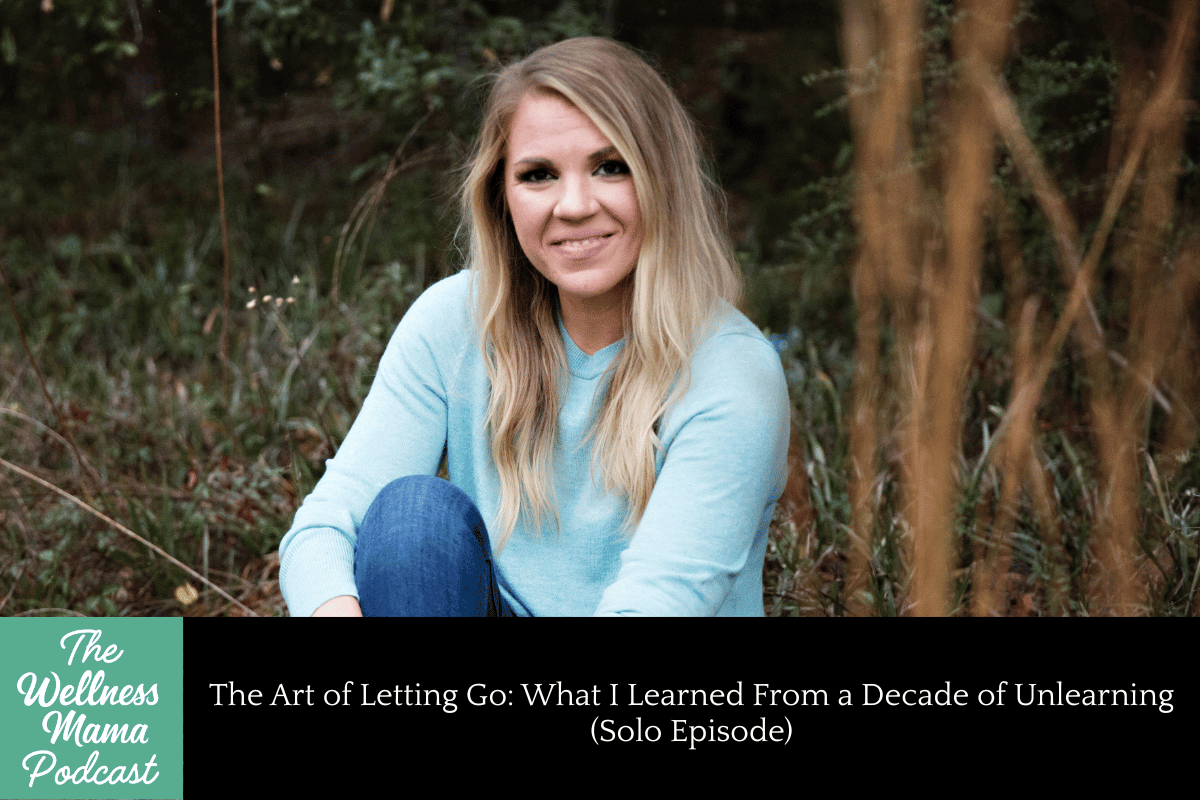
Hello, and welcome to the Wellness Mama podcast. I’m Katie from wellnessmama.com, and this episode is, I think very in line with physical health and wellness and complimentary, though not on the strict topic, because today I’m gonna talk about at least what I’ve learned so far about the art of letting go, essentially what I’ve learned from a decade of unlearning.
And I’ve, kind of hinted at parts of this in previous podcast about how I had this, quite this journey into rigid protocols and learning lots about the data and genetics and science and so much of that, and then the parts that I had to unlearn and let go of to actually finally come to balance in my health.
But before we jump in, I wanna reiterate something really important, which is that nothing I share is ever medical advice, health advice, mental health advice, or even personal advice. I actually don’t really much believe in advice. I’m simply sharing my own experience and what I’ve learned, ideas that have been helpful to me on my journey, and I offer this from a place of information and inspiration, never, hopefully, from a place of comparison, pressure, or certainly not prescription.
Because you are and always will be your own healthcare provider, and I encourage you to always be curious, to do your own research, and question everything, even and especially me. My hope is that at most, this might serve as a jumping-in point for your own experimentation with yourself. Today’s topic, I’ll hope to keep this a pretty short episode, and I’ll put some resources in the show notes if you want to read some of the things that I found helpful during this journey.
But is really the paradox of letting go, and this is not something I come by easily as a firstborn very Type A, who loves to manage the variables and keep the peace. And, I’ll talk about some of the steps of de-armoring and letting go that I experienced along the way. But for me personally, for a long time, healing and health meant doing more.
It was protocols, data, labs. I tr– I’ve talked in the past about how I had spreadsheets of the protocols I was doing, supplements I was taking, my labs. It meant more discipline, more control, more restriction. And yet, now looking back, one of the biggest transformation pieces for me was actually in letting go.
Letting go, of course, of trauma, which I’ve shared before, but also of letting go of my rigidness around protocols, of thinking I was right, of needing to constantly optimize, of expensive biohacks, of coming full circle into realizing that nature already got all those things right, and I just needed to, reharmonize with nature.
Which, if you haven’t come across his work, I hope to interview someday soon, but Dr. Zach Bush has some really beautiful podcasts with other people about this, recently about our need to return to harmony with nature, and that I feel like will be a, a whole ‘nother podcast on a separate day. But my realization related to letting go is that my life didn’t need more strategies, it needed less control, and last year was a master course in that for me, one that I did not realize I was signing up for.
That episode has aired. If you want to listen to that as well, I’ll link to that in the show notes as well. And I feel like this past decade actually has, has kind of broken me open in layers in a way that I am now so grateful for. When Wellness Mama first came to be, it was that I was researching answers to my physical health struggles, and I’ve shared that as part of the story before of learning that I had or was given the term Hashimoto’s- Which I no longer have, but even getting that initial word at first was quite the uphill battle.
And over the years, I had talked to so many doctors and practitioners. I had tried so many protocols and biohacks and supplements and all the things. I had been on restrictive diets and AIP and keto and elimination diets, all of it. And for years dialed in the physical piece. I’ve also shared how then I realized there was an emotional component I had not addressed and how pivotal that was for at least even acknowledging and beginning to accept and be aware of and understand so that I could release some of those patterns that I had from the past.
Then of course, the intensity of motherhood, the intensity of entrepreneurship, and in the last few years, all these massive identity shifts and letting go related to divorce and to rebuilding and additional pieces that I share in the episode about last year. I can say now with the perspective of having gotten through those things, that these were not just, you know, phases or hard things.
They were teachers, and I’m so grateful for them, even if I would not have chosen them. because what I realized in hindsight, what looked like breaking down at, at some points in the journey, in hindsight I can see as thresholds into new growth that I just was kind of subconsciously fighting. And I think there’s a good reason for this.
In my understanding, at least from my own experience, humans are not wired to be great at letting go. And there’s actually biology and psychology behind this as well. And I’ve talked before about safety signals. I can link to that podcast as well. But even on a biological level, we have this kind of balance between threats and safety.
And I’ve talked about this from a physical standpoint. If we want to let our body have its optimal ability to heal, we need to send as many safety signals as possible and minimize things the body considers stressful or threatening, which can be things in our environment, chemicals that we’re interacting with that we don’t mentally perceive as stressful but our body does.
Can be a mismatched sleep schedule, which the body perceives as a threat. Even overly restrictive eating for too long is huge stress signals to the body and doesn’t let it perceive safety in order to step into healing. And I’ve talked before, I’m a huge proponent of fasting when it is balanced with enough nourishment at the times we’re not fasting that the body doesn’t perceive stress.
But all that to say, the nervous system is wired to cling to the familiar, even if it’s painful. And it’s wired to resist change, even if change would be good. And this is one of the reasons I’ve had podcast guests talk about people will cling to relationships that are harmful for them or patterns or things in their life that are harmful, and they might even know that they’re harmful, but the nervous system is so wired to cling to the familiar.
There’s a lot of quotes from different therapists around this that we will cling to the familiar bad, to avoid the unfamiliar good because change feels very difficult for us as humans. And often, as was the case for me, control feels like perceived safety. Though I realized later there was a deeper layer to this, and I was holding onto this control, clinging to what I felt like was safety, but I was actually maintaining a kind of state of nervous system dysregulation in doing so.
But that said, I just wanna speak to the point that when we’re talking about letting go in any form, but especially kind of doing the inner work of letting go of whatever it is that’s our protective mechanisms, that requires a stepping into uncertainty that almost always the nervous system will code as threatening.
So that’s something to be aware of in this process. It doesn’t make it bad. It’s just being aware of that and realizing that the nervous system might need some extra support during that phase, or at least we can be aware of it so that when we encounter internal resistance, it doesn’t necessarily mean that we retreat.
And a reason for this, the nervous system and the brain, their jobs are survival, not happiness. And I think even understanding that differentiation was a huge paradigm shift for me. It’s why we choose familiar suffering over unfamiliar freedom or familiar discomfort over unfamiliar pleasure. And unlearning requires often undoing some really old wiring, even potentially childhood wiring or even pre-memory wiring, which is why this can be so tricky and which is why I’ve personally experienced many layers on this letting go journey.
I suspect there could be many more. I’m hopeful there aren’t many as hard as last year was, and if there are, that will be okay too. I just wanted to speak to as examples in case any of these are resonant to you, some of the layers that I at least became aware of and then slowly released over time.
And I’ll explain these kind of in like archetypal ways and also how they related to me personally, in case this is relevant to you. A big one for me was the good girl, and I feel like this one was wired very early for me, in ways that I interpreted that love was attached to achievement or to behaving in a certain way, or to not outwardly having big emotions, or to quote-unquote doing things right.
And this, of course, can have its benefits. It worked really well when my goal was to do really well in school and to get a scholarship. In this archetype, I was the one who didn’t wanna disappoint anyone. I was the one who kept the peace. I was the one who didn’t take up space, who did everything for everybody.
And that eventually led me into the experience of burnout and resentment in lots of key relationships in my life. And then I had to really evaluate that, that role that I was playing in a deeper way. And that one goes hand in hand with the kind of the fixer, the caretaker, the nurturer role, which of course, just like all of these, there are really beneficial, helpful parts of.
And when we run these as an identity or they get taken to an extreme and don’t balance our own actual needs as well, this was another area where I found resentment and complete burnout later on. But I had this deep belief that it was my job to hold everything together, to make sure everybody else felt happy and peaceful and calm and fed, and all the things all the time.
But the cost of this over time was personal depletion and resentment and loss of self. And I’m not saying that the pendulum then, the answer is for the pendulum to swing the entire other direction. The long-term answer is balance and taking into account one’s own needs while also taking into account the needs of those around them.
But I had to release the identity of being the caretaker before I was able to find that balance. I also had one of being the overachiever, which I can now see in the, in hindsight that I had hyper-independence partially as a trauma response, and this is one I personally, took on very, very early.
Like pre-verbally, I took on the idea that no one was coming to save me and that I had to take care of myself, and that I didn’t need help. And also connected to this one with the, the overachieving was that productivity was tied to my worth or if I was lovable. And so this, again, there’s always benefits, led me to being able to work very hard in school, to work very hard in business, to do everything for everybody all the time in my household, until it didn’t– until I hit a point of complete depletion.
And all of those were very hard roles to even consider letting go of because they did have positive benefits. And I would guess many people listening can identify with at least parts of those. I think a lot of them are very pervasive and related to childhood experiences. And again, I don’t think it’s worth throwing the baby out with the bathwater.
There’s beautiful parts of all of those. It’s, again, finding the balance. Another one that I didn’t realize I had until later on was kind of the victim story, and I’ve talked about the drama triangle before and how, victim, villain, and rescuer or savior, like I tended to… Actually, the sneaky one was savior ’cause I wanted to help everyone, and that felt good and kind, so that one was very sneaky.
But I also had a lot of victim stories over the years, and the thing with victim stories is they don’t put us in an empowering place of language that lets us t- then shift things. Because if the problem is always out there and the solution is always out there, we don’t have as much agency internally to create the ch- the changes or the life that we would hope to create.
And within my victim story in the past, I had stories like my body’s attacking itself, or I’m sick, or my body breaks easily, or I’m fragile. And I had another podcast guest recently, Mike Feldstein actually, who pointed out so beautifully in an episode about air quality actually, that the human body is not fragile.
Humans are not fragile. We’re very resilient, and I agree with him, and my push- only pushback to him was, unless we think we are, and then that story will be true. So within this kind of fragile story, that’s where a lot of my control mechanisms of overly restrictive diets or needing to control all the variables to feel okay, even my language back then often reflected that, and I would refer to life as kind of like a mathematical equation in which I was trying to control all the variables and get the right answer.
And over t- this was really for me, restriction masquerading as health, hypercontrol masquerading as, you know, health and protocols. And also there was a, like, there’s always a benefit. There was a beautiful part here as well because when I had this identity of being sick or fragile, it served me as well because, like I said so many times before, the body’s always on our side, so is our nervous system.
It doesn’t do any of these things to hurt us. It does all of these things in some perceived way to keep us safe. And for me, when I had this victim story, it helped me to have a reason to put boundaries in place that I wasn’t capable of setting at the time. So while what actually needed to happen was I needed to have more rest, or I needed to have, more capacity, more bandwidth, more ability to heal, to not take care of everyone else’s needs, always at the expense of my own.
I, at the time, wasn’t capable of verbalizing that. So having this identity of having Hashimoto’s and being so tired because of that gave me the ability to inadvertently put boundaries in place to be able to rest more. And over time, I had to learn to unlearn that story as well Another tricky one for me, and this one still sticks around sometimes, is the fear of being seen.
And I think for many people, this one is there, for fear of whatever our core wound is, and that we’re afraid if someone sees us really, that we are not gonna be lovable or we’re not gonna be worthy or we’re gonna be alone. And really often, I feel like in these cases, the thing is not the thing. It always comes from something much earlier.
It could be something even objectively like a small matter in childhood that we interpreted in a way that led to this kind of like early experience of not being good enough, not being lovable, not being worthy. And then as our mind does, it finds instances to prove that throughout time, throughout relationships.
For me, this fear of being seen, of taking up space, of being inconvenient, of not being lovable or worthy meant that I didn’t ever wanna rock the boat, so I didn’t ever speak up for things that were actually important to me. This is something I am learning slowly. I minimized or completely erased my own desires in the need to keep everybody else happy, which also minimized how much I was seen because I was more of a part of the environment, keeping everyone happy versus, being within it and staying nice instead of honest.
And that’s perhaps one of the hardest lessons for me, has been the difference between being nice and being kind. And sometimes being kind does mean saying the hard thing, and being kind does mean articulating one’s own needs so that resentment doesn’t build in the future. But those things can feel very difficult in the moment, especially if we had experiences as a child where our needs were minimized or shut down or our, we were told our emotions were too much, or we perceived in some way that those things made us less worthy of love.
So those are just a few examples of some of the identities, the masks, the archetypes that I carried willingly for a long time, and like I said, the benefits that came from them as well. When I started initially doing this work, I had this fear that if I let go of these things, if I healed, that I would kind of lose my edge because I recognized that some of these contributed to how compulsively I was able to work and kind of especially that overachiever piece.
What I learned over time is that they don’t take away your edge when you release these stories. It just lets you choose when to pick up the sword and also choose when to put it down. We don’t always have to be at war with ourselves. And so as I started letting go of these, I found some also beautiful benefits on the other side.
And my hope is I think that if we, over time we have the ability to let go of some of the, the stories and identities, not hold them so tightly, not make them I am statements, not make them part of who we are, but still keep and maintain the gifts that came with them and the learning certainly, the, the lessons, and the attributes that were so beneficial while letting go of them and getting to step into some of the benefits of not holding these things compulsively.
So as examples of that. As I started letting go of perfection, for instance, I found slowly more capacity within myself, because when I stopped trying to be perfect, when that stopped being the standard, which was never achievable to begin with, I felt much more resilient because I wasn’t always trying to meet an unmeetable standard.
And when I could reframe mistakes as feedback instead of failure, I was able to learn from them and also just address them with a much more positive attitude. I think that’s one small shift that can make a tremendous internal difference, is when we stop with the self-judgment internal script when things go wrong or we make mistakes and view them as lessons.
When our first question is, “Ooh, I wonder what I can learn from this,” or, “I wonder what benefits are gonna come from this,” we just get to approach it with a mindset that actually feels a lot better and puts us in a place to move through it in a much more gentle way. As I said, I was an overachiever and a control freak.
As I started to release my grasp of control, I found a lot more trust across the board in my life with, in, within myself, within relationships, within my relationship with my body. That was a big one. So instead of micromanaging people or relationships or my body, I partnered with my body. I trusted people slowly to take care of themselves and to not stop loving me if I didn’t take care of their every need.
Within the physical health realm, I’ve talked about this before, but I reframed symptoms as beautiful messages and communication, not threats. So instead of reacting negatively to those, I could approach them with curiosity of, okay, what is my body communicating? What does it need? How can I lovingly support it?
Versus how do I fix it? Because I’ve, what I’ve learned also over time is that the body is brilliantly and perfectly capable of healing, of living optimally, of thriving when it’s given the right inputs. So if we’re having the experience of a symptom, that message is communicating something from our body, either about what it needs that it’s not getting or that it has too much of that it doesn’t need, or it might be a place where our nervous system doesn’t have the capacity to step into a healing state because of kind of all the tabs that we’re running at the same time.
And so, I’m still working on the control one. I’m not perfect there, but I’m a lot different than I used to be in not needing to control all the variables and the situations and the people, or even to use those terms like variables anymore. Letting go of achievement as an identity was a big one, and in that I found more peace.
Because what I realized, like I said, was that it, I wasn’t losing my edge. I was just getting to choose when I wielded that sword. So slowing down, being more present, it didn’t mean falling behind, which was the fear that I had. So productivity became a choice, not a compulsion. And the beautiful gift of that is I feel like I am much more present, especially with my kids, who are my primary relationships and focus at this point in my life.
And they’re the ones that I most prioritize spending time with and building relationship with, for the re- the remainder of their childhoods. And on a more macro level, as I started letting go of all these identities in general, these roles, these masks that I wore, these roles that I performed, I found at least more of potentially myself, because I realized anything that comes after the words I am, carries tremendous weight to our subconscious, to our conscious mind, to our experience of life.
And I realized that even those… the roles and the masks that I held most sacred, like mother, entrepreneur, at the time wife, those were not my identity. Those were just roles that I was stepping into, and they’re wonderful roles, and I love to choose to step into motherhood. Ellie Rogin had a beautiful podcast called Choosing Motherhood, and I feel like I’m in a similar place right now of really prioritizing my kids, and motherhood is still just a role that I step into.
It is not who I am. Identity is deeper than that and more stable. To get a little esoteric for a second, I used to feel like… and this often quoted thing, I used to feel like a human being looking for a spiritual experience, and instead have realized, like it’s often said, that we are spiritual beings having a human experience. And that, if anything, my identity, I don’t know what I would put after the words I am these days, because I’m not even my name.
I’m not really anything. but I love the Ram Dass meditation that just says, “I am loving awareness.” And I’m not there yet by any means, but I love that as, one thing I would be willing to put after the words I am right now. And then also letting go of the stories around the identities. My friend Ryan has been on this podcast before, and he talks about what actually happened to us, and then what he calls the mythology, what we create, the story we create around those things.
And for me, much within these identity pieces, there was a lot of my own personal mythology that I had built around these roles and around these old story. And when I let go of those, I found much more freedom than I had previously had. Like I said, rewriting those I am statements. Even I try to avoid saying things like I’m sad or I’m sick or I’m anything because I’m just experiencing those things.
So even if it’s just the small verbal shift into saying I feel tired or I feel sick or I feel happy because I don’t wanna overly identify with the positive emotions either. But letting go of those past stories around my old identities made more space and more freedom for a new potential future that’s still unfolding.
I’ll keep you posted how it goes. But there is an emotional side to this as well. Even if we can mentally understand all of those pieces and cognate our way through identities, there is an emotional underlayer as well, and this is a large part of what I experienced in a big way last year. And I feel like a lot of this goes hand in hand with releasing old roles and unlearning old stories.
But the emotional side is there, and I don’t wanna discount that because for me, it was quite the experience, and I would guess for many people, shifting or releasing stories and letting go, these are parts we encounter, and they’re wonderful parts, though they often feel uncomfortable or get framed as negative.
In my personal experience, there is a grief that comes with letting go, even if the letting go is a good thing. And this grief often is a necessary part of growth and one we aren’t meant to hide from but to embrace, which is easier said than done. Again, the nervous system doesn’t like change, so there is grief in letting go.
And letting go feels like a loss because it is. We are losing a part of what we once were to make space for something new, but that doesn’t make it less uncomfortable in the moment. It’s a rebirth of sorts, and birth, while miraculous and incredible and transformational, can also be uncomfortable and intense, and that doesn’t make it bad.
That makes it part of the human experience. And so I’ve tried to, certainly not perfectly, but remember in those moments where I do feel grief or anger or sadness or whatever it is, to realize that that discomfort is a doorway into something new, and there still might be an adjustment period. And humans aren’t wired for change, and I can give myself grace in that adjustment, but to not view the doorway as one I should close but one that I am able to step through. And all that said, that’s all probably a bit more, like, conceptual versus practical, so I wanna also talk about some of the tools that I found helpful along this journey.
Things that actually practically helped me let go, and I do also feel like this is a practice, not an overnight decision by any means. I wish it were that easy. I will link to some books that I found helpful along the way in the show notes. A big one was, over time, creating habits that helped me rewrite my internal language.
So like I said, anything after the I am statements is big. Also small ones like, and instead of I have to, I choose to, or I get to. Moving away from feelings like or language like I’m trapped or I can’t or the victim stories into, I’m responsible for my freedom. That could be its own whole podcast, but I think to the degree that which we accept responsibility for everything in our lives, we have the ability to change it, and there is tremendous yet scary freedom in that.
I think this was also a big part of my experience of last year, was not wanting to accept the reality of what was, not wanting to accept my responsibility for what was, and kind of wanting to fight, and that’s why I, as I said in that podcast, had a very long temper tantrum with God and the universe.
Also from instead of saying I can’t, say I’m learning, and staying… That one really to me speaks to having curiosity instead of judgment. And I think that alone, if we could all, all just have slightly more curiosity about things versus judgment, slightly more willingness to question and be wrong than certainty that we’re right, I think that would go a tremendous way as well.
I love the quote that I would rather have questions that can’t be answered than answers that can’t be questioned. Now, because the nervous system is wired to not like change, there is a nervous system component to this, and I don’t think we can just, like, mentally willpower our way through nervous system change.
I think this actually requires a little bit of understanding and a little bit of partnership with our nervous system. I also, like I’ve said on this podcast before, if we’re talking about nervous system regulation, this does not mean we are calm all the time. This means our nervous system can appropriately respond to what is and not over-respond or not under-respond.
If we were actually, like, perfectly zen all the time, that would not be the marker of a healthy nervous system. That would be the marker of a nervous system that is maybe stuck in a freeze state or doesn’t respond when it’s necessary. The problem is in the modern world, we get so many inputs to respond to that we don’t need to respond to, that for many of us, our nervous system is kind of in the on position all the time.
So these, I feel like this is a very personalized journey, but just as kind of broad concepts, some things that can be especially helpful for supporting the nervous system and I feel like especially for women as we now are understanding that women and men have different nervous systems that run on different motivating factors.
So overly simplified, but in general, I’ve heard that men have a more dopamine-driven nervous system, so they can actually do great with achievement, challenge, battle. That’s why, like, men tend to gravitate towards sports. There’s an element of that there. Whereas women’s nervous systems are more oxytocin-driven, so by slowness, pleasure, connection. Of course, our babies, there’s a beautiful oxytocin bubble there. But we’re wired for that, for that connective, nurturing, calmer side. And so things that helped me were, as I’ve talked about in multiple podcasts, supporting my nervous system through light exposure to signal that it was safe through any safety habits I could create in life.
Also through movement, because movement is a nervous system cue that we are safe. Through breath, that’s a very powerful tool for influencing the nervous system and communicating safety. Sleep is of course huge. Connection directly with the Earth. And then some uncommon ones that I think are vastly underrated that I was…
I, I had trouble at first with, with just fear of being judgment ’cause that people pleaser. But dancing and humming and singing, those are things that help our nervous system to know that we are safe. Because just overly simplified, we would not be taking a break to dance if we were being chased by a tiger, for instance, the overly used metaphorical example.
But if we do those things, w- it’s a way to somatically communicate to the nervous system that we are safe. And then a big one I mentioned already, but I wanna highlight, is as much as possible trying to stay in a state of curiosity over judgment. I think this alone would shift so much. It shifted a lot for me as I learned it slowly.
But questions about like, what does my body need? Or why am I doing this? Versus what’s wrong with me? Why can’t I get well? Why am I sick? The, the subconscious and the nervous system will support and answer whatever questions we give it, and I feel like curiosity is what actually opens the door for letting go and unlearning.
Now, another part of this for me was learning boundaries, and like I said, I was really not great at this in the beginning. Having the experience of Hashimoto’s let me inadvertently create boundaries because I wasn’t capable of saying them myself. As we step into whatever our kind of like unlearning is, as we learn to let go, saying no becomes, or at least for me, part of the experience and the practice of letting go.
I remember how overwhelmed I was when I really was very much incapable of saying no, and so I would just do anything for anybody, and I actually lost some important relationships in my life when I started saying no out of true need for my own health because I had reached such a state of burnout, and I was truly at capacity.
But I had friendships that fell away because they were built on a, a genuine desire of wanting to help those people and I was always, in hindsight, over-giving, kind of in some instances to a very extreme degree. And then when I needed to put boundaries in place, instead of being met with understanding, I was met with like probably triggering their abandonment wounds, because I had created that in those friendships and them not understanding, or not agreeing with my need for my own rest and for my own capacity, and so I had several friendships fall away.
So boundaries aren’t always easy, and in my life at least in hindsight, they were very, very necessary. And with this, there’s also an element of allowing, and this kind of is part of the flip side of needing to be in control is allowing. I feel like the very popular book, Mel Robbins touched on this a little bit of just like let, let them.
Let people think what they will. Though I feel like it goes a little deeper than this. I personally love the book Letting Go by David Hawkins, and I’ll link to that in the show notes. But there’s so many layers of things that if we’re able to let go of them, can reduce our stress load and give our nervous system more capacity, like the weight of other people’s opinions or emotions.
Letting our own emotions exist without judgment, letting other people’s emotions exist without judgment. Not bypassing them, but also not creating stories around them. I’ve heard if… I don’t know if this is a correct statistic, but I’ve heard that emotions themselves last for only at most a few minutes, and that the, anything that lingers beyond that is actually the story that we’re creating around the emotions.
So I feel like this allowing piece is, other than the things that actually truly require our immediate attention and presence and c- and effort, which are far fewer than I used to think they were, to just allow things to be, allow people to have their own journeys. Allow emotions to exist, both your own and other people’s.
Allow people to be wrong about you. That was a big one, and I’m grateful that my capacity to sit with discomfort and allow people to be wrong without needing to… wrong about me, without needing to defend myself. Allow people to have other experiences and opinions and stories. Kind of allow, letting go of the need to be right at all, which I’ve talked about, while not bypassing.
The practice I’m currently doing in learning to cultivate this is trying to cultivate gratitude in every moment before I know what good might unfold. I did not nail this last year. It, in my kind of hardest year that I’ve ever experienced, though toward the end I started to have small experiences of this, of not saying like, “I’m grateful for this because something good will happen,” of just saying, “I am grateful for what is.”
The stoic idea of amor fati, love what is. Not because it’s what I wanted or perfect or any of those things, but more kind of on a higher level realizing everything works out perfectly, even if it’s not what I would’ve wanted, and just finding the gratitude. And when I actually found a little bit of genuine gratitude for the suffering, it stopped feeling like suffering, and I was able to develop a little bit more curiosity around it and let go of holding so tightly, which also ties into the control. For me, there was also, like I said, I, I mentioned in the friend capacity, but there was a tremendous amount of letting go in relationships.
There are some that I can’t even fully share yet, and some that have been incredibly painful in this process, but releasing roles that weren’t aligned, ending chapters with grace, hopefully. Sometimes they were not with grace, but with friends. I went through a divorce several years ago. Many of you have heard that story.
Really for me, learning how to love people without losing myself, and I’m still very much on that learning process. And I would guess if I were my own therapist, that part of my, at the ti- at least for now and potentially forever, desire to not have any more romantic relationships is from a woundology and from a fear of losing myself if I were to enter into another partnership. Along with what I consider the more important motivator right now, which is that for the rest of my kids’ childhood, they are my priority.
And it’s not worth it to me to pour energy into a partnership when my kids also are such beautiful relationships in my life, and I would love to keep my energy there. Another part of this in relation to relationships that I did not learn early on and that I suspect perhaps things could have been a lot different in my marriage and in several very important friendships in my life is if I had learned earlier not to try to take responsibility for other people’s emotions.
In hindsight, and especially in early relationship, I was really good in that people-pleasing role at chameleoning into whatever the other person needed to feel happy and safe and comfortable and all the things. But that came from a place of unsafety within myself, and so I would take responsibility for other people’s emotions so that nobody…
I didn’t want anybody to ever feel upset or angry or disco- like, any kind of discomfort. But I did that at the expense of myself, and I do think it’s possible to have a beautiful balance there. I think there… I’ve seen examples of amazing, beautiful relationships where both people are truly in service to the other without losing themselves, and it creates this beautiful dynamic.
That just wasn’t a lesson that I, at the time, had learned or was capable of. Another big one, perhaps a very tough one because the identity and the role of mother is understandably so important and our kids do depend on us for so much, but letting go in the role of parenting has been a place of growth that I’m also still very much on the journey of.
And this ranges from letting go of the kind of more obvious ones, like letting go of perfection- perfectionism when it comes to parenting or comparison or living vicariously through our kids, and allowing them to be, as I’ve said before, their own infinite autonomous beings from the time that they are born. While of course taking care of them in the role that’s physically appropriate.
Paul Blanchard, who I has had on this podcast, he had explained this beautifully in the idea of a horizontal relationship of parenting. It doesn’t mean that we don’t ever have a little bit of a hierarchical dynamic where we have to make decisions for them, of course, when they’re young, but from a place of always equal respect and honoring their agency to whatever capacity they are able to at the time.
And I feel like for me, this journey has involved learning to parent from a place of curiosity and connection, not from control, and there was some unlearning I had to do around that, just from how I was parented, from parenting books I had read early on, or from advice I had been given. I remember getting the advice early on, that I’m very grateful my intuition, blatantly refused to listen to, but from someone on my husband’s side of the family who gave me wooden spoons to, quote, “dish out discipline” and told me to, like, basically that I needed to break my kids’ will before they were toddlers or that they would just run all over me.
And even though I was very young at the time, something in me was like, “Absolutely not.” And I’m very grateful for that. But instead, over time, I’ve learned in a deeper way how to nurture curiosity and connection instead of leaning into control and really wanting to genuinely learn who my kids are and help them discover that versus tell them who they are and what they should do.
‘Cause some of my own letting go actually was around the roles that were given to me and feeling like I was a disappointment for not fulfilling those roles appropriately. And of course, that reared its head with choosing not to complete college, which was a, an important value for different people in my family.
Getting divorced was a huge one because that, like I was breaking a role that was kind of expected and felt like I was being a huge disappointment, so I got to face internally the fears of around that. But when it comes to parenting specifically, like I think also this falls under the idea of realizing we’re raising adults, not children.
And so that to me speaks to like honoring their agency even from a very young age. Not to say we don’t guide them, but we guide from respect and connection, or at least that’s my goal. And then the last category where I have felt like I’ve done a lot of letting go over the last decade has been in the health world.
Which I think the, the undercurrent of this actually, the biggest shift has been moving away from fear-based decision-making around health and into, loving, supportive decision-making around my own health and communication and friendship with my body. And this looked like releasing fear-based biohacking.
I do think many biohacks can be very helpful, and I think nature already got a lot of those things right. I’ve talked about this before, but red light is available at sunrise and sunset. Grounding is available for free outside. Movement, you can go for a walk outside. So many things that we would biohack actually exist in nature in a very harmonious way.
So releasing the fear that was driving those things and coming from a place of love instead meant I rel- released a lot of fear-based decision-making, fear-based biohacking. Learning to eat with my intuition more versus following a protocol or especially following a restrictive protocol, which often came from fear.
And there was a point where I was only eating maybe 10 foods. And now there’s actually no foods that cause any kind of reaction that’s uncomfortable in my body, and I try to still choose foods from a place of love and what most nourishes my body versus being afraid of the gluten, the dairy, the soy, the whatever the things are.
And it’s not that I maybe eat that much differently from an outside stance, but the inner motivator of that has drastically shifted. Hopefully in line with cultivating more trust in my body, more faith in its innate ability to heal and knowledge that it’s always on my side, so I’m not… I’ve released this feeling of fighting my body, trying to, quote, “fix it from the outside or get it to do what I want it or to look a certain way,” and instead trusting it, accepting it, realizing how it has been on my side from my earliest memories, how it’s always worked to keep me alive, keep me safe.
And even the things I categorized as a problem, like thyroid things, for instance, were actually my body doing exactly what it needed to do to do the best it could with what it had in that moment. So approaching my body with a lot more grace and trust, dissolving that fragile body victim narrative, which was a sticky one, and I still find places of that occasionally.
And letting, letting go as I’ve gone on that, I now look as kind of like- Look, instead of as metrics of the data, the labs, all the things, though I still occasionally do those, letting joy and presence be my metrics and do the things that I’m doing, cultivate more feelings of that within my body, more feelings of comfort and grace within my body, and within my life as a whole.
So that got a lot longer than I expected, but to summarize, I’ll keep this brief. This to me is an ongoing practice, perhaps a practice of our whole lives that we get to go on in this beautiful journey. Letting go is not a one-time event. I wish it were as simple as a decision and then it were done, but it, it, it truly is a practice and an ongoing one.
It’s a spiral in the way I see it with layers that we continually get to experience, and kind of the way at which we approach those sort of sets the tone for how we are able to navigate them. I feel like in this human experience of life, every season comes with its own requests for letting go, asking us to release what no longer fits so that we can step into the new season, whatever it is.
So that’s part of the reason why this is a lifelong process. But cultivating a trust that what comes next is also gonna be beautiful, even if our nervous system might not feel that in the moment. And I feel like unlearning for me is the real curriculum of healing and growth and health and wellness.
And I admire so much when I’ve seen others in the health and wellness world who can admit where they’ve grown or changed or what they were wrong about in the past or what they’ve shifted their views around. And I think for all of us, like staying in that curiosity and being willing to question things, even things we once held very strongly, is a marker of growth.
So thank you so much for joining me today, for sharing your time, your attention, your presence. It means the world that you take time to listen to these podcasts, and I would genuinely love to hear your feedback. I’d love to hear if you’ve had areas where you’ve had to let go and how that process has been for you.
If you found this episode or any episode helpful in any way, the best way you can support the show that I would be so grateful for is if you could leave an honest review wherever you listen to podcasts, which helps other moms and families find and listen. And if you wanna stay in the loop with episodes, behind-the-scene updates, resources, and my favorites each week, be sure to subscribe to my VIP email list at wellnessmama.com, and I hope that you will join me again on the next episode.




Leave a Reply