Read Transcript
Child: Welcome to my mommy’s podcast!
Katie: Today’s episode is brought to you by LMNT, which is my go-to electrolyte drink for staying hydrated and feeling my best every day. I have used this for years, and unlike many sports drinks which are loaded with sugar, LMNT delivers a science-backed blend of electrolytes with the sodium your body actually needs, especially if, like me, you live in a hot climate, sauna regularly, or work out regularly.
Whether you are working out, walking the dog, traveling, or simply trying to keep your minerals and your energy levels up, LMNT makes this simple and delicious. I keep their canned ones in my fridge all the time now, and their convenient salt packets are perfect for tossing in your purse, your gym bag, or your carry-on, so you are never without electrolytes when you need them
My kids are also a huge fan, especially of their new pink lemonade. What I especially love about LMNT that they have so many flavors now, so it’s easier to drink throughout the day. If mixing isn’t your thing, they also now have what I love, their new sparkling canned beverages that give you the same electrolyte benefits but in a ready-to-drink format. And those are a favorite among people who visit my wellness center as well. Adding LMNT to your daily routine is one of the easiest ways to support hydration and help your body perform at its best. I also find very helpful if you’re a breastfeeding mom.
So if you’re looking for a simple upgrade to your wellness routine, give LMNT a try and experience it for yourself. They have some delicious new flavors like lemonade iced tea and pink lemonade, and they always have their happiness guarantee. Go to drinklmnt.com/wellnessmama for a special offer.
This episode is sponsored by BON CHARGE, and specifically one of my favorite things that they have, which is their PEMF mini mat. If you are new to PEMF, this stands for pulsed electromagnetic field, which is magnetic energy that’s being sent into the body via this mat. And these energy waves are fascinating.
They work with your body’s natural magnetic field to elevate your wellbeing in a multitude of ways. Similar effect that we would have from being in direct contact with the earth, which I also think is an amazing thing to do daily. I love PEMF mats to improve sleep, to ground me, to increase calmness.
I often say that sitting on one of these mats, I feel like a cat in the sunshine and just, like, so calm and cozy. Some of the reasons I personally like this particular mini mat, it is small enough to fit in any room, and it’s easy to move from room to room. I also have a larger one, but that one is more difficult to move around.
There are different settings, so you can find what works best for you, and it’s low EMF. Some of these are not. I feel like this is an important thing to pay attention to. Some easy ways that you can use a mini mat like this: it’s great on an office chair or on a sofa or on the floor, wherever you are sitting and reading, meditating, working, et cetera.
I love to use it before bedtime or after a workout or I’m actually doing yoga teacher training. I’ll often use it during restorative classes or when you need kind of like a creative boost or a brain reset. And like I said, I love how portable this one is. You can find out more about it and get a discount by using the code wellnessmama at wellnessmama.com/go/boncharge
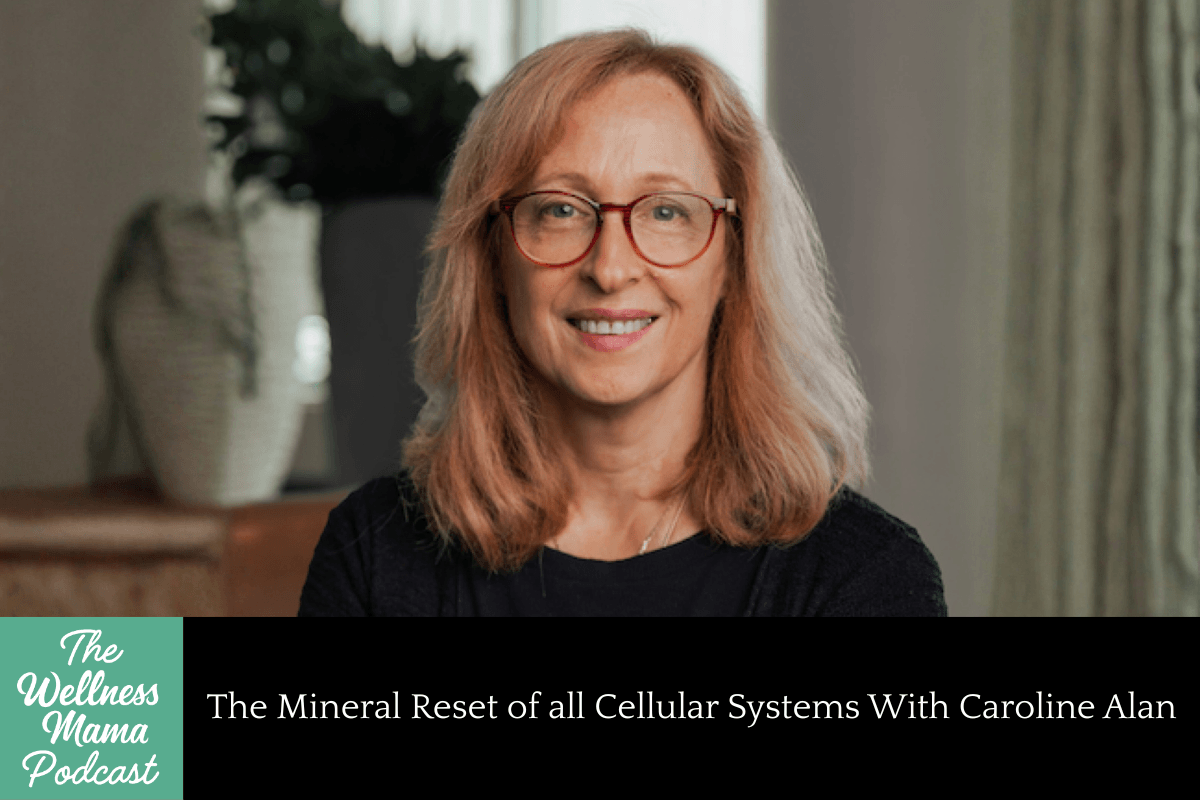
Katie: ?Hello, and welcome to the Wellness Mama podcast. I’m Katie from wellnessmama.com. And this episode is part, I think three, at least two, with Caroline Allen, who is a health survivor, a mineral expert, and an educator on a mission to shift the way we think about cellular health and, as she says, to make humic and fulvic famous.
And we talk about her story today and the way that she– her personal journey and her corporate journey and how she’s addressed both of these. But you guys know I’m a huge fan of the topic of minerals, and I feel like the ones we talk about today are not often included in the conversation enough because they actually, in my mind, are as important as the basics of sodium, magnesium, and potassium, but not understood in the same way.
And these are more like a foundational ecosystem-wide support, when it comes to minerals. So she explains it better than I can. And in this episode, we go into the mineral reset, how this replenishes all cellular systems, how these essentially work like an ecosystem within the body, and so much more. Let’s jump in now.
Caroline, welcome back. It’s such an honor to have you here again, and I’m so excited for us to get to chat.
Caroline: Thank you. It’s always a great time when I get to spend with you. It’s been fun.
Katie: Well, and I love chatting with you, and I love the topic of minerals. People probably have heard me talk about this in various ways a lot over the years, and I keep coming back to it because I really do think it is so foundational and important.
And actually, I wanna let people into a little bit of our conversation that we just had before we started recording, which is kind of your journey that led you into understanding the importance of minerals. And, I’ll share that from my personal journey right now, being postpartum, I was already a huge fan of minerals and making sure I got those.
I think that’s part of the reason I had my easiest pregnancy at almost 40, and I’ve had a very easy postpartum, but they’ve made such a huge difference, and I didn’t know as much as I know now when I had my next youngest child 10 years ago. And I feel like your story speaks to this, my story speaks to this, so let’s jump in there with your story and what you kind of like learned along the way the hard way.
Caroline: Yeah. You know, I was, I ha- I struggled with fertility when I was young and, and I’m, I’m sure that I, throughout my life, I was mineral deficient. I’ve had, autoimmune things. I’ve had, just als- like gluten intolerance, real, lots of gut problems. And then I had three miscarriages and ended up trying fertility drugs that didn’t, that just about made me crazy.
And but I ended up having two children, and they were… I, while I felt good while I was pregnant, as soon as I had the babies, I struggled. And it’s only now after many years of really understanding how minerals work in the body at a foundational level and, and, really support the building of a baby and also the, how, how everything relies on that.
All the macros, you know, the proteins, fats, and carbs, and the utilization of those in your body relies on the micros, the micronutrients. So, now that I know that, I’m, I really wish when I was postpartum that I’d known about that ’cause it would’ve saved me years of all sorts of problems including flatlined adrenals, gut, problems, inflammation in my mouth with gum, periodontal disease, bone loss in my teeth, you know, continual illness, you know, just a trashed immune system.
And then as I hit into perimenopause, a whole issue of sleep and not sleeping well.
Katie: Yeah, it seems like so much is connected when it comes to minerals, and the, the way I kind of view it now is, like, minerals are sort of the foundational pieces that sort of, like, signal the nervous system safety, for one, and also that are, like, connected to almost everything that happens in the body.
Like, a lot of people might have heard of different minerals and how they’re used in hundreds of enzymatic reactions within the body, but what I love that you talk about is it’s not like we’re playing, like, a simple, like, A equals B game when it comes to the body. There’s not, like, a single cause, single effect.
This is a whole ecosystem-wide thing, and that everything works best when the entire ecosystem is supported and everything is communicating basically in a symphony, not a single note. And so I would love to kind of take that analogy into understanding minerals on a deeper level, and specifically fulvic and humic, ’cause I would guess everybody listening, of course, has heard of minerals in some capacity.
That’s not a new word. But many may not have heard of fulvic and humic and why these are a little different and complementary and important, I feel like, even if you are doing… getting the others from food or getting the others from different sources, you still might need this missing piece.
Caroline: Yes. and, and really to help people understand it, my job, or one of my jobs, is to make fulvic and humic famous.
I wanna make them so, you know, everybody’s heard of. You know, they’re, they’re the celebrities of mineral replenishment. But to do that, I, I wanna create a little picture in people’s minds, and to understand minerals in general, if you think about your body, most of us kind of think about our body like a car, you know?
And when something’s wrong, we take it to the mechanic to fix it because, you know, they know more than we do, and we, we go to the transmission doc and, you know, or person, and we go to the engine person and the tires and, you know. And then, and we also think of our body that way in terms of, you know, fuel.
You know, we’re gonna… We think about carbs, fats, proteins, what we call the macros, and, and we think we- all we have to do is kind of put it in our mouth and we’re good, you know? Chew it up and, and we’re good. But the, the sad fact is that what we’re really doing a lot with, particularly with supplements and, and mineral supplements in particular, it’s sort of like if you went to the gas station, and instead of putting the gas in the gas tank, you filled a cup with gasoline and put it in your cup holder. It obviously wouldn’t power your car.
And so without the understanding of how minerals actually get into the body, into the place where they can provide the fuel that they are in your body, in fact, most of us don’t even recognize that minerals are the fuel that are translated or transferred into energy in your body. And the way I like to describe it is if you’re gonna build a campfire, you’re gonna need some wood.
You’re gonna need some heavy fuel that’s going to burn, and you’re gonna need some tinder, some light stuff that’s easy to light. The minerals are like the heavy fuel, the wood, and the tinder is like the amino acids in, that many of which are in your body, also some that you get from your food. The match, the thing that allows all of that to turn into energy, is something called the mitochondria, and these mitochondria exist inside your cells.
Now, the sad fact is most of us have no i- like we have, we, none of us, most people in the world don’t recognize how energy is generated in your body. And if you have enough fuel, enough mineral fuel, enough amino acids to work together with those minerals, you can generate about 1,200 watts of electricity in a day.
Your body generates about 1,200 watts of electricity in a day, and that’s enough to like power your blender and your toaster. Like it’s, it’s a fair amount of energy. But if you don’t have enough of those minerals, that heavy fuel or the tinder to support the lighting of that fuel then what happens is you- your body can’t generate enough energy.
It literally, not enough campfires are burning bright in your body. And so what ends up happening is your body can’t do everything, and it has to pick and choose, and it says, “Well, okay, hair, that’s not important,” and your hair starts falling out. And nails, they’re not important, and they start chipping. And your skin, well, we’re gonna keep it s- your body’s like, “Okay, I’m gonna do the best I can,” but the skin starts to look dull, ashy.
You know, you start sloughing off a lot more cells. Your gut, maybe you have a little inflammation, but your body c- doesn’t have enough energy to totally clear it. Or, you know, you get s- your in- you encounter bacteria from somebody sneezing, and your body doesn’t have enough energy to fight off that bacteria, so it takes hold, and you get sick more often.
And on, and also your nervous system, your cells send a signal to your nervous system that sounds like this: “We don’t have what we need. We don’t have what we need. We don’t have what we need. Go looking. We don’t have what we need. Get up. Go looking.” And then you find yourself reaching for sugar, reaching for salt, opening up the fridge and after hour- after you’re, you’ve, you’ve eaten dinner, or struggling to take your deep rest and get into deep rest because literally your nervous system is amped up from not having what it needs.
So it’s a, it’s, it’s like this foundational piece. So that’s, that’s just the, that’s just kind of the landscape of minerals.
Katie: I love that explanation. And just to double-click on what you’ve said, I’ve said a version of this, but you put it so much better than I have of when it comes to cravings. I say so often the body is very wise, and it’s always on our side.
So if we’re having cravings, it’s because the body is not getting something it needs or it’s getting too much of something it doesn’t need, and it needs us to make an adjustment. And it’s not that our willpower is the problem, especially with women. I see women getting, like, really down on themselves and thinking it’s their willpower or they need to diet more or do more.
And very often, like, your body is trying as hard as it can to signal you something very important and hoping that you’re gonna listen. And when it doesn’t work, it’s trying to get you to eat and drink anything possible to hopefully get those nutrients that it needs. This is not a body having a problem.
This is a body trying to communicate with you. And I’ve been reminded of that in the postpartum, after even just from sheer… Even though I’m getting a lot of the minerals that I’m eating more than I was eating before to make sure I’m making enough to breastfeed, I still will randomly feel cravings.
And instead of resisting them now, I go, “Okay, it’s probably not just basic carbs. What does my body need that it- I’m not getting that it’s trying to signal me by craving this thing?” And it’s been a whole different experience postpartum, and I love that you kind of tie that into why the minerals are the foundational piece there as well.
And I’ve heard you talk about, especially when, with fulvic and humic, that anywhere, what did you say? Anywhere that there’s an ecosystem, these exist, including in the body. And I love this connection to nature because I talk so much about how almost everything in the modern world could be categorized as nature deficit disorder.
And I feel like this applies to our not getting enough fulvic and humic as well. Like, this used to be part of our ecosystem, of our body, of our lifestyle so naturally, and it’s not now. But can you explain what you mean by anywhere there’s an ecosystem, these exist?
Caroline: I just love that nature deficit disorder. Oh my gosh, Katie, that’s amazing. Yeah, so, so here’s how the, here’s how natural ecosystems work, and we’re specifically talking about natural cellular ecosystems. And all life on Earth is cellular. It’s all… And your entire body is made of cells. All the trees, all the animals, you know, it’s all cells. And so there’s really cells, and then there’s minerals.
So if you look around you and you look at all of the structure, whether you’re walking and you’re seeing, you know, rocks outside or trees, I mean, all of the… Or your body, all of the structural elements in your body, it’s all minerals. So it’s cellular life and minerals. That’s, that’s, like, what we have. And gases.
There’s also gases. So- The thing you have to recognize when you’re thinking about ecosystems is, let’s think about a forest. So in a forest, when the way it works is plants grow, and the way they grow is they have roots, and the roots are in the soil, and the soil has minerals and nutrients. And the, the roots of those plants absorb the nutrients through their roots, through the surface of their roots, the same way you absorb nutrients through the lining of your gut.
So it’s, it’s the same kind of absorption process through cells. Cells actually recognize a nutrient and they absorb it into, in the plant, it absorbs into the plant. Now, the plant grows. At a certain point, in nature, the way it works is the plant dies, and as it dies, it decomposes. Now, nature did an amazing thing.
It said, “Well, I’ve got all these plants. I’ve got all these nutrients and minerals that make up this plant. What I’m gonna do is decompose those plants and create molecules that support the life of the future plants.” Make… So what it did is it created, nature created humic and fulvic, and humic and fulvic are mineral-rich molecules that are truly the way that, that the Earth stores energy for future use by plants and animal, for, by cellular life. So humic and fulvic represent stored energy for cellular life.
But they, what’s even cooler about them, so they, they have all the minerals your body needs, as an example, in the proper ratios that your body needs them, but even more so, they are very, they, we call them effectors. So they’re molecules that are functional. They have specific capacities that enhance nutrient uptake into cells, and also provide detoxification for cells and cellular systems.
And it totally makes sense because since every single cell on earth requires minerals, and all those minerals have to come from the outside, nature had to create something. You know, in nature you can’t, it, the tree over there doesn’t go, “Okay, I need, I need 500 milligrams of magnesium. I need 250 mil- milligrams of potassium.
I need…” No, it, it needs all of it all the time. And so nature created pre-formulated molecules that have all the minerals for all the cells, all the cellular life, and then made them ubiquitously, like, completely available everywhere, because plant life, as it decomposes, is, it, the, it, it’s a lot of places.
And then it allows the cellular life to access it, whether it’s through water that is drunk or whether it’s through soil, because things are grown, the plants are grown in soil, and you eat the plants, or you even eat meat that ate plants that grew in that soil. So it’s, it’s what I call the sustainable loop that nature relies on.
And sadly, we’ve disconnected from that because we cultivate. So we grow plants in soil. We take it a- we harvest it. We take it away. We, you know, we eat it far from where it’s grown, and we never get those nutrients back into that soil. And so, you know, as you well know, nutrient depletion in our soils has been a problem since the 1930s, and it’s only now with regenerative farming that we’re actually starting to turn that around.
Katie: Yeah, and I love that the way you describe that as kind of like these are so connected to life on a cellular level, and they exist in, like you said, in every ecosystem. And they communicate not just the biochemical. Like, I talk a lot about this as well. Like, it’s not just… Like JJ Virgin says, “Your body’s not a bank account, it’s a chemistry lab,” which is true.
And, and I add to that, it’s also not just a chemistry lab. It’s this amazing, incredible quantum signaling computer that is fully in touch with its environment in this electrical voltage-based synchronous way when it’s functioning properly. And so the way you’re describing these, this is something coming from the earth.
It has that light information, the correct signaling information, the same communication that plants use and that humans use and that animals use, and that exists throughout the entire ecosystem. So it’s really building the foundation that lets everything else be coded sort of correctly, and all the right information flow in and out.
And I love kind of that paradigm shift into a voltage first understanding of the body. If we think of ourselves first and foremost as electromagnetic beings and biochemical second, then we’re not left with this, like, reductionist idea that my body just needs X amount of this thing and X amount of this thing, and a supplement’s gonna fix it.
Because to your point, if the ecosystem is having a problem, you can, and people have probably experienced this, dump all of the supplements onto a gut that can’t absorb them, and you’re not gonna get the benefit. And so that’s what I love about this. And I wanna make sure we shift gears too, and also talk about, ’cause you cover a lot of this in such great detail in your new book, The Mineral Reset.
So I’d love to hear kind of what inspired this book, and, like, sort of a- anything new that you learned or that was reinforced for you along the way in the research and writing of it?
Caroline: Yeah. Thank you so much. Well, it was, was quite a process, and what really inspired me to write The Mineral Reset is that minerals can be a very complex subject, and I’ve read…
I, I went out looking for good books about minerals, and what I found were, you know, either thick tomes that were really reference books that will tell you, you know, what does selenium do or what does chromium do or, in your body, and it will… It’s more of a reference, book. Or else there were very technical, highly technical, documents and, and books that really only either scientists or very geeky practitioners would read.
So I wanted to create, a knowledge base for people and make it incredibly accessible to anyone who sat down and read it. And the reason that I wanted to do that is because I was a person who was extremely ill, and I was really felt hopeless. I wanted to give up on life, and, and I had so many hits. I mean, I had eight or nine different chronic symptoms that were hitting me, and when you have that many symptoms, just like the people you talk about, you know, I thought, “Well, it’s just because I’m not strong enough.
I’m not, you know, disciplined enough to, to have a very…” And I’m, I’m actually very disciplined, and I eat really well, and all of the… I do all of the things, and I exercise and all those things, but I just thought there’s something wrong with me. And when I went to the doctors, they kind of underlined that by saying, “You know, well, maybe you just need antidepressants, you know?
Maybe, maybe it’s just, you know, your, your, something’s wrong in your head.” And then just taking minerals, and, and this is the thing is, you know, this was about 2010 when I really hit my bottom, and I was introduced to plant-based liquid fulvic and humic, and I just started taking them. And I, I didn’t have any hope that they would make a big difference, but it was only by taking them, like I changed nothing else in my diet, nothing else in my lifestyle, nothing else in my eating style.
And just by doing that over the space of eight or nine months, all these different symptoms that I had been struggling with for years, for years resolved to the point where like today as an example, I’ve been a, an insomniac all my life, really struggled to sleep. And now I sleep through the night most nights. And that alone, just that one thing alone is miraculous.
But also now my gut is very healthy. I mean, I have… I used to struggle with constipation or, just elimination issues, bloating when I ate, even after being gluten-free for seven years. And now, and I also had kind of that weight gain issue, you know, where you start, as, as women get older, they start gaining weight around the middle.
Like, I don’t have that problem. And I’m, I’m literally every day I’m, like, surprised. And so I wanted to get this super foundational information to people because it had helped me so much. And the first was to create our company where we brought these humic and fulvic products to the world because I was like, “If they help me so much, think how many people they’re gonna help.”
But then I wanted to provide the, the context, the information because first of all, I believe that mineral replenishment is the vanguard of health, so it is the next big health issue that is gonna come to the fore. I mean, there’s, there’s a lot of talk about soils, which is very important. There’s been a lot of talk about gut health which, of course, is very important.
Now there’s a lot of focus on cognition, which is also really important because of the stress that’s happening in the world. There’s lots of issues people are having with cognition, and mental health. And the, the cool thing is that minerals support all of those things. And if we can start with minerals at the foundation, then all the other things are gonna help.
So, so I wrote the book to, to get that foundational information out there. And what I put in the book were what I kind of took people through my journey, my aha moments of as I researched why minerals had helped so many things in my life, I wanted… I, I had these, like, big, like, oh my gosh, and I’d go back to my friend who introduced me to them, who’s now my business partner, and I go like, “Did you know this?”
And he’d go, “Yeah. Now go look at this.” And I would– I kept researching. So I wanted to, in the book, I wanted to take people through the aha moments. I also wanted to help them really get started, so I gave, you know, a te- there’s a whole section on testing if you wanna get tested. There’s a whole section on buying minerals, a buyer’s guide.
There’s also a reference section where you can look up a particular health issue that you’re struggling with and learn about its relationship with minerals in your body and how you might support it. And then there’s, there’s a mineral reset program as well, so one that you can… It’s actually really your opportunity to reset your ecosystem.
Thanks for letting me talk so long.
Katie: I love that. Like I said, I love this concept of the ecosystem, and I feel like in these now almost 20 years, which is crazy to say, that I’ve been in the online world in health and wellness, everything has come so full circle. Because for a while I was getting deep into the research, and of course, there’s so much fascinating research on genetics and these very specific compounds, and bio hacks, and all the shiny fancy new objects.
And I do think those can have their time and their place, but over and over again, what gets reinforced for me is those simple foundational things that the body needs, and that the body is so wise, and that when we give the body what it needs, it can resolve most things without us having to get super complicated or do, like, thousands and thousands of dollars of bio hacks.
And I wish I had learned that, you know- Yeah … 15 years ago. Because for me, it really comes back to the pillars that I talk about a lot, which are light, getting our light exposure correct. That one is foundational. We’re meant to live in harmony with the light of the sun. Our minerals, because we’re meant to live in harmony with the minerals that exist in nature.
And we isolate ourselves and miss both of those. And then the downstream effects of that, things like sleep, our stress levels. All of those things shift when we’re not getting these nature inputs. So it is biochemical, but it’s so much more than that as well, and I think your ecosystem, explanation kind of sums that up so perfectly.
I’d love to talk about, too, kind of the things that are downstream of mineral replenishment, ’cause I know you talk at so many conferences, you talk to so many people, and people may think they have X problem when actually what they really might have is they’re missing some foundational minerals. And I hear from women especially things like if it’s blood sugar, if it’s hormones, if it’s hair loss, you touched on a little bit, if it’s iron.
There’s all these things that we sort of try to treat like whack-a-mole in a vacuum, but it turns out those things are also impacted by light, and minerals, and sleep, and the basics. So can you maybe connect some dots for us there? ‘Cause I feel like those are some really, kinda hot button issues for a lot of women.
Caroline: Yeah. And blood sugar’s a really big one. I mean, I, I was, hypoglycemic all my life. In fact, even had quite a big accident because of hypoglycemia. So I, I really struggled with it, and I have, I have zero hypoglycemia now. So, which is quite amazing to me. It’s like… And again, if you think about your body, like this energy generating tool at a very, very foundational cellular level. And so if you don’t have enough energy, so let’s say your body, if it was fully fueled, it could generate 1,200 watts of electricity every day.
But let’s say you’re only getting 800. Or you’re able, only able to generate 800 because you don’t have enough fuel, or 600. So that’s like half of the amount that your body normally would. It’s like a light, like just turn the dimmer down halfway, and that’s how your body’s trying to operate. And it’s doing so in its amazing, incredible way, choosing and prioritizing the most important things.
But then you end up, and, and this is, you know, so many places people are dealing with all these, s- so many chronic health issues. And sadly in our, in our conventional medicine, which is very good for acute problems, you break a leg or you, you know, have a heart attack, things like that, but not very good for, for chronic problems, unless there’s a prescription that is that they can get you to pay for it, so which then of course has huge side effects, et cetera.
You know, I’ve sat on many, panels with lots of different people who were representing different bio hacks as an example. You know, just name, name a whole bunch of them through C360, NAD, methylene blue, you know, all these different things that do different things in the body, and/or, or peptides.
And what always happens on these panels is by the end of the panel, everyone’s saying they’re, you know, they’re saying, “How can it help with this?” And people are going, “Well, yes, it does this, but without the minerals, you know, it doesn’t work.” So minerals, they’re the structure, they’re the fuel, and they are also the co-factors for every biosynthesis process in the body.
Every single biosynthesis process in the body requires minerals, and not just like one or two, but a whole set of them. And, you know, our, our great minds in the world, you know, have gone and tried to understand this incredible complexity, and they came up, you know, back in the 1940s actually, they came up with, you know, the minimum daily requirements or recommended daily allowances of different nutrients.
And but those really have no reference for you or I or anyone, you know? They’re, they were in fact, they were also really designed just, they needed to know the basic level that would keep somebody from starving to death. It wasn’t about optimum health, like what do you need to actually like thrive and operate at your optimal level?
So what I say is, you know, I always say to people, “If you want more energy, and if you’re struggling with chronic health issues of any type, that is your body saying, ‘I don’t have enough energy to do everything, so I’m gonna pick and choose.’” And it creates chronic, this, as you said, it’s your body communicating to you.
So if you want more energy, the best energy on Earth is from the Earth in its minerals.
Katie: Yeah, such a good way of explaining it. And I’m glad you touched on the RDA, and I’ve mentioned this also when it comes to, like, lab values when we get lab testing. Yeah. I’m becoming more and more of a fan, for one, of, like, developing a deep communication and intuition with your body so that you trust your body’s wisdom over the lab test to begin with, but that’s a whole separate discussion.
But even when we get those, like, in range or out of range on a lab test, that’s often created by the averages of the people who took the lab test, which often when people get labs it’s because they suspect something is wrong. Or certainly those aren’t dialed in of, like, what is the optimal person with thriving health, what would their labs be?
These are like what are the averages of people who suspect they have something wrong. So lab values aside, I don’t feel like in range means optimal when it comes to labs. Same thing with RDA, because they were trying to fit that in like a it’s definitely not gonna cause toxicity, people are not gonna have a problem with it, and it’s gonna avoid just the basic emergency problems that can come from deficiency.
It does not signal optimal. And I think so much can be gained from instead of even thinking about RDAs and macros and calories and all of the things we’ve been taught about nutrients in general, to look at how do I maximally nourish my body? How do I most support my body on a foundational level, which includes that voltage piece.
And on that note, I know we’ve talked about these minerals. I’ll say, like, I consume them regularly, and I think one thing important to note, ’cause people have had experiences probably with minerals that have strong taste or taste salty or they’ve got resistance to it. I will say yours tastes like water, that I can just add them to anything.
I… When I started them especially, I craved them. Like, my body knew something in them. I would literally wake up and be like, “Where are they? I need them.” But they don’t have a strong taste, which I love, ’cause they’re very easy to implement. But the question would be is for someone who is like, “Okay, maybe I need to really get my minerals replenished and help my body cellularly,” what does the path to that look like, and how much is too much?
‘Cause I knew early on I had to actually, like, throttle myself from just, like, drinking it out of the bottle. There’s probably a reason not to do that. So maybe give us a field guide for how do we actually replenish these.
Caroline: Yeah, yeah. Well, and first of all, you know, I’m glad you mentioned the salt thing, ’cause one of the things that I’m really helping, I want people to understand is if we, if you look at your body like the Earth- your digestive tract is a freshwater system, like the Earth, like the Earth’s rivers and lakes.
And your bloodstream, which is close to the salinity of the ocean, is like the ocean. It’s the recipient of nutrients. And so all the rivers run into the ocean, the ocean is salty, and in your body, your digestive tract is a freshwater system, but the nutrients end up in your bloodstream, which is salty.
Does that make sense? So it’s a, it’s… I think it’s a really great, it’s a great way to think about it. So one of the mistakes that people make is they use something w- the salt-based electrolytes. So, and this is a huge thing, and a lot of people use them ’cause they like flavored water, or they just have been told they need electrolytes.
And so these are the solutions that are out there, and they use them. The problem is that these completely trash the gut microbiome. So the gut microbiome, all the microbiota, the microflora, the bacteria, the fungi, all of the organisms and things that grow in your gut and need to be in, in a healthy balance, they’re freshwater beings.
So when you put concentrations of salt into your gut, what happens is you end up trashing your gut microbiome, and in fact, your body says, “I’ve got a concentration of salts. I need to grab water from around your body,” and it makes you have frequent urination, which actually dehydrates you. So it’s exactly opposite of what you need to do.
The beautiful thing about humic and fulvic is they are not made from salts. They’re made from– They are a derivative of plants, so they’re not salty. They’re– So imagine being able to get all the electrolytes you need without all the salt. And I’m not saying salt is bad, but salt is fine. Salt your food.
Use your pink Himalayan salt on your food. You know, if you wanna put a pinch of water in your reverse osmosis, water, that’s probably gonna be fine. Don’t put a teaspoon. Just put a small pinch, you know? But even better, use our electrolytes and put a splash of that in your water. Now you have full spectrum mineralized water.
So one of the big problems– There, there’s kind of two big problems that are support– that are, affecting mineral deficiency in people. One is our food is mineral deficient. The other is that our water, we’re drinking salt-based electrolytes which dehydrate us, and we’re, and trash our gut, and we’re also using filtered water.
So empty water, water that has no minerals in it, passes straight through your system, and in fact, it grabs minerals as it does so. So it further depletes your minerals. So instead, what you wanna do is use humic and fulvic. And the beautiful thing about Beam Minerals, there are other ways you can get humic and fulvic.
In the buyer’s guide in The Mineral Reset, I provide lots of different- ideas of where you can go. You could use something called shilajit. It tastes very strong. some people don’t mind it, others detest it. But you can take it in pill form, but you have to be absolutely sure of the source because sadly, Eastern cultures have recognized that Westerners will pay a lot for shilajit, so they take a small amount of shilajit, and they’ll mix it with who knows what.
And you, you just have to make sure that you’re getting pure shilajit. There’s also something called peat. Comes from the British Isles. It’s a clumpy, soil-like substance. Definitely wanna use that as a pill because it does not… You wouldn’t wanna… It tastes terrible. and then there are other, there are other types of things around the Earth, but we use something called humic and fulvic.
Now, there are other types. So people talk about humic acid, fulvic acid. We call ours humic and fulvic complexes because they’re not acids. So when, when you say fulvic and humic acid, that’s, an extraction method. It’s, they’ve been extracted using hydrochloric acid. It’s not a bad thing. You’ve got hydrochloric acid in your stomach.
But they end up tasting terrible, and they’re just less bioavailable, mainly because they, the acid molecule is a larger molecule that has to be broken down before it can be absorbed, whereas the minerals that are in my glass of, Beam minerals here with… This is Beam minerals with water. They’re completely already at the component size, ready for absorption.
So the cool thing about humic and fulvic is they support absorption, and this is just the misunderstanding of our Western world is, you know, it’s like, oh, you need calcium, you need potassium, you need magnesium. So then they create these pills that are made from rocks, shells, bones, and salts. We already just talked about the salts not being great.
But rocks, shells, and bones also don’t break down very well in your digestive tract, so about 90% of it ends up in the toilet. So it’s kind of a waste of money. And it’s hard on your system because you have a, a concentration and you need to get rid of the excess. Your body wants to get rid of the excess.
Katie: That makes sense to me. I’m curious also, like I said, I found my body, like, really wanted these when I started adding them in, and now I feel like I found an equilibrium. But is there, like, a kind of go slowly, like, method needed at the beginning? Like, can people cause- Yeah … sort of like detox reactions if we go too fast, or what’s kind of like the optimal?
If this is a new for someone, like, what is the good way to implement these look like?
Caroline: Yeah. Well, let’s talk about Electrolyze. So Electrolyze is the fulvic product, okay? And fulvic, if you hold your hand in a fist and you imagine that’s the size of a cell, and you imagine the head of a pin, the head of the pin is the size of the fulvic molecule.
So it’s very, very tiny relative to a cell. Now, that fulvic molecule carries with it like 70-plus minerals, and it also has the, the… Your body recognizes fulvic as a beneficial substance, so when that fulvic molecule hits up against a cell, your cells in your body go, “Oh, that’s fulvic. That’s great. Let’s let it in.”
And it lets the molecule directly into your cell, and then that fulvic molecule actually delivers its bolus of minerals and nutrients into the cell. So it’s incredible for enhancing nutrient uptake, which the, which in turn increases energy generation in your body. So the first place to start with mineral replenishment is with Electrolyze because depending on what’s going on in your body, if you’ve got a lot of chronic health issues, let’s say you’re, have autoimmune, maybe you’ve got mold exposure, Lyme disease, maybe long COVID, maybe your system is sensitive. And one of the reasons it’s sensitive is because it doesn’t have enough energy to do everything it can do.
So it, it struggles to stay healthy. The bacteria hits it. It gets, you get sick easily. You know, an allergy, you, you tend to be allergic, or you tend to have detox responses easily. Electrolyze will never cause any of those symptoms. All it does is enhance nutrient uptake, which increases energy generation.
So great place to start. There’s a, there’s a QR code on the back of the bottle. You just scan that. You can read exactly how to do it. It’s very, very easy. Like, it’s the easiest supplement you– or we don’t call it a supplement. We call it a replenisher. It’s the easiest tool you will use for your health.
So I always recommend people start, you know, maybe 10 days, one week just using Electrolyze. Uplevel the energy generation in your body. By the end of a week, you’ll, you– often people say, “Oh, yeah, I, I notice, like, that crash in the afternoon,” or, “That craving for sugar midday isn’t happening,” you know? They’ll find it’s, like, 5:00, and they’re still, they’re still going.
So that’s Electrolyze. Now, so MicroBoost is the humic product. So humic is a large molecule. I call it Mother Nature’s janitor. This is a tool that just continually gathers, binds, and removes biowaste, toxins, heavy metals, glyphosate, nanoplastics, dead zombie cells, they call them, viral detritus, graphene oxide, PFAS.
This is the tool for removing these things from your body. So the thing about this is when you have a detox tool that removes things from the body, that’s when we can get what we call detox responses. Some people call them Herxheimer. There are different kinds of responses that are called different things, but they could be a rash, they could be hives, they could be a headache, headaches, they could be aching, they could be some intestinal discomfort.
But the cool thing about having this as a liquid is when you first start, if you’re a sensitivo like I am, you would start with a like a quarter teaspoon in a glass of water, a very small amount, and you would do that for three or four days. We call this the slow introduction method. It’s also, described it by the QR code on the back of the bottle, gives you very specific directions about how to do that.
And we also, you know, when people order, we also put them into a kind of an email trail that helps them get started. Because the fir- you know, whenever you’re trying something new, you get the products, and you’re going like, “Okay, wait, what do I do?” You know? So we try to make it easily accessible via the QR, but also by proactively sending you an email say, “Hey, you’re kind of– you might be wondering how to get started.
Here’s what you do.” You know? Or, “You might be feeling this. Try doing this other thing.” Or, you know, “Maybe now is when you should start, you know, weaning yourself off that magnesium that you’re using for sleep at night.” You know, things like that
Katie: I love it. I’ve been taking so many notes, and got to read your book before recording this episode. I highly recommend that, and I will link to that in the show notes as well as I have links along with, I believe, a very special offer just for listeners from you guys for these minerals that I use daily and have given to so many friends and family now at this point.
My athlete kids use them regularly as well. Is there anything we haven’t covered that you feel like is, important to go into and understand when it comes to this topic? Or if not, any parting words for someone who is really excited to try this and see if this makes a big difference for them as well?
Caroline: Yeah. I, yeah, I just, I really want people to know that if you get mineral replenished, the world is your oyster. I mean, all of the other things that you’re doing for your health are gonna have so much more positive impact, ’cause you’re gonna have the foundation. And I also say to people, you know, if you, if you’re interested in really learning in, in a very easy way, the book is a great place to start, mineralresetbook.com.
That’s where you would go. And I always recommend don’t just get one book. Get one book for yourself, get one book for your dear friend so you can read it together and share the information, and then get another third book for that person in your life who’s just lost hope of ever feeling better, and they’ve just kind of given up.
I think most of us have someone in our life who’s just given up. And just adding minerals into their life could have such a positive impact
Katie: I love it. Well, it’s always so fun to get to chat with you. I enjoy our conversations so much. Like I said, these are a regular part of my routine, and I’m always excited to learn more about them. Thank you so much for your time, Caroline, for being here. If you guys are listening all to go, on the go, all the links are in the show notes.
But thank you so much, Caroline.
Caroline: Katie, thank you so much. I just love your perspective on life. And I wish you all the best with your six-month-old.
Katie: Thank you, and thank you for listening, for sharing your most valuable resource, your time, with us. We’re so grateful that you did, and I hope that you will join me again on the next episode of the Wellness Mama podcast.




Leave a Reply