Read Transcript
Child: Welcome to my mommy’s podcast!
Katie: This podcast is brought to you by BIOptimizers and their Magnesium breakthrough product. Our bodies need seven different types of magnesium. Each one has its own unique purpose. One form helps muscles recover, another supports heart rhythm. A third supports the nervous system and so on.
Most supplements, even the high quality, expensive ones only contain one to two forms at best, and that’s like trying to build a house with just a hammer and a screwdriver. You need the complete toolkit, and that’s why I started taking Magnesium Breakthrough from BIOptimizers, which contains all seven forms.
No other magnesium supplement on the market offers this complete approach. I have looked, and BIOptimizers is so confident in their formula that they offer a full year, 365 day money back guarantee. So you can try it for up to a year and still get a refund if you’re not happy. So if you wanna try this, go to bioptimizers.com/wellnessmama. And use the code WELLNESSMAMA for 15% off your order.
Plus, when you subscribe, you’ll enjoy exclusive discounts, free gifts, and a guaranteed monthly supply. All natural ingredients, no synthetic additives or preservatives and always vegan, gluten-free, soy-free, and lactose-free.
This podcast is brought to you by LMNT, and this is a company you might’ve heard me talk about before, and I really love their products because proper hydration leads to better sleep. It sharpens focus, it improves energy, and so much more. But hydration is not about just drinking water because being optimally hydrated, a state called euhydration is about optimizing your body’s fluid ratios. And this fluid balance depends on many factors, including the intake and excretion of electrolytes, which many people don’t get the right amounts of. Electrolytes are charged minerals that conduct electricity to power your nervous system. I talk a lot about nervous system on this podcast.
They also regulate hydration status by balancing fluids inside and outside of our cells. LMNT was created with a science-backed electrolyte ratio of 100 milligrams of sodium, 200 milligrams of potassium, and 60 milligrams of magnesium with no sugar. Since electrolytes are a key component of hydration, here’s what happens when we get our electrolytes dialed in.
We have more steady energy, improved cognitive function, suffer fewer headaches and muscle cramps, we can perform better for longer, and especially the support fasting or low carb diet because when we stop eating carbs like during a fast, the absence of insulin allows the kidneys to release sodium.
So replacing that lost sodium with electrolytes can help you feel good on a fast. Since LMNT is zero sugar, it also doesn’t break up fast. Electrolytes are also important for maintaining blood pressure, regulating digestion and proper fluid balance. Keeping skin hydrated, which is a big one that I feel like often gets missed and so much more.
I feel like proper electrolytes is a missing piece for a lot of people and I love LMNTs new canned drinks, which are sparkling water with all the same ratios and minerals I just talked about, and they are delicious. You can check it out and learn more at drinklmnt.com/wellnessmama. And at that link you will receive a free sample pack with any order.
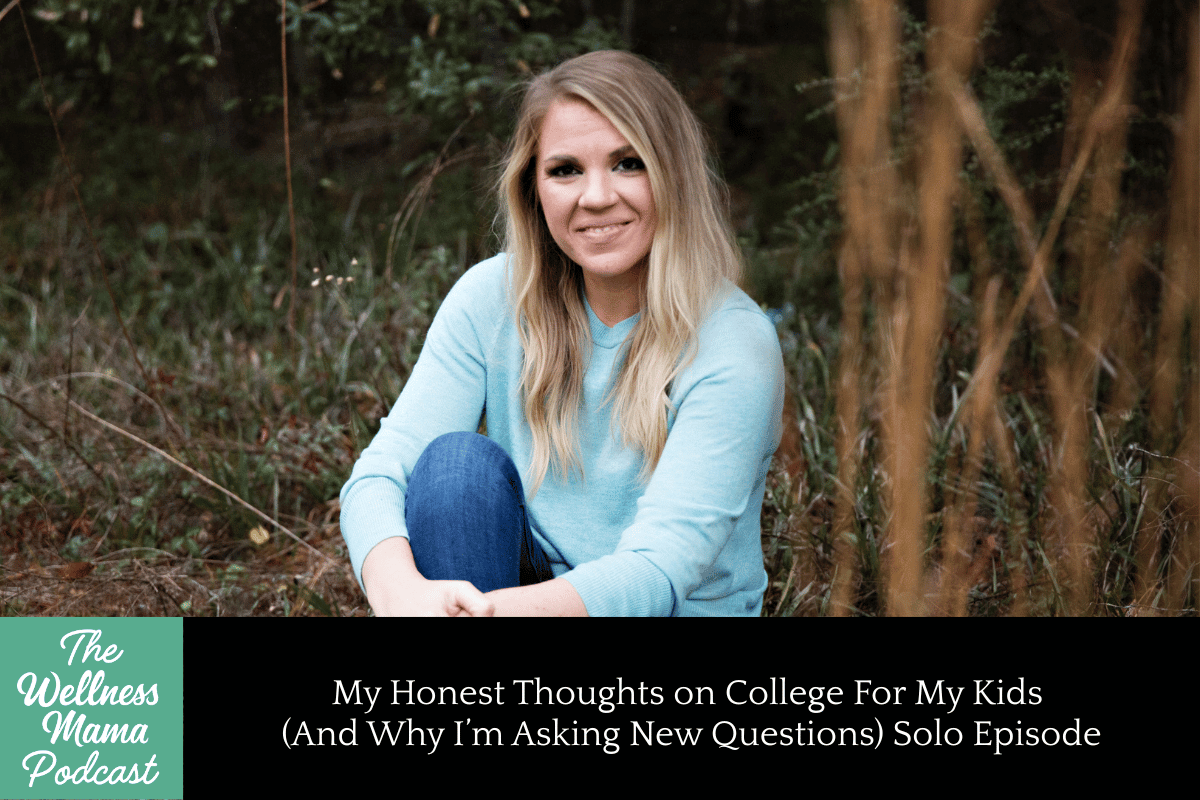
Katie: Hello and welcome to the Wellness Mama Podcast. I’m Katie from wellnessmama.com, and this episode goes more into the parenting realm and even kind of more just a very specific part of that versus physical health. And today’s topic is my honest thoughts on college for my kids and why I’m asking new questions about this.
And this has become more top of mind as I have kids now approaching this age. Making decisions around it. And I also realized I got to face some holdover emotions from my own college experience and old beliefs around that, as well as kind of like resistance to it because of my old beliefs around it.
I’ll say I never even thought to question college at 17 and how I am rethinking this with my own kids. Not that I answer those questions for them, but as they embark on this journey and I definitely imperfectly have attempted to walk it with them. And these questions are surfacing more and I have a different perspective than I used to.
And I would also say this was inspired partially by listening to an episode of Reclamation Radio called Why You Shouldn’t Send Your Kids to College, which I will link to in the show notes with a guest from degreefree.com, which I thought offered a really well thought out alternative perspective.
So I’ll link to those in the show notes as resources. As always, I’m so grateful you are here and that you are listening. As I said, we’re not really touching on anything health or medical today, so I’m not gonna give the general medical disclaimer that this is not medical advice, but I will say it’s also not personal advice or parenting advice or any kind of advice.
As always, it’s simply my own experience, my own questions, and in this case, mostly just my own questions and things I’ve learned along the way because this is gonna be a very unique area for each of us, for each of our children. And I encourage you in this area as well, to always be curious, to do your own research and to question everything even, and especially me.
So that said, let’s jump into today’s episode, and I wanna preface with some compassion and context. Because this is a big, sensitive topic that can bring up a lot of emotions for parents and for teens who are embarking on what’s a pretty big decision that can have lifelong impact. So I’m certainly not qualified in any form to give advice around this.
I’m simply sharing my perspective as a mom who’s navigating this personally, and as someone who in the past navigated the system, kind of in an interesting way, and I have always, I will say this too, going in, I am always, always in my kids’ corner. So even if they make a choice I wouldn’t have made or that I don’t think is the right choice when it comes to college or not.
I’m always on their side and I’m always in their corner and I will show up in support of that. Yeah, so from my own personal perspective and to give some context on a bias I have here, when I was 18, I didn’t even know I could question college. I actually legitimately thought it was mandatory. It was like 13th grade.
In fact, so much of my childhood and especially high school years we’re all focused on prepping for this time of college and doing as good as possible in high school to get scholarships to do well in college. And this was like literally the top focus of my life for four years. It felt like the next step that everyone did.
Where I went to high school, many people went to college and all of my peers, that was our focus. And then I went to college. And I started asking very rudimentary versions of some of the questions I am now considering on a deeper level. And also for context, I was on the presidential scholarship of where I went to school, which was at a top 10 school, at least in the conference that I attended.
And I was the presidential scholar there, so I was on full scholarship plus stipend. And so when I started asking these questions it put me in a unique place because this was something I was not paying to do. I think this is an additional factor that’s huge for a lot of people and why I wanted to bring this up today.
A lot of people are taking on lifelong debt to go to college. And I feel like that’s worth certainly asking these questions ahead of time. Whatever the answers may be, it’s certainly worth asking really good questions around, but I wasn’t even paying for college, I was actually being paid to go to college and still, when I asked some of these questions, the conclusion that I reached led me to drop out, pretty close to finishing, truly to walk into the Dean’s office and tell him gently, but firmly that I quit.
But I realized in asking some of the very early versions of these questions that I no longer agreed with the assumptions that had led me to think college was helpful. And I no longer wanted to walk that path. Now I have kids both already at this age and approaching this age, and I’ve learned enough about myself and about the world, hopefully to at least ask a few more, ask a few more questions.
This past year has rocked my personal world massively in a way that I might one day share. I’m not sure. So I certainly don’t think I have all of the answers, much less any of the answers. But I do have at least more questions. And like I said, I was inspired by that recent Kelly Brogan podcast on Reclamation radio on this topic with the people from Degree Free.
And I’ll link to those both in the show notes to revisit these questions. And they also take up a stronger approach than I’m gonna take in this episode. But I think it’s worth at least evaluating the perspective if this is something that’s top of mind for you and your family. Very blatantly. I admit my own bias.
I don’t think college is a good decision anymore. I don’t personally think it has a good ROI anymore, and with very rare and specific exceptions, it doesn’t make sense to me. But I will link to that podcast if you are facing these decisions. I actually highly encourage you to listen to it, even if you fully disagree with it.
I also wanna talk about why I feel like this conversation matters now and why I felt it was important enough to have a conversation about in the first place, which is essentially, college is not the villain, it’s just not automatically the right path for everyone. And I feel like it was often presented that way, or at least as the highest path in the past.
And that things have shifted, the landscape has changed a lot in the past few decades that bring up some relevant new questions related to this. The world has changed dramatically in the past couple of decades, certainly since I was 18. Student debt has absolutely exploded. Now, again, this is not something I personally navigated.
But there’s now an estimated 800, sorry, $848 billion in student debt, which is not treated the same as regular debt, which follows people for their whole life. And I have personal friends who have paid more than the original amount of their student loans over time and now still owe more than the original balance of their student loans.
So in some ways, I will say I think the way student loans and student debt is structured does actually verge on being criminal. And while I support my kids in whatever path they choose, I will not back or support them in getting student loans. And that’s actually one of the few things that like we have very strong conversations about.
Also fewer careers in today’s world actually require degrees anymore. I think there’s still this perception that most jobs require degrees, and the actual number from the statistics I was able to find is actually 7.7%, which is a very small amount, especially when you’re talking about the trade off of getting loans for something that potentially cost six figures when you don’t actually need to.
And of course there are exceptions. There will always be areas where very specialized education and college degrees are needed. But that’s now 7.7%. Many states and major companies are actively dropping degree requirements, so depending on what you wanna do is at least worth checking to see if you actually need a college degree in the first place.
And things like digital skills, apprenticeships, entrepreneurships, trades especially, and certifications are far more direct paths and often make more money more quickly with less or no debt than traditional college degrees. In fact, I think I didn’t even think to look at those things when I was at that age.
In hindsight, that might have been something I would’ve at least looked into in a deeper way, and that I am encouraging my kids as we now see examples of, for instance, welders and plumbers making more and having more stable work in some places than lawyers. I also feel like the culture around college equaling success is outdated and actually just not supported by data anymore.
So those are all some statistically backed but personal biases I have and kind of to support my claim that I don’t think there’s an ROI for college anymore in most cases, and that it’s not a good decision.
It’s also, I feel like worth delving into the idea of the emotional landscape for parents and also for kids. So from the parent perspective, of course we come from a place of wanting our kids to be safe, supported, and successful. And for many of us, we were told that those things, safe supported and successful, depended on a college degree when we were navigating this.
Certainly some of us have seen that not play out in adult life. And I’ve shared my own story with that. But college in the past has been marketed to parents as certainly the best choice or the only responsible choice. And that’s what I believed when I was that age. I like felt like it was failure if I didn’t go to college.
And there’s, I understand the parental fear that the kids can be left out or left behind or judged. So there’s kind of this social signaling pressure that pervades despite the evidence I just mentioned that like most people don’t actually need a college degree anymore. And it could be actually a terrible business decision, but it’s still a social signaling one related to like, oh, my kids got into whatever X school.
And I fell into that certainly. Like I applied to, I think dozens of schools just to see if I could get into them when I was in high school and did it for the ability to say I got into these kind of high profile schools that I didn’t, I couldn’t afford to go to anyway. And especially for homeschool and unschool families I feel like there’s sometimes an increased pressure on getting into and going to college to kind of prove that we as parents actually did a good job when it came to school.
And one thing that other podcasts addresses is like, if we’re going to go through all this work to homeschool our kids for all these years, it is interesting to then send them into the college system at the end to prove that we did a good job. And they kind of unpack that a little bit more. But I question the idea that college and success in college actually proves if we did or did not do a good job.
So to gently kind of push back on some of these assumptions, I would preface that college acceptance or college success or completion is not a measure of parental success, and I would suggest some alternative measures of success around lifelong metrics. I get that what we really want for our kids is to build a life that they love and to not be trapped in debt or a path that isn’t theirs.
And to have kind of that safety and stability that we thought came from college. I know we still want those things. I simply want in this episode to question, is college actually the most effective path to get there?
I also think it’s worth talking about something that’s not talked about as much, which is kind of, is college the avoidance pathway? Is it a very expensive way to not have to face some of life’s big questions for longer? And I know this can be a sensitive topic and they cover this in a much better way in that other podcast.
So again, that links in the show notes if you wanna listen to it. But from that episode, what I really took away from that was, and this was true for me, I just had never put it into words, many teens choose college because they don’t know what they want and they want to delay having to answer that question for a few more years.
And I get it. Because even now, as an adult, many decades past college, the questions of who am I and why am I here are hard to answer. I certainly didn’t have good answers to them at 18, I thought college was going to help me find those answers. It didn’t for me. But I think at the very least, if that’s the reason for going to college, to prolong having to ask those questions, that can potentially be a very expensive path of avoidance.
For many kids, they’ve spent 12 years in school. Disconnected from their own curiosity. And I’ve talked about this being my reason for homeschooling my kids largely and for developing Unstitute. They’ve been detached from their own curiosity. They’ve been taught what to think, how to answer questions on a test, not to question things.
And so now they’re facing life’s big questions in a very real way. And of course that could feel scary and they might want to delay that. So college kind of becomes an expensive way to put off those questions for more years. And sometimes avoidance feels safer than choosing something. But I feel like when we’re stacking on debt, especially large amounts of debt, that avoidance plus debt can become a life long trap that sets our kids up in a really negative way.
And this is why, that in particular, like I take a very hard stance with my kids around not taking out student loans. If you knew my kids in real life, you can ask them. Very, very rarely do I give them a hard line or a strong opinion. And not taking out student loans is one of the few things that I feel so strongly about, that they will remove themselves from my will if they take out student loans.
But to phrase it more gently than I do with my kids, if we’ve already disconnected from our inner spark, deferring for another four years from having to answer these questions will not magically bring it back. And if that is the case, my questions would be, and ones that I’ve gotten to ask in my adult life in my twenties and thirties even, is how to bring that spark back, how to reconnect to it, and how to answer those questions.
And it is hard, and I didn’t have the answers at 17 or 18, and I’m really grateful that I didn’t spend six figures of debt trying to figure out that I didn’t know how to answer those questions. I also want to challenge the social promise of college because seemingly this is the biggest hook for teens.
And I get it because when I was in high school and I had been homeschooled until high school, but spent four years in this social environment with my friends, I didn’t want that to end. And the social continuation of that in college was probably the biggest hook of why I even wanted to go. And for most people it is like the primary reason to go and I wanna validate that because especially at that age, peer communication and peer social support is huge for teenagers. They’re actually psychologically meant to be distancing from family. And there’s a long ancestral reason for this. And so that’s appropriate. I get it. The desire for community and belonging is ancient.
We all have it. It’s especially strong at that age as there’s an also a pull to separate from our biological family. So that’s extremely valid and it matters. We all crave and need social support and community and friendships and identity, and especially at that age, it’s absolutely vital. I, so I’m not discounting that.
That is extremely important. I just feel like it’s worth asking questions around, is college the best way to fulfill that? Certainly, if it’s the only way, which I would say no, but is it even the best way? Because to sort of gently challenge some edges of this, the idea of thousands of people of the same age being in one place, being the best type of community that is actually to put it nicely, historically abnormal and not what we encounter in the adult world. We don’t exist in homogenous communities of people our age having the same experience of life, all navigating the same thing. So that’s not what we’re going to navigate the rest of our lives. Real community is usually mixed ages, hopefully some overlap and shared purpose of some sort or shared values and deep relationships, but mixed backgrounds, mixed work, mixed ages and stages of life, different viewpoints and some shared commonalities that become very important. Whereas college social life is often temporary. It’s often artificial. Sometimes you pay for access. I know the fraternity and sorority culture was huge where I went and I never participated in that.
But it was so fascinating to see from a social perspective the kind of pay to play social access and all that came with that. And it’s not reflective necessarily of real world interaction. And this is actually something I’ve said related to school in general. When people challenge like my kids not getting enough are like, are they not getting enough social interaction?
And really what they’re saying are they not getting enough social time each day with kids of only their own age? And I push back on that as well because I think if done in a careful way, homeschool environments where kids are interacting with people of a wide variety of ages and ranges and expertise is actually much more representative of what they’re going to be doing the rest of their life than sitting in a classroom with a bunch of fourth grade peers or whatever the age may be. I’ll say I personally only have really one friend from my college days that I even stay in touch with at all. And I didn’t meet her in college. I met her at church while I was attending college. So a lot of people think teens often think that college is gonna be this beautiful built in social support and that it gives them a network.
But in my opinion and experience, the most meaningful networks come from shared values or life experiences, not a shared campus. And there, of course, are exceptions to this. I know I didn’t attend one, so I don’t have direct experience, but I have friends who attended Ivy League schools who did encounter like kind of an, it’s not what you know, it’s who you know with the people who graduated from that school and the networks they formed after.
But I feel like for most people, we’re not talking about sending our kids to Harvard, and I think there can be valid times and places for that depending on what the path is, but for most of us, that’s not actually what we’re considering. And so I call into question if spending four years in a homogenous group of peers with kind of these artificial social dynamics is actually productive and contributes to those things that we want for our kids and that they might more importantly want in their lives. I feel like often kids that age are given false promises of that this is going to give them these things in life rather than being encouraged or allowed to question those things. That said, I do think there still can be a time and a place for college. I’m not fully discounting it.
Like I said, I just feel like it is worth deep diving into these questions before spending, most importantly, years of one’s life and secondarily money to pursue this with the idea that it’s going to provide some sort of lifestyle.
I also want to bring up some very valid alternatives. And again, the other podcast gives a lot better examples of this you can go deeper on. But as someone who didn’t even know there were alternatives to consider, I wanna just introduce some that actually, when you look at the data, quite surprisingly, many of these can lead to better even financial outcomes in a much shorter time than having a college degree.
Specifically, I’m gonna start with the trades because the data here is really fascinating, just based on supply and demand as over generations or the past decades, fewer and fewer people have gone into trades and more have gone to college for other type of pursuits. There are simply less people in these fields.
There’s higher demand for them, which is why we’re literally now seeing things like people like plumbers and electricians and HVAC workers making more than at times lawyers or more white collar career. And I know there’s, in the past, been a stigma around this, but the data to me is absolutely mind blowing and at least worth considering, especially if someone wants to be hands-on. There could be a much shorter path, a much cheaper path through a trade to a much more stable career, more quickly than college, if that is actually the reason for considering college, especially because now having a typical college degree does not in any way, in most places guarantee a good job.
Other examples of alternatives would be apprenticeships. Which more and more companies are now open to as they start dropping college requirements as well as internships, community networking and volunteering. If you’re wanting to stay in the same community that pulls directly into the, it’s not what you know, but who you know.
And I know many people who personally got into careers they love in their local area by originally starting with volunteering and internships. I also think finding mentors can be valuable whether or not you go to college. This is something I wish I had learned much earlier in life and something I’m now do, but feel like I got a much later start on.
There’s also, I think travel can be a tremendous teacher and I have been encouraging my kids, if they want to, to take a year or two to travel before even deciding what comes next because that is often easiest at that phase of life. There’s also things like Toastmasters and Chambers of Commerce, which can be great for connections and networking locally or joining some sort of group around whatever that person might wanna do, as well as certifications that are not typical college degree related.
And so, for instance, one of my kids who’s big into athletics, even if this child considers college is also looking at things like personal training certifications or Kinstretch certifications or other things like that, which can actually be a faster path and also rival the salary of college degrees.
So, I just bring that back to bring up a challenge. It’s not that they need college for community, it’s that we need community. And so, if that’s the goal, if the social experience and the community is the goal, where else might that be sourced? That long-term could be more supportive for our children as they enter the real world.
Now I wanna get a little bit more into, so I mentioned that student loan debt is one of the things I have very strong opinions about, and I have been on a process these last 10 years of actually excavating and removing most strong opinions about most things. And this is one that remains, and I want to dive into the debt and money reality, because I know so many people who got into student loan debt without understanding it at all, and now are having very long term consequences of this. So if this is something being considered, I feel like it’s at least at a minimum worth understanding. Most teens have no concept of compound interest. Most teens don’t actually understand what they’re signing on for when they sign on for student loans. And I personally feel like that is actually predatory and criminal the way that student loan debt is targeted.
Most teens at that age, it’s easy to see college and the cost of 20 to $40,000 a year as manageable when they haven’t navigated adult life and actual living expenses before. And they just assume a good salary and this like vision of success that perhaps they grew up seeing their parents have after college.
And so it’s like deferred financial management for now, several more years. What they don’t see, I feel like, are some of the huge downsides that are certainly not talked about in an informed consent perspective before they sign on to these loans, which are things like, of course the compound interest.
And I shared before how I know people who have paid more than the original amount of their student loans and still now owe more than their original student loans because of compound interest. And they feel like they are quite literally drowning and will never get out of that debt. So in my personal opinion, even if college were the right option, which again, I question, I personally feel like it would be worth working, taking and like saving up the money to go or taking time off to work and doing anything possible to avoid student loans.
Also some costs that are not talked about are the lost working years. So we now have emerging data on kids who do much shorter certification programs or go into a trade and then are working before that and then doing, especially if they’re doing things like saving or investing or being really responsible with their money, even those few years of difference can make a tremendous difference decades down the road because of the other side of compounding, which can be really positive.
So they’re losing working years. They’re losing potentially positive compounding interest years at the cost of negative compounding interest. In a sense, like I said, it’s also delaying adulthood In some ways. It’s delaying, asking and answering life’s hard questions. It might be delaying wealth building because they’re now, monies outgo into college versus money earned and put into places where it can grow.
And then there can be stress and anxiety and pressure related to all of that, that continue for life. And we know now data wise, many college graduates are unemployed. In fact, we’re seeing some of the highest rates of this we’ve ever, ever seen, which I think, again, makes these questions even more valid.
Many graduates never work in the field that they actually went to college for. Many graduates don’t need a degree to work in the field that they are working in and now at a higher rate than ever as well, many graduates return home overwhelmed by adulthood because it turns out that college doesn’t actually adequately prepare you for adult life, nor necessarily now give you what you need to navigate that in a successful way.
So earnings don’t matter if your debt load keeps you from building a life to begin with. And if you are financially strapped and essentially a financial indentured servant from the first day of your true adult life when you exit college. So a gentle way I would frame this is debt can limit your choice for decades.
And for me, I want my kids to have more freedom and options, not less so even if college, which I think is its own thing worth questioning, for me, it’s a not student loan debt situation.
I also want to bring into question this thing I mentioned a little bit already, but the homogenous peer group issue because we somehow bought into the idea that this was good and healthy and supportive. Being in a group of all 18 to 22 year olds, to me, creates kind of an artificial community and artificial maturity because you at that age, feel mature compared to all these other people this age.
That’s your whole social group and what you know. But like I said, I feel like this delays adulthood because in college you’re not necessarily actually navigating adult life. You’re kind of living in a curated environment of that with other people your same age, often with things like housing and food and real life things, and bills put on hold while you’re in this college environment.
This can also breed anxiety and comparison and social immaturity. And it’s not reflective, like I said of real adult life or professional life or relational life or community life. And many people speak of their college years as their party years and kind of acknowledge that it wasn’t an actual entry into adulthood, whereas choosing a potentially different path, including working or entering a trade right out of high school, exposes teens to other approaches like mentors to people already working in the field. So adults with skills to people who already have families. So they get an insight into what that looks like to people of mixed ages and into real challenges, real communication and real expectation.
I have found personally that being either the youngest or the dumbest person in the room is one of the best ways to learn. And I don’t feel like college by nature creates many of those opportunities because we’re in a homogenous group of our peers at the same age and similar kind of intelligence level because we all got into the same school.
So I feel like there’s just an added cost that isn’t considered when we frame college as beneficial.
Now I wanna talk about something that’s adding a complex layer, kind of in my own navigation of this currently, which is the topic of sports. Which I think does add a little bit of complexity here. And I’m gonna do my best to sort of tackle this in the most compassionate understanding way that I can, especially knowing that one of my children, this is something that could potentially be very important and that I can understand.
And also truly that, if there’s a decision made to attend college for the reason of sports with informed consent and understanding all the potential downsides that I do support her decision in that. But my personal nuance around this and as someone who admittedly was not a college athlete but it seems that for kids who are pursuing athletics, college is framed as and can feel like the only path, certainly the best path, but really, truly the only path. And I want to challenge that because from my perspective I’m trying to explore all the options with my daughter, including pathways outside traditional college systems that might involve club or travel or private coaching.
So, interestingly, for high school years, my kids have competed under the umbrella of the public school because that’s the only way to compete in most of the high school competitions like the regional and state meets, et cetera. That’s actually not true in college. There are more creative ways to enter different types of competitions in the college years, depending on the sport.
I’m coming much from a track background with this. But there are ways to enter competitions and to train without college. Sports can still be part of life without a four year degree and community and even sports community is possible without college. It just requires more creativity. And I have a friend who’s an athlete challenge me on this and say, yeah, but a lot of times people can’t afford that and college provides it for free.
And I challenge that perspective because I’m like, yes, college that many people are paying 20 plus thousand dollars a year for, so it’s not free, provides this thing for free. In that case, is there a way to, for less than $20,000 a year, actually receive better coaching and community around sports, even potentially when the international has opened up, than just college.
I think there’s a lot that goes into this and I certainly don’t want to like actively throw anyone under the bus related to this. I just feel like it’s worth considering because I don’t buy that college is actually the best path. I don’t buy that for most sports necessarily, that college coaches are the best to continue that career.
And I don’t, it also depends on the goal. If the goal is to play college sports, then yes, college is probably the best path, and if the goal is to play professional sports, is college the best path? And it depends, of course, on the sport and the event as well. Team sports need a team. But since I’m coming from a track lens I question, with like the availability of world class coaching, is college the best way to get there, or would private coaching and working and starting a financial life be a better path to get there? Because I also know many people who went to college, played college sports, now play professional sports.
And that’s taking up a lot of time and they’re trying to navigate the finances of that, which can be very difficult at times because often until you’re at a very high level, being a professional athlete doesn’t pay that well. So now they have got to figure out how to make money alongside keeping up with training and college turns out didn’t actually prepare them that well for that part.
I will say in my own life and with my daughter, like I said in the beginning, for me, this always goes back to I’m always on their side. I’m always in their corner. So I support her fully, even if her choice is not the one that I would make, even if her choice is college, and I don’t agree that that’s the best decision, I stand behind her fully.
And I want her to actually choose this from a place of informed consent, not just by default. So if she does that, if she asks all these questions, understands the implications and all the sides of the things I’m mentioning and decides, okay, I have money in my account that I’ve saved, it is worth it to me to spend that money to get to pursue my sport in college with my friends, who I wanna stay close to. And that is the reason I’m choosing it, not because I have some illusion that having a college degree, especially if it’s not in very specific fields like medicine, is my path to success in life. But I’m choosing that because I want to have this experience that even if I would choose something differently, I support her entirely.
And on that note, I also wanna say, of course, exceptions exist. Certain fields for now do still require degrees, though interestingly, they have not always. Even medicine once had apprenticeship, but fields like medicine right now still have very strict licensure and degree requirements. Same with law, nursing, some aspects of engineering.
Even these are shifting. But yes, sometimes college is needed, especially in these realms in particular. I’m not trying to be anti college. I’m trying to challenge and be anti automatic college and I would say I am, as a personal bias, quite anti student loan debt. So I’ll share a little bit, not fully, but I’ll share a little bit of what, how I’m thinking of this and what I’m doing with my own kids.
First is I’m inviting them to explore interest through real world experiences while still in high school. So whether this is opportunities to travel or certifications or I have one who pursued being a lifeguard and has developed real world skills through that. Another through, like I mentioned, personal training has been interesting to her.
And same with encouraging internships. Or work experiences or entrepreneurship or apprenticeships. So I have a child who’s entrepreneuring with a local sourdough bakery, or I mean, interning with a local sourdough bakery, and that’s fascinating. Also helping them meet adults in various fields and see examples of alternative life paths that are not just based on a college degree.
Supporting travel, hands-on skill building without waiting till they’re 18. And certifications, many of which they can also get before they turn 18. We talk about lifestyle goals, not just careers and alternative paths to get there. And creating room for self-discovery without shame or pressure.
And I will say I am, if anything, I’m guilty of discouraging college so strongly that with one of mine, I actually, I think I created a rebellion of sorts where for a little while he was considering going to law school, and I think that was like the most valid teenage rebellion he could come up with because that was something I strongly discouraged.
So I’ve softened and I don’t want to influence their path other than to encourage them to ask good questions around them. My hope for them is that they build a life that aligns with their values, their personality, their gifts, and their future family if they choose to have one. Which is another thing I don’t think most necessarily 17 and 18 year olds are considering before taking on debt that could affect their family in the future in a very real way.
I also encourage, and I’ve been doing myself, with myself this year, again, revisiting the obituary thought experiment. Because things that feel very important when we’re in high school, when we’re 17 or 18, might not actually be the things that become important throughout the course of our lives.
And it’s hard to have that perspective of course, when we are that young. But one thing I encouraged them to think about, and that was for me actually inspired by hearing the story of someone who woke up and read his own obituary in the newspaper because his brother had died and the newspaper had mistakenly written his obituary instead and then realized, he realized he didn’t want that to be what his obituary actually said. And it led to life changes for him.
I feel like that exercise can be really valuable and that in hindsight, what I realized was it does at least frame what might become the important things in our life. And for me personally, that wouldn’t be looking back and, it wouldn’t include things like, oh, I wish I had been the best college athlete that there ever was. Or even the best athlete that there ever was. That’s my bias, for somebody that might actually be the most important thing in their life. But for me, that brings into question things like family and my kids of positive change in the world, not just a career, of kind of purpose and the why am I even here in the first place question.
And also to me on a more esoteric level that’s not appropriate for this podcast, but just brings us back to the place of love and that nothing on a obituary is actually also the grounding achievement of one’s life because my personal belief around this is that while we think we’re here to seek love and to be loved, we’re actually here to be an embodiment of love.
But again, topic for different day. But I think this is a fascinating exercise to do and revisit throughout our life to kind of like reassess our priorities and values. And for kids this age, at least thinking through, do I think family could be an important priority or value for me in the future? And like I said, if one of them chooses college, I’m a hundred percent in their corner.
If they’re wanting to go for sports, if they’re wanting to go for their social group, if they want to go to learn something, but they aren’t taking out student loans and they understand that there might be other ways to learn it, then great. If they wanna go to be in proximity to someone they’re in a relationship with and they care about, great.
As long as they have asked those questions and genuinely given them consideration and not just done that as an automatic response to graduating high school. Okay, so this has gotten longer than I expected. I will start to wrap up by sharing some gentle questions that I feel like parents and teens can consider.
Like, what kind of life might you want at 25, 30, 40, et cetera? How important is the idea of family to you and at what age do you think you might be open to that? What kind of schedule do you want in your adult life? Not just job, but what kind of schedule and flow? What kind of people do you want to be around you?
How important is debt freedom to you? What does success feel like, not just look like? What interest lights you up to take action? What skills do you wanna learn in the next two years? What environment do you feel like you can grow in? What kind of work or experience sounds exciting to try right now? And what if you don’t need a degree to do what you love?
So to bring it home, key takeaways. College can be one path of course. I want to preface and bring up that it’s not anymore the only path. And our kids deserve to ask these questions. They deserve freedom and agency and options, not debt based default. My job as their mom is not to choose for them.
My job is to give them support and hopefully help them ask questions to get clarity and to choose intentionally. But it is their choice. So no matter what my kids choose, they will always have, without question, my support, my belief, my presence, and my unconditional love. These are just some of the questions that I have brought up and I will publicly admit not perfectly, because I do have strong biases against this.
So I have definitely presented these things even to my own kids. Probably too strongly anti college. But I wanted to bring up these questions in case they’re helpful to any other families, teens, moms, anybody listening, and I would love to hear your feedback if they are, and I’d love to hear your feedback if you completely disagree. Whatever your feedback, I would actually honestly love to hear it. Please always feel free to leave a comment or even message me on Instagram, I do read all of those.
And for this, thank you so much for joining me today. If any part of this was helpful, I would be so grateful if you would leave an honest review wherever you listen to podcasts, as that helps other people find and listen and join the community.
And if you wanna stay in the loop with podcast episodes, resources, and kind of behind the scenes as well as my personal weekly tips, you can join my VIP list for free at wellnessmama.com. As always, thank you so much for listening. I’m so grateful that you did, and I hope that you’ll join me again on the next episode of The Wellness Mama Podcast.





Leave a Reply