Read Transcript
Child: Welcome to my mommy’s podcast!
Katie: ?This episode is brought to you by Hiya Health. Everyone’s talking about their New Year’s resolutions, and while everyone else is promising to hit the gym in 2026, I am focusing on something much easier that’ll actually stick (gym’s already pretty well a habit for me) which is better nutrition for my younger kids.
And that is exactly why Hiya exists, to give parents a real solution in a market flooded with products that prioritize candy-like appeal over actual nutrition. Some children’s vitamins on the market have up to seven grams of sugar per serving and are stuffed with additives and petroleum based dyes.
Hiya took the opposite approach. Zero sugar, zero gummy junk, just clean nutrition. And the crazy thing is kids actually love them. The taste, the experience, all of it. It’s thoughtfully designed. They looked at what modern kids are eating and not eating, and formulated around those specific nutritional gaps.
Working alongside pediatricians and nutrition scientists, Hiya created a superpowered chewable vitamin that packs 12 organic fruits and vegetables, plus 15 essential vitamins and minerals, including B12, C, zinc, folate, and more. The ingredient list is clean with no GMOs. It’s dairy free, allergy free, gelatin free, nut free.
They’ve thought of everything. Plus, they’ve earned their clean label projects, highest purity award certification, and they put every batch of product through third party testing for heavy metals and contaminants. So it’s the kind of transparency that actually means something. They are designed for kids 2 and up, shipped straight to your door in a reusable bottle with refills that come every month.
We have worked out a special deal with Hiya for their bestselling children’s vitamin. Receive 50% off your first order. To claim this deal go to hiyahealth.com/wellnessmama This deal is not available on their regular website. So again, go to hiyahealth.com/wellnessmama and get your kids the full body nourishment they need.
This episode is sponsored by BON CHARGE, and I love so many of their products from their red light face mask to their sauna blankets and everything in between. They focus on high-end wellness tech, and if you’re interested in how light can help you, which I talk a lot about, BON CHARGE has so much to offer.
Studies have found that specific red light frequencies can help reduce fine lines and wrinkles when used at the correct brightness and strengths. And some products don’t get these correct. The frequencies of red and near infrared light stimulate cellular activity at a mitochondrial level, which I talk a lot about on this podcast.
This can create better energy efficiency in a given location of the body. For instance, red light on your face gives more cellular energy for biological processes. This can help to decelerate the signs of aging and lead to firmer, plumper skin. So the long-term results you can see when using an LED mask over time are things like, reduction in the appearance of fine lines, reduction in the appearance of wrinkles, reduction in under eye bags, firmer skin, tighter skin, reduction in signs of aging, scar fading, plumper looking skin, reduction in visibility of blemishes, and visibly clearer looking skin.
I’m always a fan of getting natural light from outdoors, but for people who are wanting to kind of tackle the aging process head on, this is in a way to kind of give your body some extra benefit from these specific wavelengths of light.
The safe, non-invasive beauty treatment is going to be around for a while, and for a good reason given the results people are seeing. If you wanna check out the BON CHARGE Red Light Face mask, and all of their products, you can go to https://boncharge.com/wellnessmama and use the code wellnessmama for 20% off.
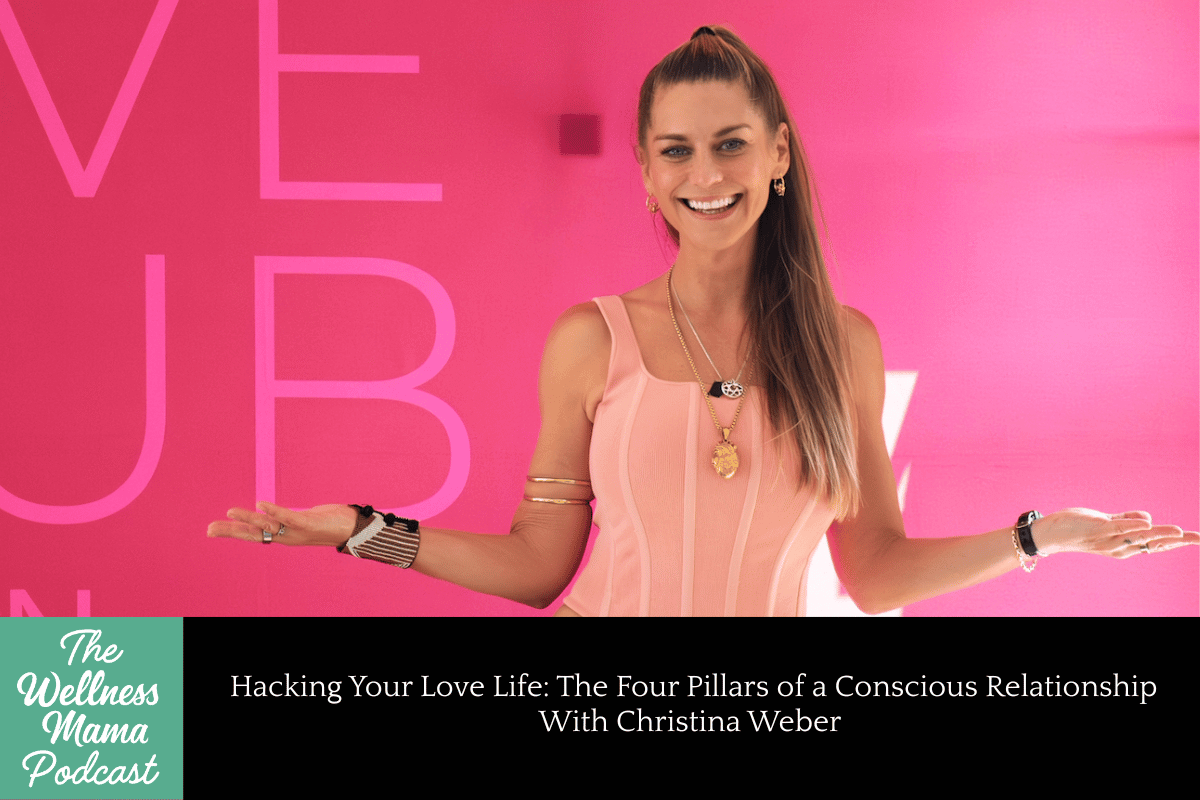
Katie: ?Hello and welcome to the Wellness Mama Podcast. I’m Katie from wellnessmama.com and this episode is about hacking your love life and especially the four pillars of conscious relationships. And I’m here with Christina Weber, who I met through a mutual friend and got to hear briefly speak at a conference earlier this year.
She considers herself a love strategist and she’s the founder of WeDeepen, which is a relationship development network dedicated to helping individuals and couples create extraordinary love through curated social experiences, transformational retreats, masterminds, mentorship, and more.
And you’ll, I’m linking to our community and our website and her events in the show notes, but I love the things we got to get into in this podcast talking about our shared experiences of getting to do silent retreats earlier this year and in different places, but what we learned from those individually. How she brings things like games into her events and challenges people’s comfort zones based on that. And then a lot on the four pillars of conscious relationships, how these can be difficult to achieve, and the proactive formula for moving from reactivity into growth in relationships. So let’s jump in with Christina. Christina, welcome. Thank you so much for being here.
Christina: Thank you so much for having me. I’m excited for the conversation.
Katie: Me too and to actually, like, this is the first time we’ve ever gotten to meet and have a conversation, even though as we discussed before recording, we have a lot of mutual friends in common, and I’ve been familiar with your work for a long time. So I’m deeply grateful to get to learn directly from you today, and we’re gonna get to go in a lot of amazing directions.
As a jumping in point, we have something in common that I’m guessing is not super common and I would love to hear your experience with it, which is, it sounds like you went on a silent retreat this year as well. Yours I think was 10 days from what I read. I only did four days, but I did four days in a darkness cave because I was going through some things in my life where I felt like I realized I couldn’t avoid the darkness, so I had to go into it and actually like, feel the feelings and face the things, and it was much more difficult than I imagined.
It was quite the crucible and an amazing experience, but a tough one. And I would love to hear what yours was like. After having spent some time in the darkness and the silence, I can relate a little bit, and you spent even longer. So I’d love to hear what came up for you. What was learned from that? What was the afterwards like?
Christina: Congratulations for going into the darkness. That’s something I have dreamed of doing and I haven’t done myself yet. In August of this year, I did do a 10 day dieta. And a dieta is when you diet a particular medicine, plant or tree. I dieted a Noya Rao, which is a tree that grows deep in the Amazonian jungle of Peru.
It’s bioluminescent, the tree lights up. They call it the tree of enlightenment or the God tree. And when you do a dieta and diet a tree, you are in silence for 10 days. 10 days is typically minimum that you would do a dieta on. And so it’s 10 days of silence, no devices, fasting, and being out in nature. I, a lot of people will go into the jungle to do this.
I had much more luxurious anenomies when I was there. I was at a temple in the Catskills and there was deep shadow work. The first three days were really hard and challenging. And then the next seven days I got to be back in my essence and spirit. So I did my dieta, I had gone through a breakup and this was a month after the breakup, and I was, him and I were supposed to be at burning man together.
So all my friends are in the desert having a blast, taking, you know, fun medicines. And here I am in silence by myself. And so the first three days I’m like, I am punished. I’m that quote unquote bad that I have had to put myself in silentary confinement, and I am not around people. So it was like everything that, every area of my life that I had been second guessing came up.
I, even if I had the piece of paper right now, I’d show you, but I did this little stick figure and I was like, self, not self. And the not self was all the areas, all the shadows that I, you know, from, oh my gosh, you’re selfish. You fell into love. You didn’t ask exactly for what you wanted. It’s like anything that I could critique about myself came up and then it was released and you know, I was joking with somebody after because I was telling them that I felt like I discharged, all of that was not me. And they’re like, oh, did you discharge or did you integrate? And I’m like, integrate, discharge, whatever, it’s been released from my system and it was one of the most profound experiences now that I have the tree growing inside of me. The, once the tree is part of you or once you ingest the tree, you can always, it’s subtly working inside of your system and can speak with it and drop in and it provides a greater level of clarity and surrender and more in tune to your intuition and God.
Katie: That is so fascinating and I haven’t heard anybody else who’s done that particular experience, so, very cool to hear about that. And I think I share similarity as well as I tend to, or at least in the past, have had that solitary confinement coping strategy in relationships, which I’ve now seen go back to actually very early childhood stuff and that I’ve been working on.
But similarly to you, I had kind of the beginning of that darkness cave experience, which was, like you are silent. There’s no devices. I couldn’t, all my normal coping mechanisms were gone. There were no audio books or podcasts or journaling or drawing. Like all those things were gone. And at first I was like, oh, this is gonna be a breeze. I’ve been trying to catch up on sleep for 19 years. I’m just gonna sleep the whole time. And I slept.
And then I woke up and I had no idea what time of day it was. I had no idea how long I had been there or how long I had left. And I got to stare in the face of all the places I still was a control freak and didn’t like not having all this, like these touch points and this data and this control over my environment. And it started this kind of cool snowball of eventually, actually long after the experience, realizing the beauty of the darkness and the interplay of the darkness and the light, and that our shadows only exist with both.
And it kind of like reframed a whole lot on a deep level within my life. And so I love that things like this are becoming more available. Not something I ever like anticipated doing. And now as tough as it was, I’m deeply grateful for it. I also, in researching for this episode, have a note that you often at your events play truth or dare.
And I love this because this brings in like a gamified element. I feel like this also, like, is a nostalgia of childhood, but also that you do it totally differently. So I would love to hear how you do this and what makes it different. Which also is a great segue into the fact that you do events and help facilitate these beautiful experiences for people.
Christina: Truth or dare is one of the greatest social hacks. People love playing games and they love, maybe not everyone who’s listening, maybe you will not agree with this, but people also love being told what to do unprompted. So truth or dare. I started taking that to events and parties in probably about five, six years ago. I was 37, I’m 44 now, and I had given up alcohol for an entire year.
And I went to a Halloween party and I was looking around this Halloween party with people drinking and taking, you know, medicines and I was like, what am I going to do at this party? So, a friend and I, we saw a dresser with a mirror on the back of it, and I asked for her lipstick and I took her lipstick out and I wrote on the mirror, truth or dare, and I started pulling people into what I called my truth or dare booth, and I would ask them what their intentions were for halloween, their relationship status, and then I would essentially dare them to go do what they wanted to do to go create the party that they wanted to have, the night that they wanted to tell the story of later.
And it was so much fun that now at, I host lots of events, I love hosting gatherings and bringing friends together, even if I’m just out at, you know, a social event, I’ll bring my truth or dare social hack out. And, but at our love immersions, we do three day masterminds for your love life. And one of the evenings typically is always dedicated to a night of truth or dare. I’ll separate the group into groups of five, and each group will brainstorm three epic dares and three epic truths.
We’ll put them all into a pot and then we pull them out. I play truth or dare consultants because if anybody gets stumped, I’d love, if you’ve ever done improv in like improv comedy, then it gives you this like brain wit nerve to stretch, to go into how can I make this experience even more creative?
So we’ll pull them out of bowls, the truth or dares. Sometimes I don’t allow dare. Sometimes I don’t allow truth. Sometimes it’s just dare or dare. And we’ll pull them out. If I see a way to expand on that dare based upon who is the receiver of it and what I know about them, where they’re at in their life, what their dreams are, I will then take it and dare them to do it.
For example, I had one girlfriend who was starting a new business and I had her present the business to a group like a blonde bimbo. And it’s just seeing the laughter and the uproar and the people really getting to know each other and having these significant moments and fun free light ways.
Katie: I love that. That’s such a fun reframe of something that I hadn’t even thought about since probably like middle school or high school. And I love that bringing that in it’s also a way to help people kind of confront parts of themselves that maybe they were like hesitant to like lean into or look at or act on.
And I love the improv connection. I’ve only done a little bit of that. My brother is big into improv though, and I love getting to watch it. I love the energy of that and the like out of comfort zone, kind of pushing the edges in such a fun and safe way and. I became familiar with your work through a mutual friend and also through kind of seeing you at different events, including I think most recently at Dave’s event.
And you had a talk about hacking your love life. I’ve also heard you say that your intimacy journey is your life story. And I would love to this, for this to be our jumping in point today because I think certainly most of us have at least something in our lives and our relationships that we maybe would like to grow or improve or shift somehow. And I love that the work that you’re doing around this, and I know you have like pillars around conscious relationships and we’ll hopefully get to those as well. But let’s dive in with that idea that your intimacy journey is your life story and what you mean by that.
Christina: You know, we all have a different money story as well as a different love story. I look at love as a process of removing layers of the ego. Coupled with ever increasing acts of sharing because we give to who you love and if you commit to having a life of growth, you mentioned the four pillars, which we can go into those, but pillar number one is no attachment to outcome.
Growth comes first. If you are, I imagine if you’re listening to this podcast, there is something inside of your system that feels pulled to grow, if when you stop growing there’s something in your system that feels stagnant or like something is wrong. And well, I think it’s twofold. I’ve actually been geeking out on this concept of mastering conscious aloneness because when you master conscious aloneness, then you can actually be in relationship as an independent sovereign being, but then move into this idea of oneness with the other person much more easily and move from that spectrum of like independence into togetherness.
But if you’re putting growth first, and you’re committing to a life of growth, that means there’s always something more. There’s always a new layer. There’s always something, a deeper truth, a deeper essence of you. And as you will peel back those layers and those can be of, you know, for example, for me it’s beautiful to to hear that, I think you said that you were at the Biohacking conference when I gave my signature talk on Hacking Your Love life. And 10 years prior to that moment, I was deeply fearful of public speaking.
That I actually just gave a talk in front of a large audience at the biohacking conference and preparing to take even more stages right now, I almost have to laugh at how fearful I was of speaking in front of groups. I used to host tons of events and I would have other people speak on my behalf. I had done one event too, where I had blacked out. This is probably about 12 or so years ago, and I was telling my Kabbalah teacher about this fear, and he said to me, wow, Christina, your ego is so big and I was like, what my ego, I’m just shy.
That’s not ego. And he said, well, you’re so self-absorbed in being perfect that you’re hoarding information from other people that could actually help them. And it was like a wake up for me. And so committing to a life of growth is realizing like there is always something more, another essence, another deep, and that’s how we fall more in love with ourself.
That’s what I believe of how we fall more in love with ourself. And also how we fall in love with each other. It’s like if you’re in a long-term relationship, when you see your partner do something that you didn’t know that they had the ability to do, whether that is again, jumping up on stage, launching a company, building a house, facilitating an event, hosting an exhibit of their work, you are, you look at them with new eyes and that’s what I think the journey of self-love is like getting to look at ourself with new eyes. It’s like going from that, those moments of darkness into light and being like, oh my gosh, I just overcame this challenge. So that, when I say your intimacy journey is your life story, it’s like the most tender aspect of our existence is how we operate through love and through our connections, and that is a lifelong journey.
Katie: I love that idea, that term of mastering, conscious aloneness. And I can only imagine that probably for many people is quite challenging. Like I think of even, was it, I know there’s multiple quotes along these lines, but like all of man’s problems stem from our inability to sit quietly alone in a room and how amplified that seems to be in the modern world where we always have a distraction, we always have a device, a phone, a podcast, something is always on.
So we never actually have to be alone, which makes it probably an even more intentional and conscious choice. And I would love to go deeper on how do we learn to master conscious aloneness in a world where it’s so easy to avoid it entirely. Especially because it seems like it often in relationships, people enter a relationship wanting the other person to fulfill them or complete them, or give them something that they don’t have internally.
Which I’ve heard people talk about, you know, like we’re then sourcing that from someone else until we drain them of it entirely. And the thing we loved about them is now gone. And this seems like this could be the antidote to things like trauma bonding, where connecting with someone because our traumas perfectly match, but not because we’re actually comfortable in who we are and consciously connecting. So how can we cultivate this kind of conscious aloneness? I love that term.
Christina: One way to master conscious aloneness is like the first step is to want to master conscious aloneness. Because once you desire, once you have a desire there that I want to be self-sufficient and good on my own, then the intention has put forth. And then all types of ways that you can do it is, meditation. A daily meditation. You can start with 10 minutes, 20 minutes. Going to a dark retreat, which you just did. That’s a step in mastering, conscious aloneness. There’s doing a dieta, there’s so many different ways that you can start to do this, but it’s start, it’s also, you know, a lot, I’m in this, like WeDeepen and in the game of true love. I want the true love experience this lifetime. And we, it’s not to say that I haven’t experienced true love. I’ve experienced true love many times, but a sustainable true love, and I see that’s flipping from because, yes, in our society, most of us weren’t taught to start relationships with growth in mind, our being in our own sovereignty.
Instead, we start with a dopamine hit validation, someone to save us from our misery of being alone. We think, will a person make us happy? And it’s totally normal, it’s completely human. But when the growth stops, love often follows right behind that. So the, I think in order to master conscious aloneness, step number one is to have a desire and intention to say, Hey, this is really important. I wanna be the sorceress or the sorcerer of my own experience. And then we shift from, I’ve been thinking of the shift. What do we shift from? Okay. In relationships we’re going for, typically, validation, attachment, control, or there’s a lot of transaction.
Transactional relationships. And if we shift them from validation to reflection, because reflection is really, is important. That’s, we get to know ourself through the reflections of other people, but it’s not, I’m not seeking approval from you. I’m seeking for you to reflect back my genius and to be in the right relationships where that is happening.
We also move from attachment into aligned belonging. Is, does this person align with my soul’s highest calling? We move from control into trust. Trust of the field, trust of the timing, trust of yourself, and then from transaction into reciprocity. Are you in a relationship where it’s, you know, the tit for tat, what can I get?
Or is there circuitry that’s happening that two people are playing in the field of the give and take and share and expand, that you become more together through that experience. And when two people are committed to mastering conscious aloneness while also being in relationship with each other, then that’s when anything, that’s the true love experience.
That’s when anything is possible. To sustain that is the commitment that you have to saying this is really important and we want to sustain that.
Katie: I love that and yeah, I can imagine this is a lifelong work and how many of us are not comfortable being alone. And also that like interplay of aloneness and togetherness within relationship and respecting that energy and that dynamic and that flow without like sourcing our fulfillment or sourcing something from the other person, which feels so easy to do in a relationship where, like you said, like sourcing the antidote for just being alone or sourcing whatever it is. And I know there are other pillars to this as well. What are the other pillars and what are some of the pitfalls you often see people encounter when they’re trying to build a conscious relationship? And that kind of like, kind of are the sneaky pitfalls that often people can fall into.
Christina: So four pillars of a conscious relationship. I first learned of these from therapist Shelley Ballard. When I read them, my entire nervous system relaxed. And oftentimes when I share them with anybody, I watch their entire nervous system. Like they’re like, yes this is it. So the four pillars are pillar number one, no attachment to outcome.
Growth comes first. So prioritizing growth. Two is both parties agree to own their own shit. When you’re para bonding with another human being, it is likely, it is pretty much guaranteed that you will feel the full range of emotions. You will feel jealousy, you’ll feel insecure, you’ll feel envy. This, you’ll feel sadness.
You’ll grieve at times, you’ll be disappointed. That is a completely normal experience and our relationships are free will. So if you’re in it to have those experiences and to hold those emotions without blaming the other person for your own experiences, because they’re typically coming from a previous experience, from a condition or from a childhood wounding.
Number three is all feelings are welcome and no internal process is condemned. This is the juicy stuff. So if you pair, two and three are really important to pair together, so you’re gonna have all these feelings and what Brene Brown has been speaking about for years is this idea of vulnerability and being authentic and really sharing yourself with another human.
This is where the magic happens because you’re like really yourself. Your mask is off within that person. You can tell them, oh, when you didn’t reply to my text message until 24 hours later, my entire nervous system was activated. I made a story up that you weren’t interested in me anymore, that you had met somebody else, or that I wasn’t important to you.
And it made me sad. And I know that this is my own stuff and I’m gonna work through it, but I wanted you to know that that’s the experience that happened to me. Now imagine being on the receiving end of that and being like, wow, oh my gosh, you just told me what it was like to be you without blaming me for any of it at all.
So that is where like this is where you can share your fantasies. You can share your boundaries and they’re all welcome. And also when the other person gets curious about them. So three, all feelings are welcome, no internal process is condemned. And number four, the relationship is a place to practice love.
So everything I’ve been saying and we’ve been talking about is a practice. Mastering conscious aloneness is a practice. Being in love and staying in love, and sustaining love is a practice. So when you position it as a practice, the risk tolerance isn’t as high. Because oftentimes, you know, the longer that you’re in a relationship, the stakes feel higher.
But if you are always in practice, then when you stumble or when you feel as though, hey, I could have done that better. You learn from that experience because there’s absolutely no mistakes. And in practicing love, we’re showing up again and again in our relationships and asking, what would love do now?
And what would love do now? What would love do now? And the answer is gonna be completely different each and every time. And I’ll reiterate that I look at love as the process of removing layers of your ego, coupled with ever increasing acts of sharing.
Katie: Ooh, that’s a really profound line as well. And definitely like the way you described this. I love those because those are, even, each of those pillars, I feel like is a paradigm shift of the way it can be so easy to just kind of on autopilot, show up in a relationship or the way relationships are portrayed in the media and the way we see them play out in movies and tv. And I love the intentionality that’s required.
And admittedly, I’ve been on a journey with this the last few years and kind of experiencing from my own perspective all the layers of that through the unraveling of a relationship and the ending of my marriage. And from seeing some of those places where it played out, where I was, I can say in the past, like I was embodying the victim role a lot or the savior role.
I love to play that one and take care of everyone else, and made him the perpetrator. And like I could see all those patterns and how they played out in places. I was certainly not owning my own stuff and not prioritizing growth. And I think in some ways as imperfectly as I navigated a lot of that situation, there was like the prioritizing growth became actually part of the ending of a relationship as well.
And I feel like this side maybe also isn’t talked about as much is like sometimes, like how does these come into play? Like does sometimes leaning into a more conscious relationship, can that actually lead to the ending of a relationship? When both people are focused on growth or are focused on things I’m sure there’s a lot that goes into that, but I’m just curious how you see that play out.
Christina: I, If you are gonna live a life where you’re gonna put growth first, it takes a ton of courage. You are, this is not, again, most people weren’t taught to start the relationships with growth in mind. And if you even think back to say, high school yearbooks, remember people writing don’t ever change. So to choose a life where you’re committed to evolve over and over and over again.
Now, this doesn’t mean that long-term relationships aren’t possible, but it means that creating aligned belonging is even that much more important. Oftentimes, we fall into relationships. I mean, human beings are gorgeous and interesting. And there’s so much play and fun to have with each other, but in order to get the love that you want, you have to be willing to risk it all over and over and over again.
So for sure the breakup experience is part of the growth. I have recently gone through a breakup. I am three months out that relationship and it’s required a lot of brain power and heart power and energy to metabolize a two and a half, three year, significant, big relationship. And when you’re detaching from that, your neurotransmitters are all getting rewired and it can feel like withdrawal from the connection.
You can miss intimacy. It requires a whole reorientation, and you can learn and grow so much more in that breakup experience than you could have in the relationship of staying in it. It’s like if somebody comes to me and they say, you know, the, one of the worst places to be, which a lot of people are at right now is they’re in that cycle of, do I stay or do I go? And they’re constantly like, do I stay? Do I go? I’m not quite sure. I imagine before you accepted divorce and decided on divorce, you probably pondered it for maybe even years. And put yourself in that place. Do I stay or do I go, do I stay or do I go?
And that is a slippery slope to be in that air, and sometimes that space that you can take from another person, whether it’s breakup, whether it’s a sacred pause, whether it’s a 90 day no contact, you know, whatever intentionality or container that you wanna wrap around that spaciousness, that’s where it sources you back to self and you can make better decisions.
Because here’s the thing, you can always get back together. If nothing real is ever threatened. So accepting that, you know, for me to really grow in the ways that my soul wants to experience reality. I actually need to step away from this for the codes, the learnings, the teaching. To even sometimes be, because the breakup experience is so painful to even like, let your soul be ripped apart for a moment so then it can get pieced back together and you become stronger than you were ever before. And again, nothing real has ever threatened.
We’ve seen over and over. I know couples who’ve divorced and then remarried. We know couples who’ve broken up and gotten back together, but at least when you do come back together, whether it’s, you know, you go find the next love of your life or you come back together, you’ll have grown so tremendously that you’ll be a different person in your next relationship, whether it’s again, with the same person or whether somebody new altogether.
Katie: I love that nothing real is ever threatened and I’m probably still in the like healing phase post all that. But you’re right, I definitely for years like thought about it but then repressed it. And then for years it was like I was clear on that’s what I was feeling, but I was like, well, but for the sake of the kids, I can, I can do this forever.
And then at some point it became clear like, oh, actually maybe parents just going through the motions and not actually connecting is not good for the kids either. I still was like, but I can do it forever so I don’t hurt him. And it was only actually when I got fully to the point where I was like, oh, this is actually not loving or serving him either because I’m not in it that I finally was like okay, nobody is being actually loved fully in this fake story that I have. And that was when kind of the first actual thing started to emerge was like after all of that inner processing. But I love that idea of like, nothing real is ever threatened.
And I feel like I’m in the evolution of this, but currently I feel like I’m in a place where I’m still very much in the healing of all the, at least some of the patterns that I saw, that I showed up with in relationships and for the first time I’m like very much okay with not being in a relationship, like I have more clarity on what I would love to experience in a relationship in the future.
And I’m totally at peace if I never do. But I would rather not experience it than go back to a version of it that wasn’t real and that wasn’t authentic and that wasn’t actually fully loving. And I don’t feel like I’m fully ready yet actually to show up in that relationship myself, much less find that person.
So I love this type of work that you’re doing for that reason, because I feel like it helps us kind of excavate some of those layers in that journey.
Christina: I love that you’re giving yourself the time and space to move through the healing. You asked that question earlier, how do you master conscious awareness? This is exactly one way that we master it. We commit to our own healing before we put ourself out there to find another relationship to actually even process, metabolize, where we, in our connections right now, currently or previous connections, where were we shrinking?
Where were we contorting ourself? Where were we compromising what we really want and who we really want to be? Because when you start to do that, that is where you feel your power, like you just, you feel like the fatigue of, or stuff you feel the power starting to shrink. You start to lose yourself in that experience.
And then as you move through the healing and the commitment to mastering, I would say being yourself. Like mastering conscious slowness is also mastering, like being me, my own authenticity and moment by moment. And that then creates the mag, the magnitude or the magnetism to be able to pull in and attract the next right best partner for you.
But it’s gotta be coming from a place of you’re sourced to draw that right best match to you. I’ve started a, I have a prayer that I’ve started to say. Do you wanna, do you wanna, this is actually, I think would be super helpful. I’ll share this prayer. I, you know, me and my former beloved, we just facilitated at the Omega Institute together.
We did a weekend on love and relationships, the WeDeepen Summit at the Omega Institute, and we had 30 people that we guided through an entire weekend together. It was so beautiful, so profound. Him and I told the group after I was like, this is probably the last time I’ll ever facilitate a full on weekend on love and relationships with somebody I’ve just broken up with.
And when I shared this prayer with them during integration, everybody’s like, send it to me please. We want this prayer. And you can, you can modify it based upon where you’re at in your life. But here it goes. I honor the love that is. I release the need to know or control. I choose growth, truth, peace, and courage.
When we align, may it be divine. I trust the field. I trust the timing. I trust myself. I am in relationship with my higher self. I am in relationship with my highest match. A partner, a family man, a shared home, where love expands in all directions. Thank you. I love you.
And as I’m moving through this phase in my life and also aligning what’s really true for me, I repeat this over and over, I wake up in the morning and it’s replaying in my head. I will go into meditation and I’ll say this prayer over and over again. I’ll be driving and saying it again and again and again and this, this is where magic happens. This is where we’re saying something out into the quantum that then has the right next best alignment. This is where alignment comes from. It gets drawn to you because you’re telling whether you believe in God or higher power or just again, even the quantum. There is magic out there. This is what creates the like the next right best step for you of praying for it.
Katie: It’s beautiful and I love how it ends with the Thank you, I love you. Which is the, also the ending part of the Hawaiian prayer. And I heard someone once say is like, that’s actually the like completion of the Hawaiian prayer. Because the other part is I believe, I’m sorry, please forgive me. Thank you, I love you. But it was like when you understand the deeper layers, like forgiveness is often in some ways self-serving and it’s often a thing we need ourselves and it’s still transactional. And that like in essence when human beings show up beautifully, it really just is the thank you, I love you. Like that is a complete prayer in and of itself.
So I love that it ends with that. And another thing I had in my notes that I really wanted to double click on from your work was the proactive formula and transforming, I think it was transforming reactivity into growth because I have also seen how easy it can be, of course, in relationships to react and how those patterns can, we can easily get sucked into them. So can you explain the proactive formula?
Christina: So the productive formula is a five step process for turning reaction into growth. So when we’re in our relationships or just operating in our everyday existence, you’re bound to get triggered at times. And this process for me shifts everything. It realizes that whatever obstacle that I perceive, it, anything that I am, how I’m navigating the obstacle, I realize it’s not actually about the obstacle, it’s about my reaction.
What am I willing to do about it? So the five step process, and I’ll use, I’ll use an example. So in my previous relationship when we were newly dating, he was out of a long-term marriage and I had never been married. So I knew, I knew in my heart that I wanted a significant all in relationship, and I also knew that he needed dating experiences.
So nine months in, I started shrinking and I started feeling it in my body. And instead of going to him and saying, hey, this is what I need right now, I took out that proactive formula. It comes from Kabbalah, which is a Jewish mysticism that I’ve been studying for over a decade, and it’s step number one is, the step number one is realizing that the obstacle, that your reaction to the obstacle is the most important piece. So, and when you feel an obstacle or challenge coming on, you typically can feel it in your body. So for me, I could feel it in that relationship because my energy was draining.
The joy I once had in the relationship was fading. I was feeling a bit more fatigue. So that’s when you know there’s an obstacle around. Step two is what are you willing to do about it? Like really po, like, what am I willing to do about this? Step number three is to pause, take a deep breath. Restrict the urge to lash out or fight or defend yourself, it’s to sit in the contemplation of what is without needing to do anything about it right now in that moment. And then step number four is to source help. Ask for support. This is where you call a friend. You tap on your intuition, you ask God, you call a friend, a coach. And then step number five is that you choose love over fear.
And so for me, in that relationship at that time, that’s when that answer came to me of I need 90 days, no contact, to come back to myself. And that was the most loving, courageous thing that I could do. So it’s essentially you’re saying, okay, there’s an obstacle. I’m gonna withhold reacting. I’m gonna then sit within the discomfort of the situation.
I’m then going to seek clarity and support from all my resources, and then I’m going to act out of love and not fear.
Katie: And I can see that being so relevant, not even just in romantic relationships, but even like so much of that applies I feel like, in parenting and not reacting in friendships and how we just show up in the world. Or imagine if we all did that before we responded to things on social media even. Just that intentionality and then not reactive and showing up in love, out, instead of fear. I feel like that alone is a complete life shift if we’re able to fully embody that. And I know so many of these things we’re talking about are of course practices. They’re not like overnight transitions or things that just lightning bolt happen.
And I know so much of your work actually is around that, around building support and community and experience and education around those shifts in a lifelong way. And I believe you have several things coming up, actually specific to a lot of the stuff we’ve been talking about. So can you speak to your community and also the events that you curate?
Christina: Yeah. Well first off, if you’re interested in the proactive formula and the four pillars of a conscious relationship, you can go to bonus.wedeepen.com, put your contact information in and I’ll send you the four pillars, a PDF of the four pillars and the proactive formula. Also, you’ll get on the list to be invited to WeDeepens experiences.
The one of the key indicators of having a successful love life and relationship is does your community support it? Why I love marriage. The true essence of marriage is that we stand in front of our friends, family, and loved ones, and we say, hey, this is really important to us. Will you support us in this dynamic, in our connection, in our commitment to one another?
And whether you’re navigating dating, healing heartbreak, or in a relationship, having people around you who are actually committed to studying love and committed to growth, to be able to support you in that journey, makes everything so much more useful. So WeDeepen. We, we’re getting ready to host our six love immersions.
These happen quarterly. The next one is March 6th through the 8th of 2026. We’re planning ahead right now, so if you’re listening, this is a great time. You’re not gonna miss out on anything. And our love immersion is our signature event. It’s a three day mastermind for your love life. Each couple or individual gets the hot seats and they are supported by world class love and relationship experts.
Both a man and a woman will take a group, so small groups, and it is, if you’ve ever sat in a mastermind experience, I’ve done lots of business masterminds, and I’d always sit in the business masterminds and think this would be so much more interesting if they were talking about their love life.
And that’s what we do. We get to know the most tender, important aspects of your existence. And it takes so much courage and so much bravery to take that hot seat and to be witnessed by a community in that experience. And each person is like, oh my God, I am navigating that too. Or I didn’t know somebody else felt that way.
And then we have other workshops and activations throughout that weekend actually going into it, we’re doing a sex education erotic cabaret. It’s being written for a love immersion. It’ll take place for the first time there. And then there’s a temple. I mentioned my dieta that I did.
There’s a temple in the Catskills and they serve medicine, ayahuasca, and we, I’m taking a group out there in April. April 22nd to the 27th. All of this is at wedeepen.com and we run a love club. I, what most people don’t know is that there is entire industry dedicated to support you in having healthy, meaningful love life.
That industry is inclusive of self-developed modalities, ways for you to master conscious aloneness, typologies, relational typologies, personality typologies, communication techniques, conflict resolution techniques and then a vast spectrum of what’s available to you in the erotic, from BDSM to tantra, to pleasure palaces, to, how, biohacking to how your body, your hormones, your neurotransmitters.
So we at WeDeepen, we are all, have a community that’s committed to studying love together. And our love club is relaunching moving into 2026 as well. So now our in-person events, our virtual events, and if you do happen to be in Austin, Texas, we have meditating that is, happens weekly to monthly, which is a group of people, we get together and we meditate, and then we hash out a relationship topic as a collective.
Katie: I love that. Well, I will put all of those links in the show notes, your website where people can find everything as well as your social media. Because I know you are very active on there as well, and you go deep on a lot of these topics we’ve talked about all the time. And your in-person events, I haven’t gotten to attend yet, but they sound amazing. I’m so grateful for your time today. Thank you for the work that you do and for everything that you have so vulnerably shared today. Thank you so much.
Christina: Thank you so much. This was such a pleasure.
Katie: And thank you for listening, and I hope you will join me again on the next episode of The Wellness Mama Podcast.





Leave a Reply