Read Transcript
Child: Welcome to my mommy’s podcast!
Katie: This episode is sponsored by BON CHARGE, and I love so many of their products from their red light face mask to their sauna blankets and everything in between. They focus on high-end wellness tech, and if you’re interested in how light can help you, which I talk a lot about, BON CHARGE has so much to offer.
Studies have found that specific red light frequencies can help reduce fine lines and wrinkles when used at the correct brightness and strengths. And some products don’t get these correct. The frequencies of red and near infrared light stimulate cellular activity at a mitochondrial level, which I talk a lot about on this podcast.
This can create better energy efficiency in a given location of the body. For instance, red light on your face gives more cellular energy for biological processes. This can help to decelerate the signs of aging and lead to firmer, plumper skin. So the long-term results you can see when using an LED mask over time are things like, reduction in the appearance of fine lines, reduction in the appearance of wrinkles, reduction in under eye bags, firmer skin, tighter skin, reduction in signs of aging, scar fading, plumper looking skin, reduction in visibility of blemishes, and visibly clearer looking skin.
I’m always a fan of getting natural light from outdoors, but for people who are wanting to kind of tackle the aging process head on, this is in a way to kind of give your body some extra benefit from these specific wavelengths of light.
The safe, non-invasive beauty treatment is going to be around for a while, and for a good reason given the results people are seeing. If you wanna check out the BON CHARGE Red Light Face mask, and all of their products, you can go to https://boncharge.com/wellnessmama and use the code wellnessmama for 20% off.
This podcast is brought to you by LMNT, and this is a company you might’ve heard me talk about before, and I really love their products because proper hydration leads to better sleep. It sharpens focus, it improves energy, and so much more. But hydration is not about just drinking water because being optimally hydrated, a state called euhydration is about optimizing your body’s fluid ratios. And this fluid balance depends on many factors, including the intake and excretion of electrolytes, which many people don’t get the right amounts of. Electrolytes are charged minerals that conduct electricity to power your nervous system. I talk a lot about nervous system on this podcast.
They also regulate hydration status by balancing fluids inside and outside of our cells. LMNT was created with a science-backed electrolyte ratio of 100 milligrams of sodium, 200 milligrams of potassium, and 60 milligrams of magnesium with no sugar. Since electrolytes are a key component of hydration, here’s what happens when we get our electrolytes dialed in.
We have more steady energy, improved cognitive function, suffer fewer headaches and muscle cramps, we can perform better for longer, and especially the support fasting or low carb diet because when we stop eating carbs like during a fast, the absence of insulin allows the kidneys to release sodium.
So replacing that lost sodium with electrolytes can help you feel good on a fast. Since LMNT is zero sugar, it also doesn’t break up fast. Electrolytes are also important for maintaining blood pressure, regulating digestion and proper fluid balance. Keeping skin hydrated, which is a big one that I feel like often gets missed and so much more.
I feel like proper electrolytes is a missing piece for a lot of people and I love LMNTs new canned drinks, which are sparkling water with all the same ratios and minerals I just talked about, and they are delicious. You can check it out and learn more at drinklmnt.com/wellnessmama. And at that link you will receive a free sample pack with any order.
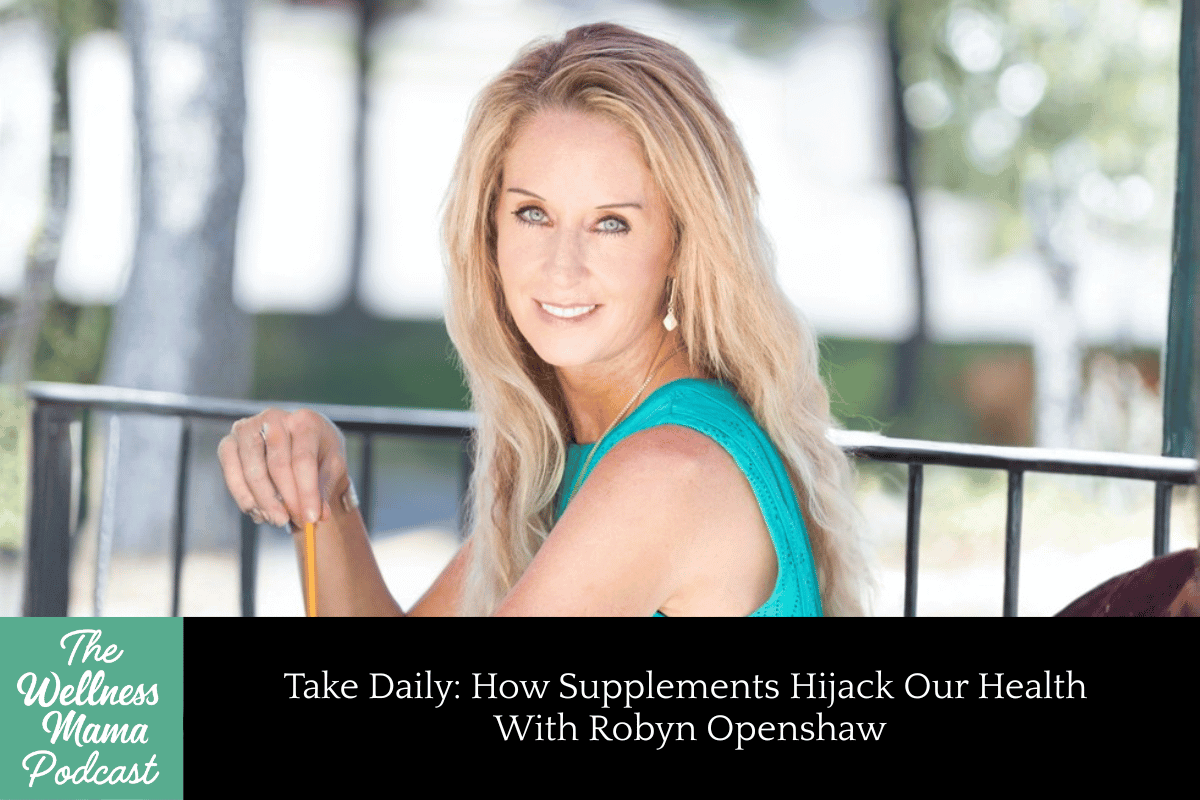
Katie: Hello and welcome to the Wellness Mama Podcast. I’m Katie from wellnessmama.com. And this episode might be a little bit controversial, although I don’t think it needs to be, but I might be putting some sacred cows on the chopping block by tackling how supplements can hijack our health. And today’s guest makes a really strong case for this.
And I encourage you to listen and certainly don’t have to agree, like I say, question everything, including her, including me. However, I do think it provides a really interesting perspective and some deeper questions that are worth asking, and you might have heard her before. She and I have been friends for a long time.
I’ve had her on before. Robyn Openshaw is the author of 16 books, including bestsellers, the Green Smoothies Diet and Vibe, and she’s also a former psychotherapist university professor. She’s a mom of four and she’s lectured in 450 cities over the years. And now she is tackling the topic of supplements and what they actually do and what they even actually are.
And so I encourage you to listen because she has some interesting questions and has some really interesting perspective and I share kind of some of my evolution around some of these topics as well. So let’s jump in and join Robyn. Robyn, welcome. Thanks for being here.
Robyn: Thank you so much for having me. Good to see you again, Katie.
Katie: You too. A lot of people may not know we are in real life friends, have been to Switzerland together actually years ago. Got to go learn at a clinic in Switzerland with you. We had known each other for a long time and I’m excited to dig into what might be, but I don’t think should be, a somewhat controversial topic today, especially in the world of health and wellness, where sometimes supplements can kind of become a holy grail of sorts. And you have written as you often do, a very deep expose into this world and like really done a deep dive into the research and I’m really excited to go into this with you today. So your new supplement is called Take Daily, how Supplements Hijack Our Health. And I would love to start with the background of this.
Maybe, A. How did you come to write this book to begin with? And what were some of the most shocking things that you learned in the process?
Robyn: Great question. I, it’s been a long journey of doubting more and more as I would come across evidence that this supplement that the public thinks is the alternative for us earthy crunchy people, for us health oriented people, for those of us who have been self-educating ourselves and reading, and reading and reading, and maybe hundreds of books, you and I, each of us about health and wellness supplements were the Holy Grail, like you said. And so my mother sold Shaklee supplements when I was a kid, and Dr. Shaley was one of the early pushers of supplements. And so I would have a cup that was like two inches deep in supplements that I had to take that took longer than it took to eat my breakfast. And sometimes I’d be in a hurry to catch the bus or whatever.
One time I stuffed them in my pocket and I put them in my first period desk and at the end of the school day, I’d forgotten I’d left them there. And I got busted for drugs. I actually had the police show up at the school and I remember when I got sent to the office and here I was this little straight A nerd and they said, what are these pills?
And all I could think was I wasn’t scared of the police. I wasn’t scared of getting arrested. I had never done drugs in my life. I was just like, please don’t tell my mom I didn’t take my vitamins. So there’s a whole lot of, there’s a whole lot of data points along the way, but it’s been the last like three years that it went from being a subject where I would take one type of supplement, whether it be fish oil, or whether it be cholecalciferol, which I refuse to call vitamin D, I might say vitamin D in quotes, because that’s how people think of it, and they believe that they’re addressing a vitamin D deficiency by taking cholecalciferol, which is also the active ingredient in a lot of rodent poisons. I kept researching when AI came out, I could find the answers. It’s really not controlled to protect the industry yet, I believe it will be. So we wanted to go hard doing the research. So I brought in a second author because then both of us could do hundreds and hundreds of hours of research and write together.
And he didn’t know anything about supplements, but he had been a headmaster in the UK who stood up to the COVID vaccine mandates for children in schools and subsequently could no longer be a headmaster in the UK. So he was my co-author and he was absolutely fantastic because he was starting from zero as a non supplement taker, just a guy who like touches the earth and gets in the sun and eats whole foods and avoids the processed foods and is a super healthy guy in his fifties, super talented. And he just kept, you know, I’d send him on a research junket on a specific topic and he would be, he would come back and say, I almost didn’t believe you. But it turns out, you’re right, these mineral supplements really are ground up rocks and chalk and shells.
Like it really is that simple. And so it was like writing blog posts. It was posting on social media, seeing the reaction of people. Where usually these women who consider themselves to be very, they’ll call themselves holistic or health oriented. They tend to be very educated. They tend to take more responsibility for their health versus the general population who just, when I get sick, I go to a doctor and the doctor tells me what to do to fix myself.
This is the kind of person who overtakes supplements. And you know, you and I were just talking about how, you know, you had a spreadsheet at one point to track all the supplements you were taking. And companies send Green Smoothie Girl, my brand supplements for me to try and you know, you and I don’t even have to pay for our supplements because there’s so many companies who want us to try out their new miracle claim supplements. So the deeper I went, the more curious I became. And eventually it was like, I have to write this book and I can’t use my, Simon and Schuster, my last publisher or my first publisher. I’m gonna have to self-publish this because pharma doesn’t want this out there.
Mostly people say, oh, pharma’s going to hate this book. No, they’re loving this book because pharma makes most of our supplements. And it is a pharmaceutical or allopathic or chemistry approach to these pills that invented the idea of a vitamin a hundred years ago. Long answer.
Katie: I love this. And it’s definitely, I feel like, could be, like I said, could be controversial, but I love that it challenges some of the kind of the core beliefs and brings in that correlation of like, a lot of us question pharma, but then essentially take the same mindset and convert it to supplements. And there’s a lot, I’ve talked a lot about mindset in general, but I have issue with when we take supplements from a perspective of, especially thinking something is wrong with the body and trying to fix that thing that’s wrong with the body versus viewing those things as like very important messages from our body that are giving us valuable feedback and not a thing to be fixed, for instance. I think there’s a whole huge cascade to that that we don’t yet fully understand. And you and I talked off air of how so much has shifted for me over the years.
And like you said, I used to have literal spreadsheets of supplements that I would take every day, like handfuls of them. Now I take very, very few and I think that so many of our problems actually can be, go back to cellular voltage, go back to our disconnection from nature. I say the term nature deficit disorder a lot, and I think at the very least, like those foundational things like our light, our circadian rhythm, our basic hydration or stress levels, the free things are worth building a foundation and addressing long before we would even consider any of these like biohacks or fancy supplements. Because even if or when there’s a time when those can be helpful, they’re gonna be more helpful if we have those sort of like foundational things in place first.
I would love to go a little bit deeper on, I love that you said you won’t even call it vitamin D because I feel like this is one that so many people think is like a really important thing to take. It’s one I won’t touch with a 10 foot pole now, but I did not know this back when my vitamin D levels when I tested them were were in the twenties and I had autoimmunity and I felt terrible and I kept taking vitamin D and nothing happened, and now I won’t touch it at all.
I spend lots of very careful time in the sunshine and my level last I tested was 86. So break down the vitamin D kind of controversy in what’s going on with this.
Robyn: Yeah, congrats on the level of 86. It’s actually the 25 D lab test that they have us take, and it’s a very clever way to shoehorn 85% of people into a deficiency narrative. And literally everybody in Canada is told to take what is called vitamin D. It’s actually cholecalciferol. The vast majority of it is derived from sheep.
The grease from sheep’s wool or lanolin. I mean, I could tell you what their logic is. It sort of defies logic. But it’s pretty creative. And then for the vegans, they will lab, make algae, in the lab and they’ll derive cholecalciferol from that. But it goes through a whole bunch of chemical processing stages.
And in the book, we don’t just leave you with, you know, it’s not like good supplement, bad supplement. We leave you with an empowerment of here’s how to find out really easily. Especially right now, I think that eventually chat, GPT Grok, all the AI platforms will be gatekeeping for the supplement industry, which is the drug industry.
Okay. This is one of the things that we have to lay it out in detail, that most of these pharmaceutical companies have a nutraceutical side of the house. People think that they’re buying up the supplement companies, and I’m not here at all to say that all supplements are bad. I take, well, one myself.
But I have to know exactly where it is. I have to have full confidence in it because I’ve researched and we go chapter by chapter. There’s a whole chapter on the vitamin D thing. 86 is a great number. I’ve been in the optimal range my entire adult life of being tested once a year by my hormone practitioner.
I’ve been up there the whole entire time and one of the things where I have so many like this that I wouldn’t wanna bore you with them all, but for instance, I was in the optimal range, which the 25 D lab test does correlate. Higher numbers correlate to people in good health. Lower numbers do correlate to poor health, but you don’t know the level of usable vitamin D, which is really a secosteroid hormone and a very complex set of many molecules, most of which are not in that cholecalciferol pill. But it was going to my hormone practitioner, who, if you think about it… Okay, I’m not saying, any of your practitioners are devious or that they know this and are keeping it from you.
Most of them do not know what we’re talking to you about here today. But she told me, oh, your vitamin D levels, based on the 25 D lab test, which really, you also need the 1,25 D lab test, but it’s a pain in the butt. It’s expensive. You have to freeze your blood. You have to trust that the person on the other side thawed it and tested it at the right time.
So doctors just don’t do it. And so everybody’s deficient. So everybody take the cholecalciferol falsely called vitamin D. But I went in and she told me, your vitamin D level looks fantastic. Like always. And then as I was leaving, she said, you should get this fish oil. That’s another story we’ll set aside, and this vitamin D, because she put her private label on a product that literally thousands of people sell.
But small practitioners, influencers, doctors can put their label on it. And most of their patients just think that like the doctor was somehow involved in making that product or formulating it, knows what’s in it, which is not usually true. And so she said to me, you need to leave with some fish oil and some vitamin D and I said, well, you just told me that my omega levels are perfect and that my vitamin D levels are perfect. And she said, and I quote, couldn’t hurt. And for that. I left $120 poorer. And why would you get $69 once a year from a patient when you can get recurring revenue of another 120 or 100… probably now 200, I don’t know, dollars a month. All the way until they come back. So you can see how it’s a really tempting thing for the practices, the clinics, they have to pay the rent, they have to pay their employees, they believe the stories that are marketed to them, and they just pass it along to the consumer.
So I took vitamin D that year, not religiously at all, but I take it here and there. I had some doubts about how this little pressed white pill could possibly give me what my body makes in contact with the sun. That didn’t really make sense to me. I already was kind of like questioning it. But where I really started questioning is the next year I went back and had the first and only time in my life, probably 25, 30 years now, 30 years now of getting it tested once a year. The only time that I was told I was below the optimal range. So what do you think, Katie? What do you think if you go in with lower than optimal vitamin D levels from the 25 D lab test, what do you think a practitioner is generally going to try to get you to do?
Katie: Well, in my experience from years of that happening, they give you supplements and they keep increasing and increasing the amount that you’re taking.
Robyn: Increasing and increasing. So Mike, who authored this with me, you know, he was just mind blown by it. And everywhere he would go, he would talk about these supplements and he, a close friend of his, had a high school daughter who was very, very ill. And he said, do you know about, does she, is she taking vitamin D?
And she goes, oh yeah. And they keep giving her high and higher and higher doses. He said, can I show you the chapter? You wanna read the chapter that Robyn and I just wrote about, quote unquote vitamin D. And she read it, got her daughter off of it. Let me say as a prelude to this, I’m not a doctor. I’m not giving you medical advice and I’m not telling you to go off of anything.
I’m all about you being informed. I’m about informed consent and education about these issues. Got her daughter off of the cholecalciferol that she was on super high doses of, and they had been to doctor after doctor, and this girl was not able to compete in her, in her different adventures and the girl got well. And there’s huge Facebook groups about this, of support for people whose health is damaged from years of the calcium flooding out of their body because of taking Cholecalciferol.
It’s a rat poison and it says on the, or it’s again, the active ingredient or rat poison, and it will say right on the bottle, if your dog or cat eats this, you know, contact poison control, do this or that. Not all, I do wanna say this just to cover my bases here, not all rodenticides have cholecalciferol as the active ingredient that causes the rat to die in a week.
Some of them have moved to using the Warfarin drug due to the bad press. There’s more and more people who are becoming aware that cholecalciferol is super toxic to animals. It’s toxic to us too. It just doesn’t kill us in a week.
Katie: Yeah, that is definitely a new information that I feel like a lot of people didn’t know, and I didn’t know the full story on that either. And just to highlight a couple things you said, kind of double click on them. I think you’re right. You and I both have a lot of friends in the health and wellness world, and we have a lot of friends who are practitioners who truly, I feel like do desire to help people.
So I never wanna throw practitioners under the bus. I think you don’t go through that much education and work and get to that point without a desire somewhere to truly help people. So it’s not like we’re trying to put down, at all, practitioners. I think there are amazing ones out there. They’re, a lot of them are very heart-centered and truly trying to help people, so I love that you mention that. But it also brings up, like I say, often too, I’m not ever giving health advice and in fact, I don’t encourage anyone to look for direct health advice from almost anyone else. At the end of the day, I say a lot. We’re each our own primary healthcare provider and we can learn a lot from other sources.
But at the end of the day, we’re the ones in the driver’s seat, which is both amazing news because we have the ability to affect change and also calls to responsibility because we have the responsibility to affect change. No one else is coming to save us. But I always say, question everything. Including, and especially me. So never take anything at face value. I think you’re the same way. You’re always encouraging people, ask better questions. Question the things I say. Challenge it. That’s how we grow. That’s how we learn, that’s how we keep evolving our understanding. And I would guess that this is not limited to vitamin D as a supplement category, so are there other examples of things that are adulterated or added to supplements or not what they seem when people are just kind of taking things that they hear about online or that were recommended to them by any kind of various practitioner or advice they got?
Robyn: Yeah, I mean that’s why we have like a whole chapter on the B vitamins. Okay. There’s, I’ll use that as an example. I mean, we go through B1, B2, B3, okay, to B6. And people have seen pyridoxine and then it says in parentheses, vitamin B six. And so we’ve been so indoctrinated to believe that pyridoxine, this chemical synthetic substance, is vitamin B6. In fact, I was talking to a functional medicine doctor last week and she said, well, I think that, tell me, educate me. You know, I think they’re really curious and I don’t like throwing the functional medicine doctors under the bus either. I think a lot of what drives them to sell people pills, pills, pills isn’t just that selling supplements is an extremely high margin activity, okay? They often are getting 40 and 50% of the price you pay on that product. That’s the, of all the middlemen, and there might be literally 30 middlemen, the doctor actually educating you and selling it to you directly gets the biggest piece of the margin.
And they are giving patients pills because patients want pills. Most patients aren’t willing to do what I’ve seen you do, Katie. You have like transformed yourself. You’re like a different person than the person I first met and you were always a great researcher and now you like you’re gorgeous and in your peak health.
And you know, people think that we just get older and lose our health, but you’re like the shining star of, and me too. Like at 58, I’m way healthier than I was at 28. Way healthier. I don’t ever wanna have the life that I did at 28 where I could barely get out of bed for my first two little kids. But the B vitamins as an example, I mean, there’s a chapter on fish oil, which is a shocking story.
It is made from the waste of fish oil or waste of fish, the stuff that nobody wants to eat. And by the time you eat it, it’s gonna be an average of probably about two years old. So it’s rancid. Everybody knows that you don’t take a fish filet outta your freezer and put it on their counter and come back in two years to grill it.
Everybody knows that, that makes people laugh, but then they’ll eat 2-year-old fish oil. And the funny story that goes along with that one, my awakening on that one is that I was at Expo West, you’ve been there, biggest trade show, top 10, biggest trade show in the world. And you could just like walk all day long and not see the same row or the same booth twice for like three days. It’s that big. But there was a whole row and it was all Chinese companies and I knew that they didn’t really like, weren’t necessarily good at English, but I like asked them, I’m like, what is it that you sell? I asked one of them and they said, we sell the chemicals that mask the rancidity of the fish oil for the fish oil industry.
And I said, what? And they’re like, yeah, so we sell the deodorizers and the purifiers so that you don’t have, you know, that rancid fish oil burp after you take your fish oil. Okay. I think everybody probably listening to you knows that rancid oil is a bad idea. It’s carcinogenic, but the, and then I said, so is that what this whole row of companies, that were all Asian, is that what they all sell? And they’re like, yeah, they’re all our competitors. They also sell just the chemicals to deodorize and purify fish oil. But let me, let me go back to vitamin B because that’s one that I wanted to use as an example. When you say, are there others? Oh, yes, there are.
And then you start to see how it works and how once it becomes a billion dollar industry, pulling it out by the roots and telling Americans what they’re really getting. It’s just not gonna happen. There’s like thousands and thousands of people who are financially being compensated for this industry and nobody’s really, there’s nobody who has like a profit incentive or a, or the drive to go and pull that thing out by the roots. It would take like an act of God or an act of Congress. And the B vitamins, every single one of them. You kind of can’t tease one B vitamin out from another. But the chemical synthetic thing called, let’s say vitamin B5 or vitamin B12, they don’t exist in isolation.
That’s not how it works in the body. But they are literally not made of any food substance. And they are made of petrochemical products, heavy metals. I mean, there’s a few different kinds of vitamin B12 that are molecularly similar, so you know, they’re kind of getting away from the cyanocobalamin. That used to be the, you know, a big one, the big seller, until people figured out that it’s made of cyanide and the heavy metal cobalt. Cyano, cobal, amin, cyanocobalamin.
So then they’ll buy, you know, methylcobalamin and think that, well, that, that one must be good. But anyway, I don’t wanna be tedious on the B vitamins, but they’re an example of how, you know, somebody puts their label on it and maybe they put the ingredients in a slightly different order, and they tell you that it’s proprietary because it’s such a crowded space that everybody has to have a story about why their product is proprietary, to get a consumer who is overwhelmed with all the pills to the point that they have a spreadsheet to keep track of them all. But anyway, we do it because we want the magical, amazing benefits. We also don’t wanna have deficiencies because we think that it somehow, when we take vitamin C, that’s, there’s a whole chapter about vitamin C too, because it’s ascorbic acid. 99% of what’s being sold is ascorbic acid, which is not vitamin C.
But the consumer doesn’t know this. And I’ve even like gone into chat GPT and asked it, like just drilled it with questions like, so ascorbic acid isn’t vitamin C. You’ve shown me the 10 compounds that we can isolate that are just parts of vitamin C saying that ascorbic acid is, vitamin C is like saying that the chaff of the wheat is bread or is wheat.
So this is kind of a metaphor. But anyway, this, I said, how have they gotten away with this? Like in the minds of the supplement makers and the pharmaceutical companies that are making most of our nutraceuticals, what would a lawyer defend it as? And it gave me a whole bunch of word salad that basically boils down to, because nobody stopped them and just from historical precedent because they’ve been doing it for a long time.
Katie: Yeah, that’s wild. And you definitely touched on some of the common ones. I haven’t gotten a chance to get through the book yet to know, but I’m curious, did you guys go into iron at all? Because this is also a very controversial category and I hear a lot of women being told to take supplemental iron and being told that they’re anemic.
And to me there’s a whole lot more nuance here that actually goes into a whole symphony of things related to copper and other minerals and not just iron in a vacuum. In fact it seems to me like I used to be anemic and I no longer am by all of their standards. But that it actually may not even be about iron at all in the first place.
And that similarly to vitamin D, that taking this might actually be counterproductive. And especially when I apply the voltage first lens to the human body, that especially makes sense to me. But I’m curious if you guys dove deep on the iron question at all.
Robyn: We don’t have a chapter on iron. My own personal story has me very stymied on iron, wondering what it is, because here’s the crazy, just an example, I’m a n=1 study, right? Like my story doesn’t really mean anything, but it does make you scratch your head and think. Something’s wrong with the way we’re measuring iron.
I mean, iron has so many forms and I never took prenatal vitamins. My four children are between 25 and 32. Never took a prenatal vitamin once. Because back then, as little as I knew about health, I did know that it was kind of a running joke among young mothers of that age that taking iron will constipate you.
And I didn’t want that and I didn’t fully trust the whole multivitamin concept, even back then. So I have four kids with an IQ of like 140 plus who I somehow managed to dodge the deficiencies enough that they’re still alive. But I have been plant-based, not vegan, but I don’t eat, I don’t need animals at home.
I don’t like tell people to be vegan. I just choose to eat that way myself after reviewing a lot of evidence and just kind of losing my taste for animal products and having a really wide diversity of plants. I don’t, people don’t know me as a vegan brand because I don’t like the word, I don’t like the divisiveness.
I think people can be healthy eating some animals, but I just think we need a lot of roughage. I think we need a lot of fiber, soluble fiber and insoluble fiber. I got well moving to a whole food, plant-based diet. So it’s what works for me. But I was anemic before I made that switch. I would get turned down for giving blood many times because I was anemic while I was eating a burger a day.
And then many years later, many years into my sort of just accidentally giving up animals, I just sort of lost my lost interest in them. I, you know, if I go to a family member’s house and that’s what they’re serving, I’ll eat it. So I’m not a vegan, but close. I had high iron for like four or five years in a row, and I’m not sure it means anything because moved here to Florida and had read that people who live at high altitudes may register a high iron level. I was living in Park City at the time at 8,000 feet here in Florida, totally normal iron. Didn’t do what the practitioner told me to do. She said to go give blood twice a, you know, every other month. That didn’t make sense to me, like, go bleed out my life force. You know, a pint of it every two months.
I did do it like once or twice, and then I was like, that just, I don’t think we know the whole story here. So I wish I could give you like real closure and put a fine point on the iron story. But I actually started writing, after this book, I started writing a book about the labs industry because we know that allopathic medicine has been really wrong about so many labs.
I mean, you know, the whole cholesterol debate, right? And blood pressure. And we put what one in seven people in the western world, adults, are on a statin drug. And we now know that it doesn’t prevent cardiac events and heart attacks. And still we have one in seven people on statin drugs. Just an example of how once it becomes a super powerful industry, it takes probably someday people will get off of statin drugs.
They feel like crap on statin drugs. And some people just refuse to take them. But they’re just kind of scared into it. Most people will just do whatever their doctor tells them to, and they assume that their doctor has their best interest in mind. I think their doctor does. Like I said, I think the doctors are educated by the pharmaceutical companies.
I think the functional medicine doctors are educated by the nutraceutical industry and they believe that they’re giving you a pill that might help you. Whether there’s evidence for that or not, I don’t know, but I think that the iron that we need is a mineral. I think we have it plentifully in any decent diet. And now, and for quite a few years now my iron test is back to being in the perfect or optimal range. Like practitioner says couldn’t ask for better. So I don’t know the answer to that, Katie, except that I have been questioning more and more of the lab tests. I might not finish writing that book because ChatGPT tells me that they’re literally approving thousands of new labs a year, and they’re approving about 10 human genome type tests a day.
So if I wrote the book, it would be like a, it’d be like a reference book and I don’t, I don’t wanna write a reference book and have to be that comprehensive. I wanna give people the tools to at least question the labs because people are being shoehorned into protocols and toxic interventions that they do just because of a number they were told by a practitioner.
Katie: Yeah, and to your point, like a number, that’s a very brief snapshot and depending on what you’re measuring can change like minute to minute, much less over the span of a week or two. And you mentioned like anecdotal data, and I’m a big fan. I always say this when I get the chance of like that N of one study that we do, when that, when we’re doing it on ourselves is perhaps the most valuable data we ever get. And that data doesn’t come from an external source. Like these are things we insource internally. And I think that there can be a time and a place for empirical data, but not at the expense of ignoring our own feedback from our own body, our own intuition.
Like these are incredibly powerful tools that we often hand off and outsource to outside sources when we’re looking at labs or taking things to fix our problems. I think a mindset shift there can be super powerful. And I also just wanted to make sure I highlighted what you said about fish oil. Because I get this question a lot. I know I’ve changed my opinion over the years on fish oil as I learned more also, and I feel like a lot of people have heard now about oxidation and they’re at least questioning that. But I’m glad that you are really diving into that in this because that’s a question I get so much. And it, to me it’s important to note like nature often gets these things right and in nature, you’re right, we don’t have ever fish oil isolated by itself. It’s always in with a whole lot of other things in the whole fish source.
And I love your analogy, like you would never leave this on the counter for years and then cook it. But that’s essentially what we’re doing when we’re taking the supplement. Not to mention the whole food source has selenium, which we know helps balance out mercury. It’s a natural source of so many things and you can’t get all of those in a fish oil supplement. So I love that you’re really…
Robyn: Well, lets don’t forget that there’s two major meta studies and they’re not even new that literally look at thousands of fish oil studies and have told us it hasn’t prevented any cardiovascular disease. Like that information is out there for functional medicine to learn. But if you’re, if you’ve spent years marketing your fish oil to people and your patients are buying it every single month, how likely are you, even if you become aware of that, how likely are you to, what, you’re gonna write a letter to everybody in your practice and say, it’s come to my attention that fish oil does you no good and may actually increase your risk of prostate cancer.
That would be embarrassing. It would be expensive. It would make people go, wait, so you may have sold me something that’s, like, harmful. Maybe you should pay me back. See, people just don’t, it’s like the mercury in the teeth thing. Do you think the American Dental Association is ever going to say putting mercury in our teeth was a horribly toxic mistake that we made for a hundred years?
I don’t think they ever are.
Katie: That’s a good point. And I know there’s more in the book and I would encourage people to read it to really understand and go deeper on all of these, but you’ve touched on a few that are not just like, not helpful, but potentially very overtly harmful. Are there any other big categories of that that you encourage people to question when it comes to their health?
And then I wanna get to the, like, kind of what to do instead category.
Robyn: So each chapter starts out with kind of a, it’s like you’re too long, didn’t read TLDR. You know, like six points, boom, boom, boom, boom. Like here’s, I’m looking at chapter two on multivitamins. Number one, multivitamins are packed with synthetic chemicals, plastics, metals, solvents, not natural nutrients from food.
Number two, vitamins like C from GMO corn, D from sheep grease, and B, from coal tar, and ammonia and more are chemical byproducts, not food extracts. So you can go to a chapter and say, I don’t wanna read the whole chapter, but I want the bullet points. I think the most dangerous one, because you kind of brought up some of them actually create harm, we go through the published research. It was kind of an accident to find out how retinyl palmitate, which is what they call vitamin A, because there’s, and this is really important, if everybody’s not listening, if you spaced off, come back to me right now, how can they say retinal palmitate is vitamin A?
Because there’s some molecular overlap. That’s the best answer I can come up with because I’ve been asking that question for years because they find some molecules that are similar and that’s good enough to say this is vitamin A and it was actually a study to show how helpful vitamin A and betacarotene were. And so they were testing it on smokers and they had such a radically higher rate of all cause mortality from the group actually taking the synthetic vitamin A and betacarotene that I think that warrants everybody reading this, because you could be told by a practitioner to take this, and I again, am not telling you to not do what your practitioner says.
I’m saying you should educate yourself. So if we do nothing else here, I wanna plant the seed to learn about the ingredients in your supplement. I don’t know if you hear this in two years and you get the book, you won’t be able to go into chat GPT and prove what I’m saying, but right now you can. And we give you specific phrases that were, like, the magic, unlock the door, show us the information that we have to look for, that before AI we could’ve, we would’ve spent two days having to research. And so I think that’s why this book hasn’t written, been written before, is it’s so much work to dig and read sources and more sources and more sources. I mean, ChatGPT will write you the research paper and give you the sources on what really is retinyl palmitate that they call vitamin A.
What chemical processes were used, what chemicals were used in manufacturing it, what country makes most of the retinal palmitate and synthetic betacarotene? So you live in the best of times because 20 years ago people were getting bombarded with all this marketing and now we could find out the truth so that we don’t just have to believe the marketers.
Katie: I love that. And yeah, of course I’ll link to the book, but I know it’s available in many places. But I’ll have it linked in the show notes especially, because I know there’s something specific people can get that is a bonus in the pre-release phase. So I’ll make sure that’s linked. I’m always a fan of questioning my own sacred cows, and one that I’m really curious to get your take on is kind of minerals as a category, but especially also we were told for a lot of years salt was bad.
We were told to avoid salt. That salt was the problem. I’m curious where you landed on the category of minerals and especially of sodium because certainly that one’s had its controversial moment in mainstream medicine. I certainly have my own opinions on it and I’m also always willing to ask questions and be, to find out where I have not been fully correct.
So, controversial and a little bit of a sacred cow for me. But what, what’s your take on minerals?
Robyn: Yeah, sacred cow for me too. My best selling product for 18 years, not the whole 18 years, but most of it is a mineral product that is right straight from the ground, ancient plant deposits. But all the other mineral supplements were ground up rocks, chalk and shells. And I’ve kind of known that for years and years because I had done the research like 15 years ago.
And I think that it places a heavy burden on the kidneys and the liver. And there’s, there is published evidence on this. That these big supplement takers, as in the people who have the pill organizer and they’re taking 20 supplements a day, or 50 supplements a day. Your body’s having to filter that out.
I mean, people have this idea that it’s just making expensive urine. It may be actually a lot worse than that because if your kidneys and your liver have to be involved in the work of getting the rocks and the chalk out that you took, it may take a long time before it shows up as a serious injury or health problem involving those filtering systems.
But it’s really, it’s a lot for the body to deal with. And we, I’ve gone out on the Green Smoothie Girl page and said, how much are you spending a month on supplements? And I’ve had women tell me, $600 a month, I’ve had one tell me a thousand dollars a month. There are people spending more on supplements because these deficiency stories and they, even if they don’t feel better eating the supplement, they keep eating the supplements and take more and more and more. Because they feel like, well, I might feel worse if I stop taking this. And so it’s amazing how little it actually takes for us to just keep taking it. But I feel like I’m not addressing your, let’s see…
Oh, minerals. So I think minerals is actually one of the few deficiency stories that’s true. Because of the way that we’ve farmed, because of the dreadful lack of minerals in the dirt. Because farmers used to know we can farm this land this year and then we have to put it, have the cows poop on it and dump, let the grass take, throw the grass on it and let it lie fallow.
Okay. That’s not even a thing anymore. In fact, they, sometimes, they try to get two crops a year out of it because the dirt has no microbiome because it’s missing minerals. I do think we have a minerals deficiency. I don’t think there’s evidence that we have any widespread or comprehensive vitamin deficiency.
Our bodies produce vitamins. That’s often a shock for people. I doubt it’s a shock for you. But minerals we really do need to get from our food and I don’t think the one at a time, calcium, potassium, et cetera, those powdered ground up rocks, chalk and shells. I don’t think that the body absorbs them based on the evidence. And I think they may actually be pretty tough on your liver and kidneys, but I do think that minerals are a problem and it’s the one deficiency story that so far in my many years of research, I think is a true one.
Katie: That’s fascinating and it makes sense. Like the minerals also don’t in nature just exist. It’s a single thing. Like there’s not just like a magnesium deposit somewhere in the world or a potassium deposit somewhere in the world. But they are present in, or meant to be present in most of our foods in a lot higher amount than they are currently.
So that has made sense to me too. I’m glad that you were able to kind of like share your perspective on that. And I’m curious so you said that’s one of the few categories that you feel like there can be some validity to the deficiency story, perhaps still a lot of questions on how to resolve that deficiency. Are there any other places like that or if not, like, what is the alternative approach for people to consider? Kind of like what’s the paradigm shift if we stop thinking of supplements as essentially just the fix like pharmaceuticals are. What is a better way to approach that? How do we have a mindset shift that actually helps us to know what our bodies actually need and to work with it instead of against it?
Robyn: Yeah, so the one, the one supplement I do take is kind of like the whole food of supplements. It’s like one compound. It’s from deep earth. It is before those ancient plant deposits become shale or rock, which is when most people are gonna grind ’em up and they are high in minerals. Like they’re not wrong.
They are high in minerals. But you know where most of these ground up rocks, like, you know, come from that become our $40 bottle of supplement is from ore mining. So they’re mining for metals and they’ll take the limestone or whatever rock, and they have to get rid of it anyway. And so it’s gone from being a cost center to being a profit center because they can sell it to the supplement industry.
So the supplement industry acquires this raw material at almost no cost. And this is the case across most of the, these huge supplement companies, private labeling for thousands and thousands of smaller businesses is they are making their product from throwaway byproducts of industry. And that’s literally the base material of most of these supplements.
And it’s hard to believe. And that’s why, you know, it needed a book. I had written blog post after blog post, after social media post, after social media post, and you know, it’s just, that’s just not enough information for people to get it. Because mostly what I would get is, well, what’s the brand I should buy then?
It’s not about the brands. They’re all buying, almost all of them, are buying from the same supply chains, big rivers of supply chains, okay? Billions of dollars in ground up rocks that are called calcium. And they do have a lot of calcium in them. Not convinced at all that humans absorb them, absorb it well.
But the mineral supplement that I take and that, like I said, has been my best seller for many, many years, I like went off of it last year, just, I was so deep in this research and I was getting so jaded that I was like, I’m gonna go off of mine. I called the biochemist who helps me make it, and I grilled her.
Like I have many times before, for 15 years. I had not since I started taking that, like I stopped getting cavities, okay? Growing up I would go to the dentist and every year I had a bunch of cavities. I stopped getting cavities. Haven’t had one in 15 years. Well, I finally had one tiny little one, only time in 15 years.
And my whole family has, like, bad teeth, like our, we just get cavities easily. And so that was kind of like, I was like, I only realized in maybe like year 15. Wow. I haven’t had a cavity in like 15 years. I wonder if it’s because I addressed a deficit in minerals. Can’t prove it, but that was a pretty interesting thing.
What I did notice when I started using it is the dark circles under my eyes. I used to be so embarrassed 15 years ago to go on camera because I had these dark circles under my eyes and I went on it and they disappeared, the puffy dark circles and they haven’t come back. So when I went off of it just as an experiment.
My massage therapist came over, she comes twice a month and I was like, just getting on her table. And she goes, what’s going on with the dark circles under your eyes? I hadn’t even noticed yet. And I was like, oh, well it’s because I stopped taking my minerals. So I started taking ’em again and now my eyes look normal.
I’m almost 59. So anyway. Point is, I think that the fulvic and humic acid that you take, that’s basically just a direct extract, no chemistry involved, no solvents involved, fulvic and humic acid, I, it’s a great idea. It’s been, it’s worked amazingly for me. My hair started growing twice as fast. My fingernails started growing twice as fast.
So anyway, that’s, that’s an example of how I will take a supplement. I think there’s small businesses who are making organic herbs that are useful and that help the, help assist the body’s immune system. But this whole idea, it’s, we’ve, we’re seeing it, Katie, allopathic medicine, functional medicine, has copied it.
And they just do, they’re mostly doing procedures and pills, and I can’t even totally blame them because it’s what most consumers want. They want the easy thing most people are not going to do with their diet what you’ve done and what I’ve done. And I am, I consider it to be an amazing thing in my life that my son’s health crashed after the MMR vaccines and in that same year, my health crashed after a flu vaccine I had to get working on a psych ward in a hospital. I was in grad school and they made me get it. I didn’t know about exemptions and both of our health crashed. And I radically changed our diet because my grandmother had beaten cancer years before. And so I, and she, I went to her and I read her books and all of a sudden it became this fascination to me because we literally got well, and my son ended up being this elite athlete, pitched a shut out in the state finals.
Top two teams in the state. I got my health back, dropped 60 pounds. Just changing our diet. Just the simple things. And it’s honestly, it’s that, it’s a simple thing. It’s a boring thing maybe to a lot of people. They’re like, oh, I know I need to eat right. But they take these pills, thus the chapter on multivitamins, they take these pills thinking that it covers for good diet.
And I’m so sorry, but it doesn’t.
Katie: Yeah, in a sense, I understand they would be nice if it were an easy way out, but I’ve said for years, even before, understanding some of these things, like you can’t out supplement a bad diet. You can’t out supplement stress levels. You can’t out supplement lack of sleep and you certainly can’t outs supplement nature.
Like there is no replacement for that. Like we, those things are all built in. The great news is a lot of those things are free and so that there is not a barrier to entry to get morning sunlight. There is not a barrier to entry to go walk outside and get natural light, and those things can have amazing compounding benefits for our health.
And so I feel like I’ve gotten more boring over the years because my advice is like the same thing over and over and it’s gotten more and more simple. And that’s also good news because it’s cheaper, it’s easier, there’s less on the to-do list. And I also have found over time, like to your point that as I’ve slowed down with a lot of the extra stuff, the bio hacks, the supplements and whatever, instead I focused on, like, shifting my mindset, even when it comes to food and nourishment away from, of course, calories or anything like that, but more into like of the food choices I’m gonna make today. How do I show my body the most love? How do I maximally nourish myself? And I find myself now making you mentioned herbs, like more herbal teas at home.
Just because in the summer, especially here, it’s hot and they’re delicious. But those like liquid sources of nutrients have felt really good to my body and come from the, come from the ground, they come from plants. And just getting more back to these simple, basic things that I used to do but with a new understanding.
Robyn: I have never even heard any of my colleagues say what you just said, which is exactly, you put words on how I feel, which is I’m getting more boring, I’m getting more repetitive. Mostly because I see that like our audience isn’t doing those simple things. I mean, you know, I started, you and I are really OG influencers.
There wasn’t a word influencer, you probably don’t like the word influencer and I don’t either, but that’s what people call us. Back there before we were mommy blogging, before that, I don’t even think that was a word. But I have, the more I try different things, the more I research the, now that AI will give me information that was hard to get, that’s now easy to get.
I’ve gotten more boring and more repetitive. But you know, it’s kinda like when people go to church, it’s like, you know, I remember growing up and saying to my mom, like, we just learned the same thing over and over again. Like, forgive, be loving. You know, just these basic things have faith and with nutrition it’s just getting to the point where most things that my colleagues are selling, I can’t sell. I can’t sell, I won’t sell. I know too much about it. It’s marketing, it’s hype, it’s fluff. I’m not saying that’s the case with everything that you or I promote, but you know, if I put myself out of business because I don’t have sexy, salacious new things to sell people, then so be it.
It was fun. But as long as people are listening, this is the kind of thing that lights me up because I have people spending a thousand dollars a month that they could be spending on food and just, even though I haven’t even released the book yet, I’m talking to you about it and we haven’t even released it.
I’ve had about six or eight women, and just from my blog posts, and they’re paying close enough attention that they’ve read enough of them, that they’re like, oh my gosh, I’m just gonna stop taking my supplements and see what happens. Six or eight women say, I quit taking my hundreds of dollars a month worth of supplements, and I feel so much better.
Hey, remember when we went to Switzerland, Katie? So I go every year and lead a retreat. For those of you listening, Katie knows this. They have blood filtering technologies there now, two different ones. And so last year I had my blood filtered and a bag of petrochemical looking crap came out of my blood.
I’ll send you a picture of it if you want. I don’t know if you can put it in here. If you can, I’ll send it to you. And I was so shocked because it was as bad as everyone else’s. Even though I eat an organic diet, I’m looking out at my one acre, I’ve got huge gardens. I pay for organic. I pay extra for it.
I’ve done so many things right. Why, why do I have all these petrochemicals? You guys, if you start studying how the supplements are made, you’ll see how much petrochemical exposure you’re getting and it doesn’t all come out. And I think that’s what happened.
Katie: Wow. Well, I love that we’ve like aligned. We’ve gotten our story started so long ago and we were aligned on many things back then. And now to get, like, to come full circle and get to have conversation. And I hope that it’s encouraged people to consider their own N of one study to like consider those deeper inputs of their own health and hopefully to consider those free like nature things.
Because that is my, like boring, but I say it all the time soapbox is like, until you’ve tried it you might be shocked to find how much morning sunlight changes your life. Or how much, getting the proper amount of full spectrum light from the sun, which by the way, directly charges your mitochondria and makes a huge impact on every aspect of your health, that’s free. Like no one can sell that, so no one talks about it. But you might be shocked how big of a change you see from those small changes without, to your point, I love that you’re tackling this directly, all the expensive stuff or the complicated stuff, or the fancy stuff or needing monthly blood tests or all these spreadsheets of supplements, and I used to do that too.
So no judgment at all. I just love that you’re asking deeper and better questions.
Robyn: And movement. Don’t forget movement. There’s no substitute for it. It’s your best anxiety antidote, even by the, you know, mainstream research. We all have more sedentary lives than we’re supposed to, so getting outside in the sunshine also grounds you and dumps electrons you don’t need that you’re getting exposure from, from your devices and move while you’re doing it.
If you’re gonna be on the phone for your work, be walking. It also helps you think better, but the movement that we’ve lost I’m just, I’m with you. Get outside, move, get charged in the sunshine, you’re literally charging your battery. There’s no, there’s no replacement for it. I mean, I’m a fan of like the red light device, but there’s also just like that sunshine right out there.
Katie: I love that you brought that up. Yeah. Sunrise and sunset are much more intense red light than we can get from a device and it’s free. And I love that you brought up movement. Somebody on the podcast said, motion is lotion and there’s no supplement that replicates this. Also, like our heart pumps our blood, but we are the pump for our lymphatic system.
So if we don’t move, it doesn’t move. And on the voltage side, like we have piezoelectricity, so when we move, you know, even just walking, it creates an electrical cascade in our body. So I love that you brought that up as well. This has been so fun. We got to go in so many different directions. Where can people find the book?
Because you mentioned it’s not at a traditional publisher. I know there’s also a lot of additional stuff and resources you have available. So where do people find that? And I’ll make sure it’s linked as well.
Robyn: I’ll give you the link because right now it’s not, it’s, we don’t even have it published yet. Like we don’t, we don’t even have the, this is the preprint. So you see the red pill and the blue pill. That is very intentional. That will make sense to some of you. You’re gonna be taking the red pill here and there’s no going back.
You’re gonna understand a lot more about supplements and you’re gonna save a lot of money. So I’m just gonna give you the link right now. That’s the place to get it. I mean, eventually it’ll be on, I think in, sometime in October. We’re not sure exactly what date it’ll be on Amazon. But with the link that you have, you get three videos of me and my co-host who has a lovely, proper British accent. He and I read every other chapter in the audio book. You get the audio book for free, and you get three videos of him and me discussing things like six supplements we would never take and why. So you get three bonus videos, you get the audio book for free.
And so Katie will have the link because right now you’re pre-ordering it and you’re gonna, you’re gonna have to wait till October till we can ship it to you. So if you can be a little patient, get it now.
Katie: Amazing. Well if you’re listening when this is aired. Look for that link in the show notes and also around that time I will include it in my newsletter and on social, so if you guys follow me, you’ll see it there as well. Robyn, I’m so glad we got to have a way long overdue catch up. I love that you took a deep dive into this.
I’m fascinated to keep learning about it and we’ll make sure people can find the links to learn as well. Thank you so much for your time.
Robyn: Thank you Katie. So great to see you. Bye everyone.
Katie: Thank you for listening and sharing your most valuable resources, your time, your energy, and your attention with us today. We’re both so grateful that you did, and I hope that you’ll join me again on the next episode of The Wellness Mama Podcast.




Leave a Reply