Read Transcript
Child: Welcome to my mommy’s podcast!
Katie: This podcast is brought to you by LMNT, and this is a company you might’ve heard me talk about before, and I really love their products because proper hydration leads to better sleep. It sharpens focus, it improves energy, and so much more. But hydration is not about just drinking water because being optimally hydrated, a state called euhydration is about optimizing your body’s fluid ratios. And this fluid balance depends on many factors, including the intake and excretion of electrolytes, which many people don’t get the right amounts of. Electrolytes are charged minerals that conduct electricity to power your nervous system. I talk a lot about nervous system on this podcast.
They also regulate hydration status by balancing fluids inside and outside of our cells. LMNT was created with a science-backed electrolyte ratio of 100 milligrams of sodium, 200 milligrams of potassium, and 60 milligrams of magnesium with no sugar. Since electrolytes are a key component of hydration, here’s what happens when we get our electrolytes dialed in.
We have more steady energy, improved cognitive function, suffer fewer headaches and muscle cramps, we can perform better for longer, and especially the support fasting or low carb diet because when we stop eating carbs like during a fast, the absence of insulin allows the kidneys to release sodium.
So replacing that lost sodium with electrolytes can help you feel good on a fast. Since LMNT is zero sugar, it also doesn’t break up fast. Electrolytes are also important for maintaining blood pressure, regulating digestion and proper fluid balance. Keeping skin hydrated, which is a big one that I feel like often gets missed and so much more.
I feel like proper electrolytes is a missing piece for a lot of people and I love LMNTs new canned drinks, which are sparkling water with all the same ratios and minerals I just talked about, and they are delicious. You can check it out and learn more at drinklmnt.com/wellness mama. And at that link you will receive a free sample pack with any order.
This episode is brought to you by Native Path creatine, and this might be the most important creatine benefit that we don’t talk about enough, which is its impact on mental health. See, research shows that creatine supplementation can improve our mood, particularly in women, and our brain needs energy to produce neurotransmitters like serotonin and dopamine. And creatine helps on a cellular level.
Some studies suggest that creatine may be particularly beneficial for women with persistent feelings of sadness. And of course, while it’s not a replacement for professional mental healthcare, it’s an additional tool that might help us feel like ourselves again. So if you’re struggling with low mood and mental fatigue, talk to your healthcare provider and consider if creatine could be a helpful addition for you.
Quality matters though, so look for the most studied form, which is creatine monohydrate. I personally use Native Path creatine, and most research says to aim for three to five grams a day. I sometimes go as high as 10 for the mental benefits. But you don’t need a loading phase despite what you might have read on the internet.
As always, of course, talk to your doctor or healthcare provider before starting any new supplement or protocol, especially if you have an underlying health condition. But for many of us as women, creatine is one of the safest, most researched supplements available. And its time we stopped thinking of it as just for men. Save up to 56% and get free shipping at wellnessmama.com/go/nativecreatine That’s wellnessmama.com/go/nativecreatine
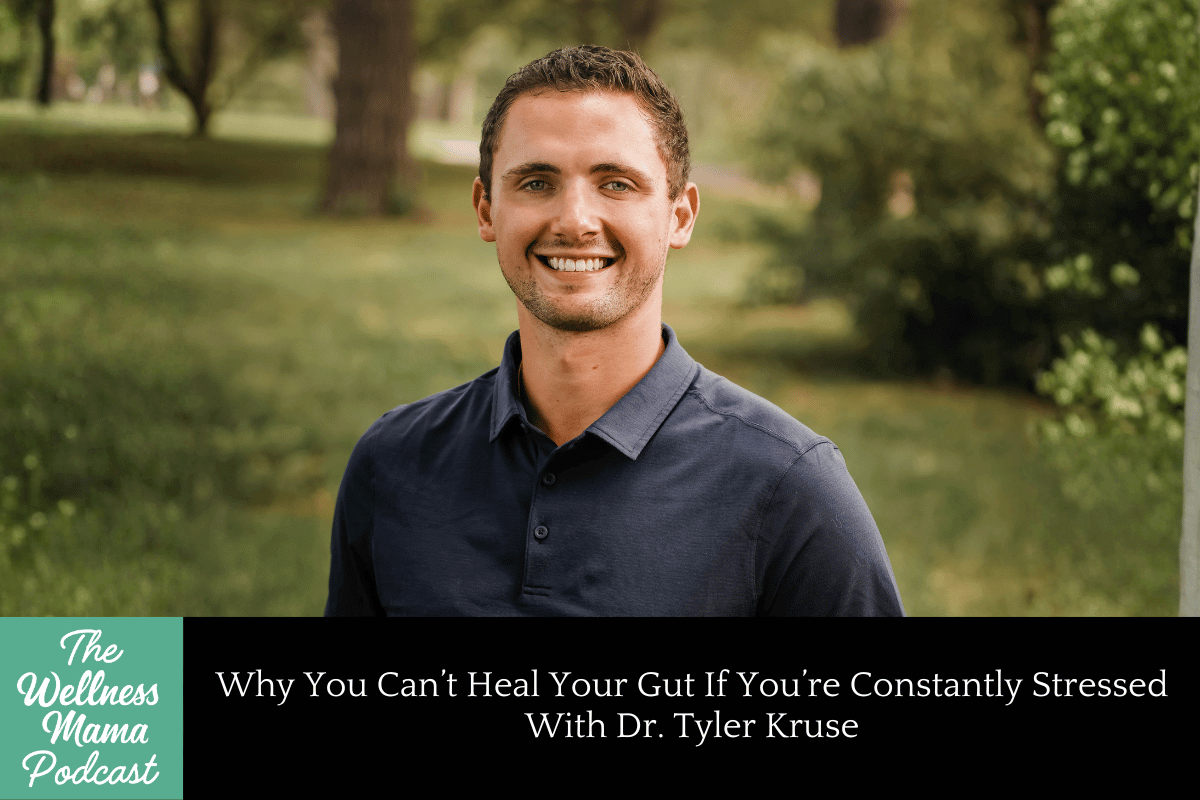
Katie: Hello and welcome to the Wellness Mama Podcast. I’m Katie from wellnessmama.com, and I am back with Dr. Tyler Kruse today to talk about why you can’t heal your gut if you are constantly stressed. And specifically the gut stress connection. And we get to go into some fascinating directions in this one, including how women and men handle stress differently and why and how this could be part of the reason women experience autoimmune disease is more why we need a different approach to things like fasting and high intensity workouts.
The way that light comes into play. Some low cost and free tools you can use to get into a less stressed state and support the nervous system, how this is connected to gut health. He talks about the universally helpful things that we can all do to support our body’s natural stress response and our gut, as well as things kind of universally to avoid and so much more.
And Dr. Kruse is a chiropractor and a holistic health advocate who really loves to go deep in working with his patients on gut health, nervous system balance, hormones, immune system, and whole body wellness. As you will hear in this episode, he is a wealth of knowledge on a lot of topics, so let’s jump in and learn.
Dr. Tyler, welcome back. Thank you for being here again.
Tyler: Yeah, absolutely. I’m super excited. We had a great conversation, last time we spoke on the Gut and the Skin Connection, and I’m excited to dive into more of how we can help people, understand the importance of stress in general on their health.
Katie: Amazing. Well I’ll link to our first conversation in the show notes. If you guys missed it. I highly recommend to listen. We got to get into everything from melanin and sunlight to the germ and terrain theory a little bit, as well as the most impactful things you can do that can improve your skin health via your gut health and why it’s so important to look at that connection.
And I have a feeling we’re gonna get to go in an equally number of fascinating directions in this conversation. You alluded to before that you spend more time talking about poop even than adjusting spines and the importance of daily elimination. And as a segue into this topic, I’m curious, how often does stress come up in these conversations as well?
Tyler: Yeah, every single day. So I usually tell people, so, not really like, kind of a joke, kind of funny thing, but a lot of times women will, you know, be kind of, you know, maybe a little nervous to talk about their poop or their periods. And I’m like, look, I talk about pooping periods every single day, because that’s a really good way for women to know what’s your health like, what’s your digestion like, and what’s your cycle like?
That tells me a good indication on your hormonal health and your ability, you know, your inflammation and your immune system, your digestive health. So, we talk about ’em on, you know, a daily basis. And that’s why, you know, even the people that do come in just to get adjusted, I typically ask questions like that.
Are you still on track? Are you still doing good? And, and that’s why my approach is the way that it is. I am a chiropractor. Yes, I adjust people. Yes. A lot of people think of chiropractors as just, you know, back crackers per se, and they don’t understand fully what the chiropractic philosophy was founded on.
It was actually founded on the way that the wellness way practices, it was founded on three Ts. Thoughts, traumas and toxins. Now, trauma, physical side of things, yeah, the adjustment’s phenomenal. Now, the emotional side and the chemical side, yes, you can help the emotional help with an adjustment 1000%.
There’s no argument to that. But when it comes to the chemical and the emotional side of it, sometimes you need a little bit more. So, you know, for example. You know, if somebody has a super low gut microbiome or, you know, potentially pathogenic yeast infection or mold toxicity, you know, the adjustment can help their body adapt back to the terrain theory 100%.
But they may need a little bit more than just a chiropractic adjustment. They, you know, because if they’re coming in and they got low back pain, but they’re eating McDonald’s and they’re living in a toxic environment and they’re the, you know, let’s say females just because they handle stress a lot differently than men.
A female that has a, that has a boss that’s just, you know, terrible, right? Just always on ’em, stressing ’em out, keeping ’em in that fight or flight wired but tired state, you know, I can do a really good chiropractic adjustment. Chances are it may help a little bit but probably not gonna fix everything if that’s what’s going on outside of the adjustment, right?
So, the adjustment, super important piece of the puzzle. But that’s why we, why we look to, why we like to look elsewhere, which is why, you know, I talk about poop a lot. Now, we don’t do a stool test on everybody, right? We pinpoint to what they need by nature. On the last podcast we talked a little bit about my story comes from gut health.
That’s a little bit of where my passion’s at. But doesn’t mean to say I don’t help people with metabolic hormones, those kinds of things. Autoimmunity, which the gut plays a big role in, as well, kinda start to heal and restore function of their body, is the big key there.
Katie: Yeah. I love that you mentioned that women handle stress differently than men because I feel like this actually has important implications to understand, even when it comes to things like fasting, cold plunges, sleep, light exposure, like we handle all those things differently. My personal take and feel free to disagree with me is that like, that doesn’t mean we can’t do those things.
It just means we need to understand how our physiology is working with those things and not try to just compete or emulate men when it comes to those. But I would love for you to explain a little bit different, since most of our listeners are women, that concept of that women handle stress differently. And then how can we actually use that to our advantage versus view it as a negative?
Tyler: Yeah, absolutely. So, I don’t disagree with you one bit there. I think that that’s a prime example of why everybody needs individualized testing. Sometimes, generally speaking for like women, for working out, we would want them to work out on their cycle. Now there’s a time and place where that needs to change a little bit.
You know, how hard can you go? What are your hormones look like? If you know that kind of stuff, you can start to pinpoint that. But so women and men handle stress a lot different, and this is the reason why. So a male, like me, like the husbands of the listeners, the boyfriends, you know, whatever. Anybody that’s a male that’s went through puberty, you know, 95 plus percent of their hormone production, specifically the major, you know, a lot of people know the major hormone is testosterone, and then in females it’s more estrogen and progesterones. Estrogens, there’s multiple ones. So a lot of people don’t know that. But a lot of people don’t realize that a testosterone, 95 plus percent of that is produced in the testicles of a male.
Now the testicles are producing that testosterone, whether a male’s sleeping, whether a male’s stressed at work, whether a male’s, you know, working out it, it’ll help. Working out will help that testosterone. But long story short is they produce right? Female side of things. When you’re cycling, you do get a lot of production from your ovaries, right?
But then you also get a good chunk, 30, 40% from the adrenals and then it your fat tissue, right? Those are the three ways you produce. And then when you get to menopause, your ovaries come down even more important for your adrenals to come up. But long story short is, you know, 30 to 40% of production or more, maybe you know, depending on the female, comes from those adrenals. A male, I mean, you’re talking 1 or 2%. Now, what’s one of the number one things that affect the adrenals? Poor sleep, stress, you know, emotional stress, stressful jobs. Anything with the word stress will affect those adrenals negatively. And so that’s why a stressful job.
That’s why women need more sleep than men. And that’s why stress affects women a lot differently than men because, you know, you’re not gonna lower somebody’s testosterone, a male, by stressing them out. It’s probably gonna raise it honestly. A female on the other side, you’ll wreck their hormones if you stress them out.
Whether you’re the husband, whether you’re the boss, it doesn’t matter. And so that’s why, you know, you’ll get a big change. Like if you, you know, in, let’s say just the job force, right? If I go to a male and I say, why didn’t you do this? You need to do this. That’s gonna make ’em do it, right? They’re not, they’re gonna be like, okay, sorry, then I’ll get it done.
A female that might shut her down completely because her stress is handling it way differently, then it’s gonna start to affect her hormones. It’s gonna put her more into a sympathetic state. And so now there are a handful of women in the business world out there that can make that switch, right?
They can handle that through the day, they can go home, be more nurturing mother, that kind of stuff, which is more of, you know, how the physiology of females were produced, right? There’s nothing wrong with that. It’s beautiful how the physiology of the human body was created. But men are meant to handle stress better.
Men are meant to go out, you know, go to the workforce, do it. You know, handle all that stress. Women’s hormones, the way that your physiology works was meant to be more nurturing, more caring for the kids. You know, different things like that. And that’s why women have more sympathy. Women, you know, their, the hormones drive that function.
But women also need to be a lot more intricate about the sleep and the stress supports and the hormone health than necessarily a male does. And that’s why when men come in, if you work on their gut, you work on their diet, you get pretty good change. Women a lot more intricate, right? It takes more ability to get that back to that homeostasis and that balance because of the way that that stress is interpreted.
And you know, you have different stressors, right? Menstrual cycle, pregnancies, you know, immune systems are a lot different in men than, and than women. I kind of joke around with this and a lot of women are like, ha, I knew there’s a reason why. But, if you notice when men get sick, they’re a lot more of a baby than a female, right?
A female gets sick and it’s like, okay, well the kids need fed, I gotta clean the house, I gotta do this, I gotta do that. It all gets done whether they’re sick or not. The husband gets sick, he’s laying on the couch. Can you bring me a little broth? And like, and a lot of that has to do with the hormonal side of things, right?
The way that cortisol and the immune system are affected. It affects how we handle different sicknesses and stuff as well. So, you know, that’s just kind of a few different aspects, but a big component of that is the aspect of how much hormone comes from the adrenals in a female, on why females handle stress a lot differently than men do.
And stress can be, remember, physical, chemical, or emotional. So I’ve hit on the emotional side with work, relationships, all that, but physical, what’s your posture look like? Are you obese? You know, and different things of that degree. And then chemical, you know, that could be a wide variety of things.
Diet, molds, infections, different things like that. But the big thing too with women, you hear a lot of horror stories when it comes to like, menopause and just in general, like, oh, my hormones are making me obese. Well, remember you have ovaries, adrenals, and then fat tissue. So if you’re in cycling years and you don’t have enough production from the first two, your body’s gonna hold onto fat tissue to make sure you have enough hormone to get through the day, right?
And then we get to menopause, we lose the ovaries production, but you need less hormone. So honestly, menopause should be a good change of life, which I know that’s going to stem some people like, oh, it’s been miserable, you know, well, your hormones are imbalanced, your stress is imbalanced to some degree.
But back to that is, you know, get to menopause, if your adrenals are stressed, then you’re really focusing on fat, you know, fat to hold that hormone, fat to neutralize things that you’re exposed to. And so that’s a lot of times what too, why you’ll see, you know, women gain weight, you know, with hormonal issues, is because the status that their adrenals in.
Katie: That makes so much sense, and it’s probably the most clear explanation I’ve heard of the actual differences when it comes to stress reactions in women and men, and I would guess is at least a factor, of course, it’s never a single factor, but a factor in why autoimmune disease disproportionately affects women in a much higher rate than men. I would guess this comes into play with that whole cascade of stress hormones into the physiology and how everything is so interconnected. And now that we understand also the like intricacies between the differences between women and men, I’d love to go deep on what’s happening physiologically when we are stuck in especially fight or flight mode or in chronic stress for a long time and what are the long term changes and impacts to the gut in that situation?
Tyler: Yep. So a lot of people call it the fight or flight. I usually say if you’re wired but tired, sympathetic dominance. So, there’s sympathetic and parasympathetic are two of the major nervous systems. So sympathetic is that fight or flight. I usually use this analogy, if you had a bear chasing you, I would hope you’d be in the sympathetic state for until that stopped.
But that’s what we want. Parasympathetic that’s more rest and digest. That’s calming. That’s good digestion. And so if you’re in that constant fight or flight, that’s gonna slow your digestion down. Maybe even shut your digestion down. And that’s why, a lot of people in super high stress states will eat less food.
They’re not hungry as much. You know, because of that sympathetic drive. It’ll drive, it can drive some more constipation. One thing I use is travel. So people that, you know, fly a lot and stuff, you’ll, if you talk to them a lot, they’ll tell you like, you know, hey, my, you know, I was a little constipated last week, but I had a trip.
Well, yeah, I mean, yes, there’s a lot of EMF and that kind of stuff when you are traveling, but also there’s stress with travel, whether you flied or not. And so that alone puts you in more of that sympathetic state. You’re always on edge a little bit, you know, watching for that. And so, that’ll affect the digestive tract.
It’ll slow down the digestive, slow down the motility if you’re constantly in that sympathetic state. Because that sympathetic state is gonna bring your cortisol up consistently. Cortisol is meant to fluctuate throughout the day, right? It needs to go up in the morning, wake you up. It needs to come down at night so melatonin can take over and you can get a good night’s rest.
Now, if you’re constantly in that fight or flight for whatever reason you may be. Then that cortisol is gonna constantly stay high. That’s gonna bring your blood sugar up consistently. That’s gonna bring up insulin consistently. Because your body thinks, hey, I need more sugar to get through this stressful state.
And so if it stays high for too long, eventually what you’re gonna hear is, you’re gonna see, is it’s gonna crash down. Because your body’s gonna say like, hey, this doesn’t seem to be going down. You know, I think we can keep more homeostasis or balance. Because that’s really what our bodies are always looking for is balance, right?
It’s always looking to keep us as balanced as it can. And so it’s looking, it would crash that down. I mean, then that’s where you start to hear the words of like adrenal fatigue. Adrenal insufficiency is because you’ve had cortisol driven so high, sympathetic state so high, you know, that it’s crashed down at that point.
Now other things it does to the digestive tract, is if you have increased insulin and blood sugar for a while, that’s gonna affect the digestive tract negatively. You know, we can only have so much sugar in our blood at one time and so it has to put it somewhere. And so if you start to get some visceral fat buildup, you start to become, get some obesity, that’s gonna slow down digestion even more. Can affect the skin, like we talked about last time. And then it’s also going to decrease your stomach acidity. So stomach acidity is very important. A lot of people think, you know, acid reflux heartburn is too much acid. Now, acid may be creating some of that pain, but it’s not the driving factor.
It’s kind of like the analogy of do firefighters cause fires because they’re at the site of the fire? Well, acid may cause the burning, but it’s the barriers, it’s the inflammation, potentially like, you know, lacerations of your barriers. You know, that’s what’s creating the incompetency. So the acid hurts.
And so when you decrease that stomach acidity from constant sympathetic state, then you don’t digest protein properly, digest food in general properly. But the other thing that you don’t do is stomach acidity, one of its number one jobs is sterilization. And so when you talk about sterilization, you should have the stomach acidity to rot a car battery.
Now you need different pH’s, you know, acid, basic, you know, in the body. But that needs to be very acidic there for sterilization because we’re exposed to a lot of things. And so if you don’t have proper sterilization, then what happens? More prone to gut infections, more prone to gut dysbiosis, microbiome deficiencies, imbalances.
And so that’s another thing too, is a lot of people get these kinds of issues and it’s, I need a probiotic. Well, what if you’re already high on that? You can push that even higher and affect it in a negative way, especially depending on what kind of probiotic you’re taking. So, that’s another thing that does is it decreases your stomach acidity.
And then the other thing that consistent high cortisol will do is weaken your gut lining, or your barriers per se. And so those are very good for absorption, for nutrients and you know, then that increases the old word, leaky gut, right? What does increased leaky gut drive to? More symptoms. More fatigue. You know, more sleep issues, which is another thing that the digestive, cortisol being high, is gonna affect sleep. When you have poor sleep, that’s gonna drive more inflammation, especially in a female, females need to be eight to 10 hours, maybe even more depending on the state of their stress and their health currently.
Men, you know, we can get by six and a half, seven and a half hours of sleep or so. But women need a lot more for kind of back to that adrenals, but also to keep their digestive tract and their circadian rhythm and stuff. But I would say the big things is how it affects the barriers, what it does to your stomach acidity, and then what it does to your, motility.
Katie: Such a good overview. And I think a couple important points to highlight in that too is like the concept you talked about is like the goal is actually not a always calm nervous system. That would actually be unhealthy as well. The goal is like an appropriately adaptable nervous system that can go back and forth appropriately based on legitimate stimulus.
And the caveat that you explained so well too is that like, unfortunately in the modern world, while it used to be that overly quoted example of when we were chased by a tiger, we knew we were being chased by a tiger. We dealt with it, then we moved on. The body interprets so many parts of the modern world like artificial light at night, like toxins in our food, like chemicals in our personal care products as those same type stressors.
Even if we don’t mentally feel stressed and the body is still dealing with that. So it’s like understanding all of that nuance. I love that you touched on the sleep thing as well. And I’ll say, just to give credence to that, anecdotally, when I was in the intensive healing stage for autoimmune disease, I avoided high intensity workouts. I got lots of just time in nature and I slept a lot and it felt like my body was needing that extra like probably 10 hours a night of sleep to catch up and to really heal. And so just to echo what you said, that especially for women, that seems like a really vital factor, especially if we’re trying to resolve something. I’d love to kinda get really practical now and talk about what are some practical starting points for someone potentially all of us in the modern world who are experiencing some level of stress that we need to deal with and might have because of that nervous system or gut challenges going on.
Tyler: Yeah, absolutely. I really like the aspect of what you said because adaptation, right? We want our nervous system adapting. We want our immune system adapting, right? If you’re exposed to a virus pathogen, I want your immune system to adapt and respond. Same thing goes with the sympathetic parasympathetic.
I don’t, it’s not a bad thing to be in sympathetic, right? In a situation. It’s a bad thing to constantly stay in it. And that’s where, you know, the adaptation comes in. So, I, you know, I do love the word adapting. If we can get your body adapting better, you know, you should start healing, start feeling better, see those changes.
But, generally speaking, kind of actionable steps, do things that support our circadian rhythm, right? Our circadian rhythm, you know, watching the sun rise, watching it come down. You talked a little bit about cold plunges, you know, that can be beneficial, but for the right people, you made a good point about that.
You know, not everybody should go jump in a cold plunge that may not affect you as positive as the next person. So, you know, that’s where getting some of the testing seen where you’re at with things is gonna be very beneficial. One thing that’s very cost effective, doesn’t really cost anything, is breathing techniques.
So just getting proper oxygenation to your cells, your mitochondria, your, you know, the, what your body needs, your muscles, makes a big difference. And I usually say the 4, 7, 4. So it’s very simple. You’re in a stressful situation or you just, you know, not in a stressful situation, just breathing technique in general.
Four seconds in through your nose, try to hold it for seven. Usually don’t go full seven and then out through your mouth for four seconds, act like it’s through a straw. That just is how we should be breathing. We, you know, we are in a very go go go society. We breathe very rapidly, very short. We don’t get good deep breaths to the bottom of our lungs to fill our lungs with good oxygen.
So just by doing that, you can kind of feel a relaxation even in your know, shoulders and your stress response as well. So, I really like breathing techniques. I really do like, you know, depending on the person I don’t like tell them how to do this specifically, but there’s a reason like meditation, journaling, book reading helps reduce stress because, you know, nervous system wise, that’s gonna benefit you as well.
And then kind of doing things to make sure your cortisol pattern or circadian rhythm is good. So as you’re going to bed, you know, don’t be eating big meals too late in the night. Don’t be staring at blue light screens without any blockers on, you know, don’t be, you know, watching, you know, like super scary movies or super action filled movies that might disrupt your sleep right before you go to bed.
And actually one thing that is super beneficial, which you can just put it on your TV screen, throw some blue light blockers on and kind of watch a fire. There’s a reason when you finish a bonfire with friends that you’re exhausted. And a lot of people are like, oh, that was such a good conversation of it.
No, actually that flame produced melatonin in your body and it’s putting you to sleep. So you can do that with a screen, just throw it on and watch that and start to help that melatonin production. Which is another kind of way to set your circadian rhythm. You can do vagus nerve work, you know, that’s a very, you know, vagus nerve activation, which is gonna be very important for, you know, the nervous system function.
You know mood, different things like that. But, another good thing for circadian rhythm is grounding. So, you know where I’m at I can’t do it in the winters necessarily, but there’s grounding mats, so kicking your shoes off, walking in the grass, sticking your feet in the ocean if you’re nearby the ocean or river, you know, those kinds of things are really good.
I do like Epsom salt bats. And then, you know, another thing, digestively, we’ve talked a lot about digestion, but, is chewing your food thoroughly. So we live in a very quick society. Everyone wants to get done quick. And I’m a, you know, I’m a caveat of this as well. I need to slow down, think about what, when I’m eating, but, getting that food into a good bolus, good chewed up because if it’s not, that’s gonna put more stress downstream on the digestive tract as well.
So, you know, and then like you had mentioned with your workout concerns, you know, knowing women, specifically knowing when to go hard for workouts, when to lighten up, maybe do more of a Pilates or like a lower intensity workout. Men on the other hand, they should be doing resistance training quite frequently.
Katie: I love that. That was so many good suggestions and I’d love to go deeper on a few of them. Also that’s really cool that you brought that up around the fire. I think like I talk about how so many things in the modern world actually to me kind of point to just nature deficit disorder and I know we have things like the camping study to point to of when we, even for a short amount of time, fully immersed in nature and realign with the light cycles with all the kind of the cycles of nature, the light, the fresh air, it’s amazing how rapidly our physiology adapts to that. And to me that doesn’t indicate that we need to go live in a tent with no artificial light. It means that how can we adapt our modern environment to be more closely resembling nature while still getting to keep all of the conveniences of a modern lifestyle.
But it seems like you’re pointing to some like universally helpful kind of categories of things that are helpful for humans across the board. And then I would guess there’s a whole lot more nuance that comes beyond there. But I know when I talk about this, I often talk about kind of getting these foundational things right. And then from there, the supplements, the biohacks, the more fancy things tend to work better because we’ve built that strong foundation.
So you’ve talked about things like breathing and I love that because I feel like that’s free, available to everyone and totally underestimated and how profound it can be. As well as things like light exposure, things like fire at night, which would be a lack of artificial light and the return to that more natural type of lighting and the way it can help with melatonin. Are there any other things that you would say are almost universally or universally beneficial to humans, especially when we’re talking about stress in the gut?
Tyler: Yeah. Sleep. Sleep is for sure universal, bound. Now, like I said, mentioned before, females need a little bit different pattern. They need the under… undisrupted sleep from, you know, eight to 10 hours. Men on the other hand, you can get up, go, you know, you don’t need sleep to repair testosterone.
You need sleep to heal your adrenals. That’s the number one thing that can heal your adrenals is sleep. And, you know, proper like nutrients, like, you know, vitamin Cs and you know, camu camu powders, those kinds of things can help as well. But sleep, I would definitely say, and I really push women, which this would surprise a lot of people, but for that adrenal kind of reserve or healing, 9:00 PM to 1:00 AM is the best window. So I would rather a female sleep 9:00 PM to let’s say 5:00 AM So you’re still getting that, you know, you’re still getting that eight hours or 6:00 PM or 6:00 AM than 11:00 PM to 8:00 AM right?
If you go to bed at 11 midnight, get up at 8, see how you feel, and then you start doing consistently 9 to kind of 6, I think you’ll see a difference in that because you’re giving your body more of that, you know, timeframe based off our circadian rhythm. Now women need to go to bed a little bit sooner than men do based off of when melatonin peaks, when cortisol’s coming down.
And kind of just the ability to adapt as well. So, I would say sleep’s universal as well. But the natural light that you had mentioned, the grounding, those are all gonna be universal. Breathing’s gonna be very universal. And then dietary. So if you, if you eat for your health, you can start to see a change in that as well.
And so that’s where, you know, don’t eating too late into the evening, you know, are you eating a bunch of processed sugars too late in the evening that are gonna spike your cortisol and your insulin and your blood sugar and make it very difficult for you to fall asleep. And then you’re gonna have to go take a melatonin or something like that. You know, those are good indications.
I mean, if, another good kind of caveat is, if you have to take something to sleep, you need to dive into your health a little bit more. I know a lot of people don’t think that that’s a weird thing. Like, oh, I just, I take my melatonin and I take this, eh, that’s not normal. You know, you, we should be able to, you know, get that rhythm better so that you can sleep, have good night’s rest, you know, not consistently waking up.
Feel like you’re getting good sleep, you’re waking up rested. You know, those kinds of things. And then the blue light, you know, the more avoidance of that’s kind of universal as well. But yeah, I mean that’s where, you know, focusing on the breathing, hydration. And when I say that, I mean electrolytes.
So one thing that’s super cost effective is taking sea salt, putting it in your water, gives you good nutrients. Not a 60, 70, 80, $90 electrolyte powder. Doesn’t have the citric acid in it, those kinds of things. So that’s a very simple technique as well. And then movement. So I know I talked about women kind of working out based on their cycle, but the weeks that I wouldn’t want you to work out based on your hormone test, I still want you moving and doing good, you know, Pilates and that kind of stuff.
Katie: That feels like a very important distinction like movement versus exercise. I feel like there’s a trend, people, especially if they’re working out for trying to get in shape or to achieve a specific goal, kind of leaning really heavy on the harder type workouts that are more stressful to the nervous system. Whereas like I think having movement as a separate category, that’s not like a thing we go do at the gym necessarily, but something we do all day as humans is an important distinction. Like I remind people we were meant to walk a lot. We were kinda meant to move all day. We weren’t really meant to sit all day.
So for me, going for long walks, taking phone calls while walking, those kinds of things, that’s not exercise. That’s just part of normal human movement. And I think that’s a thing that can also be overlooked in its simplicity, but extremely helpful. And I love that you also touched on electrolytes because I read a book years ago called The Body Electric that reframed for me a lot of the way I thought about the body. And it’s to me fascinating that like we talk about hydration so much and don’t, we’re now talking about it more, but we overlook minerals and electrolytes and they’re called electrolytes for a reason. They actually support the electrical communication of the body. So even if we’re getting enough water, if we aren’t getting enough of those, we still maybe are not getting effective hydration.
I had someone else on the podcast who is one of the leading experts in the world on salt, and he said actually most people need, to be healthy, more like 8 to 10 plus grams of salt per day. Which is far above the traditional recommendation. So I love that you echoed that as well. And as we get close to the end of our time, any kind of quick takeaways or baby steps you would leave people with?
You covered some of the big categories so well, I feel like those are the really big foundational steps, but beyond that, anything you would leave as a baby step for someone as a starting point. Someone who knows that they’re dealing with stress, potentially also has gut issues, as kind of the personalized way to start addressing.
Tyler: Yeah. I would say work on any way that you can get your sleep pattern better because, if you think of the, kind of the two ancient ways of healing, sleep, and then I wanna say this with a caveat, I don’t want everyone to run out and do this, but fasting. Now men, you could do that, females, you know, you will affect your adrenals negatively if you do it at the wrong times, or you know, if you do it in general, depending on your labs.
But the reason I say that is, you know, back in the, you know, if you get sick, what do you wanna do? You wanna sleep and not eat. That’s because that’s how your body heals. It gets it into autophagy, it helps the, you know, the cells and whatnot. At cellular levels. So, sleep would be definitely the number one thing.
Do what you can to get better sleep improvement. You know, you kind of alluded to this on your health journey. Women, you know, at this point, if your, you know, hormones are imbalanced, you have gut issues, you have a lot of stress in your life, you know, maybe you need 12 to 14 hours, you know, I know it sounds crazy, but you know, you need to be giving your body what you need so that you can be, you know, at your best and functioning.
So, I would definitely say, sleep is a major benefit. And then like you had mentioned, the salt slash the electrolytes. A lot of people are actually deficient in it. And in today’s world, a lot of people will tell you that, oh, the sodium’s creating your kidney issues. Well, yeah, if you’re, if you, and I don’t disagree with that, if you’re eating the salt that’s bleached and iodized and all that, but if you’re eating good sea salt, you’re getting good sources of it, you know, that’s a natural trace mineral.
And actually you can cause damage to yourself by drinking purely just water all day and not replenishing those trace minerals, because you can kind of flush them out, per se. So I would say proper hydration, sleep is gonna be really good. And then finding something that you just like, you know, is it reflection?
Is it, you know, is it journaling? A light movement like you said is gonna be really good. Just simple as walking. I think that’s a big reason why America’s so obese is because a lot of us sit at chairs all day and, you know, we eat a caloric intake that’s way too elevated for our movement.
And then we go home and we sit and then we lay down and it’s just, we, you know, we just don’t move like we used to. So, but definitely, if people could get better sleep habits slash routines, I think that that would improve their health quite a bit.
Katie: Amazing. And if somebody who wants to keep learning from you and to go deep, where can they find you and where can they keep learning?
Tyler: Yeah. They can find me at the wellnesswaycoralville.com. Also the wellnesswaycoralville has Instagram and Facebook pages, and then I have a Dr. Tyler Kruse Instagram page as well. They can message me. And actually, on the website and then through all the apps as well, if it’s something like, hey, I just have some questions about your approach, or, you know, just a few things.
There is a discovery call in there. It’s no charge for people in the US, just 10 or 15 minutes, learn more, chat, see if it’d be a good fit. No, you know, no skin in the game unless they decide to move forward with that. So that’d be my recommendation for people that are interested in, you know, looking into some of the stuff that we had talked about today and seeing, you know, what changes do they need to make from stress digestion, you know, just, or in their health in general.
Katie: Amazing. Well, Dr. Tyler, these have been such fun conversations. I am so grateful for your time and for all that you’ve shared. Thank you so much for being here.
Tyler: Yeah, absolutely. Well, thanks for having me. I hope we can do it again and dive into some more of these topics because it’s a really big passion of mine and you’ve had a really cool journey as well and passion of yours. And I think, we can continue to spread it to people out there and let them know that, you know, there is hope to heal in ways that aren’t maybe as conventional as you think.
And, you know, and that’s one thing that I do want to kind of pinpoint is a lot of people think like, oh, these chiropractors are anti-medicine. And I’m like, no, actually, drugs and surgery are phenomenal. They save lives all the time. But what they’re not meant to do is to, they’re not meant for long-term function, right?
If you’re having a heart attack in my, you know, lobby, absolutely I’m calling the ambulance. Go get every drug or surgery you need to save your life. But then we need to ask the question why you had that. And that’s more so what, you know, the drug and the surgery is that, you know, got you through it.
Now let’s figure out why you had that. And so, I do throw that out there. Because there is a big misconception, you know, out there of like, oh, you know, you guys don’t trust in it. It’s like, no, I love it, but I’m not dependent on it. And so like if, you know, if I have, you know, if I need it, sure.
But, you know, chances are if I support my immune system, I’m doing the things that we talked about, I’m getting tested, you know, I’m supporting good, you know, healthy choices moving forward. So, that’s a really big key thing. And just to know when it does come to the chronic, you know, like autoimmune stuff that you had talked about, the pains, the aches that, you know, there is another approach out there that, you know, maybe some people don’t know about.
And I love that, you know, people like you are putting in the time, the effort, and even the money to run a podcast like this to, you know, get that information out there.
Katie: Well, thank you so much and thanks as always to all of you for listening and for sharing your most valuable resources, your time, your energy, and your attention with us today. We’re both so grateful that you did, and I hope that you will join me again on the next episode of The Wellness Mama Podcast.




Leave a Reply