


, , ,

How to Make Bone Broth (Recipe, with Instant Pot Option)

Katie Wells Avatar

Reading Time: 8 minutes

This post contains affiliate links.

Read my affiliate policy.

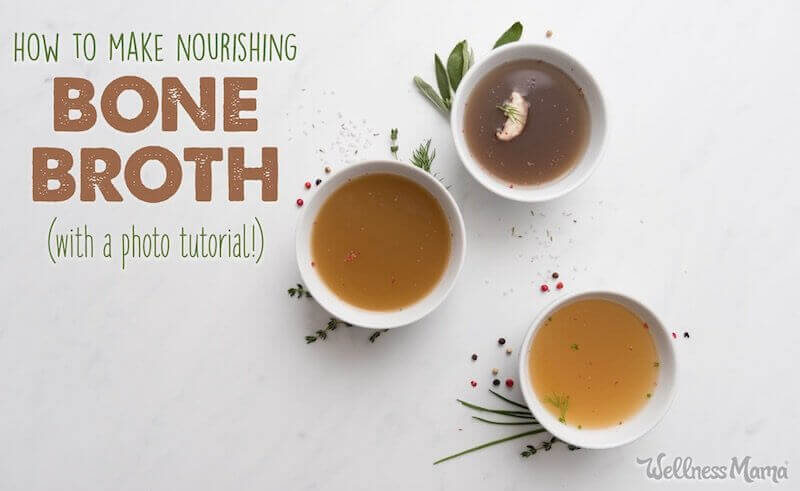
Bone Broth Recipe with Tutorial
Wellness Mama » Blog » Recipes » Beef Recipes » How to Make Bone Broth (Recipe, with Instant Pot Option)

If you aren’t already making bone broth regularly, I’d encourage you to start today! It is an incredibly healthy and very inexpensive addition to any diet, and the homemade versions beat store-bought broth in both taste and nutrition (although there is some amazing homemade organic broth you can buy pre-made now).

This is the one nutrient rich food that anyone can afford to add!

What is Broth?

Broth (or technically, stock) is a mineral-rich infusion made by boiling bones of healthy animals with vegetables, herbs. and spices. You’ll find a large stock pot of broth/stock simmering in the kitchen of almost every 5-star restaurant. It is used for its great culinary uses and unparalleled flavor, but it is also a powerful health tonic that you can easily add to your family’s diet.

Broth is a traditional food that your grandmother likely made often (and if not, your great-grandmother definitely did). Many societies around the world still consume broth regularly as it is a cheap and highly nutrient dense food.

Besides it’s amazing taste and culinary uses, broth is an excellent source of minerals and is known to boost the immune system (chicken soup when you are sick anyone?) and improve digestion. Its high calcium, magnesium, and phosphorus content make it great for bone and tooth health. Bone broth also supports joints, hair, skin, and nails due to its high collagen content. In fact, some even suggest that it helps eliminate cellulite as it supports smooth connective tissue.

It can be made from the bones of beef, bison, lamb, poultry, or fish. Vegetables and spices are often added both for flavor and added nutrients.

Delicious Homemade Bone Broth Tutorial- How to make perfect bone broth

Why Drink Bone Broth?

Anyone who has read Gut and Psychology Syndrome knows the many benefits of bone broth and how it can improve digestion, allergies, immune health, brain health, and much more.

What isn’t as well known is that broth can help reduce cellulite by improving connective tissue, increase hair growth/strength, improve digestive issues, and remineralize teeth.

Broth is also helpful to have on hand when anyone in the family gets sick as it can be a soothing and immune boosting drink during illness, even if the person doesn’t feel like eating.

Broth is very high in the amino acids proline and glycine which are vital for healthy connective tissue (ligaments, joints, around organs, etc). The Paleo Mom has a great explanation of the importance of these two amino acids:

In addition, glycine is required for synthesis of DNA, RNA and many proteins in the body. As such, it plays extensive roles in digestive health, proper functioning of the nervous system and in wound healing. Glycine aids digestion by helping to regulate the synthesis and of bile salts and secretion of gastric acid. It is involved in detoxification and is required for production of glutathione, an important antioxidant. Glycine helps regulate blood sugar levels by controlling gluconeogenesis (the manufacture of glucose from proteins in the liver). Glycine also enhances muscle repair/growth by increasing levels of creatine and regulating Human Growth Hormone secretion from the pituitary gland. This wonderful amino acid is also critical for healthy functioning of the central nervous system. In the brain, it inhibits excitatory neurotransmitters, thus producing a calming effect. Glycine is also converted into the neurotransmitter serine, which promotes mental alertness, improves memory, boosts mood, and reduces stress.

Proline has an additional role in reversing atherosclerotic deposits. It enables the blood vessel walls to release cholesterol buildups into your blood stream, decreasing the size of potential blockages in your heart and the surrounding blood vessels. Proline also helps your body break down proteins for use in creating new, healthy muscle cells.

What Kind of Broth?

Homemade, nutrient-dense bone broth is incredibly easy and inexpensive to make. There is no comparison to the store-bought versions which often contain MSG or other chemicals and which lack gelatin and some of the other health-boosting properties of homemade broth. However, if you’re short on time, I recommend Kettle & Fire’s grass-fed bone broth because it’s pretty gelatinous and made with organic ingredients.

In selecting the bones for broth, look for high quality bones from grass fed cattle or bison, pastured poultry, or wild caught fish. Since you’ll be extracting the minerals and drinking them in concentrated form, you want to make sure that the animal was as healthy as possible.

There are several places to find good bones for stock:

  • Save leftovers from when you roast a chicken, duck, turkey, or goose (pastured)
  • From a local butcher, especially one who butchers the whole animal
  • From local farmers who raise grass fed animals (ask around at your local farmers market)
  • Online from companies like US Wellness Meats (also where I get grass fed tallow in bulk- they sell pre-made high quality broth), Butcher Box, or Healthy Traditions (I order high quality beef, bison, lamb, and chicken bones from them at good prices)

This recipe for broth is my favorite and is an adaption of the recipe in Nourishing Traditions.
 

Delicious Homemade Bone Broth Tutorial- How to make perfect bone broth

Bone Broth Recipe (Stove Top or Instant Pot)

Make nourishing bone broth at home simmered on the stove top or in the Instant Pot in a fraction of the time.
Prep Time 10 minutes
Cook Time 8 hours
Total Time 8 hours 10 minutes
Calories 16kcal
Author Katie Wells

Servings

16 cups

Ingredients

  • 2 lbs bones from a healthy source
  • 2 chicken feet (optional)
  • 1 gal water
  • 2 TBSP apple cider vinegar
  • 1 onion
  • 2 carrots
  • 2 stalks of celery
  • 1 TBSP salt (optional)
  • 1 tsp peppercorns (optional)
  • herbs and spices (to taste, optional)
  • 2 cloves garlic (optional)
  • 1 bunch parsley (optional)

Instructions

  • If you are using raw bones, especially beef bones, it improves flavor to roast them in the oven first. I place them in a roasting pan and roast for 30 minutes at 350°F.
  • Place the bones in a large stock pot or the Instant Pot.
  • Pour cool filtered water and the vinegar over the bones. Let sit for 20-30 minutes in the cool water. The acid helps make the nutrients in the bones more available.
  • Rough chop and add the onion, carrots, and celery to the pot.
  • Add any salt, pepper, spices, or herbs, if using.

Stove Top

  • Bring the broth to a boil. Once it has reached a vigorous boil, reduce to a simmer and simmer until done.
  • During the first few hours of simmering, you’ll need to remove the impurities that float to the surface. A frothy/foamy layer will form and it can be easily scooped off with a big spoon. Throw this part away. I typically check it every 20 minutes for the first 2 hours to remove this. Grass-fed and healthy animals will produce much less of this than conventional animals.
  • Simmer for 8 hours for fish broth, 24 hours for chicken, or 48 hours for beef.
  • During the last 30 minutes, add the garlic and parsley, if using.
  • Remove from heat and let cool slightly. Strain using a fine metal strainer to remove all the bits of bone and vegetable. When cool enough, store in a gallon size glass jar in the fridge for up to 5 days, or freeze for later use.

Instant Pot

  • Add the garlic and parsley to the pot if using, place the lid on the pot, and set valve to seal.
  • Cook at high pressure for 2 hours, followed by either a quick release or natural pressure release. Either is fine.
  • Let cool slightly, strain, and store in a gallon size glass jar in the fridge for up to 5 days, or freeze for later use.

Nutrition

Nutrition Facts
Bone Broth Recipe (Stove Top or Instant Pot)
Amount Per Serving (1 cup)
Calories 16
% Daily Value*
Cholesterol 2mg1%
Sodium 458mg20%
Potassium 57mg2%
Carbohydrates 1g0%
Vitamin A 1575IU32%
Vitamin C 5.8mg7%
Calcium 21mg2%
Iron 0.3mg2%
* Percent Daily Values are based on a 2000 calorie diet.

Notes

Detailed stove-top timing instructions below.

Like this recipe? Check out my new cookbook, or get all my recipes (over 500!) in a personalized weekly meal planner here!

Bone Broth Instructions

The first step in preparing to make broth is to gather high quality bones. As I said, you can find them from sources listed above or save them when you cook. Since we roast chicken at least once a week, I save the carcass for making broth/stock.
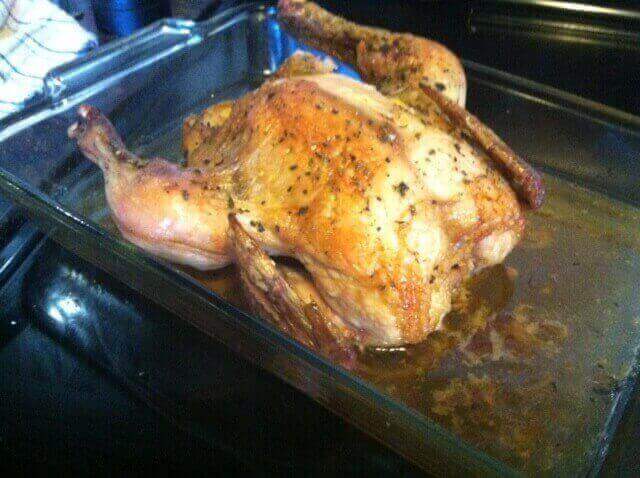
Chicken for Bone Broth

I usually aim for 2 pounds of bones per gallon of water I’m using to make broth. This usually works out to 2-3 full chicken carcasses. If possible I’ll also add 2 chicken feet per gallon of water (completely optional!).

You’ll also need some organic vegetables for flavor. These are actually optional but add extra flavor and nutrition. Typically, I add (per gallon of water and 2 pounds of bones):

  • 1 onion
  • 2 large carrots (if from an organic source, you can rough chop and don’t need to peel)
  • 2 celery stalks, rough chopped
  • 1 bunch of parsley

bone broth vegetables

Since I make in bulk, I usually use about 4 times the amount of each of these. You can make in any amount, just multiply or divide the recipe up or down.

If you are using raw bones, especially beef bones, it improves flavor to roast them in the oven first. I place them in a roasting pan and roast for 30 minutes at 350°F.

Then, place the bones in a large stock pot (I use a 5 gallon pot). Pour cool filtered water over the bones and add the vinegar. Let sit for 20-30 minutes in the cool water. The acid helps make the nutrients in the bones more available.

Rough chop and add the vegetables (except the parsley and garlic, if using) to the pot. Add any salt, pepper, spices, or herbs, if using.
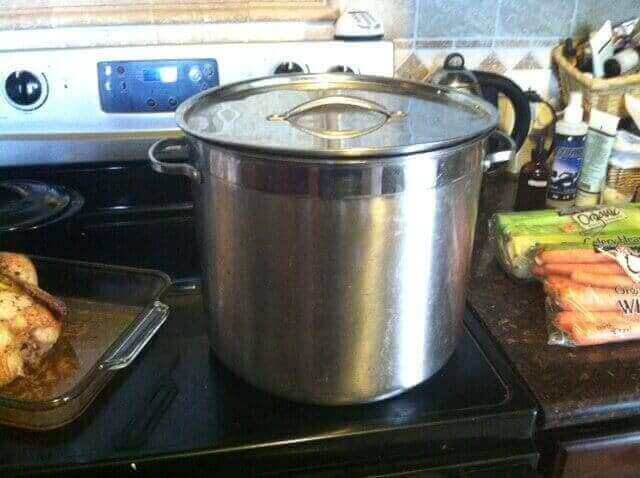
Making Homemade Bone Broth

Now, bring the broth to a boil. Once it has reached a vigorous boil, reduce to a simmer and simmer until done. These are the times I simmer for:

  • Beef broth/stock: 48 hours
  • Chicken or poultry broth/stock: 24 hours
  • Fish broth: 8 hours

During the first few hours of simmering, you’ll need to remove the impurities that float to the surface. A frothy/foamy layer will form and it can be easily scooped off with a big spoon. Throw this part away. I typically check it every 20 minutes for the first 2 hours to remove this. Grass-fed and healthy animals will produce much less of this than conventional animals.

During the last 30 minutes, add the garlic and parsley, if using.

Remove from heat and let cool slightly. Strain using a fine metal strainer to remove all the bits of bone and vegetable. When cool enough, store in a gallon size glass jar in the fridge for up to 5 days, or freeze for later use.

How to Use Bone Broth

Homemade Broth/Stock can be used as the liquid in making soups, stews, gravies, sauces, and reductions. It can also be used to saute or roast vegetables.

We try to drink at least 1 cup per person per day as a health boost, especially in the winter. My favorite way is to heat 8-16 ounces with a little salt and sometimes whisk in an egg until cooked (makes a soup like egg drop soup).

In times of illness (which doesn’t happen often) we will usually just drink bone broth until we start feeling better as it supports the body but is very easy to digest so the body’s energy can go to healing. In cases of stomach bugs or vomiting, bone broth often calms the stomach very quickly and helps shorten the duration of the illness.

If you don’t want to DIY, this is a great pre-made bone broth option shipped straight to your door!

If you aren’t already, make bone broth a regular part of your kitchen routine. It’s health boosting, inexpensive, and easy… you can’t afford not to!

This article was medically reviewed by Dr. Lauren Jefferis, board certified in Internal Medicine and Pediatrics. As always, this is not personal medical advice and we recommend that you talk with your doctor or work with a doctor at SteadyMD.

Do you already make bone broth? Will you try it now? Share your tips or questions below!
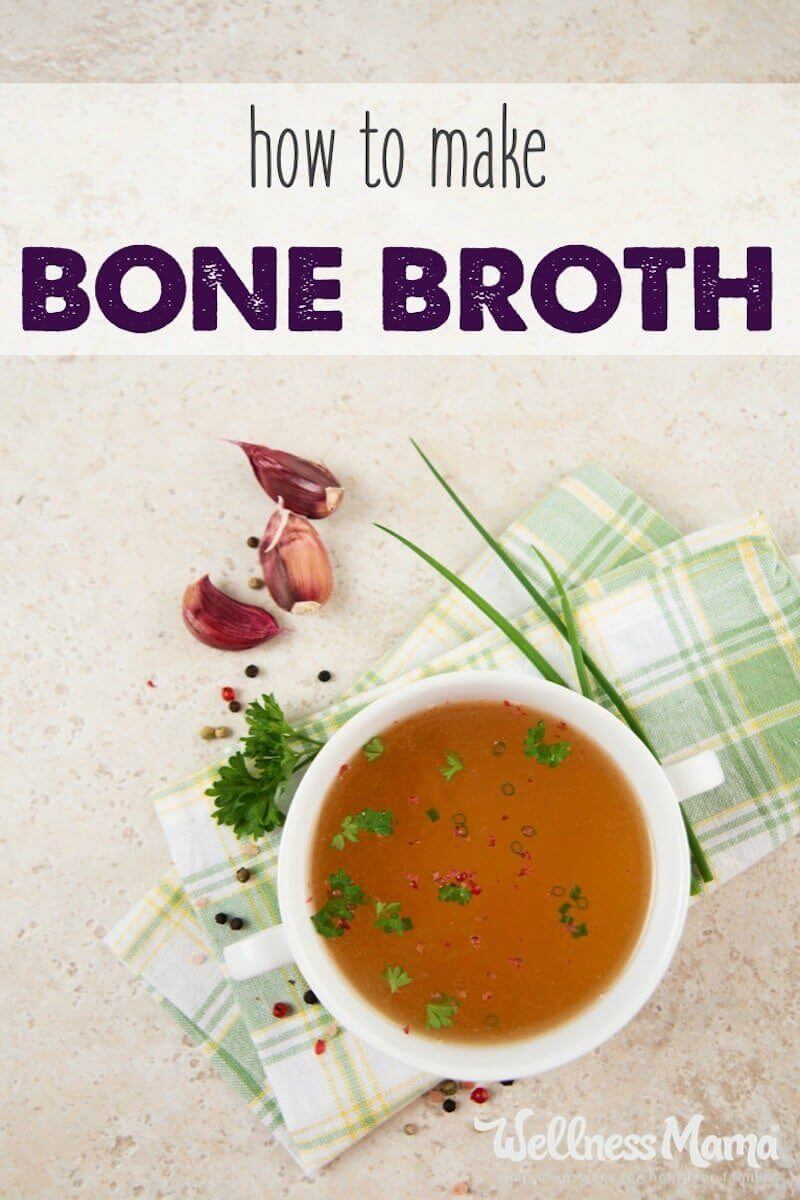
Bone broth is an incredibly nutritious and health-boosting food that is very easy to make. This step by step tutorial shows you how.

Sources

Become a VIP member!

Get access to my VIP newsletter with health tips, special deals, my free ebook on Seven Small Easy Habits and so much more!

Easy Habits ebook on ipad
Katie Wells Avatar

About Katie Wells

Katie Wells, CTNC, MCHC, Founder of Wellness Mama and Co-founder of Wellnesse, has a background in research, journalism, and nutrition. As a mom of six, she turned to research and took health into her own hands to find answers to her health problems. WellnessMama.com is the culmination of her thousands of hours of research and all posts are medically reviewed and verified by the Wellness Mama research team. Katie is also the author of the bestselling books The Wellness Mama Cookbook and The Wellness Mama 5-Step Lifestyle Detox.

Comments

1,512 responses to “How to Make Bone Broth (Recipe, with Instant Pot Option)”

  1. Ann Avatar

    I don’t know, but I was wondering also why there was a dirty sock smell to my bone broth. I used cow bones from Whole Foods, so I’m assuming grass-fed, organic.

    1. Jim Avatar

      Be very careful about making assumptions regarding grass fed beef. If it does not say it on the package then it is probably not. Anything beef resembling grass fed at Whole Foods is extremely expensive.

  2. Camille Avatar
    Camille

    Hello! I was wondering if there is a way to decrease the smell of the broth. . . I realize I can open a window and stuff of that nature, but I was wondering if you had any suggestions concerning this issue.
    Thanks!

  3. Peter Avatar

    I have got organic chicken backs and wings from whole foods to make the broth. Is it necessary to rinse the raw backs and wings before I start to make the broth? On the Internet I have read advise against rinsing meat under water as there are more chances of spreading the Bacteria while rinsing the raw meat. I would appreciate some input on this. Since I got the chicken from whole foods, I am thinking it is ok to not rinse it.

  4. Vivien Avatar

    I’ve just found your site, wonderful information! Would you just tell me, when you’ve boiled the bones for, say, 24 hours, do you strain off the broth and throw the bones away? Would it be ok to add more water and carry on the process – it’s hard to imagine traditional people discarding the bones so quickly.

    1. Christina Avatar
      Christina

      I was wondering this too… so I put the skin and bones in the blender with water and passed through a fine mesh strainer, mixed with the broth and froze in ice cubes. The bones (chicken) had cooked for a little more than 24 hours and were pretty soft, then ends easy fell apart when squeezed. I didn’t get the pretty, clear broth, but I’m guessing it has a lot more minerals, which is more important than pretty…. (and I gave my dogs the little bits left in the strainer).

  5. Cherish Avatar

    If you are looking for mineral uptake, it is vital to learn what other foods or ingredients will block or impair the mineral uptake. Onions should be alright, but a lot of these other ingredients people are suggesting adding, could impair mineral uptake. We need to remember that Intake does not equal Uptake. Additionally, we wouldn’t want to add ingredients that add toxic heavy metals like mercury by way of shellfish or other bottom feeders, and we wouldn’t want to add anything containing soy or other seriously problematic contaminants. Study, learn, Word to the wise.

  6. Len Welsh Avatar
    Len Welsh

    Some suggestions. Buy some dried porcini mushrooms, grind them to a poweder in a blender, and add as you are finishing up the cooking. I would wait to add salt until finished cooking as well. But do add salt if you like it rather than store salt free and add it later. It helps to preserve the flavor and life of your hard-won broth. Doesn’t hurt to add some parsely, as the author suggests, but wait until just finishing cooking. You might also consider adding finely chopped onions at that point too.

    Feeling multinational? Add some high quality fish sauce like three crabs, or even better Red Boat or a high “N” fish sauce in lieu of some of the salt. No more than a quarter cup. It won’t make your broth taste fishy, guaranteed, but will add wonderful flavor. That stuff is very salty, so add it first and then add salt. If you’re not sure you want to commit your whole batch to it, pour a little into a cup and add a few drops to see if you like the effect.

    Shiitake mushrooms add a nice flavor too, but you should cook them in butter until crispy to maximize the flavor.

    You can get addicted to this stuff!

  7. Aimee Avatar

    I just made this for the first time and it is so Delicious! I have a quick question – I made a 2nd time and placed in my slow cooker and after 12 hours I noticed it was boiling. Is this ok in the slow cooker? It is on low temp. (I just don’t want to lose any important nutrients. 🙂

    Thank you!
    Aimee

    1. Wellness Mama Avatar

      It shouldn’t hurt, although you will loose a lot of water, which could result in it burning. If there is any way to keep the temp down (I know most slowcookers only have a couple of levels) that would be better.

  8. Kaila Avatar

    I’ve used a pressure cooker a few times and sometimes my broth gells but sometimes it does not. However the flavor produced from a PC is much better than when I use a crock pot. If I want some serious gell, I use a crock. If I want a seriously tasty broth I use a PC, but I never leave my stove on for more than 4-5 hours so I don’t use a stock pot :]

  9. Carolyn Avatar

    Can I add plain gelatin from the grocery store to the broth? Sometimes my broth will just not gel properly.

  10. Lois Avatar

    I made the bone broth from this recipe.
    Two questions:
    1) How do I get my broth to gel? Does it happen in the pot? or after I have put it in jars?
    2) What do you do with the simmered vegetables? Do you eat them?

    Thanks:)

  11. Jacquie Avatar

    All my local butchers have Grass Fed GRAIN FINISHED bones. Is this ok? Or keep searching for just grass fed?

    1. Jim Gordon Avatar
      Jim Gordon

      Hi Jacquie, Most if not all Grain Finished beef starts as grass fed. From my understanding, once they are fed grain the quality of the meat and fat goes down very quickly. So it is not really worth spending any extra for this grain fed beef. Food for thought…if grain ruins beef so quickly, imagine what it does to us!

  12. Lynds Avatar

    Hi,

    Apologies if this is a repeat question. I’m about to make my first batch of bone broth for my 5 month old babies. Is there anything I should omit/ add to the broth for this age? I have read of the benefits to babies as first food but nowhere a baby specific recipe. I would leave any flavouring/ herbs/ salt out but what about e.g. the cider vinegar? Thanks.

  13. Christina Avatar
    Christina

    I find I like it better if I juice the onion, carrots, celery, and parsley. Their is far less to sift, and it tastes better. I also just crush the garlic and sift it out before I store it.

  14. Kim Avatar

    Why aren’t my chicken bones getting soft? They have been simmering for 2 days now.

  15. John Avatar

    I know they say in other posts to use the giblets. I humbly suggest not to, or only when very fresh, whole, and in the last 30 minutes.( NB; It will produce a foam that will need to be skimmed), This brings out the best flavour without risking a sour note background giblets sometimes produce. Make sure they are perfectly clean, trimmed of the membrane that surrounds them. This applies to all the dark offal used in stocks.

  16. Elizabeth Avatar
    Elizabeth

    I am currently 16 hours into my first batch of bone broth. I am trying to make a small batch (I don’t have a large stock pot yet). I am making it in a 5 quart Dutch oven. I ised 2 chicken carcasses, and the giblets of one chicken. I keep having to add water to it. Since my batch is so small if I don’t my pot would have ran dry long ago lol. Is this ok? Will it still turn out correctly? Will it gel and everything like it is supposed to?

  17. renee Avatar

    what blows my mind is how you say, at the end of the article, “how inexpensive” and easy this is. how?

    you are supposed to cook something for 24-48 hours (leaving a turned-on stove when you’re near it isn’t even safe!) to produce about a liter of the stock, which serves about 4 people. do you realize how much money goes into the gas (or electricity) to keep something at simmering point for 2 days straight?

    i love stock but it is just impossible to make

    1. John Avatar

      This 24 – 48 hour cooking suggestion is misleading. Not sure why a person would want to. Just put it on in the morning, bring to boil, reduce temp to very very low, skim foam that forms for the first hour or so, and by that afternoon your stock will be made. It depends on how much you are making. I made ten litres at a time(I was a chef/saucier) starting with 16 litres, and it took 12 hours. You are right – I would never leave a stove unattended. The cost is minimal compared to outcome.

      1. Cherish Avatar

        The goal is to leech as great a quantity of minerals and nutrients as possible, and that’s the purpose for using the vinegar and the 48 hours or more of simmering. Your goal is a chef is not necessarily maximum minerals, while ours is.

        1. John Avatar

          Au contraire Cherise, I spent six years as Deputy Director of Catering & Manager of Diet for patients with special or idiopathic dietary needs at a Schedule 3 Hospital for palliative and high care patients. Indeed, flavour was high on my list of goals for these people as their appetite was poor at the best of times due to their ill health, and it was part of my mission statement that flavour in the diet for these patients was a “Quality of Life” component , something so basic, but I found to be lacking in so many places of care. Equally important was the dietetics for these people, and my observations and practice was based on science, as published by the research conducted by the Royal Prince Alfred Hospital’s Department of Dietetics and Nutrition. Stocks that are left on simmer for more than 15 hours will not result in a substantive elevation of the trace mineral levels needed to peak mineral levels that can be found as solute, much like, in laymans terms, hot water will only dissolve so much salt, after which the salt, be it of sodium, potassium, magnesium etc, a) will not form the substrates needed for it to be of any metabolic utility to the patient – indeed, it can produce the sour / bitter flavour others on this site have asked about as a result of excessive heat, and b) the nutrient density of such stocks will actually fall as a part per volume due to the fracturing of the molecules. The mention of the use of the giblets, or any iron rich offal, also lead to my observation that minimal cooking at the end of the cooking time, perhaps thirty minutes, is also based on science. The protein of hemoglobin rich offal is bound through cholesterol rich lipids – these become highly alkaline with excessive cooking, and result in bitterness. Summary; the twin goals of flavour and nutrition are not mutually exclusive – I don’t understand why you would suggest or hint at any contribution to this forum I made in good faith, based on training & study, I simply suggested an alternative or observation to some wanting people to have another perspective, and answering questions on the forum, mainly as a rhetorical or theoretical alternative. 99% what I have read I have agreed with. I reply with all due respect to the theme of this forum. Everyone who wants to serve good, wholesome food to their family and friends should have this site in their Favourites sites file. xoxo

          1. Sylvia De Rooy Avatar
            Sylvia De Rooy

            Are you saying there is no need to cook chicken bones more than 15 hours and that, in fact, it is counterproductive to cook them longer? If that is the case it goes against everything I’ve seen so far so I would like to know more, in plain english if possible. Thank you.

          2. Josy Avatar

            Hi John, I have my broth on the fire, and would appreciate your guidance: 1- the 15 hours max for the cooking, is it for the chicken, or for the beef broth? Can you repeat the time for each broth for more clarity? 2- At what point do you recommend putting the veggies in the pot? Is it: i. right from the beginning, with the bones and water, or ii. later on? If so, after how many hours? (I have read so much about heat destroying nutrients in veggies that I am baffled at leaving them for hours unending on fire. Even carotene is released with some amount of heat, but cooking it for hours unending?… I am really confused here). If the answer to question ii. is yes, would it harm the “nutrientness” of the broth to have the veggies (onion, etc.) added to the bones at different times? Is there any necessary combination of nutrients in the bones and the veggies at play here that prevent the adding of veggies much later on? 3- Lastly, is it OK to leave the veggies in the pot instead of discarding them and just eat them to make sure no nutrients/minerals are lost? Waiting for your feedback to know the way forward… Thanks for your time!

  18. Jas Avatar

    Hey! I have only small quantity of bones now. Can I frozen them until I get more? Are they afterwards still good for making broth and do they lose some of their nutrients? Thanks!

    1. Wellness Mama Avatar

      Yes, you can freeze them, lots of people do! I don’t usually have to because my family an decimate a whole chicken (or two) in one sitting 😉

  19. miriam Avatar

    I recently read about lead contamination in slow cookers. I was thinking about buying one to make broth, but got a little bit put off by reading the lead comment. Any recommendations on which one to buy or would it be best to use a pressure cooker instead. Thank you

  20. Lynn Avatar

    hi WM-
    I love your blog and am planning to start incorporating bone broths into my diet.
    If you are doing this to compliment other methods to have a healthy mouth how often would it be necessary to consume bone broths?
    Also can you provide some links to learn about using bone broths to promote dental health?
    I am concerned being that my family exists on a very tight grocery budget that i won’t be able to afford incorporating quality bones [for making bone broths] into my grocery bill.

    Thank you in advance for any help!

    Lynn

    1. Katie - Wellness Mama Avatar

      If budget is tight, I’d just work it in when possible. Or if you buy an organic chicken or roast with a bone, use that to make broth. I’ve made friends with local farmers and get bones for literally pennies a pound….

      1. Lynn Avatar

        Katie- Thank you SO much for taking the time to respond to my comment!
        I neglected to ask one more question that i had.
        Can you please explain what you meant by “raw bones”?
        If i were to keep the bones from a chicken i had roasted already would they be raw?
        Thank you so much for your help i am so excited to make my first bone broth!

        Love your blog!

        Lynn

        1. Wellness Mama Avatar

          No, those would be cooked bones. If you buy directly from a butcher, they are usually raw. You can either start your broth with raw bones, or roast them a little first.

4.23 from 220 votes (125 ratings without comment)

Leave a Reply

Your email address will not be published. Required fields are marked *

Recipe Rating