

, , ,

How to Make Bone Broth (Recipe, with Instant Pot Option)

Katie Wells Avatar

Reading Time: 8 minutes

This post contains affiliate links.

Read my affiliate policy.

Bone Broth Recipe with Tutorial
Wellness Mama » Blog » Recipes » Beef Recipes » How to Make Bone Broth (Recipe, with Instant Pot Option)

If you aren’t already making bone broth regularly, I’d encourage you to start today! It is an incredibly healthy and very inexpensive addition to any diet, and the homemade versions beat store-bought broth in both taste and nutrition (although there is some amazing homemade organic broth you can buy pre-made now).

This is the one nutrient rich food that anyone can afford to add!

What is Broth?

Broth (or technically, stock) is a mineral-rich infusion made by boiling bones of healthy animals with vegetables, herbs. and spices. You’ll find a large stock pot of broth/stock simmering in the kitchen of almost every 5-star restaurant. It is used for its great culinary uses and unparalleled flavor, but it is also a powerful health tonic that you can easily add to your family’s diet.

Broth is a traditional food that your grandmother likely made often (and if not, your great-grandmother definitely did). Many societies around the world still consume broth regularly as it is a cheap and highly nutrient dense food.

Besides it’s amazing taste and culinary uses, broth is an excellent source of minerals and is known to boost the immune system (chicken soup when you are sick anyone?) and improve digestion. Its high calcium, magnesium, and phosphorus content make it great for bone and tooth health. Bone broth also supports joints, hair, skin, and nails due to its high collagen content. In fact, some even suggest that it helps eliminate cellulite as it supports smooth connective tissue.

It can be made from the bones of beef, bison, lamb, poultry, or fish. Vegetables and spices are often added both for flavor and added nutrients.

Delicious Homemade Bone Broth Tutorial- How to make perfect bone broth

Why Drink Bone Broth?

Anyone who has read Gut and Psychology Syndrome knows the many benefits of bone broth and how it can improve digestion, allergies, immune health, brain health, and much more.

What isn’t as well known is that broth can help reduce cellulite by improving connective tissue, increase hair growth/strength, improve digestive issues, and remineralize teeth.

Broth is also helpful to have on hand when anyone in the family gets sick as it can be a soothing and immune boosting drink during illness, even if the person doesn’t feel like eating.

Broth is very high in the amino acids proline and glycine which are vital for healthy connective tissue (ligaments, joints, around organs, etc). The Paleo Mom has a great explanation of the importance of these two amino acids:

In addition, glycine is required for synthesis of DNA, RNA and many proteins in the body. As such, it plays extensive roles in digestive health, proper functioning of the nervous system and in wound healing. Glycine aids digestion by helping to regulate the synthesis and of bile salts and secretion of gastric acid. It is involved in detoxification and is required for production of glutathione, an important antioxidant. Glycine helps regulate blood sugar levels by controlling gluconeogenesis (the manufacture of glucose from proteins in the liver). Glycine also enhances muscle repair/growth by increasing levels of creatine and regulating Human Growth Hormone secretion from the pituitary gland. This wonderful amino acid is also critical for healthy functioning of the central nervous system. In the brain, it inhibits excitatory neurotransmitters, thus producing a calming effect. Glycine is also converted into the neurotransmitter serine, which promotes mental alertness, improves memory, boosts mood, and reduces stress.

Proline has an additional role in reversing atherosclerotic deposits. It enables the blood vessel walls to release cholesterol buildups into your blood stream, decreasing the size of potential blockages in your heart and the surrounding blood vessels. Proline also helps your body break down proteins for use in creating new, healthy muscle cells.

What Kind of Broth?

Homemade, nutrient-dense bone broth is incredibly easy and inexpensive to make. There is no comparison to the store-bought versions which often contain MSG or other chemicals and which lack gelatin and some of the other health-boosting properties of homemade broth. However, if you’re short on time, I recommend Kettle & Fire’s grass-fed bone broth because it’s pretty gelatinous and made with organic ingredients.

In selecting the bones for broth, look for high quality bones from grass fed cattle or bison, pastured poultry, or wild caught fish. Since you’ll be extracting the minerals and drinking them in concentrated form, you want to make sure that the animal was as healthy as possible.

There are several places to find good bones for stock:

  • Save leftovers from when you roast a chicken, duck, turkey, or goose (pastured)
  • From a local butcher, especially one who butchers the whole animal
  • From local farmers who raise grass fed animals (ask around at your local farmers market)
  • Online from companies like US Wellness Meats (also where I get grass fed tallow in bulk- they sell pre-made high quality broth), Butcher Box, or Healthy Traditions (I order high quality beef, bison, lamb, and chicken bones from them at good prices)

This recipe for broth is my favorite and is an adaption of the recipe in Nourishing Traditions.

 

Delicious Homemade Bone Broth Tutorial- How to make perfect bone broth

Bone Broth Recipe (Stove Top or Instant Pot)

Make nourishing bone broth at home simmered on the stove top or in the Instant Pot in a fraction of the time.
Prep Time 10 minutes
Cook Time 8 hours
Total Time 8 hours 10 minutes
Calories 16kcal
Author Katie Wells

Servings

16 cups

Ingredients

  • 2 lbs bones from a healthy source
  • 2 chicken feet (optional)
  • 1 gal water
  • 2 TBSP apple cider vinegar
  • 1 onion
  • 2 carrots
  • 2 stalks of celery
  • 1 TBSP salt (optional)
  • 1 tsp peppercorns (optional)
  • herbs and spices (to taste, optional)
  • 2 cloves garlic (optional)
  • 1 bunch parsley (optional)

Instructions

  • If you are using raw bones, especially beef bones, it improves flavor to roast them in the oven first. I place them in a roasting pan and roast for 30 minutes at 350°F.
  • Place the bones in a large stock pot or the Instant Pot.
  • Pour cool filtered water and the vinegar over the bones. Let sit for 20-30 minutes in the cool water. The acid helps make the nutrients in the bones more available.
  • Rough chop and add the onion, carrots, and celery to the pot.
  • Add any salt, pepper, spices, or herbs, if using.

Stove Top

  • Bring the broth to a boil. Once it has reached a vigorous boil, reduce to a simmer and simmer until done.
  • During the first few hours of simmering, you’ll need to remove the impurities that float to the surface. A frothy/foamy layer will form and it can be easily scooped off with a big spoon. Throw this part away. I typically check it every 20 minutes for the first 2 hours to remove this. Grass-fed and healthy animals will produce much less of this than conventional animals.
  • Simmer for 8 hours for fish broth, 24 hours for chicken, or 48 hours for beef.
  • During the last 30 minutes, add the garlic and parsley, if using.
  • Remove from heat and let cool slightly. Strain using a fine metal strainer to remove all the bits of bone and vegetable. When cool enough, store in a gallon size glass jar in the fridge for up to 5 days, or freeze for later use.

Instant Pot

  • Add the garlic and parsley to the pot if using, place the lid on the pot, and set valve to seal.
  • Cook at high pressure for 2 hours, followed by either a quick release or natural pressure release. Either is fine.
  • Let cool slightly, strain, and store in a gallon size glass jar in the fridge for up to 5 days, or freeze for later use.

Nutrition

Nutrition Facts
Bone Broth Recipe (Stove Top or Instant Pot)
Amount Per Serving (1 cup)
Calories 16
% Daily Value*
Cholesterol 2mg1%
Sodium 458mg20%
Potassium 57mg2%
Carbohydrates 1g0%
Vitamin A 1575IU32%
Vitamin C 5.8mg7%
Calcium 21mg2%
Iron 0.3mg2%
* Percent Daily Values are based on a 2000 calorie diet.

Notes

Detailed stove-top timing instructions below.

Like this recipe? Check out my new cookbook, or get all my recipes (over 500!) in a personalized weekly meal planner here!

Bone Broth Instructions

The first step in preparing to make broth is to gather high quality bones. As I said, you can find them from sources listed above or save them when you cook. Since we roast chicken at least once a week, I save the carcass for making broth/stock.
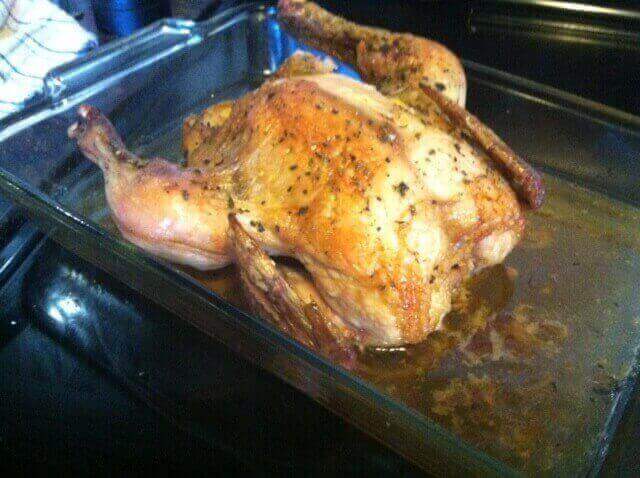
Chicken for Bone Broth

I usually aim for 2 pounds of bones per gallon of water I’m using to make broth. This usually works out to 2-3 full chicken carcasses. If possible I’ll also add 2 chicken feet per gallon of water (completely optional!).

You’ll also need some organic vegetables for flavor. These are actually optional but add extra flavor and nutrition. Typically, I add (per gallon of water and 2 pounds of bones):

  • 1 onion
  • 2 large carrots (if from an organic source, you can rough chop and don’t need to peel)
  • 2 celery stalks, rough chopped
  • 1 bunch of parsley

bone broth vegetables

Since I make in bulk, I usually use about 4 times the amount of each of these. You can make in any amount, just multiply or divide the recipe up or down.

If you are using raw bones, especially beef bones, it improves flavor to roast them in the oven first. I place them in a roasting pan and roast for 30 minutes at 350°F.

Then, place the bones in a large stock pot (I use a 5 gallon pot). Pour cool filtered water over the bones and add the vinegar. Let sit for 20-30 minutes in the cool water. The acid helps make the nutrients in the bones more available.

Rough chop and add the vegetables (except the parsley and garlic, if using) to the pot. Add any salt, pepper, spices, or herbs, if using.
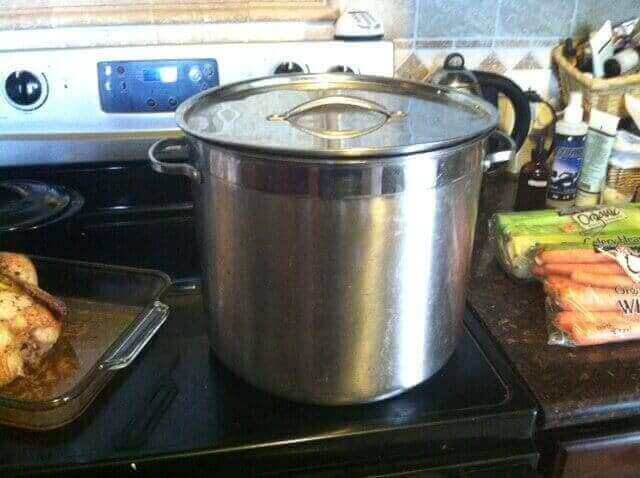
Making Homemade Bone Broth

Now, bring the broth to a boil. Once it has reached a vigorous boil, reduce to a simmer and simmer until done. These are the times I simmer for:

  • Beef broth/stock: 48 hours
  • Chicken or poultry broth/stock: 24 hours
  • Fish broth: 8 hours

During the first few hours of simmering, you’ll need to remove the impurities that float to the surface. A frothy/foamy layer will form and it can be easily scooped off with a big spoon. Throw this part away. I typically check it every 20 minutes for the first 2 hours to remove this. Grass-fed and healthy animals will produce much less of this than conventional animals.

During the last 30 minutes, add the garlic and parsley, if using.

Remove from heat and let cool slightly. Strain using a fine metal strainer to remove all the bits of bone and vegetable. When cool enough, store in a gallon size glass jar in the fridge for up to 5 days, or freeze for later use.

How to Use Bone Broth

Homemade Broth/Stock can be used as the liquid in making soups, stews, gravies, sauces, and reductions. It can also be used to saute or roast vegetables.

We try to drink at least 1 cup per person per day as a health boost, especially in the winter. My favorite way is to heat 8-16 ounces with a little salt and sometimes whisk in an egg until cooked (makes a soup like egg drop soup).

In times of illness (which doesn’t happen often) we will usually just drink bone broth until we start feeling better as it supports the body but is very easy to digest so the body’s energy can go to healing. In cases of stomach bugs or vomiting, bone broth often calms the stomach very quickly and helps shorten the duration of the illness.

If you don’t want to DIY, this is a great pre-made bone broth option shipped straight to your door!

If you aren’t already, make bone broth a regular part of your kitchen routine. It’s health boosting, inexpensive, and easy… you can’t afford not to!

This article was medically reviewed by Dr. Lauren Jefferis, board certified in Internal Medicine and Pediatrics. As always, this is not personal medical advice and we recommend that you talk with your doctor or work with a doctor at SteadyMD.

Do you already make bone broth? Will you try it now? Share your tips or questions below!
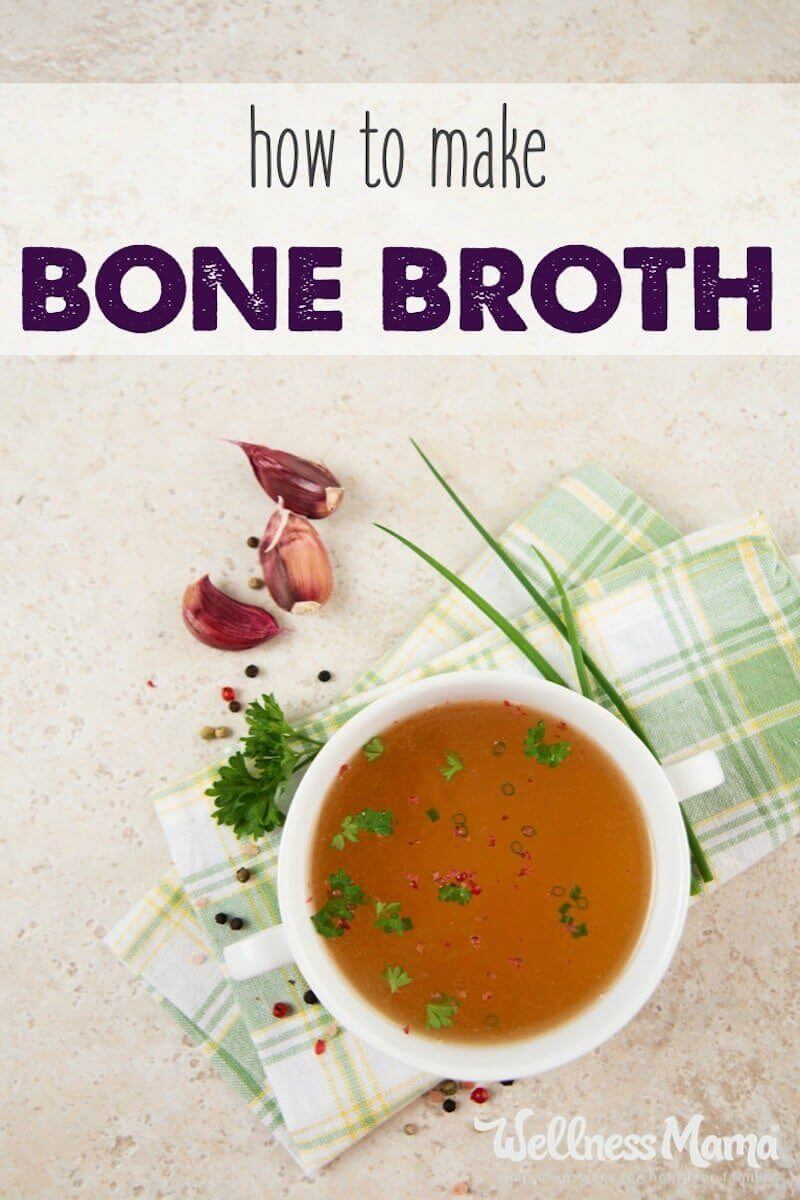
Bone broth is an incredibly nutritious and health-boosting food that is very easy to make. This step by step tutorial shows you how.

Sources

Become a VIP member!

Get access to my VIP newsletter with health tips, special deals, my free ebook on Seven Small Easy Habits and so much more!

Easy Habits ebook on ipad
Katie Wells Avatar

About Katie Wells

Katie Wells, CTNC, MCHC, Founder of Wellness Mama and Co-founder of Wellnesse, has a background in research, journalism, and nutrition. As a mom of seven, she turned to research and took health into her own hands to find answers to her health problems. WellnessMama.com is the culmination of her thousands of hours of research and all posts are medically reviewed and verified by the Wellness Mama research team. Katie is also the author of the bestselling books The Wellness Mama Cookbook and The Wellness Mama 5-Step Lifestyle Detox.

Comments

1,512 responses to “How to Make Bone Broth (Recipe, with Instant Pot Option)”

  1. Tiffany Felsenfeld Avatar
    Tiffany Felsenfeld

    I made bone broth yesterday in my crockpot. I removed my veggies after 3 hours and unplugged the crockpot after around 12 hours. Problem is, I fell asleep right after, and left the broth sitting in the crockpot overnight!

    Is it still good and safe to use? Should I simmer first and then jar it and put in fridge?

    Or, do I have to throw it all away?

      1. Tiffany Felsenfeld Avatar
        Tiffany Felsenfeld

        Thanks! Love your website and I share it with everyone I know!

  2. Sol Avatar

    Just in case someone else may be thinking that broth and stock are the same, like Mama said “What is Broth? Broth (or technically, stock) is…” — well, they are not exactly the same! Stock has the bones/vegetables but no season. Broth is flavor-enriched by seasoning. So, before you season your boiled bones, it’s only a stock and it’s a nice nutritious and neutral base for many different recipes (sauces, soups, stews, etc). When you add salt and herbs to your stock, and maybe some wine, it becomes a broth and it’s ready to be consumed like that, like a thin soup or, or you can still add something else and make it fancier. 🙂

    Stock = plain
    Broth = seasoned stock

  3. Milissa Avatar

    I love the idea of making my own bone broth but my husband doesn’t like red meat and all of us really only like chicken or turkey breasts so I never buy a whole chicken because I don’t believe in wastefulness. Being able to order or purchase just the bones would be great but, personally, I don’t feel that $49.99 plus shipping is a “reasonable price” for 10 lbs. of bones. We live on one income and I am a stay-at-home mom. We manage to eat pretty healthfully on our budget but that price for BONES is not affordable for the average family.

    1. Shawn O'Reilly Avatar
      Shawn O’Reilly

      Millisa,
      I completely agree with you… Thats astronomical! Have you looked to your local grocer instead? I was reading from someone else who was blogging here that at the whole foods market that is by her gives the bones from the deli department when they strip the chickens from the day before. Since they normally throw the bones away, she gets them for free! Wish I was blessed with a grocer like that!
      Another idea – and I think this is Katie’s, is to take and use the whole chicken, but freeze the bones until you are ready to make the broth. Again, this way your not wasting meat, or bones. Buying whole chickens is actually more economical as your not paying for the processing.

      Hope that helps…
      Shawn

  4. Mary Avatar

    Wellness Mamma, I tried this for the first and my broth is “milky” looking. What happened? It doesn’t look like you picture.

  5. Mary West Avatar
    Mary West

    I love to mash the solids (marrow, tendons, connective tissue, gristle, meat scraps) into mashed potatoes. I tried making a puree of the solids; it was awful. I just mash them into the potatoes (or by themselves) because the varied textures are more palatable to me. To get these solids I’d already checked that the bones were already boiling clean. When the solids are loose from the bones, I pull out the solids & leave the bones in. That leaves some pretty clean bones boiling toward the end, always on slow electric stove top, undulating water surface, always topped off. And it gives me a fairly clean stock with minimum broth-solids clouding it. Then I pull out the clean bones (after the full 48 hours), top off the pot one last time, this time making sure to deglaze the sides as it boils down. This is the big reduction for concentration, chilling, defatting & storage. Let cool down, re-strain for any remaining solids before pouring into 1-quart yogurt
    tubs. Chill to pull off solid clean fat. The remaining broth should be well-gelled even if your bones were more marrow than knuckle. After de-fatting beef tallow I’m saving a bit, same with lamb fat. Typically I work with a 3-gallon stock pot, filled with as many marrow bones as it will hold, simmering topped off for 48 hours, pulling out bones and boiling reduction maybe to as little as 2 quarts to a very thick defatted gel, like a rubber tire.

    I like to fractionate my broth, not complicate it with veggies. I’d rather do a potassium-rich vegetable stock in a separate pot.

  6. Mary Durocher Gardiner Avatar
    Mary Durocher Gardiner

    The home made bone broth recipe calls for soaking and cooking the bones with Apple cider vinegar which is unsafe as the acidity leeches aluminium into the broth. Is there a safer way that anyone knows of?
    I wonder if a slow cooker would work? If so how long would I cook them for. I don’t have a pressure cooker yet.
    Also if I can’t do it this way where on-line can I order some from someone that’s made it using all safety rules?

      1. Mary Durocher Gardiner Avatar
        Mary Durocher Gardiner

        Thank you very much. How much would I have to order to get a 2 month supply? Also, does shipping take long?

    1. Shawn O'Reilly Avatar
      Shawn O’Reilly

      Mary,
      I know that Katie responded already, but slow cookers work well, as well as using stainless steel pots, or if you have a cast iron, that is actually even better… those are hard to find in the big pot style that you need for making bone broth (as well as really pricy!). Most of the research that I have personally done (using cited using peer reviewed scientific sources) state that there is no considerable amounts of aluminum that leaches from stainless or cast iron. I cannot argue that you can find sources citing aluminum leaching from stainless steel, but of those that I have found, they are usually non-peer reviewed, and not of a credible source.

      Its a null argument that using cast iron or using a crock pot eliminates even trace amounts, because the simple fact is there is no aluminum in those products, and therefore there is no leaching – ergo, they may be a better product if you are overly worried about leaching.

      Another route that you may want to look into is ceramic stovetop cookware. These can also be found online. There are a couple of drawbacks to using them; first is cost – while they will last a lifetime and if used properly will never go bad, a simple sauce pan can be 75 to 100 dollars for good ware. Second is that they are either glass or ceramic – again, great heat conduction, great products normally can be moved from stovetop to oven without dificulites – but its glass and can easily break if used improperly.

      I have posted before, the amount of time is more of a guideline than an overall rule. Take for instance, when I do chicken stock, I usually only go for 24 hour before the bones are complete mush – and thats in the crock pot! harder bones, like ox tail, or bear bones take considerable longer. Bear bones I usually end up going 76-96 hours on the wood stove top.

      Finally, the apple cider vinegar does not have to be used. Before I ran across Katie’s blog, I never used vinegar in my stocks – and I have been doing bone broth for well over 30 years! My Mother, and Grandmother taught me how to make it. Growing up we left nothing to waste – bones included! And while the vinegar does help with the process, its just that, and aid in the process, not a total necessity.
      Hope that helps,
      Shawn

      1. Mary Durocher Gardiner Avatar
        Mary Durocher Gardiner

        Thank you very much Shawn. I’m quite happy that you responded because I looked into the supplier in Kate comment and they don’t deliver to Canada. I’m concerned with the steam freezing our doors shut as well as it’s winter in Canada right now. I desperately need to learn how to make this and need to get a good stock pot or slow cooker to make this broth. Are there any that you would recommend?

        1. Shawn O'Reilly Avatar
          Shawn O’Reilly

          Mary,
          Out of respect for Katie’s blog, I try not to put direct sponsorship to particular products. It is also the reason that I don’t put the citations that I have found on some of the sources that I have used, however, I can say that honestly what ever you used is probable going to be just fine… as long as it is not pure aluminum!

          I will say this, don’t go overboard with expensive stuff, and don’t go underprice with cheap either. The old saying of “you get what you pay for…” is very true. If money is not the problem look for ceramic ware, which is readily available online… Fact Katie has a post directly toward how to both find it, and how to properly use it! For me, when I was looking for cookware many moons ago, it was too pricy and so I went with stainless steal. I do NOT recommend teflon, and I don’t think Katie does either… at least not that I have found. While you can find some really expensive stainless steel products that speak to there superior make, cooking ability, and the famous people that use it – 95% of it is all made overseas in the same plants and stamped with the various names. So again, don’t go totally cheep, but don’t spend the money for the really shiny objects either 🙂

          Just do your due diligence in researching how the product is made, the layers that they use, how much of each metal is in the product… first this will give you a clue to how many manufactures are using the same things, as well as allow you to make choices that best fit your needs and your budget.

          Again I have put it in other postings, there are those that use aluminum for cooking, and while I don’t recommend it, it is what they can afford and therefore its the best that they can do on the budget that they are on. I will say that I would NOT use an aluminum pressure cooker to make the bone broth. Even without vinegar there are sources that are citing that the aluminum does leach into what ever is cooked when using pure aluminum or aluminum pressure cookers. IT IS MY OPINION that pressure cookers should ONLY be used for canning, not food preparation.

          Crock pots are a dime a dozen, and most of them work pretty much the same as everything else does. I use my crock pot for chicken and vegetable stock making only. It does not take long to make it (usually less than 24 hours until its mush), and because I get the most steam production from its use, and for me its not the freezer effect but the mold effect as I live in western Washington. The difficulty with using a crock pot is keeping an appropriate temperature. Mine hot is way to hot, and I end up with burnt tasting stock, low is still to hot, and warm I don’t keep an appropriate temperature. Hence the reason that I only use it for simple projects that don’t take long. The nice thing is that they are cost effective on a budget, and usually made of ceramic – so no leaching!

          As far as steam pressing your windows and doors shut – I have lived in that kind of cold before to – Lived in Wisconsin for a while and outside of Chicago – I honestly feel for you at this time of the year! There are a couple of tricks that you can try to midi gate the steam freezer effect – first is damp rid – you can get it at Costco, Target, Wallmart and other such various stores. It is a form of calcium chloride that absorbed moisture out of the air very well, and then you can pour it down your drains to help clean out the pipes in the house! If your on Septic I would probable look to dispose of it some other way.

          Next is bread – I know really old trick, but if you take a stale loaf of bread and put it on-top of the refrigerator while your making your bone broth, it will absorb a lot of the steam. If it is a whole loaf, cut it in half long wise. This one is a Grandmother trick, and when done, she would put it in with the hog slop… I don’t every remember her using it for anything else.

          Finally, if you have a fireplace or wood stove, this is the best remedy of all times! You get waste heat that you were using to heat the house, can use for making he broth, and a natural dehydrator for the house as well. Again I have posted this here before, if you have a wood stove, USE IT! Why waste electricity or gas on the stove when you can use the wood stove. The fireplace will naturally dehydrate the house, but you need to keep the window of the fireplace open to allow for this to happen at a rate to keep up with the stove top.

          Having said all this, that might be a mute point anyway if using the stove top. While it does create steam, if you put the lid on it, and put it to a simmer at a temperature between 140-145 for the time prescribed, you should not have an abundant amount of steam production that would cause the freeze on the windows and doors. Again, posted here before – it is critical that you keep the temperature at 140-145 to avoid bacterial growth.

          Hope this helps – and use Katie’s blog – it has more wealth of knowledge by just using the search engine on it!

          Respectfully,
          Shawn

          1. Rose Avatar

            Just get a stainless steel pressure cooker! Here’s an awesome review of one that’s totally stainless steel, not that steel coated nonsense…She convinced me to order one: https://www.foodrenegade.com/why-i-chose-advanced-brk-pressure-cookers/

            BTW, many of the cheap/ dime a dozen Crockpots can have their ceramic bowls have coatings on them…If you research, you’ll see that many of the coatings contain LEAD.

  7. Shawn O'Reilly Avatar
    Shawn O’Reilly

    Marisah,
    most defiantly add more water as it is cooking. In a crockpot that is probable the most common occurrence is the boiling off of water. As far as, “changing the quality…” it will actually add to the quality.
    I personally have found that cooking in a crockpot actually gives almost a burnt metallic taste to the broth. Adding water periodically to keep it full will decrease the likelihood of that happening.
    Respectfully,
    Shawn

  8. rachel Avatar

    Why not mix the fat into the broth and eat it? I just tried some of mine, which is cooking, and it’s delicious – I can’t imagine it would be this good with the fat missing. If there is a good reason to skim the fat, can you use it for something else? Finally, no “froth/film” formed on the top of my soup. Is that weird? I got the chicken from whole foods, so maybe it’s just very pure? Is that possible or am I missing something? There are thin little ovals of translucent fat, but no foam…

    1. Shawn O'Reilly Avatar
      Shawn O’Reilly

      Rachel,
      There is nothing wrong with eating the fat on the top! Fact is that physiologically there is more energy in fat cholesterol than any other kind of fats, and they are readily broken down by the body for energy quicker and more efficiently than some of the non-saturated fats. Also they assist in the breakdown of both carbohydrates, but more importantly proteins during digestion.

      The problem for most is the taste. even my wife skims off the fat off the top because she just can’t stomach the taste of the fat… even mixed in.

      To your second question, the “froth/scum” does not always form on the top, but if it does it should be skimmed off. Usually it is any blood or other bi-product that does not cook down. while not harmful to eat, it usually does not taste very good, and there is little to no nutritional value to it. Again, if it did not form, ya got lucky!

      Respectfully,
      Shawn

  9. Mariah Avatar

    By the time I cook the beef bone broth for 48 hours, there is very little broth, most has cooked off due to the size of the crock pot. Is it acceptable to heat more water and add as it cooks off? Do you think this will change the quality of it?
    Thank you for the recipe, website, podcast and all that you do. I’m a fan.

  10. Melissa Avatar

    I’m making bone broth for my 6 month old baby (although we will also use some as well).
    I’m wondering if you can put some wine in the stock?

    1. Shawn O'Reilly Avatar
      Shawn O’Reilly

      Melissa,
      Sure can! The alcohol will cook away and only leave taste behind.

      Respectfully,
      Shawn

      1. Daniela Avatar

        Hi, I am aslo making broth for my 6 month old baby. Do you still add peppercorn, spices and garlic?

        Thanks!!

  11. Kara Avatar

    Sorry that I’m late to the conversation, but I want to know if I need to remove all of the meat from the chicken carcasses before I cook the broth. Will it matter if I leave some meat on the bones?

    1. Wellness Mama Avatar

      Not really… Te most important thing is to make sure that the joints and such are accessible to the water. This is where your good gelatin comes from. You can leave some of the meat on, though.

  12. Kevin Avatar

    Well, my pot just started simmering. I’m seriously looking forward to 48 hours from now. It already smells delicious.

    Thanks for the recipe!

  13. Greg Avatar

    Hi,
    I have a question; not that I can see here so far although the data is immense.
    Here goes, Do you crack the large animal bones to get the marrow more available for nutrient leaching?
    Thanks.
    Greg

      1. Mitzi Avatar

        Could chia seeds be added for extra nutrition and to thicken up the broth if too watery?

  14. Angie Avatar

    Hello! I’ve been making bone broth for years and love it. I gave it to my first born as a first food. I’m about to start solids for my second and cannot remember if I had salt in the broth when I gave it to her. We save leftover bones in the freezer…plus scrapings from the pan ect which have salt and seasonings. Is it ok to have salt in it? When I make solids I don’t add salt so I’m just not wanting to do something wrong? I give about three ounces a day. Probably ok?

  15. Rachel Avatar

    I have to admit- I was skeptical about this, but having hyperthyroid disorder (which I have opted to treat naturally through diet and supplements), I was getting desperate to incorporate more true protein (meat) into my diet to combat muscle waste especially, and really- how much meat can a girl stand to eat?!

    I started making bone broth last month, incorporating it into my daily routine and now I actually replace my morning coffee or tea with bone broth at least 3x a week.

    All I can say is, wow!! What a difference! ! Even though I was protein-loading in my breakfast before, I was not sustaining my energy levels as well as I needed to with crazy kids-work-life demands. In addition, three of the worst physical symptoms I experience from hyperthyroidism- cystic acne, hair breakage and absolute exhaustion- have decreased substantially, starting about a week of bone broth.

    Needless to say, I am a believer now, and I have my whole family sipping bone broth these days! It’s amazing how much such a simple thing can make such a big difference- we all feel more energized and focused, and my kids are no longer digging in the recesses of the pantry looking for long lost sweets! Definitely curbs those cravings and staves off crashes.

    I order my meats from whiteoakpastures.com, their practices are incomparable, and they have the highest gap rating.

    Thank you for your great advice, you are a lifesaver! !

    1. Elysia Avatar

      I checked out White Oak Pastures and they do seem to be super high quality and very reasonable prices, especially on items that I havent been able to find locally, like grassfed oxtail and pastured chicken feet. Buuut, to ship me a $25 order would be $40!! Yikes! Too bad because I was really excited to try their stuff 🙁

      1. Rachel Avatar

        Ouch! That is rather disproportionate! Since I place a big order, the shipping ends up reasonable in comparison, but maybe if you contact them they might be able to work something out for your first order? Best of luck, and happy holidays!

  16. Mike Mulligan Avatar
    Mike Mulligan

    This is my second go around with the beef broth. I have stage IV cancer and after almost 2 years of chemo and radiation I decided to go with an alternative treatment using food and nutrition! My quality of live is great after 4 months of using food, vitamins and mineral supplements. There are over 400 protocols to help people live longer and even cure their cancer. I need to spread the word about beef broth! My holistic oral surgeon told me I had to make and eat the beef broth several times a week! This stuff is fantastic an I’m so glad I found your website! Your site is heads above all others out there. My wife loves the way the house smells and she and I are enjoying the broth.
    Thank You

  17. Beth Avatar

    So I just made bone broth for the first time. I followed your instructions and my disappointment is overwhelming. The first night the simmering broth smelled amazing, however at the 45 hour mark I shut it down. When I tasted it I was unbelievably disappointed. It is nasty, super dark brown and has a bitter almost burned flavor. WHAT HAPPENED! $17 of bones and I cannot consume this stuff. I kept it replenished with RO water and never had it higher than a simmer. Most of the time it was on a low simmer.
    I questioned the 48 hrs from the start but figured there was I reason. What is that reason?
    If it is supposed to taste this way then ok but I cannot tolerate the taste so I must throw it and my more than $17 out.

    1. Shawn O'Reilly Avatar
      Shawn O’Reilly

      Beth,
      Wow, that is way disappointing, and I am really sorry that it happened.

      Few questions to maybe help to find an answer. I see that your are using RO water, so I am also assuming that you used organic bones? The next question that I would have is what kind of metal were you using for your cook ware. If its aluminum, you found your problem! There are plenty of cited articles that have proven that aluminum leaches into the food product when being used. I personally only use my aluminum canner for canning jars. otherwise I don’t use aluminum in my kitchen!

      Another element may be when you put your vegetables in. To early and they can give off a metallic taste at the end. The only early vegetable that I use is onion and garlic. which I put in at the beginning; otherwise, I wait until very close to the end to add anything else.

      Finally, the 72 hours I personally feel is a guideline. Honestly I cook mine for about 50 most of the time. What you are looking for is the bones to become mushy and fall apart. If that happens at 24 or 72, that is when the process is really done.

      As far as saving this batch – I personally don’t have any good suggestions. I know that I use bones over again, and you might want to give that a try, just add in one or two fresh bones.

      Hope it works out better for you; honestly it is great stuff!
      Respectfully,
      Shawn

  18. Mike Avatar

    We’ve used an 80-year-old family recipe for stock in a pressure cooker. We didn’t do the vinegar pre-soak, and will from now on. We roast the bones, add the veggies and run it the usual 30 minutes at 15psi. Works fine; there’s no taste left in any of the ingredients. We’re going to add chicken feet to the next batch- I remember that James Beard just LOVED chicken feet. We don’t add salt or garlic- these can come in the final application. We freeze it in 1-qt containers and it lasts as long as we want – another batch when we’re down to the last quart!

  19. Telzey Amberdon Avatar
    Telzey Amberdon

    We buy a roasted chicken, the kind that turn on a spit, at Costco every week (less than $5 and very yummy). I have been boiling/simmering the bones and any chicken meat we don’t eat in glass Visionware pot a couple of days later after we picked off most of it. I was happy to see you confirm the cooking time of 24 hours–plus, you’ve made it easier because the worst part of the job was going through the bones and pulling the meat off after the broth cooled and putting it back into the broth. It really is better to toss out all the boiled meat, it’s genuinely not very tasty–I notice that even my cats won’t eat it! After I de-boned the broth, I was then adding the chopped veg and bringing it back to a boil for an hour or so to cook the veg. No longer! Your way is so much easier and frankly, I enjoy the broth a lot more than I ever enjoyed my boiled-chickenmeat soup.

  20. Darla Avatar

    I made this tasty broth yesterday. I used chicken backs and 2 feet, plus various veggies. Its really Yummy!! My question is do I skim off the chicken fat or is this part of the nutritional goodness?

4.64 from 188 votes (93 ratings without comment)

Leave a Reply

Your email address will not be published. Required fields are marked *

Recipe Rating