


, , ,

How to Make Bone Broth (Recipe, with Instant Pot Option)

Katie Wells Avatar

Reading Time: 8 minutes

This post contains affiliate links.

Read my affiliate policy.

Bone Broth Recipe with Tutorial
Wellness Mama » Blog » Recipes » Beef Recipes » How to Make Bone Broth (Recipe, with Instant Pot Option)

If you aren’t already making bone broth regularly, I’d encourage you to start today! It is an incredibly healthy and very inexpensive addition to any diet, and the homemade versions beat store-bought broth in both taste and nutrition (although there is some amazing homemade organic broth you can buy pre-made now).

This is the one nutrient rich food that anyone can afford to add!

What is Broth?

Broth (or technically, stock) is a mineral-rich infusion made by boiling bones of healthy animals with vegetables, herbs. and spices. You’ll find a large stock pot of broth/stock simmering in the kitchen of almost every 5-star restaurant. It is used for its great culinary uses and unparalleled flavor, but it is also a powerful health tonic that you can easily add to your family’s diet.

Broth is a traditional food that your grandmother likely made often (and if not, your great-grandmother definitely did). Many societies around the world still consume broth regularly as it is a cheap and highly nutrient dense food.

Besides it’s amazing taste and culinary uses, broth is an excellent source of minerals and is known to boost the immune system (chicken soup when you are sick anyone?) and improve digestion. Its high calcium, magnesium, and phosphorus content make it great for bone and tooth health. Bone broth also supports joints, hair, skin, and nails due to its high collagen content. In fact, some even suggest that it helps eliminate cellulite as it supports smooth connective tissue.

It can be made from the bones of beef, bison, lamb, poultry, or fish. Vegetables and spices are often added both for flavor and added nutrients.
Delicious Homemade Bone Broth Tutorial- How to make perfect bone broth

Why Drink Bone Broth?

Anyone who has read Gut and Psychology Syndrome knows the many benefits of bone broth and how it can improve digestion, allergies, immune health, brain health, and much more.

What isn’t as well known is that broth can help reduce cellulite by improving connective tissue, increase hair growth/strength, improve digestive issues, and remineralize teeth.

Broth is also helpful to have on hand when anyone in the family gets sick as it can be a soothing and immune boosting drink during illness, even if the person doesn’t feel like eating.

Broth is very high in the amino acids proline and glycine which are vital for healthy connective tissue (ligaments, joints, around organs, etc). The Paleo Mom has a great explanation of the importance of these two amino acids:

In addition, glycine is required for synthesis of DNA, RNA and many proteins in the body. As such, it plays extensive roles in digestive health, proper functioning of the nervous system and in wound healing. Glycine aids digestion by helping to regulate the synthesis and of bile salts and secretion of gastric acid. It is involved in detoxification and is required for production of glutathione, an important antioxidant. Glycine helps regulate blood sugar levels by controlling gluconeogenesis (the manufacture of glucose from proteins in the liver). Glycine also enhances muscle repair/growth by increasing levels of creatine and regulating Human Growth Hormone secretion from the pituitary gland. This wonderful amino acid is also critical for healthy functioning of the central nervous system. In the brain, it inhibits excitatory neurotransmitters, thus producing a calming effect. Glycine is also converted into the neurotransmitter serine, which promotes mental alertness, improves memory, boosts mood, and reduces stress.

Proline has an additional role in reversing atherosclerotic deposits. It enables the blood vessel walls to release cholesterol buildups into your blood stream, decreasing the size of potential blockages in your heart and the surrounding blood vessels. Proline also helps your body break down proteins for use in creating new, healthy muscle cells.

What Kind of Broth?

Homemade, nutrient-dense bone broth is incredibly easy and inexpensive to make. There is no comparison to the store-bought versions which often contain MSG or other chemicals and which lack gelatin and some of the other health-boosting properties of homemade broth. However, if you’re short on time, I recommend Kettle & Fire’s grass-fed bone broth because it’s pretty gelatinous and made with organic ingredients.

In selecting the bones for broth, look for high quality bones from grass fed cattle or bison, pastured poultry, or wild caught fish. Since you’ll be extracting the minerals and drinking them in concentrated form, you want to make sure that the animal was as healthy as possible.

There are several places to find good bones for stock:

  • Save leftovers from when you roast a chicken, duck, turkey, or goose (pastured)
  • From a local butcher, especially one who butchers the whole animal
  • From local farmers who raise grass fed animals (ask around at your local farmers market)
  • Online from companies like US Wellness Meats (also where I get grass fed tallow in bulk- they sell pre-made high quality broth), Butcher Box, or Healthy Traditions (I order high quality beef, bison, lamb, and chicken bones from them at good prices)

This recipe for broth is my favorite and is an adaption of the recipe in Nourishing Traditions.
 

Delicious Homemade Bone Broth Tutorial- How to make perfect bone broth

Bone Broth Recipe (Stove Top or Instant Pot)

Make nourishing bone broth at home simmered on the stove top or in the Instant Pot in a fraction of the time.
Prep Time 10 minutes
Cook Time 8 hours
Total Time 8 hours 10 minutes
Calories 16kcal
Author Katie Wells

Servings

16 cups

Ingredients

  • 2 lbs bones from a healthy source
  • 2 chicken feet (optional)
  • 1 gal water
  • 2 TBSP apple cider vinegar
  • 1 onion
  • 2 carrots
  • 2 stalks of celery
  • 1 TBSP salt (optional)
  • 1 tsp peppercorns (optional)
  • herbs and spices (to taste, optional)
  • 2 cloves garlic (optional)
  • 1 bunch parsley (optional)

Instructions

  • If you are using raw bones, especially beef bones, it improves flavor to roast them in the oven first. I place them in a roasting pan and roast for 30 minutes at 350°F.
  • Place the bones in a large stock pot or the Instant Pot.
  • Pour cool filtered water and the vinegar over the bones. Let sit for 20-30 minutes in the cool water. The acid helps make the nutrients in the bones more available.
  • Rough chop and add the onion, carrots, and celery to the pot.
  • Add any salt, pepper, spices, or herbs, if using.

Stove Top

  • Bring the broth to a boil. Once it has reached a vigorous boil, reduce to a simmer and simmer until done.
  • During the first few hours of simmering, you’ll need to remove the impurities that float to the surface. A frothy/foamy layer will form and it can be easily scooped off with a big spoon. Throw this part away. I typically check it every 20 minutes for the first 2 hours to remove this. Grass-fed and healthy animals will produce much less of this than conventional animals.
  • Simmer for 8 hours for fish broth, 24 hours for chicken, or 48 hours for beef.
  • During the last 30 minutes, add the garlic and parsley, if using.
  • Remove from heat and let cool slightly. Strain using a fine metal strainer to remove all the bits of bone and vegetable. When cool enough, store in a gallon size glass jar in the fridge for up to 5 days, or freeze for later use.

Instant Pot

  • Add the garlic and parsley to the pot if using, place the lid on the pot, and set valve to seal.
  • Cook at high pressure for 2 hours, followed by either a quick release or natural pressure release. Either is fine.
  • Let cool slightly, strain, and store in a gallon size glass jar in the fridge for up to 5 days, or freeze for later use.

Nutrition

Nutrition Facts
Bone Broth Recipe (Stove Top or Instant Pot)
Amount Per Serving (1 cup)
Calories 16
% Daily Value*
Cholesterol 2mg1%
Sodium 458mg20%
Potassium 57mg2%
Carbohydrates 1g0%
Vitamin A 1575IU32%
Vitamin C 5.8mg7%
Calcium 21mg2%
Iron 0.3mg2%
* Percent Daily Values are based on a 2000 calorie diet.

Notes

Detailed stove-top timing instructions below.

Like this recipe? Check out my new cookbook, or get all my recipes (over 500!) in a personalized weekly meal planner here!

Bone Broth Instructions

The first step in preparing to make broth is to gather high quality bones. As I said, you can find them from sources listed above or save them when you cook. Since we roast chicken at least once a week, I save the carcass for making broth/stock.
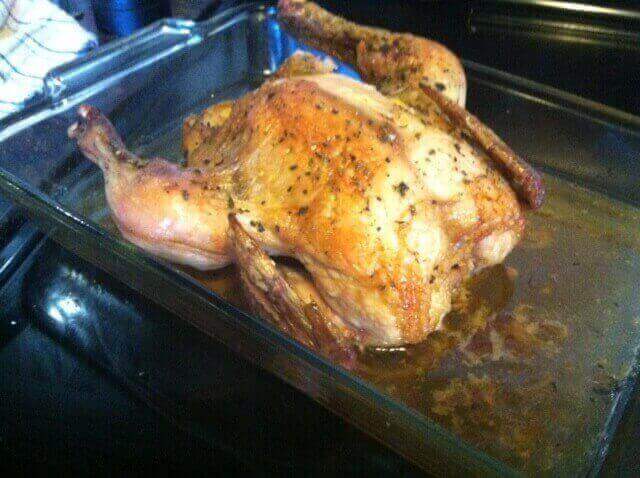
Chicken for Bone Broth

I usually aim for 2 pounds of bones per gallon of water I’m using to make broth. This usually works out to 2-3 full chicken carcasses. If possible I’ll also add 2 chicken feet per gallon of water (completely optional!).

You’ll also need some organic vegetables for flavor. These are actually optional but add extra flavor and nutrition. Typically, I add (per gallon of water and 2 pounds of bones):

  • 1 onion
  • 2 large carrots (if from an organic source, you can rough chop and don’t need to peel)
  • 2 celery stalks, rough chopped
  • 1 bunch of parsley

bone broth vegetables

Since I make in bulk, I usually use about 4 times the amount of each of these. You can make in any amount, just multiply or divide the recipe up or down.

If you are using raw bones, especially beef bones, it improves flavor to roast them in the oven first. I place them in a roasting pan and roast for 30 minutes at 350°F.

Then, place the bones in a large stock pot (I use a 5 gallon pot). Pour cool filtered water over the bones and add the vinegar. Let sit for 20-30 minutes in the cool water. The acid helps make the nutrients in the bones more available.

Rough chop and add the vegetables (except the parsley and garlic, if using) to the pot. Add any salt, pepper, spices, or herbs, if using.
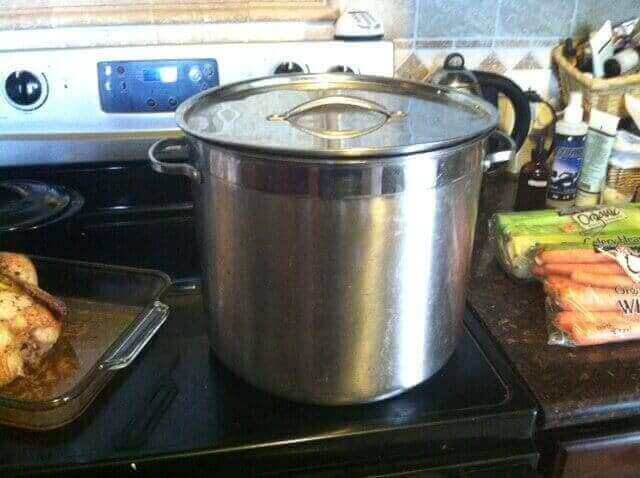
Making Homemade Bone Broth

Now, bring the broth to a boil. Once it has reached a vigorous boil, reduce to a simmer and simmer until done. These are the times I simmer for:

  • Beef broth/stock: 48 hours
  • Chicken or poultry broth/stock: 24 hours
  • Fish broth: 8 hours

During the first few hours of simmering, you’ll need to remove the impurities that float to the surface. A frothy/foamy layer will form and it can be easily scooped off with a big spoon. Throw this part away. I typically check it every 20 minutes for the first 2 hours to remove this. Grass-fed and healthy animals will produce much less of this than conventional animals.

During the last 30 minutes, add the garlic and parsley, if using.

Remove from heat and let cool slightly. Strain using a fine metal strainer to remove all the bits of bone and vegetable. When cool enough, store in a gallon size glass jar in the fridge for up to 5 days, or freeze for later use.

How to Use Bone Broth

Homemade Broth/Stock can be used as the liquid in making soups, stews, gravies, sauces, and reductions. It can also be used to saute or roast vegetables.

We try to drink at least 1 cup per person per day as a health boost, especially in the winter. My favorite way is to heat 8-16 ounces with a little salt and sometimes whisk in an egg until cooked (makes a soup like egg drop soup).

In times of illness (which doesn’t happen often) we will usually just drink bone broth until we start feeling better as it supports the body but is very easy to digest so the body’s energy can go to healing. In cases of stomach bugs or vomiting, bone broth often calms the stomach very quickly and helps shorten the duration of the illness.

If you don’t want to DIY, this is a great pre-made bone broth option shipped straight to your door!

If you aren’t already, make bone broth a regular part of your kitchen routine. It’s health boosting, inexpensive, and easy… you can’t afford not to!

This article was medically reviewed by Dr. Lauren Jefferis, board certified in Internal Medicine and Pediatrics. As always, this is not personal medical advice and we recommend that you talk with your doctor or work with a doctor at SteadyMD.

Do you already make bone broth? Will you try it now? Share your tips or questions below!
Bone broth is an incredibly nutritious and health-boosting food that is very easy to make. This step by step tutorial shows you how.

Sources

Become a VIP member!

Get access to my VIP newsletter with health tips, special deals, my free ebook on Seven Small Easy Habits and so much more!

Easy Habits ebook on ipad
Katie Wells Avatar

About Katie Wells

Katie Wells, CTNC, MCHC, Founder of Wellness Mama and Co-founder of Wellnesse, has a background in research, journalism, and nutrition. As a mom of six, she turned to research and took health into her own hands to find answers to her health problems. WellnessMama.com is the culmination of her thousands of hours of research and all posts are medically reviewed and verified by the Wellness Mama research team. Katie is also the author of the bestselling books The Wellness Mama Cookbook and The Wellness Mama 5-Step Lifestyle Detox.

Comments

1,512 responses to “How to Make Bone Broth (Recipe, with Instant Pot Option)”

  1. Mae Robinson Avatar
    Mae Robinson

    I know whey can be used in soups and stews, can it also be used in bone broth?

  2. Caitlyn Wilson Avatar
    Caitlyn Wilson

    I’m relatively new to making bone broth and converted to a slow cooker as I have a gas stove and didn’t want to leave the broth cooking overnight. When I was cooking on the stove top I would cook the broth over 4 days (for beef) by cooking it for 6 hours a day then popping it in the fridge overnight and putting it back on the stove when I got home from work. I found this made a fabulously gelatinous broth, but it was weak in flavour because I added too much water to during the cooking. The slow cooker makes it so much easier because I can set and forget and doesn’t need topping up. My favourite broth is chicken as I seem to be able to get more flavour than I do with the beef. Happy Cooking!

  3. Rebekah Avatar

    Hi Katie,

    I’ve attempted to read most of the comments and did not see my question asked, so I hope I’m not being redundant … According to WAPF, in order to avoid free glutamates, I believe a meat stock should be simmered for a shorter period of time (vs a broth). This is my first time doing any of this … instead of the 48 hrs, what would you suggest if I want to avoid the glutamate? Thanks so much!

  4. nancy Avatar

    Do you leave the pot on the stove, the entire 24-48 hours while cooking bone broth? even during the night time?

  5. Alice Avatar

    never mind my previous question about when to add the parsley and garlic. After rereading the directions numerous times I saw it! Thanks for this wonderful idea. I can’t wait to see how mine turns out!

  6. Alice Avatar

    when do I add the parsley and garlic? I am on the last few hours of cooking the broth now.

  7. Megan Avatar

    Hi Katie,
    I just made your bone broth recipe and it was delicious! But I had a couple questions because I started with 16 cups of water and only got 4 cups of broth. That seems like a lot of loss. How much broth do you expect to yield at the end? Are you supposed to cover the pot or leave it uncovered? Perhaps I simmered too high? I stopped the process after 7 hours because I could tell I was losing too much. I didn’t want to wake up in the morning without anything left!

    Thank you,
    Megan

  8. Jeanette Avatar

    I recently discover through blood test that I am allergic to a dairy protein. I stopped dairy completely now for 6 plus months. I know that it’s better for me to be dairy free but I’m frustrated because now if I even look a dairy I have a horrible reaction. And I love cheese and butter!! I don’t need a lot of it, some would be nice though. The reactions that I am getting (headaches, terrible stomach cramps, breakouts) never happened before I completely stopped. In fact, I had absolutely no reaction to dairy that I was aware of before.

    In one of your other blog articles I remember a mention that bone broth “cured” a food allergy that you or one of your children had. Just having it regularly did that? How often? Do you think this might help me or am I doomed to live dairy free forever?

    1. Shawn O'Reilly Avatar
      Shawn O’Reilly

      Jeanette,
      Sounds like your lactose intolerant, and it is actually really common for people to develop this as they age. While I would agree that there are some really great things about bone broth, to say that it ‘cures’ someone from allergies is a little far fetched. I have been in medicine for over 25 years, and if you are deficient in an enzyme, like lactose, your deficient… sorry but probable not going to come back. For those who say that it ‘cured them, more than likely they either build up a tolerance (similar to allergy shots where you take a small bit of the antigen over time and increase it till you have no reaction happening in the body), or they had a ‘taxing’ of the body, and once avoided for a period of time, their body went back to pre-allergy conditions. Miracles do happen, and I believe in them and look for them every day in practice – problem is that they don’t always happen and I can’t prescribe to just miracle belief.

      This being said, there are things that you can do that may-or-may not rule into your favor of being able to eat some of your favorite foods. Such as – there are some lactose products on the market that you use before you eat to help with lactose digestion. Some (me included) do not like the idea of using a med to help someone to eat something that their body is clearly rejecting out of natural course, but it is available, usually over the counter. Talk to your local pharmacist that you trust and they can point you directly to them.

      The other way, and the most common is to eat it in moderation and understand what are the reactions that will happen with the ingestion. Moderation for some is scant to none, others means that they can have cheese once in a while or once a week, or even once a day. Ice cream is probable the most prolifically abused items in a lactose intolerant persons diet! Understanding what reaction you have will delineate how much and how often you can indulge.

      The other thing to look into is some of the non-dairy cheeses. While not cheep (and I would avoid the ones that are – they are disgusting!!!) Cashews make excellent cheeses which you can find at whole food stores. Also some people who are lactose intolerant to cows milk do fine on goat and sheep cheeses. Check out the vegan sections too – I saw a while back a mayo that is made entirely from grape seeds – and I liked it better than my favorite brand!

      Hope that helps, and sorry to be the bearer of bad news if it does not work out.

  9. Ruby Avatar

    Help! I am close to simmering 46 hours and just realized I wasn’t supposed to cover the pot! Have a ruined the broth? Also, it is super greasy. I tasted it and couldn’t get passed the grease taste. Is this normal? any feedback would be greatly appreciated. Thanks!

    1. Shawn O'Reilly Avatar
      Shawn O’Reilly

      Ruby,
      Don’t panic! you have defiantly not ruined it, and while you will see many who don’t cover their pots, I do cover mine all the time. I have seen a couple of people blog of how the lid can cause it to seal and they get an explosion of liquid all over the kitchen stove, but I have never had that happen to me. Easy way to ensure that does not happen is to lip the lid to allow the escape of steam during the cooking process.

      As far as the ‘greasy’ or ‘oily’ taste that you are getting, its not uncommon either. There are a couple ways that you can get rid of this, one is the dilute it (either next time not putting as many bones into the broth, or directly adding more liquid). The second, and what many people do is to cook it completely, cool it and take off the fat layer that will develop on the the top of the broth. The easiest way to do this is to place it in the refrigerator overnight and you will get a nice white/yellow hockey puck formation of the fat that can easily be taken off.

      While I prescribe to the notion that this is actually ‘good for you fat’ many can’t either get over the fact that it is fat, or the taste of oil in broth. What I will say is that removing it does NOT decrease the health benefits of the broth, nor does it remove any of the taste as well… just the oily taste that you are referring to.

      Hope that helped, and happy cooking!

  10. Barbara Avatar

    Am I understanding this correctly. You use the bones repeatedly for broth until when? They actually get soft?

  11. Vanessa Avatar

    I made a batch using beef bone marrow this weekend. It made the kitchen smell wonderful and turned out with the same consistency that most posters were describing. I just came in from walking 40 minutes in snowy, windy weather and warmed up a cup of the broth; it’s delicious and perfect for this weather! Thanks for the recipe!

  12. Betsy Williston Avatar
    Betsy Williston

    Does anyone know if I need to de-frost the bones before roasting? Thanks

  13. Debbie Avatar

    In the process of making my first beef bone broth. Will the bones be good to give my Beagle to chew on after I finish using them for the broth

    1. Shawn O'Reilly Avatar
      Shawn O’Reilly

      Yes!!!!
      I have posted on this in the past – don’t let them go to waste!!!!

      This being said, I would not just throw it in the bowel either. The bones still have trace amounts of minerals and vitamins which are really good for your pets, but they are bone, so they also contain HIGH amounts of calcium, phosphorus, and other indigestible elements that will act as a “colon cleanser extrodinare!!!” so use it sparingly. We have an 80 lb labadore and she gets 3 tables spoons of “meal” in her kibble along and covered with water. Cat gets half a teaspoon, although she seems to do better with it than the dog.

      In order to make the meal when the bones are really soft, throw them into a blender and pulverize them into a paste – should look just like canned cat/dog food. at this point you can add cooked carrots, pees, sweet potatoes, corn pretty much any colored vegetable can be put into the mix. an important note – DO NOT USE ONIONS!!! Onions are toxic to your domestic pets – for this reason I also don’t use leeks, or garlic. Also you don’t need to salt or season it… one they don’t need the extra, and two there is just enough from the processing left in them that it adds all the sodium that your pets need.

      I make batches in 5 lbs, which makes quite a bit. Freeze what you won’t readily use – but I usually don’t like to keep it more than 5 days w/out freezing it.

  14. Sarah Avatar

    I don’t know what others do, but when I’m making the broth (be it chicken or beef or other) I always let it chill and settle before I drink it. I skim off the solid fat and then strain it to remove any remaining solids. If it’s chicken, other bird or pork fat, I generally save it for cooking. If it’s beef, goat, deer or other game, I usually feed it to the wild birds in winter. I don’t like the taste particularly. I’d like to hear if there’s some nutrition in the meat fats that I’m missing by giving it to the birds. In terms of jelling, I’ve found that well cleaned marrow bones do not usually jell. It needs connective tissue, so bones with some meat or cartilage left on will jell better.

  15. Andrea Avatar

    Ok, so I finished my first batch today. I used a crock pot on low for 3 days cooking beef marrow bones. After the first day, I added a large onion, celery, carrots, and cabbage. Also, celtic and pink Himalayan sea salts and white pepper corns. Around the 2nd day it smell bad and burn a little. I figured the smell was from the cabbage, but not sure why it burned on low. The flavor isn’t too burned and the broth actually came out pretty good. Also, A LOT of water cooked off. I had to add water twice and still lost half of the full crockpot. Just hoping I can get some feedback so I don’t burn it again, how to not lose so much water, and get some better flavor out of it. Thanks in advance!

    1. Shawn O'Reilly Avatar
      Shawn O’Reilly

      Andrea,
      I wonder if your “low” is to high?!? I would check to see what temperature it is actually cooking at, it needs to be above 140 in order to maintain not gaining bacterial growth, but to high and it will loose to much liquid and give you that burnt taste that you are talking about. Personally I don’t use my crock pot because on warm it does not keep it at an appropriate temperature, and low it boiling – or too hot. when I measured the temp on low it averaged 170 – which should be a nice simmer, but with the lid on it was a boil and I also got a burnt taste. When I use the stove I keep it between 145 to 155 at the top temperature! Again it has to stay above 140 to ensure it does not gain bacterial growth.

      Another thought is – is your crock pot made of ceramic or is it metal? Metal ones are really rare, but because they are metal they can leach into the food and cause a metallic burnt taste to food.

      As far as the water goes, it is pretty typical from a crock pot to loose quite a bit of water through evaporation – so I would not over-worry about it. You can continue to add water as needed to fill it back up. Personally I use to the bones over again until they are pretty much mush, and then they go into dog food preps that I make with them. When I do batches I am doing 5 lbs of bones and making nearly 5 gallons at a time (we use ALOT of it!). Even on the stove I am adding on average 2 to 4 quarts of water per morning depending on the ambient humidity in the house at the time of cooking.

      Finally, you might consider not putting any vegetables in until the last 6 hours of cooking. I add onion and garlic at the front, along with salt and pepper, but everything else goes in very late in my processing. I do this for two reasons, we eat some of the vegetables so I want to have something in them; second the vegetables that we don’t eat also get mixed into the animal food prep. Honestly I think even by that point all were getting out of them is the cellulose structure, but its better than nothing at all!

      Hope that helps, and good luck!

      1. Andrea Avatar

        Thanks for the feedback! I think I’ll go with the stove going forward. I added in the veggies after 24 hours like I’d seen suggested. It was also suggested that the veggies and bones should be fully mushy by the end or you didn’t cook it long enough. I’ll try your suggestion. I had also wondered about the bones for dogs. I had heard it might be dangerous because they would splinter and harm the dogs. I would love to be able to give them leftover bones and used veggies from the broth. Please advise.

        1. Shawn O'Reilly Avatar
          Shawn O’Reilly

          Andrea,
          Beef, venison, elk, moose, you don’t have to worry about splintering. Pork, poultry, and fish you do have to worry about splinters. BUT heres the thing… your cooking the bones until they turn to mush, and you can place them into a food processor or blender and make them into a paste – so no worries about splinters… for ANY of them once they are pulverized.

          I put it in a separate post, but we use about two table spoons in our dog food, and 1/2 table spoon in the cat food. The cat does better with it – just be cautious with the dog, its chalked full of calcium and phosphates, so it can be a natural colon cleanser!

  16. Melissa Avatar

    Help! I just made my first beef bone broth. I followed instructions but I am confused why it doesn’t taste good like my chick bone broth does. This doesn’t even taste like beef. I tried making gravy with some of it and it was like white gravy. Any ideas where I might have gone wrong? I used grass fed beef bone, the vinegar, vegis and spices. Simmered for almost 24 hours.

  17. Bree Avatar

    I think in relation to the ‘oily’ questions, if you drink the bone broth as it is cooking then the oil is dispersed throughout the liquid and it will taste oily. It seems that if you let it cool, then scoop the fat layer off the top, then reheat it, there is less oiliness in it. I was hoping to drink cups of the broth as it was cooking for the next 48 hrs, but after my first cup 13 hours in, I think I might wait until I can get rid of the oil – tends to make me a bit nauseous. Katies has indicated in previous answers that removing the fat removes some of the good nutrients but not all. Stomaching bone broth seems it will be more beneficial in the long run than not being able to stomach it because of oiliness, and not cooking it again.

    1. Shawn O'Reilly Avatar
      Shawn O’Reilly

      Lindsey,
      It is normal. While it is perfectly healthy to drink it, some people have a really hard time with the notion of drinking oil! So if you really have a hard time with it, you can cool the liquid (sometimes to just room temperature, but it is easier if you chill it) and then pull the “waxy” oil that will form on the top.
      Again, it is perfectly fine to dink it. It is chalked full of essential oils, amino acids, and cholesterols that your body can break down easily.
      Many people are worried about the fact that it is cholesterol – which is understandable, there is a lot of them – but they are also necessary for normal body function. In many instances are essential in the breaking down of food in digestion. Cholesterol is also essential in energy storage. Many physiology books cite that 90% of our energy use actually comes from triglyceride breakdown. This being noted; removing the fat layer that is on top of your broth will not remove all of them, and you will get more than enough left over in the broth to gain the health benefit.

  18. Dana Avatar

    I just made a batch of bone broth. I usually make one every week, or at least every other week. I put 1 roasted chicken carcass in my crock pot with 10 cups of water and 2T of apple cider vinegar, and let it sit for a couple of hours. Then I added celery scraps, 2T of pink salt, 4-5 cloves of garlic, and a rough-cut onion, and turned it on low. I let it cook for 2-1/2 days. The chicken carcass and veggies whittled down to about 2 cups worth of mushy pieces. I just drank a cup of the broth, and it was wonderful!! I think I need another cup 🙂

  19. Margaret Avatar

    I made this while my husband was undergoing chemotherapy and radiation for his cancer. Sometimes it was the only thing he would eat. I use organic chicken and it really makes the difference. You just can’t get too much of this! I would keep several containers of this in the freezer, and it made it easier to feed him on bad days. This is the good stuff!

4.23 from 220 votes (125 ratings without comment)

Leave a Reply

Your email address will not be published. Required fields are marked *

Recipe Rating