Read Transcript
Child: Welcome to my mommy’s podcast!
Katie: This podcast is brought to you by BIOptimizers and in particular, their product that holds my heart, which is their Magnesium Breakthrough. My goal this year is to continue to focus on my wellness and to create more harmony and resonance, and we all know that the foundation of health is a good night’s sleep.
I talk about that so much on this podcast. And magnesium is the one nutrient that helps my sleep so much as well as so many other aspects of my health because magnesium is vital for so many things within the body, and it is nearly impossible to get enough from food anymore. And Magnesium Breakthrough from BIOptimizers is in a category of its own.
They have seven different forms of magnesium in one supplement, and since magnesium is involved in over 600 different biochemical reactions in the body, no other supplement on the market offers all seven types of magnesium in one bottle. Pretty much every function of your body is upgraded when you take magnesium regularly from the quality of your sleep to your brain function, from metabolism to stress levels, and so much more.
This is one of the few supplements that lives on my nightstand and I’m a little odd, but I take every morning because I actually get energy from it though most people notice that it’s better at night. Now studies point to a lot of benefits of magnesium, including that it may help improve sleep quality, especially by supporting healthy sleep onset and have more peaceful nights.
Magnesium is also involved in stress management support and it may help maintain energy levels and positive mood while also supporting mental clearness and relaxation. Magnesium is also important for healthy and balanced muscle tone and providing the building blocks to strong bones, and it promotes a balanced stress response, supports relaxation.
And I feel much calmer when I’m regularly taking magnesium. So let’s face it, even if your 2025 resolution is not all about focusing on your health like mine is, how are you going to be able to achieve your goals in any area without enough quality sleep and stress management? Check out Magnesium Breakthrough and make it part of your daily routine this year as well.
For better sleep, better stress response, and much more. They have a 365 day money back guarantee and you can find it at Bioptimizers.com/wellnessmama and use the code Wellnessmama for a discount.
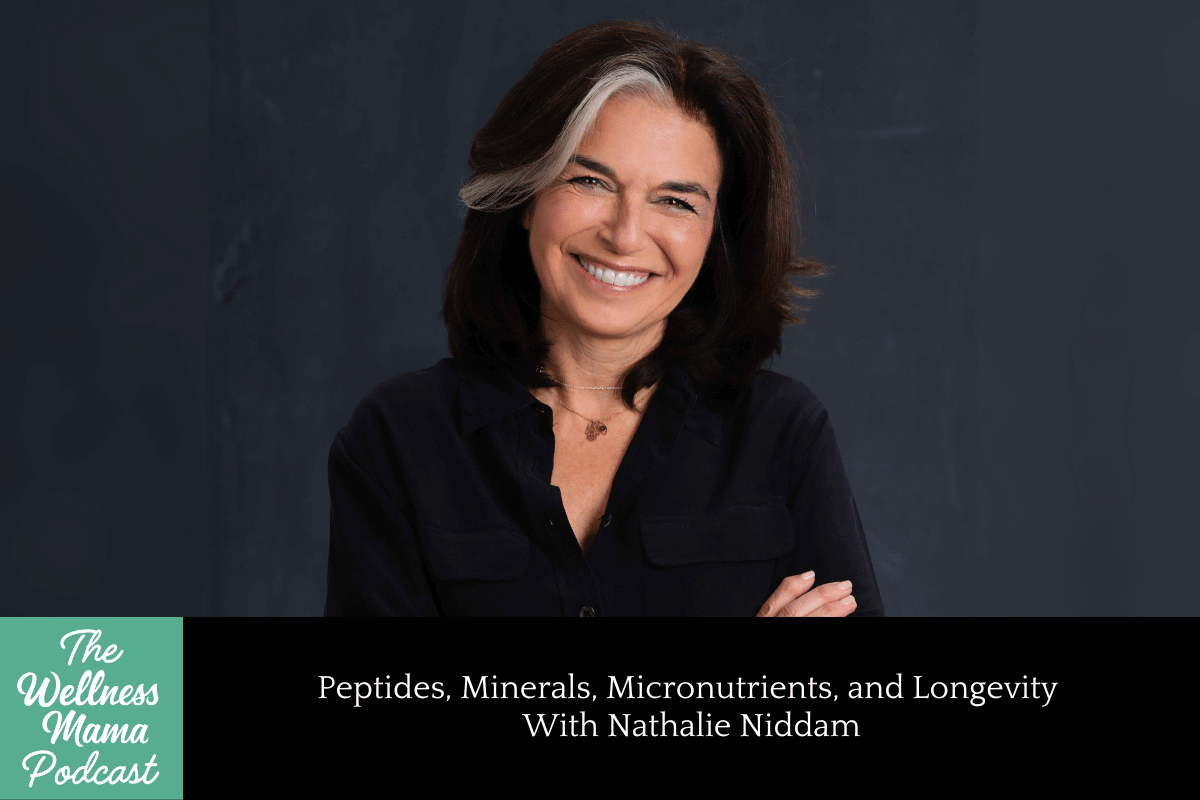
Katie: Hello and welcome to the Wellness Mama podcast. I’m Katie from wellnessmama.com, and this episode is all about peptides, minerals, micronutrients, and longevity. And I’m here with my friend Nathalie, who is such a wealth of knowledge. I love following her on social media because she’s always posting like really deep dive practical tips with really actionable steps.
And I feel like she’s so knowledgeable and a great voice when it comes to all things peptides, longevity, supplements, and so much more. She is a holistic nutritionist and a longevity educator dedicated to helping us all live joyful and vibrant lives into our fifties, sixties, and far beyond. And she, like I said, shares all kinds of strategies from health tech to ancestral health, to peptides, to supplements and more.
And she also has a podcast called Longevity Podcast with Natalie Niddam. And she also speaks internationally, especially on topics like bio regulators, which don’t get talked about that much. And much more. You’ll, I know, learn a lot from this episode. So let’s jump in. Nat welcome. I’m so excited to have you here. Thank you for being here today.
Nathalie: Katie, it is an absolute pleasure. Thank you so much for having me. I think I’m here partly because Todd Shipman reconnected us after I had him on the podcast and he said, oh my God, do you know my friend Katie? And I’m like, yeah. So here we are.
Katie: I love it. I love Todd, and I feel like I’ve known you for a long time, at least we’ve seen each other at events quite a bit, and I followed your work online for a long time. I’m always learning tips from you, even from just Instagram posts because you’re so good at going deep and taking complex topics and making them both simple and applicable, which I love.
I think that’s a superpower. And I know that you are knowledgeable on so, so many topics that we can never cover all of them in one podcast episode. But I definitely would love to hear from you, kind of, state of the Union updates, of what you’re finding most interesting right now. And especially maybe in the peptide world. Because I feel like you’re one of the leading voices when it comes to peptides.
Nathalie: Thank you, Katie. And by the way, I feel the exact same about you. But I think that, I mean, look, peptides are definitely, there, for over the last, I guess I’ve been, I’ve been really leaning into the peptide space for the last five to six years, and so, and there are people who’ve been in it for a lot longer, but what we’re seeing now is it’s starting to bubble up into, I wouldn’t call it exactly the main mainstream, but the, at least the early adopter mainstream, where people are becoming aware of peptides.
They remain quite controversial because of course many of them are not approved for human use. They’re still categorized as research chemicals. But what’s also happening is that there’s this race to make them bioavailable, in ways other than subcutaneous injections. Which typically or classically is the way that they’re used most often.
And then of course, as you probably know, I’m also extremely fascinated with a subgroup of peptides called bio regulators. And we can talk about the differences between what people think of as peptides and what bio regulators are.
And then in terms of other things that I’m really lit up about in this space, is really, there’s really two areas. One is the regenerative medicine side where we’re talking about stem cells and exosomes. I came across, I was introduced, to a company the other day that have actually taken exosomes and taken them to the next level and have 10,000 clinical trials under their, not trials, 10,000 cases under their belt and have done jaw dropping things for people using these little compounds.
So that whole regenerative space. And then I guess the next thing is testing. Right, like, both at home and in clinic. Like testing of, helping people to get insight into what’s happening in their bodies, at really, for the most part, affordable prices, is just becoming, it’s just growing by leaps and bounds.
Like I’m sure you’re seeing this every time you turn around there’s a new test. And from Dr. Jennifer Pearlman’s QT scan, which is hopefully going to eradicate mammograms altogether with a better, safer option to the Auria tear test. Where you’re putting a piece of paper in your eye, it’s sampling your tears, and it’s looking for specific proteins that are expressed in tears.
And women who have breast cancer are more likely to express a couple of specific proteins. Now, it’s not a 100% test in the sense that it’s 92% accurate for detecting cancer, but there’s also a lot of false positives. So it’s really one of those tests that people would use to then say, okay, it’s time for me to get checked out further.
Anyway, I could keep going on this, but those are the areas right now I think that really jump to mind.
Katie: I love it. Yeah, I would love to kind of dive into each of those in turn. And I know we’ve gotten to talk about this a little bit in the past, but maybe give us a little bit of a primer on peptides and the bio regulator ones. What makes them different, what makes them the same, and which ones kind of are your common ones that you use often?
Nathalie: Great, thank you. So peptides by definition are small proteins. So some people will say there are proteins that are 50 amino acids in length or less. Other people might say it’s, the cutoff is at a hundred amino acids. Regardless, proteins can be hundreds and if not more, amino acids. Everything in your body obviously is made of protein.
Your enzymes, your hormones, all the, your bones, your muscle, all the things. But the peptides are very often, especially the longer chain peptides we talk about, are very often fragments of naturally occurring proteins in the body that have very specific signaling qualities and properties. Sorry.
So for the most part, peptides will bind to receptors on the surface of cells where they will initiate chemical cascades that can result in repair of tissue. They can result in the activation of certain parts of the immune system. In other cases they can help to enhance mitochondrial function. So, there’s a myriad of these peptides. There’s about 7,000 that have been identified, and I’m sure that there are more.
The bio regulator peptides are a subset, if you will, of the longer chain peptides I just talked about. And these are only two to four amino, two to four maybe five, amino acids in length. And the bio regulators were really discovered and tested and have been researched by a doctor and researcher in Russia by the name of Dr. Vladimir Khavinson.
And these, the way that they’re different from the longer chain peptides is, because they’re so tiny, they actually make their way into the nucleus of the cell and are able to epigenetically influence the way that our genes are expressing. So they can bind to DNA. So the bio regulator peptide is very much a regenerative compound, if you will. Like it induces regeneration at a cellular level.
And it is also innate to our bodies. And so… I’m trying to, I’m kind of bifurcating here. But basically, the commonality, the common ground, is that they’re all just amino acid chains. The difference is that the bio regulator peptides also can absolutely be taken orally because they are, those sequences of amino acids are recognized by the body. And they have specific transporters that can get them through the lumen of the gut and also to the cells and into the nucleus that they need to get to.
For the longer chain peptides, some of them are bioavailable orally as well. And we’re seeing them come up a lot more in a lot of supplements from a certain supplement companies. But traditionally, the longer chain peptides are introduced into the body by subcutaneous injection.
And that’s like using a little insulin needle. It’s basically like an insulin shot, which by the way, insulin is the peptide that everybody’s heard of which is administered obviously in cases of people who have advanced stages of diabetes.
Katie: Yeah, and definitely, I think you’re right. We’re hearing much more about these in the mainstream. I feel like even like two years ago, they were considered, like, more fringe or like the biohackers were talking about it, but they weren’t really, in mainstream, at all. And now, might still be the bubble I live in, but I feel like I’m hearing about them so widely and people are using them quite widely.
I’d love to also just touch briefly, I know you’ve covered this some on social media as well and I’ll link to some of your posts on that, but of course, like the GLP-1 peptides are now of course very popular. Even where I live, I hear from so many people who are on them and have had good results.
I’ve also heard some like very specific cautions for people to be aware of if they’re going to consider those. So I would love your take on this because I know you dive so deep into the research and you probably have a much bigger or better grasp with this concept than a lot of people who are just taking this because they saw a commercial.
Nathalie: For sure. Thank you. So the GLP-1, so now of course we’re talking about, so the lab names of the compounds would be Semaglutide and Tirzepatide are the two that are commercially available right now. Semaglutide would be known as Ozempic, and Tirzepatide would be known as Mounjaro. And then there’s oral forms of Ozempic, like Wegovy, like there’s a couple of different variations here.
The GLP-1 agonists are remarkable because they actually work, right? In all the years that people have been talking about here’s this supplement, here’s this thing that can help with fat loss and help you to really lose weight. And we’re talking about people who are very resistant to fat loss for any number of reasons.
I mean, we have postmenopausal women in this group. We have people whose metabolism is just destroyed from years of yo-yo dieting. Like for whatever reason. And the GLP-1’s really move the needle for these people. And so what’s fascinating about them is, of course, GLP-1 is a peptide that is secreted naturally in our gut.
The thing is that it is there for seconds. Right, but what’s remarkable is that the GLP-1’s, and the reason I think why they’re so effective and why so many people are so enamored with them, and I’m talking about physicians here and researchers, is they don’t just work through one pathway.
They don’t just suppress appetite, they don’t just do one thing. They actually are very pleiotropic. So pleiotropic is a fancy word for saying they act on many different pathways in the body. So, to explain that a little bit. The number one thing they do is they act on the reward centers of the brain.
And what a lot of people report that they find so amazing is that it shuts down what we call food noise. That constant chatter in your head about, well what are we going to eat next, and I really need a snack, and I really love that kind of chocolate, and I really want ice cream right now. So that whole little chatter box that’s going on in your head suddenly gets quieted down.
And for a lot of people, not only does that enable them to eat less, but it’s almost like it, you hear people saying, oh my God, the food noise is gone. It’s like they’re so relieved. Right? The other thing that they do is that they do cause a little bump up in resting metabolic rate.
So in the biohacking community, you’ll often hear people say, oh my God, like my heart rate is higher at night. And my HRV has tanked. And that is because of this effect. Because it’s kind of like turning up the furnace, if you will. Not dramatically, but it is turning it up a bit. Usually after a period of time, the HRV will come back to normal or it’ll at least settle down.
It shouldn’t be a big deal. It is something that we always wanna keep an eye on. We wanna talk to our physicians about, for people who have some kind of issue, but for the most part, it’s just not that big, it’s not a negative. It’s not a big negative. The next thing that they do is they increase feelings of satiety, so they make you feel fuller faster.
So there is an appetite suppressing effect. Now, here’s where we start to get into the good news, bad news, right? The good news is when you eat a meal, you eat a, you typically can eat a much smaller meal and get much fuller. And one of the ways that that happens is by slowing down the emptying of the stomach contents.
So imagine that for some people they’ve got, you’ve got your stomach, you’ve got the passage down through to the small intestine and onwards, and that, that transit time, is really fast. Right? There, it’s almost, I don’t think it’s this fast, but imagine almost like, as you’re filling the stomach, it’s emptying out at the same time.
So they seem to have this incredible capacity to just eat and eat. But by slowing down that whole process, that means that you’re filling the stomach and it’s, you know, it’s not going anywhere and your stomach’s not that big. So basically you get this feeling of fullness much sooner. And it does this by slowing down transit time.
Now, the dark side of that. Is that for many people it can drive constipation. Right? So we have to be very mindful that we are staying hydrated, which is another issue, is people don’t feel as thirsty. So you have to remain hydrated, you gotta get your fiber in, you gotta be watchful. Right?
Because the last thing you want is to lose weight and store toxins in your body. So we need to keep an eye on that and manage it. And, but, it is a remarkable way to just get people to start to really become reacquainted with the concept of portion control. Now, the next bad news on this one is that when people eat a lot less, everything that they put into their mouth becomes really important.
So one of the big criticisms of the GLP-1’s, is that yes, people lose a lot of weight, but they lose muscle and they become less healthy. And that’s because very often the choices that they’re making in their diet are not optimal. I mean, imagine if you’re a person who’s kind of addicted to sugar and you figure out that you can have all the sweet things that you like, maybe not as much as you like, but you can still eat your sweets and you can still lose weight.
So for a lot of these people, this is Nirvana. It’s like, oh my God, this is amazing. I can eat my donuts and I can still fit into my size six or four skinny jeans. The bad news is, that if you choose to do that, you’re now robbing your body of the nutrients it needs. And if you’re not giving yourself enough protein, the chances of you losing too much muscle in the process of this fat loss go way, way up.
And now the dark side is that at the end of the day, when you get to your target weight and you stop using GLP-1’s, here you are kind of skinny fat. You have no muscle left. We know that muscle is massively important for metabolic health, on top of everything else. And your appetite is gonna come roaring back, and this is gonna be the worst version of yo-yo dieting you’ve ever experienced.
So the other thing that has to happen while you’re using GLP-1’s, to preserve that lean muscle, and this is like a law of nature, if you don’t use it, you’re gonna lose it, is you have to lift weights, you have to work out. You must exercise and keep moving. So the caveats on the GLP-1’s, prioritize protein and exercise.
You gotta watch, basically do all the lifestyle things. So what I, one of the things I say to people when they’re using GLP-1’s is take this as your invitation, because now that the food noise is gone and the cravings are gone, take this as your invitation to reboot your taste buds, to reboot your diet, to relearn how to eat real whole foods.
And to eat that protein, to exercise, focus on your sleep, focus on your lifestyle, all the good things we know. And so beyond that, I mean, there’s other pathways that the GLP-1’s are celebrated for and this is why they’re being researched in, for Alzheimer’s, neurodegenerative diseases. They’re being shown to be beneficial for cardiovascular health.
They’re also being studied for kidney health. Like they just have this satellite of benefits. Inflammation goes down in the body, which again is already a huge benefit for people. People find that their pain goes down. And there was one other thing I wanted to say. It’ll come back to me. I mean, I can stop, but there’s also, there’s black box warnings that should be, people should be aware of as well.
So the black box warnings on the GLP-1’s are for a rare type of thyroid cancer. There’s, which has only really been observed in rats, but it remains a warning on the label. There’s a pro, there’s a risk of gastroparesis, which is a problem that happens in the stomach, very painful. So again, we need to be very mindful of that and be working with our practitioners.
There’s a risk of pancreatitis, which can happen spontaneously, which is extremely painful and really not good for you. And then the other things that we see in some people, they can get very, very tired. And so sometimes there’s people who just don’t tolerate these compounds. They’re very sad because all their friends are using them and getting great results.
It can happen, right? As much as people will say, this is super safe, there’s always caveats. There’s no free lunch, right? Oh, this is the thing I meant to say. It also improves your insulin sensitivity. So it makes it easier for your body, particularly skeletal muscle, to take up glucose out of the, and fuel, out of the bloodstream into the muscles.
And this is why so many physicians who are hearing people saying, if you take a GLP-1, your muscle’s gonna melt. They’re like, no, you’re not. Actually, theoretically, it will make it easier for you to work out. It’s just that you need to do the workouts.
Katie: That makes sense. I feel like that’s the best and most balanced in-depth kind of primer I’ve heard of those, and I think very important things for anyone who might be considering it. I know also there is a segment of our audience, a lot of us are moms. And people might be in the pregnancy or breastfeeding stages of life. I know from my understanding, there’s no safety data on this in general. So this is almost beyond a ask your doctor. This is more of a, we really don’t know, so it’s not safe kind of situation. But knowing that those are available after those phases for recovery probably can be very encouraging.
Which brings me to the next topic I’m excited to learn from you on. Because I follow you on this and occasionally have done, tried new things, based on your recommendation. Even just on social media. But that is the topic of testing. And like you mentioned, there’s now so much more testing widely available than we’ve ever had before. I feel like data and our own information about our own bodies is more accessible than we’ve ever seen it throughout history.
It also feels like there can be a little bit of overwhelm because there are so many things available. It’s like the decision fatigue of what to actually prioritize and focus on. Especially if there’s budget concerns, which most of us have in some capacity. So I would love to hear what kind of testing you consider most important, kind of your own 80/20, and what you personally do to keep an eye on. As this is all now available so much more easily.
Nathalie: Yeah. Thank you. Look, the bottom line is the most important testing is always going to be your blood work. It’s just, people sometimes get caught up in all the fancy stuff and they forget the basics, and you can, if you’re working with a good practitioner, the basics will always give them great information.
But even the basics are not necessarily enough. So things like a full thyroid panel, which I’m sure you’ve had guests talk about before. Like just getting a TSH, it’s never been good enough and there’s no excuse for it now. Right? So we want our TSH, we want our free T3, free T4, RT3. I mean, if your free T3, free T4, and TSH are great and you’re having no symptoms and you’re in great shape, you may not need to go as deep as RT3.
But anytime there’s an issue or a suspicion of an issue with the thyroid, we wanna make sure that we’re digging deeper than the surface. Next, the next one that I think is really important to dig deep on is lipid panels. So this is cholesterol. Just getting HDL, LDL on its own is generally not enough.
Right? We want to get into the weeds with the LDL, with the blood lipids. And that’s become really easy, like, I have a kit in my bag. Of course I can’t get it in Canada, so I had to order the kit from the States. I have to wait till I’m in the states. Go for my blood draw in the states. I think the company is called Empower.
So what happens is your conventional doctors often are very resistant to going deeper on these labs for, I’m not gonna go into any of the reasons. I don’t know why people, but for whatever reason. So the cool thing is you can go to this, I think the company’s called Empower. They have an in-depth lipid panel where you’re gonna get a report on not just your HDL, LDL, but it’s gonna go deep into the VLDL, like very low density lipoproteins.
It’s gonna talk to you about, is your LDL fluffy or is it little? Is it oxidized? Which is the damaging kind. It’s 99 bucks, I think, this kit. It’s really, I mean, it’s really affordable for many people. And it’s really important information. Now, staying on this theme, and this has been a massive discussion recently, in my membership community, is getting a test called CIMT and it’s the cardio, intima, medial… something.
It’s basically the carotid artery and they image the carotid arteries in the neck, and what they’re looking for is plaque. And the amount, the percentage of plaque you have happening in your carotid arteries is very indicative of your potential risk for stroke and heart disease.
Okay if you can get that imaging done, you now get real insight. Is your diet really working for you? Do you have a risk of cardiovascular disease? Is it possible that you might have to go into more advanced strategies to make sure that that plaque’s not happening?
Like, this discussion in the biohacking world of cholesterol is good, there’s no bad cholesterol, we need cholesterol, is very, it lacks nuance. We do need cholesterol. Obviously there’s cholesterol in every cell membrane of your body. It’s a critical component. But it’s oversimplifying to just send people out blindly thinking that they can eat all the saturated fat in the world because somebody’s decided it’s good.
When you need to see, what you need to see is how is my body responding to this diet or this saturated fat? And that also, look, having a decent genetic test done, you only need to get it done once, but it’s gonna give you insight into certain risk factors. Like, for example, I just recorded a podcast, and released, I don’t know if you’ve met her, Dr. Christie Sutton.
She talks about high iron, iron overload in the system. Which many people don’t talk about. Really flies under the radar. Is wildly bad for you. And can cause no end of trouble and doctors just aren’t paying attention to this. Well, if you have the markers for iron overload, then at least you know to keep an eye on these things. Right?
If you have an, APO little a, or if you’re an APOE 44, which is, you’re at a higher risk for certain, for developing certain conditions. Well, if you have insight into that, then you know where you need to lead your attention. If I’m personally like genetically at a much higher risk of developing type two diabetes, which I could have told you because everybody in my family develops type two diabetes as they age.
And so I know that I have to be really watchful of my blood sugar, my insulin levels, like all of those things. And I can’t afford to even play with certain types of diets that other people can. So genetic testing is really important. And then I think the next one would be microbiome testing. Getting insight into microbiome.
I mean, everybody’s running around throwing probiotics at themselves. You know, they hear a podcast on how important Akkermansia is, and they go out and they buy the Akkermansia probiotic and they load up on phenols. So here’s the good news, bad news on Akkermansia, if you have no Akkermansia, you have a much higher risk of being overweight.
But if you have too much Akkermansia, that can drive gut inflammation. Because what Akkermansia does is it feeds on the mucus on the lining of the gut. In good amounts, that’s a good thing. When you have too much, they’re just gonna go to town and you’re gonna get into trouble. So, and that’s just one example, right?
So there’s lots of different, we have, there’s imaging for, now there’s imaging for cancer. There’s a blood test that says that they can, and I haven’t really dug into this one, but this is a blood test that is saying that they can detect cancer at stage zero. So before there’s even a tumor.
There’s tests now, the Theriome test. I don’t know if you’ve come across this. This is a metabolomics test. And so they’re not only looking at your genetics, but they’re looking at 12 different areas of the metabolome. Which is essentially how your body is expressing all, everything that’s going on in there. So they can give you insight into your micronutrient status.
So if you’re, if we have deficiencies in little things that we don’t even realize, that can just eventually drive problems down the road. But if we correct those deficiencies, then all of a sudden the body has what it needs, to do what it needs to do. I could keep going, but I feel like I’m just talking.
Katie: That was such a great list, and to your point, like these are now so much more affordable. I remember when I was first trying to figure out my own thyroid stuff with Hashimoto’s years ago. And I think it was almost impossible to even find a doctor who would order the test, even though I wanted to pay for them.
Nathalie: Yeah.
Katie: And then It was a couple thousand dollars I think, to get a full thyroid panel. And like you said, now you can get these even at like, walk-in labs, often, for under a hundred dollars in some cases. So I’m so glad that there’s now better consumer access to things like this. I think your list was so helpful, and I feel like this is also a great springboard into, kind of the topic of, preventative and regenerative medicine. Which I know is something you’ve also done a lot of research on. I’m forgetting the name of it, but I know there’s a very popular documentary right now from someone who is spending an insane amount of money per year to not age.
And I have not seen it yet, but from what I’ve heard of it, I feel like I personally would maybe take a different approach in some areas, especially things like sunlight. But I would actually love your take, because I think I respect your voice in this area much more than his or others that I’ve heard from on. What do you consider actually the most important things when it comes to longevity? And not just not aging and how we look on our face, but actually like what’s happening, cellularly, and supporting our body on a biological level.
Nathalie: Yeah, I think the person you’re talking about or thinking about is Brian Johnson. I have also not watched the documentary. Which I guess maybe someday we should make a date and watch it together. But I agree with you on, I mean, Brian Johnson’s a guy who’s taken this on as a project. Right?
Not only does he, not only does he wanna… Yeah, I mean, he never wants to die, obviously. Or maybe he wants to die in a really, really, really long time. But he’s very focused on reversing his biological age, which obviously is something we wanna do. All of us to some degree. We don’t want to be living in a state of accelerated aging.
At the very least. We wanna be aging at an appropriate rate, but it is entirely possible that we can slow down aging at a foundational level. And there’s all kinds of crazy things that he’s doing. Right? He does, he does this plasma exchange with his son, where he takes his son’s plasma and has it infused into his own veins.
He, I’m not even fam-, I’m not even clear on all of the different things he’s doing, but he’s definitely, I think he takes, what is it, like 120-200 supplements a day. And he’s monitoring every single thing. Every thing in his body is being monitored and measured every minute of every hour of every day.
And like you, I do feel like, I mean this is a, the man’s living a science experiment. He’s not, it doesn’t sound, I don’t know him, It doesn’t sound like he’s really living life to the fullest. And I think that what’s getting left off the table here is the human piece of aging well. So obviously we want to control for inflammation.
We wanna reduce systemic inflammation as much as possible because inflammaging is fundamentally one of the key factors that’s driving accelerated aging. We wanna, of course, have a low glycemic diet. Now, whatever that looks like for you, whether it’s a keto diet or a low carb diet, or for some people, because of their physiology and the way their body works, they can still eat a relatively high carb diet.
It’s still going to be whole food, but there’s many different ways to skin this cat. Like, I refuse to be told that there’s only one way to do this. It just hasn’t, it hasn’t played out. Avoiding foods that are incredibly inflammatory, moving your body and exercising, building strength, building your VO2 max, all of these things are critically important.
But community, connection, seeing the sun, leveraging natural light. Do we need to be laying out in the sun and tanning all day long? A hundred percent, no. But do we need our skin to connect with the sun on a daily basis? If it’s possible, like, I mean, I live in a climate where it’s not. Do we need to put our feet on the ground, barefoot, so that we can ground? A hundred percent. These are all things that are going to feed our bodies at a cellular and an energetic level.
And then the other piece of it, which I haven’t even mentioned, is this whole aspect of community, quality of life, living with joy, living with gratitude. These are all really, really, like these are wildly important factors that if we don’t keep those in play, if we live this highly stressed life at all times and are disconnected, we’re gonna age, badly. Like we, if you look at the blue zones, whatever you think about the blue zones, and whatever we think about how people figured out what these people are eating, which may or may not have been fully accurate. The thing that is constant through these blue zones is this concept of community and connection. Physical movement, exposure, being outside, being in nature. These are the common threads that unite every blue zone to each other.
Katie: I am so glad you brought that up. My friend Dr. Lauren says often that humans are nutrients. And I love that because I think it really, like, highlights how that is often an intangible and it’s not something we can lab test for. But it really is built into our biology. And I think so many issues in the modern world could be boiled down to what I call nature deficit disorder and connection deficit disorder.
I actually think, like, those are maybe two of the most impactful things to focus on, and thankfully in most cases those things are free. Like I know you and I live in a world where there’s always the next, like, multi-thousand dollars fancy device or a super expensive supplement, but at the end of the day, going outside is free. Nature is free. Prioritizing time with people we love, that’s free. Getting good sleep. Hopefully there’s things we can buy to help with that. But getting sleep is free. Like the things that really matter don’t have to be expensive or complicated. And I feel like they can often get overlooked because the shiny new thing is sometimes more exciting.
But I know you talk about this as well, and I see your posts, on social, too. It’s like, those things can be great, and the foundational things. Without the foundational things, they’re not gonna be as impactful as they could. So if you’re gonna spend all this money on the fancy, expensive things, it’s really helpful to get those foundational things lined up first so you get the biggest bang for the buck when you spend money on those things.
Nathalie: Yeah, a hundred percent. I mean, look, there’s no doubt that having a good PMF mat, having a red light panel, like having those, having access, even molecular hydrogen is another one. Like I started out, way back, talking about molecular hydrogen to anyone who’d sit still long enough to listen to me and I’ve circled back to it now.
Like there are certain things that are being made available to us that can be real game changers. And I think part of that is because of the world we live in. Right? The world we live in is becoming more difficult for our physiology to adapt to. And so that’s where the tech and the supplements and all these advanced things come in because our bodies do need help coping with what we’ve, with what we’re being faced with.
The other thing is I think that our expectations about how we age have changed. Right? If you go back a number of generations, people expected to feel and look old and not move the same, maybe, in their sixties and their seventies and their eighties. Like there was this kind of, how am I gonna put it?
This, this acceptance of an aging process that we now no longer accept. And so this is in large part why hormone therapy has become so it’s such a big deal. Like I would say that if we wanna age well, balancing, keeping our hormones balanced, and optimizing them at a reasonable degree, is going to become really important.
Both for, mostly for women because men have an easier time hanging, keeping their hormone levels high if they’re playing their cards right. Right? Because a guy who’s out drinking and partying doesn’t exercise, doesn’t sleep, super stressed, his testosterone levels are gonna tank. And that’ll happen even in their thirties, even even younger. Right? We’re seeing that now.
But for a woman, once you get past menopause. The factory shuts down, like the ovaries are done. They’ve passed the baton over to the adrenal glands who already have a lot to do, and they’re like, eh, all right, we’ll do what we can. But, so as a result, as our estrogen levels fall off a cliff, our bones start to degrade, our brain doesn’t work as well, obviously, our skin, all of these different things start to go with it.
So keeping those hormones balanced, I’m not saying let’s take us back to when we were 20, but keeping the hormones balanced is a critical piece of aging well for a woman. I will say though, that what’s really exciting in the regenerative space that you asked about, is there’s a lot more people now really tackling this problem, well, this problem, this fact of ovarian aging.
So as our ovaries age, so do we. And I interviewed a guy a couple of years ago now, or maybe a year ago, his name is Zack Varkaris and he’s doing really interesting work where they’re doing stem cell injections into women’s ovaries and they’re delaying menopause.
They’re delaying and they’re showing that these women, their rate of aging slows down dramatically. And there are other people working on this exact strategy. Now, in his case, if it’s the right woman and she’s in the right state of health and it’s what she wants, they may even be able to keep her fertile longer.
Now that brings up a whole list of other ethical issues and whatever, what have you, which I’m not even gonna touch. But the fact is that if we can slow down the aging, it turns out that if we can slow down the aging process in the ovaries, we can slow down our own aging process.
Katie: That is fascinating and I have not heard that, but I think, I love that you brought that up as well. It does seem like there’s less tolerance for the natural process of aging and that, like, we also do have a lot more things we can do to support the body and kind of slow that down. But it’s like finding that balance of not, like, disallowing the natural and wonderful parts of aging. And I wrote a quote once that was something along the lines of like, we only get this one life. Like, I don’t wanna age gracefully, I wanna age with mischief, audacity, and a great story to tell.
Nathalie: Oh, I like that.
Katie: And I kind of take that approach of like, I don’t wanna speed it up. I’m in no rush to age quickly. Wowever, I don’t wanna trade, life experience and a hell of a story for not having frown lines or whatever it may be that people are so worried about.
And I think to your point, I think you’re right, the kind of the best outcomes are when we get those foundational things. And because of the number of negative inputs we’re exposed to in the modern world, we can strategically use all these new tools to our advantage to help our body have the best. Whether it be detox or recovery or whatever it is that we’re working with.
I’d also love your take briefly on things like minerals and micronutrients because those are two categories I’ve been kind of deeply delving into the last couple of years. And even kind of reframed my nutritional approach much more away from macros or calories and into micronutrient density. Realizing that it seems like the body, if it’s not getting enough micronutrients, will always keep craving food to attempt to get those nutrients, even if it’s had enough calories. And then for me personally, it seems like, dialing in my minerals has been a game changer for my energy levels and how I feel.
So I would love your take on those and what you personally do. Kind of from a supplement strategy perspective. I know that’s different for everybody, but seems like you have a lot of great tools at your disposal there.
Nathalie: Yeah, that’s such a really big, it’s such a huge topic, and I think it’s not talked about nearly enough. So at a foundational level, I use a product called BEAM Minerals. And I use them because what they’re doing is they, these are soil derived micro trace minerals that are being delivered to the body.
And people might say, well, shouldn’t you be able to get that from food? Yes, we should be able to get it from food. But the truth of the matter is that our soils are incredibly depleted. And unless you have access to all, constant access to, and I’m not just talking organic here, I’m talking about biodynamically farmed food, where the farmer is actually nourishing the soil so that the plant can uptake the micronutrients and the minerals that you need for your body that will then be synthesized by the plant.
So at a foundational level, I’m gonna use, I use some, I, that’s what I use. I use BEAM. I also have a product, a really neat product. I think they’re from Australia, called Buoy, buoy. Have you come across these? It’s a really interesting little, it’s liquid, it’s a little bottle, you can have it in your purse. And you just squirt a little bit into your water or your drink. And super easy to take when you’re on the go.
I think that getting minerals assessed is a good idea. Especially if you’ve got, like, weird symptoms that are kind of, very subtle. There’s nothing that your doctor can do for you, but something’s off and you just don’t know why. So I, I’m a fan of hair tissue mineral analysis. Your blood work is gonna have some information about that as well. But HTMA is also really fascinating because they’re gonna look at the mineral balance in your body. And very often the ratios between different minerals can be indicative of things like adrenal fatigue or a thyroid imbalance.
Like what we have to remember, and I think it’s so, your approach is so great, because, it’s the micronutrients and the minerals, the vitamins, the minerals, the little trace elements that nobody thinks about. Those are the co-factors for all of the different processes in our body to happen. So there’s this thing called, for example, the Krebs cycle. And this is how your body makes ATP, which is the energy currency of the cell. Well, for each of those steps in the Krebs cycle to take place, you need micronutrients. You might need, one step might need vitamin B6, it might need copper, it might need zinc, it might need magnesium.
And if we become massively deficient or imbalanced in any of those things, it’s gonna impair our body’s ability to make that energy. It’s gonna impair your body’s ability to make ATP. If your cells don’t have enough ATP energy, your body’s really, it will hack whatever it can.
It’ll do what it can to keep the lights on and keep you going, keep you moving, but you will accumulate deficits over time. And those eventually will show up as either symptoms of fatigue or brain fog or I don’t know, anything. And or the eventual development of certain types of diseases. And it’s those things, those little micronutrients, the vitamins, the minerals, those are the things that we don’t think about that we have to keep an eye on so that we can just keep that foundational function happening in the body at a cellular level.
Because if we can keep that happy, so much unfolds because we now are, your body’s able to apply its wisdom, that we can’t even begin to match.
Katie: I love that. Yeah, definitely same team on that with the micronutrients and the minerals. I think those can be tremendously powerful levers and ones that don’t get enough talk, and so I love that we got to delve into those. And I know you have so many resources available online and I will definitely link to those in the show notes. For anyone listening who wants to keep learning from you or follow along with your work, where can they find you and where can they jump in? Where would you suggest they start?
Nathalie: Thanks Katie. So best place to start probably is just the po-, I’m, I mean, I’m looking forward to hosting you on my podcast. So I’ve got a podcast, longevity with Nathalie Niddam, on Instagram @nathalieniddam. That’ll give you a little bit of insight into a lot of the things that we talked about today.
I have a newsletter that people can sign up for on natniddam.com. And when you sign up for my newsletter, you get an eight part series email where I really talk about a lot of these basics and foundations. And I often get really cool messages back from people who are just really loving that information just out of, again, it’s a foundational, it’s foundational information, but we go deep, we go deep on sleep and stress and diet, all the things.
And then beyond that, for connecting in person, I do host a membership community and you can find information about that at natniddam.com.
Katie: Amazing. Well, all of those links will be in the show notes for any of you guys listening on the go. And Nat, this is so fun. I always love learning from you. I’m excited to get to switch roles and be on your podcast soon. But for today, thank you so much for your time, for all the in-depth research you do and for everything that you shared. This was awesome.
Nathalie: Thank you so much, Katie. It’s always a pleasure and like you said, I can’t wait to have you on the other side of the mic.
Katie: And thank you as always for listening and sharing your most valuable resources, your time, your energy, and your attention with us today. We’re both so grateful that you did, and I hope that you’ll join me again on the next episode of The Wellness Mama Podcast.




Leave a Reply