Read Transcript
Child: Welcome to my mommy’s podcast!
Katie: ??This episode is sponsored by BON CHARGE, and I love so many of their products from their red light face mask to their sauna blankets and everything in between. They focus on high-end wellness tech, and if you’re interested in how light can help you, which I talk a lot about, BON CHARGE has so much to offer.
Studies have found that specific red light frequencies can help reduce fine lines and wrinkles when used at the correct brightness and strengths. And some products don’t get these correct. The frequencies of red and near infrared light stimulate cellular activity at a mitochondrial level, which I talk a lot about on this podcast.
This can create better energy efficiency in a given location of the body. For instance, red light on your face gives more cellular energy for biological processes. This can help to decelerate the signs of aging and lead to firmer, plumper skin. So the long-term results you can see when using an LED mask over time are things like, reduction in the appearance of fine lines, reduction in the appearance of wrinkles, reduction in under eye bags, firmer skin, tighter skin, reduction in signs of aging, scar fading, plumper looking skin, reduction in visibility of blemishes, and visibly clearer looking skin.
I’m always a fan of getting natural light from outdoors, but for people who are wanting to kind of tackle the aging process head on, this is in a way to kind of give your body some extra benefit from these specific wavelengths of light.
The safe, non-invasive beauty treatment is going to be around for a while, and for a good reason given the results people are seeing. If you wanna check out the BON CHARGE Red Light Face mask, and all of their products, you can go to https://boncharge.com/wellnessmama and use the code wellnessmama for 20% off.
This podcast is brought to you by BIOptimizers and their Magnesium breakthrough product. Our bodies need seven different types of magnesium. Each one has its own unique purpose. One form helps muscles recover, another supports heart rhythm. A third supports the nervous system and so on.
Most supplements, even the high quality, expensive ones only contain one to two forms at best, and that’s like trying to build a house with just a hammer and a screwdriver. You need the complete toolkit, and that’s why I started taking Magnesium Breakthrough from BIOptimizers, which contains all seven forms.
No other magnesium supplement on the market offers this complete approach. I have looked, and BIOptimizers is so confident in their formula that they offer a full year, 365 day money back guarantee. So you can try it for up to a year and still get a refund if you’re not happy. So if you wanna try this, go to bioptimizers.com/wellnessmama. And use the code WELLNESSMAMA for 15% off your order.
Plus, when you subscribe, you’ll enjoy exclusive discounts, free gifts, and a guaranteed monthly supply. All natural ingredients, no synthetic additives or preservatives and always vegan, gluten-free, soy-free, and lactose-free.
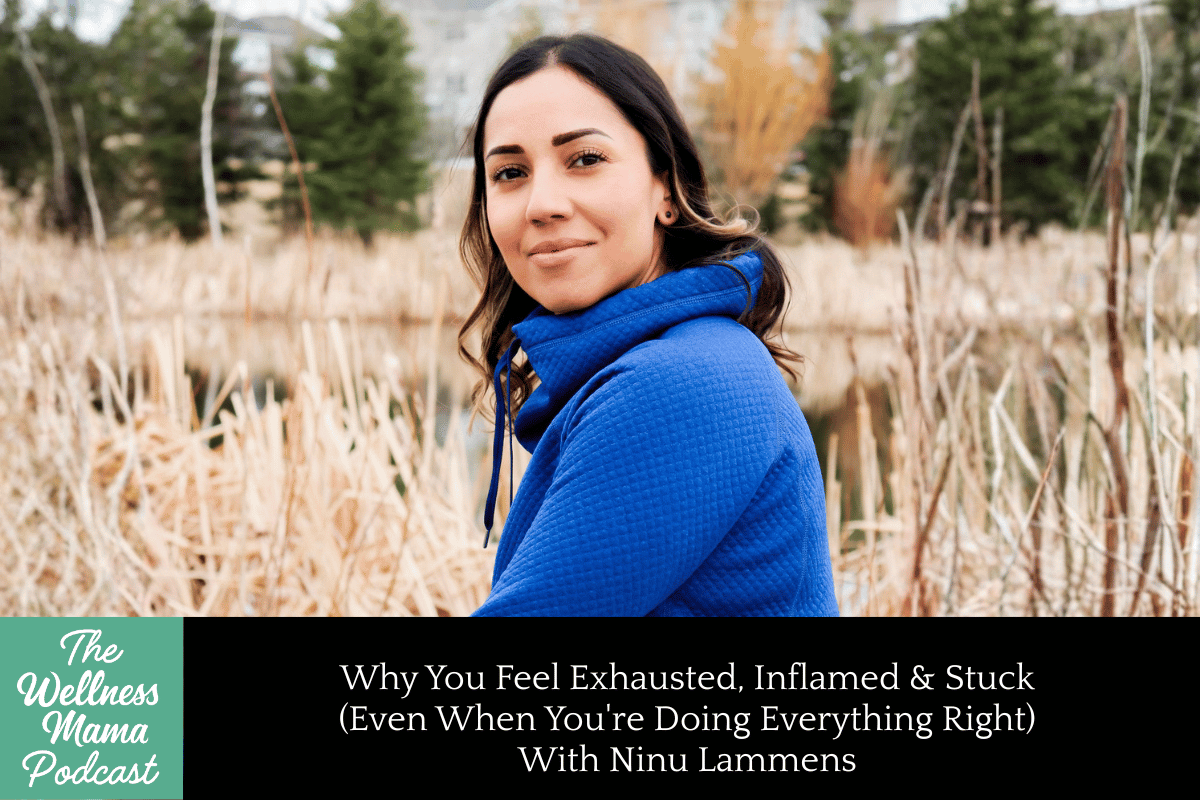
Hello and welcome to the Wellness Mama podcast. I’m Katie from wellnessmama.com, and I loved this conversation with Ninu Lammens, who I really value and admire her work. In this episode, we tackle the topic of why we can still feel stuck or exhausted or inflamed, even if we are, quote-unquote, “doing everything right.”
And I really love her message, which really gets down to first principles and fundamentals, where she talks about things like why we can still feel stuck even if we’re doing all the right things, why nutrition and exercise are only small parts of the pie and the other ones that we often miss, why women hear that our labs are normal but still don’t feel well, a reason that blood work isn’t always the answer, especially for certain things, and other tests that can be much more insightful.
We talk about liver, gallbladder, and digestion and what those actually mean, how not getting enough of the right nutrients is an acute stressor on the body, and how in all of the people she’s worked with, she’s never actually seen one case of women who are trying to lose weight who are eating too much. All that and so much more I can’t wait to dive in, so let’s join her now.
Ninu, welcome. Thank you so much for being here. I’m so excited for our conversation.
Ninu: Thank you. I am honored to be here really, Katie.
Katie: Well, I think we’re gonna get to shed some much needed light on a couple of really important topics, especially for women, because these are things I hear over and over from listeners and readers, and have experienced at different points in my life as well.
And so I’m really excited to learn from your wisdom and knowledge on this, and we’re gonna get to record a couple episodes together. In our first one, I really want to deep dive into the topic and really tackle the experience of when women feel overwhelmed or exhausted or feel stuck, despite probably a lot of the time doing many of the things right, and I know I’ve had that experience.
I felt like I was doing everything right on paper, and I had the checklist, and it still felt like I wasn’t making progress, and I hear this from so many women. So I know this is a broad topic where you have a lot of specific knowledge, but why is it that so many women might still feel unwell despite eating healthy and clean and doing, and getting exercise and all the things we know we’re supposed to do?
Ninu: Yeah, for sure. The easiest way I like to explain this to women is that we’re kind of taught in society that our health is really based on a couple things, exercise and nutrition. And not to devalue those things, they’re insanely important, but there’s a hyper-focus on those two areas.
So it’s like I’m going to the gym, I’m, you know, counting my macros, I’m eating clean, I’ve tried diets. But I like to think of those as two pieces of a bigger pie, and the rest of the pieces of the pie are where we need to look. It’s like unturned rocks. So when we turn over those other additional rocks, we can start to see where the blocks were in your health, driving symptoms or inflammation that can’t necessarily be picked up in conventional testing, and can’t be checked off as a workout or a macro or calorie count.
Katie: I love that because I feel like that’s the known experience many women have had of trying all those things and something not working, and also, like, takes into account the bio-individuality and, like you said, the other puzzle pieces that do seem to get lost when the conversation is just about diet or calories or fitness when, like you said, there’s so many other pieces that I know for me, a couple of those other pieces were the most pivotal ones.
And it was things like dealing with my emotional mental stress load and light, getting my light environment correct. Those were absolutely game changers for me. But they’re not talked about in the same way as the, all the trendy diet plans or the, you know, trendy workouts. And I know another thing that goes hand-in-hand with this that many, many women have experienced, and I’ve experienced many times, is looking for answers when we work with a practitioner, we get labs, and we’re told our labs are normal and it’s all in our head, or we just need to eat less and move more, or whatever the case may be. And so I really wanna kind of hone in on this one because I feel like so many women have had this experience.
Ninu: Oh, it is so common, Katie. Like, I probably hear about it every single day. Every single day I have somebody reach out to me who says exactly what you just said, and I think there’s a lot to say on this topic. So where I’m gonna start with is that we’re conditioned to feel like the healthcare system, the name healthcare system in Canada and the US, is where you go for health.
Now, it’s just inaccurately named in my experience being a registered nurse for 20 years. It’s actually sick care. It’s medicalized care, and it’s great with acute care, emergencies, surgeries, and they do a bang-up job at that. So we need them for those reasons. But where we’re going sort of off track is we’re relying on that for our health, but it is not a health modality.
That’s not where you’re gonna get healthy by figuring out, your doctor’s gonna run some blood tests and that’s gonna tell you what’s wrong. And I’m very passionate and I share a lot about why blood and blood testing is not always and not often the right place to look for the underlying root cause of symptoms.
But again, we’re relying largely on this medicalized care to tell us that blood work’s wrong, therefore you have X, Y, Z problem, therefore here’s the medication to manage the symptoms. So where I would, like, really postulate to look and- or the reason why, I should back up, that blood work isn’t accurate as a measure is because it’s a homeostatic fluid. It is literally life and death that your blood stays within normal ranges of calcium, magnesium, sodium, potassium.
We are electrical beings, as you’ve shared with your community, and our heart, our breathing, everything is run off of electrolytes. So the, it is our body’s job to keep our blood, like, dialed in. And that blood is only gonna change when the rest of the body has been compromised, sometimes for a decade or more.
So when we go to the doctor and get that blood test, and it’s normal, normal year after year, and then we think, “Well, okay, I guess it’s in my head,” or, “It’s my anxiety or my genetics,” we miss the point that the blood wasn’t going to show us the problem until it was so deeply embedded that it showed up and now they’re gonna flag it and give you a medication to manage the symptoms.
So blood is that last domino to fall. I always try to have women visualize a row of dominoes, and you push the first one, and all the others fall. So, you know, cellular function. You know, liver function gets sluggish. Gallbladder gets sluggish. Gut microbiome is dysregulated. Circadian rhythm is off. Blood sugar’s fluctuating.
Minerals are depleted at the cellular level. And then way down the road, decades or years later, the blood will show it. So waiting for that to be a marker to tell you you’re healthy or sick is the number one sort of mistake, is over-relying on blood work. Now, in some cases, like for you in particular with past thyroid issues, that is a good way to look at it, right?
But again, the ranges in the conventional medicine system are super wide, and they’re based on a sick population. So the numbers for TSH, the ideal values for T3, T4, they are tighter and more restrictive in terms of like this is optimal. And that wide range means you could be bordering on or already have a functional thyroid issue decades before or years before you’re diagnosed.
So there’s those couple issues with blood and why it’s not really where you wanna look for the root of the issue.
Katie: I really appreciate that context that you just said on that. And I think to your point, just to echo a couple of things that really stood out to me and kind of double-click on them. I agree with you.
I always like to say, like, I have so much admiration and respect for doctors, and I think the vast majority go into that profession truly looking to help people, so I never wanna, like, you know, speak negatively about doctors. I think many of them are as frustrated with the system as we are on the patient side often.
And to your point, like if I was in a car accident or I had an emergency C-section with my third for placenta previa, I was very grateful to be in a system that is excellent for that kind of stuff. But like you said, they may not always be the best kind of first line if– especially if you intuitively know something’s going on in your body.
And I love that context on blood work because even I think of simple markers like vitamin D, for instance, or ferritin, those for me were in, quote-unquote, “normal range” on labs. But when I started working on inflammation and improved my gut health, then a lot of different factors changed. My vitamin D went from like thirty-five, which they said was normal, to eighty-six without me supplementing it, and I felt so much better.
Or things like ferritin, where women can be told a certain number might be normal, but might actually feel much better if they were able to naturally get their ferritin higher or things like that. So I love that you brought those up. And I would love to kind of dive into more you mentioned that like the liver/gallbladder might be a thing that would be compromised early on or cellular function.
What are ways that women can look at or kind of have insight into if those might be factors that are going on for them?
Ninu: The first is always symptoms. You know, our– we’re taught to sort of think that symptoms are this like annoyance and this irritation, and they’re stopping you from carrying on with your day.
But symptoms are a gift. They’re a gift to you telling you, “Hey, there’s an issue here, and I’m gonna sound the alarm down here in your joints or in your thyroid or with your mood because something’s not right.” It’s like the teeter-totter is imbalanced, and it is on us, as, you know, you say all the time, to be our own primary care provider and say, “Huh, my joints are inflamed.”
It’s not like, “Woe is me, perimenopause. You know, I ha- my parents have these issues as well.” It’s more about, “Okay, so if my joints are inflamed, where could that be coming from? How can I get beneath that?” So when it comes to the liver, gallbladder, and digestion, it is a huge, gigantic, like waving the red flag issue with most women.
Because most women that I work with particularly, and even statistically, a lot of women have digestive issues, but they’ve been told there’s nothing they can do. It’s just you just have constipation, a lazy bowel. You have IBS. You know, you just have loose stools. No, you don’t have any, you know, anything wrong on a colonoscopy.
You don’t have celiac disease, therefore everything else is fine and you have IBS. But really there are things and ways we can look at, for example, the stool as a, and the microbiome as a proxy for what is driving this inflammation, what is going on to drive the mood or make the ligate, the liver, sorry, struggle.
And so the liver, gut, and gallbladder are like in this trifecta, and when there is stress on the liver, so adequate nutrients aren’t coming in, so adequate protein, but adequate antioxidants, adequate environmental support, like ways that you’re supporting detox benefit, like exercise, walking, rebounding, your liver is gonna be compromised, but it’s so resilient that you’re not gonna see that in blood testing for a long time. But yet, if you have blood sugar fluctuations, you get hypoglycemic, you have chronic weight struggles, but you’re told that you’re not yet diabetic or pre-diabetic, the liver is largely responsible for regulating those things.
So just symptoms alone will show you that this is a bit of a liver issue. Or say with your gallbladder, when you eat a burger and fries, not that that’s the healthiest choice, Katie, but if you, you should be able to go and eat a burger and fries and feel completely fine. Now, would you wanna go and crush a workout later?
Maybe not. Maybe it would make you feel slightly less motivated, slightly less energized, but you shouldn’t have… feel heavy or have digestive issues afterwards because we are built to be a resilient human being that can tolerate a lot when we’re well. But the problem is most people are not well, so they end up doing that on top of layers and layers of inflammation, of liver dysfunction, of gut dysbiosis, of chronic stress, and then they put the bur- have the burger and fries, and they feel like complete crap because it’s like that one more, you know, straw that broke the camel’s back.
Like, their body can’t tolerate that because they already have a bucket full of chronic symptoms that aren’t being addressed and imbalances. And so we really wanna get to a place where we look at our body in terms of if we have symptoms, we have to investigate what the root cause is, and the best way to know that you are in good, you know, liver function, gallbladder, gut, and even cellular health, are markers that… I’ll kinda walk through a day.
You wake up naturally to light around the same time every day. You don’t wake up sluggish, groggy, needing coffee. You don’t wake up feeling anxious, so you’re calm, regulated. You can nourish yourself without any dietary dogma built in of, you know, what you need to put upon yourself that morning. Then you can maybe get your kids ready for school, get yourself or take care of your toddler.
Maybe you’re sitting at an office and you have really sharp brain health. You remember what your tasks are. You accomplish them. You aren’t feeling compelled to go eat sugar and treats in the office or grab another iced coffee. But rather you have prepared a blood sugar balancing meal. Maybe you go outside for a walk at lunch.
You come inside in the afternoon, and I see a lot of women having slumps of energy in the afternoon. It is, like, very common around, like, that 3:00 PM range. So it’s having the energy to get through to the afternoon, and then go on about the second part of the day. Can we pick up our kids and not be irritable and snappy and rude?
Can we eat dinner and prepare it without pinching on crackers and cookies and snacks? And then can we shuttle them around like an Uber driver or be present in whatever it is we’re doing for their sports or our life? And then winding that all down, falling asleep quickly, not waking up in the night and repeating that.
Because a series of really amazing days is going to link together to be your life, and if every day is not that, then, you know, what saddens me and really drives me to work in this area instead of the conventional medical system is because your life is so precious, and to waste it on days where you’re lethargic, fatigued, irritable, moody, staying inside, being a recluse, digestive problems, energy issues, lacking motivation and drive is sad, and it’s preventable and reversible.
Katie: Oh, that was such a great explanation, and I love the hamburger analogy because that was a realization I had in my healing journey, was I got to a point where I was on a pretty restrictive diet, and I did feel pretty good, but I realized my goal was not to feel good with very limited inputs all the time and have to live in this bubble.
But my goal was eventually to become resilient enough that no matter what inputs I chose, my body was still thriving. And it took a while to get there, of course, but I love that analogy of, like, not that I’m gonna eat a hamburger for every meal, and I want my body to be able to thrive even if I do sometimes do that.
And you made so many good points. I really wanna highlight what you said about not getting enough nutrients and enough basic building blocks in food is actually an acute stressor on the body. I was such a slow learner in that, and it was hilariously funny to me how much more energy I had when I simply, like, started eating enough food after years and years and years of chronic dieting.
I was like, “Wow, I had no idea I could have this much energy.” So I’m curious, how common do you think that is for women that we’re just simply not getting enough basic nutrients that our body needs to have, like, our normal baseline energy? And kind of like tying that in with blood sugar, like, how commonly do you see those being big issues, especially with women?
Ninu: Oh, you nailed that, Katie. Absolutely that is a major issue. The undereating is pretty, is chronic. I would say in the women, in the hundreds of women I’ve worked with, there’s never been somebody who was overeating, which is quite shocking. Like, I’ve never been like, “Wow, you know, you really need to cut your calories down.”
It’s never been the case. And yet the interesting thing is when we work on that sort of the pieces of the puzzle or the pie, so not necessarily the exercise piece even, but the diet and then the other factors like liver function, gut microbiome, nervous system, adrenals. When we work on the whole person, almost every single woman I work with loses weight.
But we don’t count calories or macros, we don’t track portion sizes, and I don’t put them on exercise plans. Like, I don’t say, “Okay, you know, the way we’re gonna do this is four days a week,” you know? And those are… It’s very important to exercise for so many reasons, like bone health and a whole other slew of bazillion amazing benefits.
But for the reasons of trying to really help someone restore their health, they’re like needing to rebuild the foundation. You know? It’s like that, they’ve been putting their body under so much stress with the undereating, over-exercising, and we need to like pull the reins back and be like, bring it back to basics.
We are human beings, and our primal needs when we wake up every single day is to see the sun. I always explain this to my clients is if you were like the cave version, like cave woman Katie. Cave woman Katie would have literally woken up in the cave because the light would come in the cave, and that’s the only signal you had in the darkness to wake up.
So you’d wake up with the tribe, and your brain and nervous system’s primary goal, whether you wanted to or not, was to go find food, so it sends that signal of safety, and to go maybe get it on with somebody later that night after you hunted and foraged and all that kind of thing. So it’s like can we nourish ourselves to create balanced enough hormones to then procreate and pass our genes to the next generation?
These were the only goals. And avoid danger. But our modern-day life is primarily inside, so we’re inside for 90% of our day, so we’re not getting that light signal in the morning. You know, I know you’re a huge advocate for light, which is part of your healing journey, and I also share that with my clients, that it has to be that we have to mimic and re- you know, use the past as a guide of how humans were well, before chronic illness.
So it’s really mimicking that pattern of getting outside, eating meals regularly. And now in a world where there is so much amazing research on fasting, there is so much amazing research and benefit. But at the time when a woman comes to me and they’re… Imagine the cave version of them.
They haven’t found food consistently- Their body’s like, “No, you can’t procreate whether you want to or not because this isn’t safe.” They don’t really have a safe, reliable tribe. They run into danger a lot and those modern-day dangers, skipping meals, over-exercising, so running from the bear and then finding some source of tiny nutrients later.
Then at night when it’s supposed to be dark, there’s, the fire’s still lit. The lights are on, the screens. And that is sending that signal to the brain of, “Ugh, it’s not really that safe to go into a deep sleep right now because there’s still light exposure here.” And so when we can start to really help women understand that you are the same primal being you used to be, the parts of the brain that interpret stress are the same.
But we live in a modern world, but our brain doesn’t know that we have fancier cars and nicer homes and technology and, “Don’t worry, I’m just watching a scary movie at 11:00.” “Don’t worry, I’m just trying to fast because I’m trying to, you know, elicit autophagy.” Your body doesn’t really know that because in order to be able to do those stressors and have those stressors on the system, you need to be in the system and the routine of consistency for all of the basic human needs.
And when you do that over time, then doing things like prolonged fasting or HIIT training or sprint intervals or… Then your body’s like, “Ooh, we can get stronger now. We got all the basics covered, but now we can optimize, make this organism stronger.” And that’s the lens that I look through, look at women’s health through.
So almost every woman I work with under-eats, under-fuels, and I remind them that your primary goal as a human is actually to nourish yourself to give you the brain power and energy to accomplish your life. And food is the fuel. So when… It’s funny when you mention, like, when you eat more and you’re like, “Oh, I actually feel better.” And it’s like we forgot this basic thing that food is how you get energy.
Katie: Yeah, I think that is such an important message, especially for women. And that’s really striking to me that you said in all the women you’ve worked with, you’ve actually not seen a case of women overeating. I would guess there’s maybe, like, they needed more of certain nutrients or even certain macros than they were getting, but not that they were actually eating too much.
They just might need some shifts in whatever they were eating. And just to, like, really back up what you said, I have seen the most noticeable lasting changes in things I do track, like my heart rate variability, my resting heart rate, my deep sleep, when I consistently nourish myself enough. And I get it.
It’s actually really hard as a mom to make that a priority, and so I understand that that’s not, like, an easy thing to just, like, work into our life. However, I see really noticeable changes when I do that consistently. And I would love to, like, to dive into what are some of the most common levers you do use with women who are in this place of feeling stuck or low energy or overwhelmed or bloated or whatever they’re dealing with.
What are some of the biggest levers that we all have access to that you work with women on? I would guess light would be one of them. You’ve mentioned minerals. But I would love to really, like, delve into kind of solution-oriented. What are some things that we can do that are within our ability that can help noticeably start to shift things?
Ninu: Yeah. The first piece is, like you mentioned, it’s really paying more attention to what your plate is made up of, you know. People like Mark Hyman are such a great advocate for this. But your food informs whether you’re safe or not. So if you eat foods that are a struggle for your system, that end up with a net loss of nutrients because they’re fried in deep oils, they’re inflammatory by nature, they are man- largely manmade, so they’re made mostly with shelf-stable preservatives, sprayed crops, sprayed grains, you know, crackers, cookies.
If, even if that meets the macros, which is why I don’t teach a macro approach, but if it’s meets the macros, it doesn’t mean it meets nutrient needs for the micronutrients in there. So looking at your plate and really seeing is this vibrant? Is it, part of it fresh and living? So is it colorful? Does it have enough protein for my needs?
And then I always like to teach to pair a protein with a healthy carbohydrate or fiber with fat. So looking at that, you never need to diet again when you look at your plate and you always just have protein, fat, and fiber. So if when I review what clients are eating when they first join the program that I run and they give me the list, I can eyeball it right away and say, “After you’ve done, you know, the education I have, you know, what can you see about your nutrition?”
They’re like, “Oh, I was totally just eating, you know, carbohydrates for breakfast,” or, “I was actually just eating protein and no carbohydrates,” or, “At lunch I was just having an avocado with my salad and we’re missing the protein.” So they start to see where the gaps are. And that gap for a day or two, Katie, it’s not gonna matter.
Like, if you miss a day of not eating balanced meals because life got crazy, maybe you were stuck at an airport and in the hangar that had no food or who knows. There’s different things that come up, but it’s your input over time. So it’s do you mostly, 90% of the time, have a balanced plate of protein, fat, and fiber/carbohydrate?
Because those carbs… People separate carbs and fiber a lot, but a lot of fibers are carbohydrates. So having that on your plate three times a day. If that’s a stretch for you, then start with one meal. Start with breakfast and just see how the day goes. Because when you start it that way, then you’re starting on a more even trajectory for blood sugar, so you are far less likely to crave sugar, have the energy lows over time, even if you just shift the one meal.
So I’d say that is huge, and everyone can kinda control what they put on their plate for the most part. So in my, you know, methodology and strategy, we always start with that. So blood sugar stabilizing meals, easy to digest meals, so we remove a lot of the things that are causing digestive problems or, you know, blood sugar highs and dips, or they’re just not really meant to be in the human body, especially when you’re trying to heal.
If, again, if it’s that, you know, I’m already optimized, sure, have the thing. But when you’re trying to heal and you’re in a healing journey, it does require some shifts that you don’t have to keep forever, but for a short period of time
Katie: Yeah, I think that’s so important, and it’s like the concept you mentioned of how do you send more safety signals and fewer stress signals to your body? Especially I think stress is a huge piece for a lot of women, especially in the modern world due to all the things you mentioned. And I think, like for me, I’ve talked about my fasting journey and how that was really helpful for me in healing.
However, that was balanced with I realized, like, there has to be a category of nourishing optimally that allows for fasting, and only when I was able to really dial in the nourishment for long enough was fasting effective. And to your point, like if you’re not getting that piece right first, it’s another huge stressor on your body.
You’re sending the signal basically like, “I’m in a famine. Shut down anything not essential and just keep me alive. Hoard everything.” Versus when I was, like, optimally nourishing and looking at like how do I get the most nutrition possible in any given meal and make it… Those things are thankfully very delicious and vibrant and very easy once you get in the habit.
But when I made that shift, it allowed me to have the capacity to fast very intentionally at times for the autophagy, but that didn’t come until after I established safety with my body, and I think that’s, maybe the order gets mixed up for a lot of women. And I would love to touch briefly on the stress piece as well because I feel like often this gets dismissed as the like, “Oh, just reduce your stress load,” and often it’s just talking about maybe, like, situational stress or emotional mental stress.
But really there’s so much that seems to go into that, especially for the female body and how we can register stress from not eating enough but also from what we’re exposed to in our environment and of course to, like, relationships and situational things as well. But it never seems as easy as just like, “Oh, reduce your stress. Check mark.”
Ninu: Yeah, exactly. No, absolutely. So I explain that also to the women I work with, that we know the obvious stress, right? We know that, you know, tight schedules, deadlines, mean bosses, snarky coworkers, you know, having problems with maybe a child, your child, and things they’re navigating. Like, those are the obvious stuff, right?
The stuff that you’re like, “Ugh.” The stuff that you would go and talk to your girlfriend about and be like, “Oh, this is bothering me.” But what we’re not, what we’re not capturing and women are not realizing is that so much of what they’re doing on a daily basis is sending the stress signal, like the coffee on an empty stomach, you know, missing or skipping meals, over-fasting because you really want to lose those, the weight, waking up at 5:00 AM to exercise even though you got six and a half hours of sleep.
I see that all the time. Those things people think, “Well, I don’t know if they’re necessarily gonna be part of why my metabolism’s wrecked,” or, “I can’t lose weight,” or, “I’m bloated,” but they actually are because all of them impact your adrenal function, and your adrenals are going to sound the alarm or chill things out depending on what they perceive.
So when your adrenals are chronically under stress, they actually burn through vitamin C, they burn through B vitamins, so you’re more likely to get sick. UTIs, sinus issues, sore throats, feeling run down the second that, you know, one more thing is piled up on your plate. And then you lack the B vitamins, and the B vitamins, guess what?
They’re needed for the liver. So when your adrenals are using that for safety and draining your B vitamins, you will end up with less energy, anxiety, more stress, you know, compounding where you feel stressors more, and you’re that burnt out, snappy, that sort of picture. And now your… the rest of your body that relied on those B vitamins isn’t there.
So your energy goes down, so you see a chronic energy low, then you see impaired digestion. Because when cortisol spikes, cortisol pries apart your gut wall. So we have that, a lot of people have heard about the gut microbiome and which is the collection of bacteria. But the actual gut wall is the same sort of like slippery texture on the inside of your cheek.
So if you rub your tongue against your cheek, it’s all slippery, it’s mucusy, it’s coated, it’s very like supple and healthy. That tissue extends all the way down to your anus, and in the microbiome, in the intestines I should say, it’s a single cell thick. So we have one soldier by one soldier by one soldier by one soldier, and the soldiers stand very tight together.
Now, in order to keep pathogens, bacteria, fungus, parasites outside of your bloodstream and not affecting your immune system, they have to stay inside your intestines, and the only block they have is this single cell layer. Now, that single cell layer gets largely disrupted by our modern life. So cortisol will pry this apart.
Pesticides pry it apart. Environmental contaminants, heavy metals, pry it apart. Alcohol, pry it apart. So if we’re constantly damaging the wall, then we’re left with this leaky gut where we’re having a lot of symptoms outside the body now. Now it’s progressing to headaches, joint pain, anxiety, skin problems like rosacea, eczema, psoriasis, and even autoimmunity because now, now like the wall has been breached at the microscopic level, of course, it’s called intestinal permeability in medicine, and now the immune system, you know, very incredibly designed, sits right behind that wall.
So it was always there as a backup to be like, “If anything get through that wall, I’m gonna make sure I shoot to target.” And so when there’s cases of autoimmunity, the body doesn’t make a mistake. Your body is innately brilliant and beautiful beyond comprehension. It’s that it’s actually trying to help you.
So autoimmunity is a sign that the wall is breached. In all cases of autoimmunity, there’s leaky gut, and that the immune system’s over-triggered, and now we see it elsewhere in the body. But again, everyone gets hyper-focused. “Well, I have RA. I have a joint problem. I don’t have a gut problem,” or, “I just have anxiety because I don’t handle stress.”
And they don’t end up looking into the gut because they kind of think, “Oh, it just has to do with digestion and pooping, and I’m okay if I’m semi-constipated.” But really, gut health is a driver for total body health in a million and one ways. But to keep it brief, that’s how stress and a stressful life, lack of sleep, for example, as well, over-exercise, all those things are impacting the gut wall itself.
And so they’re compromising your, the rest of your body, organs, bones, blood, brain, that is outside of your intestines if you live a life that’s chronically under stress. And you’re, you can’t heal in those conditions with chronic cortisol and adrenal dysfunction.
Katie: I think that is the perfect segue because we’re gonna, our next episode, we’ll get to really dive into the gut and hormone connection, which I think is a missing piece for so, so many people. So I’m excited for our follow-up conversation on that. But to put a pin in this conversation, I will link to everything in the show notes, but you’ve shared so many important points that I’m guessing are gonna be really pivotal for a lot of people.
Where can people find you and keep learning from you and work with you?
Ninu: My website is womenshighvibehealth.com, and I’m on Instagram at womenshighvibehealth. And that’s mainly the platforms I’m on. I’m not a young TikToker or anything like that. So you can find me basically on my website or Instagram.
Katie: Amazing. Well, I’ll have those linked in the show notes, and you guys stay tuned for our next conversation that really deep dives into the gut hormone connection. But for this episode, thank you so much for your time. This was such a fun conversation.
Ninu: Great. Thanks, Katie.
Katie: And thank you for listening. I will see you again on the next episode of the Wellness Mama Podcast.




Leave a Reply