Read Transcript
Child: Welcome to my mommy’s podcast!
Katie: This episode is brought to you by Hiya Health. Everyone’s talking about their New Year’s resolutions, and while everyone else is promising to hit the gym in 2026, I am focusing on something much easier that’ll actually stick (gym’s already pretty well a habit for me) which is better nutrition for my younger kids.
And that is exactly why Hiya exists, to give parents a real solution in a market flooded with products that prioritize candy-like appeal over actual nutrition. Some children’s vitamins on the market have up to seven grams of sugar per serving and are stuffed with additives and petroleum based dyes.
Hiya took the opposite approach. Zero sugar, zero gummy junk, just clean nutrition. And the crazy thing is kids actually love them. The taste, the experience, all of it. It’s thoughtfully designed. They looked at what modern kids are eating and not eating, and formulated around those specific nutritional gaps.
Working alongside pediatricians and nutrition scientists, Hiya created a superpowered chewable vitamin that packs 12 organic fruits and vegetables, plus 15 essential vitamins and minerals, including B12, C, zinc, folate, and more. The ingredient list is clean with no GMOs. It’s dairy free, allergy free, gelatin free, nut free.
They’ve thought of everything. Plus, they’ve earned their clean label projects, highest purity award certification, and they put every batch of product through third party testing for heavy metals and contaminants. So it’s the kind of transparency that actually means something. They are designed for kids 2 and up, shipped straight to your door in a reusable bottle with refills that come every month.
We have worked out a special deal with Hiya for their bestselling children’s vitamin. Receive 50% off your first order. To claim this deal go to hiyahealth.com/wellnessmama This deal is not available on their regular website. So again, go to hiyahealth.com/wellnessmama and get your kids the full body nourishment they need.
This podcast is brought to you by LMNT, and this is a company you might’ve heard me talk about before, and I really love their products because proper hydration leads to better sleep. It sharpens focus, it improves energy, and so much more. But hydration is not about just drinking water because being optimally hydrated, a state called euhydration is about optimizing your body’s fluid ratios. And this fluid balance depends on many factors, including the intake and excretion of electrolytes, which many people don’t get the right amounts of. Electrolytes are charged minerals that conduct electricity to power your nervous system. I talk a lot about nervous system on this podcast.
They also regulate hydration status by balancing fluids inside and outside of our cells. LMNT was created with a science-backed electrolyte ratio of 100 milligrams of sodium, 200 milligrams of potassium, and 60 milligrams of magnesium with no sugar. Since electrolytes are a key component of hydration, here’s what happens when we get our electrolytes dialed in.
We have more steady energy, improved cognitive function, suffer fewer headaches and muscle cramps, we can perform better for longer, and especially the support fasting or low carb diet because when we stop eating carbs like during a fast, the absence of insulin allows the kidneys to release sodium.
So replacing that lost sodium with electrolytes can help you feel good on a fast. Since LMNT is zero sugar, it also doesn’t break up fast. Electrolytes are also important for maintaining blood pressure, regulating digestion and proper fluid balance. Keeping skin hydrated, which is a big one that I feel like often gets missed and so much more.
I feel like proper electrolytes is a missing piece for a lot of people and I love LMNTs new canned drinks, which are sparkling water with all the same ratios and minerals I just talked about, and they are delicious. You can check it out and learn more at drinklmnt.com/wellnessmama. And at that link you will receive a free sample pack with any order.
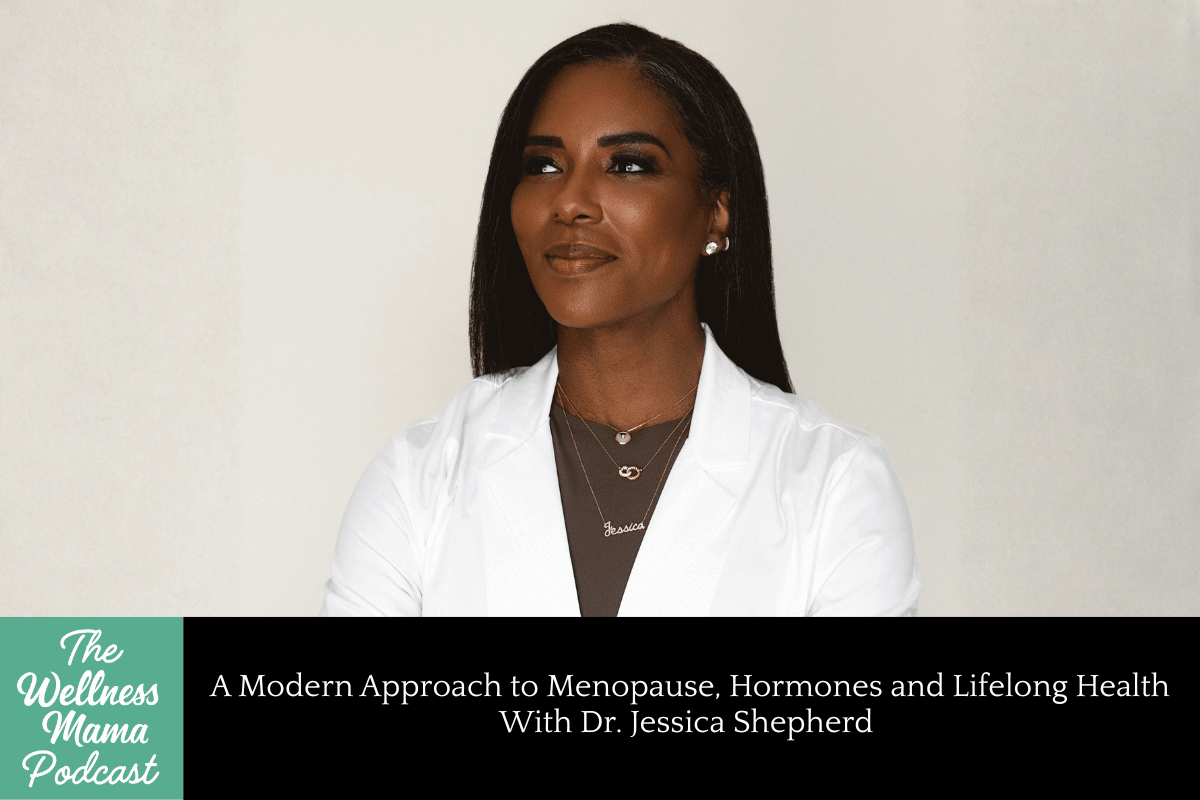
Katie: Hello and welcome to the Wellness Mama Podcast. I’m Katie from wellnessmama.com, and I am back today with Dr. Jessica Shepherd to tackle a moderate approach to menopause and hormones, to dispel some persistent myths related to hormone replacement and to get her take on what to actually do if we want to not just survive, but thrive through these shifts in life.
And I love that she reframes menopause and says it’s not actually a pause, it’s a beautiful biological evolution that comes with a lot of advantages. And we go deep on the nuance of understanding how there are so much individualization that comes into play here and there’s not a one size fits all approach.
And she specifically dismantles some of the black or white thinking that is related to all aspects of women’s health, but especially in this context to menopause. So fascinating conversation and let’s join her now. Dr. Jessica, welcome back. Thanks for being here again.
Jessica: Thank you so much. I’m excited because our first conversation was really just like a nice little nugget of information that I hope that women can take something from that, and so I can’t wait to see what we have to discuss this time.
Katie: And I will link to that one in the show notes if you guys missed it. Dr. Jessica’s phenomenal. So much good information in that one. And this one I feel like is gonna resonate with so many women because I get a tremendous amount of questions about perimenopause and menopause and hormones and are they safe and are they not?
And are they gonna gimme cancer or do I need them? And it seems like there’s so much that is like wrapped up in this topic. And I love your perspective. Because I’ve heard you say that menopause isn’t a pause. That it’s a biological evolution, and I would love to start there because I feel like even our words around this shift are not empowering, and I would love to reframe some of them and to let women approach this from a place of personal power and understanding so they can make really informed and good choices for themselves.
Jessica: I think you said it perfectly there, giving women the information to make the best choice for themselves, and I really am glad that you started it out that way because I feel women sometimes feel pressured that they have to do something or not. There’s this, I’ll give you perfect example. We do this to women all the time where we vilify if they choose one against the other. Breastfeeding versus bottle feeding, natural birth versus anesthesia, C-section versus vaginal delivery.
And I see that I’ve seen this happen throughout my entire career, especially being an OB-GYN and women’s health is, why do we not account for the gray area in between? Why do we not let women allow to make decisions for themselves without judgment? That has been my evolution in this field is to always allow women to take pause and allow them to make decisions for themselves without judgment. And so as we enter this phase with hormones, right, I am starting to see a little bit of that of, hormones or not, and if you choose to or not.
I feel that my responsibility and how I would love to enter the space and how I have been, you know, showcasing my expertise in this is at the end of a talk or a podcast or a patient coming to see me is I hope that the information that we share and that I give you and the questions that you ask me, that you feel more informed to make a better decision for yourself. Whether you decide to do hormones or not without judgment.
Katie: I love that. That’s such an important thing, I think, to call out. And I’ve noticed that in the mom world, like to your point kind of across the board for years, it’s like that dichotomy between the way you birth and of course all the controversial topics of how you raise your child in every phase and how you feed them and parent them and vaccinate them and et cetera.
Like there’s so much like kind of at this black and white, either or. And also if I’ve had one lesson in the past, almost now, 20 years in health and wellness, it’s that also we’re all so unique and individual and that there’s a personalized aspect to all of this. So I love that you brought up that gray area, that there’s probably not a blueprint that works for every single person, and that’s beautiful and wonderful and okay.
And so respecting that individualization and giving people the building blocks to make informed decisions within that, I think is so powerful. What are some of the misconceptions that still exist around menopause and the shifts that happen?
Jessica: Oh man, there’s so many. I probably will start with the most obvious one, or the one that I hear the most is that hormone therapy, namely estrogen, causes breast cancer. That has been kind of the detrimental headline that has created chaos and confusion for the last 23 years since the WHI study that was done in the late nineties, early two thousands.
And so with that, and I hope we can, you know, dive a little bit into that and not kind of overwhelm or take over the whole session with that because it is, that’s where I would love to debunk a myth and also provide reassurance to women to understand exactly why that’s not correct, so that they can make a better decision for themselves based on the information that is true.
Katie: Yeah, it does feel like, or at least from my understanding, and you have a much, much deeper expertise on this, but like that has been largely disproven. Like there were clear reasons that that was actually not the case, but why it showed up in the data. And yet it seems like that headline still persist all these decades later.
And I still hear that as like an automatic reaction from people whenever the topic of hormone replacement comes up. It’s like, oh no, I would never do that because it causes cancer. So it sounds like that’s not actually true, but there was this like massive misconception around the data at that point that is still lingering, which is wild to me.
Jessica: I would say massive is a understatement because like you said, as of last week, when I have patients come to see me, that still is something that is very widely believed. And so wanna give it like it’s 30 minute timeframe of why it’s not true. So at least it’s not overwhelming and people can at least remember the 30 seconds that I devoted to it so that they can move on. So here it goes. Here’s my 30 second spiel on it.
The study that was done was looking at hormones for cardiovascular risk, not for menopause. In that study there was a portion of it, which is why studies are done, that was contributed towards what are outcomes that we look for as researchers to say what are the things we see as potentially being concerning. In the study, a synthetic progestin, which is not a bioidentical progesterone, and that part of the study showed a slight increase in breast cancer, which was not significant, meaning it wasn’t a substantial amount of women that got breast cancer, but it did increase the risk slightly. So from that came estrogen causes breast cancer. So where I wanna dispel that is it wasn’t the estrogen, it was a synthetic progestin in the study. Estrogen was actually shown in the arm alone that women just use estrogen, was shown to be breast protective, so that yes, estrogen was shown to be breast protective.
And now when we think of hormone therapy, we are actually not using the synthetic progestin that was used in that study. So there are so many inlets in where women can say, oh, with that information that you just gave, I can at least open myself to receiving more of the conversation. Leave that myth where it needs to be left, and now where do I go from this in order to make a better decision for myself? That was my 30 seconds.
Katie: That was awesome. Well, and so on that note, like what, what do you feel like the data actually points to in today’s world? Like what is kind of the most compelling approach? Understanding that there is, of course bioindividuation as well. But what do you feel like both the data and your clinical experience support when it comes to navigating hormone replacement?
Jessica: Yeah, so living in that space that we now have from that 30 second kind of myth busting is now we’re in the space of what are the benefits, right? So there’s still risk. Risk and benefit for every decision that anyone makes. So when we’re thinking of hormone therapy, I like to showcase the benefits as well because that’s typically how you can make an informed decision, knowing both.
So the benefits are that later on in life, it improves your bone mineral density, so decreases risk of osteoporosis. And when you fall risk of a fracture. We talked about that earlier. We looked at being heart disease is the number one killer of women. A lot of that has to do with the decline in estrogen and how it impacts our heart health. So you are increasing or improving your cardiovascular health to some degree where you can prevent, not prevent all heart disease, but you’re contributing to the bucket of beneficial. And also when we think of muscle mass and decline in muscle mass, estrogen receptors are on our muscle. And so it can contribute to that as well in addition to resistance training and also our gut health.
Right? And so, decrease in colon cancer. We know it’s breast protective. We talked about heart health, we talked about muscle mass and we talked about bone. So in all of these different other features of a woman’s life, as she starts to age, it can impact her negatively or positively. So using hormone therapy as a benefit towards those things that we just discussed, in addition to your symptoms that women go through, there are so many symptoms of menopause 34 plus more, estrogen and progesterone and testosterone can contribute to symptom resolution. So that’s quality of life. So with that bucket there that I just gave, everyone can like pick and sift through that how they would like to and decide from the benefits that we’re given in relation to the risk. Where do I lie and how can I make an informed decision for myself without judgment?
Katie: Yeah, I love that. And that’s where I often say on this podcast, at the end of the day, we are each our own primary healthcare provider because it’s our daily decisions, habits, et cetera, that actually really contribute to our health. And the best outcomes happen when you have a practitioner in your corner who understands that as a partnership and gives specific knowledge that you don’t have and lets you make that informed choice.
So I love that you just gave us the physician’s perspective on that. And you mentioned estrogen, progesterone, and testosterone. And I would guess these are of course, in the category of very individualized and specific, and work with a knowledgeable practitioner who can test you and help you figure out if you need them, how much and when. I’m also curious though, because I like when it comes to most categories of health, I talk about before you’re gonna take expensive supplements or do a fancy biohacking things or spend thousands of dollars on red lights or whatever it is, like get the foundationals in place first.
Get your sleep solid, get your light exposure correct, hydrate, get your mineral levels in the right range, like the foundations make all of the other things work better. So I’m curious if that is also true in the realm of hormones, and if so, what are some of the foundational things that women can do that are highly supportive, especially in this shifting time of life?
Jessica: In addition to hormones?
Katie: Yeah, kind of in addition to hormones that would help the hormones to be more effective, especially if a woman’s gonna prioritize, like both, you know, financially and time-wise to do hormones. Like what are things, whether it’s nutritional, lifestyle, sleep related, like are there things we can do that are supportive and provide an even stronger foundation for hormones to be more effective?
Jessica: Yeah, I’ll give probably four little, like highlights. So it can be something that someone could take away is exercise. Exercise is medicine. Your body thrives on it. And when I say exercise, we had touched on it before, it doesn’t have to be always this gregarious workout. It’s movement, it’s incorporating movement into your daily life.
It does not have to be long, can be 20, 25 minutes if that’s the time that you have to give to it. Our body really utilizes exercise in ways that we don’t even see. Yes, our body attunes to it, externally, it feels better. It’s toned, it operates better. But internally, just from a metabolic, from a glucose sensitivity and utilization perspective, exercise is going to allow you to thrive. Second is nutrition. We live in a society that unfortunately places emphasis on convenience. And with that comes processed food, ultra processed food, which internally our body does not appreciate. And so how do we utilize nutrition as fuel? Think of it as when you go to the gas station, if you had no obstruction, obviously, we’d always choose premium gasoline, right? So we have the opportunity to do that with food as well. And that comes with choosing wisely, using foods that we either prepare at home or has less processing.
And there are ways to do that, and it doesn’t have to be an overhaul at one time, it’s slowly but surely. How do we improve our intake and decrease things that are not helpful for us, such as alcohol and sugar and glucose, refined sugar. And then the third thing that I would say is looking at sleep. Sleep is imperative to how we function, but also we have data that clearly shows the less we sleep or lack of, and women typically need more, anywhere in between 30 minutes to 45 minutes than males, is that that has an impact on later on in life when it, when we look at diseases that can come from lack of sleep, which would be cardiovascular disease, sleep apnea, obesity, diabetes, all of those and more.
Then the last thing I would say is supplementation. Yes, supplements can be a very hot topic because they’re, again, polarizing those that are for or against. I typically say that if I were to, for me, if you were to look at it at a macro level, I would say ones that I really stand by for women are vitamin D, creatine, fiber, and omega 3’s. And so those are things that you can incorporate through nutrition and also with supplementation. Nutrition is always the best way to incorporate those features that I said, but obviously you can get that in supplementation too, in a way to balance that out and make sure that you’re maximizing that.
But there are other supplements that, you know, someone might be deficient in. And vitamins that they can do, you know, see through testing. But those are four that I typically see in my patient population that women are usually deficient in or could use help in. So those are the four things that I would say, like of a short list of things that you could even start with today, say today I am gonna get 20 minutes in walking, today I am going to pick food that is less processed and has more rich supplementation and nutrients in. The third thing, I’m gonna go to sleep on time, and I’m gonna get as much quality and quantity of sleep starting today.
And then the fourth is, I’m going to maybe look at supplementation through fiber and vitamin D, right? So it’s these small little pockets that we can do. So I would say that’s a good list to start with and I hope that someone who’s listening could say, yeah, those are four easy ticket items that I could knock off in one day. And then you just start working there, right? It’s never too late to start. Those are four tips that you could start with within one day. And then over the course of time, you just keep refining it and you just keep tending to it in how you live your life and making sure that you have the goal to better your life.
You have to make that conscious decision because our mind really is going to be the engine in what our body follows through with, what our habits follow through with and our routine. So set that goal for yourself and make it an intention.
Katie: And on that note, I’ll make sure I link to it in the show notes as well. But can you speak to your Menopause Strong plan? Because I know you have resources for women to like really specifically address a lot of these things we’re talking about.
Jessica: So the Menopause Strong program in the plan is what I feel is something that someone could take hold of in order to start the process. And in there, not only is it a six week plan for series guided workouts that really focus on movement, strength recovery as well, but it also has, I guess you could say, snippets and little fragments of information where we have conversations and educational videos and guidance that again, demystify this complexity in the science behind menopause and really explaining how strength training and pelvic work support really go towards this goal. And so it’s built to showcase how to use guided workouts, but also provides knowledge which can then provide empowerment.
Katie: Amazing. Well, like I said, I’ll make sure that and your online resources are all linked in the show notes. And kind of to circle back to where we started in this conversation, I would love to end by speaking of like, maybe it’s mindset, maybe it’s a paradigm shift, maybe it’s ways we support our body, but what are some practical ways that we can all embrace perimenopause and menopause as an evolution, not an ending or a pause, or like a negative, because I do feel like society still maintains this sort of like negative perception around it and that it’s a bad thing.
So I would love to just kind of like offer some practical paradigm shift around the topic in general.
Jessica: I believe that we are beautiful beings and as females our experience on this earth is biologically, this is what we are presented with, and I believe that we have this opportunity. This opportunity as we enter into this next phase of life is that we really get to write that chapter. We have not really been given the luxury or the flexibility to do that, but I firmly believe and have seen that, you know, over the course of the last few years is that women, the more that we celebrate our strengths, the more that we look at what is designed for our bodies and how do we wanna show up later on in life?
We get to write that chapter and I believe that we have an opportunity for ourselves individually to change language and how we brand ourselves as a woman, and we get to redefine that. And so, you know, my goal is to change that narrative on perimenopause and menopause and give a new approach to how we want to live well long term.
So I feel that this is where we are. We are at a pivotal time in women’s health, and the more that we keep pushing, the more that we’re going to get further in this journey. And so I appreciate these conversations and thank you for allowing me to showcase what I have learned, what I know, and also to present what I see coming down as far as science and research when it comes to women’s health.
Katie: Amazing, and I will make sure people can find these links in the show notes, but where can people find you, keep learning from you and or is it possible for them to work with you if they are in these phases and want direct help?
Jessica: Yeah, absolutely. I think that people can find me on social media. That’s where I do most of my work on @jessicashepherdmd. And then also through Pvolves, you know, seeing me there in the videos educationally and being part of the workout through Menopause Strong @pvault.com.
Katie: Amazing. Well, those will be linked and I wanna make sure I respect your time and you’ve gotta get to actually being a doctor and helping people hands on. Thank you for making the time today for all that you’ve shared and for all that you do to contribute to women’s health. I’m so grateful for your time. Thank you.
Jessica: Thank you so much.
Katie: And thank you for listening, and I hope you will join me again on the next episode of The Wellness Mama Podcast.




Leave a Reply