Read Transcript
Child: Welcome to my mommy’s podcast!
Katie: ?This episode is brought to you by Hiya Health. Everyone’s talking about their New Year’s resolutions, and while everyone else is promising to hit the gym in 2026, I am focusing on something much easier that’ll actually stick (gym’s already pretty well a habit for me) which is better nutrition for my younger kids.
And that is exactly why Hiya exists, to give parents a real solution in a market flooded with products that prioritize candy-like appeal over actual nutrition. Some children’s vitamins on the market have up to seven grams of sugar per serving and are stuffed with additives and petroleum based dyes.
Hiya took the opposite approach. Zero sugar, zero gummy junk, just clean nutrition. And the crazy thing is kids actually love them. The taste, the experience, all of it. It’s thoughtfully designed. They looked at what modern kids are eating and not eating, and formulated around those specific nutritional gaps.
Working alongside pediatricians and nutrition scientists, Hiya created a superpowered chewable vitamin that packs 12 organic fruits and vegetables, plus 15 essential vitamins and minerals, including B12, C, zinc, folate, and more. The ingredient list is clean with no GMOs. It’s dairy free, allergy free, gelatin free, nut free.
They’ve thought of everything. Plus, they’ve earned their clean label projects, highest purity award certification, and they put every batch of product through third party testing for heavy metals and contaminants. So it’s the kind of transparency that actually means something. They are designed for kids 2 and up, shipped straight to your door in a reusable bottle with refills that come every month.
We have worked out a special deal with Hiya for their bestselling children’s vitamin. Receive 50% off your first order. To claim this deal go to hiyahealth.com/wellnessmama This deal is not available on their regular website. So again, go to hiyahealth.com/wellnessmama and get your kids the full body nourishment they need.
This podcast is brought to you by LMNT, and this is a company you might’ve heard me talk about before, and I really love their products because proper hydration leads to better sleep. It sharpens focus, it improves energy, and so much more. But hydration is not about just drinking water because being optimally hydrated, a state called euhydration is about optimizing your body’s fluid ratios.
And this fluid balance depends on many factors, including the intake and excretion of electrolytes, which many people don’t get the right amounts of. Electrolytes are charged minerals that conduct electricity to power your nervous system. I talk a lot about nervous system on this podcast.
They also regulate hydration status by balancing fluids inside and outside of our cells. LMNT was created with a science-backed electrolyte ratio of 100 milligrams of sodium, 200 milligrams of potassium, and 60 milligrams of magnesium with no sugar. Since electrolytes are a key component of hydration, here’s what happens when we get our electrolytes dialed in.
We have more steady energy, improved cognitive function, suffer fewer headaches and muscle cramps, we can perform better for longer, and especially the support fasting or low carb diet because when we stop eating carbs like during a fast, the absence of insulin allows the kidneys to release sodium.
So replacing that lost sodium with electrolytes can help you feel good on a fast. Since LMNT is zero sugar, it also doesn’t break up fast. Electrolytes are also important for maintaining blood pressure, regulating digestion and proper fluid balance. Keeping skin hydrated, which is a big one that I feel like often gets missed and so much more.
I feel like proper electrolytes is a missing piece for a lot of people and I love LMNTs new canned drinks, which are sparkling water with all the same ratios and minerals I just talked about, and they are delicious. You can check it out and learn more at drinklmnt.com/wellnessmama. And at that link you will receive a free sample pack with any order.
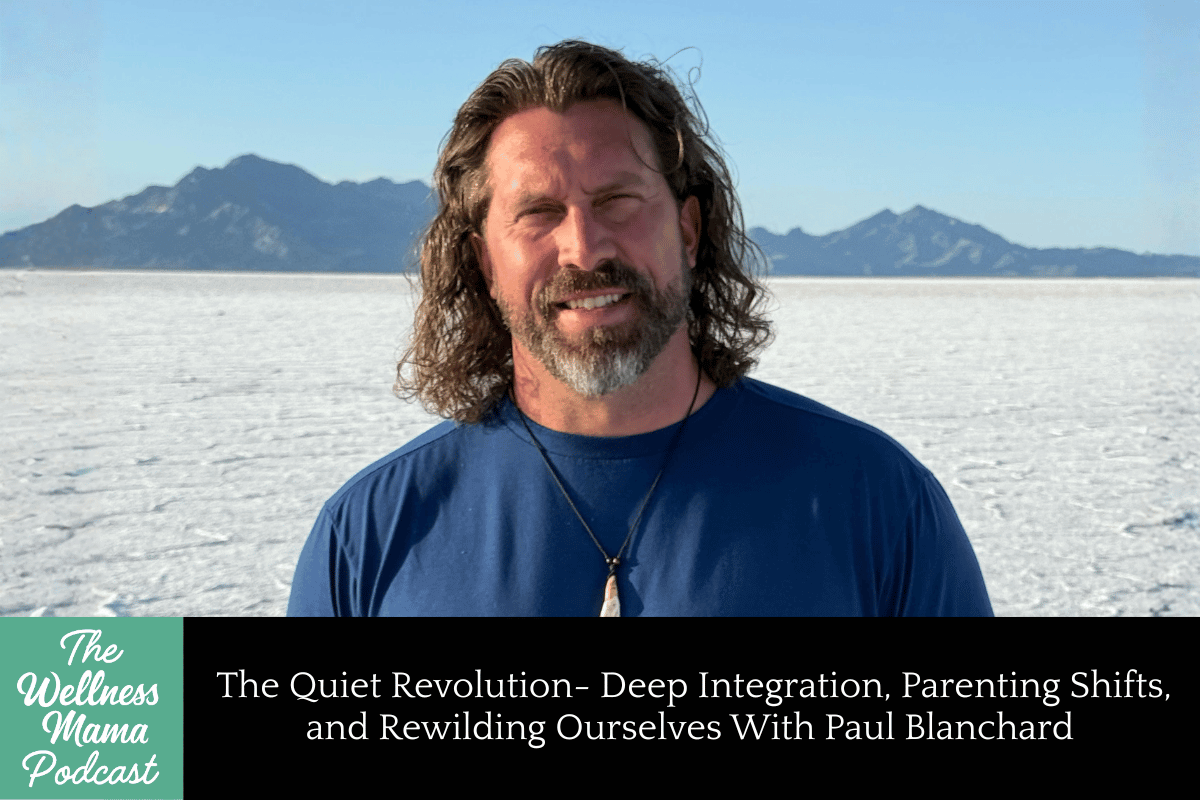
Katie: ?Hello and welcome to the Wellness Mama Podcast. I’m Katie from wellnessmama.com, and I thoroughly enjoyed this conversation, which got deeper and deeper throughout the conversation. Ended up going long, which I loved, and by the end got to talk about horizontal relationships and parenting, what that even means, why it’s so important.
We touched on shadow work. We talked on somatic experiencing trauma work. Deep healing and so much more. I love especially the places we got to go on parenting and on the inner work side. And my guest today is Paul Blanchard, who I got to meet in person recently at an event and have had a couple brief conversations with, and I love his approach.
He’s considered a transformation guide and executive coach, and I love this, an unapologetic dismantler of superficial success. He has over two decades of experience. He’s immersed himself in the study and lived experience of what it means to be fully human integrating, developmental psychology, somatic experiencing.
Entrepreneurship leadership dynamics, trauma-informed coaching, business building, and deep wisdom that only comes from repeating repeatedly, walking through the fire yourself. And I’ll put links in the show notes to a few of his tools. I found his habit finder assessment really helpful personally, and we talk about what that is in this episode as well.
But I really love his insight and reframe of a lot of different things and I know you will enjoy him as well. So let’s jump in. Paul, welcome. Thanks for being here.
Paul: Thank you Katie. It’s a pleasure to be here.
Katie: I am really excited for this conversation because we got to meet at an event recently and have a couple brief conversations, and I’m excited for a chance to get to go deeper on some of those topics and get to share this conversation with a lot of listeners today. And from what I know of your work, I really love your approach to so many different things, and there’s seemingly hundreds of directions we could go in this conversation.
To start, I would love to hear a little bit of background about you and how you actually got into the work that you’re doing, because I think it’s so fascinating kind of all the modalities that you use and the way that you work with people.
Paul: It’s a great question and I have the advantage of being able to go in retrospect and kind of shape it and form it to sound like whatever I want it to sound like today. So one of the first things that usually comes up when asked that question is I usually go back to my 11, 12 year old self that was sneaking out of the house in the middle of the night with a girl down the street.
And we’d go to a local playground and lay on the tire swing and look at the stars and talk about like what the meaning of life was about and why our parents seemed to get caught up on things that didn’t seem to matter as much as we thought and whatever else. And I guess I didn’t realize how peculiar that was until I got older and realized that I’m pretty sure a big part of what’s led me to where I am today is I’ve been pretty obsessed with the human experience for a long, long time. Always been curious a little I think appropriately stubborn and rebellious. But also, you know, wanting to please and creating a full spectrum of things. Another part of it was my father is a coach and built the Og Mandino Leadership Institute. For those of you who are familiar with the greatest salesman in the world and Og Mandino’s amazing work, he was asked to carry that forward in 2000.
And that gave me an opportunity to partner with him for about 10 years which was extraordinary. We built an amazing company and a big part of that was the creation of a tool that I think you and I may be having a discussion about today, a little bit in the Habit Finder assessment and then just all sorts of different things.
I thought in my early twenties I was gonna go to Hollywood and win an Academy Award someday. I was a theater major in college. And in college I’d met an incredible director who created a depth in me as a human that was well beyond theater. And I think it also added to what I do today in terms of finding the character inside of someone else that is wanting to be played out in this point in their life and what the authenticity is that we can find in the fiction of the game we’re playing here as human beings.
And I think that there’s just something really magical about that. A couple things that guide a lot of what I do is I love the metaphor of dance for almost everything. Like dancing in yourself, dancing in relationships, dancing with your emotions. I think there’s such a broad spectrum to that. And then the other is something that I heard in a sweat lodge several years ago. We’re in the third round, so we’ve been in this, basically this very primal sauna for almost two hours at this point. And this lady, three people over from me, it’s pitch black, so I can’t see her, but it’s her turn to share in the prayer circle.
And all she said is, it’s sacred, not serious. One of the things that I think about almost every day up to that point in my life, I had never considered that those two things could be separate. And it created this, this beautiful fracture in me that has contributed to being able to just love holding space for people, diving into the counterintuitive, counterproductive, hypocritical adventure that is being human.
So that’s just a little bit about me and at least in the abstract how I got here, there’s some, there’s some fundamental brags in there I’m sure I could throw in and stuff, but I mean, overall, that’s kind of the deeper flow of the river.
Katie: I love that. And I will admit when you first said sneaking out, I didn’t expect that story to end with, to discuss the meaning of life at 11 years old. I love that so much. And I feel like some of that resonates with me. The curiosity about the human experience and the rebelliousness, that’s something I’ve learned to have, I hope, a healthier relationship with as I’ve gotten older in life. But certainly that was a loud part of my psyche when I was a lot younger. I also love that line, you said authenticity and the fiction of the game we are playing. And would love to make sure we circle back to authenticity. But before we do I wanted to learn more from you actually about the habit finder because I got to take this assessment recently.
I’ll put a link in the show notes so that everyone listening can take it as well. But I loved how this was so different than many like personality tests that I had taken or like different assessments that seemed to not go as deep on some of the things. And I was surprised how, for such a simple assessment, seemed to like actually give so much insight.
So can you explain for anybody listening, what is the habit finder and what is, what makes it so different than like personality test or something someone else might have already taken?
Paul: Yeah, it’s a great question. I want to keep it as brief and relevant and potent as possible. It is the life work of Dr. Robert Hartman, who was born in Germany at the rise of World War, just across the street from what would later become the headquarters of the Third Reich. And he asked himself a question one day.
He wrote in his book, why are we so good, naturally good, at organizing evil? And what is it that makes it so difficult to build good? And this led to his mathematician brain, his philosophical brain, to create, if we fast forward quite a bit, Axiological mathematics, which is a Nobel Prize nominated technology and theory that involves cancerous finite calculus and the concepts of infinitude from Galileo, which all make me sound like I’m really smart because I can just repeat that.
But what’s really unique about it is most assessments, and by most I mean 99.9% of what’s out there are what are called inductive assessments. They’re designed to create psychometric shapes and forms and funnels to induce a diagnosis. What animal you are, what color you are, what letter you are, what type you are, what Disney princess you are. I always tested as Jasmine, which I thought was dope, so.
But this assessment is a deductive assessment, which ironically makes the taking of it much simpler, but the output much more complex and far more objective. And so you’re not being asked any questions. It’s, you’re not looking for these patterns where you can kind of start to tell what different answers may be tied. And I also can’t manipulate it, meaning if you’re taking it because you’re applying for a job or you’re taking it because you want to do self-discovery, both of which would alter the results in most other assessments, it, you don’t know what we’re looking for in this unless you’ve studied Axiological Math and Dr. Hartman’s work.
And so it gives us about 6.4 quadrillion variables in the mechanics of your subconscious mind. Now none of those are dictating, so I don’t, I don’t look at your assessment results, Katie, and go, oh, this is Katie. It’s not you. They’re your mechanics. You know, any neurological function you have, any elements to your physicality are not your identity. They’re not who you are. They’re, attributes, their mechanics to you. And the same with the habit finder. We can look at the mechanics of, well, okay, you have these tendencies in how you think about people.
You have these tendencies in how you think about yourself and the direction of your life and structure and things like that. And that can give us some tremendous clues into the cognitive functions of your life. And for the work that I do, it can gimme some really interesting clues for being able to connect the dots to much deeper elements in the realms of trauma and shame and attachment wounds in the ways that they impact entrepreneurs and business leaders.
Katie: Yeah, it’s so fascinating and it looks that I feel like even different categories than I’ve seen on other assessments. And I like that it kinda gave a score out of a hundred, but not, it wasn’t like, it didn’t feel like taking a test with like a pass fail. It kind of pointed to like areas of improvement or like, this might not be an issue for you based on these, but these things could get in the way based on this.
But it wasn’t like prescriptive or it didn’t kind of point to anything being wrong, which I appreciated. And I’d love to go deeper on how, like the insight related to trauma and the way we kind of show up in the world, because I know I have my own story with that and how impactful that work was for me and how much I didn’t even realize that was getting in my way for so long.
And I hear from a lot of women now who are like, I feel like as this has entered the mainstream conversation more, realizing that they have trauma of some sort and are wanting to work through it. And I know firsthand for me, that was a long and winding journey. And I certainly threw a lot of things at the wall before any of them kind of stuck.
So I would love to hear how this relates to that part of the journey. Because I feel like this is deeply relevant for a lot of people right now.
Paul: Sure, sure. We we’re, we’re looking to get to the natural rhythm, the flow of our identity. Our identity is very fluid. It’s one of the challenges I have with personality tests is if you haven’t done a lot of self-aware awareness work, taking one is an awesome introduction to you. And it’s, there’s quite a wow factor to having something like that tell you things about you, you wouldn’t even be sure that a close friend would know about your inner thoughts or your inner being. However, we have a tendency to get attached to that and it becomes like, oh, I am a high D or, you know, I am a, I’m a seven or an eight, or whatever it is that we get connected to.
And there’s limitations to that. We want to get into the fluid flow because in our identity, that expression of identity has, if, you know, it’s arbitrary, but probably seven to nine different personalities that we express in different parts of our life and depending on what side of the bed we woke up in. And trauma is oftentimes a core element of our identity, meaning we have been working with those things for so long that a lot of us, our identity is how we cope and navigate and stuff down and deal with that trauma in the body. I think it’s really important to differentiate. Not that I want, I’m not here to debate what trauma is or isn’t, but the most helpful way to work with it is, one of the ways that I look at it, and that trauma is not what happened to you, it’s what’s going on inside of you. We are atomic beings.
Meaning we’re made up of millions and millions of atoms, and if you took like just a few of those atoms from the tip of your finger, and we could spontaneously release the energy in those, it would level the city. You know, Oppenheimer Einstein discovered atomic energy and when our body, our being, our primal animal, feels like its life is threatened, it activates that atomic energy so that it can either fight with it or run away. And then if it’s not quite sure what to do with those two things within a third of a second, it will freeze that energy and hopefully be able to use it a short time later.
However, especially for those of us who have been in more colonized domesticated society, we’ve lost a lot of the natural ways that that energy gets expressed and gets released. And the body was never meant to be a storage facility for that energy. It was meant to allow it to flow and to be more fluid. And trauma essentially, in its simplest form, is that trapped energy. And it stays trapped until it’s safe to actually feel it, safe to actually express it. And that often means it’s gotta be a lot slower than when it initially happened. That’s oftentimes why it got stuck there.
And also, we’re dealing with existential trauma. We’re dealing with activation that wasn’t because there was a bear with its mouth wide open running at us or someone that pulled a gun on us. It was because, it was because of other relational elements. It was because of a Facebook comment. It was because of a email we got from our boss on a Friday that they wanted to meet with us on Monday, and we spent the whole weekend in an anxious sweat wondering if we were gonna still have our jobs only to find out they wanted to congratulate us on our one year anniversary.
And so there’s a lot of other elements now that weren’t meant to trigger that system, that now do in modern society, which makes it even more difficult to work through the core causes of that. And I think the last thing to share when anyone starts to zone out of like, oh yeah, I don’t have a lot of trauma in my life. Well, okay, cool. I mean, in the pantheon of trauma, cancer, lost child, you know, lost a loved one, whatever, every human being has experienced the most traumatic event that a human can experience. And that’s birth, if you really understand sensory psychology and sensory neurology and the experience of a creature that is going from the womb to the daylight essentially, whether it’s vaginal or cesarean.
That’s about as traumatic as it gets on a sensory level to a creature. That contrast. That ah, kind of thing. And it kind of levels the playing field where there are still very unique stories, very significant violations that have happened to people that are really important to be very sensitive to and to work through. However, it’s a pretty level playing field in terms of having a core activation of energy that a lot of us were not given permission to let out in domesticated society because we needed to use our inside voice. We need no tantrums. You know, you can be angry, but you can’t be sad. In other families you can be sad, but you can’t be angry.
And all these different things that stunt the expression of the human animal, which a lot of us have forgotten that we are an accelerated being on this planet in a lot of ways. And we’re still a human animal. And so being able to see the way that that trauma has impacted our cognitive patterns in the habit finder and vice versa, gives for really interesting give and take and dance to see, okay, here’s some place we could shift like the cognitive behavioral approach and it might be able to release and work through some trauma, and here’s some trauma we might want to be able to process that will naturally shift the the cognitive behavioral approach.
Like for example, almost everyone today is trying to lose weight by shifting the cognitive behavior and not addressing the deeper trauma. Talk about something that is required to go slow, and that is not something most people want to do slowly. Because they don’t find the momentum. It’s too hard because they’re going after an outcome versus getting to know themselves, making it safer to be in their body again. And so that’s kind of the fun part of being able to get six months worth of intuitive work in about 10 minutes from that assessment.
Katie: Yeah, this is so fascinating to me, and I resonate so much with so many of the points that you just said. From my own personal experience and from seeing this with other people I’ve talked to as well. And I definitely wanna make sure we circle back to, from a parent’s perspective, realizing that we all kind of enter the experience of life, having just gone through a traumatic experience, ways that we can create that feeling of safety for our kids to hopefully maybe give them a better foundation than a lot of us had.
And I know part of that is actually the doing the work for ourselves and the modeling and that how powerful that is as a parent. So I’d love to double click and go deeper on this because I think what you said about we have to feel safe for those emotions to come up and that’s often a slower process, that really resonated with my experience of it. And mine was somewhat inadvertent and then somewhat trying to figure it out once I started realizing there were things going on kind of under the hood and wanting to process them.
And I didn’t feel like I had good answers. I felt like I was kind of searching in the dark at that time so I love that this work you’re doing, you get all of that insight in a short amount of time that like kinda gives you a place to build those things you’re talking about, that feeling of safety for emotions to process instead of remaining stuck. But I would love to talk about ways that some people can cultivate that and curate that in daily life, in trauma work or whatever that journey typically looks like that can be really impactful.
Paul: Yeah, so a lot of this, these concepts and these principles are like kinda like watch the birdie for like a photographer with a child, is the work is in stillness. The work is in presence. There’s a very simple but very potent technology that we’ve kind of lost touch with, of presence, breath, movement and sound. And that’s really the crux of being able to create the healthiest, present, happiest, fulfilled, explorative, adventurous version of you is, and I often share, number one is presence. Number two is presence. Number three is presence. And tied for number four is unconventional breath, movement and sound in terms of being able to do that.
And we build all these other concepts and frameworks that are interesting and, but they’re playgrounds and they’re, and most, not most, all of them are made up. I mean, everything that we consider to be life and the rules of life and the laws of life and whatever else are all made up. They’re really all made up and that doesn’t diminish them. We’ve made up some pretty good stuff, you know, like making up that we shouldn’t kill each other. I think that was, I think that was a pretty good thing to make up. But there are things that we’ve made up that may have been appropriate at one time that no longer are.
There’s other things that we’ve made up that don’t apply to us, but they may be relevant to somebody else. And we’ve got this survival mechanism we built early on in our evolution called reference that was unbelievably powerful. Like one of the most amazing things we developed was being able to realize like, oh, Billy Bob ran over there at night and fell off a cliff and died. I don’t, I probably shouldn’t do that. Like, reference is powerful. It’s the, I don’t need to stick my hand on the hot stove to get burned because I was told, I can make reference that that will cause unnecessary pain.
But today, references turned into comparison. And, but it’s this, it’s the same beautiful evolutionary mechanism, but it’s now tied into self-worth. now tied into ego in some really interesting and significant ways. And so being able to sit with that. And I think one of the most challenging things to this kind of work, Katie, is that you’re actually not trying to change anything. In fact, that often perpetuates the trauma. I was listening to an interview with David White on Rick Rubin’s podcast.
David White’s, one of my favorite poets, just an amazing Irish poet, amazing human. And he was talking about how when we sit with the deepest parts of ourselves, we’re not there to fix them or change them. We’re simply there to offer them different options. That’s it. And so being able to find philosophical, intellectual perspectives as a way to get the attention and give almost like a chew toy to our cognitive thinker mind that for most of us has taken over our lives. But it’s only one leg of a three legged stool of the cognitive mind, the neocortex, the mammalian aspect of our being, of the heart, mind, and the reptilian aspect of our gut mind and not as poetic elements. I think they’re beautiful in that regard too, but as actual biologically intelligent elements of us, our head, our heart, and our gut, that actually have significant neurological networks in each one of them.
And in fact, neurosciences has been flipped on its head in the last decade or so in we believed that the brain was the command center for a long time, and it’s not, it’s actually receiving more guidance and more information from the body. And then it figures out like what to do with that, how to react to that with the pharmacy that it has access to up there, like heart rate variability, for example.
Something we’ve just recently in our history been able to start measuring. If you wear a WHOOP or an Oura ring, it’s one of the primary things that determines how your recovery score is or how ready your body is for activity. Heart rate variability seems to be the whispering language of the heart to the mind, to let it know what emotions, what chemicals can support, how the body’s actually experiencing reality right now. But somewhere along the way it got too difficult to try and keep up with society and bring the body along because the mind is never present, the body is always present.
And as society’s gotten more conceptually fast, the mind has run way out ahead of the body. And we’re seeing huge deficits and challenges in mental health and all kinds of different elements because of that. And so, really what we’re looking to do is find a system, a playground, a game that will allow us to rewild ourselves. To get back to the natural rhythm of how we function and operate. Not to never zoom into the future and the imagination, the fantasy of the mind, or replay the past to prevent things, but to balance the scales of most of us are spending over 90% of our day living in a day other than today.
Or the things we’re doing today are for a day other than today. I just, if I can just get there, then I’ll be happy. If I can just get there, then I’ll take a break. If I can just get there… And we build this habit of there, which is an unbelievable perpetual torture. Because even if we have specific attributes for what there will look like, that’ll make here worth it, the pain I’m going through, the hard work I’m going through, the challenge that I’m going through will be worth it if there can look like this.
Even if there becomes here, we have a pattern based system and now it is built and set to count on there. So even if there becomes here, it still diminishes here because it needs to always have a there. And it’s just, it’s what I see a lot of entrepreneurs get stuck in when they accomplish something and it’s very anticlimactic. Like they, they’re like, oh, I’ve, I made it. But it doesn’t feel okay to like own it.
It doesn’t feel natural to fully celebrate and just indulge and land in it. Because we forget in the pattern of doing that, what energy it takes to build something will always be the energy required to maintain it. And so if we built something by incentivizing there, we will continue to incentivize there and continue to diminish, and even for many of us in a certain sensory way, we will hate here because what better way in a survival state to motivate us to get there than to hate here? So, went to a few different places there. Kinda Tommygun spray some things there, but…
Katie: Oh, I love it. I love that phrasing of learning to rewild ourselves. And I would love to kind of talk through some ways we can begin that journey. Because in hindsight, I can see in my life so many times I had those stories of if only blank, then I would be happy. And I can see some examples of places where I either, and I think maybe this is part of the lesson, achieve those things and then found out the hard way that that was in fact not true or tied to happiness at all or in inadvertently did the work.
Like I used to have stories of if only I was a certain size or if only I could lose weight, then I would be happy and I actually got to learn in that one that I could learn to build and find and choose happiness now. And then, ironically, the weight loss happened, but it was no longer the goal. It was a byproduct of actually having a better relationship with my body and with myself.
So I’ve gotten to see this kind of play out in different ways, but I love that concept of rewilding ourselves partially because I talk a lot about, in a physical sense, nature deficit disorder and how we are divorced from nature, which is so vital to our biology and I think also to our mental health.
But I feel like also all these things relate to that concept you have of kind of the quiet revolution and of slowing down, which is so tough to do in the modern world and of learning to be in the present moment. Like I think of the Ramdas idea of just being here now and how profound and how difficult that is.
So I’d love to go deeper on this concept of how do we cultivate that? How do we rewild ourselves? Where are some places to dive into that work?
Paul: Yeah, at risk of keeping this more ethereal and abstract, one thing that I usually start having most of my clients do right off the bat is on a daily basis, two things I’ll share. One is a very simple morning experience. I have fun with words. I don’t want people to get overly self-conscious with words, but it’s fun to play with words and their deeper sensory meaning in our bodies. But I sometimes get hesitant when people get to like, I know you don’t like it when we say this word. It was like, no, it’s not about that. It’s about getting a really sensitive connection to what you mean by that word and what stories and beliefs are tied into that word.
But I do have some hesitation about the word routine oftentimes. Especially if we’re looking to grow and we’re looking to heal and we’re looking to expand. Because routine is the least conscious thing we can do. It’s one thing that our brain craves. It just wants a routine because then it can use less calories to function, which makes it feels like, feel like it’s going to be able to survive longer. And so it wants things that are predictable. Your brain’s number one kind of programming is to keep you safe, especially your core survival systems. And the way that it does that is keep you predictable. Which if there are any elements of your life that you’re frustrated with or even are devastating…
I used to work with women, with a nonprofit we would support in domestic violence. And the reason you’d see a beautiful woman return back and get the crap kicked outta her by some douche bag was because her whole body, her survival system needed that predictability. It was too scary to leave and not know what could come next, as much as the fist was that was that painful.
That’s how strong that orbit is, that gravitational pull to predictability. And so we want to have more conscious experiences, that necessarily build this disciplined routine. There’s so many entrepreneurs out there, structure, structure, structure, structure. It’s really not helping and it’s also creating a lot of shame for people that can’t sustain it because they weren’t meant to. I mean, a lot of people are trying to build structure in their lives that if you’re, the room you’re in right now, Katie was a metaphor of the structure you needed to build in your life, most people believe it needs to look like there’s a pillar every 12 inches in every direction.
Like that’s how organized their life needs to be. And yet the room you’re in right now is pretty structured. But guess what there’s more of in it than anything else? There’s air, there’s space, there’s room to breathe. That’s the structure we want. And so starting your morning with room to breathe. Which I recommend doing by first and foremost, as soon as you are relatively conscious, conscious enough to realize that you’re not sleeping anymore, drink a glass of water.
It should be on your nightstand, your com, your bathroom counter. One of the first things you do within 30 seconds of your feet hitting the floor or of you turning in your bed, is to drink a glass of water. And that alone, you can create so much depth to that practice from even the actual sensory experience of feeling the water go onto your lips and into your mouth and down your throat. The actual physiological function of the water kind of gently waking up the body and saying, hey, we’re ready to start functioning inside and out, as it is outside to in activity. All the way to speaking words and energy.
You can get pretty woowoo with just drinking a glass of water if you want to, which can be pretty rad. And then from there, I recommend getting dressed and go for a walk, even if it’s around your, around your living room. Outside can be fantastic if it’s safe and even if it’s just to the mailbox and back, but just moving your body and then being able to sit and take… If you understand certain breath work practices, great.
If you find yourself very zealously tied to one, I wouldn’t do that one. I wouldn’t do the one that you’re so super familiar with. But a really simple place to start is just take three deep breaths and sigh on the exhale. Make some sound on the exhale. And then just sit. You might start by just sitting for two minutes. You don’t need much more than five. and just see what it’s like to just be still and just notice yourself. If your mind is racing, notice it. If you feel really tired, like you wanna fall back asleep, notice it. That’s why it’s nice to have a timer that goes off just in case you do fall back asleep. But that right there alone, when done consistently, can make a huge difference.
And then the second element is kind of an extension to that, and I would do a second, two to five minute sit, in stillness, in the kind of the prime hours of like 11 to 4 when most people’s like conveyor belt has gotten going in their day, in their life. Just to show yourself that you’re allowed to as my first life coach would say, Zach Morris, time out, and just pause for a second and just sit and just be. Because your life right now is as busy, difficult, crazy, hard, empty, depressing, whatever it is as you, meaning all the parts of you need it to be.
Your life is exactly what all the parts of you need it to be right now in it, in primary form. In it’s, in it, at least in its abstract and sometimes in its very specific elements. And so if we’re wanting to change that, we’re going to want to join the conversation, not shout orders from the tower of our brain. And so that right there is, is one of the ways that people can start to join the conversation. What’s beautiful about the body is it doesn’t need a lot of time. Like growing a tree or a plant, you could water it all day.
It’s not gonna make it grow faster. Just give it a little bit each day you’ll start seeing this major underlying shift you won’t be able to explain. And when you have that in place, then we can start playing some of the more micro games. Some of the more interesting ways of growth and transformation with a humble sensitivity that it is so easy to cross the line from transformation to manipulation, which is not wrong or bad. Manipulations are really important. If I am in a Jeep driving off road and I fly off the road and I need to use my winch to pull me back onto the road, that’s a manipulation. But thank goodness I had the winch. If I had choked on something and someone gives me the Heimlich, that’s a manipulation. So manipulations are not inherently bad. In fact, in the 16th century before a lot of words were muddied and dirtied, it’s simply meant to handle masterfully.
The pain of manipulation is when we think it’s long term, when we think it’s a actual transformation, and so we start planning on something has actually shifted. The aha is going to last, and the deficit of that, the disappointment when we thought the manipulation was a transformation is really where the irk of manipulation comes in, not the act itself. I thank goodness we have medication, which can be a manipulation, you know, that can help us and serve us.
Thank goodness we have the Heimlich Maneuver. Thank goodness we have CPR, the number of lives that have been changed from that. However, if you’re needing CPR every day, there’s a deeper issue. If you’re needing Heimlich every time you have breakfast, there’s a much bigger issue, and that long-term manipulation is gonna take a toll. And yet most of us are living this way. But there’s a reason people don’t sue someone for breaking their sternum with CPR, because they were gonna die if they didn’t get that.
And yet most of us are not actually facing imminent death in our lives, but what’s going on in our body, you would think that we were. And so just having that water walk and breathe and then just noticing, having that still session a little bit later to most high performers that I work with just sounds silly, but the liminal space that allows life to be easier and successful, which is a real place. I thought it was a made up fantasy world. I thought, ease was a bad word for me as a business coach for many years.
Like, oh, people that want it easy just aren’t committed. They don’t want it. Little did I know, like, hi trauma, very nice to meet you. Fueling the fire of my performance. And we can get to a different way of doing things, but it’s a different hard to get there. Having a business that’s easier and still makes you lots of money is hard, but it’s not the hard work that you were taught it took. It’s not necessarily the extra hours, it’s not doing nothing, but it’s finding the difference, for example, between obligation and devotion. And this kind of stillness can start to open that up.
Obligation requires everything from you. Devotion, simply ask for what’s true. And like, that’s the kind of differentiation, that’s the kind of things you can find and rewild in your body that has been distorted by this never enough, more is better, across the board more is always better kind of attacking approach that we’ve taken to life that only pays off if we can keep doing it. And then when we burn out and whatnot, it’s challenging.
So when I sit with a high performer, when I sit with a very successful entrepreneur or aspiring entrepreneur or business leader, and tell them, hey, the space we’re looking to find in your body, at first is gonna feel like we find a busted pipe that is flooding your basement and you’re holding a wrench to fix it. And I’m gonna ask you to just sit there and let it spray you in the face. And it’s very difficult to do, and it doesn’t have to be for long periods of time. Because otherwise we just reactivate the threat response and survival response and just reloop into the same things. But eventually we start realizing like, wow, it’s not flooding my basement, it’s filling up a swimming pool.
You know, just being playful with the metaphor, but there are things we didn’t know were possible on the other side of being able to join the conversation of our body that we’ve been taught to outrun since we were young.
Katie: Oh, so many beautiful and good things in what you just said. I love that line that your life is exactly what you need it to be. And I feel like this is kind of the inner work corollary of something I say often on the physical health side, which is your body’s always on your side if you’re having symptoms, that’s direct communication from your body, but it is still your body acting in your absolute best interest.
Your body is always on your side. If it wanted to kill you, it could do it in under half a second. It is always working in your favor. And I love that like this seems like the corollary in kind of the mental, emotional and spiritual realm is like our life as it is, is exactly to our benefit. And I feel like understanding that alone, it is such a paradigm shift that probably lets you approach these things just from an entirely different light.
From a like getting to work on and for versus this is happening to when we understand it’s, is there to serve us. And I love that you also brought up the emotional experiencing side. And I think often of the term, I heard one time of like, so much in our life is related to what we’re unwilling to feel.
And I could see this in my life of, I didn’t, I had trauma in high school, sexual trauma that I vowed in that moment without realizing it never to feel helpless again. So I had built all these elaborate structures. I had those like every 12 inch or probably every 3 inch in my metaphorical structure of life, structures and spreadsheets and everything ran on structure. Because that let me never feel helpless because every detail was managed. Or I had a very early childhood experience. My parents both are hard of hearing, so I knew they couldn’t hear me. And I remember crying in my crib and realizing nobody’s coming because they can’t hear me.
And so being unwilling to feel vulnerable or connected because I had this very early story of nobody’s coming and how those kept showing up in my life. Over and over. So I just, so much resonance with what you just explained and I love that like messy metaphor of just like letting that all spray you in the face and realizing like there is actually an end to it too.
It’s not a, even though it feels like it, it’s not a forever gonna spray you in the face. There is an end to that, to that journey. And I feel like that also brings in the idea of the somatic experiencing side, which I actually get a lot of questions about. Because that was part of my journey in even understanding I had trauma and addressing it.
And I get a lot of questions about that. And I don’t have like a protocol or a plan or a way someone can just sort of follow what I did that might work the same. But I do see firsthand how that was such a vital part of my journey. I love that you even talked about dance being a metaphor and I wonder about dance as an actual physical practice too, because that was something I was terrified of for a long time and I’ve recently started doing.
But I know that was a whole lot to throw at you at once, but just so much resonance in what you just said. And I would love to talk a little bit more about the somatic side and if it’s helpful, like how do we even begin to incorporate some of those things and maybe even dance.
Paul: Thank you. The somatic experiencing. I do not want to establish myself as some kind of expert in that regard. I feel I’ve been blessed with some tremendous mentors and coaches and mystics and amazing humans that have held containers and created very unique experiences for me in that.
But the challenge I think that some people face is they’re looking for the expression of themselves to be facilitated. And they’re looking for the construct that can extract it from them. And somatic experiencing is not about giving you your language of this sensory experience of your body. In my opinion, it’s about creating a container where you can find it, you can discover it. And there are a lot of practitioners out there that I think are, I’m, I think they all meet people in different places, you know?
And I think that that’s appropriate, that’s really important. A lot of people have facilitated the living daylights out of themselves, and I’ve met people who have found such a better quality of life because of the modalities that they’ve adopted. But one of the things I try to check in with is my attachment to anything.
And that is if I stop using the modalities I’m using right now. What is my quality of life? What is my relationship with myself when it’s just me? And that’s where I think some of the deeper work starts to begin is we get to use the footholds of breath work, we get to use the footholds of yoga or of certain therapies.
All kinds of different things. Long, long lists. And then eventually the foothold is no longer needed. Eventually, it’s like the parable of the raft in Buddhism where you’ve used it to get across waters you wouldn’t be able to to scale. And now you’re looking to dive down into the depths of you.
And you don’t need a raft in those caves. And so there’s no reason to bring it with you. And so, that, I think that’s one thing that would be really important to me to impress upon people that are looking at somatic experiencing is there’s a lot of facilitated versions of it. But one of the things that’s most important to me before I work with anyone and have spent, I’ve spent years working on these, this stuff in myself before I ever started to facilitate it for another human. And as a part of that, I want to be able to look you in the eyes and say, I will trust you for you more than me for you in this work.
And to provide a container, a collaborative dance in your somatic experience on a horizontal level. I think that’s a huge thing that’s missing in leadership. A huge thing that’s missing in coaching and even in parenting is we have perpetuated the vertical hierarchy of authority and underling. And In fact, I’m a huge fan of Alfred Adler, Adlerian psychology, he was one of the three main people, Carl Young, Sigmund Freud and Alfred Adler, Young was more of a protege of Freud, but Adler broke off.
Kind of left the mainstream drive of Freudian psychology and later on Jungian principles and expansion and depth. One of the primary reasons was because Adler believed that relationships and human beings thrive in their best when they’re horizontal, when it’s a person and a person, not a leader and an employee or a parent and a child in terms of superior and inferior. But understanding that there is a natural collaborative exchange person to person.
And there might be some organizational hierarchal elements, you know, like a parent providing the money to pay for the food for the child. But it, to stand on that in ceremony as that makes you superior or just because you’re older, that makes you superior, versus that just means you see things differently. And to believe that you’ve graduated from the sensory experience of a child into an adult is hilarious. That’s like the tree looking at the roots and being like, well, I don’t need you anymore. Because now I’m a tree, now I’ve got branches. And if those roots disappeared, the roots of being a baby and an infant, a totally sensory creature and a child and being more reliant on the sensory expansion and the wonder of awe of life rather than figuring it out. There’s no graduation there.
And so finding your somatic experience is totally unique to you. And so having a container where someone is not over facilitating and is really able to take the time, and it is far more challenging than I ever expected. Not only that, but some of the people that are the greatest at facilitating that, it, when I started to do it more consistently, I’ve never had my imposter like get that inflamed ever before. And 20 years as a coach, when I started holding space for people to find their somatic expression, to be able to find their way into their body and having some, we could try this and we could try that.
I know a lot of different approaches and whatever, but I’m really looking to allow their somatic experience to whisper the guidance to me of how to take them into that. That’s the easiest way I could explain it. I know that sounds weird, but not that that’s actually what’s happening, but that’s the easiest way I could describe how I experience it in session. It’s, can be very challenging to make sure that I am not more loyal to the modality than I am to their unique expression, their singular, unique fingerprint in this world. And I think that’s, seeking that is awesome. Starting with some facilitation, just like starting with a personality test and self-awareness is awesome. It’s rad.
But I think a horizontal relationship, which is hard to find, people express it in tension all the time. As parents, we tell our children, I love you no matter what. And I tell my, the parents that are clients of mine, that’s a beautiful intention. But your nervous system can’t back that up yet. Because if you’re gonna say that, you’re gonna need to more fully understand how that child experiences love. Not what you have intellectualized and what you have conceptualized as loving them. And not what, just what you intend. How their body actually experiences love and safety. So that if you’re gonna say, I’m gonna love you no matter what. Are you really prepared to feel your stuff in a way and show up for your stuff that you don’t unnecessarily project that onto your child in a vertical relationship that was very well intended but is not as helpful as we might think.
Katie: I love that. And I feel like that perfectly circled back to the idea that I had in the beginning of how do we actually create that safety for our kids? How do we help them? And obviously it’s work they’re gonna do themselves, but how do we help them create a solid foundation for some of these things that we’re talking about?
And I love this concept. I don’t feel like I’ve heard this talked about much, but of the horizontal relationship. And I can think of so many examples, I’ve certainly been guilty of it too, but in parenting examples where parents kind of like Lord over their kids, the, or have like, you must respect me because I’m your parent.
Or like, you hear those phrases like, you can’t talk to me like that because I’m your father, or whatever it may be. And how, especially that line you just said of like, we say we unconditionally love our kids, but it’s actually how that child experiences love. And I would guess many of us listening can think of how our parents were likely very well intentioned.
Most of us probably had parents who did love us and still didn’t love us in the way we needed at certain times. And we can probably like identify examples in our lives of those times and how even small moments of that can be so impactful even into adulthood. And then those are our now things to feel and to work through ourselves.
But I would guess many people listening can identify those in our own lives as when we were children and likely maybe if we’re parents also with our kids. So I love that. I love, I feel like it gives kind of a tangible understanding to my core parenting philosophy, which is that my kids are each their own infinite autonomous being that is, from the moment I conceive them and meet them and hold them equal to me, and that I get to go on this journey with them.
But I’m not in any way superior to them in that journey. And certainly I’ve acted in ways that didn’t, I’m sure, support their nervous system fully, even with having that intent. But I love that you brought this up, and I think that that alone is such an important concept and as we sort of like reparent our own inner child, having that understanding helps us to understand the places we maybe weren’t met or given what we needed at certain times and how to sort of work through that.
And I’m curious also your take on that note on Shadow work and how that comes into play, what your thoughts on it are.
Paul: So first your oldest is how old Katie, your oldest child.
Katie: He’s 19 now.
Paul: 19. Okay. So in that regard to make the commitment that your child is their own autonomous infinite being, that’s a beautiful affirmation of a horizontal relationship. And I wanna make clear we’re, I’m not here to argue the, that there aren’t elements where you might have a vantage point that your child doesn’t have in terms of like, you know decisions that they might make and rules that you might have and different things like that.
Like I’m, I don’t wanna dismiss that and I’m certainly not here to set up some kind of idea that you need to be perfect as a parent. There’s quite a lot of beauty in the kaleidoscope of humans raising humans kind of thing that is really excellent and beautifully imperfect. But I would imagine in your commitment, to see your children that way, that there have been many times you have been terrified you weren’t doing enough or you might’ve been doing too much, or should I intervene?
Should I not? I, but I don’t want them to… That is very indicative of a horizontal relationship because that, those are the signals and the impulses of your ego and of your fear and your insecurity, and those are the things that parents have been taught to not feel, but to just do something about. And so I’m gonna be, I’m gonna be different from my parents, right? I don’t want to, I’m gonna do things differently when the key to not passing down unnecessary garbage generationally is not to focus on doing it differently, but to feel what generations before weren’t able to feel, to hold and process and join the conversation that has been passed down in shame or passed down in attachment wounds or trauma and different things.
The key to feeling better is to get better at feeling. And so there are a lot of things that we do with our children that we have convinced ourselves are for their benefit. And I’m not saying that they’re totally wrong, however, most of them are for our benefit first. For example, punishment. When we punish our children, that’s for us, makes us feel like we get resolution right off the bat.
We did something about it. We can stamp it. Most of us would never want to admit that. Lying, great example. I can’t believe you lied to me as if they violated something that you had a right to. And it’s, which is which is silly. It’s silly. No human being lies, nefariously. They lie to protect themselves. And some have been doing it for so long that it’s turned into very nefarious acts and thievery and whatever else.
But if your child lies to you, it’s because they don’t feel safe. That doesn’t mean it’s okay. I’m not saying lies are okay. It’s just an expression of a lack of safety. No, no, no, no, no. I’m not saying it’s okay. It deserves your attention. But I want you to taste the flavor of attention between, wow, my child told me a lie.
I wonder why they don’t feel safe. And what if we approach the conversation from there and then we’re able to talk about how the some of the repercussions of lying. Whereas most of us go the other direction because we’re the authority, because we’re in the vertical position. Because you violated the authority by lying to me and I deserve the truth. Whoa, I’m exaggerating this a little bit, but this is what is actually happening energetically. And so being able to soften that is terrifying. You’ve experienced, it’s terrifying to like, okay. After 7-year-old, seven years old, neurologically, my primary role is to be the safe place for them to come back to when they experience the world in their exploration of self-expression.
I want to give some tips. I want to give some ideas, I want to give some guidance, but I want to be really careful. This is something that a lot of parents do that give a lot of advice that wasn’t asked for, that wasn’t solicited. Because one of the most beautiful questions you can get asked as a parent is, what do you think, mom? But what do you think dad? And if you’re not getting asked that, you’re probably saying too much or have some, some fractured relationship to repair with your child, no matter their age.
And being able to understand that the more you, advice you give them that wasn’t solicited or overdo it when it is, the more likely you are to create an I told you so relationship with your child and you don’t even have to say it. They will feel it. You could say the contrary, like, oh, I don’t need to rub this in your face. You don’t even need to say, I told you this was gonna happen. If you said it was gonna happen, and then it happened. They are now in a state of shame of, oh, they told me so versus giving very gentle guidance, but realizing you have never lived their life in today’s day and age, the gap between child and parent has always been huge in terms of relational context, and it’s bigger than it’s ever been. I do not understand what it’s like to be a child today. I do not understand what it’s like to be bombarded with the information and technology that they do. And they don’t understand what it was like for me to be a child in my day.
Why do we need to keep proving that our perspective was more important or less important or whatever? Or like, you know, like, oh, kids have it so much harder, or, oh, we had it so much harder. That argument is irrelevant. Let’s just understand. I don’t get you and you don’t get me. That’s a really humble place to start.
I’d like to understand though and the best place to understand is being a safe place for them to naturally return to when the world told them something affirmational. So you get to celebrate with your child or the world told them something confrontational. And so you get to hold space as they get to feel through that and process that.
And you don’t need to save them. You don’t need to prevent things from happening within reason. Within reason. Because a child who feels safe with their parents long term has an exceptionally different life than the one who was a good child. Okay. In fact, in ancient cultures, most children in their adolescence, in their puberty would have an initiation of sorts. They’d go do something very difficult that usually required a separation from their family, even of their whole community. Which was super important.
And it was scary and it was dangerous but not nearly as scary, as dangerous as what’s happening to a lot of our kids today, who we just keep trying to engineer into good people rather than hold space to watch the blossoming of who they could possibly be. Most of my shadow work, as you asked that as a follow up, has been in going back to the parts of me that were told they weren’t okay to be in this world. They weren’t allowed to explore the things they wanted to explore. And being able to work with that and not to change any of those parts. See, that’s I think where shadow work gets misunderstood is you’re not going there to shine the light into the shadow.
You’re going there to make love to the shadow. You’re going there to integrate the shadow. Because we naturally want to seek wholeness as a human whole is the light and the dark. Now we could get into a whole cultural, philosophical discussion about how the dark has been pegged as evil and the light has been pegged as good, which is not necessarily true. There’s been a lot of evil done in this world in the name of light, and there’s been, and there’s been a lot of incredible compassion found in the dark. So to stand on that principle is archaic and unbelievably outdated, but also understanding that to be more whole is intimidating to those who haven’t yet.
The spiritual men and women who were most whole in this world intimidated society. Inspired one part of society, intimidated another part of society. Gandhi, for example, inspired some people and pissed off other people because they just didn’t understand someone who could be more whole with their light and their dark, their shadow and whatnot. And so being able to understand that. And then lastly, the hypocritical dance of shadow work of wholeness is that we are contradictory creatures. We are and we are becoming, endlessly. We are.
And there are certain parts of our elements and our bodies and our mind that are designed to support who we already are. Even neurotransmitters that are designed for who we already are, the here and the now. In fact, there are far more neurotransmitters for pleasure and feeling good built for right here and now than there are for who we are becoming. We only needed one to help nudge us into becoming more. And it’s dopamine, but it’s the one we’re most addicted to in our society today. And we keep being convinced that if we can just write more checks with dopamine, that everything else will be able to cash them. And it’s creating a devastating experience for a lot of people. But shadow work is extraordinary. It’s an adventure. It’s fun, it’s difficult, it’s wild.
It’s sadomasochistic in ways which every human being naturally is, whether they think they’re kinky or not. Every human is quite interestingly kinky. Whether you get it out by the reality TV you watch or an actual expression in different parts of your world or not, it’s a natural part of us and a lot of us have been taught that it’s evil and bad. But Katie, the whole trick of it is that it’s actually resisting it that’s created the case for not being, allowing it to be a part of you. Meaning in shadow work, the devil is only the devil when it’s the devil resisted. It’s often in the rejection of the shadow of ourself that we create the stuff we were afraid the shadow would do in our life. I think that’s really important to understand.
It’s often in the rejection of our shadow that creates the things in our life we were worried the shadow would do. You know, so, that’s part of the rewilding as well, is we have passions. We have these different things that we’ve been taught to be afraid of because it’ll lead to, it’ll lead to adultery and pornography and all these different things when it’s actually the rejection and the suppression of those things in our society that have blown all of those things off the off the top in terms of being more rampant and more challenging than they ever have been before.
Not because evil created that, because we wanted it. We create, we had the appetite for it because we weren’t feeding it in a healthy way, just like the creation of social media. Millennial generation felt so unseen, but was tied into technology enough that they needed some place to be seen, some stage. And so we brought it into fruition. We brought social media, we brought the stage that anyone could be seen in any time. And then we demonized it, which is hilarious considering like, it’s not bad, it’s not good. It’s an expression of our appetite. If we’re gonna continue to look out there in society and be like, it’s attacking us. No, it’s providing what we as a collective society felt we wanted the most. Just as our life is exactly what we need it to be.
Our society collectively is feeding what we are not allowing to be a healthy expression or what we’re pretending we don’t actually want. And so I think that’s a reason to get doom and gloom. I think it’s a really interesting way to go inside and do some different kind of work and then be able to plug back into the world in a way that we can make an impact that doesn’t require aggressive activistic kind of approaches as much as people can feel in their nervous system, that there’s something about you they would like to be able to access in themselves and they don’t even understand it. Which is probably ideal because it’s also part of quieting the brain that has been tried to be so dominant for good reason.
It was really trying to help, but it was never meant to do the job of the heart and the gut. And so much of our lives gets so much better when we allow all three to dance together. So.
Katie: Once again, so many things you just said I feel like could have been a whole podcast on their own. And I’m gonna put the request out there. If you’re willing, I’d love to do eventually future episodes on horizontal relationships in parenting and how we can cultivate that. And on the shadow side. Because I think that is its own whole topic.
And I fully agree with you. I’ve had quite the experience on going into the shadow this year and going into the darkness. And when I’m able to fully share it, I would love to circle back and do another episode on that. In the meantime, I wanna just reiterate a couple things you said on the parenting side, especially because I feel like these are difficult and so worthwhile things as parents of anytime we can make that subtle shift into curiosity, not judgment, especially when our kids are resisting something or seem like, like they’re lying or they’re being rebellious.
Almost always in those cases when I’ve been able to stay curious instead of going into, you will do this because I said so, there is, I always learn fascinating information about my kid and their experience and what they’re going through in that moment that if I had just made them do whatever the thing was, I wouldn’t have ever gotten that information and I wouldn’t have gotten to get that insight into their world and why they were having such a strong reaction to whatever that thing was in the first place.
So I love that. And the not jumping in to save them, but staying curious about them and how can that be a learning thing. I also think the idea to not give advice that isn’t asked for, I think that’s actually so important in any relationship, especially with our kids. And I feel like it can be really tough to do because we get in that mindset that we’re supposed to know what to do and we’re supposed to tell them what to do.
And I’ve had quite the journey also this year with the law of request and how that’s even shifted with my kids, not giving them advice unless they ask me for it. And how different that feels in my relationship with them. And vulnerably I’ll share that this past year there’s been a lot that shifted in my personal life and my oldest for a couple of months wasn’t really speaking to me.
And this was a great mirror for those places in parenting that you talked about where I wondered if I had done it all wrong, if I had messed everything up, if I had been a terrible parent. And what I actually got to realize in that moment was that I could, A, I could respect his experience of life and what he was going through, that I loved him unconditionally, and that would never change if he never spoke to me again.
It actually didn’t depend on that at all. That just was an absolute statement in my life, is that I love him unconditionally. It never depended on him loving me back. And so I got to let go of that need and realized that was my ego that wanted him to say I love you back at night and wanted him to talk to me.
But it actually wasn’t connected to me loving him at all. And ironically or not, as soon as I shifted that, our relationship slowly started shifting and he came to me to ask what I thought about the situation that was going on in his life and we’re now speaking again. But it was interesting to get to kind of stare in the face of that, in that moment of him not speaking to me and feel all the things that came up within myself and all the doubts that came up when he wasn’t speaking to me.
Paul: Katie, the, just two quick things from your habit finder. I know we didn’t get to dive too deep into that and maybe we can come back to that as well on another opportunity personally or another episode. What you did is became more conscious of you. And that’s where we miss the mark as parents a lot is we get so focused on them that we miss how much of what we’re doing for them is from our insecurity, from our fear of screwing up.
And so it’s woven into the punishments we make and the guidance we give and the advice we give. One of the things I found interesting in your assessment is you have a thought process that leans towards being indifferent. And have a thought process that leans towards what I would call people fatigue. And both of those come from a deep love of people and an incredibly attuned empathy. And so, just, if anything, just wanting to offer, just some affirmation that you have needed to not notice as much, even people you really care about because it would overload your system too much to try to do all the things you do and be all the things that you are.
That indifference has been something that your body has built to take care of you. And so when you notice that, I should have noticed that I should have been paying more attention, be really kind to not beat yourself up as the least amount possible because you’ve needed to do that. Because otherwise the system would break. It needed to have you not notice as much because you feel so much about what you notice. And so becoming more conscious of that, as you did with your son, is like, oh, I don’t act, I actually don’t want to love him expecting it in return. It allows you to create more spaciousness in you that makes that indifference not be as needed because now there’s more room for the incredibly attuned empathy that you have, so you can feel him without feeling all these other layers that there wasn’t room for before you did that.
And the other piece is, and I’m, and I get the sense looking at some supporting measurements that this is something you’ve probably been working on a lot is the people fatigue is just loving people, but also you have a very clear analytical mind. And so you likely give instruction that most people, it sounds like common sense to you, but they would have a difficult time executing with the same clarity that you do. And it can create really frustrating things when people keep telling you that they’re gonna do certain things in their life or they’re gonna show up in certain ways and they can’t sustain it because there isn’t a lot of distortion in that place for you.
When you say something, it’s usually very clear and it’s very honest and it’s very authentic. And so there’s a natural inherent expectation that when other people do that for you, it must be from the same place and they just don’t have the same access and it, people wear you out in that process. So just being curious about that when you’re feeling that people fatigue, similar to what you did with your oldest son, check in with the expectations you may not have realized you had. And remember, your common sense may not be as common as you think because you have a incredibly clear intellect. A curse of clarity, if you will. And so, you know, people that don’t do what they say and whatever are like nails on a chalkboard and different things.
So just keeping that in mind first go in and show up the way your body is showing you to show up for you, just like you showed up for you and then all of a sudden your son showed up. That’s something that a lot of parents, a lot of people misunderstand is you are the priority. Please don’t make your kids the priority. Because if you self-sacrifice and self abandon making your kids the priority, then that’s all they’re gonna do. And then that’s all their kids are gonna do and that’s all their kids are gonna do, and no one is gonna actually get to live their own life and it’s not live their own life at the dismissal of their kids.
Just like you just described briefly in that example with your son, you took care of you and he showed back up naturally. That takes some trust and some feeling through some challenging things that I know it wasn’t as simple as just what you talked about in terms of going in and feeling through all that. Amazing, but that’s what we’re talking about here. That’s some real magic right there.
Katie: Well thank you. That’s super, actually very resonant and hopeful feedback and I’m very personally excited to keep learning from you. And I will make sure I put links to the Habit Assessment, and also another one that you have as well. Those will both be in the show notes. And if you’re willing, I would love to eventually do future episodes on a couple of these other topics as well.
But for today’s episode, where can people find you and keep learning from you? And I’ll put those links in the show notes as well.
Paul: A great question. My website, wholebodymindset.com, you can find the Habit Finder assessment there. Instagram is a good place to connect with me as well. I’m on Facebook. And yeah, keep, I want people… I’ve been doing this for a long time, and I have, I’ve been very blessed and lucky and intentional in creating a very successful coaching practice. However, I’ve never built an ivory tower. I tried it a few times in terms of like, in order for people to get access to you, they should pay lots of money. You, if you took the habit finder assessment, you’re gonna get emails from me to have a consultation with me, not a team, not a sales team or anything like that, with me.
I’ve built it that way on purpose. There are certain elements to what I do that people find out if they’re really ready to do this kind of work or not, or whether they just want to keep investing in the magic of short-term manipulation. But I just, I wanted to emphasize that, that you’re listening to me talk right now, and if you go and take the assessment or any of the other links that you have, the only buffer between me and you is a few emails, not a sales team, not a funnels and all this elaborate stuff. It just doesn’t seem to resonate with the work that I’ve been doing. So, so thank you.
Katie: Thank you so much for your time. Like I said, I’m excited to continue these conversations in the future. I took a lot of notes for the show notes and we’ll put all those links in the show notes for any of you guys listening on the go. Paul, thank you so much for your time. This was so wonderful and I’m so grateful you were here.
Paul: My pleasure. Thank you, Katie, an honor to be here.
Katie: And thank you for listening and I hope you will join me again on the next episode of the Wellness Mama Podcast.




Leave a Reply